Available online throug
ISSN 2229 – 5046
UNSTEADY NATURAL CONVECTION MHD FLOW THROUGH POROUS MEDIA PAST
AN ACCELERATED VERTICAL PLATE IN A THERMALLY STRATIFIED FLUID
U. S. RAJPUT, SURENDRA KUMAR*
Department of Mathematics & Astronomy, University of Lucknow, Lucknow, India.
(Received On: 21-04-16; Revised & Accepted On: 09-05-16)
ABSTRACT
U
nsteady natural convection MHD flow through porous media past an accelerated vertical plate in a thermally stratified fluid is studied here. The fluid considered is gray, absorbing-emitting radiation but a non-scattering medium. The governing equations involved in the present analysis are solved by the Laplace-transform technique. The velocity, skin friction and Nusselt number are studied for different parameters like Prandtl number, thermal Grashof number, magnetic field parameter, permeability parameter, stratification parameter and time.Key Words: Unsteady flow, MHD, Stratified fluid, Porous media.
MS Classification 2000: 76R99, 76W05, 76S05.
INTRODUCTION
Study of MHD flow with heat and mass transfer plays an important role in chemical, mechanical and biological Sciences. Some important applications are cooling of nuclear reactors, liquid metals fluid, power generation system and aero dynamics. The response of laminar skin friction and heat transfer to fluctuations in the stream velocity was studied by Lighthill [6]. Free convection effects on the oscillating flow past an infinite vertical porous plate with constant suction - I, was studied by Soundalgekar [11] which was further improved by Vajravelu et al. [13]. Further researches in these areas were done by Gupta et al. [1], Jaiswal et al. [4] and Soundalgekar et al. [12] by taking different models. Some effects like radiation and mass transfer on MHD flow were studied by Muthucumaraswamy et al. [7-8] and Prasad et al. [9].Radiationeffects on mixed convection along a vertical plate with uniform surface temperature were studied by Hossain and Takhar [3]. Mass transfer effects on the flow past an exponentially accelerated vertical plate with constant heat flux was studied by Jha, Prasad and Rai [5].
On the other hand, Radiation and free convection flow past a moving plate were considered by Raptis and Perdikis [10]. We are considering radiation effects on MHD flow through porous media past an impulsively started vertical oscillating plate with variable mass diffusion. The results are shown with the help of graphs (Fig-1 to Fig-7) and table-1.
MATHEMATICAL ANALYSIS
In this paper we have considered the flow of unsteady viscous incompressible fluid. The
x
-axis is taken along the plate in the upward direction andy
- axis is taken normal to the plate. Initially the fluid and plate are at the sametemperature. A transverse magnetic field
0
,
B
of uniform strength is applied normal to the plate. The viscous dissipation and induced magnetic field has been neglected due to its small effect. Initially, the fluid and plate are at the sametemperature
T
∞ in the stationary condition. At timet
'>
0
, the temperature of the plate is raised toT
w and the concentration level near the plate is raised linearly with respect to time.Corresponding Author: Surendra Kumar*
© 2016, IJMA. All Rights Reserved 101 The flow modal is as under:
(
)
2 02' 2
p
B u
u
u
u
g
T
T
t
x
K
σ
β
υ
υ
ρ
∞′
′
′
′
∂
=
−
+
∂
−
−
∂
∂
(1)2
' 2
T
T
u
t
γ
α
x
∂
= −
′
+
∂
∂
∂
(2)where
.
p
dT
g
dz
C
γ
=
∞+
Here
dT
dz
∞ is thermal stratification and
p
g
C
is pressure work term. The environment is statically stable, neutral orunstable if
γ
> =
,
or
<
0
. We consider the cases of stable and neutral conditions only.The following boundary conditions have been assumed:
'
' '
0 :
0,
for all the values of
0 :
,
at
0
0,
as
0
w
t
u
T
T
x
t
u
At
T
T
x
u
T
T
x
∞
∞
′
≤
=
=
′
>
=
=
=
′ →
=
→
(3)
where
A
( )
>
0
is the constant acceleration,\where the symbols are:C
p- specific heat at constant pressure,T
- temperature of the fluid near the plate,T
∞- temperature of the mainstream fluid,t
′
- time,ρ
- density,g
- accelerationdue to gravity,
α
- thermal diffusivity,β
- volumetric coefficient of thermal expansion,υ
- kinematic viscosity,B
0 -external magnetic field,
σ
- Stefan– Boltzmann constant,γ
- thermal stratification parameter,u
′
- velocity of the fluid in thez
- direction andK
p - permeability of porous medium.Introducing the following non- dimensional quantities:
(
)
12 '
, ,
r w,
w
g
T
T
T
T
A
t
At
G
x
T
T
A
β
θ
ξ
υ
∞ ∞ ∞−
−
=
=
=
=
−
(
)
2 0, ,
r p, ,
pw
C
k A
B
M
P
S
K
A
k
A T
T
µ
σ
γ
µ ρυ
ρ
∞υ
=
=
=
=
=
−
(4)where
u
-dimensionless velocity,θ
-dimensionless temperature,G
r–Grashof number,ξ
-dimensionless coordinatenormal to the plate,
P
r - Prandtl number,t
-dimensionless time,M
- magnetic field parameter,k
- thermal conductivity of the fluid,K
- permeability parameter of porous medium and S - non-dimensional stratification parameter.Equations (1) and (2) leads to
2 2
1
r
u
u
G
M
u
t
θ
K
ξ
∂
=
−
+
+
∂
∂
∂
(5)2 2
1
rSu
t
P
θ
θ
ξ
∂
∂
= −
+
∂
∂
(6)and the boundary conditions (3) reduces to:
0 :
0,
0 for all the values of
0 :
,
1 at
0
0,
0 as
t
u
t
u
t
u
θ
ξ
θ
ξ
θ
ξ
≤
=
=
>
=
=
=
→
→
→ ∞
in a thermally stratified fluid / IJMA- 7(5), May-2016.
METHOD OF SOLUTIONS
Using the Laplace transform technique, equations (5) and (6) subject to (7) is transformed to, taking
P
r=
1
,Laplace transform of
V
=
u
andϕ
=
Laplace transform of
θ
(
)
(
)
24 * 2 * 2
2
0
D
s
M
D
s
M
H
ϕ
−
+
+ +
+
=
(8)where *
1
1
and
2 *2.
2
rM
M
H
SG
M
K
=
+
=
−
Therefore solution is given by
* * * *
2 2
1
2
2
s M iH s M iH s M iH s M iH
e
e
iS
e
e
s
s
H
s
s
ξ ξ ξ ξ
ϕ
=
− + ++
− + −
+
− + −−
− + +
. (9)
and
* * * *
2 2
1
2
2
s M iH s M iH s M iH s M iH
e
e
iH e
e
V
s
s
S
s
s
ξ ξ ξ ξ
− + + − + − − + + − + −
=
+
+
−
(10)Using Hetnarski’s algorithm [2] for inverse Laplace Transform of
ϕ
andV
, therefore solutions forϕ
andV
are given as:(
)
(
)
* * * * * *1
1
4
2
2
1
1
4
2
2
M iH
M iH
iSt
iS
e
erfc
M
iH t
H
t
H M
iH
iSt
iS
e
erfc
M
iH t
cc
H
t
H M
iH
ξ ξ
ξ
ξ
θ
ξ
ξ
− + +
=
−
+
−
−
+
+
+
+
−
+
+
+
(11)(
)
(
)
* * * * * *1
4
2
2
1
4
2
2
M iH
M iH
iH
u
e
erfc
M
iH t
t
S
t
M
iH
iH
e
erfc
M
iH t
t
cc
S
t
M
iH
ξ ξ
ξ
ξ
ξ
ξ
− + +
=
−
+
+
−
+
+
+
+
+
+
+
+
(12)Where
cc
is the complex conjugate andM
*+
iH
=
A
andM
*−
iH
=
B
.
SKIN FRICTION
Skin friction is given by
0
u
ξτ
ξ
=
∂
= −
∂
(13)(
)
* * * *(
)
(
)
1
1
(
)
2
2(
)
M t
e
H
tCos Ht
Sin Ht
S
t
iH
M
iH t
erf
M
iH t
cc
S
M
iH
τ
π
−
=
+
+
+
+
+
+
+
+
(14) NUSSELT NUMBERNusselt number is given by
u
N
θ
ξ
∂
= −
∂
© 2016, IJMA. All Rights Reserved 103
(
)
*
* *
*
(
)
(
)
1
1
(
)
2
2
(
)
M t
u
e
St
N
Cos Ht
Sin Ht
H
t
iSt
iS
M
iH
erf
M
iH t
cc
H
H M
iH
π
−
=
−
+
+
−
+
+
+
+
(16)
RESULT AND DISCUSSION
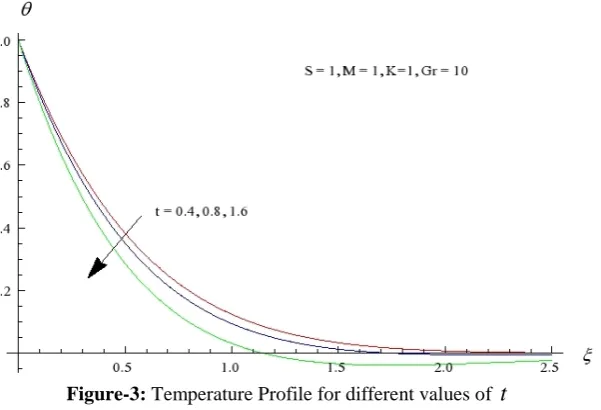
Figures 1 and 2 represent the temperature profile at time t = 0.4. Figure -1 shows that when the value of S is increased the temperature decreases. Similarly in Figure - 2, it is observed that when the value of magnetic field increases the temperature of the plate decreases. Other parameters are kept constant in both figures. Figure-3 represents the temperature profile for different values of time parameter. It shows that the value of time t is increased the temperature decreases.
Figure-1: Temperature Profile at
t
=
0.4
in a thermally stratified fluid / IJMA- 7(5), May-2016.
Figure-3: Temperature Profile for different values of
t
The velocity profile for different parameters like magnetic field parameter, permeability parameter, thermal stratification parameter and time are shown in figure - 4 to figure - 7. Figure – 4 shows that when the value of
S
increased the velocity decreases (Keeping magnetic field, thermal Grashof number and permeability parameter constant). But in figure- 5 shows that, keeping the value of
K
andS
constant and increased the velocity of magnetic field the velocity decreases att
=
0.4
. In figure -6, it is cleared from figure that when permeability parameterK
is increased the velocity increases. In figure -7, it is observed that when timet
is increased the velocity increases.Table (1) represents the values of skin friction and Nusselt number.
© 2016, IJMA. All Rights Reserved 105
Figure-6: Velocity Profile at
t
=
0.4
Figure-7: Velocity Profile for values of
t
Table-1: Skin friction and Nusselt number for different parameters
M
K
G
rS
t
τ
N
u0 1 10 0.5 0.4 -2.7428 1.09968 1 1 10 0.5 0.4 -232712 1.24792 1 1 10 1 0.4 -2.3165 1.42555 2 1 10 1 0.4 -1.88472 1.54337 2 1 5 1 0.4 -0.41729 1.46015 2 1 5 0.5 0.4 -0.12692 1.33586 1 1 5 0.5 0.4 -0.72012 1.98460 1 1 5 0.5 0.8 -0.74336 1.20093 1 2 10 0.5 0.4 -0.25318 1.74730 1 4 10 0.5 0.4 -0.30360 1.70896
The values of skin friction and the Nusselt number are tabulated in table-1. When the values of
M
andS
are increased (keeping other parameters constant) the values of skin friction and the Nusselt number are also increased. Butin a thermally stratified fluid / IJMA- 7(5), May-2016.
CONCLUSION
In this section a theoretical analysis has been done to study the unsteady natural convection MHD flow through porous media past an accelerated vertical plate in a thermally stratified fluid. Solutions for the model have been derived by using Laplace – transform techniques. Some conclusions of the study are as below:
1- Velocity increases with the increase in
S G K
,
r,
andt
and decreases with increase inM
.2- Temperature of the fluid decreases when
M
andS
are increased.3- Skin friction increases when magnetic field parameter, stratification parameter, permeability parameter and time are increased but decreases when thermal Grashof number is increased.
4- Nusselt number increases when magnetic field parameter, thermal Grashof number, permeability parameter, stratification parameter and time are increased.
REFERENCES
1. A.S. Gupta, I. Pop and V.M. Soundalgekar, Free convection effects on the flow past an accelerated vertical plate in an incompressible dissipative fluid, Rev. Roum. Sci. Techn. -Mec. Apl., 24(1979) 561
−
568.2. R.B. Hetnarski, An algorithm for generating some inverse Laplace transforms of exponential form, ZAMP, 26(1975) 249
−
253.3. M.A. Hossain and H.S. Takhar, Radiation effect on mixed convection along a vertical plate with uniform surface temperature, Heat and Mass Transfer, 31 (1996) 243
−
248.4. B.S. Jaiswal and V.M. Soundalgekar, Oscillating plate temperature effects on a flow past an infinite porous plate with constant suction and embedded in a porous medium, Heat and Mass Transfer, 37 (2001) 125
−
131. 5. B.K Jha, R. Prasad and S. Rai, Mass transfer effects on the flow past an exponentially accelerated verticalplate with constant heat flux, Astrophysics and Space Science, 181(1991) 125
−
134.6. M.J. Lighthill, The response of laminar skin friction and heat transfer to fluctuations in the stream velocity, Proc. R. Soc., A, 224(1954) 1
−
23.7. R. Muthucumaraswamy and Janakiraman, MHD and Radiation effects on moving isothermal vertical plate with variable mass diffusion, Theoret. Appl. Mech., 33(1) (2006) 17-29.
8. R. Muthucumaraswamy, K.E. Sathappan and R. Natarajan, Mass transfer effects on exponentially accelerated isothermal vertical plate, Int. J. of Appl. Math. and Mech., 4(6) (2008) 19-25.
9. V.R. Prasad, N.B. Reddy and R. Muthucumaraswamy, Radiation and mass transfer effects on two-
dimensional flow past an impulsively started infinite vertical plate, Int. J. Thermal Sci., 46(12) (2007) 1251– 1258.
10. A. Raptis and C. Perdikis, Radiation and free convection flow past a moving plate, Int. J. of App. Mech. and Engg., 4 (1999) 817-821.
11. V. M. Soundalgekar, Free convection effect on the oscillatory flow an infinite vertical porous, plate with constant suction. I, Proc. R. Soc., A 333(1973) 25-36.
12. V. M. Soundalgekar and H. S. Takhar, Radiation effects on free convection flow past a semi-infinite vertical plate, modeling, Measurement and Control B51 (1993) 31- 40.
13. K. Vajravelu and K. S. Sastri, Correction to ‘Free convection effects on the oscillatory flow an infinite, vertical porous, plate with constant suction. I, Proc. R. Soc., A.353 (1977) 221-223.
Source of support: Nil, Conflict of interest: None Declared