Proceedings of the
Fourth International Workshop on
Graph-Based Tools
(GraBaTs 2010)
From the Behavior Model of an Animated Visual Language to its Editing
Environment Based on Graph Transformation
Torsten Strobl, Mark Minas, Andreas Pleuß, Arnd Vitzthum
13 pages
Guest Editors: Juan de Lara, Daniel Varro
Managing Editors: Tiziana Margaria, Julia Padberg, Gabriele Taentzer
Abstract: Animated visual models are a reasonable means for illustrating system behavior. However, implementing animated visual languages and their editing envi-ronments is difficult. Therefore, guidelines, specification methods, and tool support are necessary. A flexible approach for specifying model states and behavior is to use graphs and graph transformations. Thereby, a graph can also represent dynamic aspects of a model, like animations, and graph transformations are triggered over time to control the behavior, like starting, modifying, and stopping animations or adding and removing elements. These concepts had already been added to Dia-Meta, a framework for generating editing environments, but they provide only low-level support for specifying and implementing animated visual languages; specify-ing complex dynamic languages was still a challengspecify-ing task. This paper proposes the Animation Modeling Language(AML), which allows to model behavior and anima-tions on a higher level of abstraction. AML models are then translated into low-level specifications based on graph transformations. The approach is demonstrated using a traffic simulation.
Keywords:animated visual language, behavior modeling
1
Introduction
Visual modeling languages (VLs) are widespread in engineering and computer science. Several frameworks and tools have been realized that make implementing VLs, i.e., providing tool sup-port for such models, easier.DiaGen/DiaMeta[7], GenGED [1] or AToM3[6] are only a few of them. Many VLs have an execution semantics, i.e., models can be executed and executions are visualized by animations, e.g.,Statecharts[3],Pictorial Janus[4], orToonTalk[9] and many fur-ther examples, especially in simulation. However, fur-there is still a lack of tool support, so dynamic VLs usually have to be implemented manually. Recently, a new approach for specifying inter-active dynamic VLs based on graph transformation (GT) has been proposed and realized within theDiaMetatool [13]. Previous approaches based on GT (e.g., [1]) use graphs for representing static model states whereas the effects of GTs can be animated. In contrast, graphs in [13] do not necessarily represent the static aspect of a model, but rather its dynamic aspects. GTs, when triggered at specific points of time, modify such graphs and implement the dynamic behavior of
∗This work was supported, in part, by Science Foundation Ireland grant 03/CE2/I303 1 to Lero – the Irish Software
the system. As a consequence, GTs can start, change, or stop animations, for example. GTs can easily describe interactions within the model or between user and model as well. This approach allows specifying dynamic VLs including rather complicated animations and interactions, e.g., several concurrent animations may simultaneously take place in a model. However, GTs without further abstraction mechanisms do not provide sufficient support for the easy specification of complex animations. This paper addresses this problem and proposes theAnimation Modeling Language (AML), which is based on previous work with the Multimedia Modeling Language (MML) [11] and the Scene Structure and Integration Modeling Language (SSIML) [15]. Its pur-pose is the modeling of behavior and animations on a higher level of abstraction. It allows to decompose a dynamic system into its basic constituents and to describe behavior by hierarchical automata. AML models can then be refined and transformed into a specification forDiaMeta following the approach presented in [13].
The rest of the paper is structured as follows: The next section introduces a traffic simulation as the running example. Section3then briefly outlines the specification approach for animated interactive VLs presented in [13]. AMLand the translation ofAMLmodels into a specification forDiaMetabased on GT are described in Sections4and5. Section6reports on related work, and Section7concludes the paper.
2
Running Example:
Traffic
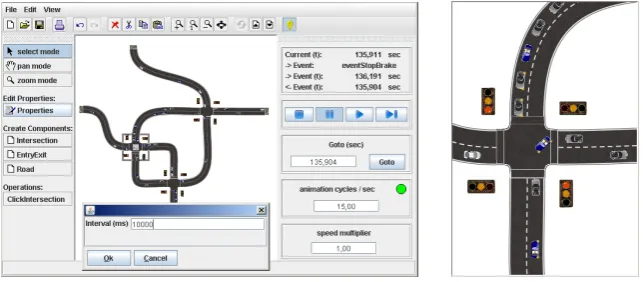
Traffic simulations can be considered as complex dynamic systems. The modeling of the behav-ior for each traffic participant in such simulations is non-trivial because participants have to take care of many different situations. For this running example, simplified but still complex aspects of a traffic simulation have been chosen and realized in a system calledTraffic. Fig.1shows two screenshots of aTrafficeditor whose code has been generated based on aDiaMetaspecification. A video of the resulting editor can be found online1.
The road network in this system contains the following components: Roads,Intersections and
EntryExitpoints. Thereby, aRoadalways connects two of the other components. It is not neces-sarily straight, i.e., it can also be curved. AnIntersectionalways has a predefined size and one connection point for each cardinal direction. Finally, there areEntryExitpoints which are special elements where cars can enter or exit the simulation.
EachIntersectionhas one 4-stateTrafficLight(statesGo,Caution,Stop, andReady) for each di-rection. The duration of states GoandStopis configurable by a property interval available for eachIntersection, and as a special feature for interactivity, the user is also allowed to click on an
Intersectionin order to trigger an immediate switch. EachEntryExit“produces” cars randomly. A parameterrandomNextspecifies the maximal amount of time between two cars. Cars that arrive at anEntryExitare “consumed” by theEntryExitand disappear.
Cars can accelerate and brake, but they have a fixed maximum speed.Cars must stop at a traffic light if it is in statesStoporCautionas long as there is enough time for stopping. At a predefined distance in front of eachIntersection, eachCardecides (randomly) whether to turn left or right or to move straight on and indicates its aim by turn signals.Cars have to obey apparent rules before and while turning, e.g., left-turning drivers have to wait when oncoming traffic blocks the road.
Figure 1: Screenshots: (a) editor during animated simulation, (b) zoomed
In addition, cars also have to watch cars in front of them and must start braking if the car in front is stopping and if the safety distance is violated otherwise. If the front car is starting again, a minor delay time for restarting the car behind is applied in order to imitate real world flow of traffic. Finally,Cars also have to watch traffic jams, i.e., they must stop in front of anIntersection
if the destination street is jammed.
The remainder of the paper describes how the Traffic editing environment can be specified, focusing on the dynamic aspects.
3
Animation by Graph Transformation with
DiaMeta
The GT-based approach for specifying animated interactive VLs described in [13] uses hyper-graphs for internally representing animated visual models. Each model component (e.g., aCar, a
Road, or anIntersectionin theTrafficexample) is represented by acomponent hyperedgethat vis-its the nodes representing the component’s attachment points. These hyperedges carry attributes representing properties of their component, e.g., its position. Model hypergraphs also contain relation edges(binary hyperedges), that stand for relationships between components, and further link hyperedgeswhich have multiple purposes as shown later. The visual model is just a view of the hypergraph and depends on the hypergraph’s attributes, but also on the continuously pro-ceeding time. This means that a hypergraph without changing its structure or its attributes may still represent a visual model that is currently animated, i.e., the hypergraph represents both the current structure of a visual model and its current animation state. Changes of the structure and animation state are the result of events, which may be triggered externally, e.g., by the user, or internally, e.g., when a running car must start breaking because of a red light. With regard to such events, our approach is closely related toDEVS(cf. [14]).
in contrast, occurs after a certain amount of time depending on the current structure of the visual model and its animation state. Therefore, the specification of an internal event consists of a GTP and a time calculation rule. This special rule is used for determining the point of time when such an internal event occurs: Whenever the hypergraph of a visual model is changed due to an event, the runtime system has to check which internal events may happen next. This is done by examining the GTPs of all internal events and checking whether they are enabled. However, the enabled transformations are not yet actually performed. Instead, the time calculation rules are used to compute the points of time when the events will occur. The GTP of the earliest internal event is actually performed at the computed point of time if no external event has been triggered meanwhile, changing the model’s hypergraph and possibly removing other scheduled internal events. This procedure of computing the next internal event is repeated after each modification of the model’s hypergraph.
This specification approach has been realized within theDiaMetatool and has been used for several animated VLs as described in [13]. However, this specification approach can hardly be applied to more complex animated VLs without analyzing required structures and events first. The large amount of required events (i.e. GTPs), which appear confusing, is a inhibition threshold for realizing the VL specification. The following section introduces the more abstract modeling languageAML, which addresses this problem.
4
Animation Modeling Language
Because of the complexity of an animated VL like Traffic, we propose to use an appropriate modeling language to specify animated VLs and their behavior forDiaMeta. This section in-troduces the Animation Modeling LanguageAML, which is based on previous work with two other modeling languages MML [11] and SSIML [15]. The long-term goal ofAMLis to define general concepts for modeling interactive animations which can be applied in other modeling languages, e.g., for multimedia or augmented reality. In the context of this paper,AMLis used for a high-level specification of animated VLs from which the GT-based implementation can be derived. A simplified metamodel ofAMLis shown in Fig.2which presentsAMLas extension of UML elements.
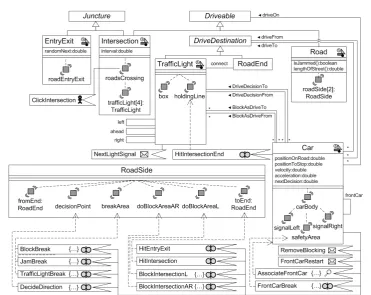
The main structural elements in AMLare visual elements. We adopt the concept of media components[11] to model them. A media component encapsulates some media content together with basic functionality, e.g., methods that render or play the media content, such as audio, video, 3D graphics. However, we will focus on 2D graphics in the following. Each media component provides some standard properties and operations depending on its media type, e.g., size and po-sition for graphics. In addition, custom properties, operations, and associations can be specified in the same way as for UML components. For instance, Fig.3shows the graphics component for
Intersectionand its custom propertyinterval, but without custom operations. Standard properties and operations need not be specified explicitly in the model.
Figure 2:AMLmetamodel (simplified)
Figure 3:AMLmodel: media components, associations, inner properties and sensors
A media component’s inner structure is defined in terms ofinner propertieswhich are orga-nized in a hierarchical manner. Manipulations of parent properties also affect their children; e.g., moving a car also means moving all its inner properties (e.g., the turn signals). An inner property has a name, an optional type, and an optional multiplicity. A type needs only to be specified to indicate that this inner part is an instance of another media component. If no type is specified, the media part is just an instance of an anonymous media component. A multiplicity can be specified to indicate multiple instances. For instance, theIntersectiongraphics in Fig.3consists of aroadsCrossingwhich contains fourtrafficLights. The latter ones are instances of another media componentTrafficLightwhile forroadsCrossingno further type is specified.
Dynamic behavior of animations is modeled using specific kinds of events. In conventional interactive applications, events are mainly triggered by user actions, such as pressing a button. However, applications with complex animations require additional kinds of events resulting from the dynamic behavior of media components. For instance, behavior should be triggered if a moving object reaches a specific position or touches another object on the screen (e.g., a car reaches a traffic light) or if a certain point of time is reached.
InAML, this is modeled by different kinds ofsensors. Four kinds are presented in this paper. Fig.3shows several sensors which are denoted similarly to an accept event action in UML. Fun-damentally, a sensor is owned by a media component or by a media component’s inner property. Auser sensorlistens for user events, such as clicks on a specific component. For instance, Click-Intersectionlistens for a user click onroadsCrossingwhich is a part of anIntersection. A signal sensorsuch asNextLightSignalis similar, but is used for passing events internally, so media com-ponents can pass messages to each other. Acollision sensorhas a relationship to one or more other graphic components (calledopponents) and triggers an event when its owner collides with its opponent(s), i.e., when they overlap on the screen. The collision sensorDecideDirectionowned by the graphic componentCartriggers an event as soon as the car reaches a specific area on its street. As a consequence, the driver decides upon a direction and starts indicating if necessary.
A sensor can also be associated with OCL constraints to specify that the sensor is active only under certain conditions. Most sensors in Fig.3contain constraints, but details are not illustrated there. Several additional keywords such as owner, opponent(sensor) or parent(inner property) are available in constraint expressions allowing to refer to involved components or to navigate through their structures. A special kind of sensors, theconstraint sensor, is always modeled with OCL expression. The purpose of this sensor type is to observe connected components for satisfying the OCL constraint. An example is sensorAssociateFrontCarwhich checks whether a car is driving behind another one on the sameRoadSideand, in this case, associates them in the model by the associationfrontCar.
The behavior and animations of a media component or an inner property is modeled by a special kind of state machine (see Fig. 4). As different aspects of one component can have their own behavior, multiple state machines (or regions) can be executed in parallel. The state machines basically support the same concepts as state machines in UML, i.e., states, pseudo states, parallel states, state transitions, guards, and activities associated with states or transitions. Expressions in the state machines can refer to all properties and operations of its owner.
Figure 4:AMLmodel: state machines and animation behavior (excerpt)
orchange eventsas trigger for transitions. The former is indicated by keywordafterand occurs automatically after a period of time in the state, the latter is indicated bywhenand occurs as soon as annotated constraints are satisfied.
Finally, transitions can also send signals to other components. InAML, this is denoted ex-plicitly by a special kind of send signal action where one or more receivers of the signal can be specified explicitly (using the keywordreceiver). Such signals are designed for correspond-ing signal sensors of the receiver. After receivcorrespond-ing a signal, these sensors trigger other events, if possible. An example in Fig.4 isNextLightSignalwhich is sent by anIntersectionto each of its
TrafficLights at the same time one of the attached state transitions is performed.
The most importantAML-specific concepts areanimation stateswhich are a special kind of state. They define the change of properties over time while the owner of the state machine is in this state (i.e., the animation of the graphic component or a part of it). Animation states have a small symbol in the top right corner and animation instructionsat the bottom. Within these instructions, properties of media components, e.g., position or angle, can be bound to expressions. Fig. 4 shows two examples of animation states. For instance, state DecisionLeft
describes the blinking of the car’s left turn signal by switching the visibility attribute of graphic componentSignalLefton and off depending on the elapsed time (denoted by<t>) and a constant for the interval.
5
Translating
AML
Models to
DiaMeta
Specifications
Figure 5:IntersectionandTrafficLight Figure 6:Carassociated withTrafficLights
(1) Specifications of static components and dynamic components of the VL represented by AMLmedia components must be derived. (2) The resulting specification must be extended by constructs which allow the representation of all states within theAMLmodel. (3) GT rules must be derived from the model in order to map each state transition. (4) Resulting GT rules must be specified asDiaMetaevents. (5) Animation visualizations during animation states must be considered.
Each of the following subsections describes one step forTraffic. Please note, that only a rough picture of these steps can be presented due to the space limitations of this paper. The translation starts with the specification of static VL components (1.1) and dynamic VL components (1.2).
(1.1) As a first step, theAMLmedia component model (see Fig.3) must be investigated for static language elements. While independent media components are declared as regular VL com-ponents, media elements that are used as inner properties must be specified assub-components, i.e., they are represented by so-calledsub-component (hyper-)edgesbeing connected to the com-ponent hyperedge of its parent comcom-ponent through appropriate nodes. Fig.5shows anIntersection
as a component hyperedge and itstrafficLights as sub-component edges.
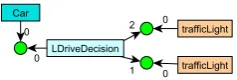
(1.2)TheAMLmodel usually contains further media components (e.g.,Car) and associations that are used during animation only. Such elements are maintained by state transitions of the behavioral model. For example, AML associations belonging to dynamic aspects require the specification of so-calledanimation (hyper-)edgeswhich can link components in order to repre-sent associations. Fig.6 shows animation edgeLDriveDecision which corresponds to bothAML associations DriveDecisionFrom and DriveDecisionTo. The shown graph represents a car whose driver has decided to drive from the first traffic light attached toLDriveDecisionto the second one. (2) The next step is to translate all state machine states (see Fig. 4). Thereby, the state of the dynamic system must be expressible by the graph representing the model (cf. Sec.3), i.e., specifications which allow the characterization of each component’s state are required. In some cases, no additional specification is necessary because a state can already be determined implic-itly (e.g., by attached animation edges). The state of aCar’s state machineDrivingDecision, for instance, is already characterized by edgeLDriveDecision(see Fig. 6). Depending on its con-nections totrafficLightedges, it is determined whether the driver wants to drive straight, left, right, or has not decided yet if there is no such edge.
A specification option, which is always available for embedding state information, is to create an explicit attribute for a (sub-)component edge. This attribute has to store the active state.
case of external events. In terms of DiaMeta, the specification of an external event means the specification of a GTP which is executed directly if the user selects a component and pushes a defined key or button. This event-related GTP, and the following is also true for internal events, must choose the applicable state transition depending on the recipient’s current state and execute the corresponding GT rule specified in step (3).
In a sense, but not correct in terms of definition, receiving signals (e.g.,NextLightSignal) can also be considered as external events from the recipient’s point of view. Therefore, signal sensors can be translated into external event specifications in the same way. However, the specified GTPs may not be accessible from outside of the system, e.g. for the user.
(4.2) The DiaMeta specification of internal events, which are also based on GTPs, initially follows the guidelines described in the previous step, except that internal events can never be accessed by an external system or the user. In addition, a time calculation rule is required for internal events and must be specified. In order to derive meaningful time calculation rules, differentAMLelements indicating internal events are described in the rest of this step:
The simplest internal events found in theAMLmodels areelapsed time events indicated by keyword after. In this case, the GTP is already complete, and the required time calculation rule can be deduced directly by adding the argument of the elapsed time event, e.g., “3 sec”, to the time the state has been entered. This implies that astate entry timemust be tracked at corresponding state transitions, e.g., by maintaining an appropriate component attribute. Another kind of internal events arechange eventsindicated by keywordwhen. They can also result in a simple time calculation rule, i.e., the rule that always returns the time when the internal event is calculated. This means that the state transition is performed immediately if the graph pattern and additional conditions match, which is possible if arguments of the change event are part of the GT rule’s graph pattern and conditions. However, if a condition depends on a value which changes during an animation state, the time calculation rule, which has to calculate the first point of time when the condition is true, gets more complicated.
Figure 7: Event specification forDecideDirectionLeftand according state transition
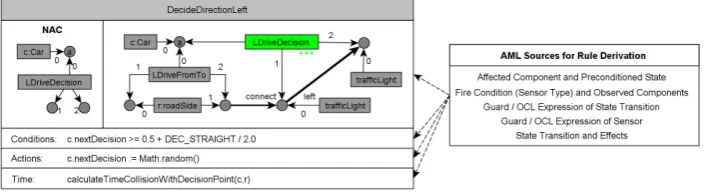
specifications. Depending on theCar’s attributenextDecisiononly one of them may be applicable. Fig.7shows the ruleDecideDirectionLeft2which is applied if this attribute indicates the decision to drive left. The figure also outlines theAMLelements used to derive the rule.
(5)The remaining part is the interpretation of theanimation stateswithin theAMLmodel, e.g., aCarwhich is moving along aRoador aCarwith an activated turn signalsignalLeft(see Fig.4). The animation instructions stated in animation states indicate which and how the attributes of the component must be changed while an animation state is active (cf. Sec.4). These instruc-tions must be transferred into the DiaMeta specification. In terms ofAML, property changes are performed while in a state without any transition necessary. ForDiaMeta this means that graphical primitives are not drawn using static attributes, but drawn using temporarily calculated values derived from such attributes and modified by referring to the current animation time and the associated animation instruction. Finally, when leaving or entering an animation state, it is often necessary to update static attributes which have been the basis for animation visualization before. Within theDiaMetaspecification, this must be done by the GT rule which realizes the corresponding state transition. For instance, a Car is moved during an animation state called
Drive. TheCar’s position (static attributes) must be updated when leaving this state. Otherwise, information about the new position would not be available after the movement animation.
6
Related Work
AMLintegrates concepts from two existing modeling languages: theScene Structure and Integra-tion Modeling Language(SSIML) for 3D development and theMultimedia Modeling Language (MML) for interactive multimedia applications. SSIML/Behaviour [15] is a modeling language based on UML2 state machines which also introduced animation states for modeling animation details but focused on 3D applications.
MML [11] is a platform-independent language for model-driven development of multimedia applications. It provides concepts such as complex media components with inner structure, user interface elements, and sensors, which have been reused here. However, it does not support
2It shows the GT rule within one segment: parts which are added by the rule are drawn in green with “+++”. Attribute
mon environment. This possibility makesAMLalso attractive for the specification of domain-specific visual languages for agent-based modeling and simulation. In this field of research other tools are already available, e.g., in [10] a toolkit for specifying the behavior of agents and their visual appearance within a modeling environment is demonstrated.
There are also other concepts for the animation of VLs based on GT. An example is the approach described in [1] which basically allows specifying animations for discrete event sim-ulations. However, animations are visualized for state transitions (GTs) which restricts the VLs especially in terms of interactivity and parallelism of independent animations. The resulting animations are self-running movies, and amalgamated GT rules are already required for the specification of less complex examples such as animated Petri nets.
In [8] a set of visual languages is introduced in order to describe the behavior of diagrams of metamodeled languages. The concepts are also based on events and state machines, but most lan-guages are less close to UML. In addition, the concepts include the modeling of user interfaces, whereas aspects of smooth graphical animations are not covered. Concerning the flexibility, the approach is less adequate for a language with many independently animated actors (agents) such as inTrafficas the behavior is represented by a single state machine.
Another approach for the application of models in order to implement graph-based simulations is shown in [14]. The authors describe how DEVS models can be used as a semantic domain for programmed GTs which allows simulation-based design. However, the concepts describe GTs consuming time and because of possible needs for parallel executions or interruptions, additional control structures are required.
7
Conclusions
In this paper we introduced theAnimation Modeling Language(AML) to model complex anima-tions at an appropriate abstraction level. It has been used here to systematically deriveDiaMeta specifications to generate interactive editors for animated VLs.
Different levels of details can be chosen, soAMLcan illustrate rough ideas as a starting point forDiaMetaspecifications, but also models which are very close to the resulting specifications. On the other hand, fully featuredAMLdiagrams even documentDiaMetaspecifications which are usually less explanatory. UsingAMLandDiaMetais a promising approach for simplifying the specification effort for complex VLs.
for the automated generation of graph-based VL specifications. In this context, a reasonable set of predefined animation instructions must also be found and offered by our framework in order to avoid self-programmed routines realizing animations or collision detection.
Bibliography
[1] C. Ermel.Simulation and Animation of Visual Languages based on Typed Algebraic Graph Transformation. PhD thesis, Tech. Univ. Berlin, Books on Demand, Norderstedt, 2006.
[2] S. Gyapay, R. Heckel, D. Varr´o. Graph Transformation with Time: Causality and Logical Clocks. InICGT ’02, LNCS 2505, Springer, 2002, pp. 120–134.
[3] D. Harel, H. Kugler. The Rhapsody Semantics of Statecharts (or, on the executable core of the UML). InIntegrations of Software Specification Techniques for Applications in Engi-neering, LNCS 3147, Springer, 2004, pp. 325–354.
[4] K. Kahn, V. Saraswat. Complete Visualizations of Concurrent Programs and their Execu-tions. In1990 IEEE Workshop on Visual Languages. 1990, pp. 7–15.
[5] J. Kienzle, A. Denault, H. Vangheluwe. Model-based Design of Computer-Controlled Game Character Behavior. InModels 2007, LNCS 4735, Springer, 2007, pp. 650–665.
[6] J. de Lara, H. Vangheluwe. AToM3: A Tool for Multi-formalism and Meta-modeling. In FASE ’02, LNCS 2306, Springer, 2002, pp. 174–188.
[7] M. Minas. Generating Meta-Model-Based Freehand Editors. InGraBaTs’06. ECEASST 1. 2006.
[8] T. M´esz´aros, G. Mezei, H. Charaf. Engineering the Dynamic Behavior of Metamodeled Languages. InSimulation85(11):793–810, 2009.
[9] L. Morgado, K. Kahn. Towards a specification of the ToonTalk language. InJ. of Visual Languages and Computing19:574–597, 2008.
[10] M.J. North, E. Tatara, N.T. Collier, J. Ozik. Visual Agent-based Model Development with Repast Simphony. InAgent 2007 Conf.. 2007.
[11] A. Pleuß. MML: A Language for Modeling Interactive Multimedia Applications. In 7th IEEE Int. Symp. on Multimedia (ISM’05). IEEE, 2005, pp. 465–473.
[12] S. Sauer and G. Engels. UML-based Behavior Specification of Interactive Multimedia Ap-plications. In IEEE Symp. on Human-Centric Computing Languages and Environments (HCC 2001). IEEE, 2001, pp. 248–255.
[13] T. Strobl, M. Minas. Specifying and Generating Editing Environments for Interactive Ani-mated Visual Models. InGT-VMT’10, ECEASST 29. 2010.
[14] E. Syriani, H. Vangheluwe. DEVS as a Semantic Domain for Programmed Graph Transfor-mation. InDiscrete-Event Modeling and Simulation: Theory and Applications. CRC Press, 2009.