ISSN: 2147-611X
International Journal of Education
in Mathematics, Science and
Technology (IJEMST)
www.ijemst.com
Instrumental Appropriation of a
Collaborative, Dynamic-Geometry
Environment and Geometrical
Understanding
Muteb M. Alqahtani1, Arthur B. Powell2
1 Rutgers University
2 Rutgers University-Newark
To cite this article:
Alqahtani, M.M. & Powell, A.B. (2016). Instrumental appropriation of a collaborative,
dynamic-geometry environment and geometrical understanding.
International Journal of
Education
in
Mathematics,
Science
and
Technology,
4
(2),
72-83.
DOI:10.18404/ijemst.38054
This article may be used for research, teaching, and private study purposes.
Any substantial or systematic reproduction, redistribution, reselling, loan, sub-licensing,
systematic supply, or distribution in any form to anyone is expressly forbidden.
Authors alone are responsible for the contents of their articles. The journal owns the
copyright of the articles.
Volume 4, Number 2, 2016
DOI:10.18404/ijemst.38054
Instrumental Appropriation of a Collaborative, Dynamic-Geometry
Environment and Geometrical Understanding
Muteb M. Alqahtani, Arthur B. Powell
Article Info
Abstract
Article History
Received: 23 May 2015
To understand learners’ appropriation of technological tools and geometrical understanding, we draw on the theory of instrumental genesis (Lonchamp, 2012; Rabardel & Beguin, 2005), which seeks to explain how learners accomplish tasks interacting with tools. To appropriate a tool, learners develop their own knowledge of how to use it, which turns the tool into an instrument that mediates an activity between learners and a task. The tool used in our study is the Virtual Math Teams with GeoGebra (VMTwG) environment. It contains a chat panel and multiuser version of GeoGebra. The learners are seven middle and high school mathematics teachers who participated in a professional development course in which they collaborated synchronously in VMTwG to solve geometrical tasks. We use conventional content analysis to analyze the work of a team consisting of two high school teachers. Our analysis shows that the teachers’ appropriation and application of the dragging feature of VMTwG shaped their understanding of geometrical relations, particularly dependencies. This informs the broader question of how and what mathematical knowledge learners’ construct using certain technologies.
Accepted: 29 September 2015
Keywords
Dynamic geometry Instrumental genesis Professional development Collaboration
Geometric reasoning
Introduction
Understanding geometry is important in itself and for understanding other areas of mathematics. It contributes to logical and deductive reasoning about spatial objects and relationships. Geometry provides visual representations alongside the analytical representation of a mathematical concept (Goldenberg, 1988; Piez & Voxman, 1997). Pairing learning geometry with technological tools of Web 2.0 can allow learners to investigate collaboratively geometrical objects, properties, and relations and develop flexible understanding of geometry. The Common Core State Standards for Mathematics underscores that mathematics educators should seek to develop students’ mathematical practices so that they “use appropriate tools strategically,” including dynamic geometry environments (Common Core State Standards Initiative, 2010, p. 7). Although teaching with technology is recommended, meta-analytic studies show that teaching mathematics with technology cannot guarantee positive influence on learning (Kaput & Thompson, 1994; Wenglinsky, 1998). Consequently, careful investigations are required to understand the appropriation of technology and how it shapes mathematics learning. To contribute to this understanding, we describe the influence of learners’ appropriation of online dynamic geometry tools on their geometric understanding. This paper responds to the question: How does learners’ appropriation of an online, collaborative dynamic geometry environment shape their geometrical understanding?
Literature Review
interacted with DGE; their main goals were investigating the impact of introducing such technologies on learning and teaching mathematics.
Other studies focused on certain aspects of interacting with DGEs. Arzarello, Olivero, Paola, and Robutti (2002) studied the dragging action in DGE and the cognitive processes behind each different type of dragging. They identify two levels of cognitive processes linked to dragging: ascending (moving from drawings to theory) and descending processes (moving from theory to drawings). Ascending processes allow users to investigate the drawings freely to look for patterns and invariants. Descending processes are used with a theory in mind to validate or test properties. Dragging within those two cognitive levels can vary between wondering dragging, bound dragging, guided dragging, dummy locus dragging, line dragging, linked dragging, and dragging test (Arzarello et al., 2002). Baccaglini-Frank and Mariotti (2010) used the work of Arzarello et al. to develop a model that tries to explain cognitive processes behind different types of dragging. They used four different types of dragging: wondering dragging, maintaining dragging, dragging with trace activated, and dragging test. Wondering dragging is dragging that aims to look for regularities while maintaining dragging is dragging base points so that the dynamic figure maintain certain properties. Dragging with trace activated is dragging base points with trace activated on them. Drag test is dragging base points to test whether certain properties will meet certain conditions (Baccaglini-Frank & Mariotti, 2010).
The last group of studies looked at the instrumental transformation of technological tools into instruments that mediate users’ activity. An example of these studies is Guin and Trouche’s (1998) study. They investigated the instrumentation process that a group of students used to transform graphing calculators to mathematical instrument. They conclude that instrumentation is a complex and slow process and that interacting with technological tools in learning mathematics might not result in transforming the tool into an instrument. Similarly, Guin and Trouche (2002) and Trouche (2003) show how learners transform technological tools into mathematical instruments with more focus on the teacher’s and the environment’s roles that support this transformation.
Based on our review, there is a need for studies that investigate how users, through the instrumentation process, interact with each other in DGEs. The users’ interactions with DGEs have an influence on their thinking and learning of geometry (Hegedus & Moreno-Armella, 2010; Rabardel & Beguin, 2005), which makes investigating how learners appropriate an online, collaborative dynamic geometry environment important. It can help mathematics educators understand how DGEs shape learners’ geometrical understanding.
Theoretical Perspective
Just interacting with an artifact is not an instrument-mediated activity. In instrument-mediated activity, instruments mediate users’ activity or action to achieve a certain goal. While engaging in an activity, users monitor consciously the continuous transformation of an object towards their goal. This mediator role that instruments play governs the user-object relations, which might take epistemic or pragmatic forms. The epistemic mediation form focuses on the object and its properties. In this form, the instrument helps the user understands the object and its structure. On the other hand, in the pragmatic mediation form, the user is mainly concerned with the required actions while using the instrument to transform the object into the desired final result (Lonchamp, 2012; Rabardel & Beguin, 2005). The final result is the final transformation of the object, which might not match exactly the initial goal. The user may find certain form of the transformed object satisfying enough and, therefore, end the activity.
During an activity that is mediated by an instrument, it is understandable that the artifact affects the activity; however, users play a major role in shaping the activity. The users’ interactions with an artifact shape the activity. Two different users can approach an artifact differently, develop different utilization schemes, and create two different activities and instruments.
The transformation of an artifact or tool into an instrument, or instrumental genesis, occurs through two important dialectical processes that account for potential changes in the instrument and in the learners, instrumentalization and instrumentation. The instrumentalization process is defined as “the process in which the learner enriches the artifact properties” (Rabardel & Beguin, 2005, p. 444). In this process, the user selects and modifies the properties of the artifact, for example, using a wrench as a hammer. The second process of instrumental genesis is instrumentation. This process is about the development of the learner side of the instrument. The development of the learner is basically the assimilation of an artifact to a scheme and the adaptation of utilization schemes. With the example of using a wrench as a hammer, the learner already had acquired the utilization scheme of a hammer and when a hammer was not available at the time of the action, the learner chose the wrench and associated it to the hammer utilization scheme. This is an example of “direct assimilation of artifact into a utilization scheme” (Rabardel & Beguin, 2005, p. 446), which changes the meaning of the artifact. During the act of assimilation, the learner employs previous utilization schemes to new artifact. In our example, acquiring the hammer utilization scheme led the learner to choose the wrench and not another tool because he is aware of the functions of the hammer and its structure that makes him look for a similar tool that can take the same scheme. In the situation where a new artifact cannot be assimilated to previously acquired utilization scheme, the learner adapts utilization schemes and makes the necessary modifications to it.
Through the two processes of instrumental genesis, instrumentation and instrumentalization, dialectically the tools influence the thinking of the learner and the learner influences the design of the tools. On the one hand, the structure and functionality of tools shape how the learner uses the tool, which result in shaping the learner’s thinking. On the other hand, the learner’s interactions with the tool also shape the tool and how it is used. In the case of dynamic geometry environments (DGEs), instrumentation occurs when users develop utilization schemes of how to use the environment. Utilization schemes include learning how to use a DGE’s tools to construct and manipulate geometric objects. It also includes understanding the functions of those tools and their links to the theory of geometry and using the tools to explore, conjecture, and justify relations among geometric objects. The instrumentalization process concerns the design and the use of DGEs. Concerning the design, developers instrumentalize by deciding on what functions to include, how to organize the environment, how it reacts to user’s actions, how to support users’ activity, and so forth. Concerning the use of DGEs, instrumentalization occurs with users’ decisions about how to use the environment. Users may use the environment and its functions as the developers intended. However, to achieve certain goals, users may use DGEs’ tools differently from how developers intended. For example, constructing two parallel lines can be accomplished using “Parallel Line” tool, but users may use “Regular Polygon” tool to construct a square and then construct two lines on two opposite sides of the square. Of these two dialectically related processes, for this study, we are concerned with instrumentation in DGEs since we are interested in understanding how users develop their utilization schemes and learn to use the tools as intended. This understanding can provide insights into learners’ geometrical knowledge and its development.
its construction process. Hot-spots are “points that can be used to construct mathematical figures, e.g. join two points with a segment, or construct a piecewise graph, and then used to dynamically change the construction.” (Hegedus & Moreno-Armella, 2010, p. 26).
The relationship between the user and the DGE is a result of co-action between the two (Hegedus & Moreno-Armella, 2010). The notion of co-action has two sides: (a) the user’s action can guide DGE and (b) DGE’s reaction can guide the user. A dynamic geometry software allows users to act on it and, in turn, reacts to their actions. As users drag (click, hold, and slide) a hotspot of a geometric figure, the DGE redraws and updates information on the screen, preserving all constructed mathematical relations among objects of the figure. In redrawing, the DGE creates a family of not only visually but also mathematically similar figures. Users may then attend to the reaction of the DGE and experience and understand underlying mathematical relations such as dependencies. DGEs “remember” underlying mathematical relations among various objects of a construction. For instance, if a point P is the midpoint of a segment AB, then as the length or position of segment AB changes, P’s relationship to AB remains invariant, namely that P is equidistant from the line segment’s endpoints A and B.
Dynamic geometry environments are tools that learners can appropriate through an instrumentation process. Learners will need to acquire utilization schemes – usage schemes and instrument-mediated activity schemes – to appropriate the tool. In DGE, the usage schemes include knowledge about the software use and its functionalities. The second level of utilization schemes for a DGE includes knowledge of geometry and dependencies. When learners appropriate a DGE as an instrument, they will be able to use it to demonstrate geometrical concepts and solve geometrical problems. This appropriation may result in knowledge of how to use dynamic geometry software as well as knowledge of geometry. The geometrical knowledge can be a special type of knowledge shaped by DGE. Within DGEs, Straesser (2002) sees that geometry is “lived in differently, broader scope, has a new, more flexible structure, [and] offers easy access to certain heuristic strategies.” (p. 331). Balacheff and Kaput (1996) claim that characteristics of DGEs result in creating new mathematics, a geometry that is different from Euclidian geometry in the plane.
Methods
Data come from a project that integrates a cyberlearning environment with digital tools for collaborative geometrical explorations grounded in a pedagogical approach that engages learners in developing significant mathematical discourse. The project investigates learners’ actions as they occur through an iterative coevolution of the technology and curricular resources in the context of engaging, reflective collaborative learning experiences of significant mathematical discourse by in-service teachers and their students. The data for this paper come for an online professional development course for middle and high school teachers that occurred over 15 weeks in the fall 2014. In small teams, seven New Jersey middle and high school mathematics teachers engaged in interactive, discursive learning of dynamic geometry through collaborating to solve tasks in a computer-supported, collaborative-learning environment: Virtual Math Teams with GeoGebra (VMTwG). They also read and discussed articles about collaboration (Mercer & Sams, 2006; Rowe & Bicknell, 2004), mathematical practices (Common Core State Standards Initiative, 2010), accountable talk (Resnick, Michaels, & O’Connor, 2010), technological pedagogical content knowledge (Mishra & Koehler, 2006), implementing technology in mathematics classroom (McGraw & Grant, 2005), and validating dynamic geometry constructions (Stylianides & Stylianides, 2005) and analyzed logs of their VMTwG interactions to examine, reflect, and modify their collaborative and mathematical practices.
VMTwG, a product of a collaborative research project among investigators at Rutgers University and Drexel University, is an interactional, synchronous space. It contains support for chat rooms with collaborative tools for mathematical explorations, including a multi-user version of GeoGebra, where team members can define dynamic objects and drag the hotspots around on their screens. VMTwG records users’ chat postings and GeoGebra actions. The research team designed dynamic-geometry tasks that encourage participants to discuss and collaboratively manipulate and construct dynamic-geometry objects, notice dependencies and other relations among the objects, make conjectures, and build justifications (Powell & Alqahtani, 2015).
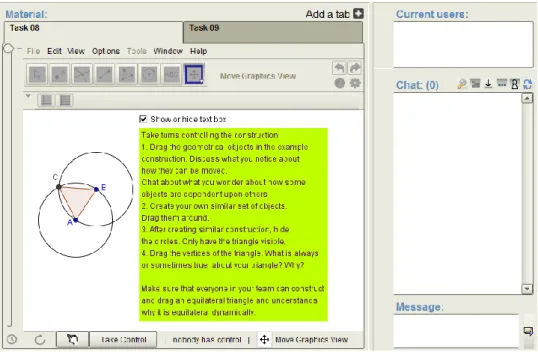
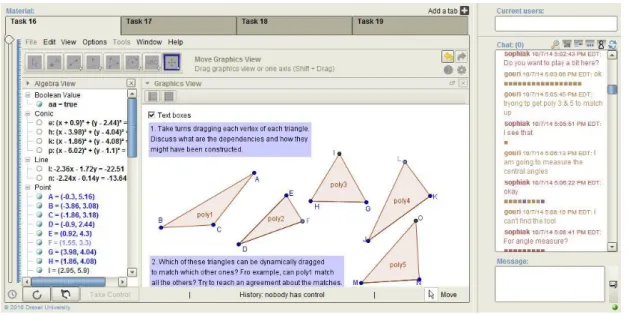
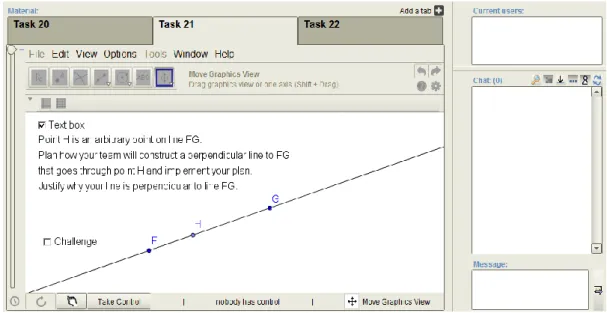
knowledge, we used the discursive data generated from their work on three tasks, Task 8, which they worked on in the fourth week, Task 16, which they worked on in the fifth week, and Task 21, which they worked on in the seventh week. Task 8 (see Figure 1) asks the teachers to discuss the construction of equilateral triangle and then construct it and Task 16 (see Figure 2) asks the teachers to drag dynamically different triangles and discuss the dependencies involved in their construction. Task 21 (see Figure 4) asks teachers to construct a perpendicular line that passes through an arbitrary point. The discursive data includes the logs of teachers’ chat communications and their GeoGebra interactions. Using conventional content analysis (Hsieh & Shannon, 2005), we analyzed their discursive data to understand the developmental process of instrument appropriation and the implications of that appropriation. In addition, we used the construct of co-action to understand when, why, and how do teachers interact with base points; what feedback do they perceive and what do they do with this feedback; and how does the feedback shape their subsequent actions.
Results
Our analysis focuses on understanding how the teachers’ appropriation of VMTwG shapes their geometrical understanding. Specifically, our results show how through co-action teachers’ interaction with VMTwG leads to shaping their understanding of affordances of dragging in GeoGebra while working on constructing an equilateral triangle (Task 8). The result from Task 16 shows how teachers used aspects of the environment to identify dependencies among geometric objects. Our results in a later VMTwG session also show how the VMTwG environment shapes the knowledge that the teachers develop while working to construct a perpendicular line that goes through an arbitrary point as well as their heuristic to solve the problem (Task 21).
Appropriating Dragging
Task 8 asks teachers to drag objects and then to discuss (in the chat window) what they notice about the given figure and then construct a similar one in GeoGebra (see Figure 1). Among other things, previous tasks engaged the teachers in noticing as they dragged hotspots variances and invariances of objects and relations of figures.
Figure 1. Task 8: Constructing equilateral triangle.
necessity to revisit their understanding of dragging after being instructed to create an equilateral triangle. # User Chat Post
26 sophiak It seems that point C is fixed but pts A&B are not. I am thinking somehow A&B were used to create the circles which is why the make the circles bigger or smaller.
27 sophiak How about you try to explore now?
28 gouri ok I'll continue on with #2 [the second instruction in Task 8] as well
29 sophiak No, I would like to create the objects as well. I think it is valuable if we both explore 30 gouri C does seem fixed/constrained
31 gouri sure - how about i do it and then you do it as well after? 32 sophiak Sounds good. Please type what you do.
33 gouri So far I created 2 circles
34 gouri and overlapped the D point as the raius point for E 35 gouri one more try
36 gouri ok - i deleted the other circle because i dont need it
37 gouri I somehow thought i could create all 3 points, abc through two circles 38 sophiak How did you create F?
39 gouri I added a point
40 gouri then the polygon tool for the triangle
41 sophiak Did you want to explore your picture to see if it behaves the same way as the original? 42 gouri ok
43 gouri [after dragging for few minutes] I noticed that it's the points that make the circle dynamic
44 gouri and not the circle (in black) itself
Our analysis of this excerpt reveals two aspects of this team’s instrumentation process: collaboration and tool use, which parallels their mathematical understanding. From a collaboration point of view, the team was trying to establish collaborative norms by starting tasks by exploring the pre-constructed figures and then reproducing those figures. In lines 27 and 29, sophiak suggests explicitly that gouri explores before she constructs. This team’s evolving collaborative norm seems to start with each member exploring and sharing noticings and then each member constructing the figures.
With regards to teachers’ actions towards solving the task, the teachers started by stating their noticings of the construction. In line 26, sophiak mentions that point C is fixed and points A and B are not and states that points A and B are used to construct the two circles. She states that since dragging points A and B effects the circles then they are used in constructing the circles. It indicates how sophiak views the relationship between dependency and construction and how she is starting to identify the hotspots of the figure. Her comment at line 26 seems to indicate that she is connecting prior experience (A and B’s independent role) with other tasks to what she notices about the size of the circles. The co-action—dragging points A and B with the change in the circumference of the circles—provides epistemic mediation since sophiak acquires knowledge about the relationship between the base points, A and B, and the circumference of the circles. The second team member, gouri, takes control, agrees that point C is “fixed/constrained”, and tries to construct a similar figure. She successfully creates a similar figure to the task’s figure. In lines 33 to 40, gouri describes to sophiak the process of her construction, and following sophiak’s suggestion in line 41, drags and tests gouri’s construction and the pre-constructed figure. She states after dragging in lines 43 and 45 that “the points that make the circle dynamic and not the circle (in black) itself”. These comments suggest that gouri was concerned with what is being dragged in a dynamic geometry environment and what makes it dynamic.
Identifying Dependencies
In the fifth week of the course, Team 3 worked on Task 16. The teachers were asked to drag dynamically different triangles and discuss the dependencies involved in the construction (see Figure 2).
Figure 2. Task 16: Triangles with dependencies.
The teachers show fluent use of dragging dependency while discussing the triangles. They stated that the first triangle does not have any dependencies involved in its construction. While discussing the second triangle (poly2), they dragged the vertices D, E, and F vigorously then checked the Algebra View in GeoGebra to look for more relationships among triangle DEF objects. Algebra View is an analytical view that shows some properties of the objects in the graphic view. It also shows the hidden objects and their properties (see Figure 3). Team 3 was able to use Algebra View to explore the objects and their relationships.
Figure 3. Algebra view for Task 16.
The following excerpt from Team 3’s work on Task 16 shows how the team effectively used dragging and Algebra View to identify dependencies involved in the construction of triangle DEF.
# User Chat Post
11 gouri I don't really see many dependencies between the triangles in this case 12 sophiak I thought the same thing, poly 1 seems independent
14 sophiak What do you mean by different?
15 gouri [dragged point E] When I drag point E, point F is dependent in that it follows E 16 sophiak Does it move from either point F or D?
17 gouri [dragged points D, E, and F and made the circle that was used in the construction visible] Points E and F are on a circle
18 gouri they are radii and move accordingly 19 sophiak How did you notice that?
20 gouri [dragged points E and D] D is the center of the circle 21 gouri I went to algebra view and unhid the conic e
22 sophiak Oh, intersecting. DEF is a an isosceles triangle 23 sophiak I meant to type interesting
24 gouri yes
25 gouri and it can be obtuse or acute
26 sophiak Right, either way it will always be isosceles since DE and DF are radii of the same circle.
As mentioned above, the team states that the first triangle does not have dependencies in lines 11 and 12. In line 13 and 15, gouri drags point E, an independent point, and notices that point F is changing, which makes point F dependent on point E. Then sophiak asks about the other points in line 16. That question made gouri drag all the vertices of the triangle. In lines 17 and 18, gouri realizes that there is a hidden circle used in the construction and states that DE and DF “are radii and move accordingly” when changing the circle. In line 20, she states that point D is the center of the circle. The second teacher, sophiak asks “How did you notice that?” In line 21, gouri states that she used Algebra View to unhide the circle used in this construction. This allowed sophiak to know that the triangle is an isosceles triangle and justifies that in line 26 saying “it will always be isosceles since DE and DF are radii of the same circle.” The team’s work on this task shows that this team is using VMTwG with its different component efficiently to explore mathematical objects and their relations and to justify those relations.
Constructing Perpendicular Lines
Teachers’ understanding of dragging different types of objects, hotspots and other objects, in DGE helped them appropriate the environment, which influenced the type of knowledge that teachers developed in later sessions in the course. To further illustrate this, we now discuss the teachers’ work on Task 21 (see Figure 4). Between Task 8 (constructing equilateral triangle) and Task 21, the teachers used the compass tool to copy line segments and to construct different types of triangles. Task 21 invited them to construct a perpendicular line that passes through an arbitrary point on a given line (see Figure 4).
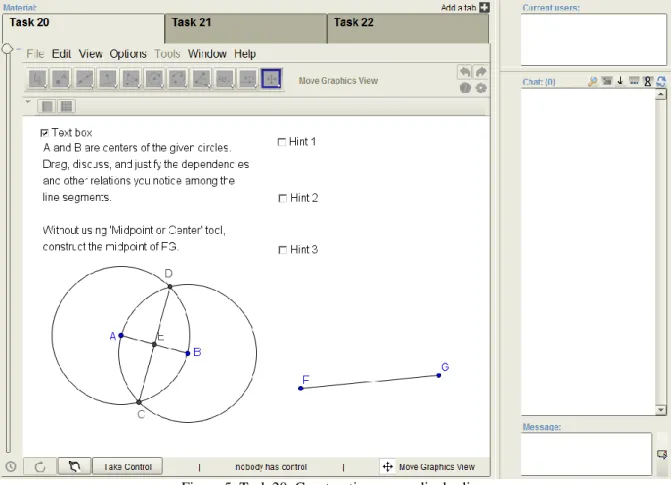
In the preceding task, Task 20, the teachers constructed a line perpendicular to a give line (see Figure 5). In this task, our intent was to enable the teachers to develop insight and skill to solve Task 21. However, after working on Task 20, this team of teachers were unable to solve Task 21 in their first attempt. As Mason and Johnston-Wilder (2006) note that “What is intended, what is activated (implemented), and what is attained or constructed by the learners are often rather different” (p. 27). In written feedback, we suggested that in their next synchronous session they revisit Task 20 and try to use its technique to solve Task 21.
Figure 5. Task 20: Constructing perpendicular line.
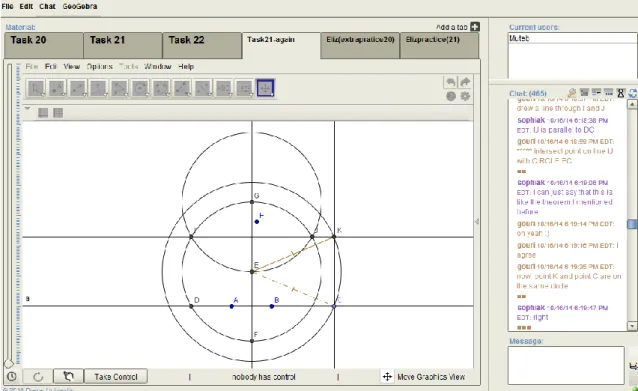
The teachers met again to solve Task 21. To do so, they created a new GeoGebra workspace or tab within Task 21 and labeled it, “Task21-again” (see Figure 6) and successfully solved it. Interestingly, however, their solution did not rely on the solution of Task 20 in the way we anticipated. We intended that Task 20 would help the teachers see that one way to solve Task 21 is by constructing a circle that has the arbitrary point as center then mark the two intersection points of this circle with the given line to identify the radius for two other circles that will intersect in two points. Connecting those two intersecting points will create a perpendicular line that passes through the arbitrary point. Instead, the teachers develop another approach.
Figure 6. Team 3’s solution to Task 21 In VMTwG.
Proving that KC is perpendicular to AB is beyond the scope of this paper; however, it can be done easily using triangle congruency. The teachers struggled for about an hour to solve this task. They passed the control of GeoGebra to each other and tried to make sense of each other’s actions. They referred to Task 20 a few times and discussed how they could use it in solving Task 21. They collectively constructed their final solution. After each step of their construction, they dragged points A, B, and C to make sure that at each stage their construction maintained properties they intended. Their appropriation of dragging–what to drag, how to drag, and what to expect–was dominant in their problem solving of Task 21.
Discussion
A team of two high school teachers was introduced to collaborative, online, dynamic geometry environment, VMTwG, in a 15-weeklong professional course. During this course, the members of this team interacted in VMTwG to notice variances and invariances of objects and relations in pre-constructed figures or figures that they constructed and to solve open-ended geometry problems. Our analysis of their interactions allowed us to understand how they appropriated the environment and how this appropriation influenced their geometrical knowledge. At the beginning of the course, the teachers started by focusing on appropriating the dragging affordance of DGEs. They paid special attention to the characteristics of the objects that being dragged. Their interactions indicate that they see the significance of dragging the hotspots of a construction (Hegedus & Moreno-Armella, 2010). The co-action of the VMTwG environment that occurs while they drag different objects in Task 8 helped the teachers identify the hotspots and use them to test their construction and become aware of dependencies. The need for more than wondering dragging (Arzarello et al., 2002; Baccaglini-Frank & Mariotti, 2010) in this task motivated the teachers to develop more purposeful dragging. They used maintain dragging to check if the triangle maintains its properties and later on, drag to test the validity of their construction (the drag test). Similarly, the teachers used combination of wondering dragging and maintain dragging to identify dependencies in Task 16. Their maintain dragging was more evident while trying to understand dependencies in the isosceles triangle.
While trying to solve Task 21, as mentioned above, the teachers referred to Task 20 multiple times and collectively constructed their solution for Task 21. They dragged the hotspots of their construction after each step. Their understanding of dragging hotspots helped them solve the task. While constructing a perpendicular line that passes through an arbitrary point, the teachers constructed a rectangle. Their procedure anticipates work they will be doing in a later task.
Understanding how instrumentation process occurs in DGEs informs implementing DGEs in learning and teaching mathematics. As Guin and Trouche (1998) found, instrumentation is a complex, slow process. The appropriation of dragging is an important aspect of transforming dynamic geometry tool into an instrument. The environment’s reaction to dragging helps users identifying the independent, partially independent, and completely constrained points in any geometric figure, but users need to be attentive to dragging points and see what geometric relations and properties remain invariant. It is also important to anticipate DGE to shape users’ knowledge by developing relational understanding of geometric notions.
Finally, further research is needed to understand what other aspects of DGEs are important in the instrumentation process. Investigating how the appropriation of different aspects or tools of DGEs might influence learners’ knowledge is also needed. The instrumentalization process with DGEs is another important area of research since it can inform DGE design and implementation in teaching and learning mathematics. Understanding how learners use DGEs informs how researchers and educators design tasks for this environment and how to support learners’ appropriation of this technological tool. Additionally, research is needed to investigate how teachers implement DGE collaboratively in their teaching to support students’ strategic use of DGE tools and the discursive development of their geometric ideas.
Acknowledgements
This paper is based upon work supported by the National Science Foundation, DRK-12 program, under award DRL-1118888. The findings and opinions reported are those of the authors and do not necessarily reflect the views of the funding agency.
References
Arzarello, F., Olivero, F., Paola, D., & Robutti, O. (2002). A cognitive analysis of dragging practises in Cabri environments. International Reviews on Mathematical Education (ZDM), 34(3), 66-72.
Baccaglini-Frank, A., & Mariotti, M. A. (2010). Generating conjectures in Dynamic Geometry: The maintaining dragging model. International Journal for Computers in Mathematical Learning, 15.
Balacheff, N., & Kaput, J. J. (1996). Computer-based learning environments in mathematics. International
handbook of mathematics education (pp. 469-501): Springer.
Common Core State Standards Initiative. (2010). Common core state standards for mathematics Retrieved from http://www.corestandards.org/assets/CCSSI_Math%20Standards.pdf
Goldenberg, E. P. (1988). Mathematics, metaphors, and human factors: Mathematical, technical, and pedagogical challenges in the educational use of graphical representation of functions. The Journal of
Mathematical Behavior, 7, 135-173.
Guin, D., & Trouche, L. (1998). The complex process of converting tools into mathematical instruments: The case of calculators. International Journal of Computers for Mathematical Learning, 3(3), 195-227. Guin, D., & Trouche, L. (2002). Mastering by the teacher of the instrumental genesis in CAS environments:
necessity of intrumental orchestrations. Zentralblatt für Didaktik der Mathematik, 34(5), 204-211. Hegedus, S. J., & Moreno-Armella, L. (2010). Accommodating the instrumental genesis framework within
dynamic technological environments. For the Learning of Mathematics, 30(1), 26-31.
Hohenwarter, J., Hohenwarter, M., & Lavicza, Z. (2009). Introducing dynamic mathematics software to secondary school teachers: The case of GeoGebra. Journal of Computers in Mathematics and Science
Teaching, 28(2), 135-146.
Hsieh, H.-F., & Shannon, S. F. (2005). Three approaches to qualitative content analysis. Qualitative Health
Research, 15(9), 1277-1288.
Kaput, J. J., & Thompson, P. W. (1994). Technology in mathematics education research: The first 25 years in the JRME. Journal for Research in Mathematics Education, 25(6), 676-684.
Lonchamp, J. (2012). An instrumental perspective on CSCL systems. International Journal of
Computer-Supported Collaborative Learning, 7(2), 211-237.
McGraw, R., & Grant, M. (2005). Investigating mathematics with technology: Lesson structures that encourage a range of methods and solutions. In W. J. Masalski & P. C. Elliott (Eds.), Technology-supported
mathematics learning environments (Vol. Sixty-Seventh Yearbook, pp. 303-317). Reston, VA:
National Council of Teachers of Mathematics.
Mercer, N., & Sams, C. (2006). Teaching children how to use language to solve maths problems. Language and
Education, 20(6), 507-528.
Mishra, P., & Koehler, M. J. (2006). Technological pedagogical content knowledge: A framework for teacher knowledge. Teachers College Record, 108(6), 1017-1054.
Piez, C. M., & Voxman, M. H. (1997). Multiple representations—Using different perspectives to form a clearer picture. The Mathematics Teacher, 164-166.
Powell, A. B., & Alqahtani, M. M. (2015). Tasks and meta-tasks to promote productive mathematical discourse in collaborative digital environments. In I. Sahin, A. Kiray, & S. Alan (Eds.), Proceedings of
International Conference on Education in Mathematics, Science & Technology (pp. 84-94). Antalya,
Turkey.
Rabardel, P., & Beguin, P. (2005). Instrument mediated activity: from subject development to anthropocentric design. Theoretical Issues in Ergonomics Science, 6(5), 429-461.
Resnick, L. B., Michaels, S., & O’Connor, C. (2010). How (well-structured) talk builds the mind. Innovations in
educational psychology: Perspectives on learning, teaching and human development, 163-194.
Rowe, K., & Bicknell, B. (2004). Structured peer interactions to enhance learning in mathematics. Paper presented at the 27th Annual Conference of the Mathematics Education Research Group of Australasia-Mathematics Education for the Third Millennium, Towards 2010. , Townsville, Australia.
Sinclair, N., & Yurita, V. (2008). To be or to become: How dynamic geometry changes discourse. Research in
Mathematics Education, 10(2), 135-150.
Straesser, R. (2002). Cabri-Geometre: Does dynamic geometry software (DGS) change geometry and its teaching and learning? International Journal of Computers for Mathematical Learning, 6(3), 319-333. Stylianides, G. J., & Stylianides, A. J. (2005). Validation of solutions of construction problems in dynamic
geometry environments. International Journal of Computers for Mathematical Learning, 10(1), 31–47. Trouche, L. (2003). From artifact to instrument: mathematics teaching mediated by symbolic calculators.
Interacting with Computers, 15(6), 783-800.
Wenglinsky, H. (1998). Does it compute? The relationship between educational technology and student
achievement in mathematics. Retrieved from
http://www.ets.org/Media/Research/pdf/PICTECHNOLOG.pdf
Author Information
Muteb M. AlqahtaniRutgers University
110 Warren Street, Newark, NJ 07102, USA
Contact e-mail: [email protected]
Arthur B. Powell
Rutgers University-Newark