Address for correspondence Dr. Farzana Faiz
Senior Registrar
Department of Dermatology PGMI/AMC/LGH, Lahore Email: [email protected]
Original Article
Efficacy of platelet-rich plasma in the treatment of
melasma: a pilot study
Introduction
Melasma is a common chronic acquired hypermelanosis that occurs on sun exposed areas mainly on face and neck and occasionally on forearms. It is common in people of Hispanic and Asian origin.1 Prevalence of melasma is higher in females, with a female to male ratio of approximately 4:1. The exact mechanism of melasma is poorly understood however exposure
to sunlight, genetic and hormonal factors are considered to play an important role in the pathogenesis of this pigmentary disorder. Other factors like drugs (phenytoin, oral contraceptive pills etc.), systemic disorders (thyroid dysfunction, anemia) show that it is multifactorial in origin.2 On the basis of its distribution pattern, clinically it is classified as centrofacial (forehead, nose cheek, upper lip), malar (nose and cheek) and mabndibular (ramus), however on the basis of Wood’s lamp examination it is labeled as epidermal, dermal and mixed.
Management of melasma has been a challenging Farzana Faiz, Atif Shehzad, Rabia Farooq, Shaiqa Mufti, Asma Nasir, Tahir Jamil Ahmad* Department of Dermatology, Post Graduate Medical Institute/Ameer-Ud-Din Medical College/Lahore General Hospital, Lahore.
* Department of Dermatology, King Edward Medical University, Mayo Hospital, Lahore.
Abstract
Objective To evaluate the efficacy of platelet-rich plasma (PRP) in patients with melasma attending the dermatology outpatient clinic of a tertiary care hospital.Methods We performed a therapeutic trial of 20 melasma patients having Fitzpatrick skin type, III, IV and V. Both male and female patients with mixed melasma were included in the study. The treatment included five fortnightly sessions of autologous PRP injections in the facial melasma. Results were assessed by percentage reduction in baseline MASI score and by digital photography. The patients with baseline reduction in MASI score between 0 to 25% were labeled as showing mild response; 25-50% reduction fair response, 50-75% reduction good response and >75% reduction as excellent responders. The treatment trial was considered effective if there was greater than 50% reduction in MASI score from the base line.
Results Of 20 enrolled patients with mixed melasma, 5 patients lost to follow-up. Mean age of the patients was 28 years. Of 15 evaluable patients, 2 (13.3%) patients showed good response, 9 (60%) patients showed fair response, and 4 (26.7%) patients poor response. None of patients showed excellent response.
Conclusion Platelet-rich plasma may prove to be an effective adjuvant therapy for the treatment of melasma.
Key words
task for dermatologists in the past and present. Various treatment options like hydroquinone, tretinoin, azelaic acid, kojic acid alone and in combination are in use by dermatologists over decades.
In general epidermal type of melasma responds better to conventional treatment as compared to dermal variety, however, many of melasma patients reporting to hospital outpatient department have mixed type melasma which is generally resistant to treatment because of its recurrent nature.
Therapeutic trial of autologous platelet-rich plasma in pigmentary disorder is a novel idea based on the fact that platelets contain many growth factors in their alpha granules. These factors have established role in the process of tissue repair. There are more than 30 bioactive substances in these granules.3 Among them, transforming growth factor-beta 1 (TGF B1) inhibits melanin synthesis via delayed extracellular signal-related kinase activation4 while epidermal growth factor (EGF) lowers melanin production in melanocytes by inhibiting prostaglandin E2 (PGE2) expression and tyrosinase enzyme activity.5 Uptil now only few case reports are published about the efficacy of therapeutic trial of PRP in melasma. This therapeutic trial may represent the pilot study about the effect of PRP in melasma patient of Asian origin.
Methods
This therapeutic trial study was conducted in Lahore General Hospital PGMI AMC, Lahore, Pakistan. Twenty patients with age 18 years and above of either sex with mixed melasma were enrolled between July 2015 to December 2015. After taking informed consent and recording
demographic data, complete history and
examination was done. Type of melasma was
established with Wood′s lamp examination. Baseline MASI scoring was done, those patient having baseline MASI score between 6 to 35 were enrolled in the study. The treatment course consisted of five sessions of autologous platelet-rich plasma injection in the face 2 weeks apart.
Exclusion criteria included pregnancy, patient with known platelet dysfunction syndrome, critical thrombocytopenia less than 50000/µl, any hemodynamic instability or chronic medical illness (diabetes, chronic infection, blood dyscrasias). Patients with local inflammatory skin disorder or active herpes infection at the site of procedure were excluded. Patient on consistent use of anticoagulants or NSAIDS within 48 hours of procedure, corticosteroid injection at treatment site within 1 month, systemic use of corticosteroid within 2 weeks, recent fever or illness and hemoglobin less than 10g/dl were excluded.
were mostly concentrated above buffy coat layer. The supernatant plasma was withdrawn and recentrifuged at 4000 rmp for 10 minutes so that platelets were spun down and separated as a pellet at the bottom of the tube from platelets poor plasma (PPP) above. The volume reduction of platelet-poor plasma defined the final platelet
concentration. Almost three-fourth of
supernatant plasma was wasted and platelet-rich pellet was resuspended in remaining amount of plasma. The resultant plasma was withdrawn and 0.1ml of calcium chloride was added for each 1 ml of plasma to activate the platelets and then injected into the selected area using 30 G needle for superficial microinjections.
Therapeutic results were analyzed by % reduction in baseline MASI score and were labeled as excellent (>75% reduction), good (51-75% reduction), fair (26-50% reduction) and poor (0-25% reduction). Digital photography was done as another tool to assess the therapeutic result of PRP. In our study, efficacy is defined as > 50% reduction in baseline MASI
score. Final evaluation was done 2 weeks after
last session i.e. at the 12th week.
Results
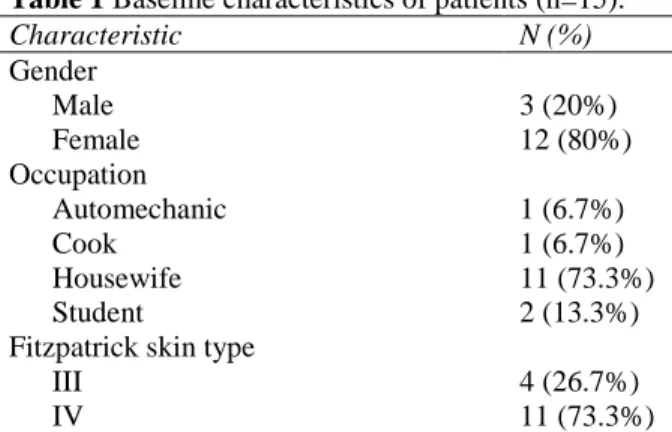
Twenty patients were included in the therapeutic trial. Five patients lost to follow-up. Fifteen patients completed study i.e. a total of 5 sessions done fortnightly. Among the fifteen patients there were 12 (80%) females and 3 (20%) male patients. The mean age of the patient was
28.2
±6.19 year with minimum age of 21 year and maximum age was 42 years. The enrolled patients of mixed melasma belong to Fitzpatrick skin type III and IV. The other demographicfeatures are shown in Table 1.
Among fifteen patients, no patient (0%) showed excellent response, 2 (13.3%) patients showed good response, 9 (60%) patients showed fair
response and 4 (26.7%) patients showed poor
response (Table 2). Overall efficacy of
treatment was 13.3%.
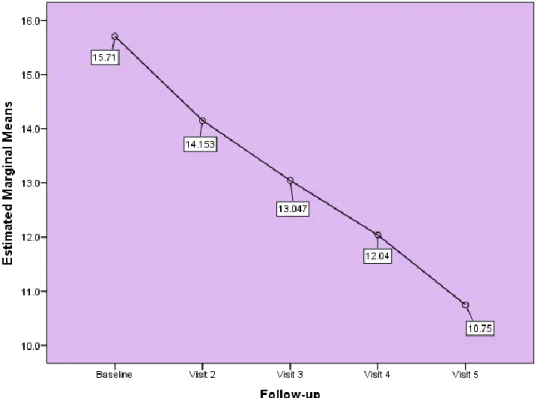
A progressive reduction in the mean MASI was seen (Figure 1). The mean score decreased from 15.71±6.81 at baseline to 4.98±2.13 at end of study (p=0.0000).
No serious or persistent side effect was noted during the course of study except for temporary mild (barely visible) erythema at the time of injecting the two patients.
Discussion
The role of PRP was introduced by M. Ferrari in 1897.6 Since then its role is defined in various fields ranging from sports medicine, orthopedics, dentistry, otolaryngology, neurosurgery, ophthalmology, urology and dermatology. It is gaining popularity because of it autologous nature. It is an emerging area of interest in aesthetic medicine because of its role in enhancing dermal elasticity.7 Now for past few years, researchers are trying to define its role in pigmentary disorder because they
Table 1 Baseline characteristics of patients (n=15).
Characteristic N (%)
Gender Male Female
3 (20%) 12 (80%) Occupation
Automechanic Cook
Housewife Student
1 (6.7%) 1 (6.7%) 11 (73.3%) 2 (13.3%) Fitzpatrick skin type
III IV
4 (26.7%) 11 (73.3%)
Table 2 Grades of efficacy of treatment based on decrease in MASI score (n=15).
Grades of efficacy N (%)
Poor (0-25% decrease) 4 (26.7)
Fair (26-50% decrease) 9 (60)
Figure 1 Decrease inMASI score during follow-up observed that application of PRP reduces postinflammatory hyperpigmentation when it is used to treat other skin conditions.8,9 In this therapeutic trial five sessions of PRP were done 2 weeks apart. Results were assessed on the basis of % reduction in baseline MASI score and digital photography. Two (13%) patients showed good response nine (60%) patients showed fair response, four (26%) patients showed poor response. As in our study 13% patients showed good response and 60% showed fair response, therefore we can say that PRP might have a role in halting the process of melanogenesis, but its efficacy is limited in patients of Asian origin. In our study we found that initial baseline MASI score was reduced in almost every patient but in successive sessions some patient did not show sustained response. In our patients along with decrease in pigmentation the facial tightening effect was also noted which can be explained on the basis of PRP role in improving dermal elasticity. PRP procedure is an organically based therapy that is safe and natural alternative to surgery. PRP improves dermal elasticity by
enhancing the removal of ultraviolet radiation damaged extracellular matrix (ECM) components and promotes new collagen synthesis by dermal fibroblasts.10 Till now only transforming growth factor beta 1 (TGF-ß1) and epidermal growth factor (EGF) have been investigated to have a role in melanogenesis.11,12,13 Among them TGF-ß1 inhibits melanin synthesis via delayed extracellular signal related kinase activation while EGF lowers melanin production in melanocytes by inhibiting prostaglandin E2 (PGE2) expression and tyrosinase enzyme activity.
showed moderate improvement in dark circles assessed by digital photographs. Another case report from Malaysia showed variable results in two cases of refractory dermal melasma. PRP sessions were injected at monthly interval for two sessions in combination with monthly Q-switched Nd-YAG laser and topical alpha arbutin application.15
Aforementioned data was based on small sample size. In the Malaysian study PRP was used as an adjuvant with Q-switched Nd-YAG laser and alpha arbutin therapy, therefore the results are not true representative of efficacy of PRP in melasma.
The difference in response in our study could also be explained on the basis of the fact that patient of our population are noncompliant to the regular use of sunblock because of poor socioeconomic background. Majority are field workers and belong to Fitzpatrick skin type III, IV, V. Another factor unique in our study was that all of our study group patients suffered from mixed type of melasma which is generally resistant to all kind of therapies. As the result pattern in our study showed that there was decrease in MASI score in majority patients (up to 60%) but was not reduced to the point of effective value, this could be explained due to limited sessions of PRP, if we increase the PRP sessions, we may achieve effective results. As the sample size was small, therefore larger sample size with increased number of PRP sessions in melasma are required to prove the efficacy of PRP in melasma. We recommend that PRP may be used as an adjuvant therapy as it has role in inhibiting melanogenesis, enhancing angiogenesis and dermal elasticity, however as a monotherapy results are not very impressive.
To our knowledge, this study is the first therapeutic trial done on patients of melasma
having Asian skin conducted in a tertiary care hospital, therefore result of this study are better representative of the actual role of this novel treatment modality for the challenging cases of melasma.
Conclusion
PRP may prove to be a promising adjuvant therapy for resistant cases of melasma. However clinical trials with larger sample size are needed.
References
1. Salim A, Rengifo-Pardo M, Vincent M. Melasma. In: Williams HC, Bigby M, editors. Evidence Based Dermatology. 2nd edn. London: Blackwell Publishing; 2008. P. 497-510.
2. Lapeere H, Boone B, Schepper SD. Hypomelanoses and hypermelanoses. In: Wolff K, Goldsmith LA, Katz SI, editors. Fitzpatrick’s Dermatology in General Medicine. 7th edn. Philadelphia: McGraw-Hill; 2008. P.622-40.
3. Eppley BL, Pietrzak WS, Blanton M. Platelet-rich plasma: a review of biology and applications in plastic surgery. Plast Reconstr Surg. 2006;118:147e-159e. 4. Kim D, Park S, Park K. Transforming
growth factor-β1 decreases melanin synthesis via delayed extracellular signal-regulated kinase activation. Int J Biochem Cell Biol. 2004;36:1482-91.
5. Yun WJ, Bang SH, Min KH, Kim SW, Lee MW, Chang SE. Epidermal growth factor and epidermal growth factor signaling attenuate laser-induced melanogenesis. Dermatol Surg. 2013;39:1903-11.
6. Ferrari M, Zia S, Valbonesi M, Henriquet F, Venere G, Spagnolo S et al. A new technique for hemodilution, preparation of autologous platelet-rich plasma and intraoperative blood salvage in cardiac surgery. Int J Artif Organs. 1987;10:47-50. 7. Cho J, Kim S, Lee K. Platelet-rich plasma
induces increased expression of G1 cell cycle regulators, type I collagen, and matrix metalloproteinase-1 in human skin fibroblasts. Int J Mol Med. 2012;29:32-6. 8. Lacz N, Vafaie J, Kihiczak N, Schwartz R.
common but troubling condition. Int J Dermatol. 2004;43:362-5.
9. Domínguez E, Muñozledo F, Harcuch W. Growth factors and extracellular matrix proteins during wound healing promoted with frozen cultured sheets of human epidermal keratinocytes. Cell Tissue Res. 2002;307:79-89.
10. Shin K, Lee J, Lee S, Kim N. Platelet rich plasma combined with fractional laser therapy for skin rejuvenation. Dermatol Surg. 2012;38:623-30.
11. Solano F, Briganti S, Picardo M, Ghanem G. Hypopigmenting agents: An updated review on biological, chemical and clinical aspects. Pigment Cell Res. 2006;90:550-71.
12. Yang G, Li Y, Nishimura E, Xin H, Zhou A, Guo Y et al. Inhibition of PAX3 by TGF-β
modulates melanocyte viability. Mol Cell. 2008;32:554-63.
13. Cayirli M, Ercan C, Acikgoz G, Erbil A, Erturk G. Regression of melasma with platelet rich plasma treatment. Ann Dermatol. 2014;26:401-2.
14. Al-Shami S. Treatment of periorbital hyperpigmentation using platelet rich plasma injections. Am J Dermatol Venereol. 2014;3(5):87-94.
15. Yew C, Ramasamy T, Amini F. Response to intradermal autologous platelet rich plasma injection in refractory dermal melasma: Report of two cases. Available on