228
PRELIMINARY STUDIES ON MAINTAINING THE BIODIVERSITY OF
MEDICINAL PLANTS WITHIN NIRDPSB BRASOV
Nițu Sorina, Ștefan Floriana Maria, Chelmea Carmen, Hermeziu Manuela National Institute of Research and Development for Potato and Sugar Beet Brasov, Fundăturii 2, Brașov,
Romania; e-mail: [email protected]
Keywords: medicinal plants, spontaneous flora, introduction into crop, crop technology
ABSTRACT
The researches are carried out at NIRDPSB Brasov and are developed in the research project ADER 2.4.1., in the period 2015-2018.
The overall objective of this studies is to introduce in crop some valuable medicinal species from local spontaneous flora.
The researches started by collecting information on existing genetic resources and seed harvesting from spontaneous flora and aimed at enriching and preservation of the genetic resources collection from NIRDPSB Brasov.
It was followed the establishment of multiplication way, the seed norm/ha, the sowing time, optimal nutrition space at Malva sylvestris L. species and also the production of seed material of superior biological categories. These technological links have influence on the production of vegetable raw material and also on the content in active principles.
INTRODUCTION
Humans have developed a broad knowledge of useful plants over time through continuous contact with their environment (Tabaraki,2012). At present, there is an increasing interest both in industry and scientific research in vegetables, fruits, medicinal plants and spices because of their antioxidative phytochemicals and antimicrobial properties.
The use of medicinal plants by a traditional community, both in the simplest forms such as tea and in the sophisticated manufacturing industry, transforming them into tablets, drops or capsules with the isolated active principle, is motivated by properties to generate beneficial reactions to the body (Lorenzi, 2008).
Malva sylvestris L. (Malvaceae) is a biennial–perennial herbaceous plant distributed mainly in Europe, North Africa and South-West Asia, and its traditional use has been documented since a long-time ago (Razavi, 2011; Gunjeet Kumar, 2014). M. sylvestris is an important medicinal plant which shows a wide range of biological activities; the plant exhibits antioxidant, anti-inflammatory, anticancer, wound healing, hepatoprotective, antinociceptive and antimicrobial activities (Dipak, 2016). Moreover, its use is not only limited to therapeutic purposes; the species is also locally regarded as a food wild herb (Barros, 2010; Arabaci, 2013).
Reference information on this plant are directed towards the study of taxonomy, anatomy-morphological characteristics and functional-curative properties of the plant. Thus, in the present work we intend to reach a less scientific known topic, namely, introducing into crop from the spontaneous flora and cropping technology of the Malva sylvestris L. species.
MATERIAL AND METHOD
229
drawn so that we can determine the optimum sowing time and the optimal nutrition space of the plant.
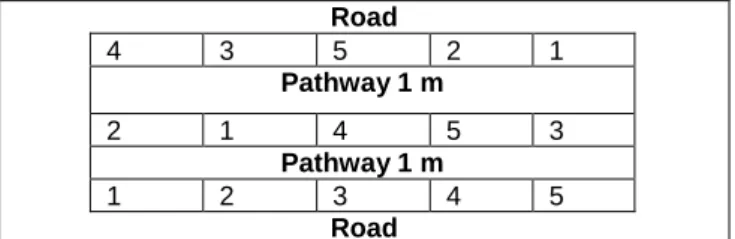
Thus, to determine the optimum sowing time was set up a single factor experience of five variants (three repetitions) (Figure 1), the first two were sown in autumn and variants V3-V5 in the spring, function of climatic conditions.
Single factor experience:
V3 - sowed in the urgency I, late March to early April
V4 - sowed in the urgency II, the second decade of April to the third decade of April V5 - sowed in the last decade of April - early May.
A - distance between rows with graduations: 50 cm;
B - distance between plants on row: 25 cm; C - repetition length: 500 cm;
Road
4 3 5 2 1
Pathway 1 m
2 1 4 5 3
Pathway 1 m
1 2 3 4 5
Road
Figure 1. The sketch of experiences to determine the optimum sowing time
In order to determine the optimal nutrition space of the plant was established a bifactorial experience of nine variants in three repetitions (Figure 2) as follows:
Bifactorial experience:
A - distance between rows with graduations: 25 cm, 50 cm; 70 cm;
B - distance between plants on row with the graduations: continuous line; 15 cm; 25 cm; C - repetition length: 200 cm;
Road
3 1 2 6 4 5 9 7 8
Pathway 1 m
2 3 1 5 6 4 8 9 7
Pathway 1 m
1 2 3 4 5 6 7 8 9
Road
Figure 2. The sketch of experiences to determine the optimal nutrition space of the plant
At each variant/repetition was determined the number of plants/ha, was evaluated plant height, number of ramifications, the total weight of the plant (stems, leaves, flowers), was established production of fresh and dry herb and rate of seed / ha. Results were subjected to statistical analysis.
RESULTS AND DISCUSSIONS
To determine the optimum sowing time was established in autumn 2015 a single factor experience, with 50 cm between rows and 25 cm between plants / row, 2 variants (V1 and V2) of 3 repetitions, with a length of repetition of 500 cm. Variants V3, V4, V5 were sown in the spring of 2016 at different intervals of time (Figure 1).
230
a b
c d
c d
Photo 1 a,b,c,d. Malva sylvestris L. species from crop establishment to herb harvest
As shown in Table 1, were made measurements on plant height, the results are different on variants/repetitions with values ranging from 94 cm (V5R1) to 145 cm (V3R2) and measurements concerning the number of ramifications of each plant, number between 10 (V5R1) and 25 (V3R3) ramifications/plant.
Plant weight fluctuated between variants, having values between 458 g (V5R1) and 838 g (V3R3). Based on the weight of the plant, the stem represents 51.1 to 57.4% of total plant, leaves from 25.7 to 40.0% of the plant and the flowers are 7.3 to 19.7% of the plant, different depending on the variant/repetition.
The amount of fresh or dried herb assured distinct productions depending on the variant/repetition. The best variant was V3, which conducted a production of fresh herb between 29.200- 32.800 kg/ha and a production of dry herb of 5300-5930 kg/ha.
Biometric measurements for determining the optimal time of sowing
Table 1
To establish the optimal nutrition space, it was established a bifactorial experience with the distance between rows 25, 50 and 70 cm, between plants/row of 15 cm, 25 cm and a continuous row, in three randomized repetitions with a repetition length of 200 cm (Figure 2). The number of plants/ha was between 57-600 thousand plants/ha, depending on the variant (Table 2).
Var. No.
Plant height
(cm)
Ramifications number
Plant weight
(g)
Stem weight
(g)
Leaves weight
(g)
Flowers weight
(g)
Fresh herb production (kg/ha)
Dry herb production
(kg/ha)
% from plant weight
% from plant weight
% from plant weight
231
The number of plants / ha depending on the variation
Table 2
From the data presented in Table 3 we can see that the plants had a height between 133 cm (V1R3) and 170 cm (V5R1), with a number of ramifications between 12 (V7R3) and 23 (V6R1, V3R3, V8R3) of ramifications. The weight of the plant, it had different values depending on the variant/repetition and reached values between 234 g (V2R3) and 1162 g (V9R3). Percentage share of the stem was 39.8 to 70.5% of total plant, the leaves of the plant were 20.2 to 42.7% and from 2.4 to 18.8% of the plant were flowers.
Biometric measurements for determining optimal nutrition space
Table 3
Variant The number of plants
(thousand) / ha
V1 ( continuous row -25 between rows ) 600
V2 (15 cm between plants/row -25 cm between rows) 280
V3 (25 cm between plants/row -25 cm between rows ) 160
V4 ( continuous row -50 cm between rows ) 300
V5 (15 cm between plants/row -50 cm between rows) 140
V6 (25 cm between plants/row -50 cm between rows ) 80
V7 (continuous row-70 cm between rows ) 215
V8 (15 cm between plants/row -70 cm between rows) 100
V9 (25 cm between plants/row -70 cm between rows ) 57
Var. No. Plant height (cm) Ramifications number Plant weight (g) Stem weight (g) Leaves weight (g) Flowers weight (g) Fresh herb production (kg/ha) Dry herb production (kg/ha) % from plant weight % from plant weight
% from plant weight
232
Statistical evaluation within variants on the production of fresh herb (kg / ha)
Table 4
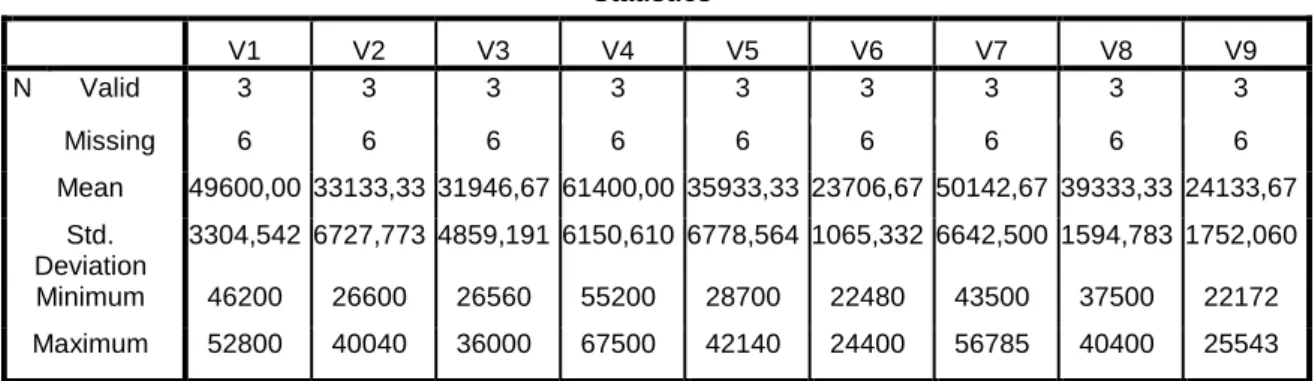
In Table 4 was performed the statistical interpretation of the fresh herb within each variant, as shown the productions from Table 3.
The standard deviation was calculated (the value deviating from calculated average of average population from which has been extracted the batch on which the measurements were made) and the amplitude of each variant (minimum and maximum production in the variant).
At the same time, we evaluated statistically also between variations the production of fresh herb (Table 5).
Statistical evaluation between variants on the production of fresh herb (kg/ha)
Table 5
Statistics
The production of fresh herb (kg/ha)
N Valid 9
Missing 0
Mean 38814,4078
Median 35933,3300
Std. Deviation 12681,41189
Minimum 23706,67
Maximum 61400,00
The average between variations is 38814.41 kg/ha, four variants have higher production 35933.33 kg/ha, and four smaller, standard deviation of 12661.41, maximum and minimum production on variants being 61400 kg/ha, respectively 23707 kg/ha.
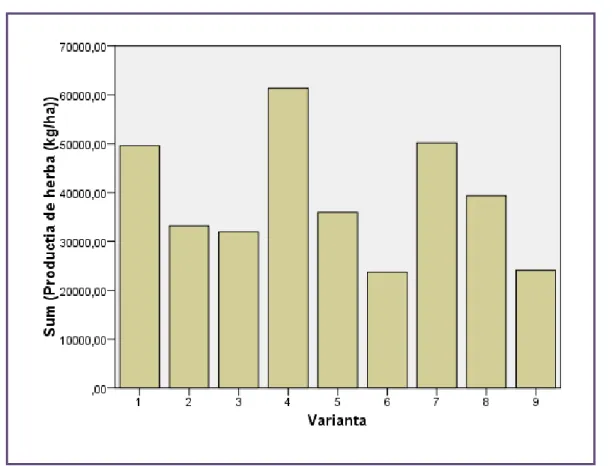
To interpret which variant was better and determine optimal nutrition space needed to Malva sylvestris L. grow efficient, in Figure 3 we determined according to the production of fresh herb (kg/ha), the productions diagram between the established variants. Thus, the chart shows that the variant 4 was the best, namely, continuous row and 50 cm between rows and ensured the variant 9 weakest production (70 cm between rows-25 cm between plants/row). From the above, we can infer that the large distance between rows and between plants on the row has led to lower production herb/ha.
Statistics
V1 V2 V3 V4 V5 V6 V7 V8 V9
N Valid 3 3 3 3 3 3 3 3 3
Missing 6 6 6 6 6 6 6 6 6
Mean 49600,00 33133,33 31946,67 61400,00 35933,33 23706,67 50142,67 39333,33 24133,67
Std. Deviation
3304,542 6727,773 4859,191 6150,610 6778,564 1065,332 6642,500 1594,783 1752,060
Minimum 46200 26600 26560 55200 28700 22480 43500 37500 22172
233
Figure 3. Production of fresh herb between the variants established (kg / ha)
After calculating the MMB (1000 grain weight), depending on experience, respectively, to determine the optimal time of sowing and determination of optimal nutrition space, was established norm of seed/ha. According to calculation, the 1000 grain weight measurements revealed that the value of MMB is 6.8. At the single factor experience (50 cm between rows-25 cm between plants/row) where we watched optimum time sowing the norm seed/ha is 0.544 kg / ha. At the second trial, which was targeted optimal nutrition space, norm seed/ha depending on the variants differ, as shown in Table 6. The biggest norm of seed /ha is required for V1 (4.080 kg) and the lowest seed norm is needed to V9 (0.388 kg).
Setting the norm seed/ha
Table 6
In terms of favorability for harvest period, both experiences, in terms of NIRDPSB Brasov recommending the optimal time to harvest the last decade of July.
Variant The norm seed/ha (kg)
V1 4,080
V2 1,904
V3 1,088
V4 2,040
V5 0,952
V6 0,544
V7 1,457
V8 0,680
234
CONCLUSIONS
1. Species Malva sylvestris L., a species of wild flora with special therapeutic properties may be introduced in crop.
2. Generative propagation method gives good results at NIRDPSB Brasov in terms of compliance the period of end of March-beginning of April, as the optimum sowing time. 3. The optimal nutrition space necessary for the harmonious development of the plant is differently depending on the scheme of crop established, also norm seed/ha. 4. As a cropped plant provides higher herb/ha productions in terms of technology applied judiciously.
ACKNOWLEDGMENTS
This work was supported by the project ADER 2.4.1. „Menţinerea biodiversităţii la plantele medicinale şi aromatice prin conservarea şi îmbogăţirea colecţiei de resurse genetice şi producerea de sămânţă din categoriile biologice superioare pentru speciile reprezentative zonei de deal şi de munte”(contractor: SCDA Secuieni), where NIRDPSB Brasov is partner.
REFERENCES
1. Arabaci G. and Usluoglu A.. „Catalytic Properties and Immobilization Studies of
Catalase from Malva sylvestris L.”, Hindawi Publishing Corporation, Journal of Chemistry, Volume 2013
2. Barros L, Carvalho AM, Ferreira IC. „Leaves, flowers, immature fruits and leafy
flowered stems of Malva sylvestris: A comparative study of the nutraceutical potential and composition” Food Chem Toxicol 2010;48(6):1466-72
3. Dipak Paul. „A review on biological activities of common mallow (Malva
Sylvestris L.)”, Innovare Journal of Life Science, Vol 4, Issue 5, 2016
4. Gunjeet Kumar, Ganesh Kadam, Tarak NathSaha, Ramesh Kumar „Studies
on floral biology of Malva sylvestris L.”, Indian Journal of Horticulture 17(02):295 – 297, 2014
5. Lorenzi H. „Plantas medicinais no Brasil - Nativas e Exóticas”, 2ª Edição. Nova
Odessa: Editora Plantarum, 2008
6. Reza Tabaraki, Zeynab Yosefi, Hossein Ali, Asadi Gharneh. „Chemical
Composition and Antioxidant Properties of Malva sylvestris L.”, Journal of Research in Agricultural Science, Vol. 8, No. 1 (2012), Pages: 59 – 68
7. Seyed Mehdi Razavi, Gholamreza Zarrini, Ghader Molavi, Ghader Ghasemi.