Finite Element Study of Behavior of Sandwich Beam Under Static And
Dynamic Conditions
Nagasuryanarayana P#1, J Suresh#2, P.Satish Reddy#3, N.Guru Murthy#4 PG Scholar,Asst. Prof., Assoc.Prof.,Asst. Prof.
ME Department, Prasiddha College of Engg and Technology, Anathavaram 1
[email protected],[email protected],[email protected],[email protected]
Abstract- Sandwich Beams are broadly utilized in the development of aviation, common, marine, car and other elite structures because of their high explicit firmness and quality, phenomenal weariness opposition, long toughness and numerous other better properties thought about than the regular metallic materials.
Sandwich shafts are composite frameworks having high solidness to-weight and Strength-to-weight proportions and are utilized as light Strength-to-weight burden bearing parts. The utilization of flimsy, solid skin sheets clung to thicker, lightweight center materials has enabled industry to construct solid, firm, light, and strong structures. Because of the utilization of viscoelastic polymer constituents, sandwich shafts can show time-subordinate conduct. This investigation looks at the conduct of sandwich bars driven by the viscoelastic elastic center. Limited component (FE) strategy is utilized to break down the general transient reactions, symphonious reactions and the static reactions of the sandwich frameworks subject to a gathered point load at the mid range of the pillar.
In this examination the skin, i.e; the top and base layers are comprised of mellow steel while the center is comprised of elastic. The pressure, strain, and twisting fields are broke down. The center thickness is differed keeping the skin thickness consistent and the conduct of the sandwich bar is considered under static and dynamic conditions.
In this proposition static and dynamic investigation of sandwich shafts with various center thickness under essentially bolstered condition is considered. Parametric investigations demonstrate that the variety of center thickness significantly affects the common frequencies and mode shapes and greatest redirections.
Keywords- Sandwich beam, viscoelastic, deformation fields, harmonic and the static responses
I. Introduction
A sandwich organized composite is an exceptional class of composite materials that is manufactured by appending two flimsy yet hardened skins to a light weight however thick center. The center material is typically low quality material, however its higher thickness furnished the sandwich composite with high twisting firmness with by and large low thickness. Open and closes cell organized froths like polyvinylchloride, polyurethane, polyethylene or polystyrene froths, and honeycombs are usually utilized center materials.
as light weight burden bearing segments. Elastic and compressive burdens are chiefly conveyed by the skins, while transverse shear stresses are transcendently experienced by the center. Regularly, materials, for example, steel and aluminum sheets are utilized for the skins. The fundamental capacity of the center is to expand the flexural unbending nature of the sandwich bar, limiting transverse twisting. Honeycombs, froths, and folded centers made of polymers or metals are regularly utilized.
Sandwich structures can be broadly utilized in sandwich boards; these sorts of boards can be in various kinds, for example, FRP sandwich board, aluminum composite board and so forth. FRP polyester fortified composite honeycomb board (sandwich board) is made of polyester strengthened plastic, multi-pivotal high-quality glass fiber and PP honeycomb board in exceptional antiskid track example form through the procedure of steady temperature vacuum adsorption and agglutination and cementing.
Because of the utilization of polymer constituents, sandwich bars can show time subordinate conduct. Visco versatility is the investigation of time-subordinate materials demonstrating a consolidated flexible strong and thick liquid conduct when exposed to outside mechanical loadings. The reaction of viscoelastic materials is resolved not just by the present condition of the heap, yet additionally by the historical backdrop of the stacking.
II. Modelling of Sandwich beam
A sandwich beam whose core thickness is varied is modeled using ANSYS. The specifications of the beam are as follows:
DIMENSIONS OF THE BEAM a=0.02m…… thickness of the skin
w=0.2m…….width of the beam P=5000N…… load acting on the beam l=1m………...length of the beam
Dimension of core varies.
Fig-1.1 Dimensions of Beam Table-1: Variation of core thickness
Condition Thickness(m)
1 0.01
2 0.015
3 0.02
4 0.025
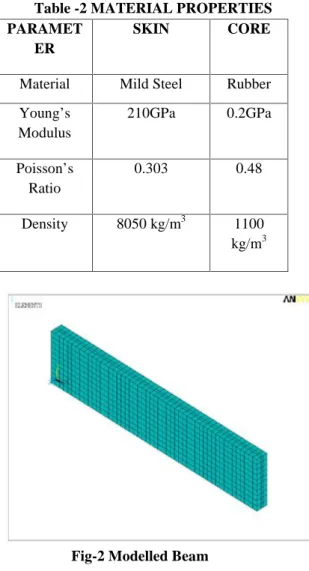
Table -2 MATERIAL PROPERTIES PARAMET
ER
SKIN CORE
Material Mild Steel Rubber
Young’s
Modulus
210GPa 0.2GPa
Poisson’s
Ratio
0.303 0.48
Density 8050 kg/m3 1100 kg/m3
Fig-2 Modelled Beam
III.Static Analysis
Fig-3 Von Misses Stress for 0.01m thick
Fig-4 Von Misses Stress for 0.015m thick
Fig-5 Von Misses Stress for 0.02 m thick
Fig-7 Von Misses Stress for 0.03 m thick
Variation of Deflection and stress with thickness
Thickness (m) Deformation Stress(Pa)
0.01 0.0024 0.912e7
0.015 0.00186 0.810e7
0.02 0.00146 0.725e7
0.025 0.00118 0.654e7
0.03 0.00097 0.596e7
Fig-8: graph between deflection and core thickness
Fig-9 Graph between Vonmisses stress
From this we can note that the deflection is decreasing with that of the core thickness. It is the same as in case of the stress also. This decrease will continue in the same fashion as the skin thickness is constant. When the value of the skin changes then an optimum value could be found out.
IV Modal Analysis
Six Mode shapes are considered and modal analysis is done for every thickness value.The following are the mode shapes for the thickness value of 0.02m
Fig-11: Fifth Mode Shape Modal Frequencies
Mod e shap
e 0.01m
0.015
m 0.02m
0.025
m 0.03m
1
39.98
7 45.41 50.88 56.54
61.42 9
2
158.5
4 179.35 199.8 219.76
239.1 5
3
240.8
5 262.75 260.6 258.62
256.6 2
4
264.9
8 267.70
292.9
6 316.54
338.4 2
5
351.2
1 394.96
437.1
2 477.38
515.5 8
6
494.8
9 548.86
598.9
0 594.21
589.6 2
V Harmonic Analysis
Fig-12 First mode frequency for beam with core thickness 0.01m
Fig-13 first mode frequency for beam with core thickness 0.025m
Fig-14 graph for harmonic analysis for core thickness 0.025m
Fig-15 graph for harmonic analysis for core thickness 0.03m
to a certain frequency value and then decreases gradually. Hence we can calculate an optimal value where the amplitude may not reach very high and also the fundamental frequency could be found out.
VII CONCLUSIONS AND FUTURE SCOPE Conclusions
The accompanying ends are drawn from the present work:
Analysed the sandwich shaft and watched different parameters for fluctuating thickness.
It is seen from the outcomes that the crucial recurrence increments as the center thickness expands which suggests that the regular recurrence likewise increments as the center thickness increments.
By this examination we can decide the recurrence at which vibrations are most extreme and abstain from working the framework at that recurrence and work it at different frequencies.
Future Scope
Examination can be done on various materials with various stacking groupings and limit conditions and fluctuating center and skin thickness. Further examination should be possible for forecast of delamination stress. The skin thickness can likewise be shifted alongside that of the center thickness and relations could be discovered.
VIII REFERENCES
[1] Project thesis of Roberts Tompkins submitted to TAMU University- Visco elastic analysis of Sandwich beam having Aluminum and Fiber reinforced polymer skins with polystyrene foam core-December 2009
[2] Y. Swathi and Sd Abdul Kalam, “Sandwich
Treatment in FRP beams: Static and Dynamic
Response”. IJERT, vol1 9,2012,pp 2-5.
[3] Noor AK and Burton WS, “Stress and free
vibration analysis of multilayered composite panels”
[4] Frostig Y, Baruch M, Vinley O and Sheinman I,
“High order theory for sandwich beam behaviour with transversely flexible core”, J Eng Mech, vol 1
18, 1992, pp1026-1043.
[5]Kant T and Swaminathan K, “Analytical solutions
for the static analysis of laminated composite and sandwich plates based on a higher order refined
theory”, Compos Structures, vol56, 2002, pp. 329 -344.
[6]Pandit MK, Sheikh AH and Singh BN, “ Analysis
of laminated sandwich plates based on improved
higher order zig zag theory”, J Sandwich Struct
Mater, Vol 12 2010, pp.307-326.
[7] K.Malekzadeh, M. R. Khalili and R.K. Mittal,
“Local and Global Damped Vibrations of Plates with
a viscoelastic soft flexible core: An improved high
order approach” , Journal of sandwich structures and