Journal of Global Pharma Technology
Available Online at: www.jgpt.co.in
RESEARCH ARTICLE
Microwave Vacuum Drying Variables Affecting to Processing of
Dried
Gomphrena globosa
Floral
Nguyen Phuoc Minh
Faculty of Natural Sciences, Thu Dau Mot University, Binh Duong Province, Vietnam.
Abstract
Microwave vacuum drying is one of the most energy demanding processes. Water evaporation takes place at lower temperatures under vacuum, and hence the product processing temperature can be significantly lower, offering higher product quality. Gomphrena globosa is one of the traditional medicinal plants widely distributed in Vietnam. It’s considered as a valuable source for pharmaceuticals against various ailments. Gomphrena globosa L. flowers are a promising source of natural antioxidants. Objective of this study focused on the influence of processing parameters such as the microwave power (100, 150, 200, 250, 300 W), system pressure (20, 25, 30, 35, 40 kPa) and drying time (15, 20, 25, 30, 35 min) on shrinkage coefficient, rehydration ratio, color change, total phenolic, flavonoid, betacyanin of dried herbal during the microwave vacuum (MV) drying of Gomphrena globosa. At the end of drying process, we also monitored the stability of dried Gomphrena globosa flower during 12 months of preservation. Our results showed that the optimal drying process should be conducted at microwave power 250 W at 35 kPa within 30 min to get the best quality of dried Gomphrena globosa flower. From this approach, shelf-life of dried
Gomphrena globosa flower could be last for 12 months without any deterioration. The low temperature and fast mass transfer conferred by vacuum combined with rapid energy transfer by microwave heating generates very rapid, low temperature drying and thus it has the potential to improve energy efficiency and product quality.
Keywords: Gomphrena globosa, microwave vacuum drying, Shrinkage coefficient, Rehydration ratio, Color change, Total phenolic, Flavonoid, Betacyanin.
Introduction
Drying is a suitable alternative for postharvest management especially for countries with poorly established low temperature distribution and handling facilities [1]. During drying, the moisture content is reduced to a certain level where microbiological growth will not occur while maintaining high nutrient value. Medicinal and aromatic plants are mainly preserved by air drying. Dried products can be stored for a long time and can be easily blended, powdered or packed for direct use or for
further processing in the food or
pharmaceutical industry [2].
The use of vacuum in the microwave drying process could be of interest especially for thermo-labile products [3]. In microwave drying, when the material couples with microwave energy, heat is generated within the product through molecular excitation. The critical next step is to immediately remove the water vapour [1].
The use of vacuum lowers the solvent boiling temperature, permitting operation at lower temperatures, directly influencing final product quality [4]. Average temperature during microwave vacuum process is slightly lower than during microwave convective one, which is expected, because during the microwave convective drying additional thermal energy was brought with hot-air [5]. Microwave vacuum drying has been
successfully applied to many fruits,
vegetables and other heat sensitive foods.
Vacuum-dried materials are characterized by better quality retention of nutrients and volatile aroma [6]. Microwave vacuum drying is a promising, rapid, and efficient dehydration method, which yields improved product appearance and quality compared to conventionally dried products [7, 14].
dark red-purple, white or pink in colour [15].
Gomphrena globosa commonly known as glove amaranth is an annual branched herb which is cultivated as ornamental flowering herb in garden [16].
It has been used for oliguria, heat and empacho, hypertension, cough and diabetes and expectorant for animals [17, 18]. The phytochemical components presented of flavonoids, saponins, alkaloids, reducing
sugars and coumarins [19]. Gomphrena
globosa flowers included the presence of epidermal cells, scalariform xylem vessels, medullary rays, lignified fibers, oil globules, crystals of calcium oxalate, tracheids and uniseriate multicellular trichome [20].
The major betacyanins identified in Globe Amaranth are gomphrenin, isogomphrenin II
and isogomphrenin III [15]. Gomphrena
globosa have been screened for pharmacological activities and reported to possess central and peripheral analgesic [21], anti-inflammatory [22], hypoglycemic [23], antihypertensive [19], anticancer [24], antimicrobial, antioxidant and cytotoxic activity [25].Dry flowers are economically important because fresh flowers are short lived and will retain only for few days or week while dry material will last indefinitely [26]. Drying flowers is an exotic physical process with the unique ability to preserve a life appearance and colour in beautiful blooms [27].
There were not many studies mentioned to
drying of Gomphrena globosa. An
investigation was carried out to standardize the medium and temperature for drying of
Gomphrena globosa L. They were dried in silica gel and mixture of sand and silica gel for 3, 4 and 5 min. in microwave oven with 24, 48 and 72 h setting durations [28].
Therefore, objective of this our study focused on the effectiveness of processing variables such as the microwave power, system pressure and drying time on shrinkage coefficient, rehydration ratio, color change, total phenolic, flavonoid, betacyanin of dried herbal flower during the microwave vacuum
(MV) drying of Gomphrena globosa
Materials and Method
MaterialGomphrena globosa flowers were collected from Soc Trang province, Vietnam. After
collecting, they must be kept in cool and dry cotton box, conveyed to laboratory for experiments. They were subjected to the microwave vacuum drying under different conditions.
Researching Procedure
Effect of Microwave Power in drying to the Quality of Dried Gomphrena globosa Flower
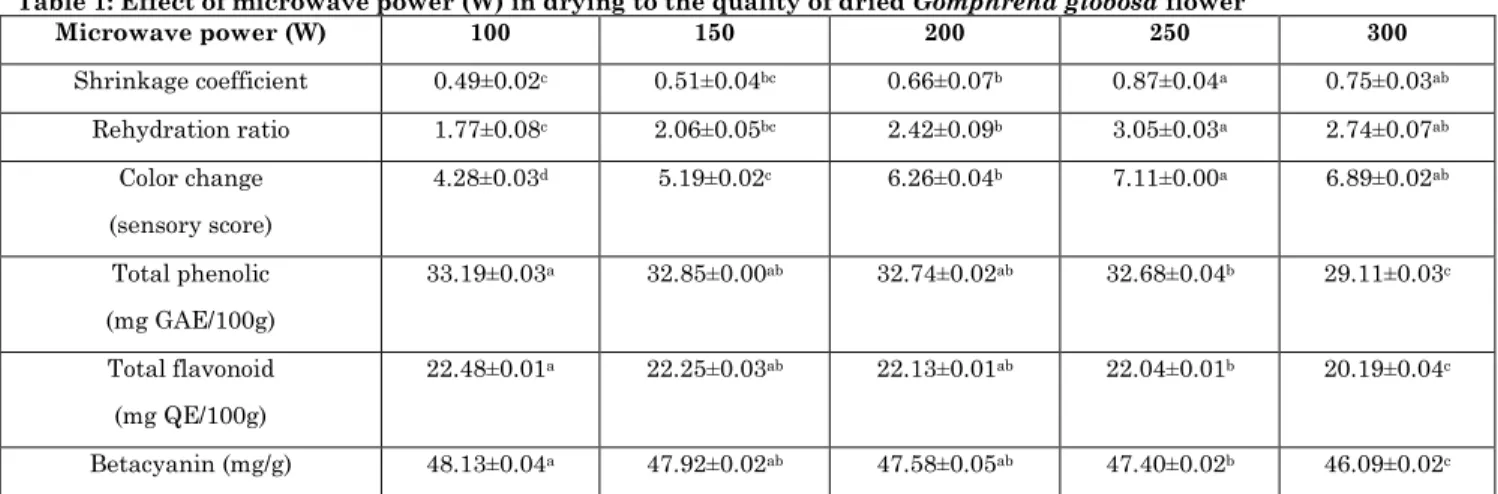
Raw Gomphrena globosa flower were dried under various microwave power (100, 150, 200, 250, 300 W) by the same system pressure (20 kPa) and drying time (15 min). At the end of drying process, all samples were analyzed the shrinkage coefficient, rehydration ratio, color change, total phenolic (mg GAE/100 g), flavonoid (mg QE/100 g), betacyanin (mg/g) to validate the appropriate microwave power condition.
Effect of System Pressure in drying to the Quality of Dried Gomphrena globosa Flower
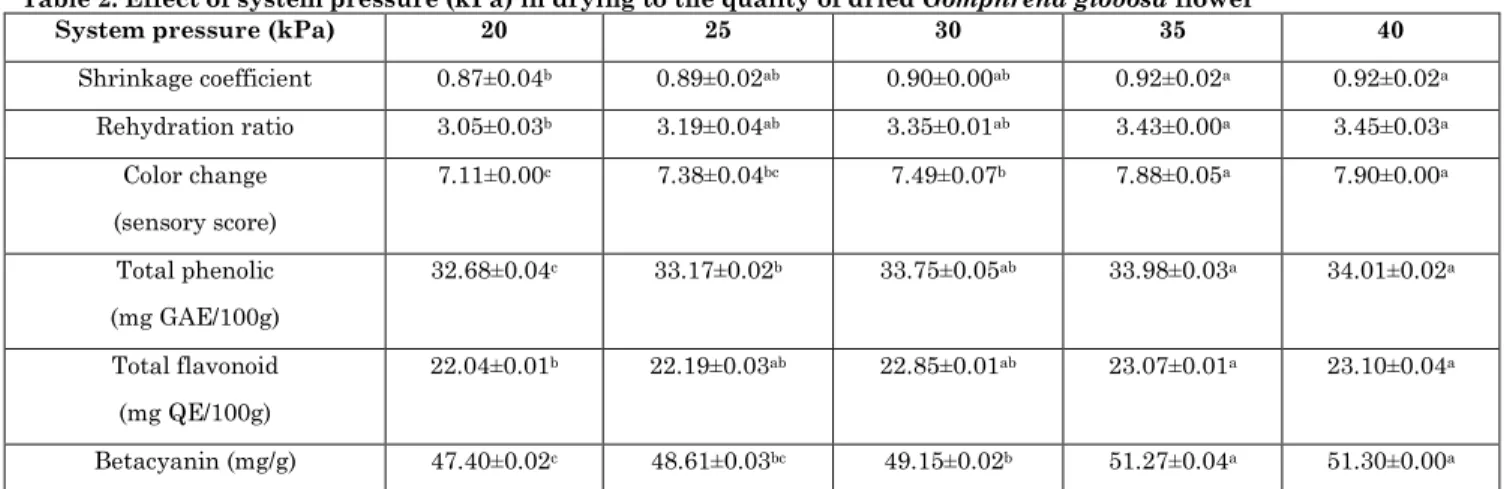
Raw Gomphrena globosa flower were dried under microwave power (250 W) by the different system pressure (20, 25, 30, 35, 40 kPa) and drying time (15 min). At the end of drying process, all samples were analyzed the shrinkage coefficient, rehydration ratio, color change, total phenolic (mg GAE/100 g), flavonoid (mg QE/100 g), betacyanin (mg/g) to validate the appropriate system pressure condition
Effect of drying Time in drying to the Quality of Dried Gomphrena Globosa Flower
Raw Gomphrena globosa flower were dried under microwave power (250 W) by the system pressure (35 kPa) and different drying time (15, 20, 25, 30, 35 min). At the end of drying process, all samples were
analyzed the shrinkage coefficient,
rehydration ratio, color change, total phenolic (mg GAE/100 g), flavonoid (mg QE/100 g), betacyanin (mg/g) to validate the appropriate drying time condition
Stability of Dried Gomphrena globosa Flower under Storage
After drying treatment, the dried Gomphrena
The shrinkage coefficient, rehydration ratio, color change, total phenolic (mg GAE/100 g), flavonoid (mg QE/100 g), betacyanin (mg/g) will be evaluated in 12 months by 3 month-interval.
Physico-Chemical, Sensory and Statistical Analysis
The shrinkage coefficient was defined as the ratio of the volume (V) of a sample at any dryness level to that of the fresh sample (V0). The shrinkage coefficient (S) was calculated as following equation: S=V/V0
The rehydration ratio (RR) was defined as the ratio of the weight of the rehydrated sample (WR) to the weight of the dried sample (WD). The RR was calculated as the following equation: RR=WR/WD. Colour change was based on sensory score by a group of panelist using 9 point-Hedonic scales. Total polyphenol content (mg GAE/100 g) was determined by Folin
Ciocalteu reagent method [29].Aluminum chloride colorimetric method was used for flavonoids (mg QE/100 g) determination [30, 31]. Spectrophotometric method was used for the quantification of betacyanins content (mg/g) [32]. The experiments were run in triplicate with three different lots of samples. Statistical analysis was performed by the Stat graphics Centurion XVI.
Result & Discussion
Effect of Microwave Power in drying to the Quality of Dried Gomphrena globosa
Flower
Microwave power and vacuum levels are key factors (Wanxiu Xu et al., 2018). Raw
Gomphrena globosa flower were dried under various microwave power (100, 150, 200, 250, 300 W). Our result showed that the optimal microwave power should be 250 W to maintain the best quality of dried
Gomphrena globosa flower (see Table 1).
Table 1:Effect of microwave power (W) in drying to the quality of dried Gomphrena globosa flower
Microwave power (W) 100 150 200 250 300
Shrinkage coefficient 0.49±0.02c 0.51±0.04bc 0.66±0.07b 0.87±0.04a 0.75±0.03ab
Rehydration ratio 1.77±0.08c 2.06±0.05bc 2.42±0.09b 3.05±0.03a 2.74±0.07ab
Color change (sensory score)
4.28±0.03d 5.19±0.02c 6.26±0.04b 7.11±0.00a 6.89±0.02ab
Total phenolic (mg GAE/100g)
33.19±0.03a 32.85±0.00ab 32.74±0.02ab 32.68±0.04b 29.11±0.03c
Total flavonoid
(mg QE/100g)
22.48±0.01a 22.25±0.03ab 22.13±0.01ab 22.04±0.01b 20.19±0.04c
Betacyanin (mg/g) 48.13±0.04a 47.92±0.02ab 47.58±0.05ab 47.40±0.02b 46.09±0.02c
Note: the values were expressed as the mean of three repetitions; the same characters (denoted above), the difference between them was not significant (α = 5%)
The microwave power was found to be more influential than the system pressure [33]. One study investigated the changes in the total polyphenolic content and antioxidant properties after subjecting Pink Rock Rose (Cistus creticus) leaves to three different drying procedures, including convection drying (CD) at 40, 50 and 60 °C;
vacuum-microwave drying (VMD) at 240 W
microwave power; and combined drying consisting of convective pre-drying at 50 °C followed by vacuum-microwave finish drying at 240 W microwave power (CPD-VMFD).Convection drying at 40 °C and vacuum-microwave drying yielded dried leaves with the highest bioactive potential in terms of the total polyphenol content and antioxidant activity. The lowest bioactive
potential was found in a product dried at 60 °C, which can be attributed to the possible degradation or changes in polyphenol structures under high temperatures [34].
Effect of System Pressure in drying to the Quality of Dried Gomphrena globosa
Flower
The optimal primary system pressure was
recorded 35kPa so we choose this value for further experiments.
Table 2:Effect of system pressure (kPa) in drying to the quality of dried Gomphrena globosa flower
System pressure (kPa) 20 25 30 35 40
Shrinkage coefficient 0.87±0.04b 0.89±0.02ab 0.90±0.00ab 0.92±0.02a 0.92±0.02a
Rehydration ratio 3.05±0.03b 3.19±0.04ab 3.35±0.01ab 3.43±0.00a 3.45±0.03a
Color change (sensory score)
7.11±0.00c 7.38±0.04bc 7.49±0.07b 7.88±0.05a 7.90±0.00a
Total phenolic
(mg GAE/100g)
32.68±0.04c 33.17±0.02b 33.75±0.05ab 33.98±0.03a 34.01±0.02a
Total flavonoid (mg QE/100g)
22.04±0.01b 22.19±0.03ab 22.85±0.01ab 23.07±0.01a 23.10±0.04a
Betacyanin (mg/g) 47.40±0.02c 48.61±0.03bc 49.15±0.02b 51.27±0.04a 51.30±0.00a
Note: the values were expressed as the mean of three repetitions; the same characters (denoted above), the difference between them was not significant (α = 5%)
Reducing microwave power and system pressure resulted in higher uniformity in temperature distributions. The average temperatures deviated slightly from the targeted drying temperatures at high microwave power. The highest shrinkage coefficient (0.3705±0.0233) and rehydration ratio (3.82±0.091) values were obtained at 800 W and 12.4 kPa [33].
Effect of Drying Time in Drying to the Quality of Dried Gomphrena globosa
Flower
The microwave generates a specific quantity of energy, conveniently shortening the drying time [36, 37]. Raw Gomphrena globosa flower were dried under different drying time (15, 20, 25, 30, 35 min). Our results were noted in Table 3. The optimal drying time was recorded 30 min so we choose this value for further experiments.
Table 3:Effect of drying time to the quality of dried Gomphrena globosa flower
Drying time (min) 15 20 25 30 35
Shrinkage coefficient 0.92±0.02a 0.88±0.03ab 0.83±0.06ab 0.81±0.02b 0.68±0.04c
Rehydration ratio 3.43±0.00a 3.29±0.03ab 3.15±0.01b 2.87±0.04c 2.19±0.06d
Color change (sensory score)
7.88±0.05c 8.23±0.02b 8.39±0.04ab 8.75±0.01a 7.99±0.00bc
Total phenolic (mg GAE/100g)
33.98±0.03a 33.69±0.05ab 33.54±0.00ab 33.48±0.02b 31.05±0.02c
Total flavonoid (mg QE/100g)
23.07±0.01a 23.01±0.03ab 22.94±0.01b 22.89±0.01bc 20.33±0.04c
Betacyanin (mg/g) 51.27±0.04a 50.19±0.03b 48.62±0.00c 47.53±0.04d 43.19±0.02e
Note: the values were expressed as the mean of three repetitions; the same characters (denoted above), the difference between them was not significant (α = 5%)
An investigation was carried out to standardize the medium and temperature for drying of Gomphrena globosa L. They were dried in silica gel and mixture of sand and silica gel for 3, 4 and 5 min. in microwave oven with 24, 48 and 72 h setting durations.
The maximum scores for quality parameters (out of a total of 20) based on colour, texture, brittleness and shape retention were obtained when flowers were embedded in silica gel and kept for 3 min. with 72 h setting time in cv.
Magenta and for 3 min. and kept for 24 h. setting in cv. White [28]. One sutdy investigated the effect of process parameters such as the microwave power (450-800 W), system pressure (12.40-31.20 kPa) and drying time (0-25 min) on the drying kinetics,
quality characteristics and heating
uniformity indices during the microwave vacuum (MV) drying of artichokes [33].
Stability of Dried Gomphrena globosa
Flower during Preservation
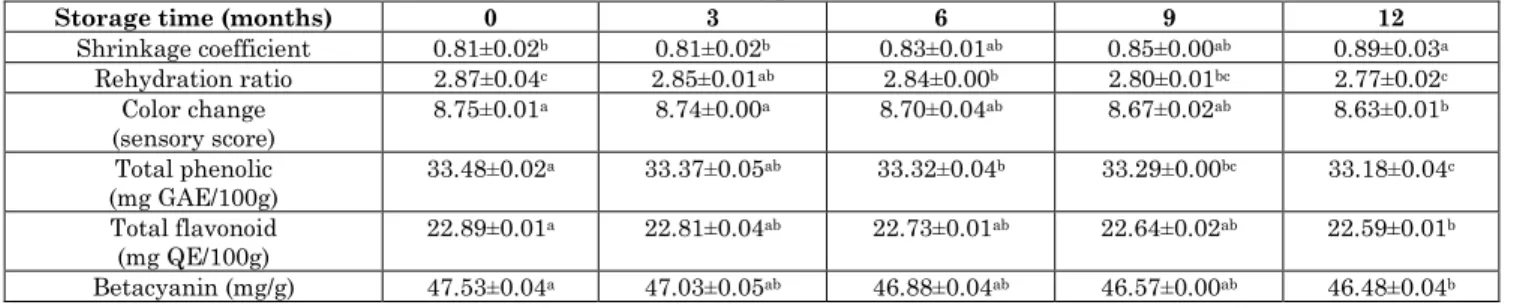
At the end of the drying treatment, the dried
storage. They were kept in PET/AL/PE
(vaccum) bag at 28oC. The shrinkage
coefficient, rehydration ratio, color change, total phenolic (mg GAE/100 g), flavonoid (mg
QE/100 g), betacyanin (mg/g) will be evaluated in 12 months by 3 month-interval (see Table 4).
Table 4: Stability of dried Gomphrena globosa flower during preservation
Storage time (months) 0 3 6 9 12
Shrinkage coefficient 0.81±0.02b 0.81±0.02b 0.83±0.01ab 0.85±0.00ab 0.89±0.03a
Rehydration ratio 2.87±0.04c 2.85±0.01ab 2.84±0.00b 2.80±0.01bc 2.77±0.02c
Color change
(sensory score) 8.75±0.01
a 8.74±0.00a 8.70±0.04ab 8.67±0.02ab 8.63±0.01b
Total phenolic (mg GAE/100g)
33.48±0.02a 33.37±0.05ab 33.32±0.04b 33.29±0.00bc 33.18±0.04c
Total flavonoid
(mg QE/100g) 22.89±0.01
a 22.81±0.04ab 22.73±0.01ab 22.64±0.02ab 22.59±0.01b
Betacyanin (mg/g) 47.53±0.04a 47.03±0.05ab 46.88±0.04ab 46.57±0.00ab 46.48±0.04b
Note: the values were expressed as the mean of three repetitions; the same characters (denoted above), the difference between them was not significant (α = 5%)
Conclusion
The benefit of drying is not only to preserve crops as food but also reduce package and transport cost in terms of weight and volume, while offering the possibility of adding value
to harvested commodities. Microwave
vacuum drying is more energy-efficient than
microwave convective drying. Gomphrena
globosa L. (Amaranthaceae) is used in folk medicine in the treatment of high blood pressure and other diseases.
We have successfully studied major technical variables affecting to the drying process of
Gomphrena globosa floral. Microwave energy can dramatically enhance drying of medicinal and aromatic plants, save energy and preserve product quality if properly applied in combination with hot vacuum drying. From this study, the added value of
Gomphrena globosa floral would be improved and consumer would have more chance to enjoy a benifical healthy dried tea.
References
1. Valérie Orsat, Viboon Changrue, GS
Vijaya Raghavan (2006) Microwave drying
of fruits and vegetables. Stewart
Postharvest Review, 6(4): 1-7.
2. Albert GW Heindl, Joachim Müller (2007)
Microwave drying of medicinal and aromatic plants. Stewart Postharvest Review, 4(5): 1-6.
3. MN Berteli, E Rodier, A Marsaioli Jr (2009) Study of the microwave vacuum drying process for a granulated product.
Brazilian Journal of Chemical
Engineering, 26(2): 317-329.
4. Péré C, Rodier E (2002) Microwave
vacuum drying of porous media:
experimental study and qualitative
considerations of internal transfers. Chemical Engineering and Processing 2002; 41: 427-441.
5. PS Sunjka, TJ Rennie, C Beaudry, G SV Raghavan (2004) Microwave-convective
and microwave-vacuum drying of
cranberries: A comparative study. Drying Technology, 22(5): 1217-1231.
6. SK Giri, PP Sutar, Suresh Prasad (2014) Effect of process variables on energy
efficiency in microwave-vacuum drying of button mushroom. Journal of Food Research and Technology, 2(1): 31-38. 7. A Figiel (2009) Drying kinetics and quality
of vacuum-microwave dehydrated garlic cloves and slices. Journal of Food Engineering, 94(1): 98–104.
8. Á Calín-Sánchez, A Figiel, A Wojdyło, M Szarycz, ÁA Carbonell-Barrachina (2014) Drying of garlic slices using convective
pre-drying and vacuum-microwave
finishing drying: kinetics, energy
consumption, and quality studies. Food and Bioprocess Technology, 7(2): 398-408. 9. S Ferenczi, B Czukor, Z Cserhalmi (2014)
Evaluation of microwave vacuum drying combined with hot-air drying and compared with freeze- and hot-air drying by the quality of the dried apple product.
Periodica Polytechnica Chemical
Engineering, 58(2): 111-116.
10.S Ambros, SAW Bauer, L Shylkina, P
and Bioprocess Technology, 9(11): 1901-1911.
11.J de Bruijn, F Rivas, Y Rodriguez (2016) Effect of vacuum microwave drying on the
quality and storage stability of
strawberries. Journal of Food Processing and Preservation, 40(5): 1104-1115.
12.M Zielinska, P Sadowski, W Błaszczak
(2016) Combined hot air convective drying
and microwave-vacuum drying of
blueberries (Vaccinium corymbosum L.):
Drying kinetics and quality
characteristics. Drying Technology, 34(6): 665-684.
13.Y Tian, S Wu, Y Zhao, Q Zhang, J Huang,
B Zheng (2015) Drying characteristics and processing parameters for microwave-vacuum drying of kiwifruit (Actinidia
deliciosa) slices. Journal of Food
Processing and Preservation, 39(6): 2620-2629.
14.D Wray, HS Ramaswamy (2015) Quality
attributes of microwave vacuum
finish-dried fresh and microwave-osmotic
pretreated cranberries. Journal of Food Processing and Preservation, 39(6): 3067-3079.
15.Edla Chandana, CH Pradeep Kumar
(2018) A review on different
pharmacological activities of Gomphrena globosa L. World Journal of Pharmacy and Pharmaceutical Sciences, 7(8): 386-394. 16.Muller K, Borsch T (2005) Phylogenetics of
Amaranthaceae using matK/trnK
sequence data-evidence from parsimony, likelihood and Bayesian approaches. An Missouri Bot. Garden, 92: 66-102.
17.Yusuf AA, Iwuafor ENO, Abaidoo RC,
Olufajo OO, Sanginga N (2009) Grain legume rotation benefits to maize in the northern Guinea savanna of Nigeria: Fixed-nitrogen vs. other rotation effects. Nutr. Cycl. Agroecosyst, 84: 129-139.
18.Arcanjo DDR, De Albuquerque, ACM Neto
BN, Silva NCBS Moita MM (2011) Phytochemical screening and evaluation of cytotoxic, antimicrobial and cardiovascular effects of Gomphrena globosa L ethanolic extraction. J. Med. Plants Res., 5: 2006-2010.
19.Daniel Dias Rufino Arcanjo, Ingrid
Virgínia de Oliveira Sena, Adonai Carvalho Medeiros de Albuquerque, Bernardo Melo Neto, Lorena Citó Lopes
Resende Santana, Náiguel Castelo Branco Silva, Maria Marilza Moita, Maria das Graças Freire de Medeiros, Maria José dos Santos Soares, Nilza Campos de Andrade, Antônia Maria das Graças Lopes Citó (2011) Phytochemical screening and evaluation of cytotoxic, antimicrobial and cardiovascular effects of Gomphrena globosa L. (Amaranthaceae). Journal of Medicinal Plants Research, 5(10): 2006-2010.
20.Syeda Nishat Fathima, S Vasudeva
Murthy (2018) Investigation of
pharmacognostical and physical
parameters of Gomphrena globosa flowers. Journal of Innovation in Pharmaceutical Sciences, 2(2): 7-12.
21.Hamiduzzaman M (2013) Significant
hypoglycemic activity from Gomphrena globosa (Amaranthaceae) in mice model. Universal Journal of Pharmacy, 02 (05): 68-72.
22.Luis RS, Patrícia V, Joana F, Federico F, Carla S, Angel G, Brígida RP, Paula BA (2012) Phytochemical investigations and biological potential screening with cellular and non cellular models of globe amaranth (Gomphrena globosa L.) inflorescences. Food Chemistry, 135(2): 756-763.
23.Hamiduzzaman M (2013) Evaluation of
central and peripheral analgesic activity of whole plant Gomphrena globosa (L), family: Amaranthaceae. International Research Journal of Pharmacy, 4(6): 54-57. 24.Latha ST, Rajendran NN, Babu G (2013) Anticancer screening of Gomphrena globosa against ehrlich ascites carcinoma in swiss albino mice. Journal of Chemical and Pharmaceutical Research, 5(2):283-289.
25.Md Hamiduzzaman, ATM Zafrul Azam
(2012) Antimicrobial, antioxidant and cytotoxic activities of Gomphrena globosa (L.). Bangladesh Pharmaceutical Journal, 15(2): 183-185.
26.Shailza, Shalini Jhanji, HS Grewal (2018)
Emerging prospective of floriculture industry: drying of ornamental plants and their parts. International Journal of
Current Microbiology and Applied
Sciences, 7(7): 1619-1633.
28.Sangeeta Kumari, Bharati Kashyap, Youdh Chand Gupta (2017) Studies on microwave oven drying of Gomphrena
globosa L. Indian Journal of
Horticulture 74(1): 146-151.
29.Hossain MA, Raqmi KAS, Mijizy ZH, Weli
AM, Riyami Q (2013) Study of total
phenol, flavonoids contents and
phytochemical sreening of various leaves crude extracts of locally grown Thymus vularis. Asian Pacific Journal of Tropical Biomedicine, 3(9): 705-710.
30.Eswari ML, Bharathi RV, Jayshree N
(2013) Preliminary phytochemical
screening and heavy metal analysis of leaf extracts of Ziziphus oenoplia (L) Mill.
Gard. International Journal of
Pharmaceutical Sciences and Drug
Research, 5(1): 38-40.
31.Mandal S, Patra A, Samanta A, Roy S, Mandal A, Mahapatra TD, Pradhan S, Das K, Nandi DK (2013) Analysis of phytochemical profile of Terminalia arjuna bark extract with anti-oxidative and antimicrobial properties. Asian Pacific Journal of Tropical Biomedicine, 3(12): 960-966.
32.Custódio Lobo Roriz, Lillian Barros, MA Prieto, Patricia Morales, Isabel CFR Ferreira (2017) Floral parts of Gomphrena globosa L. as a novel alternative source of
betacyanins: Optimization of the
extraction using response surface
methodology. Food Chemistry, 229: 223-234.
33.Ç Muştu, İ Eren (2019) Drying kinetics, is heating uniformity and quality changes during the microwave vacuum drying of artichokes (Cynara Scolymus L.). Ital. J. Food Sci., 31: 681-702.
34.Agnieszka Ewa Stępień, Józef Gorzelany,
Natalia Matłok, Krzysztof Lech,
Adam Figiel (2019) The effect of drying methods on the energy consumption, bioactive potential and colour of dried leaves of Pink Rock Rose (Cistus creticus). Journal of Food Science and Technology, 56(5): 2386-2394.
35.Drouzas AE, Tsami E, Saravacos GD
(1999) Microwave/vacuum drying of model fruit gels. Journal of Food Engineering, 39: 117-122.
36.Wenjiang Dong, Ke Cheng, Rongsuo Hu,
Zhong Chu, Jianping Zhao, Yuzhou Long (2018) Effect of microwave vacuum drying on the drying characteristics, color, microstructure, and antioxidant activity of green coffee beans. Molecules, 23(1146): 1-16.
37.Wanxiu Xu, Guanyu Zhu, Chunfang Song,
Shaogang Hu, Zhenfeng Li (2018)