http://www.cisjournal.org
Cloud Computing and Sustainable Development in Higher Education
1Sunday A. Idowu,
2Adenike.O.Osofisan
1
Babcock University, Ilishan-Remo, Nigeria 2
University of Ibadan, Ibadan, Nigeria
ABSTRACT
Sustainable development (SD) in higher education constitutes a global process that transcends economic, political and social barriers. Developmental transformation process in higher education supported with necessary information technology (IT) infrastructures will create sustainable improvements that give students the best opportunity to thrive in the global economy. This paper presents the role of cloud computing in the provision and support of sustainable development in higher education that yield skills that meet the needs of the 21st century society. Furthermore, we present general building components for a sustainable transformation in the development of higher education with cloud computing as an appropriate alternative support.
Keywords: Cloud computing, Sustainable development, Information technology, higher education, virtualization.
1. INTRODUCTION
Higher education has been acknowledged as one of the building blocks for a developing society that desires to experience transformational growth politically, technologically and economically. Evidences exist that suggest that higher education can produce both public and private benefits. Through the collaborations between higher education institutions, government and industry; researchers and students are expected to generate new ideas and develop skills aimed at transforming the society and world economy. In other words, higher education institutions are a major source for providing the human capital required for knowledge production to build a society. The collaboration between technology and education has formed a concrete basis for societal development and advancement. In fact education feeds Information Technology (IT), and IT in turn forms the bedrock of education. Therefore, it is evident that information technology has
impacted strongly on the methods, purpose and perceived potential of education. Attainments of sustainable socio-economic development in a society implies that there needs to be a sustainable development framework that enables delivery of education services with maximum benefits at minimal service cost.
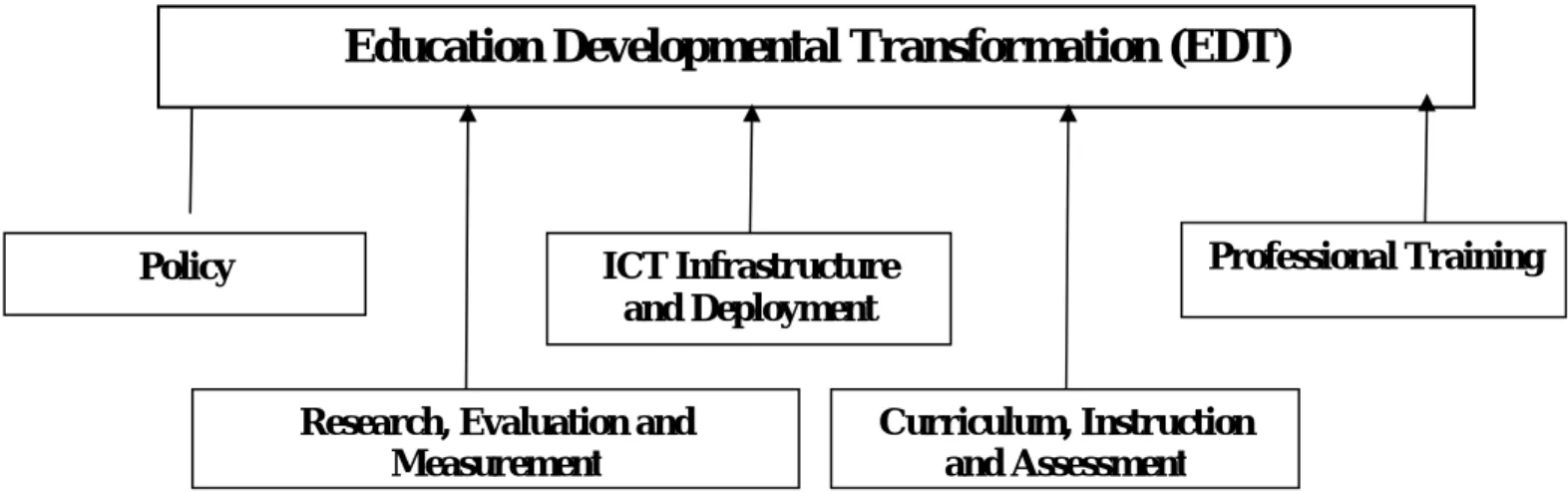
Education developmental transformation (EDT) is a global phenomenon that can be described with the following support components, [1].
a. Policy
b. Research, Evaluation and Measurement c. Information and Communication d. Technology Infrastructures and Deployment e. Curriculum, Instruction and Assessment f. Professional Training
Fig 1: Basic support components of EDT
According to Horn as cited by [2], traditional higher complex products that are unsuitable for many users due to
Education Developmental Transformation (EDT)
Policy
Research, Evaluation and
Measurement
ICT Infrastructure
and Deployment
Curriculum, Instruction
and Assessment
http://www.cisjournal.org
In today’s information-driven societies, knowledge drives economic growth and development. Higher education is the main source of that knowledge – its production, dissemination and its absorption by any society, [3]. Therefore, since higher education plays a crucial role in enhancing a nation’s human capacity to produce, absorb and use knowledge for sustainable development, higher education itself deserves a sustainable developmental process for optimal result. Cloud computing is emerging as a new computing paradigm which relies on the existing Information Technology infrastructures and tools such as Internet, virtualization, grid computing, Web services, etc to provide an improved efficiency ,minimum service cost, and convenience in the development of Higher Education and services delivery.
Many research works exist in literature that deal with the impact of IT on the development of Higher Education and the delivery of its various services.
1.1 Information Technology in the Development of Higher Education
There is no question on that IT and the onslaught of digital data have caused changes to the methods, purpose and perceived potential of Higher Education. Universities and colleges could not function without ICT, which is ubiquitous for administration, communication, information gathering and research, and is rapidly becoming so for teaching and learning.
The followings briefly describe how IT has affected Higher Education,[4]
a. Convenience and Availability(Changes to Learning and Teaching)
Many Higher Institutions offer online education. Also, being able to access large databases of information enhances learning and has made students to be creators and collaborators in the access and construction of discourses of information. IT has also affected method of teaching; today teachers can supplement their teaching in many exciting ways such as online video conferencing.
b. Purpose of Education
Information technology has shifted the aims of education from teaching and learning to the process of creating, preserving, integrating, transmitting and applying knowledge for the growth of the society.
c. Potential of Education
It has been observed that IT infrastructures provided a suitable platform for Higher Educational Institutions to be able to carry out functional educational activities and meaningful scientific research,[5] and[6].
1.2 Cloud Computing and Sustainable Development of Higher Education
Cloud computing has evolved as an enhanced computing paradigm that promises to provide affordable opportunities for delivering of education services based on existing IT infrastructures in a way that has not been experienced before. It is important to adopt a systematic and sustainable developmental process in Higher education in order to achieve a functional and goal-oriented education services delivery. Many authors in literature have demonstrated how business organizations are already taking advantage of the benefits of this new approach in computing. How then is the development of Higher education affected by this technology? In what ways can teachers, students, higher institutions administrations and the society benefits from this 21st century IT grace in a sustainable way.
Cloud computing is not just a technology concept that promises to deliver many exciting things; it is already a reality that has many commercial implementations. For instance, Amazon's Elastic Compute Cloud(EC2) offers a number of services and it represents a virtual computing environment that allows users to use Web service interfaces to launch instances with a variety of operating systems, load them with customers 'customized application environment and manage customers' network's access permissions,[7].
What is Cloud Computing? Cloud computing - cloud is an evolving term that describes the development of many existing technologies and approaches to computing into different concept. Cloud separates application and information resources from the underlying infrastructure, and the mechanisms used to deliver them. Cloud enhances collaboration, agility, scaling, and availability, and provides the potential for cost reduction through optimized and efficient computing. Generally, assets supported by the cloud can be classified as
a. Data
b. Applications/Functions/Processes
http://www.cisjournal.org
Fig 2
Architectural framework for Cloud computing was provided by U.S. National Institute of Standards and Technology (NIST) as illustrated by Figure 3, [8]
http://www.cisjournal.org
Cloud computing was described by NIST as consisting of five essential characteristics, three service cloud models, and four cloud development models
Previous works done in literature on cloud computing have been concerned with cloud computing as a new technology, cloud computing in the business arena, security requirements and the future evolutions. The techniques to model Cloud computing as an emerging application platform for sharing data, computations and business services were explored by[13]
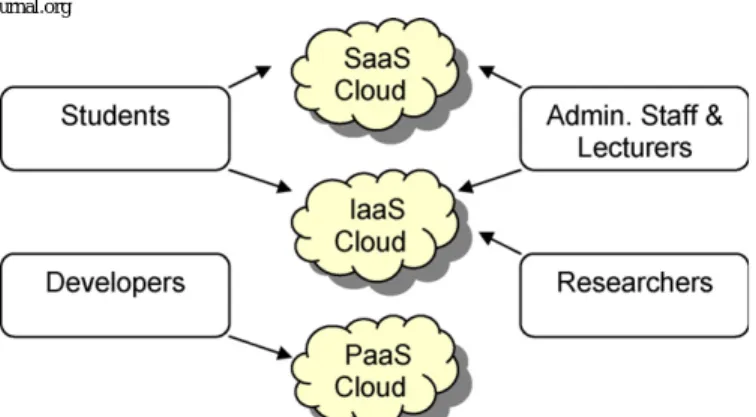
An overview of technological researches done in HP labs was provided by [9]. A cloud-based infrastructure optimized for wide area networks performance, with provision to support data mining applications was developed by [10]. Cloud computing infrastructures have provided support for different technological innovations and easily accessible resources for higher institutions as on-demand services,[11]..A proper understanding of the types of services offered by cloud computing helps in the understanding of what this new approach in IT is all about. Using the Gartner definition of cloud computing as “a style of computing where massively scalable IT-enabled capabilities are delivered ‘as a service’ to external customers using Internet technologies, [12].We presents a typology of cloud computing as a service as characterized in the following ways:
a. Infrastructure as a Service (IAAS)
Products or services offered via this mode include the remote delivery, over the Internet, of a full computer infrastructure (e.g., virtual computers, servers, storage devices, etc.);
b. Platform as a Service (PAAS)
To understand this cloud computing layer one needs to remember the traditional computing model where each application managed locally required hardware, an operating system, a database, middleware, Web servers, and other software. One also needs to remember the team of network, database, and system management experts that are needed to keep everything up and running. With cloud
computing, these services are now provided remotely by cloud providers under this layer;
c. Software as a Service (SAAS)
In this layer, instead of installing and maintaining software, you simply access it via the Internet, freeing
yourself from complex software and hardware
management. This type of cloud service offers a complete application functionality that ranges from productivity (e.g., office-type) applications to programs such as those for
Fig 4: Cloud computing services in an academic Institution The evolution of cloud computing as a technology for on-demand infrastructure, application, and support services is important as a possible means of providing sustainable development of Higher Education transformational framework. The list below indicates some of the possible means:
a. Bringing down the capital and overhead costs of IT in higher education development.
b. Facilitating and improving the transparent
matching of IT demand, costs, and funding.
c. IT resources, products and infrastructures
scalability.
d. Improvements in IT services and products standardization
e. Accelerating time to market of IT products and services by reducing IT supply bottlenecks
f. Increasing interoperability between disjoint technologies between and within institutions of higher education.
1.3 Cloud Computing: Virtualization and Higher
Education Services Delivery
The rapid increasing rate of changing in IT devices and products will continue to place a great deal of pressure on organizations’ budgets especially higher education institutions, Universities and Colleges. However, cloud computing which is not just a technology promising exciting things to come is already providing commercial implementations aimed at leveraging cost and services. An example is the Amazon’s Elastic Compute Cloud (EC2) which offers a variety of services and representing a virtual computing environment that allows users to use Web service interfaces in order to launch instances with a variety of operating systems, load them with customers’ customized application environment and manage customers’ network’s access permissions. Google also
http://www.cisjournal.org
decision makers with solutions to key strategic questions such as:
a. What is the quickest, most efficient and
affordable way to deliver education services? b. How do students in this 21st-century acquire
skills that can prepare them for the labour market?
c. How do governments, higher education
institutions and IT administrators encourage local innovation within a country or sub-region?
d. How do we encourage sharing of resources
across institutions, regions and beyond.
With proper setting of cloud computing technology as sustainable developmental strategy, solutions can be provided to questions raised above in such a way that
a. Simplify, enhance and reduce the cost of
development, integration procurement,
and operation and maintenance of ICT infrastructure
b. Capitalize on worldwide innovation of
developers and tap from the world of benefits available.
c. Focus on the user experience and expected
outcomes, not on infrastructure
d. Simplify management of vendors.
e. Provide better visibility of results and impacts, using cause-and-effect analyses for continuous improvement.
Virtualization is a key factor in cloud computing, and it is primarily concerned with the technology that enables the creation of a virtual (as opposed to actual) version of something e.g. an operating system, a server, a storage device or network resources. It is through this concept that a variety of services can be delivered using many different types of devices.
A categorization of services available through virtualization in cloud computing is illustrated in the Figure 5 below
Some educational services that can be better supported by cloud computing include
a. An e Assessment service for managing
student assessments
b. Grade book, roster, lesson plan and classroom management services for teachers
c. Content management services that teachers
use to assign curriculum content to students and that students use to access the assigned content
d. An online community service that teachers
use to interact with peers and share resources
e. A professional development service that
teachers use to manage their career development path and become more proficient on the use of technology in the classrooms and in their various research endeavours. Other important services that can be enjoyed using cloud computing include
a. A fundraising service to track contribution
and fundraising events
b. A school asset tracking service to track
equipment and supplies
c. A school bulletin service to inform parents
and the entire community of school activities, [1].
1.4 Conclusion and Recommendation
Sustainable developmental transformations
process in Higher education is very possible more especially in this world wide economic meltdown using the facilities and services provided by cloud computing. Using cloud computing will reduce the number of staff engaged and thereby cutting on budgets, also it will eliminate the problems of licensing of some applications used within institutions and the money for that can be used elsewhere. Generally, adopting clouding computing allow staff and students to do their computing on tablets and handheld mobile devices more than on notebooks or desktop computers. Companies such as Google, Postini, Cast Iron, Sales force etc can provide successful implementation of cloud computing technology services for higher institutions.
Finally, cloud computing has come to stay and stay to provide a sustainable development in the transformation process of higher education especially in the developing countries with strong financial stress. Issues still being studied concerns risk and security issues as it relates with data and confidential information of institutions.
REFERENCES
[1] Fogel, Robert (2010).The Education Cloud: Delivering Education as a Service White Paper Intel World Ahead, Intel
http://www.cisjournal.org
[3] Bray, Mark (2007).Higher Education and Development. International Institute for Educational Planning (IIEP). Vol. XXV, No. 1, January-March [4] Dunn, Jeff (2012).How Technology is changing
Education as We Know Ithttp://edudemic.com/2012/01/tech-changing/
[5] Mircea, M (2010)."SOA, BPM and Cloud Computing: Connected for Innovation in Higher Education". 2010 International Conference on Education and Management Technology (ICENT2010), Nov 4, Cairo, Egypt, ISBN: 978-1-4244-8617-5.
[6] Bozzelli,T.(2009)."Will the Public Sector Cloud Deliver Value?.Powering the Cloud Infrastructure" CISCO.http://www.cisco,com/web/strategy/docs/gov /2009_cloud_public_sector_tbozelli,pdf
[7] Sultan,N (2010).Cloud computing for Education: A
new dawn. International Journal of Information Management, 30(2010) 109-116.
[8] McKinsey & Co.,(2008) Enterprise Software
Customer Survey,(Sand Hill Group),2008, p. 6. [9] Banerjee,P.(2009).An intelligent IT infrastructure for
the future.15th International Symposium on
High-Performance Computer Architecture, Proceedings, Feb 14-18, 3
[10]Grossman,R.L.,Gu,Y.H.,Sabala,M.,&Zhang,.W.Z.(200 9).Compute and Storage clouds using wide area
high performance networks. Future Generation
Computer Systems-the International Journal of Grid
Computing Theory Methods and
Application, 25(2), 179-183
[11] Delic, K.A. & Riley, J.A (2009).Enterprise Knowledge Clouds: Next Generation KM Systems?
International Conference on Information
Process, and Knowledge Management. Cancum, MEXICO, 49-53.
[12] Gartner, Inc.,(2008). Cloud Computing: Defining
and Describing an Emerging Phenomenon, June
17, p. 3
[13] Lijun, M., Chan, W.K.and Tse, T.H.(2008).A Tale of Clouds: Paradigm comparisons and some thoughts on research issues. IEEE Asia-Pacific Services Computing Conference.APSCC'08,464-469.
[14] Brunette, G. and Mogull, R(Editors).2009. Cloud Security
Alliancehttp://www.cloudsecurityalliance.org/guidan ce/csaguide.v2.1.pdf
![Fig 3: Architectural Framework, [8]](https://thumb-us.123doks.com/thumbv2/123dok_us/8519205.2286285/3.918.119.800.458.892/fig-architectural-framework.webp)