Sustaining the Seventh Generation:
Strategic Energy Planning of American Indian Tribes
by
Daniel Brookshire
A Master’s Project submitted to the faculty of the University of North Carolina at Chapel Hill
in partial fulfillment of the requirements
for the degree of Master of City and Regional Planning in the Department of City and Regional Planning.
Chapel Hill
2012
Approved by:
_________________________ ______________________
Acknowledgements
I would like to thank Professor Nikhil Kaza for his guidance and support of this project as well as serving as my mentor during my time in the UNC Department of City and Regional Planning. I would also like to thank and credit Sean Murphy for making follow up calls with the tribes that were surveyed and for his assistance with creating the maps for this paper.
I would also like to thank the UNC Odum Institute, UNC American Indian Center, DOE Tribal Energy Program, and Damon Lambert of the Eastern Band of Cherokee Indians for
Table of Contents
Acknowledgements ... 1
Table of Contents ... 2
Figures ... 3
Tables ... 3
1. Introduction ... 4
2. Context and Literature Review ... 5
2.1 History of Tribal Energy Development and Federal Regulations ... 6
2.2 History and Definition of Strategic Energy Planning ... 9
2.3 Tribal Energy Planning ... 11
3. Methods ... 13
4. Results and Analysis ... 15
4.1 Aggregate Characteristics of Tribes Responding to Survey ... 15
4.1.1 Population and Land Characteristics of Tribes Surveyed ... 15
4.1.2 Economic Characteristics of Survey Respondents ... 18
4.2 Energy Development Efforts of the Tribes Surveyed ... 18
4.2.1 Types of Energy Resources Developed by the Tribes ... 18
4.2.2 Where Energy Resources are Being Developed by the Tribes ... 19
4.2.3 Who is Developing these Resources on Tribal Lands ... 20
4.2.4 Why Tribes are Developing Energy Resources ... 23
4.3 Tribal Strategic Energy Planning and Policy Efforts ... 26
4.3.1 Types of Energy Plans of Surveyed Tribes ... 26
4.3.2 Why Tribes are Creating Strategic Energy Plans ... 26
5 Conclusions ... 29
6 Appendix ... 32
7 References ... 47
Figures
Figure 1: Map of All Federally Recognized Tribes and Tribes Responding to Survey ... 16
Figure 2: Natural Gas Resources for Tribes Responding to Survey ... 34
Figure 3: Coal Resources for Tribes Responding to Survey ... 35
Figure 4: Biomass Resources for Tribes Responding to Survey ... 36
Figure 5: Geothermal Resources for Tribes Responding to Survey ... 37
Figure 6: Solar Resources for Tribes Responding to Survey ... 38
Figure 7: Wind Resources for Tribes Responding to Survey ... 39
Figure 8: Energy Planning and Development Survey Instrument ... 40
Tables
Table 1: Responding Tribes by U.S. Census Region ... 15Table 2: Population Characteristics of Tribes Responding to Survey ... 17
Table 3: Economic Characteristics for Responding Tribes and U.S. Population ... 18
Table 4: Energy Resources Currently Harvested or Pending Development ... 19
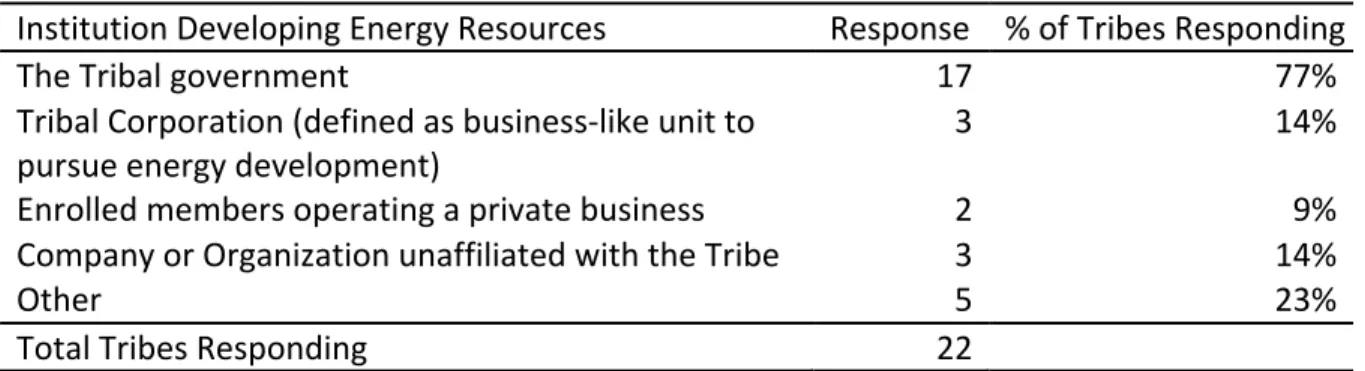
Table 5: Institutions Developing Energy Resources on Tribal Lands ... 21
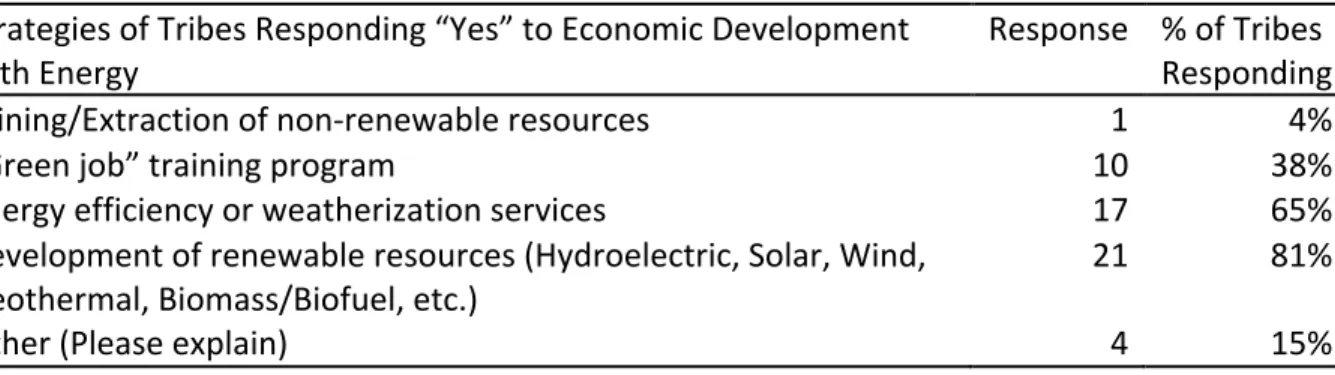
Table 6: Strategies of Tribes Pursuing Economic Development Opportunities with Energy ... 23
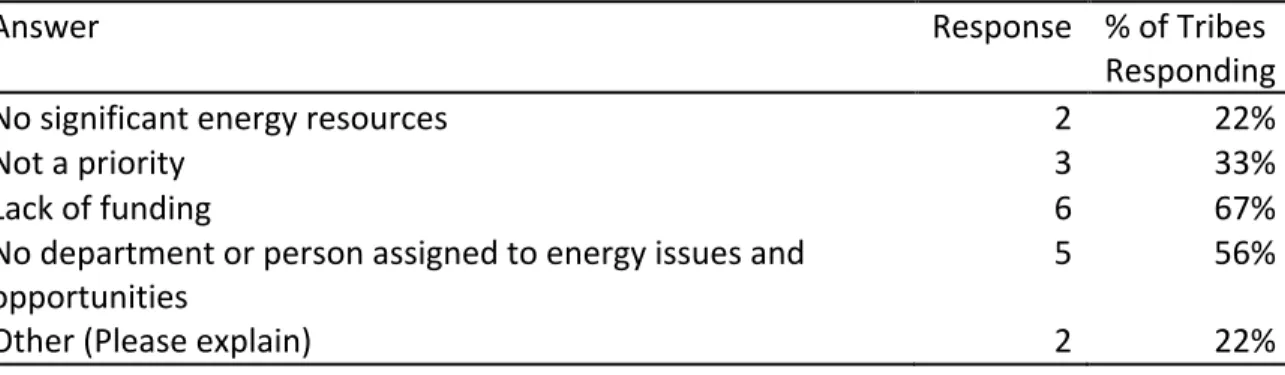
Table 7: Reasons Tribes are Not Pursuing Energy Related Economic Opportunities ... 24
Table 8: Barriers to Energy Resource Development ... 25
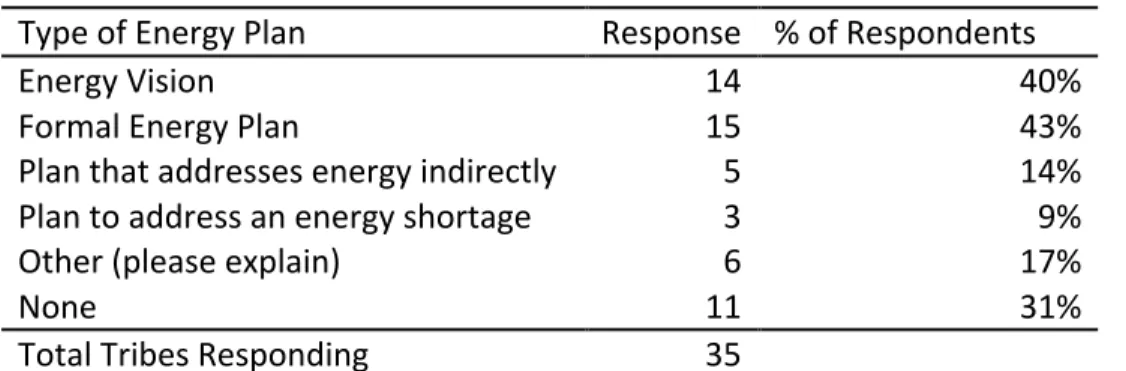
Table 9: Survey Tribes with Energy Plans ... 26
Table 10: Issues Addressed in Energy Plans ... 28
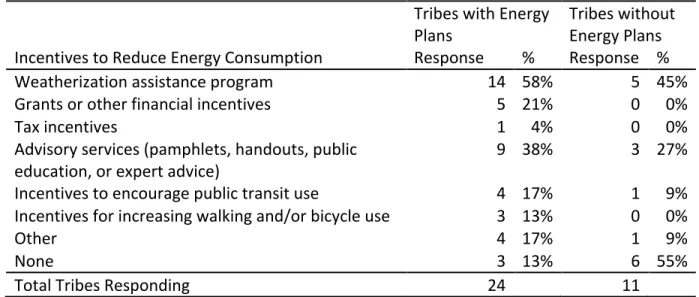
Table 11: Incentives for Tribal Members to Reduce Energy Consumption ... 28
Table 12: Poverty Rates for Responding Tribes and U.S. Population ... 32
Table 13: Potential Energy Resources and Years to Development ... 32
Table 14: Potential Energy Resources of Tribes with No Current Resources in Development ... 33
1.
Introduction
In a world of unstable energy prices, oil spills, and the harmful effects of climate change, many communities are recognizing the need for sustainable management and development of their energy resources. This has been especially true for American Indian communities where the management of both renewable and nonrenewable resources is intertwined with energy independence and tribal sovereignty. The U.S. Department of Energy (DOE) has estimated that American Indian tribal lands hold roughly ten percent of all federal onshore energy minerals while making up less than five percent of the total land area in the U.S. Tribal lands are estimated to contain three percent of the U.S.’s known oil and gas reserves, as much as 30 percent of the coal west of the Mississippi, and up to a third or more of the nation's uranium reserves (Cohen, 2005, p. 1086, 1107). The DOE also predicted that sixty-‐one of the most populous tribal reservations and jurisdictional areas appear to have the potential for significant renewable energy development (though excluding transmission costs) (EIA, 2000). As technological advancements continue to make renewable and nonrenewable resources more accessible for development, tribes are increasingly looking to develop these resources in ways that help them become more energy independent and boost tribal revenues.
The purpose of this study is to analyze both the energy development and energy planning efforts of American Indian communities. The study analyzes what energy resources are currently being developed on tribal lands, who is developing these resources, what regions particular resources are being developed, and why tribes are developing these energy resources. The study also analyzes aspects of tribal energy plans in addition to energy related policies and incentives offered by tribes. The main source of information for this study comes from a survey sent to tribal leaders and to tribal employees working on energy issues and asked them to describe and classify their tribe’s energy planning and development efforts. Overall this study is intended to provide a status report on tribal energy planning and development and examine the future implications of these efforts. The main research questions include; what are the impetuses and conditions under which tribes develop some type of energy plan or energy resources, what issues are connected to the energy plans and energy development, how are the plans being used, and what are the cross tabulations and correlations between energy resource development and planning strategies.
The key findings of this study include a clear indication that tribal governments are the main institutions developing energy resources on tribal lands and that energy resource development by non-‐tribal entities is minimal. Tribes are primarily using federal
incentives and advisory services to develop energy plans and to initiate renewable energy development and management for tribal communities. Based on energy resource maps for tribal lands, it appears tribes are not taking full advantage of the renewable energy
resources best suited for development in their regions. Overall, tribes with energy plans are more likely to connect energy development with other issues facing the tribal
higher levels of income are developing a wider range of resources than tribes with smaller land areas, smaller populations, and lower income levels.
The prevalence of energy resources on Native American lands, the links between energy management and tribal sovereignty, and the recent opportunities for strategic energy planning from sources like the DOE Tribal Energy Program and American Recovery and Reinvestment Act (ARRA) make tribal energy planning an interesting case study for community energy planning. This paper studies the strategic energy planning efforts, energy resource development, and energy goals and policies established by tribes within the continental US. As sovereign nations, Native American tribes are in unique positions to control and manage their own energy resources in ways that other state and local
governments cannot. However, the lessons learned from tribal energy planning can provide valuable case studies for communities across the U.S.
2.
Context and Literature Review
Despite the energy resources located on American Indian lands, more than 14 percent of American Indian households on reservations have no access to electricity, compared to 1.2 percent of all US households (NWF, 2010). For example, while the Navajo Nation has substantial oil, uranium, coal, and renewable energy resources within its borders, an estimated 16,000 out of about 45,000 (36%) Navajo households are without access to electricity and many more homes and families are without access to basic infrastructure, such as telephones, water, wastewater, and natural gas services (NTUA, 2012 and ACS 2006-‐2010 estimates). While some large tribes, like the Navajo, have their own electrical utilities, most energy utilities that serve American Indian communities are not owned and operated by tribal entities, meaning money paid to these utilities does not stay within the tribe. This disconnect between the prevalence of tribal energy resources and the use of these resources for the benefit of the tribe is a partial reflection of the complex and complicated history of tribal energy development and its relation to tribal sovereignty.
While federal policy regarding tribal mineral leases and energy resources was repeatedly reformed over the 20th century, researchers believe they all failed to fully promote
economic development or increase tribal sovereignty while preserving environmental quality on tribal lands. The Harvard Project on American Indian Economic Development spent a decade identifying the key factors in successful economic development and determined that one of the key factors is increasing tribal sovereignty. Tribes have historically viewed federal mineral rights and energy resource policy as a challenge to tribal sovereignty that compromises the ability of the tribe to govern as a semi-‐sovereign nation in the U.S. According to the Harvard Project, tribal sovereignty has both practical and political aspects. The Harvard Project defines political sovereignty as “the extent to which a tribe has genuine control over reservation decision-‐making, the use of reservation resources, and relations with the outside world.” Practical sovereignty “puts the
the modern tribal political sovereignty and the exercise of tribal powers. Tribal powers of self-‐government within the territorial bounds of the U.S. are recognized by the U.S.
Constitution, legislation, treaties, judicial decisions, and administrative practices. Neither the passage of time or assimilation of American Indians can be interpreted as diminishing a tribe’s status as a self-‐governing entity, and once recognized, a tribe retains its sovereignty until Congress acts to divest that sovereignty (Cohen, 2005, p. 205-‐206). Federally
recognized tribes generally have the powers to determine the form of tribal government, determine membership, legislate and tax, administer justice, exclude persons from tribal territory, and power over nonmembers of the tribe residing within a tribal jurisdiction (Cohen, 2005, p. 201-‐202). Despite this legal foundation for the political sovereignty of tribes, the practical sovereignty of tribes has often been undermined, especially with the development of nonrenewable energy resources.
Tribes with nonrenewable energy resources have a troubled history with mining
companies who operated on tribal lands under mining leases that ensured revenues to the tribes were only a fraction of what they were worth at market value. However, since only about 40 out of the 335 continental U.S. tribes have already experienced development of their nonrenewable resources, many tribes have not experienced this troubled history with energy development (Wilkins & Stark, 2011, p. 155). With the advent of new extraction techniques for nonrenewable resources (such as hydraulic fracturing for natural gas) and the prospect for large-‐scale renewable energy development on many tribal lands, many new tribes could experience energy development on their lands and accompanying federal regulations. With the tension between these federal regulations and tribal sovereignty, it will be important for tribes to understand the history behind federal tribal energy
regulations and how energy plans can help tribes navigate these regulations while promoting or preserving their sovereignty.
2.1 History of Tribal Energy Development and Federal Regulations
Allotment Era
One of the first modern tribes to experience development of their non-‐renewable energy resources was the Navajo. Pressure and harassment from oil companies actually led to the first assembly of Navajo leaders and the formal establishment of the first Navajo Tribal government in 1923. Forming this government allowed the Navajo to negotiate with the oil companies as a formal entity (Wilkins and Stark, 2011, p. 155). The Navajo government was formed during the “allotment era” of federal policy regarding Indian mineral rights, which under the 1891 allotment statute authorized tribal councils to issue grazing and mining leases. However, application of the law varied in the degree of tribal consent that was required to negotiate mineral leases and all of the leases authorized state taxation on production during this era. Some consistent traits of the leases during this era included federal government control over decisions regarding what resources could be developed and for what period of time (Royster, 2009, p. 1072).
Reorganization Era
The 1934 Indian Reorganization Act (IRA) authorized tribes to form constitutional
While mining and oil companies were required to get consent from the tribe before
extracting resources, the full details of the mineral rights leases were negotiated by the U.S. Department of the Interior (DOI). This process often led to leases that were undervalued compared to what mining companies were paying on the open market to non-‐Indian property owners. For example, the original lease negotiated by the DOI for the Peabody Coal Company Black Mesa coal mine on the Navajo Reservation, paid the Navajo $.17 per ton of coal during a time when standard payment was $1.50. Since there was no provision in the lease for renegotiation when the price of coal increased, the Navajo still received $.17 per ton even during energy crisis of the 1970s when coal reached $15 per ton. In addition, the Black Mesa coal mine also consumed much of the Navajo’s water resources for a coal slurry and left behind toxic waste before it was closed in 2006 (Perdue and Green, 2010, p. 106-‐107). DOI negotiated mineral leases also resulted in uranium mines that created significant environmental damage and toxic waste on the Navajo and Hopi reservations. These uranium leases were quickly negotiated during and shortly after WWII to supply the development of the U.S. nuclear arsenal. These abandoned uranium mines still threaten the health of tribal members and livestock raised on reservation lands, but the responsible mining companies have long-‐since dissolved or gone out of business (Macmillan, 2012). Both the Black Mesa and uranium mining controversies exemplify the failures in the historic policy of requiring the DOI to negotiate mineral leases on behalf of American Indian tribes. This historic policy resulted in the economic exploitation of the Navajo and severe environmental degradation on parts of the Navajo reservation.
In response to this era of exploitation of tribal energy resources, in 1974, 25 energy-‐ resource-‐rich tribes organized the Council of Energy Resource Tribes (CERT). The tribe’s purpose for creating CERT was to provide a clearinghouse for providing information, financial assistance, expertise, studies, and to provide a forum to advise the federal
government about Indian energy development. With now more than 50 member tribes in the organization, CERT continues to play an important role by helping members monitor and negotiate energy contracts (Wilkins and Stark, 2011, p. 156-‐157).
IMDA and IERA Era
Congress first attempted to respond to the problems with tribal mineral leases with the 1982 Indian Mineral Development Act (IMDA). Under IMDA, all tribes were authorized to enter into mineral agreements of any kind such as joint-‐venture production, but these agreements were still subject to the approval of the Secretary of the Interior. The IMDA allowed the tribes for the first time to directly negotiate the terms of their mineral resource production but stopped short of granting them full control over their resources. In
addition, the IMDA still required an often lengthy process for DOI approval of each specific lease or agreement (Royster, 2009, p. 1074-‐1077). After lobbying by the Navajo Nation, Congress amended general surface leasing statute in 2000 to streamline the mineral leasing process specifically for the Navajo. Congress authorized the Navajo to issue business and agricultural leases for up to 25 years and other surface leases for 75 years if the lease is executed under tribal regulations approved by the U.S. Secretary of the Interior (Royster, 2009, p. 1079).
By 1992, little change had occurred under IMDA and the provision for tribal cooperative agreements was not widely implemented, so Congress enacted the Indian Energy
Resources Act (IERA). IERA intended to promote tribal economic self-‐sufficiency through energy development while providing for greater tribal control of mineral development on tribal lands. Unlike the previously mentioned federal tribal energy legislation, IERA also involved the Department of Energy (DOE) and charged the Secretary of Energy to work in consultation with the Secretary of the Interior. IERA requires the DOE to establish
demonstration projects to increase the development of energy resources on tribal reservations, provide technical and financial assistance for tribal energy development projects, and to consult with tribes in a manner that requires the “full participation” of tribes in developing regulations and policy initiatives (Cohen, 2005, p. 1098-‐1100). IERA also established the Indian Resource Commission composed of the Secretaries of Energy and the Interior along with their appointees and those from tribes in order to provide recommendations for federal tribal energy legislation. Like past federal legislative efforts, the implementation of IERA has had mixed results and the Indian Resource Commission was never formed or funded (Cohen, 2005, p. 1100). However, the funding and technical assistance mandates of IERA are being carried out by the DOE Tribal Energy Program, which has invested more than $30 million in 129 tribal energy projects across the U.S. from 2002-‐2010 (DOE TEP, 2011).
ITEDSDA Era
The Indian Tribal Energy Development and Self-‐Determination Act 2005 (ITEDSDA) was intended to correct historic problems with the federal government oversight over tribal energy resources by giving all tribes greater self-‐determination and control over their energy resources. The Act intended to do this by establishing Tribal energy resource agreements (TERAs) with the DOI. Under ITEDSDA, the Secretary of the Interior is required to approve a TERA if the proposed agreement complies with statutory requirements under which the tribe demonstrates “sufficient capacity to regulate the development of tribal resources.” Once a tribe has an approved TERA, it is authorized to enter into leases and business agreements for energy resource development and to grant rights of way for pipelines and electric transmission and distribution lines without DOI approval. Thus, unlike historic federal regulations regarding tribal energy development, ITEDSDA abolishes the need for DOI secretarial approval of specific energy resource
development. ITEDSDA does not exempt tribes from the National Environmental Policy Act (NEPA) and each proposed TERA still requires an environmental impact statement
(Royster, 2009, p. 1080-‐1081).
expertise to organize a TERA, all tribes, are currently operating under previous federal regulations. This has led to further calls for amending federal policy to increase tribal sovereignty while streamlining the energy resource development efforts of tribes. The most recent of these efforts has been the proposed bill H.R. 3973: Native American Energy Act, which seeks to “facilitate the development of energy on Indian lands by reducing Federal regulations that impede tribal development of Indian lands” (H.R. 3973, 2012).
In addition to abiding by the ever changing and sometimes unclear federal regulations that tribes are subject to, tribes are now confronted with the challenges of increasing demand for their energy resources and calls for managing their energy resources in accordance with the values of the tribe. In response, some tribes have already critically evaluated their approaches to energy resources and developed strategic energy plans and energy policies. For example, in 2012, the Navajo Nation announced the formation of a Navajo Energy Policy and a partnership with Lawrence Livermore National Laboratory to help draft this policy. While the policy is still under development, its intent is to serve as a comprehensive guide for the Navajo Nation as it expands nonrenewable and renewable energy resource development (Lucchetti, 2012). In addition, tribes with nonrenewable resources can currently enact a severance tax charged on the removal of energy resources from any lands within the tribe’s jurisdiction. For example, the Navajo already have an Oil and Gas
Severance Tax (SEV) enacted on any nonrenewable energy resources exported from Navajo nation regardless of ownership of the lands (meaning regardless if an oil or gas company owns the land). The tax rate is 4% of sale price and the SEV is collected every 45 days after the end of the month. This tax provides revenue to the Navajo tribal government and helps to ensure that all Navajo share in at least some of the energy production on Navajo lands (NNDED, 2010, p. 13).
In addition to existing tribal energy policies, utilities, and taxes, with technical and financial assistance from the DOE Tribal Energy Program, over 30 tribes have already developed strategic energy plans (DOE TEP, 2011). Energy planning provides a tool for tribes to develop their energy resources in accordance with the values of the tribe, abide by or provide a framework for dealing with federal and state and local regulations, and address sustainability concerns about the environmental, economic, and social impacts of
developing these resources. Energy planning could help tribes avoid the troubled past of tribal energy development while meeting other tribal economic and environmental goals.
2.2 History and Definition of Strategic Energy Planning
A strategic energy plan “Is a roadmap to achieving community energy goals in both the near and long term. The goals outlined in a strategic energy plan are determined by stakeholder input, so the plans are inherently local and have stakeholder buy-‐in” (DOE
urban areas by incorporating goals of reducing energy consumption into land use planning. Topics included planning for solar energy generation within communities, managing
energy conservation under planned growth, and the legal and institutional barriers to energy independent communities. While the collection is dated and does not cover the impacts of energy resource harvesting on communities, it is still one of the most
comprehensive collections related to energy and land use.
Another post-‐oil shock guide to energy planning is the National Research Council (1994)
Summary of an American-‐Bulgarian-‐Romanian Workshop that was intended as a guide to energy planning for countries that were in the post-‐Soviet era of energy consumption. The sudden transition to market economies sent drastic shocks to energy prices for Eastern European countries and strategic energy planning was seen as a way to manage these shocks. This summary also outlines an early participatory model for energy planning and how to incorporate community goals for energy conservation while also expanding the energy production capacities of the community.
The original post-‐oil shock discussion around using energy planning and strategies to conserve energy for a purpose unto itself has transitioned into the recent attention on “green jobs” and the economic development potential of fields in renewable energy, energy efficiency, green design, etc. Some of the more prominent recent works on this topic
include The Green Collar Economy (Jones, 2008) and Hot, Flat, and Crowded (Friedman, 2008). Both works outline a plan for reviving the US economy through green technology jobs, investments in electric grid infrastructure, and creates opportunities for both highly skilled and unskilled workers. In Emerald Cities, Fitzgerald (2010) outlines how green jobs and green infrastructure upgrades can economically revive cities but requires coordination between many public and private actors and requires new job training programs to bridge the gap between traditional job skills and “green” ones. These works demonstrate that tribal energy planning is linked to a national emphasis on creating green economic
opportunities for communities and they provide a theoretical justification for emphasizing energy planning as a tool for both improving local environmental quality and economic development opportunities.
The U.S. DOE now provides a template for local governments to develop strategic energy plans for their communities. This template establishes a participatory model for strategic energy planning where the goals of the plan are determined by stakeholder buy-‐in and input. The DOE stresses that strategic energy plans can be developed to meet multiple community goals and objectives such as energy expense/cost savings for individual community members or organizations, utility and infrastructure planning, and reduced greenhouse gas emissions from the community (DOE Community Greening, 2010). The DOE guide outlines a nine step strategic energy planning process:
1. Identify and Convene Stakeholders 2. Establish a leadership team
3. Develop a common energy vision 4. Develop community energy baseline
6. Identify and evaluate supply and demand policy and program resource options, matching these to the goals and ranking of program options
7. Find and secure funding sources 8. Compile the plan
9. Measure and evaluate-‐Schedule process for evaluating implementation and updating the plan (DOE Community Greening, 2010)
Additionally, DOE now has a Solar Powering Your Community guide which serves as a guide for local governments on how to conduct solar feasibility studies and provides examples of policies that local officials can adopt to promote residential and commercial solar power. This publication also stresses the participatory approach and stresses the need for an initial “model project” such as a solar installation on a community center or well-‐known landmark to generate community interest and support for solar.
In addition to these DOE resources, the American Planning Association (APA) also has published a guide for Planning for a New Energy and Climate Future (Shuford et al., 2010). This guide stresses the need for plans that have the goal for using energy in a way that reduces the overall carbon emissions of a community while simultaneously planning for future conditions that have been altered by climate change. This is in contrast to the DOE resources, which do not incorporate preparation and adaptation strategies for climate change to the extent found in the APA guide. The APA guide also goes into further detail on the need to consider the energy consumption form transportation when developing an energy plan, which the DOE strategic energy planning guide is also weak on. However, the overall APA approach was similar to the DOE model and stressed the need for identifying the important energy stakeholders early on in the planning process and for communities to use energy plans as a way, “To assess the potential for different energy options and to anticipate future energy needs and use” (Shuford, 2010, p. 2010).
2.3 Tribal Energy Planning
To differentiate tribal energy planning from other forms of energy planning requires an understanding of the unique issues with planning for tribal communities, an understanding of the power dynamics within the community, and the external institutions that exert power over the community. Zaferatos (1998), details the historic struggles of tribal
planning. The central characteristic of tribal planning efforts is that they emphasize community control to overcome the dysfunctions of externally imposed planning and policy solutions.
The tribal community based planning approach emphasized by Zafertatos and Hibbard et al. acknowledges that the planning capacity of many tribes will need to be increased through collaborative partnerships with outside institutions that do not undermine tribal sovereignty. This collaborative approach is moderately reflected in current U.S. federal financial and/or technical assistance provided to tribes for the development of certain types of plans. These plans include fire management, transportation, economic
development, infrastructure, emergency response, agricultural development, and rural development plans. Some of the federal agencies providing assistance for these plans include the U.S. Bureau of Indian Affairs/Department of the Interior, Department of
Transportation, Economic Development Administration, and the Department of Agriculture (White House, 2009). Some of the most commonly used resources by tribes are grants from the U.S. Economic Development Administration for developing economic
development plans and feasibility studies. Between 1993 and 2002, 99 tribes received these grants and the tribes used the grants to pay staff salaries or the broad administration of the tribes’ planning departments in addition to developing specific economic
development plans and environmental impact statements for economic development projects (GAO, 2004, p. 16). The reliance on federal funding and/or technical assistance for tribal planning efforts is also found with the development of tribal strategic energy plans.
The primary federal advocate for tribal strategic energy planning has been the Tribal Energy Program (TEP), under the DOE's Office of Energy Efficiency and Renewable Energy. Established in 2002, the TEP provides tribes with financial assistance through competitive grants for renewable energy and energy efficiency projects, technical assistance through DOE laboratories, and education and training through online short courses, student internships, and workshops. The TEP also publishes a guide to tribal energy development which emphasizes writing a strategic energy plan as the first step of the development process. Recent financial incentives offered by the TEP and from the American Recovery and Reinvestment Act have provided historic opportunities for tribal strategic energy planning. In 2010, the TEP was provided a historic high of $10 million in discretionary funding (DOE TEP, 2011).
This model for energy planning found in the DOE Tribal Energy Program’s Guide to Tribal Energy Development involves a process for incorporating both expert and community stakeholder input. The Tribal Energy Program guide is similar to the DOE Community Greening guide but it is more tailored for Native American Tribes and provides many examples from Native American communities. Both guides have a similar process
companies, joint ventures, and small businesses. Both of these resources outline a participatory model for energy planning but require some technical input from energy planners, engineers, etc. in order to help the community assess and design potential energy options.
With templates for specifically creating tribal energy plans provided by the DOE and more general templates provided by groups such as the APA, it is unknown to what extent tribes are using such templates to create their own energy plans. Analyzing the results of the survey to the tribes provides some insight into how tribes are developing their plans and how they are implementing them. In addition, with recent federal policy and funding emphasis on tribes to develop energy plans, feasibility studies, and for project
implementation, analyzing the survey results can help determine if this federal government emphasis is the main reason tribes are creating these plans or if tribes are developing them independently.
3.
Methods
The methodology for this study consisted of administering and analyzing results from a survey sent to tribal leaders and tribal personnel involved in energy planning and
development. The sources for these contacts came from the Bureau of Indian Affairs (BIA), which keeps a directory of Tribal leaders, and from representatives of tribal governments that attended the DOE Tribal Energy Program Review in November 2011. These survey results were analyzed to determine under what conditions tribes are developing energy plans, how tribes are developing the plans, for whom are these plans developed, how these plans are used, how the plans address the impacts of energy resource development or conservation, how the opinions of the tribal community are incorporated into energy plans and policies, and the capacity of the tribes to implement the energy plans. Identifying and analyzing the characteristics of tribes that are actively involved in energy planning and development can help researchers understand why certain communities are more likely to develop energy plans and resources than others.
The survey was intended to gather data on the both the energy development and energy planning efforts of American Indian tribes. The survey instrument is attached in the Appendix as Figure 8, and was submitted to the UNC Office of Human Research Ethics for Institutional Review Board (IRB approval) but was deemed as not requiring approval by the IRB since it dealt with publically available knowledge. While developing the survey instrument, I consulted the UNC Odum Institute, the UNC American Indian Center, and also solicited advice from the DOE Tribal Energy Program. By soliciting advice from these institutions I hoped to create a culturally and technically appropriate survey instrument that could be taken by members of the selected sample of tribes with minimal difficulty and investment of time.
Figure 8. The survey instrument was designed using the principles of the “tailored design method” formulated by Dillman (2009). This tailored design method means that questions and the format of the questionnaire were carefully constructed in such a way to maximize response rate. The survey instrument was also designed based on my literature review of recommendations for developing community and strategic energy plans that promote sustainable energy development.
With 565 US Department of the Interior recognized indigenous entities throughout the US. I chose to focus the survey on the indigenous entities in the lower 48 states, which still amounted to 335 entities. From this subset of indigenous entities, I selected a sample of all the tribes in possession or exercising control over reservations or tribal lands of 10,000 or more acres. The reasoning for selecting tribes with 10,000 or more acres was to
administer the survey to tribes that have a possibility of exercising control over currently developed or potential energy resources. The sample selection was carried out using ArcGIS 10 and the “TIGER/Line Shapefile, U.S., 2010 Census American Indian/Alaska Native/Native Hawaiian Areas,” which lists the acres within tribal lands or jurisdictional areas (US Census Bureau, 2010). This amounted to 161 tribes within the continental U.S. with more than 10,000 acres. The corresponding data on the names of the tribes, location, and acreage, was then joined to the information provided in the Tribal Leaders Directory. Published by the Department of the Interior’s Bureau of Indian Affairs (BIA), the directory lists the name and contact information for the tribal chief, president, or leader of each of the 565 recognized tribes. This join required adjustment for discrepancies between the names of the tribes as recorded by the Census Bureau and those listed by the BIA. After joining and correcting the discrepancies between the acreage and tribal leader data, I had the contact info for 158 tribes. From this sample, I sent the survey to 100 of the tribal leaders via email through the Qualtrics electronic survey program. The other 58 tribes did not have emails listed so they were mailed hard copies of the survey with stamped return envelopes inside.
In addition to administering the survey via mail and email, I also distributed the survey to fellow attendees at the DOE Tribal Energy Program Review in November of 2011. This Program Review is an annual gathering of TEP employees, members of tribes who have or are seeking technical or financial assistance from the program, and other stakeholders such as energy development consultants, private industry and non-‐profit representatives. Using the directory of those who attended the Review, I sent the survey via email and
administered some in-‐person during the Review. In total, 100 additional surveys were sent to attendees of the Review who directly represented and/or worked for tribal governments and agencies. The intention for sending the survey to these attendees was to gather survey responses from individuals who were likely to be affiliated with their tribe’s energy
planning efforts. However, sending surveys to these Program Review attendees resulted in surveys being sent to tribes that did not meet our original standards of surveying tribes with 10,000 or more acres. In total, 10 of the responding tribes did not meet the 10,000 or more acre threshold but they did provide a useful sample of smaller tribes to compare with the energy efforts of the larger tribes.
After the initial distribution of the survey, several rounds of follow up were done via email and Qualtrics. In addition, follow up calls were conducted with tribes that had not
responded to the survey. In total 185 unique tribes were contacted and I received 40 completed surveys. Adjusting for multiple responses received from two tribes and one mistakenly from an Alaskan tribe, 35 individual tribes in the continental U.S. completed a survey for a response rate of 19%.
4.
Results and Analysis
After the survey was distributed and the results were collected they were summarized by total survey responses and subdivided into smaller groupings to provide additional insight and analysis. The following analysis of the survey results seeks to answer the main
research questions regarding the energy planning and development efforts of the tribes, such as; what are the impetuses and conditions under which tribes develop some type of energy plan or energy resources, what issues are connected to the energy plans and energy development, how the plans are being used, and cross tabulations and correlations
between energy resource development and planning strategies.
4.1 Aggregate Characteristics of Tribes Responding to Survey
4.1.1 Population and Land Characteristics of Tribes Surveyed
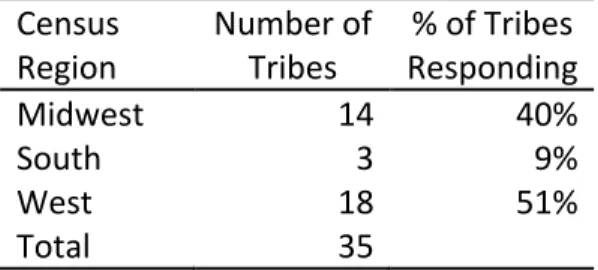
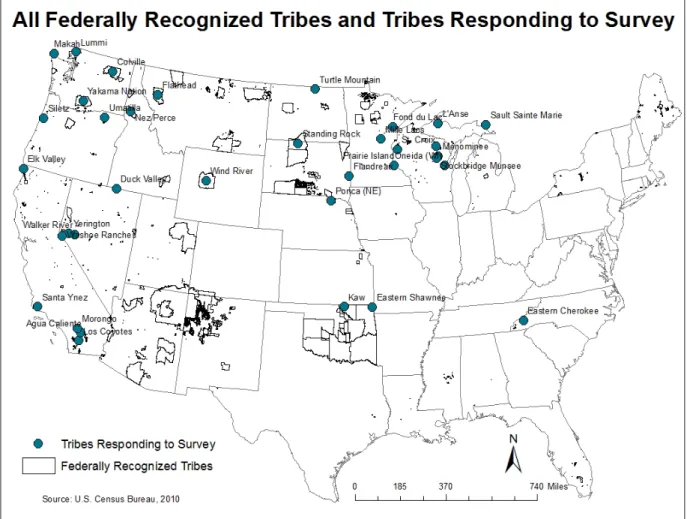
Figure 1 illustrates the locations of tribes responding to the survey and the boundaries of all the tribal lands in the continental U.S. including tribal reservations, trust lands, or statistical areas as defined in the 2010 U.S. Census. Grouping tribes responding to the survey by Census Region (U.S. Census, 2010) revealed that a majority of tribes responding were in the West and Midwest regions (see Table 1). This is probably a reflection of both the high concentrations of continental U.S. tribes in those regions, and the greater
prevalence of potential energy resources on tribal lands in these regions (see Figures 2-‐7 in the Appendix).
Table 1: Responding Tribes by U.S. Census Region
Census
Region Number of Tribes Responding % of Tribes
Midwest 14 40%
South 3 9%
West 18 51%
Total 35
Figure 1: Map of All Federally Recognized Tribes and Tribes Responding to Survey
Source: US Census Bureau, 2010
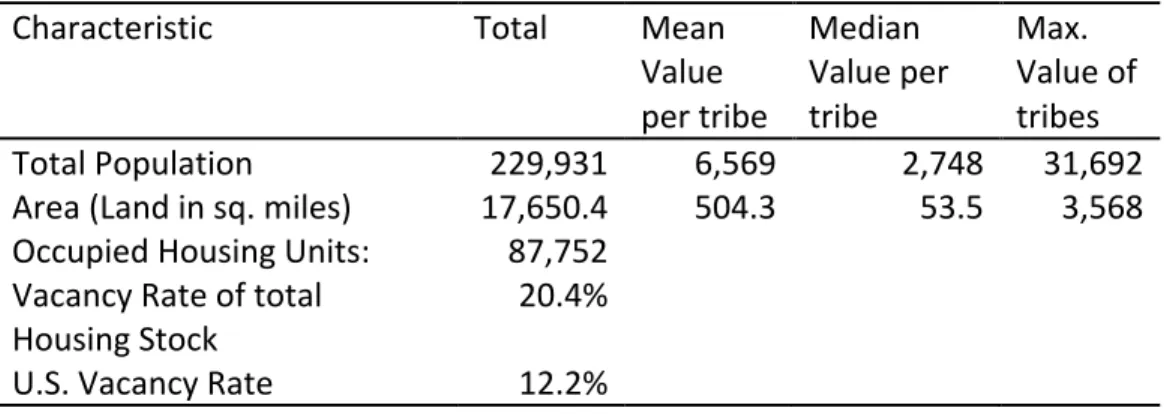
Overall, the 35 tribes that responded to the survey represent tribal reservations and U.S. Census defined American Indian geographies with a total population of nearly 230,000 individuals (See Table 2). According to the American Community Survey 2006 to 2010 five year estimates, the mean population of the responding tribes was 6,569 while the median population was 2,748. There were also differences between the mean and median values for the area of the tribal lands, and the amount of occupied housing units. These
differences between the mean and median values of our survey respondents suggest that many of the responding tribes are small both in terms of land area and in population, but that a few of the responding tribes were comparatively large; such as the Yakama Nation and Confederated Salish & Kootenai Tribes.
Table 2: Population Characteristics of Tribes Responding to Survey
Characteristic Total Mean Value per tribe
Median Value per tribe
Max. Value of tribes Total Population 229,931 6,569 2,748 31,692 Area (Land in sq. miles) 17,650.4 504.3 53.5 3,568 Occupied Housing Units: 87,752 Vacancy Rate of total
Housing Stock 20.4%
U.S. Vacancy Rate 12.2%
Source: ACS 2006 to 2010 (5-‐Year Estimates); U.S. Census Bureau
*Ponca tribe has 0 land and population according to Census defined boundaries
As mentioned earlier, surveys were also sent to TEP Program Review attendees who represented tribes that did not contain the original 10,000 acre sample selection. This resulted in survey responses from 10 tribes that had less than 10,000 acres (15.6 square miles). The tribe responding with the least amount of tribal land and population, the Ponca Tribe of Nebraska, does not have a formal reservation or population according to the U.S. Census Bureau (ACS, 2010) but it does have 2,800 members according to the tribe’s website (Ponca Tribe, 2012). Despite their lack of a large land base, the Ponca tribe indicated that they did have a strategic energy plan and received an Energy Efficiency Conservation Block Grant for building retrofits.
The Ponca also exemplify the difficulty of defining “tribal lands” for some tribes because the U.S. Congress terminated the Ponca tribe in 1966 before being restored to official federal recognition in 1990. During this period of termination, the tribe lost its formally defined boundary, but now has a small trust land area and a 15 county service area where enrolled members can receive services from the tribal government. The Ponca demonstrate how historically institutions outside of the tribal community, such as the U.S. federal
government, have defined the boundaries of tribal lands. The Ponca example also shows how smaller tribes and other tribes without federally recognized reservation or trust lands (such as tribes with state-‐recognition only) can have difficulty in taking control of the development of their energy resources, since they do not have the same land-‐use authority as tribes with larger federally recognized reservations or trust lands. In other words, if a tribe lacks a federally recognized reservation or some type of land base, the tribal
government and members will be subject to the energy resource and land use regulations of other institutions such as municipal, county, or state governments. However, as the Ponca demonstrate, the lack of a large land base has not prevented smaller tribes from pursuing energy efficiency or some renewable energy development opportunities.
4.1.2 Economic Characteristics of Survey Respondents
Economic indicators and characteristics of responding tribes were determined using data provided by the U.S. Census Bureau American Community Survey (ACS) 2006-‐2010
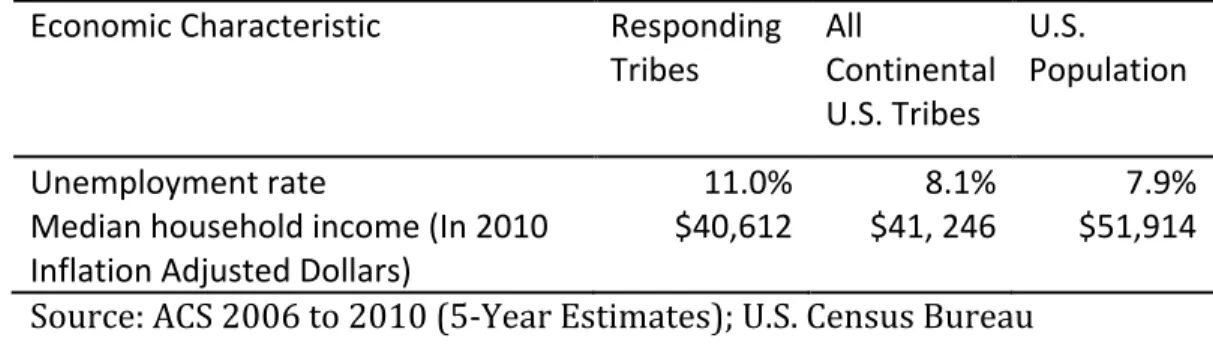
estimates. Overall, these indicators for the responding tribes are lower than corresponding averages for the total U.S. population. The responding tribes had about a 4% higher mean unemployment rate than the U.S. average (see Table 3). The responding tribes also had a 26% lower median household income than the U.S. average and higher poverty rates for all age groups (See Table 3 and Table 12 in the appendix). However, there is a discrepancy between how the U.S. Census ACS calculates the tribal unemployment rate and DOI Bureau of Indian Affairs (BIA) estimates. In 2005, the BIA estimated that the unemployment rate for tribal reservations and nearby indigenous populations in both the continental U.S. and Alaska and Hawaii was 49% (DOI BIA, 2005). Therefore, these ACS estimates maybe underestimating the actual unemployment rate, which is likely to be higher in 2012 since the 2006-‐2010 5-‐year estimates include years before the 2008 financial crisis and
recession.
Table 3: Economic Characteristics for Responding Tribes and U.S. Population
Economic Characteristic Responding
Tribes All Continental U.S. Tribes
U.S.
Population
Unemployment rate 11.0% 8.1% 7.9%
Median household income (In 2010
Inflation Adjusted Dollars) $40,612 $41, 246 $51,914 Source: ACS 2006 to 2010 (5-‐Year Estimates); U.S. Census Bureau
4.2 Energy Development Efforts of the Tribes Surveyed
4.2.1 Types of Energy Resources Developed by the Tribes
included coal bed methane, wind turbine manufacturing, and a natural gas fueled co-‐ generation facility. One of these respondents, the Makah Nation, indicated that they had received a Federal Energy Regulatory Commission (FERC) permit to pursue wave/tidal energy development.
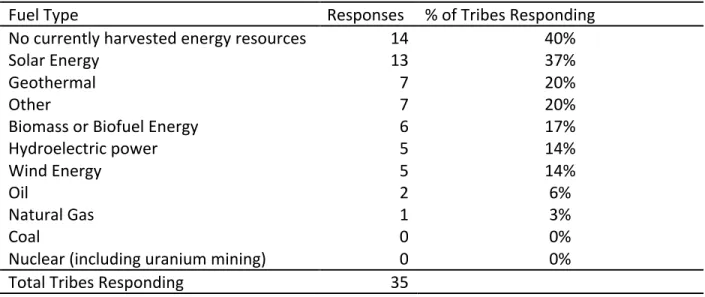
Table 4: Energy Resources Currently Harvested or Pending Development
Fuel Type Responses % of Tribes Responding No currently harvested energy resources 14 40%
Solar Energy 13 37%
Geothermal 7 20%
Other 7 20%
Biomass or Biofuel Energy 6 17%
Hydroelectric power 5 14%
Wind Energy 5 14%
Oil 2 6%
Natural Gas 1 3%
Coal 0 0%
Nuclear (including uranium mining) 0 0%
Total Tribes Responding 35
Out of the tribes surveyed, only two indicated they were currently developing oil, and one of these tribes, the Northern Arapaho in WY, indicated there was also natural gas and coal bed methane development on their tribal lands. The other tribe, the Kaw Nation in OK, indicated that oil could be potentially developed on their tribal lands in the next 0-‐5 years. As seen in Table 4, 40% of the tribes responding to the survey had no currently harvested energy resources or any pending immediate development. However, out of these 14 tribes, 12 indicated that there were potential energy resources that could be developed in the future; including oil, hydroelectric, solar, wind, geothermal, and biomass/biofuel resources (See Table 13 & Table 14 in the Appendix).
4.2.2 Where Energy Resources are Being Developed by the Tribes
Out of all of the tribes that were surveyed, some regional differences emerge regarding the types of energy resources that are developed by the tribes. As mentioned earlier, 14 of the tribes surveyed are in the Midwest region, 18 are in the West, and 3 are in the South. The two tribes that indicated they were currently developing energy resources are located in the West and South regions, where there are more prevalent natural gas resources than other regions of the country, such as the Midwest where there are very few natural gas resources (see Figure 2).