Jenny Sun
Senior Honors Thesis Department of Biostatistics
University of North Carolina at Chapel Hill April 2015
Approved by:
Dr. Eric Bair, Thesis Advisor
D,r, Jane Monaco, Reader
if/
ABSTRACT
Nonspecific orofacial symptoms as risk factors for first-onset TMD and chronic TMD (Under the direction of Dr. Eric Bair)
Previous studies found the count of 6 nonspecific orofacial symptoms was one of
the most important predictors of first-onset TMD. We further examined the influence of
these symptoms (jaw siftness, cramping, fatigue, pressure, soreness, and ache) on
first-onset TMD and chronic TMD among U.S. adults aged 18 to 44 years in the OPPERA
study. We identified 259 first-onset TMD cases and 185 chronic TMD cases. Hazard
ratios were computed to estimate the association between each nonspecific orofacial
symptom and first-onset TMD. We calculated odds ratios to measure the association
between each symptom and chronic TMD. A principal component analysis was used to
determine if all six symptoms are measures of a single underlying construct or largely
independent of one another. Multivariable cox models quantified the combined effects of
non-specific orofacial symptoms, clinical orofacial measures, and first-onset TMD.
Multivariable logistic models examined these same associations on chronic TMD. Each
nonspecific orofacial symptom was significantly associated with increased incidence of
first-onset TMD and greater odds of chronic TMD. Results from the principal component
analysis suggest it is reasonable to summarize the six variables by simply counting the
number of symptoms reported. In the multivariable analysis, nonspecific orofacial
symptoms significantly predicted first-onset TMD (HR=1.33; 95% CI: 1.11-1.59) and
chronic TMD (OR=3.06; 95% CI: 2.03-4.97). The results indicate that the count of
nonspecific orofacial symptoms is an independent risk factor and not a surrogate variable
Introduction
Temporomandibular disorder (TMD) is an umbrella term used to describe
musculoskeletal disorders in the temporomandibular region. This paper focuses on
painful forms of TMD where the defining feature is pain in the temporomandibular joint
or the masticatory muscles.1, 2, 3
In the 2002 National Health Interview Survey, five
percent of adults in the United States reported TMD-type pain (6% of women, 3% of
men).4
Longitudinal studies indicate that the average incidence rate is 4% of people per
annum.5
Most studies report that women have higher prevalence of painful TMD
symptoms than men, with a female-to-male ratio of approximately 2:1. 6,7
The Orofacial Pain: Prospective Evaluation and Risk Assessment (OPPERA)
study was designed to identify potential risk factors for painful TMD. TMD etiology is
multifactorial, with biological, psychological, and social models of causation currently
favored. Although previous studies have identified risk factors for TMD, we could not
clearly indicate whether risk factors predated TMD onset or were a consequence of TMD
because of the cross-sectional study design. OPPERA overcomes this limitation by
conducting a prospective cohort study of initially TMD-free individuals. By using this
design, we can establish a temporal sequence that links risk factors measured prior to
TMD onset to case development.3
Ohrbach and Bair previously explored clinical characteristics associated with
TMD development.8, 9
One characteristic evaluated was nonspecific orofacial symptoms,
which are orofacial symptoms that are not primarily painful. These six symptoms were:
jaw stiffness, cramping, fatigue, pressure, soreness, and ache. Bair found that count of 6
TMD. One hypothesis to explain this association is that nonspecific orofacial symptoms
are merely a precursor to painful TMD, rather than an independent risk factor. If
nonspecific orofacial symptoms are a surrogate variable for known risk factors, then the
theoretical and practical relevance will be diminished.
The aim of this paper is to further investigate the influence of nonspecific
orofacial symptoms on TMD onset and chronic TMD. Specifically, we will use principal
components analysis to better understand the nature of this count of nonspecific orofacial
symptoms. We also used multivariable regression to determine if the associations
between this count and TMD can be explained by surrogate measures of clinical TMD or
major risk factors for TMD (e.g., jaw pain or function limitation) or if it represents an
independent risk factor for TMD.
Methods Study Design
This paper reports findings from the OPERRA prospective cohort study of
first-onset TMD and the baseline case-control study of chronic TMD. Study methods are
explained briefly below and in more depth in previous papers.10
The target population
was community-based volunteers aged 18 to 44 years. To provide a demographically
diverse sample, there were 4 recruitment sites: Baltimore, MD; Buffalo, NY; Chapel Hill,
NC; and Gainesville, FL. Most participants heard of the study through advertisements,
word of mouth, or email. The OPPERA project was reviewed and approved by
institutional review boards at the 4 study sites and at the data-coordinating center,
baseline, all participants completed a questionnaire, clinical examination, measurement of
pain perception and autonomic function, and collection of a blood sample.
Trained examiners classified TMD based on the Research Diagnostic Criteria for
Temporomandibular Disorders. Briefly, people were classified as chronic TMD cases if
they met the following criteria: 1) frequently reported pain in the cheeks, jaw muscles,
temples, or jaw joints during the past 6 months; 2) pain in the orofacial region for at least
5 days in the past month; and 3) evoked pain in at least 3 masticatory muscles or at least
1 tempormandibular joint in response to examiner’s palpation of orofacial muscle
palpation or jaw maneuver. The 6-month time criterion is consistent with the 1994 IASP
recommended threshold for research in chronic pain.13
First-onset TMD cases satisfied
the following criteria: 1) pain within anatomic locations for more than 5 of the past 30
days and 2) examiner findings of pain in muscles, joints, or both from jaw maneuver and
digital palpation of masticatory structures.10
Participants classified as controls met the
following criteria: 1) no previous diagnosis of TMD; 2) infrequent facial pain during the
past 5 months and infrequent headache in the past 3 months; 3) no more than 4 days of
facial pain in the past month; and 4) no use of night guard of occlusal splint.12
Non-specific orofacial symptoms in the past month were assessed with a 6-item check list.
Study Design
The unmatched case-control study enrolled 3,247 controls and 185 chronic TMD
cases between 2006 and 2008. Controls were selected among the participants in the
prospective cohort study using a stratified random sample. Among the 3,247 controls,
prospective cohort study. Follow-up questionnaires were conducted every 3 months
through mid-2012 to screen for TMD symptoms. Questions inquired about “headaches or
pain in your face, jaw, temples in front of the ear, or in the ear”, which is defined as
orofacial pain. The self-reported questionnaires were completed at home prior to a
follow-up clinical examination. Examiners re-evaluated symptomatic study participants,
and 259 people were classified with first-onset TMD. Examiners did not refer to
questionnaire responses during the diagnosis of TMD. More detailed information about
the follow-up questionnaires and clinical assessments can be found in other papers.14
Statistical Analysis
First, each non-specific orofacial symptom was individually assessed. The
univariate association between each symptom and first-onset TMD was examined using
Cox proportional hazards regressions. Hazard ratios (HRs), 95% confidence intervals
(95% CIs), and p-values were computed. Although the hazard ratio is a theoretical
construct, it provides a good approximate of the average incidence rate-ratio in a cohort
study. The Cox proportional hazards models have convenient statistical advantages over
other methods that model the incidence rate directly. HRs were adjusted for study site
and the following demographics: age, gender (male, female) and race/ethnicity (White,
African-American/Black, Hispanic, Asian, and Other). To evaluate the association
between each non-specific orofacial symptom and chronic TMD, logistic regression was
used. ORs, 95% CIs, and p-values were calculated. ORs were adjusted for study site and
Principal component analysis is a technique used to model the variation between a
set of variables. This procedure was used to determine if all six symptoms are measures
of a single underlying construct or if the variables are largely independent of one another.
The correlation between each of the six symptoms was also computed.
Multivariable models were used to further examine the effects of nonspecific
orofacial symptoms and determine whether non-specific orofacial symptoms act as a
substitute variable for pain, jaw function limitation, or somatic awareness.A multivariable
Cox regression model was used to estimate the combined effects of non-specific orofacial
symptom count, various clinical pain measures, study site, and demographic variables on
TMD incidence. The following clinical pain variables were included in the multivariable
model: the Facial Pain Intensity Score from the Graded Chronic Pain Scale, the global
score for the Pennebaker Inventory Limbic Languidness, and number of palpation tender
points in the following regions: right temporalis, left temporalis, right masseter, left
masseter, right mandibular, left mandibular, right lateral pterygoid, left lateral pterygoid,
right temporomandibular (TM) joint, and left TM joint. Pain in response to palpation
tender points in these regions is part of TMD case-classification. These clinical pain
measures were selected because they may be a surrogate variable for the number of
non-specific orofacial symptoms. Three separate models were tested: one crude model, one
model adding demographics variables, and one model adding demographic and clinical
pain variables. All models were adjusted for study site. HRs and 95% CIs were
calculated. A multivariable logistic regression model was also conducted to examine the
association between these same variables and chronic TMD. ORs and 95% CIs were
Results
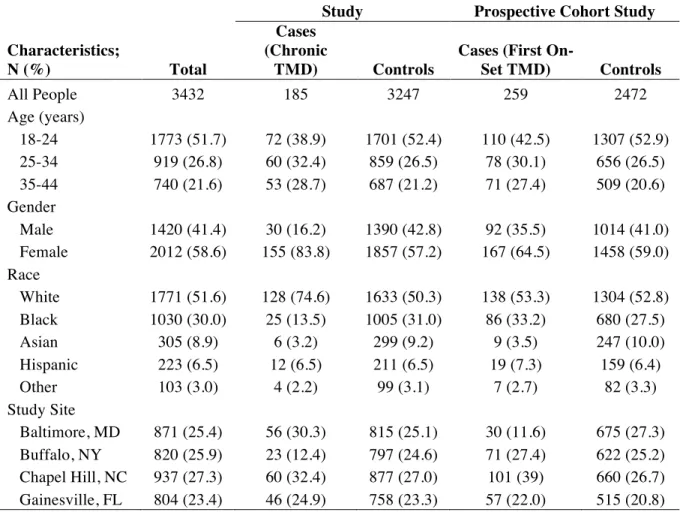
Brief demographic information is reported in Table 1. More detailed descriptive
statistics have been reported in previous OPPERA papers.10
In the prospective cohort
study, 2,731 initially TMD-free participants were followed for a total of 7,378
person-years (median=2.8 person-years/person). During this time, 259 people developed first-onset
TMD. The baseline case-control study consisted of 185 chronic TMD cases and 3247
controls. Participants were more likely to be 18-24 years old (51.7%), female (58.6%),
and white (51.6%).
Assessment of each non-specific orofacial symptom
Hazard ratios and 95% confidence intervals for the associations between each
non-specific orofacial symptom and TMD incidence are presented in Table 2. For each
non-specific orofacial symptom, presence of the symptom predicted TMD incidence. The
strongest predictor of TMD incidence was cramping in the past 6 months (HR=3.09; 95%
CI: 1.77-5.40). Cramping was reported in 4% of TMD cases. The weakest predictor is
fatigue (HR=1.43; 95% CI: 0.90-2.25).
ORs and 95% CIs estimating the association between nonspecific orofacial
symptoms and chronic TMD are displayed in Table 3. Each non-specific orofacial
symptom is significantly associated with chronic TMD. Ache in the past 6 months is the
strongest association (OR=167.36; 95% CI: 88.83-322.57). 95% of TMD cases reported
Relationship between the non-specific orofacial symptoms
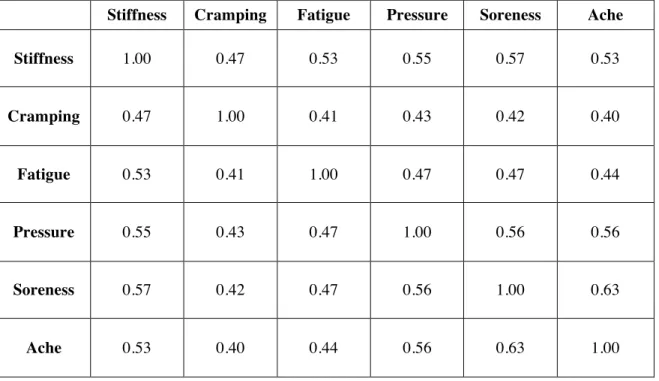
Table 4 illustrates the correlation between each non-specific orofacial symptom.
The 6 symptoms are moderately correlated, with correlations ranging from 0.40 to 0.63.
Ache and soreness are the most correlated (r=0.63).
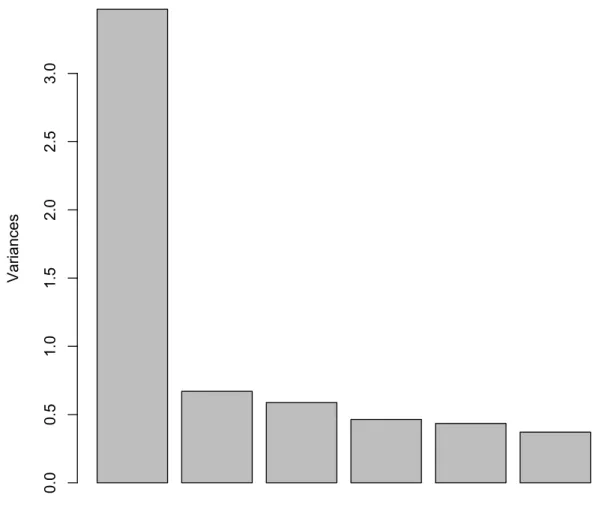
The scree plot for the principal component analysis is shown in Figure 1. The first
component explains the majority of the variance (variances greater than 3.0). The five
remaining components explain a smaller proportion of the variance in the data. All the
loadings are approximately equal, indicating that it is reasonable to summarize the six
variables by simply counting the number of symptoms reported.
Multivariable Models
The HRs and 95% CIs for the multivariable association between nonspecific
orofacial symptoms and first-onset TMD are shown in Table 6. The count of nonspecific
orofacial symptoms significantly predicts incidence of first-onset TMD in all 3 models.
After adding clinical pain variables in model 3, the number of nonspecific orofacial
symptoms remains significantly associated with increased incidence of first-onset TMD
(HR=1.33; 95% CI: 1.11-1.59). This suggests that count of non-specific orofacial
symptoms is not a substitute for any of the clinical pain variables, but rather an
independent risk factor that is associated with increased incidence of first-onset TMD.
Table 7 displays the ORs and 95% CIs for the multivariable association between
nonspecific orofacial symptoms and chronic TMD. In the first 2 models, the crude model
and the model that includes demographic variables, the count of nonspecific orofacial
were added in model 3, the symptom count was significantly associated with greater odds
Table 1. Descriptive Characteristics of OPPERA Study Participants
Baseline Case-Control
Study Prospective Cohort Study
Characteristics;
N (%) Total
Cases (Chronic
TMD) Controls
Cases (First
On-Set TMD) Controls
All People 3432 185 3247 259 2472
Age (years)
18-24 1773 (51.7) 72 (38.9) 1701 (52.4) 110 (42.5) 1307 (52.9)
25-34 919 (26.8) 60 (32.4) 859 (26.5) 78 (30.1) 656 (26.5)
35-44 740 (21.6) 53 (28.7) 687 (21.2) 71 (27.4) 509 (20.6)
Gender
Male 1420 (41.4) 30 (16.2) 1390 (42.8) 92 (35.5) 1014 (41.0)
Female 2012 (58.6) 155 (83.8) 1857 (57.2) 167 (64.5) 1458 (59.0)
Race
White 1771 (51.6) 128 (74.6) 1633 (50.3) 138 (53.3) 1304 (52.8)
Black 1030 (30.0) 25 (13.5) 1005 (31.0) 86 (33.2) 680 (27.5)
Asian 305 (8.9) 6 (3.2) 299 (9.2) 9 (3.5) 247 (10.0)
Hispanic 223 (6.5) 12 (6.5) 211 (6.5) 19 (7.3) 159 (6.4)
Other 103 (3.0) 4 (2.2) 99 (3.1) 7 (2.7) 82 (3.3)
Study Site
Baltimore, MD 871 (25.4) 56 (30.3) 815 (25.1) 30 (11.6) 675 (27.3)
Buffalo, NY 820 (25.9) 23 (12.4) 797 (24.6) 71 (27.4) 622 (25.2)
Chapel Hill, NC 937 (27.3) 60 (32.4) 877 (27.0) 101 (39) 660 (26.7)
Table 2. Univariate Associations between Non-Specific Orofacial Symptoms and Incidence Rate of First-Onset TMD
Symptom
TMD-free; N (%)
First-Onset TMD cases;
N(%) HR (95% CI)*
Adjusted HR
(95% CI)** P Value
Stiffness
Yes 145 (6) 33 (13) 1.13 (0.74, 1.72) 1.80 (1.20, 2.71) 0.005
No 2323 (94) 225 (87) 1.00 1.00 .
Cramping
Yes 54 (2) 11 (4) 2.36 (1.23, 4.54) 3.09 (1.77, 5.40) <0.001
No 2414 (98) 247 (96) 1.00 1.00.
Fatigue
Yes 125 (5) 29 (11) 1.18 (0.78, 1.78) 1.43 (0.90, 2.25) 0.128
No 2342 (95) 229 (89) 1.00 1.00.
Pressure
Yes 117 (5) 31 (12) 1.75 (1.20, 2.56) 1.80 (1.20, 2.71) 0.004
No 2350 (95) 227 (88) 1.00 1.00.
Soreness
Yes 139 (6) 38 (15) 2.16 (1.51, 3.08) 2.20 (1.58, 3.06) <0.001
No 2330 (94) 220 (85) 1.00 1.00.
Ache
Yes 200 (8) 44 (17) 2.01 (1.46, 2.76) 2.12 (1.53, 2.93) <0.001
No 2267 (92) 212 (83) 1.00 1.00.
*Adjusted for study site
Table 3. Univariate Associations Between Nonspecific Orofacial Symptoms
and Chronic TMD
Symptom
TMD-free; N(%)
TMD cases;
N(%) OR (95% CI)*
Adjusted OR
(95% CI)** P Value
Stiffness
Yes 215 (7) 169 (92) 163.66 (94.57, 283.22) 156.73 (90.00, 272.94) <.001
No 3025 (93) 15 (8) 1.00 . 1.00 .
Cramping
Yes 83 (3) 79 (43) 30.96 (21.29, 45.03) 34.49 (22.95, 51.85) <.001
No 3156 (97) 103 (57) 1.00. 1.00.
Fatigue
Yes 183 (6) 130 (71) 42.66 (29.84, 60.98) 42.08 (29.01, 61.03) <.001
No 3054 (94) 52 (29) 1.00 . 1.00.
Pressure
Yes 177 (5) 138 (75) 55.63 (38.24, 80.94) 48.51 (33.10, 71.09) <.001
No 3060 (95) 46 (25) 1.00. 1.00.
Soreness
Yes 218 (7) 164 (90) 140.63 (84.04, 235.33) 135.32 (80.23, 228.24) <.001
No 3022 (93) 18 (10) 1.00. 1.00.
Ache
Yes 300 (9) 173 (95) 183.34 (95.43, 352.25) 167.36 (86.83, 322.57) <.001
No 2934 (91) 10 (5) 1.00. 1.00.
*Adjusted for study site
Table 4. Correlation Matrix for Nonspecific Orofacial Symptoms
Stiffness Cramping Fatigue Pressure Soreness Ache
Stiffness 1.00 0.47 0.53 0.55 0.57 0.53
Cramping 0.47 1.00 0.41 0.43 0.42 0.40
Fatigue 0.53 0.41 1.00 0.47 0.47 0.44
Pressure 0.55 0.43 0.47 1.00 0.56 0.56
Soreness 0.57 0.42 0.47 0.56 1.00 0.63
Figure 1. Scree Plot of the Nonspecific Orofacial Symptoms PCA Results
Table 5. Matrix of Loadings for the PCA Results of the First Component
Stiffness Cramping Fatigue Pressure Soreness Ache
PC1 -0.43 -0.36 -0.39 -0.42 -0.43 -0.42
Scree Plot of the Nonspecific Orofacial Symptoms PCA Results
Va
ria
nce
s
0.0
0.5
1.0
1.5
2.0
2.5
Table 6. Multivariable-Adjusted Associations between Nonspecific Orofacial Symptoms and First-Onset TMD Model 1* Model 2* Add: Demographics Model 3* Add: Pain Measures
Variable Coding
HR
(95% CI) P Value
HR
(95% CI) P Value
HR
(95% CI) P Value
Number of nonspecific
orofacial symptoms
z-score 1.32
(1.21, 1.45) <0.001
1.31
(1.20, 1.43) <0.001
1.23
(1.09, 1.39) 0.001
*All models adjusted for study site
Table 7. Multivariable-Adjusted Associations between Nonspecific Orofacial Symptoms and Chronic TMD
Model 1*
Model 2* Add: Demographics
Model 3* Add: Pain Measures
Variable Coding
OR (95% CI)
P
Value
OR
(95% CI) P Value
OR
(95% CI) P Value
Number of nonspecific
orofacial symptoms
z-score 4.51
(3.80, 5.47) <0.001
4.93
(4.03, 6.23) <0.001
3.06
(2.03, 4.97) <0.001
*All models adjusted for study site
Discussion
Bair previously found that count of 6 nonspecific orofacial symptoms was one of
the most important predictor of first-onset TMD.9
Here we show that during the median
2.8 follow-up years of the OPPERA prospective cohort study, each of the 6 nonspecific
orofacial symptoms individually predicted incidence of TMD. In the baseline
case-control study, each individual nonspecific orofacial symptom is also significantly
associated with greater odds of chronic TMD. Though the correlation matrix shows that
nonspecific orofacial symptoms are interrelated, the count of symptoms represents an
individual construct. The principal component analysis further supports this conclusion,
since the large majority of the variance was captured by the first component. Since each
of the symptoms produced similar loadings, that indicates that a simple count of the
symptoms provides an adequate measure of this construct.
In the multivariable analysis, the count of nonspecific orofacial symptoms is a
significant predictor of first-onset TMD even after the addition of demographic variables
and clinical pain measures. The significance of the symptom count in the fully adjusted
model corroborates the hypothesis that count of nonspecific orofacial symptoms predicts
chronic TMD independently of other risk factors. One hypothesis to explain the strength
of the association between symptom count and TMD was that these symptoms
represented measures of pain or preclinical TMD symptoms, so it would not be surprising
that those with nonspecific orofacial symptoms converted to acute TMD. However, we
now see that this is not the case, as the symptom count remains significant after including
the pain variables. Indeed, the effect size of the symptom count is hardly modified when
symptoms is not simply a surrogate variable for pain. These 6 symptoms were asked in
the questionnaire to capture experiences that were seemingly adverse, but did not fit the
definition of “pain” used for TMD case classification. Ohrbach previously suggested that
the neurobiology underlying the semantics of the nonspecific orofacial symptoms is
likely different from pain. These findings support Ohrbach’s hypothesis.
In summary, the count of nonspecific orofacial symptoms represents an
independent construct that predicts both first-onset and chronic TMD independently of
other risk factors. The number of symptoms is not a substitute variable for pain, but its
References
1. Dworkin SF, LeResche L, editors. Research Diagnostic Criteria for
Temporomandibular Disorders: review, criteria, examinations and specifications,
critique. J Craniomandib Disord Facial Oral Pain. 1992; 4(6): 301–355.
2. Sessle BJ, Bryant PS, Dionne RA, editors. Temporomandibular Disorders and Related
Pain Conditions. Seattle: IASP Press. 1995.
3. Maixner W, Diatchenko L, Dubner R, Fillingim RB, Greenspan JD, Knott C, Ohrbach
R, Weir B, Slade GD. Orofacial pain prospective evaluation and risk assessment study—
The OPPERA study. J Pain. 2011; 12(11): T4-T11.e2.
4. Isong U, Gansky SA, Plesh O. Temporomandibular joint and muscle disorder-type
pain in U.S. adults: The National Health Interview Survey. J Orofac Pain. 2008; 22:
317-322.
5. Slade GD, Bair E, By K, Mulkey F, Baraian C, Rothwell R, Reynolds M, Miller V,
Gonzalez Y, Gordon S, Ribeiro- Dasilva M, Lim PF, Greenspan JD, Dubner R, Fillingim
RB, Diatchenko L, Maixner W, Dampier D, Knott C, Ohrbach R. Study methods,
recruitment, sociodemographic findings, and demographic representativeness in the
6. Locker D, Slade G. Prevalence of symptoms associated with temporomandibular
disorders in a Canadian population. Community Dent Oral Epidemiol. 1988; 16: 310-313.
7. Solberg WK. Epidemiology, incidence and prevalence of temporomandibular
disorders, in Laskin D, Greenfield W, Gale W (eds): The President’s Conference of the
Examination, Diagnosis, and Management of Temporomandibular Disorders. Chicago,
IL, American Dental Association, 1983.
8. Ohrbach R, Bair E, Fillingim RB, Gonzalez Y, Gordon SM, Lim P-F, Ribeiro-Dasilva
M, Diatchenko L, Dubner R, Greenspan JD, Knott C, Maixner W, Smith SB, Slade GD.
Clinical Orofacial Characteristics Associated With Risk of First-Onset TMD: The
OPPERA Prospective Cohort Study. J Pain. 2013; 14(12): T33-T50.
9. Bair E, Ohrbach R, Fillingim RB, Greenspan JD, Dubner R, Diatchenko L, Helgeson
E, Knott C, Maixner W, Slade GD. Multivariable modeling of phenotypic risk factors for
first- onset TMD: The OPPERA prospective cohort study. J Pain. 2013; 14(12):
T102-T115.
10. Slade GD, Bair E, By K, Mulkey F, Baraian C, Rothwell R, Reynolds M, Miller V,
Gonzalez Y, Gordon S, Ribeiro-Dasilva M, Lim PF, Greenspan JD, Dubner R, Fillingim
RB, Diatchenko L, Maixner W, Dampier D, Knott C, Ohrbach R. Study methods,
recruitment, sociodemographic findings, and demographic representativeness in the
11. Dworkin SF, LeResche L. Research diagnostic criteria for temporomandibular
disorders: Review, criteria, examinations and specifications, critique. J Craniomandib
Disord Facial Oral Pain. 1992; 6: 301–355.
12. Greenspan JD, Slade GD, Bair E, Dubner R, Fillingim RB, Ohrbach R, Knott C,
Diatchenko L, Liu Q, Maixner W: Pain sensitivity and autonomic factors associated with
development of TMD: The OPPERA prospective cohort study. J Pain. 2013; 14(12):
T63-T74.e6.
13. Merskey H, Bogduk N. Classification of chronic pain: Descriptions of chronic pain
syndromes and definitions of pain terms. Seattle, WA: IASP Press; 1994.
14. Bair E, Brownstein NC, Ohrbach R, Greenspan JD, Dubner R, Fillingim RB, Maixner
W, Smith SB, Diatchenko L, Gonzalez Y, Gordon SM, Lim P-F, Ribeiro- Dasilva M,
Dampier D, Knott C, Slade GD: Study protocol, sample characteristics, and loss to