TSAAC: THRESHOLD SENSITIVE ASSISTANT AIDED
CLUSTERING PROTOCOL FOR HETEROGENEOUS WSNs
USING NICHING PARTICLE SWARM OPTIMIZATION
1A. KARTHIKEYAN, 2FALAK JINDAL,2 NEERAJ KAUR BUMRAH, 2 SWAPNIL PAMECHA 3T.SHANKAR
1
Assistant Professor (Sr.), School of Electronics Engineering, VIT University, Vellore, India
2
B.Tech Electronics and Communication Engineering IV year student, VIT University, Vellore, India
3
Assistant Professor (SG.), School of Electronics Engineering, VIT University, Vellore, India
E-mail: 1
[email protected]
,
2 [email protected]ABSTRACT
The energy efficiency and improvement in network’s lifetime are some of the critical issues in wireless sensor networks (WSNs). Remote environmental monitoring and target tracking are the important applications of a wireless sensor network. In this paper, TSAAC (Threshold Sensitive Assistant Aided Clustering) a heterogeneous protocol using Niching Particle Swarm Optimization (NPSO), for wireless sensor networks is proposed. It employs three levels of heterogeneity with cluster head being selected optimally based on the fitness function of NPSO, which is an important technique for multimodal optimization. To further balance the energy dissipation and enhance the system robustness, an assistant cluster head can be selected based on the cluster state information. Being threshold sensitive, this protocol significantly improves the stability period and reduces energy consumption considerably by 14% compared to TSEP (Threshold Sensitive Stable Election Protocol). The performance of the proposed protocol is compared with the existing protocols like LEACH, AAAC-NPSO, SEP and TSEP. The simulation results show that TSAAC-NPSO can achieve better network lifetime.
Keywords: –
WSNs (Wireless Sensor Networks), NPSO (Niching Particle Swarm Optimization),Heterogeneity, Assistant-Aided Clustering, Thresholding.
1. INTRODUCTION
With advancements in technology especially with the development of Micro-Electro-Mechanical System (MEMS) and Very Large Scale Integration (VLSI) Technology, Wireless Sensor Networks (WSNs) are gaining more importance. Wireless sensor network consists of hundreds to thousands of small sensor nodes which perform data collection, compression, aggregation and transmission, acquired from the physical environment to an external base station (BS), thus allowing analysis of various physical parameters or environmental conditions such as temperature, humidity, sound, motion, etc. Energy is one of the most essential resources of a wireless sensor network as sensor nodes are limited in power as they are battery operatable. Once deployed, the sensor nodes are often unreachable to users and thus, periodically replacing the battery of the nodes in large scale is not feasible. Therefore, a robust and energy- efficient method to manage data generated by sensors as well as to minimize power
consumption is required to enhance the life- time of WSNs [1].
Clustering is one of the important techniques used to manage the network energy consumption efficiently by distributing the energy consumption evenly among the nodes in the network. In this approach, the entire network of nodes will be divided into groups and each group of sensor nodes has a cluster head node which performs data aggregation and transmission to base station. It reduces number of nodes taking part in transmission as well as communication overhead, thus, useful in energy consumption and scalability of nodes as well as enhancing resource allocation and bandwidth reusability [2].
niching method is included in PSO, multiple stable solutions can be obtained in parallel [3].
2. BACKGROUND
In this section, detailed description of various protocols whose performance would be compared with the proposed protocol is provided.
2.1 LEACH Protocol
A cluster-based protocol, Low Energy Adaptive Clustering Hierarchy (LEACH), proposed in [5] randomly elects cluster head among the nodes in the network based upon some probability. Each node generates a random number r inclusive of 0 and 1, if generated value is less than threshold computed by formula given below, then this node becomes CH.
Where, G is set of nodes that has not become CHs in the past. LEACH does not guarantee evenly positioning of the cluster heads and desired number of cluster heads being selected in the network. It organizes its operation in rounds where each round consists of cluster head set up followed by data aggregation and data transmission to the sink. Clusters are re-established in each round. All the nodes in the network are homogeneous and constrained in energy. After cluster formation nodes sense and transmit data to the associated cluster head.
2. 2 Adaptive Assistant Aided Clustering Protocol using Niching Particle Swarm Optimization (AAAC-NPSO)
As described in [7], an Adaptive Assistant Aided Clustering Protocol using niching PSO (AAAC-NPSO) considers the sensor network’s state information such as residual energy, the average distance between the cluster head and its member nodes for cluster head selection. It takes the advantage of niching PSO that can get multimodal optimal values. If needed an assistant aided cluster head is chosen based on the threshold function aiming to enhance the existing clustering algorithms. Compared to LEACH and PSO, energy consumption is minimal and has higher network life span. All the nodes deployed are homogeneous.
2. 3 Stable Election Protocol (SEP)
A Stable Election Protocol (SEP) [8], considers the two level heterogeneity of nodes using characteristics parameters namely additional energy factor α between the advance and the normal nodes and the fraction m of advance nodes which enhance the stability period which is crucial in many applications. The probabilities of normal nodes and advance nodes to become cluster head can be calculated by using following formulas:
Where, p is probability of each node to become CH.
2.4 Threshold Sensitive Stable Election Protocol (TSEP)
An extension of SEP, Threshold Sensitive Stable Election Protocol (TSEP), proposed in [9] is a reactive routing protocol where nodes sense data continuously, however, transmit only at the time when there is a drastic change in sensed value and also it considers three level heterogeneity. Cluster head node selection in is done randomly on the basis of probability of each type of node (normal node, intermediate node and advance node) as in LEACH. The probabilities of normal nodes, intermediate nodes and advance nodes to become cluster head can be calculated by using formulas given below:
3. NITCHING PARTICLE SWARM OPTIMIZATION (NPSO)
Bio inspired optimization approaches usually can find good solutions efficiently and effectively. Particle Swarm Optimization (PSO) is a popular population- based optimization technique motivated by the social behaviour of a flock of birds.
PSO algorithm locates a single global solution because of the global selection scheme used. However, many real world problems require multimodal satisfactory solutions. Niching is an important technique that has been developed in the past for locating multiple optima (global or local). Since a niching PSO searches for multiple optima in parallel, the probability of getting trapped on a local optimum may be reduced, which is of great value even when the objective is to locate a single global optimum [4].
PSO consists of swarm of particles that are initialized randomly. Each particle in the swarm represents a potential solution. The basic idea of the PSO is to find the particle position that results in the best evaluation of a given fitness function. In PSO, each particle randomly searches through the multidimensional search space by updating itself with its own memory and the information gathered from its neighbouring particles. During the evolution process, these components are represented in terms of two best locations i.e. particle’s previous best individual position and global best position. This information is used to maximize the probability of moving towards a better solution space that will result in a better fitness. When a fitness better than the individual best fitness is found, it is be used to replace the individual best fitness.
4. PROPOSED PROTOCOL
In this section, the proposed protocol TSAAC-NPSO (Threshold Sensitive Assistant Aided Clustering Protocol using Niching Particle Swarm Optimization) is described. It has mainly three features:
1. Three levels of heterogeneity that prolongs the stability period.
2. Based on cluster’s information, if needed, an assistant cluster head is selected.
3. Transmission is possible only when a specific threshold is reached as continuous transmission consumes more energy.
4.1 Heterogeneity
We consider a heterogeneous network with nodes having different levels of energy:
1. Normal nodes 2. Intermediate nodes 3. Advance nodes
Advance nodes are nodes with highest energy level, intermediate nodes with energy in between normal and advance nodes while the remaining are normal nodes. Energy for normal nodes is Eo, for advance nodes it is
and for intermediate nodes it
can computed as , where
. Total energy of normal nodes will be for intermediate nodes it will be and for advance nodes it will be . So, the total energy of nodes will be:
Where, n is number of nodes, m is fraction of nodes which are advance nodes, b is fraction of nodes which are intermediate nodes, α is energy factor for advance nodes, u is energy factor for advance nodes.
4.2. Cluster Head Setup using NPSO algorithm
Cluster head (CH) is selected based on the optimal fitness function which is closely related with the properties of problem domain and determines the algorithm’s performance of the optimal solution directly. As in [7], fitness function for NPSO considers the residual energy of the node and the average distance between the cluster head and its member nodes as these are some important parameters in cluster head
selection. f(i) for node i is defined as follows:
(1)
Where, E(i) is the residual energy of ith node, f1(i) is the ratioof node i’s energy to the
average residual energy within the cluster, n is the total number of member nodes, f2(i) considers the
residual energy and the distance between the node and the other nodes among the cluster, α is weight of functions that we get from experiments. So according to this fitness function the node that has the maximum value is chosen as the cluster head.
4.3 Assistant Aided Cluster Head Setup
If cluster head has little residual energy, the distance is far from the base station and the amount of nodes among the cluster is large then an assistant aided cluster head (AACH) is selected based on the threshold function defined below to balance the energy dissipation and enhance the system robustness :
Where, c is control parameter, Ere is the
residual energy of the cluster head, Emax is the
maximum energy of the CH, davg is the average
distance between BS and the nodes in the network, d(CH,BS) is the distance between the CH
and the BS, Navg is the average number of nodes
in the cluster, NCi is the number of nodes in the
cluster i. A random number is chosen by CH, if the number is less than TAACH then cluster need to
select a node as AACH.
4.4 Threshold Sensitive Approach
Nodes keep on sensing continuously but transmission is done only when there is a drastic change in the sensed value hence, reducing energy consumption of the network which is crucial for many applications.
At every cluster change time, the cluster-head broadcasts to its members the following parameters:
Hard Threshold (HT): If sensed value becomes equal to or greater than this threshold value, then node switch on its transmitter and transmits that information to cluster head.
Soft Threshold (ST): This is a small change in the sensed value that triggers the node to switch on its transmitter and transmit.
All nodes keep on sensing environment continuously. Transmitter is turned on only when parameters reach hard threshold value and then
data is transmitted to CH, however it is only for the first time. This sensed value is stored in an internal variable in the node, called Sensed Value (SV). Then for second time and the other, data is transmitted only if sensed value is greater than hard threshold value or if difference between currently sensed value and the value stored in SV variable is equal to or greater than soft threshold.
5. SIMULATION RESULTS
The performance of the proposed protocol is evaluated using MATLAB. The performance of the proposed protocol TSAAC-NPSO is compared with LEACH, AAAC-TSAAC-NPSO, SEP and TSEP on the basis of energy dissipation and longevity of network.
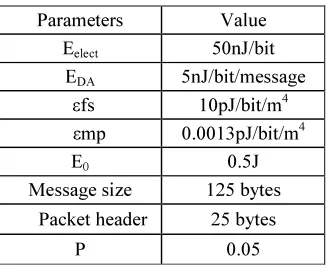
A network consisting of 100 nodes placed randomly in a region of 200×200 is considered. Simulations are performed with m = 0.2, α = 3 for different locations of BS in network. For the first case, BS is considered at the centre of the network that is (100, 100). For the second case, BS is considered at (180, 180). This is done to observe change in network’s stability and life relative to change in BS location. Other parameters used in simulations are shown below in Table I.
Table 1: Simulation Parameters
Parameters Value
Eelect 50nJ/bit
EDA 5nJ/bit/message
εfs 10pJ/bit/m4
εmp 0.0013pJ/bit/m4
E0 0.5J
Message size 125 bytes Packet header 25 bytes
[image:4.595.330.493.480.619.2]
(a)
[image:5.595.89.510.96.530.2](b)
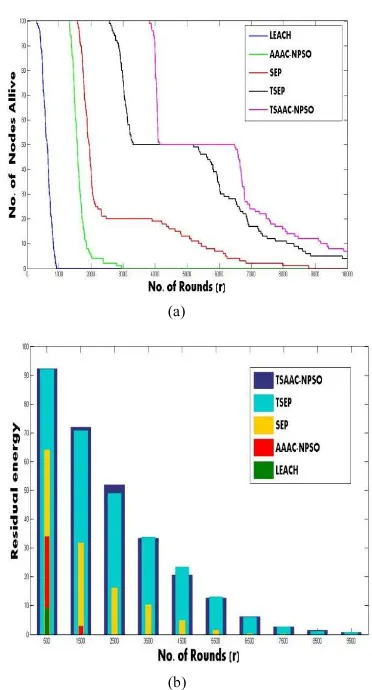
Fig. 1 Shows Simulation Results When M=0.2, Α=3 With BS Located At (100,100) (A) Number Of Nodes Alive Over Time (B) Residual Energy Of The Network
Over Time
Fig. 1(a) illustrates the system lifetime defined by the number of nodes alive over time. Comparing all the protocols, AAAC-NPSO shows better result than LEACH because it produces better network partitioning with minimum intra cluster distance and does optimal selection of cluster head. SEP with two levels of heterogeneity shows better results than the above two protocols. TSEP, threshold based protocol with three levels of heterogeneity obviously shows better results as stability period is greater than the above discussed protocols. But our proposed protocol prolongs the network lifetime significantly. This is because of more nodes available with extra energy and cluster heads are optimally distributed across the network. A threshold function is considered to determine if an assistant cluster head is needed to balance energy dissipation. And the threshold sensitive approach in which nodes keep on sensing but transmission is done only at particular threshold reduces the energy consumption and
hence, results in increased stability period and network lifetime compared to other protocols.
Fig. 1(b) shows the residual energy of the network, the protocol we proposed consumes less energy compared to other protocols.
(a)
[image:5.595.102.289.108.454.2](b)
Fig.2 Shows Simulation Results When M=0.2, Α=3 With BS Located At (180,180) (A) Number Of Nodes Alive Over Time (B) Residual Energy Of The Network
Over Time
[image:5.595.325.511.206.551.2]
sensing but transmission is done only when a particular threshold is reached.
6. CONCLUSION
In this paper TSAAC-NPSO, Threshold Sensitive Assistant Aided Clustering Protocol using Niching Particle Swarm Optimization with three level of heterogeneity is proposed. Cluster head selection is fitness based which takes into consideration the residual energy of nodes and the average distance between the member nodes and its cluster head. Based on cluster state information that is residual energy of CH, its distance from BS and number of nodes among cluster, if needed an assistant cluster head is selected. Results from the simulation indicate that the proposed protocol gives higher network lifespan and energy consumption is minimal compared to LEACH, AAAC-NPSO, SEP and TSEP. It can also be concluded that this proposed protocol will improve the stability period significantly.
REFERENCES
[1] J. Yick, B. Mukherjee, D. Ghosal, "Wireless
Sensor network survey",Computer
Networks, vol. 52, no. 12., 2008,pp. 2292-2330.
[2] A. Abbasi, M. Younis, "A survey on Clustering algorithms for wireless sensor networks" Computer Communications, vol. 30, no. 14-15, 2007,pp.2826-2841.
[3] R. Kulkarni, G. Venayagamoorthy, "Particle Swarm Optimization in Wireless Sensor Networks: A Brief Survey",IEEE Trans. Systems, Man & Cybernetics, vol. 41, no. 2, 2011, pp. 262-267.
[4] X. Li, "Niching Without Niching Parameters: Particle Swarm Optimization Using a Ring Topology", IEEE Trans.Evol
Comput., vol. 14, no.14, pp. 150-169.
[5] W. B. Heinzelman, A. P. Chandrakasan, H.Balakrishnan, "An
Application-SpecificProtocol Architecture for Wireless
Microsensor Networks",IEEE Trans.
Wireless Commun., vol. 1, no. 4, 2002, pp. 660-770.
[6] J. Tillet, R. Rao, F. Sahin, "Cluster-head identification in ad hoc sensor networks using
particle swarm optimization", IEEE
International Conference on Personal
Wireless.
[7] Dexin Mal, Jian Mal and Pengmin Xu, “An
Adaptive Assistant-Aided Clustering Protocol for WSNs Using Niching Particle Swarm
Optimization” 4th IEEE International
Conference on Software Engineering and Service Science (ICSESS), 2013.
[8] G. Smaragdakis, I. Matta and A. Bestavros, "SEP: A stable election protocol for clustered
heterogeneous wireless sensor networks", in Second International Workshop on Sensor
and Actor Network Protocols and
Applications (SANPA 2004).
[9] A. Kashaf, N. Javaid, Z. A. Khan, I. A. Khan,“TSEP: Threshold-sensitive Stable Election
Protocol for WSNs”, 10th International
Conference on Frontiers of Information Technology 2012.
[10]T. Shankar, S. Shanmugavel, A.Karthikeyan,” Hybrid approach for energy optimization in wireless sensor networks usingPSO”,International Review
on Computers and Software (IRECOS), vol.
8, no. 6, 2013.
[11]T. Shankar, S. Shanmugavel, A. Karthikeyan, Akanksha Mohan Gupte, Suryalok Sarkar,
“Load balancing and optimization if network lifetime by use of double cluster head clustering algorithm and its comparison with various extended LEACH
versions”, International Review on
Computers and Software (IRECOS), vol. 8, no. 3, 2013.
[12] W. Heinzelman, A. Chandrakasan and H. Balakrishnan, “Energy- Efficient Communication
Protocols for Wireless Microsensor
Networks.” In Proceedings of Hawaiian
International Conference on Systems Science, January 2000.
[13] Femi A. Aderohunmu, Jeremiah D. Deng,” An Enhanced Stable Election Protocol (SEP) for
Clustered Heterogeneous WSN”
Department of Information Science,
University of Otago, New Zealand .
[14] Manjeswar, A.; Agrawal, D.P. “TEEN: A Protocol for enhanced efficiency in wireless
sensor networks,” In Proceedings of 1st
International Workshop on Parallel and Distributed Computing Issues in Wireless Networks and Mobile Computing, San Francisco, CA, USA, 2001; p.189.
[15] S. Bandyopadhyay and E. J. Coyle, “An Energy efficient hierarchical clustering algorithm
for wireless sensor networks,” in
Proceedings of IN FOCOM , April 2003 [16] S. Bandyopadhyay and E.J.
hierarchically-clustered networks of wireless
sensors,” Computer Networks, Vol. 44,
Issue 1, , January 2004, pp. 1-16.
[17] Li Qing, Qingxin Zhu, Mingwen Wang,
“Design of a distributed energy-efficient Clustering algorithm for heterogeneous
wireless sensor networks,” Computer
Communications, Vol. 29, no. 12,2006, pp. 2230-2237.
[18] C. Siva Ram Murthy and B.S Manoj, Ad Hoc Wireless Networks Architectures and
Protocols (Prentice Hall Communication
Engineering and Emerging Technologies Series, 2004).
[19] A.M. Gupte, S. Sarkar, A. Karthikeyan,
Deploying a single or a double cluster Head Particle Swarm Optimization technique based on WSN scenarios”,International
Review on Computers and Software
(IRECOS), vol. 5, no. 2, 2013.
[20] T. Shankar, S. Shanmugavel, A.Karthikeyan,”Modified harmony search algorithm for energy optimization in WSN”, International Review on Computers and
Software (IRECOS), vol. 8, no. 6, 2013.
[21] A. Karthikeyan, S. Sarkar, A.M. Gupte, V. Srividhya, ”Selection of cluster using Fuzzy
adaptive clustering for energy optimization in wireless sensor network”, International
Review on Computers and Software
(IRECOS), vol. 53, no. 1, July 2013. [22] N. Latiff, C. Tsimenidis, B. Sharif,
"Performance comparison of optimization algorithms for clustering in wireless sensor networks", In Proc. IEEE Int. Conf. Mobile Ad Hoc Sens.Syst.,2007, pp. 1-4.
[23] Y. Valle, G. Venayagamoorthy et aI.,
"Particle swarm optimization: Basic concepts, variants and applications in power systems", IEEE Trans. Evol.Comput., vol. 12, no. 2, 2008, pp. 171-195.
[24] M. H. Yeo et aI., "An Energy Efficient Distributed Clustering Approach with
Assistant Nodes in Wireless Sensor
Networks", in Proc. IEEE Radio and
Wireless Symposium, 2008, pp. 235-238. [25] N. Latiff, C. Tsimenidis, B. Sharif,
"Energy-aware clustering for wireless sensor
networks using particle swarm
optimization", In Proc. IEEE PIMRC,2007, pp. 1-5.