Screening for Anxiety and Depression in a Chronic Pain Population
Authors:
Anne M. Misher, Carol G. Bledsoe, Diane R. Dolan-Soto, Susan J. Blalock, Amy Weil, Timothy J. IvesIntroduction:
Chronic pain can be extremely debilitating for patients. One study reported the prevalence of chronic
pain as 11% in the United States1. Comorbidities of depression and anxiety have been found to make
chronic musculoskeletal pain more severe and result in greater interference with daily activities2-4.
Depression can have a negative effect on the perception of chronic pain. Patients with depression have
increased disability resulting from their pain, financial difficulties and higher unemployment rate2.
Therefore, treating comorbid depression could be beneficial in achieving pain control5.
The effect of anxiety on chronic pain is far less defined than the relationship with pain and depression.
One study directly addressed the treatment of DSM-IV anxiety disorders and somatization in chronic
pain patients6. The study demonstrated that anxiety disorders are frequent in the general population
and in primary care patients. Anxiety is defined as generalized anxiety disorder, panic disorder, social
anxiety disorder, or posttraumatic stress disorder as these disorders have previously been shown to be
effectively screened for by GAD-77-8. As such, the GAD-7 is a previously validated anxiety disorder case
finding instrument. By treating patients' anxiety, it is anticipated there will be an overall improvement in
attitude towards the physician's role in treating chronic pain and that patient mood, health and
functioning will also benefit.
There is significant evidence to show that both depression and anxiety are linked to making pain
perception worse, making finding quick yet effective ways to screen chronic pain patients important3-4.
Therefore, this study evaluated the use of the GAD-7 as a screening tool for anxiety in chronic pain
patients. We hypothesized that reducing anxiety symptoms will lead to the improvement of care for
chronic pain patients as characterized by lower pain scores. Likewise, we hoped to show patients with
chronic pain not only have comorbid depression, but have comorbid anxiety contributing to chronic pain
symptoms. Assessing the relevance of screening tools in the primary care setting is intended to develop
treatment algorithms including use of patient education, pharmacotherapy options, and indicate
Methods:
Study Design
The study was a prospective cohort pilot study to determine if utilizing the GAD-7 to screen for anxiety
in ambulatory chronic pain patients would be beneficial. The GAD-7, PHQ-9 and BPI were administered
to the study population at the initial clinic visit. Participants additionally completed follow-up
questionnaires at 1 month and 3 months either in clinic or via telephone interview. Informed consent
was obtained for all participants. The University of North Carolina at Chapel Hill Institutional Review
Board approved all study procedures.
Participants
Patients were enrolled with or newly referred to a tertiary care clinic at the University of North Carolina
at Chapel Hill Internal Medicine Pain Clinic between January 2013 and April 2013. Patients with or
without a simultaneous diagnosis of an anxiety disorder, prior to or at the time of the initial visit were
included in the study. Patients were included if they were adults 18 years or older with uncontrolled,
chronic, non-malignant pain. Patients were excluded if they were unable or unwilling to complete
questionnaires.
Study Outcomes:
Demographics including age, sex, race and prior psychiatric diagnoses were collected and assessed with
descriptive statistics. Changes in GAD7, PHQ9, and BPI scores were used to detect a relationship
between anxiety, depression, and pain level. Pearson correlation coefficients were used to evaluate for
correlations between these screening tools. A GAD-7 cut point of 10 or greater would yield both
sufficient specificity and sensitivity to indicate the presence of one or more of the four most common
anxiety disorders (generalized anxiety disorder, panic disorder, social anxiety disorder, and
posttraumatic stress disorder).
Results:
A total of 97 patients were enrolled. The study population included 73.2% women (n =71) with a mean
age of 52.9 years. Comorbid psychiatric diagnoses included anxiety, depression, bipolar disorder,
withdrew from the study while three patients were lost to follow up. Within the chronic pain patient
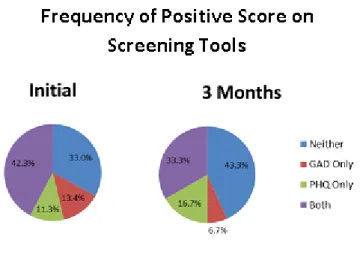
population, initial screening revealed that 42.3% (N =41) screened positive for significant symptoms of
both anxiety and depression (i.e., scores greater than 9 on GAD7 and PHQ9, respectively). Figure 1
demonstrates, at the three month follow up visit, the percentage of patients screening positive for both
anxiety and depression decreased to 38.7% (36 of 93 patients) and 33.3% (30 of 90 patients),
respectively. The frequency of patients screening for significant symptoms of anxiety alone also
decreased from 13.4% (13 of 97 patients) at the initial visit to 6.4% (6 of 93 patients) and 6.7% (6 of 90
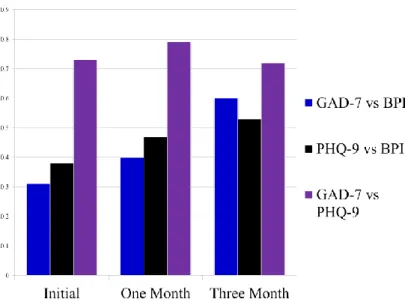
patients) at the one and three month visits, respectively. FA correlation was found between pain scores
and GAD7 scores at all three time points (Pearson correlation coefficient 0.31, 0.40 and 0.60 for initial,
one month and three month visits, respectively), as displayed in Figure 2.
Figure 2. Patient screening for anxiety and/or depression. Patients were identified by GAD-7 with anxiety symptoms who were not captured utilizing PHQ-9 alone.
Discussion:
Comorbid anxiety and depression are prominent within patients with chronic pain4. Identifying patients
who could benefit from treatment from these comorbid conditions is necessary in order to improve
chronic pain symptoms6. Currently our clinic has had success in identifying patients with depression
utilizing the PHQ-9 questionnaire and hopes to expand screening to include anxiety utilizing the GAD-7.
The use of validated questionnaires can aid clinicians in screening patients for these comorbidities. This
study demonstrated that although the GAD-7 and PHQ-9 are highly correlated in chronic pain patients,
the GAD-7 still remains useful for identifying patients who are affected by comorbid anxiety alone. This
finding is important as the use of only one screening tool would not identify all patients in need of
further care.
The study had several limitations. The study was intended as a pilot study, so sample size was small and
the study was conducted at only one clinic site. This study was intended to provide initial data to
support the feasibility of adding the GAD-7 screening tool into the clinic’s current workflow.
Additionally, potential bias could have added by assessing patients via telephone as opposed to an office
Further studies are needed to determine if administration of the GAD-7 in chronic pain patients is cost
effective and leads to better treatment outcomes. This study was intended as a pilot study for quality
improvement to determine if the given population was in need of additional services for comorbid
anxiety. It is our belief that identification and treatment of patients with anxiety will result in improved
pain management.
References
1. Hardt J, Jacobsen C, Goldberg J, Nickel R, Buchwald D. Prevalence of chronic pain in a representative sample in the united states. Pain Med. 2008;9(7):803-812. doi: 10.1111/j.1526-4637.2008.00425.x; 10.1111/j.1526-4637.2008.00425.x.
10. Ho PT, Li CF, Ng YK, Tsui SL, Ng KF. Prevalence of and factors associated with psychiatric morbidity in chronic pain patients. J Psychosom Res. 2011;70(6):541-547.
2. Bair MJ, Wu J, Damush TM, Sutherland JM, Kroenke K. Association of depression and anxiety alone and in combination with chronic musculoskeletal pain in primary care patients. Psychosom Med. 2008;70(8):890-897.
3. Ho PT, Li CF, Ng YK, Tsui SL, Ng KF. Prevalence of and factors associated with psychiatric morbidity in chronic pain patients. J Psychosom Res. 2011;70(6):541-547.
4. Poleshuck EL, Bair MJ, Kroenke K, et al. Psychosocial stress and anxiety in musculoskeletal pain patients with and without depression. Gen Hosp Psychiatry. 2009;31(2):116-122.
5. Chelminski PR, Ives TJ, Felix KM, et al. A primary care, multi-disciplinary disease management program for opioid-treated patients with chronic non-cancer pain and a high burden of psychiatric comorbidity. BMC Health Serv Res. 2005;5(1):3.
6. Gerhardt A, Hartmann M, Schuller-Roma B, et al. The prevalence and type of axis-I and axis-II mental disorders in subjects with non-specific chronic back pain: Results from a population-based study. Pain Med. 2011;12(8):1231-1240.
7. Kroenke K, Spitzer RL, Williams JB, Monahan PO, Lowe B. Anxiety disorders in primary care: Prevalence, impairment, comorbidity, and detection. Ann Intern Med. 2007;146(5):317-325.