April, 2009. 36 pages. Advisor: Jane Greenberg
This paper presents the findings of a survey of fifteen undergraduates from three public institutions in North Carolina on their use of cell phones as a tool for instruction, learning, and collaboration. The survey was conducted to better understand the state of students’ attitudes toward using cell phones within the context of the educational realm. Participants in the survey were selected as part of the Bot 2.0 project which seeks to promote the field of Botany to traditionally underrepresented populations using mobile phones, social networks, and collaborative web services. The results indicate a lack of use of cell phones by undergraduates within an educational setting while showing a heavy use within the social realm. A majority of the students studied did not regard cell phones as a good tool for completing homework or for accessing instructional materials. All but two of the students (87%) were in agreement about cell phones as a tool for collaboration with classmates.
Headings: Mobile phones
by
David N. Woodbury
A Master’s paper submitted to the faculty of the School of Information and Library Science of the University of North Carolina at Chapel Hill
in partial fulfillment of the requirements for the degree of Master of Science in
Information Science.
Chapel Hill, North Carolina
April 2009
Approved by
I would like to thank all of the participants and team members of Bot 2.0 especially Jacob Kramer-Duffield who led the creation of the survey for the project. I also owe a big
thanks to Jane Greenberg for her advice and support as well as her contagious enthusiasm for research. I also thank my wife, Ellen, and my daughter, Stella, for their patience,
...
1. Introduction
2
...
2. Literature and Background
4
...
2.1 Increase in cell phone adoption rate 4
...
2.2 Increase in technology capabilities 4
...
2.4 Individual studies 7
...
3. Research Goal
12
...
4. Methodology
13
...
4.1 General description 13
...
4.2 Participants 13
...
4.3 Procedures 14
...
4.4 Survey Description 15
...
6. Discussion
24
...
7. Further Study
27
...
7. Data tables
29
...
8. Appendix
31
...
A. BotCamp recruitment flyer 31
...
B. Survey question examples 32
...
1. Introduction
Today’s educators are faced with new challenges as they struggle to teach students
that are immersed in the always on, always available, and content rich digital
environments that characterizes the current college campus. Digital educational tools
from the adoption of PowerPoint presentations in the classroom to course management
software are seen in every discipline. Nearly every modern classroom has wireless
Internet accessibility and is set up with a computer projector. More recently, students’
laptops have become as ubiquitous as spiral bound notebooks once were. We are
experiencing the next wave of technological progress as cell phones are quickly being
adopted by students (Horrigan, 2009). Students are bringing new mobile technology,
such as the iPhone and the Blackberry into the classroom. These devices have
capabilities more powerful than the personal computers of just a few years ago and offer
exciting new opportunities and new challenges for educators as they learn how to use
them in instruction. Mobile technology can help extend the classroom out into the world
by bringing teaching tools into new contexts.
Students are starting to arrive at college very familiar with how to play games,
listen to music, and text their friends using the latest cell phones. As mobile platforms
become the norm on a social level, they are likely to become more widely used on an
educational level. Educators and creators of new mobile educational tools can be more
using their cell phones within the physical and virtual classroom. This research seeks to
better understand how students currently use cell phones and to gauge students’ attitudes
towards potential use of cell phones in the educational realm. This paper presents the
findings of a survey of undergraduates on their use of cell phones as a tool for instruction,
learning, and collaboration. The survey was conducted as part of the NSF-funded Bot 2.0
project which seeks to promote the field of Botany to traditionally underrepresented
2. Literature and Background
2.1 Increase in cell phone adoption rate
Cell phones have quickly become the main platform for communication by people
worldwide. The past decade has seen a ten fold increase in the adoption rate of phones
with a worldwide subscriber rate of 6 subscriptions for every 10 inhabitants on the planet.
The United States currently ranks 17th in usage of cell phones with a 83.5% subscriber
rate according to the recent International Telecommunications Union (ITU) report (2009).
The ITU also found that there are more individual cell phone subscriptions than there are
households with a computer (70.2%) and Internet connections in the United States
(61.7%).
2.2 Increase in technology capabilities
Cell phones are not simply about voice communication anymore and are
increasingly being used for other tasks. Cell phones are being used to not only talk with
friends and family but to share photographs, videos, and text messages sent from their
phones. In addition to owning cell phones at a higher rate, young adults use the extended
features of cell phones at a higher rate. The Pew Internet & American Life Project
Survey found that users in the 18-29 year old age range are twice as likely to use text
messaging, play games, access the internet, record and watch videos, play music, and
were as much as five times more likely to use these advanced features than the those in
the 50-64 age range (Horrigan, 2009, p. 5).
Cell phones have become sophisticated computing platforms. The newest devices
known as smartphones can be used to access the Internet and to run applications. These
devices are not just smaller versions of traditional computers; they are changing the
nature of computing interaction. Additional capabilities such as GPS and video recording
mean that these devices can serve as sophisticated tools in research and are being used or
considered as a primary data collection device in research from everything from
epidemiology (Datadyne.org, 2009) to the social sciences (Raento, Oulasvirta & Eagle,
2009).
College aged students are carrying smartphones in larger and larger numbers.
Although data is limited on the overall number of smartphones in use by students, these
phones currently represent 13 percent of the total cell phone market (Meford, 2008). A
particular smartphone, the iPhone, is highly coveted by younger people with a recent
survey finding that 22 percent of teenagers expected they would own an iPhone in the
next 6 months (Chen, 2008). The market research company Rubicon Consulting, Inc.
(2008) found that half of the users of the iPhone are under age 30 and 15% of the users of
the iPhone are students. Rubicon also found that people tend to carry their iPhone in lieu
2.3 Cell Phones in education
Teens are shifting away from using the computer for “traditional” communication
activities such as email, preferring instead to use other methods such as text messaging
on a cell phone (Lenhart, Madden, Macgill & Smith, 2007). The prevalence of text
messaging and other non-voice usage of cell phone by undergraduate students can be
seen by simply walking across a college campus, standing in line at the cafeteria, sitting
in on a class, or visiting the library. Universities are recognizing this trend and, just in the
past year, schools have received attention for their large scale attempts to enter the realm
of mobile education. In 2008 Abilene Christian University offered an iPhone or an iPod
touch to each incoming student (Brown & Metcalf, 2008). The university sees the new
technology as a platform to drive teaching innovation. ACU (“Our Vision”, 2009)
indicates:
The [iPhone program] is built upon the theory that humans learn best when they are in community—collaborating with others in a learning environment without boundaries. A technological solution that aims at increased learning must enhance communication and convergence.
The school is realizing this vision through the use of delivery of learning materials
directly to the iPhones in the form of podcasts, PDFs, and custom software applications.
These applications include classroom response systems, file storage, and direct access to
student and course management systems (“Our Progress”, 2009). Other schools such as
Duke University and Stanford University are creating similar programs with integrated
mobile tool for iPhones and Blackberries that focus on informational materials such as
2.4 Individual studies
There are a number of multiple small-scale studies on the use of portable
computing devices in individualized learning contexts. The rise of research addressing
this area predates the current smartphone technology and has its origins with personal
data assistants (PDA) which were more prevalent in the mid 1990s to early 2000s.
The early educational pilot studies involved introducing students to these new
types of technology without the students having prior experience using the tools. A pilot
study by National Council for Educational Technology in the United Kingdom provided
handheld “pocketbook” computers (essentially PDAs) to a class of 15 and 16 year-olds
and studied the students’ feelings about the new technology and examined the learning
factors involved in using these tools (Fung, Hennessy, & O'Shea, 1998). The researchers
found in their results that the technology was a motivator to the students to complete
materials and the use of the computers contributed to the overall learning goals. Waycott
& Kukulska-Hulme (2004) found that although the student motivational factors were
high, there were practical issues with mobile devices such as small text size, difficult
navigation, and issues entering data into the PDAs.
A large portion of studies on the educational use of PDAs focus on specialized
learning environments with a particular emphasis of studies in the areas of health
education (Johnston, Janice M et al., 2004). Kho, Henderson, Dressler, and Kripalani
(2006) found in a meta analysis of 67 PDA studies focused on medical education that
medical students were early adopters of PDA and smartphone technology with 70% of
popular use of the PDA was as a receiver and viewer of course materials. Researchers
found only one of the 67 studies that examined educational outcomes. Leung et. al
(2003) showed that learning outcomes increased with the use of PDAs but also indicated
technical issues that students have when using these tools. The high rate use of PDAs by
medical students mimicked the actual practice of doctors--PDAs are widely used in
medicine. However, the same is not true of general college students where they will not
necessarily be using PDAs but they will and are carrying their cell phones and
smartphones.
More recently studies have focused on using the devices that students already
have in their pockets and not just an additional computing tool that is unfamiliar to them.
Thorton and Houser (2004) conducted research in the use of cell phones for language
learning in Japan. The 333 students studied were found to be heavy users of text
messaging using the phone to send messages an average of 194 times a week and to
receive messages 82.8 times a week. In comparison, the students reported using the
phone as a method of voice communication (a phone call) only 6.6. times a week. As
part of the study, students received periodic English vocabulary lessons via mobile email
and were encouraged to use these emails as a part of their studies. These students were
compared to groups that were encouraged to use a traditional paper study method or to
just read the material on a laptop or desktop computer. The mobile email group who
studied using their phones were happier with this method, found to have learned more,
Students in the Mottiwalla (2007) study also reported that students found phones
to be useful in an online learning environment called mobile learning service (MLS)
created by the researchers. These students, in a senior year elective course, were
provided materials through mobile optimized web pages accessed through their own
phones or through a cell phone simulator on a computer (for those who didn’t have web
capable phones). The study found that 65% of the subjects reported a 4.20 average (on a
scale where 5= strongly agree and 1=strongly disagree) to the statement “MLS is an
effective learning aid or assistant for students” The students studied reported having a
neutral response (2.68) as to the ease of use of the system. This study’s reliance on the
simulator rather than using tools that students currently own could have been an issue
affecting ease of use.
Another approach to the use of cell phones in the classroom is to keep the use of
the phones to the lowest complexity level and to only use Short Messaging Service
(SMS) which is used to send text messages or Multi-media Messaging Services (MMS)
which is used to send photographs from phones. Some of these projects have used cell
phones within the classroom to gain feedback and provide an interactive tool for students
(Markett, Sánchez, Weber & Tangney, 2006). Phones have also been used as a way to
respond to experiments or games within a class via SMS. Cheung (2008) created a way
for economics students to participate in a game theory experiment during class using their
cell phones. These types of projects show how cell phones can be useful not only for
Now that most mobile phones include cameras, educators can explore ways of
using images as part of the learning experience. An example of such an activity is shown
by a pilot study by Moura & Carvalho (2008). The reseearchers had 10 secondary
students in Portugal use their own phones to take photographs of monuments within the
city of Braga as part of a field study. Students then emailed the photographs to Flickr
where they were annotated by other students working at desktop computer. The students
studied reported agreement by a rate of 70% to the question, “I like to be able to send a
picture from my phone to the web via Mobile Flickr.” They had a rate of 60% agreement
and 40% uncertainty to the question, “Using the phone to conduct this activity led me to
the study of Baroque.” All of the students studied cited that emailing photos using the
phone had a high cost.
Studies of smartphones in education are more limited, perhaps because only a
minority of users own them. However, some researchers such as Milrad & Sikol (2007)
have conducted studies in which they provide a smartphone to the participants in order to
get data in this area. In the “MUSIS Project” the researchers created a delivery system
that included lectures, web pages, and communication tools for a series of classes at two
colleges in Sweden. They found that integrating the smartphone tools into the course
content. In one course where the content was integrated, 40% of the students reported
that the educational mobile services were “very useful” and 27% reported they were
“useful.” A course where the educational mobile services were offered but not integrated,
a majority of students found the the service only “fairly useful” (41%) or “not
collaboration and found a majority (64%) found the phones were either “helpful” or
“very helpful” in communicating with their classmates. In the area of instructor
feedback, the researchers found only 29% found the mobile tool “helpful” or “very
helpful.”
The review of the literature gives an indication of the growth of the use of phones
by young adults as well as a variety of potential applications of the technology. There is
a need for additional studies to explore and demonstrate the new learning potentials cell
phones can provide by bringing instruction out into “the field” to enable new ways and
forms of data gathering and collaboration for learning. In addition the literature doesn’t
generally address the needs of minority populations. The NSF-funded Bot 2.0 program
provides a chance to study these aspects of mobile learning. Bot 2.0 uses mobile phones
as a tool alongside social networks and collaborative web services to enable an engaged
Botany learning experience for traditionally underrepresented populations. A look at the
3. Research Goal
The goal of this research is to examine both the state of cell phone use in the educational
realm as well as the state of students’ attitudes and current use toward using cell phones
as a tool in an educational manner. Through an examination of students’ current attitudes
toward the use of cell phones as well as usage rates of the phones within the multiple
contexts--with friends, family and instructors--we can better understand the prevailing
perspectives of students using cell phones within a learning environment. Educators can
be more effective with the use of mobile tools if they better understand students’ current
acceptance of the educational realm moving into what has been a traditionally social
realm. This research, conducted as an element of the NSF-funded Bot 2.0 project, can
4. Methodology
The method used for this study was a survey completed by participants of the Bot
2.0 project at the University of North Carolina at Chapel Hill. This ongoing project is
conducted by members of the North Carolina Botanical Garden, School of Information
and Library Science at the University of North Carolina at Chapel Hill, and the
Renaissance Computing Institute.
4.1 General description
In order to gather information about student attitudes and current use of cell
phones a survey was created. The survey included questions on cell phone usage for
personal and academic settings as well as other methods of communication for
comparison purposes. Surveys were completed by participants in Bot 2.0. The survey
was conducted at the start of the project prior to any learning activities. The survey
questions on cell phone usage and attitudes were a subset of a longer survey created for
multiple additional research areas. All of the survey questions were created in a
collaborative process with members of the Bot 2.0 research team. A separate follow-up
survey was completed that contained identical questions to the initial survey. The
findings of the second survey are not reflected in these results.
The participants in the survey were subject to the requirements of the Bot 2.0
project which included stipulations that they were over the age of 18, currently enrolled
in an undergraduate program in North Carolina, had little or no prior knowledge of
Botany, and were able and willing to participate in the summer BotCamp program
consisting of 5 weeks of virtual classroom sessions and 3 days of on-campus sessions.
Participants were recruited from three campuses in North Carolina including North
Carolina Agricultural & Technical State University (North Carolina A&T), North
Carolina State University, and Alamance Community College. Although the focus of the
project was on minority and traditionally underrepresented students, no exclusions of
participants in the program based on race or gender were made. However, the
recruitment process focused on programs that involve primarily women and minorities
and the sample reflects this effort.
Recruitment tools were created including an informational web site and flyer. The
researcher met with an undergraduate class at North Carolina A&T, the director of the
Women in Science and Engineering (WISE) program at North Carolina State University,
and with faculty members and librarians at Alamance Community college to promote the
program. An honorarium of $200 and a stipend of $50 were offered to participants who
completed both the surveys and the BotCamp program.
4.3 Procedures
After the students were recruited, they were instructed to take the survey prior to
was entered and hosted on a web-based survey platform (SurveyMonkey.com). An email
was sent to the subjects and a link to the survey was provided with a request that the
survey be completed on their own over the course of several weeks. Prior to taking the
survey, the students agreed to an electronic letter of implied consent as a research subject
following requirements of the University of North Carolina’s Institutional Review Board.
4.4 Survey Description
The full survey consisted of a total of 147 questions which included a section of
45 questions selected for the portion related to this study of cell phone usage as well as a
demographic section and questions related to botanical learning, metadata literacy, and
social networks. The survey was not anonymized and students provided their names as
well as other identifying details on the survey but this information is not revealed in
public distribution of the results.
The survey portion on cell phone and other technology usage consisted of 50
questions on several areas. These areas included binary questions on technology
ownership and use such as:
Do you own a cell phone?
Do you use your cell phone to access web sites?
Have you ever used a phone to access instructional materials?
Questions about frequency of use of various mediums of communication technologies
were asked. These questions were asked under three different contexts including friends,
family, and school instructors. A typical question of this type was:
Participants answered each question for the following communication methods:
• landline phone • cell phone • in person • text message • instant messaging
• messaging through Facebook/MySpace
In order to elucidate information about the subject’s attitudes about using cell
phones for instructional purposes and how those attitudes compare to using cell phones
for other purposes, a series of questions using a Likert scale with seven categories was
used. An example of these questions on attitude is:
For the following questions, please rate your level of agreement with the statement from 1 to 7 with 1 = “strongly disagree” to 7=”strongly agree” A cell phone is how I generally collaborate with class peers
Two of these questions addressed the same communication methods (e-mail, landline
phone, etc.) as addressed above. In addition, one series of questions also using a Likert
scale focused on the use of cell phones in different contexts including: accessing
instructional materials, completing homework assignments, and communicating with
classmates. An example of these questions is
For the following questions, please rate your level of agreement with the statement from 1 to 7 with 1 = “strongly disagree” to 7=”strongly agree” Cell phone is a good way to access instruction assignments.
In addition to these Likert scale questions about preferences on instructional
materials, the survey included a direct question on which format they prefer out of the
This research uses portions of the demographic section of the survey including
gender, race and age. Other identifying sections are not included. Portions of the survey
on social networking, botany knowledge, and metadata literacy are not included in these
5. Results
Nineteen students agreed to participate in the BotCamp program. Four students
dropped out due to conflicts prior to the beginning of the BotCamp program. The survey
was taken by 15 students and 14 students eventually participated in the full BotCamp
program. Surveys were completed between July 10 and July 23, 2008.
The survey participants included 7 students from North Carolina Agricultural &
Technical State University, 2 students from Alamance Community College, and 6
students from North Carolina State University. There were 11 female and 4 male
participants and the group was approximately half self -identified as African-American/
black and the other half as Caucasian/white. The subjects were between 18 and 26 years
old with an average age of 20.5.
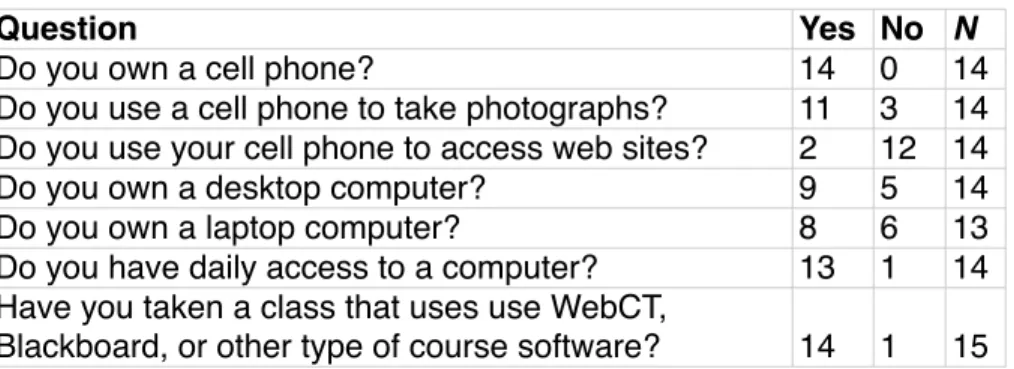
All the subjects reported that they own a cell phone and all but one reported
owning either a desktop or laptop computer. All but one subject had daily access to a
computer and had used a course management software program like Blackboard. A
majority (78%) reported using a cell phone to take photographs.
The survey found that cell phones were the most frequently used communication
device among friends and family. Text messaging and social networks were a close
second and third in frequency for communicating with friends. In-person and email were
the most popular forms of communicating with instructors. All other methods of
nearly in full agreement on social networks almost never used as shown with the standard
deviation of .26.
The subjects spent a substantial amount of time using technology. They reported
to be regular users of SMS text messaging with an average of a little more than 15
0 2 4 6 8 10
0 1 to 14 15 - 29 30+
Number of subjects reporting messaging frequency
Figure 2: Subjects reporting of the number of SMS text messages sent on a daily basis (number of subjects responding).
Friends Family Instructors
1 2 3 4 5
Email Landline Cell Phone In Person Text Msg IM Social Networks Never
Every day
messages sent and received per day. They also reported an average of 3.9 hours of daily
desktop and/or laptop computer use.
Students were not in complete agreement in their responses on the series of
questions asking the subjects about their attitudes towards cell phone use within the
context of learning environments. Most of these questions had standard deviations
Figure 3: Level of agreement with the statement, “Cell phones are a good way to access instructional materials” (percentage of responses).
20%
7%
20%
27%
13%
13%
Strongly disagreeDisagree
Somewhat disagree Neutral
Somewhat agree Agree
Strongly agree
Figure 4: Level of agreement with the statement, “Cell phones are a good way to complete homework assignments” (percentage of responses).
13%
20%
7%
27%
13%
20%
Strongly disagreeDisagree
Somewhat disagree Neutral
Somewhat agree Agree
greater than 2. About a third of the subjects responded that they strongly agreed or
agreed with the statements “Cell phones are a good way to access instructional material”
and “Cell phones are a good way to complete homework assignments”
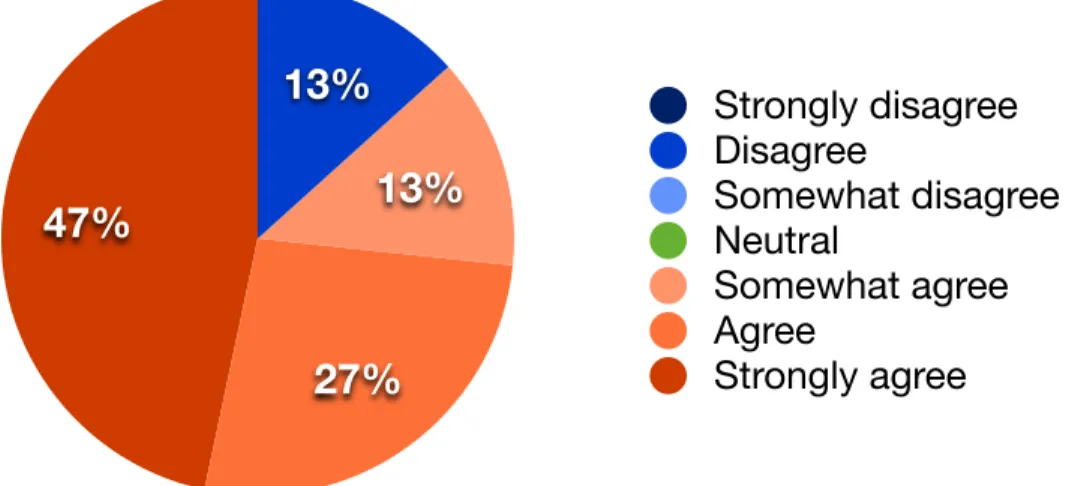
The response of subjects attitudes towards cell phone use within the context of
classmates is vastly different than the attitudes toward use of phones in the context of
homework or talking to their instructors. Only two subjects (N=15) disagreed with the
statement, “Cell phones are a good way to communicate with classmates” and eleven of
the subjects selected “agree” with the statement.
A majority of the subjects reported a preference for materials delivered in
traditional manners. Two-thirds of the subjects preferred either textbooks or notes from
attending lecture. One-third preferred materials online over textbooks and lecture notes.
Subjects were also asked about their preferred methods of collaboration as well as their
perceptions of the best ways to collaborate. There was general agreement about most
methods with the exception of using landline phones and text messaging to collaborate.
47%
27%
13%
13%
Strongly disagreeDisagree
Somewhat disagree Neutral
Somewhat agree Agree
Strongly agree
Landline phones received neutral response when the subjects asked if they were
one of the “best ways to collaborate” but the subjects reported that they disagreed with
the statement that using a landline phone “is how I generally collaborate.” The subjects
had slight agreement with the statement in terms of text messages as a form of
Strongly Disagree 1
2 3 4 5 6 7
Email Landline Cell Phone In Person Text Msg IM Social Networks
“Is one of the best ways to collaborate” “Is how I generally collaborate”
Strongly Agree
Figure 7: Collaboration attitudes (mean of responses).
53%
13%
33%
OnlineTextbook Lecture/Notes
collaboration but were, on average, neutral about text messaging as a form they use to
collaborate. Instant messaging and the use of social networks generally received neutral
6. Discussion
The results of the study confirms the findings of the recent Pew study (Kennedy,
2008) showing that students are heavy users of technology. All of the students were
found to be using cell phones on a regular basis for calls and for text messaging and
nearly all own a computer and are on the internet for a significant portion of the day.
These results are not surprising given prior studies and the easily observable ubiquity of
cell phones and computers on campus.
These students choose to use cell phones as the main way to stay in touch with
their friends either using calls or text messages. Social networks are not far behind in
preferences for keeping up with their friends. However, these students do not use cell
phones, their main communications channel, to interact with their instructors nor do they
see these tools as a good way to get access to instructional materials. The prevailing
attitude indicating a lack of support towards using phones in an educational setting by a
majority of the students indicates that there may be a barrier to introducing instructional
tools within this realm. Students are definitely more inclined to approach their instructor
in person or on email.
There are several possible reasons for the participants disagreement towards
statements on educational cell phone use. It may be that students have not had an
opportunity to think about using cell phones in this manner and therefore it is more of an
their instructors and course materials on a regular basis, this attitude will improve.
Previous research (Mottiwalla, 2007, Thorton & Houser, 2004) indicates that this is likely
to happen.
Another possible reason that students may not support cell phones within class is
that they may have tried to interact with instructors and course materials and had poor
experiences in the past. Although this is a possible reason, it is less likely since there
isn’t much of a movement among most instructors to use and encourage the use of cell
phones. However, the early impressions of these students should be taken into account as
educators enter this medium.
It is interesting to note that in a focus group conducted by Hill Taylor as part of
the Bot 2.0 project (not included in the scope of this data), this selection of students
indicated a sensitivity toward pricing of their cell phone plans (2008). When they are
using the extended capabilities, these particular students may be aware of the cost of
using their phone to access the web (a capability that can cost as much as $30 a month in
the case of the iPhone). It may be that students are reluctant because of these high costs.
If there is additional cost related to the capabilities of cell phones that are used in
education, there may be an additional barrier in place that needs to be overcome by
students and teachers.
There was a higher percentage of agreement toward the statement about
homework on the cell phone versus the statement on instructional materials. This is
the relative ease of reading material on cell phones. Again, this may be due to the lack of
experience students have had using a cell phone beyond the social realm.
There is room for optimism in these results in that there is a high recognition by
this group that cell phones and text messaging are good a way to collaborate. In fact
these are equal to (if not greater than) the use of email. The negative responses as to
instructional materials, interacting with their instructors, and homework indicate that
what they consider their sphere of collaboration does not include the instructor. This
attitude matches similar attitudes in prior research (Milrad & Spikol, 2007) indicating
that an active instructor role on mobile phones may not be as successful as a more passive
7. Further Study
This research focused on an initial survey given to students participating in the
Bot 2.0 project. The follow-up survey is being analyzed to see if there is change in
attitudes in the use of mobile phones for education by these participants. However, given
the small role of mobile phones in relation to the longer BotCamp, it is likely that this
data will not show much change for these factors. A better experiment to elucidate the
possibility to change student attitudes would involve greater use of the cell phones to
create materials, use materials, and to interact with both instructors and classmates.
As wealthier students are able to purchase and use the latest cell phones, there is
also a need to better understand the possibilities this creating a tiered access to education.
If education is going the way of mobile technology, then there will be barriers to those
who can not afford the latest phones that are able to connect at the fastest speeds.
Educators creating mobile learning platforms will need to understand what minimum
amount of technology access can provide the greatest benefits.
There is a tremendous opportunity to conduct a more controlled study with the
onset of the smartphone programs such as the one at Abilene Christian University where
iPhones are provided to all students. When students all have the same phone and the
same ability to get access, we can get a better sense of the underlying attitudes by
eliminating the biases that can occur because of different technology being used or issues
achieved as the barriers to access are removed and the true potential of mobile tools for
8. Data tables
Question Yes No N
Do you own a cell phone? 14 0 14
Do you use a cell phone to take photographs? 11 3 14
Do you use your cell phone to access web sites? 2 12 14
Do you own a desktop computer? 9 5 14
Do you own a laptop computer? 8 6 13
Do you have daily access to a computer? 13 1 14
Have you taken a class that uses use WebCT,
Blackboard, or other type of course software? 14 1 15
Question Online Textbook Lecture/Notes N
What is your preferred way to access
course materials? 5 2 8 15
Question M SD N
Approximately how many hours do you use a computer per day? 3.9 3.1 14
Approximately how many text messages do send per day? 15 16 14
Approximately how many text messages do you receive per day? 15 15 14
How do you communicate with your friends? 1 = “Never” and 5 = “Every day”
How do you communicate with your friends - e-mail? 2.7 1.0 15
How do you communicate with your friends – landline phone? 1.9 1.1 15
How do you communicate with your friends – cell phone? 4.7 0.62 15
How do you communicate with your friends – in person? 3.9 0.99 15
How do you communicate with your friends – text message? 4.1 1.2 15
How do you communicate with your friends – instant messenger? 3 2 15
How do you communicate with your friends – messages through
Facebook/MySpace? 4 1.3 15
How do you communicate with your family? 1 = “Never” and 5 = “Every day”
How do you communicate with your family - e-mail? 2 1.2 15
How do you communicate with your family – landline phone? 2.5 1 15
How do you communicate with your family – cell phone? 4.5 0.74 15
How do you communicate with your family – in person? 4 1.1 15
Table 2
Question M SD N
How do you communicate with your family – text message? 2.7 1.5 15
How do you communicate with your family – instant messenger? 1.7 1.0 15
How do you communicate with your family – messages through
Facebook/MySpace? 1.7 1.2 15
How do you communicate with your school instructors? 1 = “Never” and 5 = “Every day”
How do you communicate with your school instructors - e-mail? 4 0.76 15
How do you communicate with your school instructors – landline
phone? 1.3 0.59 15
How do you communicate with your school instructors – cell phone? 1.7 1.2 15 How do you communicate with your school instructors – in person? 4 0.74 15 How do you communicate with your school instructors – text
message? 1 0.77 15
How do you communicate with your school instructors – instant
messenger? 1.3 0.8 15
How do you communicate with your school instructors – messages
through Facebook/MySpace? 1.1 0.26 15
Please rate your level of agreement with the statements, from 1 to 7, with 1=“strongly disagree” to 7=“strongly agree”.
...e-mail is one of the best ways to collaborate 4.7 2.1 15
...call on landline is one of the best ways to collaborate 4 2.2 15
...cell phone is one of the best ways to collaborate 5 2.0 15
...in-person is one of the best ways to collaborate 7 0.74 15
...text-messaging is one of the best ways to collaborate 4 2.1 15
...instant messaging is one of the best ways to collaborate 3.5 1.8 15
...messages through Facebook/MySpace is one of the best ways to
collaborate 4 2.4 15
...e-mail is how I generally collaborate with class peers. 4.9 1.7 15
...call on landline is how I generally collaborate with class peers 2.3 2.1 15
...cell phone is how I generally collaborate with class peers 5.1 1.8 15
...in-person is how I generally collaborate with class peers 6.7 0.6 15
...text-messaging is how I generally collaborate with class peers 3.7 2.6 15 ...instant messaging is how I generally collaborate with class peers 3.8 2.4 14 ...messages through Facebook/MySpace is how I generally
collaborate with class peers 3.9 2.4 13
Have you ever used a cell phone to access instructional materials? 1.7 0.49 15
Cell phone is a good way to access instructional materials 4 2.1 15
Cell phones are good way to complete homework assignments. 3.3 1.8 15
Cell phones are a good way to communicate with classmates. 6 1.7 15
9. Appendix
A. BotCamp recruitment flyer
Bot 2.0
Bot 2.0 uses Web 2.0 technologies like face-book, flickr, wikis, and blogs to learn about the botanical world living right outside your door.
Join area college students who will participate in the three-day, expenses paid, BotCamp at UNC-Chapel Hill, along with two hands-on vir-tual classroom sessions in June and August. At the BotCamp you will:
Meet leading researchers and educators in Botanical Science and Information Technol-ogy
Explore behind the scenes at the North
Carolina Botanical Garden and UNC’s Her -barium.
Enjoy hands on experience with the latest
web technologies at UNC’s number one
School of Information and Library Science and the Renaissance Computing Institute. Participants completing the Bot 2.0 course will receive a certificate from the North Carolina Botanical Garden.
Explore this outstanding opportunity to learn about botanical science as a field of study, ca-reer, or as a hobby. The program is free and financial assistance is available for any neces-sary technology needs.
• • • Better understand the everyday botanical world around you--from your backyard to the grocery store Enjoy a three-day, two-night all expenses paid, ex-perience in Chapel Hill at BotCamp Learn about and use the latest web and digital technologies for learning and com-munication Make valuable contacts with lead-ing scientists and students at peer institutions Improve your knowledge and skills for tech-nologies you use daily—cell phones and social net-works • • • • •
Explore and have hands-on experi-ences behind the scenes ac-cess to the North Carolina Botanical Garden, Renais-sance Computing Institute, and the School of Informa-tion and Library Science
No previous expe-rience or courses in Botany required No cost to partici-pate.
Receive financial assistance for tech-nology needs Undergraduates from NCA&T, NCCU, UNC-CH, NCSU, & Alamance CC are encouraged to apply • • • • •
An Exciting Summer Opportunity
Learn about nature, botanical science, and the latest web technologies!
For more information email [email protected]
Bot 2.0 is supported by the NSF Award number 0737466.
B. Survey question examples
Educational cell phone use attitudes Modes of communication
10. References
Abilene Christian University. (2009). Our Progress with Mobile Learning - Abilene Christian University. ACU Connected. Retrieved March 28, 2009, from http:// www.acu.edu/technology/mobilelearning/progress/index.html.
Abilene Christian University. (2009). Our Vision - Abilene Christian University. ACU Connected. Retrieved March 28, 2009, from http://www.acu.edu/technology/ mobilelearning/vision/index.html.
Anderson, P., & Blackwood, A. (2004). Mobile and PDA technologies and their future use in education. JISC Technology and Standards Watch, 4(3), 3-33.
Aoki, K., & Downes, E. J. (2003). An analysis of young people's use of and attitudes toward cell phones. Telematics and Informatics, 20(4), 349-364. doi: 10.1016/ S0736-5853(03)00018-2.
Chen, B. (2008, October 8). Survey: 22 Percent of Teens Want iPhone. Gadget Lab: Wired.com. Retrieved December 2, 2008, from http://blog.wired.com/gadgets/ 2008/10/survey-22-perce.html.
Cheung, S. L. (2008). Using Mobile Phone Messaging as a Response Medium in Classroom Experiments. Journal of Economic Education, 39(1), 51-67. doi: Article.
Brown, J., & Metcalf, D. (2008). Why Mobile Learning Now? Learning Consortium Perspectives. The Masie Center. Retrieved March 2, 2008, from http://
www.masieweb.com/p7/MobileLearningUpdate.pdf.
Datadyne.org. (2009). About | DataDyne.org. About Datadyne.org. Retrieved March 28, 2009, from http://www.datadyne.org/?q=about.
Fung, P., Hennessy, S., & O'Shea, T. (1998). Pocketbook computing: a paradigm shift? Computers in the Schools, 14, 109-118.
the International Conference on Dublin Core and Metadata Applications 2008, Frankfurt, 119-121, September, 2008.
Horrigan, J. (2008). Mobile access to data and information. Pew Internet & American Life Project. Retrieved March 10, 2009, from http://www.pewinternet.org/~/ media//Files/Reports/2008/PIP_Mobile.Data.Access.pdf.pdf.
International Telecommunications Union. (2009).Measuring the Information Society: The ICT Development Index. Retrieved from: http://www.itu.int/ITU-D/ict/
publications/idi/2009/material/IDI2009_w5.pdf.
Johnston, J. M., Leung, G. M., Tin, K. Y. K., Ho, L., Lam, W., & Fielding, R. (2004). Evaluation of a handheld clinical decision support tool for evidence-based learning and practice in medical undergraduates. Medical Education, 38(6), 628-637. doi: 10.1111/j.1365-2929.2004.01842.x.
Kho, A., Henderson, L., Dressler, D., & Kripalani, S. (2006). Use of handheld computers in medical education. Journal of General Internal Medicine, 21(5), 531-537. doi: 10.1111/j.1525-1497.2006.00444.x.
Kennedy, T., Smith, A., Wells, A. T., & Wellman, B. (2008, October 19). Pew Research Center: Networked Families. Pew Internet: Networked Familes. Retrieved November 7, 2008, from http://pewresearch.org/pubs/998/networked-families.
Lenhart, A., Madden, M., Macgill, A., & Smith, A. (2007). Pew Internet: Teens and Social Media. Retrieved November 8, 2008, from http://www.pewinternet.org/ PPF/r/230/report_display.asp.
Leung, G., Johnston, J., Tin, K., Wong, I., Ho, L., Lam, W., et al. (2003). Randomised controlled trial of clinical decision support tools to improve learning of evidence based medicine in medical students. British Medical Journal, 327(7423),
1090-1093.
Markett, C., Sánchez, I. A., Weber, S., & Tangney, B. (2006). Using short message service to encourage interactivity in the classroom. Computers & Education, 46(3), 280-293. doi: 10.1016/j.compedu.2005.11.014.
Medford, C. (2008, November 7). Smartphone Sales Surge. redherring.com. Retrieved December 2, 2008, from http://www.redherring.com/Home/25429.
Milrad, M., & Spikol, D. (2007). Anytime, anywhere learning supported by smart
Technology & Society, 10(4), 62-70. Retrieved March 28, 2009, from http:// www.ifets.info/download_pdf.php?j_id=37&a_id=795.
Motiwalla, L. F. (2007). Mobile learning: A framework and evaluation. Computers & Education, 49(3), 581-596. doi: 10.1016/j.compedu.2005.10.011.
Moura, A., & Carvalho, A. (2008). Mobile learning with cell phones and mobile flickr: one experience in a secondary school. Proceedings IADIS Conference Mobile Learning (pp. 216-220).
Raento, M., Oulasvirta, A., & Eagle, N. (2009). Smartphones: An Emerging Tool for Social Scientists. Sociological Methods Research, 37(3), 426-454. doi: 10.1177/0049124108330005.
Rubicon Consulting, Inc. (2008) The Apple iPhone: Challenges and Success for the Mobile Industry. Retrieved March 1, 2008 from rubiconconsulting.com/ downloads/whitepapers/Rubicon-iPhone_User_Survey.pdf
Shieh, D. (2009, March 4). Duke U. Unveils Application Suite for iPhone. The Wired Campus. The Chronicle of Higher Education. Retrieved March 10, 2008, from http://chronicle.com/wiredcampus/article/3643/duke-launches-application-suite-for-iphone.
Tarumi, H., Satake, F., Kusunoki, F., & Takahashi, M. (2007). Collaborative Learning with Fieldwork Linked with Knowledge in the Classroom. Proc. of the IADIS International Conference on Mobile Learning 2007 (pp. 204-208). Retrieved February 10, 2008, from
Taylor, H. Bot 2.0 Advisory Board Meeting (2008) conducted in Chapel Hill, NC December 17, 2008.
Thornton, P., & Houser, C. (2005). Using mobile phones in English education in Japan. Journal of Computer Assisted Learning, 21(3), 217-228. doi: 10.1111/j.
1365-2729.2005.00129.x.
Waycott, J., Jones, A., & Scanlon, E. (2005, July). PDAs as lifelong learning tools: an activity theory based analysis. Learning, Media, & Technology, 30(2), 107-130. Retrieved March 2, 2009, doi:10.1080/17439880500093513