109 © The Author 2017. Published by Oxford University Press on behalf of the European Orthodontic Society. All rights reserved.
For permissions, please email: [email protected]
Original article
Extractions, retention and stability: the search
for orthodontic truth
Sheldon Peck
1,21Department of Orthodontics, University of North Carolina, Chapel Hill, NC, USA
2Historian, The Edward H. Angle Society of Orthodontists
Correspondence to: Sheldon Peck, 180 Beacon Street, Boston, MA 02116, USA. E-mail: [email protected]
Adapted from the 2016 E. Sheldon Friel Memorial Lecture, presented 13 June 2016 at the 92nd Congress of the European Orthodontic Society, Stockholm, Sweden.
Summary
Background and objectives: From the beginnings of modern orthodontics, questions have been raised about the extraction of healthy permanent teeth in order to correct malocclusions. A hundred years ago, orthodontic tooth extraction was debated with almost religious intensity by experts on either side of the issue. Sheldon Friel and his mentor Edward H. Angle both had much to say about this controversy. Today, after significant progress in orthodontic practice, similar arguments are being voiced between nonextraction expansionists and those who see the need for tooth extractions in some orthodontic patients. Furthermore, varying concepts of mechanical retention of treatment results have evolved over the years which have been misinterpreted as enhancing natural orthodontic stability.
Materials and methods: In this essay, representing the Ernest Sheldon Friel Memorial Lecture presented in 2016 at the 92nd Congress of the European Orthodontic Society, a full spectrum of evidence from biology, anthropology and history is critically discussed in the search for truth among highly contested orthodontic variables: extraction versus nonextraction, fixed retention versus limited retention, and rationalized stability versus biological homeostasis.
Conclusions and implications: Conscientious clinicians should try to develop individualized treatment plans for their patients, and not be influenced by treatment ‘philosophies’ with untested claims in clinical orthodontics.
Orthodontics is a relatively young sphere of studied biomedical interest. The first writings about therapeutic tooth movement in 18th-century Europe largely concerned the regulation of teeth, or straightening of crooked teeth. In fact, ‘orthodontosie,’ the art of making teeth straight—the neologism from which ‘orthodontics’ is derived—was suggested in 1841 by French surgeon-dentist, Pierre-Joachim Lefoulon (1). Then and earlier, there was no focus on dental occlusion, the way upper and lower teeth meshed together. Cosmetic straightness was the first and only goal of any treatments that would reposition the teeth (2).
In 1899, Edward H. Angle is generally credited with introduc-ing the concepts of occlusion and malocclusion as essential elements of orthodontic thinking (3). No longer could dentists entering the
nascent field of treating malalignments of the teeth neglect consid-eration of abnormal variations in the bite. Whether orthodontic treatment was initiated to correct an irregularity of the teeth such as dental crowding, or a malocclusion such as underdevelopment of the lower jaw, a critical decision was to determine if dental arch space needed to be made by the extraction of selected permanent teeth, a clinical practice that was popular at that time, but coming under scrutiny. For many years, Angle intensely studied this extraction-nonextraction conundrum in orthodontic treatment.
Frederick Noyes, first a dentist-histologist and then an Angle-trained orthodontist, taught Angle School students that bone growth is produced in response to mechanical stimuli such as orthodontic forces (4). Angle embraced this ‘bone-growing’ rationalization as the
doi:10.1093/ejo/cjx004 Advance Access publication 23 February 2017
core of his arch expansion, nonextraction dictum for orthodontic treatments (5, 6). Although current knowledge roundly debunks the notion of tooth-anchored bone-growing, Noyes lived by the Angle expansionist nonextraction rules his entire professional life (7). Thomas Graber, in reminiscences of his 5-year association in Noyes’s office in the late 1940s and early 1950s (8), recalled Noyes often boasting: ‘I have never extracted in 50 years of orthodontics, and never will!’
An early articulation of Edward Angle’s nonextraction bias in orthodontic treatment planning is in a letter he wrote in 1902 to a correspondent in Japan. Commenting about the next edition of his textbook, Angle said he will not advise extraction ‘except in the rar-est of cases—in perhaps not over two in one thousand. I am more and more convinced each day,’ he continued confidently, ‘that the Creator intended we should have the full number of teeth, and that we as orthodontists, can succeed best only by preserving the full complement of teeth (5).’
Indeed, the 7th edition of Angle’s textbook (9) featured many patients with severe bimaxillary crowding that he had treated without permanent tooth extractions by greatly enlarging the dental arches and ending treatment with 2 fixed banded retainers (Figure 1).
In order to assay the extraction-nonextraction dilemma in ortho-dontics fully we need to put this decision in the context of the impor-tant diagnostic decisions in clinical orthodontics. In my view and experience, there are 4 critical sequential questions in orthodontic treatment planning:
1. Is orthodontic treatment necessary? 2. Is jaw surgery necessary?
3. Are tooth extractions necessary? 4. Is fixed retention necessary?
The first question, acknowledging the elective nature of most con-temporary orthodontic treatment, may be elusive to business-minded practitioners who treat nearly all who visit their offices. There is a fashion trend today that celebrates dental spacing and smile irregu-larity as a desired sign of natural and wild beauty in youth culture. Gap-toothed women abound among American and European fash-ion models. Thus, some adolescents today would prefer to keep their imperfect and individualistic smiles, rather than undergo orthodon-tic corrections. Furthermore, in some cultures, the estheorthodon-tic preference favors what orthodontists would call malocclusion. In Japan, for example, severe dental crowding is perceived as ‘cute’ and desirable especially in young women. This trend is called ‘yaeba,’ a mimick-ing of child-like dental imperfections to resemble a more endearmimick-ing youthful appearance, sociologists have theorized (10). So not all peo-ple with malocclusions want or seek orthodontic corrections. Before recommending any treatments, we as circumspect clinicians must always start our conversation with a new patient asking, What do ‘you’ think about your teeth?
The 4 critical diagnostic questions are shown in Table 1, compar-ing the binary decisions for each question made in my own ortho-dontic practice in Boston with the decisions that would be typical for a hard-core nonextraction expansionist practice.
Regarding question 1, ‘Is orthodontic treatment necessary,’ a binary response is usually produced from clinicians with dif-ferent perspectives and training depth. For example, when a new patient complains about an upper midline diastema in an otherwise sound dental occlusion, a circumspect orthodontist may thought-fully send the person to a prosthodontist for a consultation about
augmentation cosmetic bonding. In contrast, a business-driven pro-vider of nonextraction orthodontics may embrace such a patient for orthodontic space closure and permanent retention, without explor-ing nonorthodontic alternatives.
Regarding the question of jaw surgery, properly trained orthodontists recognize at least 10% of their practices (mixed adolescent/adult) requiring surgical orthodontic solutions. In comparison, a practice biased to nonextraction orthodontic treat-ment, would try to keep things purely orthodontic and avert the complications of surgery, except in the most extreme skeletal discrepancies (~1%).
The next critical diagnostic question regards permanent tooth extractions. We know from published studies that today’s most vocal nonextraction orthodontic expansionists are claiming that they
Figure 1. (a) Edward Angle’s patient, Winfred Gregory, age 13 years, pre-treatment dental casts, 03 November 1903. Patient presented with severe bimaxillary dental crowding which Angle called ‘arrest in the development of the alveolar process.’ (b) Winfred Gregory, post-treatment dental casts, no date. Dr. Angle performed nonextraction orthodontic treatment by ‘greatly enlarging’ the dental arches, concluding treatment with 2 fixed banded retainers (9).
succeed with extraction frequencies of low single digits (11, 12). In comparison, a typical unbiased orthodontic practice would diagnose the need for orthodontic extraction in about 25% of cases.
Of course, management of the end game, retention, tells much about the clinician’s confidence level in the homeostatic self-mainte-nance of results. Nonextraction expansionists tend to employ fixed permanent retention as a fail-safe essential element of treatment (~95%). From our experience, unbiased orthodontists who extract permanent teeth regularly in the treatment of dental crowding need to use lifetime fixed retention significantly less (~5%).
The anthropology of dental crowding
Another important resource in the search for truth in the proper solution to modern tooth-size arch-size discrepancy that ortho-dontists grapple with daily is the anthropological view of this anatomical condition. For years, biological anthropologists have been weighing in with clear answers to basic orthodontic ques-tions. Anthropologist Robert Corruccini wrote a book in 1999 that should be in every orthodontist’s library: How anthropology informs the orthodontic diagnosis of malocclusion’s causes (13). He gives compelling evidence that dental crowding is increasing in modern societies. Corruccini documents the ongoing reduc-tion in jaw size, decrease in tooth wear patterns, and increase in malocclusion, comparing samples from ancient to modern times, and rural vs. urban lifestyles. He asks and cogently answers the question, ‘Why are malocclusion and dental crowding so positively correlated with the rise of civilization?’ Others too have deduced the reduction in human jaw size over the past 100-thousand years as a result of soft diet and functional relaxation/disuse (14, 15). Another major factor causing increased dental crowding is the decrease in tooth wear from prehistoric to modern times (16, 17). Modern jaws have an increased mesiodistal tooth-mass burden because of the functional reduction in tooth wear. As a result of this gross tooth-mass excess today from unworn teeth, Evensen and Ogaard found a significant increase in both the prevalence and severity of crowding malocclusions from medieval to present times, studying 700-year-old skulls from Norway, compared to dentitions of modern Norwegians (18).
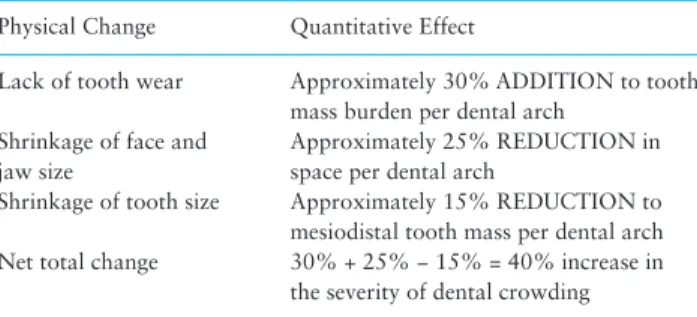
From an anthropological viewpoint, over the Late Pleistocene Epoch (50–100 000 years Before Present, BP) several dramatic quan-titative trends have been documented regarding the human face, jaws and teeth (13, 19). Scientific evidence uniformly shows reduc-tion of tooth wear and measurable shrinkage of the face and jaws over this time period due to functional relaxation (disuse)(20). The added tooth mass excess in modern man can range up to 22 mm per dental arch, the amount of natural tooth wear per dental arch over a prehistoric lifespan. This is equivalent to roughly a 30% increase in tooth mass burden in each arch deriving from the absence of natural tooth wear. There has been some secular relief of crowding in the form of a generalized tooth size reduction (about 15% MD
size reduction) due to relaxed selection and disuse (19). Collectively, these physical changes in teeth, jaws and face point to reduced dental arch size and increased dental crowding and tooth mass excess in modern man (Table 2).
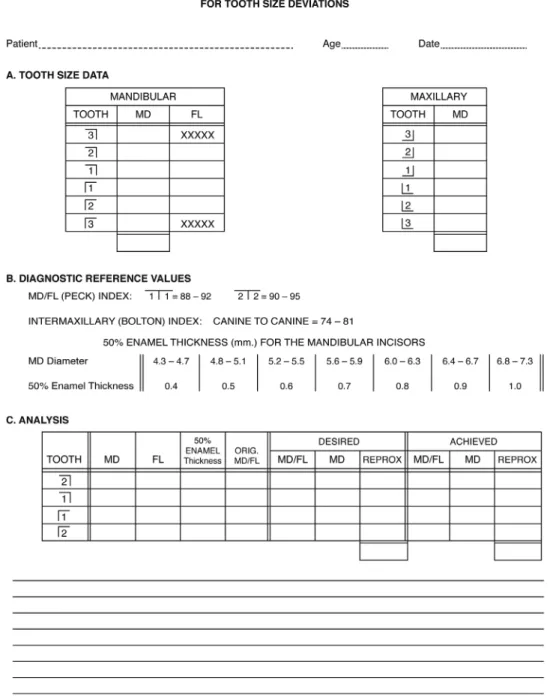
In orthodontic treatment, there is often another acceptable method, besides extracting selected permanent teeth, to neutral-ize tooth-sneutral-ize arch-sneutral-ize discrepancies and treat dental crowding. It involves reducing the mesiodistal dimensions of certain teeth in an effort to mimic the reduction seen in natural tooth attrition among primitive peoples eating coarse, robust diet. Since the mandibular incisors have been the most prone human tooth type to crowding and recrowding, studies have been performed on the relationship of the crown shape of these teeth and their propensity for crowding (21, 22). A tooth shape index was constructed from maximum mesi-odistal/faciolingual crown dimensions (MD/FL) X 100, the recipro-cal of the traditional ‘crown index’ used by anthropologists, for the mandibular incisors. These odontometric measurements, roughly representing the configurations of crown shape, are taken directly on the teeth intraorally, not on plaster casts that often mask the maxi-mum FL dimensions of these teeth of adolescents. Thus, the MD/FL Index and Tooth-Shape Analysis becomes a valuable diagnostic tool to determine the biological need and limits for mandibular incisor enamel reduction, or reproximation, as we named the clinical pro-cedure (22–25), Figure 2. The Bolton intermaxillary tooth-size ratio/ index is incorporated into the analysis (26).
The historical record and issues of orthodontic
extractions, retention and stability
In modern practice, depending on the prevalent ethnicity of a population, we can say that a biologically based range of extrac-tion frequencies will vary from 15% to 50% of an orthodontic patient sample (27). The early orthodontists, over 100 years ago, were limited by their dogma and by lack of diagnostic tools in the pre-radiographic era. Many precepts were framed as natural ‘laws’ to be promulgated and accepted without scientific scrutiny. Edward H. Angle, who probably influenced the early path of ortho-dontics more profoundly than anyone else, embraced the neoclas-sical sculptural fashion of Apollo Belvedere as his paradigm of facial beauty while admiring the complete dentitions he observed in American Indian skulls. He conflated two disparate anatomical conditions to promote an impossible and unnatural aesthetic ideal: the bimaxillary dentoalveolar prognathism of the Amerind skull type supporting the neoclassical Apollo orthognathic facial profile. To this end, he created a ‘natural law’ that said, ‘The best balance, the best harmony, the best proportions of the mouth in its relations to the other features require that there shall be the full complement of teeth, and that each tooth shall be made to occupy its normal position—normal occlusion (9).’Angle was further armed with ‘bone-growing’ pseudoscience vigorously popularized in orthodon-tics by Frederick Noyes (4).
Table 1. Comparisons of the imputed results of 4 critical diagnostic questions in orthodontic treatment planning, unbiased orthodontic practice vs. nonextraction-biased orthodontic practice.
Diagnostic Question Unbiased orthodontic practice Boston, USA Nonextraction-biased orthodontic practice, USA
1. Is orthodontic treatment necessary? Yes = 85%, No = 15% Yes = 100%, No = ~0%
2. Is jaw surgery necessary? Yes = 10%, No = 90% Yes = 1%, No = 99%
3. Are tooth extractions necessary? Yes = 25%, No = 75% Yes = 2%, No = 98%
4. Is fixed retention necessary? Yes = 5%, No = 95% Yes = 95%, No = 5%
It was not until the 1920s that a voice of reason was heard to challenge the Angle-Noyes fallacious dictum promoting nonex-traction orthodontic treatments. Axel F. Lundström was a dentist in Stockholm, Sweden, who spent several months in 1907 work-ing and observwork-ing in Edward Angle’s private orthodontic practice in St. Louis. On his return to Stockholm, he initiated an exclusive practice of orthodontics, one of the first specialty practices in the world, and began clinical research into malocclusion and its causes. During the next decade, Lundström collected, carefully measured and scrupulously recorded many treated cases. In 1923 his doctoral thesis was published, entitled, ‘Malocclusion of the teeth regarded as a problem in connection with the apical base (28).’ From his data and observations, Lundström concluded that ‘when the bony apical base of the teeth is deficient, crowded teeth moved by mechanical means into an expanded acceptable arrangement will relapse when retainers are removed.’ This was a profound finding at the time. It prompted world attention when his thesis was republished in its entirety in 1925 in the International Journal of Orthodontia, Oral Surgery, and Radiology, forerunner of the present American Journal of Orthodontics and Dentofacial Orthopedics. Conscientious spe-cialists began examining and rethinking their nonextraction, arch expansion rationalizations (29, 30). Key among them was Charles H. Tweed of Arizona, an honor graduate of Angle’s College of Orthodontia in Pasadena in 1928. After much failure with Angle’s nonextraction arch-expansion approach and with Lundström’s powerful evidence now supporting tooth extractions in orthodontic treatment, Tweed courageously started to extract premolars to avoid the unstable ‘horsey look’ he described in his nonextraction out-comes (31, 32). Soon most orthodontic specialists became similarly enlightened. Thus, Lundström’s brilliant clinical research led the way to a more reasoned and balanced approach to the extraction–nonex-traction question among thinking orthodontists.
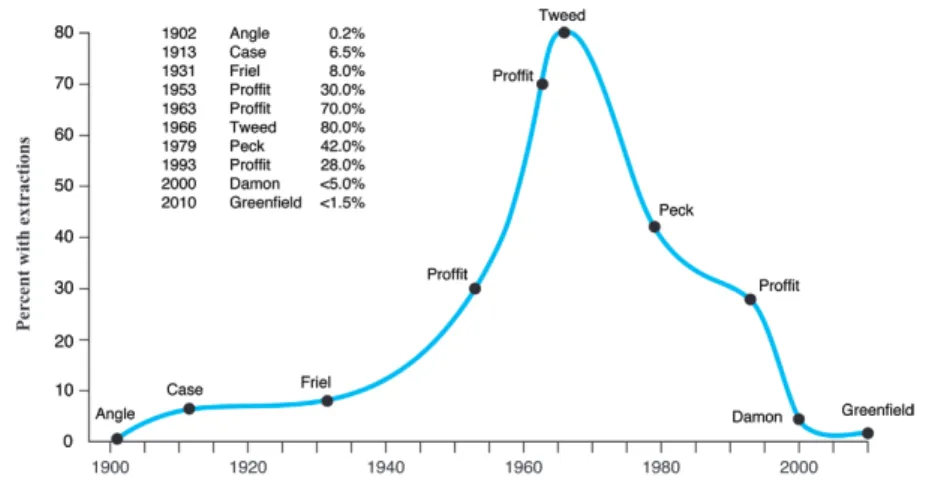
Nevertheless, over time, other factors beyond reason and science have thwarted the universal embrace of this solid historical evidence. Thus, it appears we have not made much progress in the 100 years or more since Angle’s vehement nonextraction and expansion dogma in his classic textbook (9). If we plot published orthodontic extraction frequencies during this interval, we find a sharp ascent and then a steep descent in reported frequency of extractions (Figure 3). It looks like a normal distribution; however, this strange curve is anything but normal. This curve represents the collective rationalizations, biases, and pseudoscience of the changing times. Angle sets the base-line with an extraction rate of 0.2% in 1902. Then Calvin Case in a bold report in 1913 revealed his extraction cases to be 6.5% of his sample of orthodontic treatments (33). A year after Edward Angle’s death, one of his former students, Sheldon Friel of Ireland, reported 8% extraction frequency (34). A multi-year comparative study was
published by Proffit in 1994, tabulating the extraction frequencies in an American university orthodontic clinic in 1953, 1963 and 1993 (35). It showed a dramatic 40% rise and fall in extraction rates dur-ing that period. Publications by Tweed (36) and Peck and Peck (27) confirm this wild gyration in extraction frequencies during this time. Furthermore, nonextraction expansion methods are good for busi-ness, as orthodontic commercial interests have demonstrated. Sales for their targeted products are enhanced when they promote non-extraction approaches. Nonnon-extraction expansion orthodontic treat-ments are less complicated and more inviting for poorly trained or partially trained clinicians.
Dwight Damon and his touring disciples who unnaturally link his interesting self-ligating bracket design to old-fashioned expan-sionist dogma is probably one of those most responsible for the cur-rent explosion in nonextraction orthodontic ‘philosophy’ (37, 38). Damon has claimed his methods can reduce orthodontic extrac-tion frequency to below 5% (11). And Greenfield has contended his ‘coordinated arch development’ can reduce tooth extraction for orthodontic treatment magically to under 1.5% of patient samples (12).
The relatively recent introduction of clear plastic aligner therapy (for example, Invisalign devices) as an adjunctive orthodontic mecha-nism for treatments has further distorted the extraction–nonextraction orthodontic decision conundrum. Invisalign was founded by two non-doctor entrepreneurs in the late 1990s. They marketed and popular-ized this weak removable ‘invisible’ appliance technique to specialists, generalists and the public as a psychologically appealing alternative to fixed-appliance orthodontic treatments. A major limitation in remov-able aligner appliances is that they can not produce orthodontic forces and tooth/root movements necessary to manage properly a typical tooth-extraction treatment plan (39). So removable aligner orthodon-tic treatments soon began to be associated rather indiscriminately with nonextraction arch-expansion orthodontic treatment plans, those that were simpler for nonspecialists to manage, and which sounded less invasive and more agreeable to the general public.
Another innovation that supported this trend for nonextraction expansion treatment in orthodontics was the introduction of ‘invis-ible’ composite-bonded retainers in the 1970s. Bjorn Zachrisson of Norway may rightly be considered the ‘father’ of the invisible bonded retainer in orthodontics. His first detailed article on this subject and his experience appeared in 1977 (40). Zachrisson, more than any other clinician, showed the orthodontic community how to fabricate permanently bonded hidden orthodontic retainers that would not receive patient objections, unlike the visible fixed retain-ers that were used earlier. Unwittingly, the introduction and promo-tion of easy-to-make ‘invisible’ esthetic bonded fixed retainers may have invited us back to the nonextraction ‘Stone Age’ in orthodon-tics. Now, any unstable outcome resulting from indiscriminate arch expansion could be retained forever without patient objections. As Zachrisson wrote in 1977, ‘The bonded retainer has all the advan-tages of a fixed soldered retainer, in addition to being invisible. [It] seems to open up a range of promising new possibilities.’
By 2015, after writing at least seven enthusiastic articles over 37 years on refinements in techniques and materials for invis-ible bonded permanent retainers in orthodontics, Bjorn Zachrisson reflected sagely on the method’s limitations and the need for its highly selective use: ‘It is probably wise to restrict the use of permanent retention to the orthodontic patients who really need it. This cat-egory may include adults with advanced periodontal breakdown… patients with marked median diastemas and adults with pronounced anterior crowding (41).’
Table 2. Summary of human tooth size and jaw size changes over the last 100 000 years, adapted from Corruccini (13) and Brace (19).
Physical Change Quantitative Effect
Lack of tooth wear Approximately 30% ADDITION to tooth mass burden per dental arch
Shrinkage of face and jaw size
Approximately 25% REDUCTION in space per dental arch
Shrinkage of tooth size Approximately 15% REDUCTION to mesiodistal tooth mass per dental arch
Net total change 30% + 25% − 15% = 40% increase in
the severity of dental crowding
Indeed, recent studies and case reports show iatrogenic sequela resulting from bonded permanent retainers (42–44). Further, bonded fixed retainers have been implicated as a cause of subclinical gingival inflammation and may be a risk factor for future periodontal bone loss (45).
The future of orthodontic retention
Despite these apparent cautions against the use of long-term ortho-dontic retention, there is some hope for a balanced, reasonable, healthful strategy for favourable orthodontic results at least 5 years post-retention. A recent randomized clinical trial (RCT) by Edman Tynelius et al. (46) from Malmö University, Sweden, compared three
different retention methods in 4-premolar-extraction orthodontic treatments. One group received a maxillary removable vacuum-formed aligner and a mandibular lingual-bonded canine-to-canine fixed retainer. The second group received a maxillary removable vacuum-formed aligner with reproximation (enamel stripping) of the mandibular anterior teeth. The third group received a prefabri-cated elastomeric tooth-positioner appliance (covering both arches). The results of this RCT study showed no significant differences in orthodontic results among the 3 methods after 5 or more years beyond orthodontic retention. All three methods of retention pro-duced equally favourable clinical results in this study. In a euphoric editorial commentary, Miethke (47) hailed this landmark study as ‘A farewell to dogmatic retention.’ I agree. Of the 3 retention methods
Figure 2. Peck MD/FL analysis of tooth size deviations of the mandibular incisors. This odontometric analysis identifies mandibular incisors that are candidates for reproximation (enamel stripping) to enhance tooth positional stability (23). The Bolton intermaxillary tooth-size ratio/index is incorporated into the analysis (26).
tested, my preferred retention approach when possible after rou-tine full orthodontic treatment is to employ a maxillary removable retainer with progressive reproximation of the mandibular incisors when indicated by tooth-shape analysis.
Conclusions
We understand anthropologically that human jaw size is shrinking much faster than tooth size. Thus, dental crowding is becoming more prevalent and severe. It is reasonable to extract teeth often in ortho-dontics to balance tooth mass with the ‘new’ human jaw size for the best natural post-treatment stability. Extraction of selected per-manent teeth in orthodontic treatment is an essential compensatory method enabling orthodontists to achieve relatively stable outcomes in the treatment of malocclusions involving significant dental crowd-ing and arch space deficiencies.
It is worthwhile to calculate the orthodontic extraction fre-quency in your practice. It is an easy statistic to compute. In Europe and North America at least 15% to 25% of our full-treatment ortho-dontic patients should biologically require some permanent tooth extractions. In Asia, where bimaxillary dental crowding is more prevalent biologically, orthodontic extraction frequencies should be even higher.
Try to use bonded fixed retainers less often. Give patients fewer years in ‘tooth prison’ that may cause periodontal problems. Measure the shape-sensitive mandibular incisors and reproximate them as needed as a stabilizing procedure.
Don’t get involved in orthodontic treatment ‘religions.’ Diagnose and treat each patient on an individualized basis. There are no mira-cle shortcuts for good orthodontics.
Conflict of interest
I, Sheldon Peck, author of the above article, attest that I have no financial interests or connections, direct or indirect, or other situations that might raise the question of bias in the work reported or the conclusions, implica-tions or opinions stated—including pertinent commercial or other sources of funding for the individual author(s) or for the associated department(s) or organization(s), personal relationships, or direct academic competition. I con-firm that I am the sole author of this paper.
References
1. Lefoulon, J. (1841) Nouveau Traité Théorique et Pratique de l’Art du Den-tiste. Fortin, Masson et Cie., Paris, pp. 175–205.
2. Philippe, J. (2009) A history of words. Journal of Dentofacial Anomalies and Orthodontics, 12, 192–197.
3. Angle, E.H. (1899) Classification of malocclusion. Dental Cosmos, 41, 248–264, 350–357.
4. Noyes, F.B. (1912) The relation of the teeth to the development of the jaws and face. The American Orthodontist, 3, 133–143.
5. Angle, E.H. (1902) Letter to Morinosuke Chiwaki, Tokyo, September 17, 1902. In Peck, S. (ed.). (2007) The World of Edward Hartley Angle, MD, DDS: His Letters, Accounts and Patents. 4 vols. E. H. Angle Education and Research Foundation, Boston, vol. 2, pp. 566–567.
6. Angle, E.H. (1910) Bone-growing. The American Orthodontist, 2, 61–77. 7. Pearson, O.M., Lieberman, D.E. (2004) The aging of Wolff’s ‘law’: ontog-eny and responses to mechanical loading in cortical bone. American Jour-nal of Physical Anthropology, Suppl 39, 63–99.
8. Graber, T. M. (1976) An orthodontic perspective after 75 years. American Journal of Orthodontics, 69, 572–583.
9. Angle, E.H. (1907) Treatment of Malocclusion of the Teeth: Angle’s System. S. S. White Dental Manufacturing Co., Philadelphia, 7th edn, pp. 393–402. 10. Maekawa, Y. (2011) Yaeba gāru [Double tooth girl]. Asahi Shimbun
Pub-lishing, Tokyo.
11. Damon, D.H. (2005) Treatment of the face with biocompatible orthodon-tics. In Graber, T.M., Vanarsdall, R.L., Jr, Vig, K.W.L. (eds). Orthodontics: Current Principles and Techniques. CV Mosby Company, St Louis, 4th edn, pp. 753–831.
12. Greenfield, R.L. (2010) Non Ex Factors: 98.5% Nonextraction Therapy Using Coordinated Arch Development. DaehanNarae Publishing, Seoul, South Korea, 1082.
13. Corruccini, R.S. (1999) How Anthropology Informs the Orthodontic Diagnosis of Malocclusion’s Causes. Edwin Mellen Press, Lewiston. 14. Lieberman, D.E., Krovitz, G.E., Yates, F.W., Devlin, M., St Claire, M.
(2004) Effects of food processing on masticatory strain and craniofacial growth in a retrognathic face. Journal of Human Evolution, 46, 655–677. 15. Holmes, M. A., Ruff, C. B. (2011) Dietary effects on development of the
human mandibular corpus. American Journal of Physical Anthropology, 145, 615–628.
16. Begg, P.R. (1954) Stone age man’s dentition. American Journal of Ortho-dontics, 40, 298–312, 373–383, 462–475, 517–531.
17. Kaifu, Y. (1999) Changes in the pattern of tooth wear from prehistoric to recent periods in Japan. American Journal of Physical Anthropology, 109, 485–499.
18. Evensen, J.P., Ogaard, B. (2007) Are malocclusions more prevalent and severe now? A comparative study of medieval skulls from Norway. Ameri-can Journal of Orthodontics and Dentofacial Orthopedics, 131, 710–716. 19. Brace, C.L., Rosenberg, K.R., Hunt, K.D. (1987) Gradual change in human
tooth size in the late Pleistocene and Post-Pleistocene. Evolution, 41, 705–720. 20. Zink, K.D., Lieberman, D.E. (2016) Impact of meat and Lower Palaeo-lithic food processing techniques on chewing in humans, Nature, 531, 500–503.
Figure 3. 110 years of orthodontic extraction frequencies (data from publications).
21. Peck, S., Peck, H. (1972) Crown dimensions and mandibular incisor align-ment. Angle Orthodontist, 42, 148–153.
22. Peck, H., Peck, S. (1972) An index for assessing tooth shape deviations as applied to the mandibular incisors. American Journal of Orthodontics, 61, 384–401.
23. Peck, H., Peck, S. (1975) Reproximation (‘enamel stripping’) as an essen-tial orthodontic treatment ingredient. In Cook JT, (ed). Transactions of the Third International Orthodontic Congress, London. CV Mosby, St. Louis, pp. 513–523.
24. Peck, S. (2003) Crown dimensions and the alignment or crowding of mandibular incisors. American Journal of Orthodontics and Dentofacial Orthopedics, 124, 20A–21A.
25. Peck, S. (2007) Tooth size, tooth stability, and the master’s thesis. Ameri-can Journal of Orthodontics and Dentofacial Orthopedics, 131, 3–4. 26. Bolton, W.A. (1958) Disharmony in tooth size and its relation to the
analy-sis and treatment of malocclusion. The Angle Orthodontist, 28, 113–130. 27. Peck, S., Peck, H. (1979) Frequency of tooth extraction in orthodontic
treatment. American Journal of Orthodontics, 76, 491–496.
28. Lundström, A.F. (1923) Malocclusion of the teeth regarded as a problem in connection with the apical base. Svensk Tandläkare Tidskrift Sup-plement, Stockholm. Also, serialized (1925) in: International Journal of Orthodontia, Oral Surgery and Radiology, 11, pp. 591–602, 724–731, 793–812, 933–941, 1022–1042, 1109–1133.
29. Townend, B.R. (1955) The comedy of expansion and the tragedy of relapse. The Dental Magazine and Oral Topics (London), 72,153–166. 30. Schwarze, C.W. (1972) Expansion and relapse in long follow-up studies.
Transactions of the European Orthodontic Society, 263–274.
31. Tweed, C.H. (1936) The application of the principles of the edgewise arch in the treatment of Class II, division 1, malocclusion. The Angle Ortho-dontist, 6, 198–208.
32. Tweed, C.H. (1944) Indications for the extraction of teeth in orthodontic procedure. American Journal of Orthodontics and Oral Surgery, 42, 22–45. 33. Case, C.S. (1913) The question of extraction, an answer to Dr. Ferris’
dis-cussion. Dental Cosmos, 55, 54–55.
34. Friel, S. (1931) Discussion of: Chapman H. Orthodontics, extraction as a part of treatment. Transactions of Second International Orthodontic Con-gress, London, p. 308.
35. Proffit, W.R. (1994) Forty-year review of extraction frequencies at a uni-versity orthodontic clinic. The Angle Orthodontist, 64, 407–414. 36. Tweed, C.H. (1966) Clinical Orthodontics. 2 vols. The C. V. Mosby
Com-pany, St. Louis, vol. 1, p. 42.
37. Peck, S. (2008) So what’s new? Arch expansion, again. The Angle Ortho-dontist, 78, 574–575.
38. Wright, N., Modarai, F., Cobourne, M.T., Dibiase, A.T. (2011) Do you do Damon®? What is the current evidence base underlying the philosophy of this appliance system? Journal of Orthodontics, 38, 222–230.
39. Djeu, G., Shelton, C., Maganzini, A. (2005) Outcome assessment of Invis-align and traditional orthodontic treatment compared with the American Board of Orthodontics objective grading system. American Journal of Orthodontics and Dentofacial Orthopedics, 128, 292–298.
40. Zachrisson, B.U. (1977) Clinical experience with direct-bonded orthodon-tic retainers. American Journal of Orthodonorthodon-tics, 71, 440–448.
41. Zachrisson, B.U. (2015) Multistranded wire bonded retainers: from start to success. American Journal of Orthodontics and Dentofacial Orthope-dics, 148, 724–727.
42. Pazera, P., Fudalej, P., Katsaros, C. (2012) Severe complication of a bonded mandibular lingual retainer. American Journal of Orthodontics and Dentofacial Orthopedics, 142, 406–409.
43. Shaughnessy, T.G., Proffit, W.R., Samara S.A. (2016) Inadvertent tooth movement with fixed lingual retainers. American Journal of Orthodontics and Dentofacial Orthopedics, 149, 277–286.
44. Renkema, A.M, Fudalej, P.S., Renkema, A., Kiekens, R., Katsaros, C. (2013) Development of labial gingival recessions in orthodontically treated patients. American Journal of Orthodontics and Dentofacial Orthopedics, 143, 206–212.
45. Rody, W.J. Jr, Akhlaghi, H., Akyalcin, S., Wiltshire, W.A., Wijegunasinghe, M., Nogueira, G. Jr. (2011) Impact of orthodontic retainers on periodontal health status assessed by biomarkers in gingival crevicular fluid. The Angle Orthodontist, 81, 1083–1089.
46. Edman Tynelius, G., Petrén, S., Bondemark, L., Lilja-Karlander, E. (2015) Five-year postretention outcomes of three retention methods–a rand-omized controlled trial. European Journal of Orthodontics, 37, 345–353. 47. Miethke, R.R. (2015) A farewell to dogmatic retention. European Journal
of Orthodontics, 37, 354–355.