THE RELATIONSHIP BETWEEN COLLABORATIVE LEARNING AND SELF-REGULATED LEARNING DURING ADOLESCENCE: A META-ANALYTIC REVIEW
Adrian D. Bridges
A dissertation submitted to the faculty of the University of North Carolina at Chapel Hill in partial fulfillment of the requirements of the degree of Doctor of Philosophy in the
Department of Education
Chapel Hill 2014
ii ABSTRACT
ADRIAN D. BRIDGES: The Relationship Between Collaborative Learning and Self-Regulated Learning During Adolescence: A Meta-Analytic Review
(Under the direction of Jeffrey A. Greene)
There is evidence that, on their own, both self-regulated learning (SRL) and
collaborative learning (CL) are effective ways of bolstering students’ academic performance. Yet, the relationship between CL and SRL has remained unclear. Using meta-analysis, I explored the relationship between CL and the SRL skills and knowledge that are required for academic success for adolescent students. I identified and investigated a number of factors that might moderate the relationship between CL and SRL, including but not limited to, age, gender, and method of SRL assessment. Scholars also require knowledge about the relative strength of the relationships between various collaborative learning methods and the acquisition of SRL skills and knowledge. The extent to which the relationship between CL and SRL varies across adolescence and subject areas was also unclear. I investigated those and other related research questions.
iii
ACKNOWLEDGEMENTS
This dissertation is the culmination of many hours of endeavor, both individually and collaboratively, with a number of important people. I am deeply indebted to these
individuals for their wisdom, support, and encouragement. First, I would like to acknowledge my adviser and committee chair, Dr. Jeffrey A. Greene. I owe a profound debt of gratitude to this scholar and guide for his patience, support, and counsel throughout this entire process. His detailed reviews of my writing have helped me clarify many concepts and his
contributions to the domain of self-regulated learning have influenced me in a number of positive ways.
I am likewise indebted to the other members of my dissertation committee: Dr. Gregory Cizek, Dr. Jill Hamm, Dr. Judith Meece, and Dr. William Ware. I wish to express my gratitude to each of them for their insightful suggestions, patience,
consideration, knowledge, expertise, and encouragement. In addition, I offer my appreciation to Dr. Leigh Hall for working with me during my graduate studies at UNC and Sharon Powell for assisting with and facilitating key events. Finally, I would like to express my appreciation to my fellow students in the Educational Psychology, Measurement, and
iv
Table of Contents
ABSTRACT ... ii
ACKNOWLEDGEMENTS ... iii
LIST OF FIGURES ... ix
CHAPTER 1 ... 1
INTRODUCTION ... 1
Theoretical Framework... 4
Self-regulated learning theory ... 4
Collaborative learning and social cognitive theory ... 6
Summary ... 9
Benefits of Meta-Analysis and Research Questions ... 9
CHAPTER 2 ... 14
LITERATURE REVIEW ... 14
Models of Self-Regulated Learning ... 14
Boekaerts’ model of self-regulated learning. ... 14
Winne’s model of self-regulated learning. ... 16
Pintrich’s model of self-regulated learning. ... 18
Zimmerman’s model of self-regulated learning. ... 19
Forethought phase. ... 20
Self-control, observation, and experimentation during the performance phase ... 23
Judgment ... 24
v
Summary of self-regulated learning models. ... 28
Social Cognitive Influences on Self-Regulated Learning ... 31
Social and Environmental Support of Self-Regulated Learning ... 33
Collaborative Learning ... 34
Problem-solving methods ... 38
Inquiry learning ... 39
Cooperative learning. ... 41
Reciprocal teaching. ... 43
Self-regulatory skills and processes within collaborative learning. ... 44
Summary of collaborative learning. ... 46
Theoretical Moderators... 48
Socio-economic status. ... 48
Gender. ... 50
Race... 53
Prior achievement. ... 55
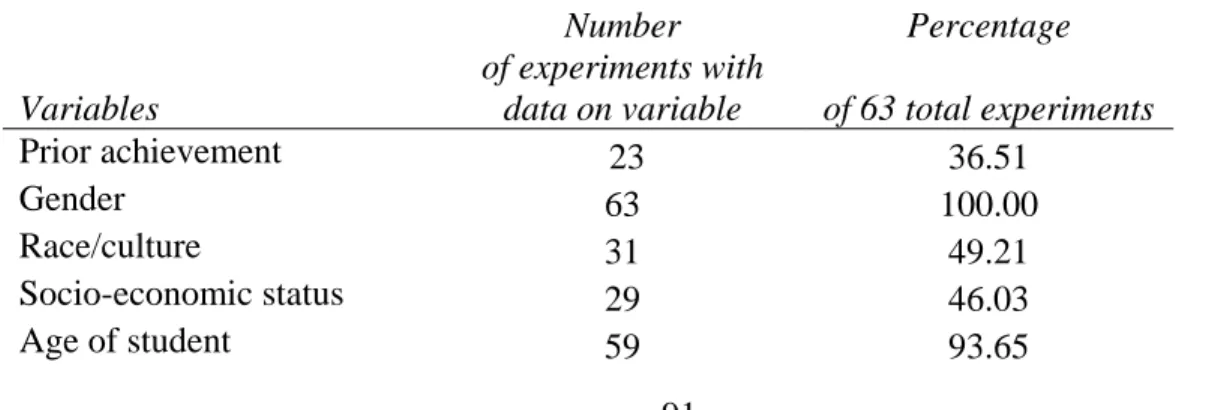
Age. ... 56
Academic subject. ... 60
Collaborative instructional methods ... 62
Year of publication. ... 63
Methodological Moderators ... 64
Type of publication. ... 64
Type of self-regulated learning measure. ... 64
Offline measures of self-regulated learning ... 65
vi
Fidelity of Implementation. ... 69
Why Meta-Analysis, and Why It Was Needed ... 70
CHAPTER 3 ... 73
METHODS... 73
Data Collection and Preparation ... 73
Study inclusion criteria. ... 75
Experiment exclusion criteria. ... 76
Information coded from the experiments. ... 77
Variable coding. ... 78
Potential moderating variables and outcome variables. ... 79
Coding reliability. ... 79
Data Analysis ... 80
Testing distributional assumptions. ... 82
Random effects models. ... 84
Heterogeneity. ... 85
Analyzing moderator effects ... 86
Summary ... 87
Research Questions and Expected Outcome(s) ... 87
CHAPTER 4 ... 90
RESULTS... 90
Descriptive Analyses of the Experiments ... 90
Sample Distribution and Outliers ... 93
Assessing the Risk of Publication Bias ... 94
Research Questions and Hypotheses Tested ... 96
vii
Hypothesis 2... 97
Summary. ... 104
Hypothesis 3... 104
Results Summary ... 107
CHAPTER 5 ... 109
DISCUSSION ... 109
Summary of Major Findings... 110
The overall relationship between CL and SRL. ... 110
Variation in the relationship between CL and SRL according to theoretical factors. .... 110
Variation in the relationship between CL and SRL according to methodological factors. ... 112
Theoretical Implications and Future Research ... 114
Educational Implications ... 119
Instructional Recommendations... 121
Conclusions ... 122
Appendix A ... 127
INFORMATION CODED IN EXPERIMENTS ... 127
Appendix B ... 129
FOREST PLOT ... 129
Appendix C ... 130
SUMMARY OF EXPERIMENT EFFECT-SIZES ... 130
Appendix D ... 134
ARTICLES INCLUDED IN META-ANALYSIS ... 134
Appendix E ... 139
SUMMARY OF VARIABLE RELATIONSHIPS ... 139
viii LIST OF TABLES
Table 1 - Summary of Variables Coded for Meta-Analysis ... 11
Table 2 - Levels of Self-regulated Learning Skill ... 27
Table 3 - Summary of Sample Characteristics ... 91
Table 4 - Summary of Outlier Processing ... 93
Table 5 - Summary of Analysis for Publication Bias ... 95
Table 6 - Summary of Continuous Variables ... 98
Table 7 - Summary of Categorical Variables ... 102
Table 8 - Summary of Pairwise Comparisons ... 103
ix
LIST OF FIGURES
x
LIST OF ABBREVIATIONS
CI Confidence interval
CIRC Cooperative integrated reading CL Collaborative learning
CMA Comprehensive meta-analysis CoL Cooperative Learning
CSCL Computer supported collaborative learning
df Degrees of freedom
EBSCO Elton B. Stephens Co ES Effect size
FOI Fidelity of implementation IL Inquiry learning
LASSI Learning and study strategies inventory Mod Modeling
MSLQ Motivated strategies for learning questionnaire PA Peer assisted learning
PBL Problem based learning RT Reciprocal teaching SES Socio-economic status
SE Standard error
SMD Standardized mean difference
xi SRL Self-regulated learning
1 CHAPTER 1
INTRODUCTION
People live in complex social and cultural contexts that constantly require them to make decisions about how to act in ways that satisfy both personal and environmental demands (Brandtstädter, 2006; Demetriou, 2000). This process of adaptation is especially salient for adolescents, who are defined by the American Psychological Association (APA, 2002) as individuals in the age range from 10 to 18. This period is considered particularly significant because adolescents must make behavioral adjustments in the midst of
tremendous changes in their neurological, physiological, cognitive, emotional, somatic, and behavioral characteristics (Geldoff & Little, 2011; Lerner et al., 2011).
The pressure to adapt behavior must be managed in the context of major changes in family, peer group, and school (Bandura, Barbaranelli, Caprara, & Pastorelli, 1996; Buckner, Mezzacappa, & Beardslee, 2009). Such circumstances are evident when adolescent students (hereafter, students) must learn how to adjust to, and manage, differently structured school environments, enlarged peer networks, and work or chore responsibilities (Dotterer & Lowe, 2011; Parker, 2009). Selecting the best means to accomplish multiple and sometimes
2 Maehr, & Midgley, 1999; Caprara et al., 2008).
To regulate their learning, adolescents must develop skills to monitor and control
motivational, affective, cognitive, and social factors that influence their learning (Bandura,
1993; Caprara et al., 2008). Self-regulatory skill development requires bringing
self-influence to bear on every aspect of students’ learning experiences; however, scholars lack
sufficient knowledge about how such skills develop (Rudolph, Lambert, Clark, &
Kurlakowsky, 2001; Wang & Eccles, 2013). Understanding this phenomenon is important
because developing and exercising self-regulatory skills are central to setting the course of
one’s academic trajectory (Bandura, 2006; Kitsantas, Steen, & Huie, 2009; Usher & Pajares,
2008a).
Numerous researchers such as Hadwin, Järvelä, and Miller (2011) and Kitsantas, Zimmerman, and Cleary (2000) have suggested that collaborative learning (CL) helps students develop self-regulatory skills. Researchers have described collaborative learning in many ways (i.e., cooperative learning, peer-assisted learning, group work), but virtually all forms of this pedagogy involve instruction during which teachers arrange students into small groups in which students assist each other and share responsibility for learning classroom material (O’Donnell, 2006; O’Donnell & Hmelo-Silver, 2013). Examples of student
3
thinking) (Iiskala, Vauras, & Lehtinen, 2004; Vauras, et al., 2003; Volet, Summers, & Thurman, 2009). In other words, social influences within CL environments are mechanisms that help students develop SRL skills and knowledge.
Although the benefits of SRL and CL, are well known (Webb, 2013; Zimmerman, 2001) on their own, researchers and educators require a better understanding of how CL contributes to the acquisition of SRL during adolescence; I used meta-analysis to investigate this relationship between CL and SRL. Meta-analysis is a quantitative method used to summarize and combine the results of numerous studies using a common numerical index (Hedges & Pigott, 2001).
Current literature was also unclear on how various social cognitive factors (Bandura, 1977, 1989, 1993, 2006) moderate the relationship between CL and SRL. Specifically, there was a dearth of information on how personal factors (e.g., age, gender, race, prior
achievement, socio-economic status), environmental factors (e.g., instructional method, subject domain), and behavioral factors (e.g., homework practices) influence the relationship between SRL and CL. There was also little information on how methodological factors (e.g., type of SRL measure, type of research study) might moderate the relationship between CL and SRL. I investigated those issues in the present study.
In the remainder of this chapter, I discuss social cognitive theory, the organizing frame for the current study. I also introduce theoretical and empirical findings about the social cognitive factors that may moderate the relationship between CL and SRL, as well as the findings that emphasize how CL contributes to the acquisition of SRL skills and
4 Theoretical Framework
Self-regulated learning theory. Zimmerman (2001) described self-regulated learners as students who personally initiate and direct their own efforts to acquire knowledge and skill rather than relying on other agents of instruction (e.g., teachers). Self-regulated learning (SRL) connotes the use of task strategies, self-evaluations, and a commitment to goals in order to accomplish a learning task (Zimmerman & Moylan, 2009). Self-regulated learners monitor and control their thoughts as they pertain to learning; negative self-evaluations of performance can undermine those efforts (Zimmerman, 2001). Thus, SRL contains many interconnected processes because feedback, both internal and external, shapes not only current learning efforts but also affective beliefs (e.g., computer anxiety) and strategic planning (e.g., detailed steps to accomplish a learning goal) for future learning (Zimmerman, 2000).
5
Adolescents’ self-efficacy perceptions can also influence how students engage with their learning tasks; highly efficacious students use more effective planning and task
strategies and are more persistent in their work than students with low self-efficacy (Bandura, 1986). It is significant that some nations and communities use, often inadvertently, teaching strategies and beliefs (e.g., limited student autonomy, lower student expectations based upon race) that reduce the possibility that students will develop a strong sense of self-efficacy. Unfortunately, students within these contexts develop their academic skills while being exposed to environmental factors that do not foster SRL (Birenbaum & Alhija, 2013; Murdock, 2008; Nodoushan, 2012; Tang & Neber, 2008).
Larson and Brown (2007) indicated that many of the factors that moderate student self-regulation success are motivational or emotional in nature. Although the students they observed wanted to work on their assignments, they were not able to focus their attention and behaviors. In addition, these students needed to regulate their emotions such as anger toward collaborating peers or disappointment with a setback, as well as the need to control outward expressions of pride about something they had done well (Larson, 2010). When Larson and Brown (2007) examined their data in detail, they indicated that although they had classified motivational and emotional factors as internal or personal, they realized that almost all of the student observations they analyzed involved an interaction or fit between internal (i.e., personal) and external (i.e., environmental) factors. This insight highlights how reciprocal influences among social cognitive factors moderate the success of students’ attempts to regulate their learning.
6
Ainley, 2008). Emotional factors often involve events or interpersonal dynamics related to schoolwork, such as negatively perceived teacher interactions or lack of connection with one’s school (Wang & Eccles, 2011; Rudolph et al., 2001). The motivational and emotional factors that adolescences encounter do not occur in a vacuum; they intertwine with dynamics in the task environment that require regulation. These factors in the task environment are not centrally related to regulating the self but rather to regulating one’s work, including, for example, how to influence a peer through discourse (Määttä, Järvenojä, & Järvelä, 2012; Salonen, Vauras, & Efklides, 2005). In these contexts, environmental factors are cause for students to engage in personal and behavioral regulation that, in turn, suggests the existence of a reciprocal relationship among personal, environmental, and behavioral factors related to SRL (Bandura, 2006; Zimmerman, 2002a). Such factors can moderate students’ attempts to regulate their learning (Zimmerman & Cleary, 2009). Other examples that pertain to these relationships include circumstances that indirectly relate to schoolwork, such as cultural norms that discourage the development of higher-level thinking skills (Pino-Pasternak & Whitebread, 2010; Tempelaar et al., 2013) and limited parental income that restricts access to educational resources that can foster SRL skills (Evans & Rosenbaum, 2008; Schultz, 1993).
Finally, biological age can limit student capacity to use self-regulatory skills due to underdeveloped memory capacity or reasoning ability (Veenman, Kok, & Blote, 2005; Wigfield, Klaudia, & Cambria, 2011). Limited domain knowledge also impedes SRL because many self-regulatory processes are domain-specific (Boekaerts & Corno, 2005; Pintrich, 2000; Schunk & Zimmerman, 2007). In sum, there is evidence that personal, environmental, and behavioral factors influence the use of self-regulatory skill.
7
emphasize shared responsibility for learning and student autonomy during learning are some of the environmental factors that influence the development of SRL skills and knowledge (Schünemann, Spörer, & Brunstein, 2013; Zimmerman & Lebeau, 2000). This means that CL can activate positive motivational beliefs and trigger behaviors such as the use of self-regulatory skills (Nichols, 1996; Chin & Brown, 2002). Moreover, CL affords students with numerous opportunities to model positive self-motivational beliefs and self-regulatory skills amongst each other (Newman, 1994); all of these conditions contribute to the acquisition of SRL skills and knowledge (Stright & Supplee, 2002; van Grinsven & Tillema, 2006; Wang & Lin, 2007). The general belief is that during CL, members distribute and share thinking responsibilities (Brown et al., 1993) and that this shared responsibility fosters self-regulatory skill (Paris & Paris, 2001; Perry & Winne, 2013).
Social cognitive theorists emphasize that students acquire self-regulatory skills and knowledge by observing behavior and that their learning is most effective when they observe people who are both similar to themselves and display a high level of self-efficacy, in itself an important component of SRL (Britner & Pajares, 2001; Gaskill & Woolfolk Hoy, 2002; Joët, Usher, & Bressoux, 2011). This is a key example of how environmental factors help students acquire self-regulatory skills. Feedback provided by a model during the performance of a behavior amplifies the power of observational learning and helps students internalize the behaviors and skills they observe as well as assume more responsibility for demonstrating the relevant task themselves (Butler & Winne, 1995; O’Donnell, 2006; Zimmerman, 2000). The advantages of such behaviors are often bidirectional, meaning that students who are more capable can benefit from working with less-capable students (King, 1999; Webb, 2009).
8
conceptual definitions (Roschelle, 1992), mathematical operations (Webb & Farivar, 1994) and reading comprehension (Palinscar & Brown, 1984). Watching a peer accomplish a task can give students hope that they can do it too, which aids their motivation to learn materials taught in school (Schunk & Zimmerman, 1996). It is important to note that the social
cognitive perspective of CL implies that novice learners will observe, listen to, and seek help from a peer (e.g., a model) who has more advanced SRL knowledge and skills. This
perspective allows peers, an environmental factor, to help foster SRL during CL; as a result, students who perceive similarity to a peer who successfully demonstrates an SRL skill will be highly motivated to practice that SRL skill themselves (Wolters, 2011).
Aside from observational learning, students are likely to experience two sources of positive self-efficacy for SRL because of collaborating with peers: mastery experiences and acts of verbal persuasion (Webb & Mastergeorge, 2003). Mastery experiences result from attempts to develop a competency, for example by creating a task strategy (Bandura, 1993). Discourse and other forms of persuasive communication, for instance encouragement to persist during challenging learning tasks, are most effective when expressed by capable and honest parties (Schunk & Zimmerman, 1997, 2007). Both of these conditions foster positive self-efficacy beliefs that help students acquire self-regulatory skills and knowledge
(Zimmerman, 2000) and are excellent examples of how environmental factors foster SRL during CL.
9
self-regulatory skills such as self-reflection (Van Grinsven & Tillema, 2006). Other instructional elements of collaborative tasks that help students acquire SRL skills and knowledge include providing students with a choice of learning activities (Mason, 2004; Perry, 1998), having students participate in problem-solving exercises (Webb &
Mastergeorge, 2003; Zimmerman & Lebeau, 2000), and assigning students authentic problems that pique their interest (Hidi & Ainley, 2008; Wolters, 2011). Both observational learning and instructional elements inherent to CL provide insight into how CL, an
environmental factor, helps students acquire SRL skills and knowledge.
Summary. It is reasonable to differentiate the influences that moderate the
acquisition of self-regulatory skill into personal (i.e., related to age or gender), behavioral (i.e., related to student actions such as strategy use), and environmental (i.e., related to instructional methods) factors (Wang & Ling, 2007; Wigfield, Klaudia, & Cambria, 2011; Zimmerman, 2001). Although there is substantial evidence that CL methods can foster self-regulatory skills, there is also a continuing need for researchers to investigate such
relationships because numerous factors, for example, age-related characteristics or family income, may moderate the relationship between CL and SRL (Buckner, Mezzacappa, & Beardslee, 2009; Dotterer & Lowe, 2011; Fried & Chapman, 2012). Due to the reciprocal influences of social cognitive factors and the interrelated nature of self-regulatory processes, the current study required a method of analysis that could consider social cognitive
influences upon multifaceted constructs in several contexts. Meta-analysis certainly addressed this need.
Benefits of Meta-Analysis and Research Questions
10
11 Table 1
Summary of Variables Coded for Meta-Analysis
Predictor Variable Moderator Variables Outcome Variables
Collaborative instruction
1. Theoretical
a. Prior achievement b. Gender
c. Race/ethnic group d. Socio-economic status e. Age of student
f. Type of collaborative instruction method g. Year of publication h. Subject domain 2. Methodological
a. Type of SRL measure(s) b. Study classification c. Fidelity of implementation
Self-regulated learning or self-regulatory process
Note: Theoretical moderator variables represent social cognitive (Bandura, 1997) factors and methodological moderator variables represent study design features (Wu & Zumbo, 2008); both categories include variables that could influence the relationship between collaborative learning and self-regulated learning.
The third phase of meta-analysis is the calculation of effect sizes, with the goal of estimating the average standardized mean difference between CL and control or comparison conditions in terms of SRL outcomes, along with estimating the heterogeneity (e.g., variance) within the distribution of standardized mean differences (Borenstein et al., 2009). An
12
effect sizes (Lipsey & Wilson, 2001). Overall, I used pooled data to calculate the average magnitude of the overall relationship between CL and SRL and to examine the extent to which conceptually relevant moderator variables strengthen or weaken this relationship (Borenstein et al., 2009).
Perhaps the most important benefit of meta-analysis is its potential for generating explanatory knowledge of the intervening mechanisms through which CL causes its self-regulatory effects (Cook et al., 1992). This benefit is particularly useful when synthesizing multiple bodies of literature that are comprised of experiments that test dissimilar domain and pedagogical arrangements (Borenstein et al., 2009; Cooper, 2010). Whereas researchers can perform individual experiments to test a specific theory or question (e.g., whether one experimentally manipulated variable induces student learning relative to a control), a meta-analysis can explore a wider range of variations (i.e., subject domains and types of SRL measures) and identify specific conditions (i.e., types of instructional methods) that facilitate an effect. Knowledge of these conditions improves researchers’ theories that attempt to explain how academic interventions work; it can also help predict the effects of similar interventions that share similar conditions, as well as produce new recommendations for instructional practice (Cook et al., 1992; Cooper, 2010).
Meta-analysis was well suited to address the data analysis needs of the current study. Specifically, I used meta-analysis to answer three research questions:
13
2) How do theoretical factors (e.g., prior achievement, gender, race, SES, age, type of collaborative learning method, year of publication, subject domain) moderate the relationship between CL and SRL?
14 CHAPTER 2 LITERATURE REVIEW
In this chapter, I review literature on how collaborative learning (CL) helps students acquire self-regulatory skills required to overcome academic challenges. I begin this
discussion by defining and describing the various models of self-regulated learning (SRL). Next, I define and describe various forms of collaborative learning and discuss how CL helps students acquire self-regulatory skills and knowledge. Then, I discuss factors that moderate the relationship between CL and SRL and conclude the chapter by reviewing my research questions and presenting associated hypotheses for each research question.
Models of Self-Regulated Learning
Several researchers have defined competing models of SRL that emphasize different facets (e.g., metacognition). Reviewing these empirically supported models of SRL is helpful in understanding how CL helps students acquire the SRL skills and knowledge that are required to overcome their academic challenges. The researchers associated with these models are Boekaerts (Boekaerts, 1996; Boekaerts & Niemivirta, 2000), Winne (Winne & Hadwin, 1998), Pintrich (2000), and Zimmerman (2000).
Boekaerts’ model of self-regulated learning. Boekaerts (1996; Boekaerts &
15
technology, and other entities that foster learning. A third priority, the maintenance of emotional well-being within reasonable boundaries, is indicated when students try to protect their egos, avoid emotional harm, and seek additional help in school (Boekaerts, 1996).
It is important to note Boekaerts’s hypothesis that, when students attempt to balance the above priorities, they monitor and control their learning activities based upon their perceptions of their learning performances [i.e., they engage in the principal processes of metacognition (Flavell, 1979)]. In other words, favorable conditions for academic tasks and opportunities for learning foster an intrinsic interest in students to learn materials taught in school and to expand their resources and skills that foster SRL (Boekaerts & Corno, 2005). Negative appraisals of academic tasks and opportunities for learning, however, result in a sense of difficulty or distress that causes students to disengage from academic activities to protect their well-being; as they do so, they develop skills that are less likely to foster SRL skills and knowledge (Boekaerts, 1996).
Within this model of SRL, students base their self-appraisals upon metacognitive and domain knowledge [e.g., subject-activated, goal-directed behavior and other
self-motivational factors that play a central role in SRL (Boekaerts, 1995)]. From this perspective, metacognitive and domain knowledge pertain to monitoring and evaluating goal achievement along with procedural knowledge (e.g., learning strategy use) (Boekaerts, 1999); goal-
16
Boekaerts and colleagues (e.g., Boekaerts, 1999; Seegers & Boekaerts, 1993) have instantiated their SRL model by demonstrating how two motivational (e.g., positive and negative emotional) mechanisms can influence the development of self-regulatory skills, specifically reading and mathematical skills. Boekaerts and Cascallar (2006) identified instructional strategies that teachers can use to promote positive emotional states that foster SRL. Finally, Boekaerts (1997) demonstrated the importance of prior content and
metacognitive knowledge to SRL success thereby supporting the emphasis of these types of knowledge within her model of SRL.
Winne’s model of self-regulated learning. Winne (2001) developed his model of
SRL to describe student study behaviors such as doing homework or preparing for an oral presentation. He postulated that SRL develops throughout four flexibly ordered and recursive phases. In Phase 1, learners identify external conditions that define the assigned academic task (Winne & Hadwin, 2010). These conditions fall into two main categories. Task conditions are features of the assigned task such as objectives of the teacher (or textbook), time available to complete the task, whether peers are involved, and whether responsibility is individual or shared (Winne & Hadwin, 2010). Cognitive conditions are internal to the learner. They include the range and significance of prior knowledge, motivational factors such as goal orientation (e.g., intrinsic desire to learn material taught in school), and epistemological beliefs such as the value of knowledge, known study tactics, and other qualities that make the student a unique individual (Greene & Azevedo, 2007b; Winne, 2001).
17
learners begin engaging with the task and taking steps to reach goals. In Phase 4, students make decisions to adapt their behaviors regarding actions taken in the preceding phases, including changing or repairing metacognitive knowledge (e.g., the effectiveness of learning strategy use), to enhance success in the present and for future tasks. Because students may reexamine external resources or what they know about the task during any phase of SRL, metacognitive monitoring may reveal significant gaps in their knowledge that cause them to retreat to a prior phase to make adjustments––this is the recursive property of Winne’s model (Winne & Hadwin, 2010). Therefore, metacognitive monitoring and feedback are critical components of this model (Winne, 2001).
Each stage of this model shares the same general structure, referred to as COPES (conditions, operations, products, evaluations, and standards; Winne, 2001). Conditions include information about task conditions (e.g., time constraints, available resources, and social context) and cognitive conditions (e.g. interest, goal orientation, and task knowledge) both of which influence how students engage with their learning tasks. Winne defined operations as the cognitive processes, tactics, and strategies students engage in when faced with a task; products refer to information created by operations, such as when students create new knowledge. A different product is thus created at each stage. Products can be internal (e.g., an inference drawn from an attribution) or external (i.e., observable behavior or performance). Evaluations consist of feedback, whether internal or external, about the products. Standards are criteria that students believe are the optimal objectives of whatever phase they are performing; they include both metrics and beliefs, for example obtaining a particular grade on a task (Greene & Azevedo, 2007b).
18
for various components and phases of Winne’s model. This research includes Winne and Perry (2000) along with Butler and Winne (1995), who demonstrated that feedback and metacognitive processes form the basis for future actions that support the recursive nature of Winne’s SRL model. Winne also conducted several empirical studies that explored aspects of his model. This research includes Winne (1996) in which he identified how the products of metacognitive monitoring can result in a student updating the goals he or she has assigned to a task because of newly found resources, and Winne (1997) where he investigated the importance of task conditions in SRL.
Pintrich’s model of self-regulated learning. Pintrich’s (2000) model of SRL is
19 future.
Pintrich (2000) presented his model as a heuristic and indicated that the context of learning and motivational factors would heavily influence the use of self-regulatory processes (e.g., monitoring) within each phase and area (e.g., cognition) of the model. His work indicates that SRL does not always follow a time-ordered sequence and that some students may not engage in all of the phases of his model during a learning episode (Pintrich & Zuscho, 2007). An example of a self-regulatory processes defined within Pintrich’s model of SRL is a student setting a goal of reading one chapter in preparation for a test. This behavior pertains to the forethought phase of SRL. Another example concerns the same student using his or her metacognitive awareness to determine if he or she understands the text being read; this behavior concerns the monitoring phase of SRL. When a student realizes that he or she does not understand the text that has been read and decides to repair
comprehension by rereading parts of the text, this student is adjusting reading strategy—a behavior that pertains to the control phase of SRL (Pintrich, 2000). If this student does not perform admirably on a test after reading the chapter and attributes this underperformance to the unsuccessful use of learning strategies, he or she has the opportunity to elevate future achievement via this self-reflection process. In general, if students attribute their success to causes they can control, they will expect to succeed in the future (Dweck & Master, 2008); these behaviors pertain to the self-reflection phase of SRL (Pintrich, 2000).
Zimmerman’s model of self-regulated learning. Zimmerman (1989) has posited
20
of these reciprocal interactions is the influence that a student’s self-efficacy perceptions concerning prior learning experiences exert upon his or her future writing behavior, for example the choice of an essay topic (Schunk & Zimmerman, 2007). Adolescents’ personal beliefs can also influence how they manage their learning environment, for example when students turn off their TV due to the belief that they can accomplish the relevant task in a quiet location (Zimmerman, 2000). SRL is a proactive process because feedback (both internal and external) shapes not only current learning efforts but also affective beliefs (e.g., anxiety concerning computer instruction) and strategic planning (e.g., detailed steps to accomplish a learning goal) for future learning (Zimmerman, 2000).
The fact that personal, behavioral, and environmental factors change during the course of learning necessitates the use of feedback to monitor and control SRL processes (Zimmerman, 1989). Personal self-regulation involves monitoring and controlling cognitive and affective learning processes such as perceptions of self-efficacy and fears related to learning. Behavioral self-regulation involves monitoring and controlling learning
performance processes, for example managing the time spent on discussing a concept with peers. Environmental self-regulation involves monitoring and controlling external conditions such as communicating with and learning from peers (Zimmerman, 1989).
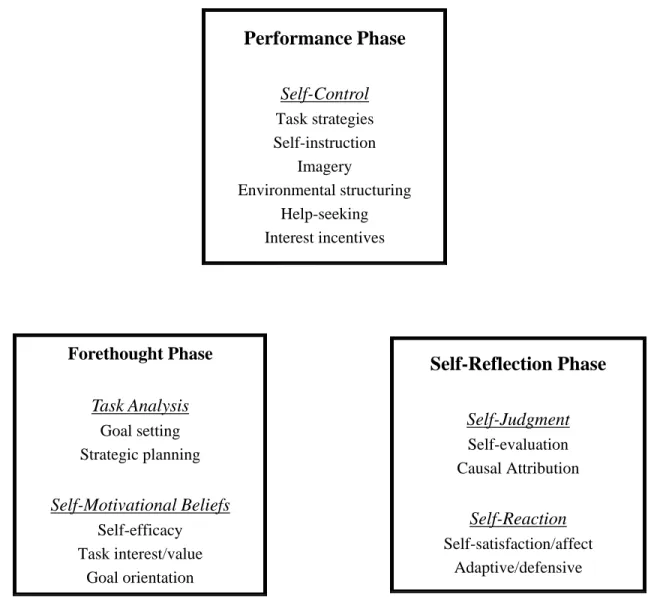
Cyclical self-regulated learning. Because students use feedback to plan future learning performances, Zimmerman (2002a) hypothesized that self-regulation is a cyclical process. Self-regulatory processes, such as planning to use a specific learning strategy, and concomitant beliefs, such as efficacy beliefs, help make up three related phases of self-regulation: forethought, performance, and self-reflection.
21
22
Figure 1. Cyclical phases of SRL. Adapted from B. J. Zimmerman and T. J. Cleary (2009), “Motives to self-regulate learning: A social cognitive perspective,” in K. R. Wentzel and A. Wigfield (Eds.), Handbook of motivation at school (New York, NY: Routledge), p. 249.
Self-motivational beliefs are important during the forethought phase of SRL because students rely upon these beliefs when they execute their plans and strive to meet the
academic goals they have set (Cleary & Zimmerman, 2004). Moreover, the attainment of goals helps students bolster their self-efficacy beliefs––a behavior that helps foster SRL skills and knowledge (Zimmerman, 2001). Two additional self-motivational beliefs that influence the forethought phase of SRL are outcome expectations and interest. Outcome expectations
Performance Phase
Self-Control Task strategies Self-instruction
Imagery
Environmental structuring Help-seeking Interest incentives
Self-Reflection Phase
Self-Judgment Self-evaluation Causal Attribution
Self-Reaction Self-satisfaction/affect
Adaptive/defensive Forethought Phase
Task Analysis Goal setting Strategic planning
Self-Motivational Beliefs Self-efficacy Task interest/value
23
pertain to the consequences of performing a certain task, such as securing a high-paying job after obtaining a college education or receiving a gift from a parent after achieving a perfect test score (Bandura, 1993). It is important to note that perceptions of self-efficacy influence outcome expectations; in other words, students’ beliefs about the usefulness of learning outcomes pertain to their efficacy beliefs about such outcomes (Zimmerman & Cleary, 2009). A student’s level of interest in the subject matter is also significant during the forethought phase of SRL because high interest levels increase one’s motivation and
engagement to learn. Hidi and Harackiewicz (2000) have identified these as states that foster SRL skills and knowledge.
control, observation, and experimentation during the performance phase. Self-control processes involve activities that facilitate the successful completion of a task.
Examples of self-control techniques that students use are self-rewarding after completing a challenging assignment (Zimmerman, 1989) and attention-focusing that is designed to improve a student’s concentration by screening out external events during study episodes (Zimmerman, 2000). Zimmerman (2002a) also emphasized that the goal of student self-control activities is to practice basic skills in order to optimize learning efforts. Self-observation processes involve keeping track of one’s cognitive or behavioral activities, for example, maintaining a journal of time per day spent on homework. By becoming aware of patterns (e.g., time, duration, frequency) associated with their learning, students increase their chances of successfully monitoring and controlling their learning behaviors
24
achievement after using different learning strategies (e.g., studying with peers vs. studying alone) with similar homework assignments.
Judgment and reaction to learning in the self-reflection phase. Bandura (1977)
identified two types of processes that social cognitive researchers have continued to associate with the self-reflection phase of SRL: self-judgment and self-reaction. The standards that students choose, such as obtaining a specific GPA, affect their self-judgments (Schunk & Zimmerman, 1997). Using a peer’s performance as an achievement goal is an example of how standards can influence self-judgments (Schunk & Zimmerman, 1997) because this act may lower one’s self-efficacy (for example, if a student’s learning efforts result in grades that are lower than another student’s grades). Clearly, these circumstances would not lead to a student’s self-satisfaction; therefore, a person’s motivation to learn does not stem from the goals themselves, but rather from self-evaluative reactions to behavioral outcomes
(Zimmerman, 2000).
Previous performance or self-evaluated criteria provide opportunities to compare one’s performance with earlier levels of behavior (Bandura, 1997); these self-judgments can result in efforts to improve SRL skills if inadequate effort is the reason for deficient
25
During self-reaction to learning tasks, students develop inferences about how they will approach future learning tasks. Adaptive inferences are important because they help people obtain new and better forms of self-regulatory skill, for example using a more effective learning strategy or setting challenging goals that foster an intrinsic interest in learning (Cleary & Zimmerman, 2004; Zimmerman, Bandura, & Martinez-Pons, 1992). Students may also make defensive inferences about how they need to approach their
subsequent efforts to learn or perform. Examples of such behavior include student efforts to protect their egos from future dissatisfaction and adverse affect; this type of self-reaction is often associated with task avoidance, procrastination, and apathy toward materials taught in school (Garcia & Pintrich, 1994). It is significant that self-reactions affect forethought processes cyclically, for example by enhancing self-efficacy beliefs about mastering academic tasks, developing learning goal orientation (Schunk & Zimmerman, 1996), and intrinsic interest in the task (Zimmerman & Kitsantas, 1997). In a similar manner,
dissatisfaction with a course grade can undermine a student’s sense of self-efficacy to continue enrollment in an advanced learning program (Bandura, 1997). These types of evidence make it apparent that a social cognitive model of SRL can explain the persistence and sense of self-fulfillment of capable students as well as the avoidance and self-doubts of less-capable students (Zimmerman, 1989).
Four levels of self-regulated learning skill. To become a self-regulated learner,
26
use such as persistent behavior (Schunk & Zimmerman, 1996). Students acquire an observational level of self-regulatory skill when they can demonstrate an applicable skill after watching a model (Zimmerman, 2000).
Models can exert an even more positive influence upon an observer’s future performance by expressing their beliefs about and interest in their learning performance, because these behaviors help increase observers’ self-efficacy for the relevant task (Bandura, 1989; Schunk & Zimmerman, 1997). Models also provide feedback (e.g., explanations) that help students obtain the emulation level of SRL (Cleary & Zimmerman, 2004). Offering explanations is important because this type of discourse helps information providers and receivers become more skilled in enacting the steps (e.g., of a learning strategy––an SRL skill) outlined in the explanation (Chang & Wells, 1987; Schunk, 1982). Nonetheless, when students demonstrate the emulation level of SRL skill, they seldom imitate the exact actions of a model but instead emulate a model’s basic pattern of performance (Bandura & Jeffrey, 1973).
To master the first two levels of SRL skill, students depend upon peers who are social sources of regulation. To attain advanced levels of SRL skill, students must deliberately practice tasks designed to enhance performance (Zimmerman & Kitsantas, 1997). When students can routinely produce a required skill, such as performing a learning strategy during a preplanned quiz, they have internalized the learning strategy and acquired the self-control level of SRL skill appropriate to the relevant learning task (Zimmerman, 2000).
27
students focus their attention on the outcome they want and use internalized self-regulatory skills (e.g., environmental structuring) to achieve their goals (Zimmerman, 2000). When students demonstrate such behaviors, they have acquired the self-regulation level of SRL skill (Zimmerman, 2000). Table 2 contains a summary and descriptions of the four levels of SRL skill.
Table 2
Levels of Self-regulated Learning Skill
Level Name Description
1 Observation Vicarious induction of a skill from a proficient model 2 Emulation Emulative performance of the model’s basic skill with
social assistance
3 Self-control Independent display of the model’s skill under structured conditions
4
Self-regulation
Adaptive use of skill during dynamic conditions
Note: Adapted from “Attaining self-regulation: A social cognitive perspective,” by B. J. Zimmerman, 2000, in M. Boekaerts, P. R. Pintrich, & M. Zeidner (Eds.), Handbook of self-regulation: Theory, research, and applications (San Diego, CA: Academic Press), p. 29.
It is evident that researchers have conducted numerous empirical studies to test Zimmerman’s model. Self-efficacy has surely been the most-studied aspect of Zimmerman’s model (see, for example, Schunk, 1990, 1994; Schunk & Zimmerman, 1996, 1997).
Zimmerman and Martinez-Pons (1986, 1988) have developed a structured interview method, the self-regulated learning interview schedule (SRLIS), to test students’ use of SRL
28
strategies, such as self-evaluating, organizing, transforming, planning, and monitoring. Zimmerman and Martinez-Pons (1990) used SRLIS to examine the relationship between students’ use of SRL strategies and their perceptions of both verbal and mathematical self-efficacy. The results revealed, as hypothesized, that both types of self-efficacy measures were correlated with the use of self-regulated strategies. Grade (5th, 8th and 11th), giftedness (gifted vs. regular), and gender further differentiated the results. Older students’ self-efficacy surpassed that of younger students; giftedness had a positive relationship with self-efficacy; and boys’ verbal self-efficacy was significantly higher than that of girls. The researchers did not find any gender-related differences concerning mathematical self-efficacy. Zimmerman has also explored and instantiated his model in other domains, such as self-regulated writing (Zimmerman & Bandura, 1994; Zimmerman & Risemberg, 1997), and the acquisition of complex motor skills (Zimmerman & Kitsantas, 1997; Kitsantas & Zimmerman, 1998).
Summary of self-regulated learning models. Even if the self-regulatory terminology varies from one model to another, all of the authors mentioned above have assumed SRL to proceed from a preparatory phase, through the actual performance or task completion phase, to an appraisal or adaptation phase (Winne & Hadwin, 2010). The preparatory phase of SRL includes task analysis as well as planning and goal-setting activities. This phase is based on self-knowledge, motivational beliefs, and metacognitive knowledge about the self, the task, and the situation and it prepares the individual for a forthcoming learning performance.
The second phase concerns performance processes. It consists of learning strategy use and real-time self-regulatory and monitoring activities such as resource allocation and
29
evaluation of learning outcomes. Internal and external performance feedback provides students with information about the efficacy of their activity and serves as a basis for attributions, comparisons, and adaptations that influence future learning episodes. Thus, all the authors of the models assume that SRL is cyclical in that self-reflection results in appraisals that influence subsequent preparatory processes.
Examining the commonalities and differences between the models provides further insight into how SRL helps students overcome their academic challenges. Some may argue that Boekaerts’ model of SRL places substantial emphasis on the regulation of affect and that this is a distinguishing attribute of her model. However, all of the other models, perhaps with the exception of Winne’s model, also thoroughly address this issue (Boekaerts, 1988; Greene & Azevedo, 2007b; Pintrich, 2000; Zimmerman, 2000). SRL affords students the ability to regulate their emotions and this is a strength because emotions can surely influence students’ use of self-regulatory skills such as help-seeking (Newman, 1994) and adaptive behaviors (Zimmerman, 2000) that lessen the chance they will engage in self-defeating behaviors (Boekaerts, 1993, 1995). Boekaerts and her associates have also spent significant time investigating the interaction between cognition and affect and have identified how volitional strategies (i.e., actions related to persistence) can help students overcome significant
challenges (Boekaerts, 1992, Vermeer, Boekaerts, Seegers, 2001). It is also evident that the other models incorporate how persistence fosters SRL (Greene & Azevedo, 2007b; Pintrich, 2000; Winne & Hadwin, 2010; Zimmerman, 2000).
30
model as a heuristic and indicates that students may not engage in all of the phases or all of the processes in each phase during a learning episode (Pintrich 2000). I agree with this perspective, for example, because I surely doubt that students consider planning for self-observation during every learning task. Winne’s and Boekaerts’ models both emphasize this aspect of SRL because metacognitive and/or motivational processes can redirect a student’s learning according to their models. However, Zimmerman’s model emphasizes the cyclic aspect of SRL and one can argue that the performance phase of Zimmerman’s model is recursive, similar to the other two models, because it includes metacognitive processes that enable learners to redirect their efforts for instance by changing learning strategies. To me it is significant that both Pintrich’s and Winne’s model have a separate SRL phase for
monitoring and controlling self-regulatory processes because Boekaert’s and Zimmerman’s model specify that that the two types of self-regulatory processes occur in all phases of SRL.
31
1988). Without question, the authors of the other models recognize the importance of memory processing and learning strategy use concerning SRL success, however those authors place a greater emphasis on how motivation related factors and beliefs influence students’ self-regulatory successes. This is a key distinction between the models because the creators of the other models all suggest that SRL results from the interaction between
metacognitive and motivational processes (Boekaerts, 1996; Pintrich, 2000; Zimmerman & Moylan, 2009). One example of this interaction concerns how changes in students’ goals can disrupt their attempts to self-regulate. Indeed, Greene and Azevedo (2007b) have indicated the need for additional research on how Winne’s model incorporates motivational processes.
Notwithstanding these differences, I concur with several researchers (e.g., Pintrich, 2000; Puustinen & Pulkkinen, 2000; Winne & Hadwin, 2010) who have suggested that the differences in the definitions used within the models are blurred. This suggestion indicates that the relative weight given to the component parts, more than the components themselves, distinguishes one model from another. Most importantly, I argue that social cognitive
constructs that are common to all of the models play a key role in helping students regulate their learning.
Social Cognitive Influences on Self-Regulated Learning
32 SRL.
An example of a self-motivational belief that is common to all of the SRL models is self-efficacy; it is important to note that both agency and self-efficacy are significant elements of social cognitive theory (Bandura, 1977, 1986, 1993). Like self-reflection and self-reaction processes, agency related actions and self-efficacy beliefs can precipitate changes in personal thoughts and behaviors. These constructs, along with other social cognitive processes and self-motivational beliefs such as task interest, are critical
determinants of whether or not students acquire SRL skills and knowledge (Zimmerman, 2001).
33
Moreover, a social cognitive perspective of SRL links students’ self-regulatory processes to specific social learning or behaviorally enactive experiences and can explain the reciprocal impact of these experiences (Zimmerman, 1989); which are important to the current research. Third, Zimmerman’s (2000) social cognitive theory of SRL clearly defines distinct levels of SRL skill and the mechanisms and contexts that students can use to acquire increasing levels of SRL skills and knowledge (e.g., Schunk & Zimmerman, 1996;
Zimmerman & Cleary, 2009; Zimmerman & Kitsantas, 1997). For these reasons, I have chosen Zimmerman’s social cognitive model of SRL to frame how CL helps students acquire SRL skills and knowledge. In the next section, I make my initial conceptual connections between the social cognitive perspective of SRL to CL by introducing two key ways that CL can scaffold students’ acquisition of SRL skills and knowledge. Afterward, I provide more evidence for why I think CL can foster SRL, and why this phenomenon requires further investigation.
Social and Environmental Support of Self-Regulated Learning
34
Environmental supports such as praise (Webb, 2009) and other forms of feedback from peers during class (Butler & Winne, 1995) can increase student self-regulatory skill. Praise provided by a creditable and sincere peer can certainly increase a student’s self-efficacy for SRL (Schunk, 1987; Schunk & Zimmerman, 1997) and thereby affect his or her future use of performance phase strategies. Feedback provided by peers can direct attention to the processes that need attention, correct misconceptions in a student’s understanding, and incite his or her interest in a learning task (Winne & Hadwin, 2010). It then follows that the interdependence between environmental and personal influences of regulation promotes goal-directed behavior, the effective use of learning strategies, and the motivation to learn. It is important to note that these behaviors and thoughts foster SRL for students.
Thus, peers are a valuable resource for self-enhancing forethought, performance, and self-reflection phase processes (Zimmerman, 2001). Modeling serves as the primary
mechanism through which students acquire self-regulatory skills such as persistence, learning strategy use, and adaptive behaviors related to instruction provided by teachers (Wolters, 2011). Collaborative learning is a form of instruction that relies upon the skills that are required for SRL; therefore, CL can help students acquire the skills they need to overcome academic challenges.
Collaborative Learning
35
& Corno, 2005; Wang & Lin, 2007; Wolters, 2011). Researchers have described
collaborative learning in many ways (i.e., cooperative learning, peer-assisted learning, group work) but virtually all forms of this pedagogy involve instruction during which teachers arrange students into small groups in which students assist each other and share
responsibility for learning classroom material (O’Donnell, 2006; Webb & Palinscar, 1996). O’Donnell and Hmelo-Silver (2013) refined the definition of CL by arguing that CL
emphasizes an equal relationship and mutual influence among group members. The ultimate goal of CL is convergence; among other things, this means the construction of shared meanings for conversations, concepts, and processes (Brown et al., 1993; Roschelle, 1992). In acknowledgement of these perspectives, CL methods that embody these characteristics were only considered in the current study.
Many of the original theories of collaborative learning were strongly influenced by social-psychological principles (Deutsch, 2006). The general principle underlying these theories is that of interdependence (Cary, Johnson, & Johnson, 2008). Interdependence is a condition in which group members share common goals that form a basis for the fostering of self-motivational beliefs (Hakkarainen, Jarvela, Lehtinen, & Lipponen, 1998; Johnson & Johnson, 1989a, 1989b). Thus, if a student is to succeed in accomplishing his or her goals, other students must also accomplish their goals and be successful (Cary, Johnson, & Johnson, 2008). This relationship means that instruction that fosters cooperation rather than
competition among students is a mechanism educators can use to foster self-motivational processes that are essential to the forethought phase of SRL (Zimmerman, 2000).
36
(O’Donnell & Hmelo-Silver, 2013). The former approach relies on the use of rewards or recognition for group performance; the use of these incentives influences self-motivational processes in the form of outcome expectations that occur in the forethought phase and self-satisfaction processes that occur in the self-reflection phase of SRL (Zimmerman, 2000).
Theorists who espouse the theory of interdependence assume that students will be motivated to work together and help one another because the group as a whole will receive a reward or recognition. A second assumption is that individual accountability (e.g., by
issuance of individual grades to each student) will ensure equal participation. Instructional approaches derived from these perspectives include, among others,
teams-games-tournaments (TGT; Slavin, 2011), team-accelerated instruction (TAI; Slavin, 2011), and cooperative integrated reading (CIRC; Slavin, 2011).
37
science experiment (Schraw, Crippen, & Hartley, 2006)] that leads to the acquisition of SRL skills and knowledge (Zimmerman, 2000).
Effective CL requires students to use interpersonal and small-group skills (Cohen, 1994b) that help foster the self-regulatory processes required for SRL. In outlining the Learning Together collaborative method, Cohen (1994b) paid a great deal of attention to the steps educators must take to ensure that students have the necessary environmental supports for the self-regulatory skills that are required for effective collaborative learning. In
particular, the teacher must make important decisions about the size of each collaborative group and which students make up a group. Specifically, groups with more than four students may impede CL, and thus self-regulatory skill acquisition; and groups of students with vast differences in skills (e.g., cognitive and social) may not be able to work in a collaborative manner (Webb, 1980) and thereby regulate their learning (Vauras, Iiskala, Kajamies, Kinnunen, & Lehtinen, 2003). The teacher must also ensure that adequate materials are available and assign students to specific roles within a group. In addition, the teacher must establish criteria for evaluating the success of the group and develop a strategy for ensuring that each individual in the group is accountable for his or her performance. As students work together on the assigned task, teachers must monitor and sometimes control their verbal (e.g., asking questions) and behavioral (.e.g., demonstrating a math procedure) interactions.
Additionally, teachers should comment on the effective use of particular social skills such as help seeking that is a self-regulatory task strategy (Zimmerman, 2000); students should conclude their CL task by analyzing what they did well and indentifying areas in which they can improve (Cohen, 1994b).
38
processes in CL methods, it is evident that these types of instructional approaches require students to use and thereby internalize the self-regulatory processes that are required for SRL. In particular, CL requires students to regulate their efforts in pursuit of a single goal, to monitor their individual progress toward that goal, and to redirect their efforts if necessary (O’Donnell & Hmelo-Silver, 2013). Importantly these behaviors are representative of the three cycles of Zimmerman’s (2000) social cognitive model of SRL.
Problem-solving methods. In this form of pedagogy, student learning centers on a complex problem that has multiple paths to an acceptable answer (Hmelo-Silver, 2004). Problem solving methods (e.g., problem-based learning or PBL, which is a form of CL) include an iterative cycle of steps for identifying the problem, defining the problem, constructing a strategy to solve the problem, organizing information required to solve the problem, allocating resources, and monitoring and evaluating problem solutions (Bruning, Schraw, Norby, & Ronning, 2004; Byrnes, 2009a). Students work in collaborative groups in order to solve a problem, and teachers often assign math or science collaborative tasks so that students can enhance their critical thinking skills (e.g., creating a hypothesis) (Webb & Mastergeorge, 2003).
In her review of PBL, Hmelo-Silver (2004) indicated that problem-solving methods and SRL emphasize similar cognitive processes; in a related manner, many of the
experiments cited in the current study involve problem solving (e.g., Barnes & Todd, 1977a, 1977b; Hogan et al., 2000, Roschelle, 1992, Webb & Mastergeorge, 2003). Therefore it is not surprising that Sinatra and Taasoobshirzai (2011) asserted successful problem solving involves using learning strategies and monitoring the effectiveness of those learning
39
Hmelo-Silver’s (2004) work is also noteworthy because it indicated that this method of learning benefits from the use of learning strategies, goal setting, and intrinsic motivation. She also emphasized the goal of helping students apply their knowledge in flexible ways; all of which help foster SRL skills and knowledge (Zimmerman, 2000). In problem-solving methods, students work on practical problems and have the ability to choose their learning materials and set their own learning goals, (Mayer & Alexander, 2011). The authenticity, intrinsic motivation, and self-direction associated with these types of academic tasks
motivate students to learn and use their metacognition, both of which foster SRL skills and of knowledge (Zimmerman & Moylan, 2009). Based upon the literature review of the current study, no other researcher has investigated the relationship between PBL and SRL across the period of adolescence. Including this instructional method as part of my analysis expanded scholarly knowledge concerning the relationship between CL and SRL.
40
especially when such observational learning concerns learning strategies for hypothesis testing (Windschitl, 2002) or asking questions to generate new knowledge (Chinn & Brown, 2002). It is important to note that both ways help foster the acquisition of all levels of self-regulatory skill (Zimmerman, 2000).
IL also fosters SRL because throughout IL students expand and elaborate upon their prior knowledge during collaborative discussions of meaningful tasks (Mayer & Alexander, 2011). This constructivist and thus motivational process is a combination of cognitive (e.g., learning strategy use), metacognitive (e.g., monitoring) and social conditions (e.g., peer interactions) that allow students to collaborate and individually self-regulate their learning (Schraw et al., 2006). Specifically, during IL students choose the procedures they use to solve research question(s) that initiate the IL task. After this step, students produce an inventory of their existing knowledge/resources about their research question(s) and collect new information necessary for subsequent learning steps. Next, students develop arguments to support their findings using testable hypotheses. In IL, teachers scaffold student learning to ensure adequate learning progress but reduce their interactions as students become more capable (Mayer & Alexander, 2011).
41
[see for example (Baird & Penna, 1996; Neber & Schommer-Aikins, 2002; Nichols, Tippins, & Wieseman, 1997)] support the efficacy of IL in fostering SRL skills and knowledge. Exploring the relationship between IL and SRL within my current study increased scholarly knowledge concerning the relationship between CL and SRL.
Cooperative learning. This form of collaborative learning enhances achievement through an emphasis of group goals and individual accountability. That is, students receive grades based upon the individual learning of all group members (Slavin, 1991). Evidence favoring cooperative learning (CoL) as a way to foster SRL is substantial (Slavin, 1991, 1999) in a wide variety of academic subjectsand age groups (Eilam & Aharon, 2003; Lou, Abrami, & & d’Apollonia, 2001). As with other forms of CL, during CoL teachers arrange students into small groups which then work together to assist one another in learning material taught in school (Slavin, 2011); to do so they use a variety of learning strategies (e.g.,
providing explanations to peers) that foster SRL skills and knowledge (Nichols, 1996). It is clear that during CoL students have the opportunity to discuss information and practice learning strategy skills (Slavin, Lake, & Groff, 2009), both of which help foster SRL (Zimmerman, 1989, 2000). However, theorists have typically used social cohesion,
developmental, and motivational perspectives, rather than social cognitive theory, to explain student success during CoL (O’Donnell, 2006; Webb & Palinscar, 1996). Social cohesion theories stress the idea that because students identify with their work group and want each other to succeed, they will work efficiently to help their group members learn (Webb & Palinscar, 1996). A hallmark of CoL is an emphasis on social activities to create “team spirit” within student work groups (Cohen, 1994b).
42
maintain that social interaction among peers enhances their mastery of critical concepts as well as their self-esteem (Lau & Chen, 2013; Slavin, 2011). Advocates of a related
theoretical perspective called cognitive elaboration posit that cooperative learning enhances achievement by giving children opportunities to master information by summarizing and restating (i.e., by using a learning strategy) their current understandings while working with peers (Slavin, 2011). In this context, CoL often involves pairs of students taking turns teaching each other discrete skills or content. Instructional methods based on these methods have shown strong evidence of academic effectiveness and fostering SRL (Boekaerts & Corno, 2005; Collins et al., 1989; Paris & Paris, 2001).
There is also evidence that cooperative learning elevates a student’s motivation to learn (Slavin, 2011), a circumstance that also fosters SRL (Zimmerman, 2000). One way that cooperative learning increases student motivation to learn is by allowing students to gain confidence by watching someone else performing a reading comprehension strategy. Ideally, the model for strategy performance will come from someone with whom the learner has a positive relationship (Schunk, 1987; Webb, 1980). Another way that cooperative learning stimulates motivation to learn is by increasing engagement during learning tasks (Fox and Alexander, 2011).
Without question, educators have used CoL (Slavin, 2011) extensively to improve student learning. Research supports this method of instruction as an effective way to foster SRL (Cohen, 1994a; Nichols, 1996; Palinscar & Brown, 1984). However, because
43
Reciprocal teaching. Palincsar and Brown (1984) developed reciprocal teaching
(RT), a CL method for reading comprehension instruction that incorporates many of the self-regulatory processes that help students acquire skills described in Zimmerman’s (2000) model of SRL. These self-regulatory processes include observational learning, articulation of learning strategies, evaluating and monitoring the work of others. In addition, RT requires self-evaluation by comparing one’s performance to a peer’s performance and to self-set standards of performance (Collins et al., 1989; Palinscar & Brown, 1984).
Specifically, during RT educators teach students four learning strategies
(clarification, question generation, summarization, and prediction) that include both cognitive and metacognitive processes through modeling combined with the Socratic teaching method (Palincsar & Brown, 1984). That is, during dialogue between a teacher and students, the teacher first demonstrates and clarifies learning strategies, and then uses procedural prompts to help students use the learning strategies themselves. It is clear that during this method of instruction students initially depend upon teachers, a social source of regulation, to acquire observation and emulation levels of self-regulatory skill (Zimmerman, 2000).
Next, teachers gradually fade their scaffolding as students demonstrate proactive attempts to regulate their learning using the four learning strategies; this process results in a gradual shift from the teacher doing much of the modeling and explaining to dyads or small groups of students taking over the control and direction of the collaborative dialogues
44
& Brown, 1984); as Bandura (1989) and Schunk (1982) indicated, such behavior fosters self-regulatory skills and positive self-efficacy beliefs that are necessary for the highest level of SRL skill. At the self-regulated level of SRL, skill students require limited teacher
scaffolding because students serve as role models as not only owners of some aspects of reading comprehension knowledge but also as acquirers, users, and extenders of such knowledge (Cohen & Scardamalia, 1998; Järvelä & Järvenoja, 2010). A wealth of evidence (e.g., Boekaerts & Corno, 2005; Paris & Paris, 2001) supports the efficacy of RT in fostering SRL skills and knowledge. Based upon my knowledge there is a paucity of information concerning the relative strength of the relationship between RT and SRL; investigating this issue addressed a gap in extant CL and SRL literature.
Self-regulatory skills and processes within collaborative learning. Social
cognitive theorists emphasize that students learn by observing behavior and that their learning is most effective when they observe people who are both similar to themselves and display high levels of self-efficacy (Bandura, 1997; Schunk, 1987). This means that
observing a similar peer who exhibits high-level SRL skills can help students with low self-efficacy beliefs for SRL increase their self-self-efficacy for SRL and thus their SRL skill levels (Schunk & Zimmerman, 1996). Because of this relationship, I hypothesize that modeling, a common occurrence during CL, is a mechanism that helps students acquire SRL skills during CL.