Prevention of HIV-1 Infection with Early Antiretroviral Therapy
Myron S. Cohen, M.D., Ying Q. Chen, Ph.D., Marybeth McCauley, M.P.H., Theresa Gamble, Ph.D., Mina C. Hosseinipour, M.D., Nagalingeswaran Kumarasamy, M.B., B.S., James G. Hakim, M.D., Johnstone Kumwenda, F.R.C.P., Beatriz Grinsztejn, M.D., Jose H.S. Pilotto, M.D., Sheela V. Godbole, M.D.,
Sanjay Mehendale, M.D., Suwat Chariyalertsak, M.D., Breno R. Santos, M.D., Kenneth H. Mayer, M.D., Irving F. Hoffman, P.A., Susan H. Eshleman, M.D., Estelle Piwowar-Manning, M.T., Lei Wang, Ph.D.,
Joseph Makhema, F.R.C.P., Lisa A. Mills, M.D., Guy de Bruyn, M.B., B.Ch., Ian Sanne, M.B., B.Ch., Joseph Eron, M.D., Joel Gallant, M.D., Diane Havlir, M.D., Susan Swindells, M.B., B.S., Heather Ribaudo, Ph.D.,
Vanessa Elharrar, M.D., David Burns, M.D., Taha E. Taha, M.B., B.S., Karin Nielsen-Saines, M.D., David Celentano, Sc.D., Max Essex, D.V.M., and Thomas R. Fleming, Ph.D., for the HPTN 052 Study Team*
Abs tr act
The authors’ affiliations are listed in the Appendix. Address reprint requests to Dr. Cohen at the University of North Carolina at Chapel Hill, Institute for Global Health and Infectious Diseases, Suite 2115, Bio-informatics Bldg., 130 Mason Farm Rd., CB 7030, Chapel Hill, NC 27599, or at [email protected].
*Other members of the HIV Prevention Trials Network (HPTN) 052 Study Team are listed in the Supplementary Appen-dix, available at NEJM.org.
This article (10.1056/NEJMoa1105243) was published on July 18, 2011, at NEJM.org.
N Engl J Med 2011;365:493-505. Background
Antiretroviral therapy that reduces viral replication could limit the transmission of human immunodeficiency virus type 1 (HIV-1) in serodiscordant couples.
Methods
In nine countries, we enrolled 1763 couples in which one partner was HIV-1–positive and the other was HIV-1–negative; 54% of the subjects were from Africa, and 50% of infected partners were men. HIV-1–infected subjects with CD4 counts between 350 and 550 cells per cubic millimeter were randomly assigned in a 1:1 ratio to receive antiretroviral therapy either immediately (early therapy) or after a decline in the CD4 count or the onset of HIV-1–related symptoms (delayed therapy). The primary preven-tion end point was linked HIV-1 transmission in HIV-1–negative partners. The pri-mary clinical end point was the earliest occurrence of pulmonary tuberculosis, severe bacterial infection, a World Health Organization stage 4 event, or death.
Results
As of February 21, 2011, a total of 39 HIV-1 transmissions were observed (incidence rate, 1.2 per 100 person-years; 95% confidence interval [CI], 0.9 to 1.7); of these, 28 were virologically linked to the infected partner (incidence rate, 0.9 per 100 person-years, 95% CI, 0.6 to 1.3). Of the 28 linked transmissions, only 1 occurred in the early-therapy group (hazard ratio, 0.04; 95% CI, 0.01 to 0.27;P<0.001). Subjects receiving early therapy had fewer treatment end points (hazard ratio, 0.59; 95% CI, 0.40 to 0.88; P = 0.01).
Conclusions
C
ombination antiretroviral thera-py decreases the replication of human im-munodeficiency virus type 1 (HIV-1) and improves the survival of infected persons.1,2 Such therapy has been shown to reduce the amount of HIV-1 in genital secretions.3-5 Because the sexual transmission of HIV-1 from infected persons to their partners is strongly correlated with concentra-tions of HIV-1 in blood6 and in the genital tract,7 it has been hypothesized that antiretroviral therapy could reduce sexual transmission of the virus. Sev-eral observational studies have reported decreased acquisition of HIV-1 by sexual partners of patients receiving antiretroviral therapy.8-11 These results have been extrapolated to suggest that the use of early antiretroviral therapy could reduce the spread of the virus in a population.12 Some ecologic stud-ies have shown a reduction in the incidence of new cases of HIV-1 after expanded use of antiretroviral therapy.13,14The effect of the timing of the initiation of antiretroviral therapy on clinical and microbiologic outcomes has been controversial in evaluations of the benefit of therapy and of the associated short- and long-term complications and costs. For many years, antiretroviral therapy was delayed un-til a patient’s CD4 count fell below 200 cells per cubic millimeter, which led to frequent opportu-nistic infections.15 Retrospective analyses of pa-tients with HIV-1 infection who were treated in developed countries have suggested a benefit from early antiretroviral therapy,16-18 although the abil-ity to control for bias in these studies has limits. To evaluate the effect of combination antiretro-viral therapy on the prevention of HIV-1 transmis-sion to uninfected partners and on clinical events in infected persons, the HIV Prevention Trials Net-work (HPTN) conducted a multicontinent, ran-domized, controlled trial, called HPTN 052, to compare early versus delayed antiretroviral ther-apy for patients with HIV-1 infection who had CD4 counts between 350 and 550 cells per cubic millimeter and who were in a stable sexual rela-tionship with a partner who was not infected.
Methods Study Population
We enrolled HIV-1 serodiscordant couples at 13 sites in 9 countries (Gaborone, Botswana; Kisumu, Ke-nya; Lilongwe and Blantyre, Malawi; Johannesburg and Soweto, South Africa; Harare, Zimbabwe; Rio
de Janeiro and Porto Alegre, Brazil; Pune and Chen-nai, India; Chiang Mai, Thailand; and Boston). A pilot phase started in April 2005, and enrollment took place from June 2007 through May 2010. Cou-ples were required to have had a stable relation-ship for at least 3 months, to have reported three or more episodes of vaginal or anal intercourse during this time, and to be willing to disclose their HIV-1 status to their partner. Patients with HIV-1 infection were eligible if their CD4 count was be-tween 350 and 550 cells per cubic millimeter and they had received no previous antiretroviral therapy except for short-term prevention of mother-to-child transmission of HIV-1. (Full criteria for inclusion and exclusion are provided in the Supplementary Appendix, available with the full text of this article at NEJM.org.)
The study protocol, which is also available at NEJM.org, was approved by at least one local insti-tutional review board affiliated with each site, by boards affiliated with collaborating organizations, and by other local regulatory bodies when appro-priate (for details, see the Supplementary Appen-dix). All study participants provided written in-formed consent in their local languages, or English, if preferred.
Study Oversight
The study was funded by the National Institute of Allergy and Infectious Diseases (NIAID) of the National Institutes of Health, which assumed all sponsor responsibilities through an investigation-al new drug application with the Food and Drug Administration (FDA). The antiviral agents that were used in the study were donated by pharma-ceutical companies, which were not involved in the design or management of the study. All authors vouch for the completeness and accuracy of the data presented, as well as the fidelity of the report to the study protocol.
Study Design
after the development of an illness related to the acquired immunodeficiency syndrome (AIDS). HIV-1–infected participants who had active tuber-culosis were excluded, and isoniazid prophylaxis was available, according to local guidelines and practice standards.
After enrollment, study participants were asked to attend three monthly visits, which were fol-lowed by quarterly visits unless they became ill or needed additional antiretroviral medications. HIV-1–infected participants who were receiving antiretroviral therapy had one additional visit 2 weeks after starting therapy. HIV-1–uninfected partners were encouraged to return for all visits together for counseling on risk reduction and the use of condoms, for treatment of sexually transmitted infections, and for management of other medical conditions. Some HIV-1–infected participants received trimethoprim–sulfamethoxa-zole prophylaxis, according to local guidelines.
HIV-1–uninfected partners were tested for HIV-1 seroconversion on a quarterly basis. Samples from all seroconversion events were evaluated at a central laboratory, and results were reviewed by an independent HIV end-point committee. Partners with seroconversion were released from the study and referred to a prearranged local clinic for care.
After the initiation of antiretroviral therapy, virologic failure for HIV-1–infected participants was defined as two consecutive plasma HIV-1 RNA measurements of more than 1000 copies per mil-liliter at 16 weeks or later. Assessment for clinical signs and symptoms, laboratory measurements, interviews about sexual behavior, review of ad-herence to the antiretroviral regimen (including a self-reported questionnaire and pill counts), and adherence counseling were conducted at each visit. (Details regarding study procedures, including guidelines for adherence counseling, are provided in the Supplementary Appendix.)
Any woman who was pregnant at enrollment or became pregnant was provided antiretroviral therapy appropriate for use during pregnancy at the start of the second trimester. On the basis of the judgment of the site investigator, women in the delayed-therapy group discontinued antiretrovi-ral therapy after delivery or when breast-feeding ended. A new partner could be enrolled with an HIV-1–infected participant if the original partner was released from the study and the new HIV-1– uninfected partner met all inclusion or exclusion criteria.
Antiretroviral Drugs
Study drugs included a combination of lamivudine and zidovudine (Combivir), efavirenz, atazanavir, nevirapine, tenofovir, lamivudine, zidovudine, di-danosine, stavudine, a combination of lopinavir and ritonavir (Kaletra and Aluvia), ritonavir, and a combination of emtricitabine and tenofovir (Tru-vada). A prespecified combination of these drugs was provided to participants at monthly or quar-terly visits. Sites could also use locally supplied, FDA-approved drugs if they could be purchased with nonstudy funds. For participants with viro-logic failure, specified second-line treatment regi-mens were provided.
Assessment of Linkage of Seroconversions To assess whether seroconversions were linked, HIV-1 pol gene sequences were generated by pop-ulation sequencing for study-partner pairs and for 10 additional HIV-infected local control subjects for each relevant site. Sequences were analyzed with the use of phylogenetic methods. The probability of linkage was also assessed with the use of Bayes’ theorem to compare the genetic similarity of HIV-1 from partner pairs with the genetic sim-ilarity of HIV-1 from local control subjects. In some cases, HIV-1 samples from partner pairs were ana-lyzed with the use of ultra-deep pyrosequencing of the gp41 region.19
Statistical Analysis
with cumulative incidence rates of 8.7% in the early-therapy group and 18.0% in the delayed-therapy group.
The study was reviewed twice each year by an independent NIAID multinational data and safe-ty monitoring board. To guide the board in its recommendations regarding trial continuation, a composite monitoring end point was developed to include the occurrence of either death or WHO stage 4 events (excluding esophageal candidiasis) in HIV-1–infected participants or the transmission of HIV-1 to uninfected partners, whichever oc-curred first in the discordant couple. These were the events that were considered to have the great-est clinical effect on both the HIV-1–infected par-ticipant and the uninfected partner. A Lan–DeMets implementation of an O’Brien–Fleming monitor-ing boundary was used to evaluate the interim data with respect to this composite end point.20,21 An early termination would be indicated if there were conclusive evidence to rule out a hazard ratio of 0.80 or more in the early-therapy group.Interim analyses were planned when approximately 25%, 50%, 75%, and 100% of a total 340 composite events were observed.
We used the Kaplan–Meier method to calculate event-free probabilities and person-year analysis for incidence rate for a given year. We also used Cox regression to estimate relative risks, which were expressed as hazard ratios and 95% confidence intervals, and to provide adjustment for potential prognostic factors, such as the infected partici-pant’s baseline CD4 count, baseline plasma HIV-1 RNA concentration, and sex. The same Cox analyses were performed on linked transmis-sions, any transmistransmis-sions, clinical events, and com-posite monitoring events. We used chi-square tests to compare the frequencies of adverse events. A P value of less than 0.05 was considered to indi-cate statistical significance. The cutoff was ad-justed for multiple comparisons in trial-monitoring boundaries.
R esults Study Participants
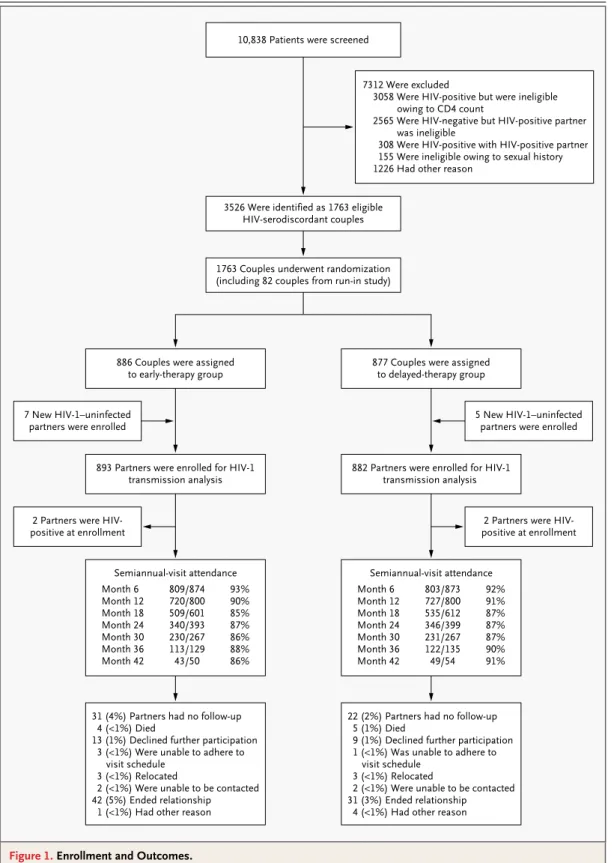
A total of 10,838 persons were screened in order to enroll 1763 HIV-1–serodiscordant couples; 886 couples were randomly assigned to the early-ther-apy group and 877 to the delayed-therearly-ther-apy group) (Fig. 1, and the Supplementary Appendix). Twelve additional HIV-1–uninfected partners were enrolled as the result of a new relationship.
The majority of couples (97%) were heterosex-ual, and 94% were married; 50% of HIV-1–infected participants were men. The majority of partici-pants (61%) were between 26 and 40 years of age. At enrollment, 1291 of HIV-1–infected participants (73%) and 1281 of HIV-1–uninfected partners (72%) reported having had at least one sexual encounter during the previous week. During the same period, 5% and 6%, respectively, reported having unprotected sex. The median CD4 counts for the HIV-1–infected partners were 442 cells per cubic millimeter in the early-therapy group and 428 cells per cubic millimeter in the delayed-ther-apy group. The median log10 plasma viral load
was 4.4 in each study group. Participants in the two study groups were similar in educational status, self-reported sexual behavior, and rate of condom use (Table 1).
At enrollment, less than 5% of participants had a sexually transmitted infection, and rates and types of infection were similar in the two study groups (see the Supplementary Appendix). A to-tal of 84 of 449 HIV-uninfected male partners (19%) in the early-therapy group and 64 of 460 (14%) in the delayed-therapy group had been cir-cumcised (P = 0.05). New sexually transmitted in-fections were detected with similar frequency among participants in the early-therapy group and the delayed-therapy group during the study, with 36 and 34 syphilis infections, 6 and 8 gonorrhea infections, 10 and 11 chlamydia infections, and 22 and 19 trichomonas infections, respectively. Among HIV-1–infected participants, a mean of 96% of those in the early-therapy group and 95% of those in the delayed-therapy group reported 100% condom use during the study.
On April 28, 2011, the data and safety moni-toring board recommended that the results of the study be released on the basis of data collection through February 21, 2011. At that time, 90% of couples remained enrolled in the study, with a median follow-up of 1.7 years; the total number of person-years of follow-up was 1585 in the early-therapy group and 1567 in the delayed-early-therapy group. The expected effect of early versus delayed antiretroviral therapy on log10 plasma viral load
initia-1763 Couples underwent randomization (including 82 couples from run-in study) 3526 Were identified as 1763 eligible
HIV-serodiscordant couples 10,838 Patients were screened
7312 Were excluded
3058 Were HIV-positive but were ineligible owing to CD4 count
2565 Were HIV-negative but HIV-positive partner was ineligible
308 Were HIV-positive with HIV-positive partner 155 Were ineligible owing to sexual history 1226 Had other reason
886 Couples were assigned
to early-therapy group 877 Couples were assignedto delayed-therapy group
7 New HIV-1–uninfected partners were enrolled
2 Partners were HIV-positive at enrollment
5 New HIV-1–uninfected partners were enrolled
2 Partners were HIV-positive at enrollment 893 Partners were enrolled for HIV-1
transmission analysis 882 Partners were enrolled for HIV-1transmission analysis
Semiannual-visit attendance Month 6
Month 12 Month 18 Month 24 Month 30 Month 36 Month 42
809/874 720/800 509/601 340/393 230/267 113/129 43/50
93% 90% 85% 87% 86% 88% 86%
Semiannual-visit attendance Month 6
Month 12 Month 18 Month 24 Month 30 Month 36 Month 42
803/873 727/800 535/612 346/399 231/267 122/135 49/54
92% 91% 87% 87% 87% 90% 91%
22 (2%) Partners had no follow-up 5 (1%) Died
9 (1%) Declined further participation 1 (<1%) Was unable to adhere to
visit schedule 3 (<1%) Relocated
2 (<1%) Were unable to be contacted 31 (3%) Ended relationship
4 (<1%) Had other reason 31 (4%) Partners had no follow-up
4 (<1%) Died
13 (1%) Declined further participation 3 (<1%) Were unable to adhere to
visit schedule 3 (<1%) Relocated
2 (<1%) Were unable to be contacted 42 (5%) Ended relationship
1 (<1%) Had other reason
Figure 1. Enrollment and Outcomes.
tion of antiretroviral therapy, from a median of 442 cells per cubic millimeter at enrollment to 603 cells per cubic millimeter by 12 months, and the counts continued to rise throughout the follow-up period (see the Sfollow-upplementary Appendix). A modest decline in CD4 counts was observed in the delayed-therapy group, from a median of 428 cells
per cubic millimeter at enrollment to 399 cells per cubic millimeter by 12 months. A total of 21% of HIV-1–infected participants in the delayed-therapy group began taking antiretroviral therapy after a median of 42 months. Among all participants, 72% received a combination of zidovudine, lamivu-dine, and efavirenz (see the Supplementary
Appen-Table 1. Baseline Characteristics of the Participants.*
Characteristic HIV-1–Infected Participants HIV-1–Uninfected Participants† Early Therapy
(N = 886) Delayed Therapy(N = 877) Early Therapy(N = 893) Delayed Therapy(N = 882)
Demographic
Female sex — no. (%) 432 (49) 441 (50) 441 (49) 418 (47)
Age group — no. (%)
18–25 yr 145 (16) 161 (18) 154 (17) 174 (20)
26–40 yr 556 (63) 547 (62) 537 (60) 526 (60)
>40 yr 185 (21) 169 (19) 202 (23) 182 (21)
Education level — no. (%)
No schooling 101 (11) 69 (8) 112 (13) 77 (9)
Primary schooling 360 (41) 347 (40) 317 (35) 344 (39)
Secondary schooling 346 (39) 388 (44) 373 (42) 367 (42)
Postsecondary schooling 79 (9) 72 (8) 91 (10) 93 (11)
Missing data 0 1 (<1) 0 1 (<1)
Marital status — no. (%)
Single 49 (6) 38 (4) 53 (6) 43 (5)
Married or living with partner 833 (94) 833 (95) 834 (93) 833 (94)
Widowed, separated, or divorced 4 (<1) 6 (1) 6 (1) 6 (1)
Region — no. (%)
North or South America 142 (16) 136 (16) 145 (16) 139 (16)
Asia 267 (30) 264 (30) 268 (30) 264 (30)
Africa 477 (54) 477 (54) 480 (54) 479 (54)
Sexual activity — no. (%)
Any unprotected sex in past week 37 (4) 51 (6) 49 (5) 53 (6)
No. of sex partners in past 3 mo
0–1 831 (94) 833 (95) 863 (97) 844 (96)
2–4 48 (5) 41 (5) 29 (3) 36 (4)
>4 7 (1) 2 (<1) 1 (<1) 1 (<1)
Missing data 0 1 (<1) 0 1 (<1)
No. of sexual encounters in past week
0 246 (28) 225 (26) 253 (28) 240 (27)
1–2 430 (49) 438 (50) 410 (46) 433 (49)
3–4 156 (18) 158 (18) 180 (20) 151 (17)
>4 54 (6) 55 (6) 50 (6) 57 (6)
dix). Adherence to the study regimen of at least 95% (as measured by pill count) was observed in 79% of participants in the early-therapy group and in 74% of those in the delayed-therapy group. Details with respect to regimens of antiretroviral therapy and pill counts are provided in the Sup-plementary Appendix.
Virologic failure was observed in 45 of 886 participants (5%) in the early-therapy group and in 5 of 184 participants in the delayed-therapy group who initiated antiretroviral therapy (3%) (P = 0.23). Of all treated participants, 66% initiated a second-line regimen.
Primary Prevention Outcome
A total of 39 HIV-1 transmission events were ob-served (incidence rate, 1.2 per 100 person-years; 95% confidence interval [CI], 0.9 to 1.7), with 4 events in the early-therapy group (incidence rate, 0.3 per 100 person-years; 95% CI, 0.1 to 0.6) and
35 events in the delayed-therapy group (incidence rate, 2.2 per 100 person-years; 95% CI, 1.6 to 3.1), for a hazard ratio in the early-therapy group of 0.11 (95% CI, 0.04 to 0.32; P<0.001) (Table 2 and Fig. 2; also see the Supplementary Appendix for details regarding the incidence of transmission). Through viral genetic analysis, 28 transmissions were linked to the HIV-1–infected participant (in-cidence rate, 0.9 per 100 person-years; 95% CI, 0.6 to 1.3), with 1 transmission in the early-therapy group (incidence rate, 0.1 per 100 person-years; 95% CI, 0.0 to 0.4) and 27 transmissions in the delayed-therapy group (incidence rate, 1.7 per 100 person-years; 95% CI, 1.1 to 2.5), for a hazard ratio in the early-therapy group of 0.04 (95% CI, 0.01 to 0.27; P<0.001). The remaining 11 trans-missions (3 in the early-therapy group and 8 in the delayed-therapy group) included 7 transmissions that were unlinked (3 in the early-therapy group and 4 in the delayed-therapy group), 3 transmis-Table 1. (Continued.)
Characteristic HIV-1–Infected Participants HIV-1–Uninfected Participants† Early Therapy
(N = 886) Delayed Therapy(N = 877) Early Therapy(N = 893) Delayed Therapy(N = 882)
Clinical
CD4 count — no./mm3
Median 442 428
Interquartile range 373–522 357–522 NA NA
Plasma RNA viral load — no. (%)
<400 copies/ml 54 (6) 43 (5) NA NA
400–1000 copies/ml 24 (3) 33 (4) NA NA
1001–10,000 copies/ml 212 (24) 183 (21) NA NA
10,001–100,000 copies/ml 407 (46) 432 (49) NA NA
100,001–1 million copies/ml 186 (21) 186 (21) NA NA
Missing data 3 (<1) 4 (<1) NA NA
Women reporting previous antiretroviral therapy during pregnancy — no./total no. (%)
115/432 (27) 119/441 (27) NA NA
Type of serodiscordancy — no. (%)
HIV-positive man, HIV-negative woman 436 (49) 417 (48) NA NA
HIV-positive woman, HIV-negative man 431 (49) 441 (50) NA NA
HIV-positive man, HIV-negative man 18 (2) 19 (2) NA NA
HIV positive woman, HIV-negative
woman 1 (<1) 0 NA NA
* Data regarding the incidence of sexually transmitted infections are provided in the Supplementary Appendix. HIV denotes human immunodeficiency virus, and NA not applicable.
sions that could not be classified on the basis of available data, and 1 transmission that has not yet been evaluated. The latter 4 transmissions were all in the delayed-therapy group.
The rate of transmission events in the delayed-therapy group was relatively constant across the first 3 years of study follow-up for both linked and any transmissions. Of the 28 HIV-1–infected participants who had linked transmission to a partner, 17 (61%) had a CD4 count of more than 350 cells per cubic millimeter at the study visit before the detection of linked HIV-1 transmission. The single linked transmission in the early-therapy
group was identified 3 months after the HIV-1– infected participant initiated treatment; all linked transmissions in the delayed-therapy group oc-curred while the HIV-1–infected participant was not receiving antiretroviral therapy. The Kaplan– Meier curves for both linked and any transmis-sions show immediate and sustained reduction in the risk of HIV-1 transmission after the initiation of antiretroviral therapy (Fig. 2).
Of the 28 linked transmissions, 23 (82%) oc-curred at African sites. HIV-1–infected women were the source of infection in 18 of 27 (67%) linked transmissions in the delayed-therapy group, Table 2. Incidence of Partner-Linked and Any HIV-1 Transmission and Clinical and Composite Events.
Variable Early Therapy Delayed Therapy Hazard or Rate Ratio (95% CI)*
Events Person-yr (95% CI)Rate Events Person-yr (95% CI)Rate
no. % no. %
Linked transmission
Total 1 1585.3 0.1 (0.0–0.4) 27 1567.3 1.7 (1.1–2.5) 0.04 (0.01–0.27)
1 yr 1 819.0 0.1 (0.0–0.7) 16 813.3 2.0 (1.1–3.2) 0.06 (0.00–0.40)
2–3 yr 0 686.5 0.0 (0.0–0.5) 9 682.8 1.3 (0.6–2.5) 0.00 (0.00–0.50)
>3 yr 0 79.9 0.0 (0.0–4.6) 2 71.2 2.8 (0.3–10.1) 0.00 (0.00–4.75)
Any transmission†
Total 4 1585.3 0.3 (0.1–0.6) 35 1567.3 2.2 (1.6–3.1) 0.11 (0.04–0.32)
1 yr 2 819.0 0.2 (0.0–0.9) 18 813.3 2.2 (1.3–3.5) 0.11 (0.01–0.46)
2–3 yr 2 686.5 0.3 (0.0–1.1) 14 682.8 2.1 (1.1–3.4) 0.14 (0.02–0.62)
>3 yr 0 79.9 0.0 (0.0–4.6) 3 71.2 4.2 (0.9–12.3) 0.00 (0.00–2.16)
Clinical events‡
Total 40 1661.9 2.4 (1.7–3.3) 65 1641.8 4.0 (3.1–5.0) 0.59 (0.40–0.88)
1 yr 29 831.0 3.5 (2.3–5.0) 39 832.6 4.7 (3.3–6.4) 0.75 (0.44–1.24)
2–3 yr 9 739.8 1.2 (0.6–2.3) 21 725.7 2.9 (1.8–4.4) 0.42 (0.17–0.96)
>3 yr 2 91.1 2.2 (0.3–7.9) 5 83.6 6.0 (1.9–14.0) 0.37 (0.04–2.24)
Composite events§
Total 23 1700.1 1.4 (0.9–2.0) 79 1642.0 4.8 (3.8–6.0) 0.28 (0.18–0.45)
1 yr 13 843.7 1.5 (0.8–2.6) 47 833.9 5.6 (4.1–7.5) 0.27 (0.14–0.51)
2–3 yr 8 763.8 1.0 (0.5–2.1) 26 732.5 3.5 (2.3–5.2) 0.30 (0.12–0.67)
>3 yr 2 92.6 2.2 (0.3–7.8) 6 75.5 7.9 (2.9–17.3) 0.27 (0.03–1.52)
* Hazard ratios were calculated with the use of unstratified univariate Cox regression analysis on an intention-to-treat basis. Year-specific rate ratios were calculated on the basis of the person-year analysis. P<0.001 for the between-group comparison for linked transmission, P<0.001 for all transmission, P = 0.01 for clinical events, and P<0.001 for composite events, with all comparisons favoring early therapy.
† Any transmission includes all transmission events observed during follow-up, regardless of their linkage between partners. ‡ Clinical events include death, World Health Organization stage 4 events, severe bacterial infections, and pulmonary
tuber-culosis for index partners.
and a man was the source of the single transmis-sion in the early-therapy group. Women were the HIV-1–infected participant in 58% of African cou-ples. A high viral load in blood plasma of infected participants at baseline increased the risk of HIV-1 transmission (Table 3). The median
plas-ma viral load in 27 participants at the visit most proximal to the detection of HIV-1 transmission was 4.9 log10 (range, 2.6 to 5.8). Conversely,
self-reported 100% condom use at baseline was associ-ated with a reduced risk of HIV-1 transmission. In the stratified multivariate analysis according to
Cumulative Probability
1.0
0.8
0.6
0.4
0.2
0.0
0 1 2 3 4 5
Years since Randomization
C Clinical Event D
A Linked HIV Transmission
No. at Risk
Early
Delayed 893882 658655 298297 7980 3126 2422 0.3
0.2
0.1
0.0
0 1 2 3 4 5 Delayed
Early
Cumulative Probability
1.0
0.8
0.6
0.4
0.2
0.0
Years since Randomization B Any HIV Transmission
No. at Risk
Early
Delayed 893882 658655 298297 7980 3126 2422 0.3
0.2
0.1
0.0
0 1 2 3 4 5 Delayed
Early
Cumulative Probability
1.0
0.8
0.6
0.4
0.2
0.0
Years since Randomization No. at Risk
Early
Delayed 886877 700701 333317 8586 3632 2925 0.3
0.2
0.1
0.0
0 1 2 3 4 5 Delayed
Early
Cumulative Probability
1.0
0.8
0.6
0.4
0.2
0.0
Years since Randomization Composite Event
No. at Risk
Early
Delayed 886877 719702 344320 9084 3628 2922 0.3
0.2
0.1
0.0
0 1 2 3 4 5 Delayed
Early
0 1 2 3 4 5
0 1 2 3 4 5 0 1 2 3 4 5
site, the adjusted hazard ratio for linked transmis-sion in the early-therapy group was 0.04 (95% CI, 0.01 to 0.28; P<0.001) (Table 3).
Primary Treatment Outcome
A total of 105 treatment end points, as measured by the first serious HIV-1–related clinical event or death, were observed in HIV-1–infected partici-pants: 40 in the early-therapy group and 65 in the delayed-therapy group (hazard ratio, 0.59; 95% CI, 0.40 to 0.88; P = 0.01 (Table 2, and the Supplemen-tary Appendix). Of such clinical events, 44% oc-curred in Asia and 45% in Africa. The baseline plasma viral load was an important predictor of clinical events, as assessed on multivariate analy-sis (Table 3). In the stratified multivariate model, the adjusted hazard ratio for clinical events in the early-therapy group was 0.59 (95% CI, 0.40 to 0.89). The difference in the rate of clinical events ap-peared to be driven mainly by the incidence of extrapulmonary tuberculosis, which developed in 3 participants in the early-therapy group and 17 in the delayed-therapy group (P = 0.002); of these cases, 55% were observed in India. Pulmonary tu-berculosis was observed in 13 participants in the
early-therapy group and 15 in the delayed-therapy group; isoniazid prophylaxis was administered to only 4% of participants in each study group. There were 23 deaths during the course of the study, 10 in the early-therapy group and 13 in the delayed-therapy group (hazard ratio, 0.77; 95% CI, 0.34 to 1.76; P = 0.27) (for details regarding causes of death, see the Supplementary Appendix).
Composite Monitoring Events
Among 102 composite monitoring events, there were 39 transmission events in which the sexual partner acquired HIV-1. Among HIV-1–infected participants, 21 died and 42 had WHO stage 4 clin-ical events. Of these monitoring events, 58 (57%) occurred in Africa, 31 (30%) in Asia, and 13 (13%) in the Americas. Overall, 23 monitoring events were observed in the early-therapy group and 79 in the delayed-therapy group (hazard ratio, 0.28; 95% CI, 0.18 to 0.45; P<0.001) (Table 2). Accord-ing to the monitorAccord-ing guidelines that were based on the Lan–DeMets implementation of O’Brien– Fleming boundaries, the computed z statistic was 4.43, which exceeded the prespecified cutoff of 3.93 and thus ruled out the hypothesis that early Table 3. Hazard Ratios for Prognostic Factors for Partner-Linked and Any HIV-1 Transmission and for Clinical
and Composite Events.*
Variable TransmissionLinked TransmissionAny Clinical Events Composite Events
hazard ratio (95% CI)
Univariate analysis
Early therapy vs. delayed therapy 0.04 (0.01–0.26) 0.11 (0.04–0.32) 0.60 (0.41–0.90) 0.28 (0.18–0.45) Baseline CD4 count (per 100 CD4
i ncrement) 1.27 (1.02–1.59) 1.25 (1.02–1.52) 0.84 (0.70–1.00) 1.06 (0.91–1.24) Baseline viral load (per unit log10
increment) 1.96 (1.17–3.27) 1.66 (1.08–2.55) 1.74 (1.32–2.30) 1.51 (1.15–1.97) Male sex vs. female sex 0.69 (0.31–1. 52) 0.88 (0.45–1.71) 1.61 (1.05–2.48) 1.18 (0.78–1.78) Baseline condom use (100% vs. <100%) 0.35 (0.14–0.88) 0.47 (0.19–1.14) NA 0.68 (0.29–1.60) Multivariate analysis
Early therapy vs. delayed therapy 0.04 (0.01–0.28) 0.11 (0.04–0.33) 0.59 (0.40–0.89) 0.28 (0.18–0.45) Baseline CD4 count (per 100 CD4
increment) 1.24 (1.00–1.54) 1.22 (1.02–1.47) 0.90 (0.75–1.08) 1.11 (0.96–1.28) Baseline viral load (per unit log10
increment) 2.85 (1.51–5.41) 2.13 (1.30–3.50) 1.65 (1.24–2.20) 1.60 (1.21–2.11) Male sex vs. female sex 0.73 (0.33–1.65) 1.00 (0.51–1.97) 1.46 (0.95–2.26) 1.18 (0.78–1.80) Baseline condom use (100% vs. <100%) 0.33 (0.12–0.91) 0.41 (0.16–1.08) NA 0.64 (0.27–1.52)
therapy would provide at most a 20% reduction in the risk of the composite monitoring end point.
Adverse Events
After the exclusion of primary clinical end points (death, WHO stage 4 events, pulmonary tubercu-losis, and severe bacterial infections), 246 HIV-1– infected participants had one or more severe or life-threatening adverse events (grade 3 or 4): 127 of 886 (14%) were in the early-therapy group and 119 of 877 (14%) were in the delayed-therapy group (P = 0.64). The most frequently reported ad-verse events included infections, psychiatric and nervous system disorders, metabolism and nutri-tion disorders, and gastrointestinal disorders (for details, see the Supplementary Appendix). Grade 3 or 4 laboratory abnormalities during study fol-low-up occurred in 242 participants (27%) in the early-therapy group and 161 participants (18%) in the delayed-therapy group (P<0.001). The most frequent laboratory abnormalities included neutro-penia, abnormal phosphate level, and total biliru-bin elevations (with bilirubiliru-bin elevations observed primarilyin participants taking atazanavir as part of their drug regimen) (see the Supplementary Appendix).
Discussion
In this study involving 1763 serodiscordant cou-ples in which HIV-1–infected participants had a CD4 count of 350 to 550 cells per cubic millime-ter, there was a relative reduction of 96% in the number of linked HIV-1 transmissions resulting from the early initiation of antiretroviral therapy, as compared with delayed therapy. There was a relative reduction of 89% in the total number of HIV-1 transmissions resulting from the early initiation of antiretroviral therapy, regardless of viral link-age with the infected partner. The sustained sup-pression of HIV-1 in genital secretions resulting from antiretroviral therapy is the most likely mech-anism for the prevention of HIV-1 transmission that we observed.4,5
The majority of HIV-1 transmissions (82%) were observed in Africa. This result reflects not only the large number of study participants who were en-rolled in this region (54%) but also other factors that increase the probability of HIV-1 transmission among African couples. Several groups have re-ported higher viral loads in patients with HIV-1 infection in sub-Saharan Africa than in patients in
developed countries.22,23 Clade C HIV-1, the domi-nant type in southern Africa, may have other trans-mission advantages as well.24 More frequent sexual encounters and limited condom use would also favor increased HIV transmission among African couples, possibilities that are being evaluated.
Although HIV-1 transmission from patients with acute and early HIV-1 infection and advanced HIV-1 disease and the acquired immunodeficiency syndrome (AIDS)25 appears to be most efficient,26 the results from this and other studies9 emphasize that HIV-1 can be transmitted from infected per-sons who are asymptomatic or minimally symp-tomatic and who have high CD4 counts. Since most persons with established HIV-1 infection fall into the latter category, such transmission, albeit not maximally efficient, must help fuel the spread of HIV-1.
Early antiretroviral therapy was associated with a relative reduction of 41% in the number of HIV-1–related clinical events, which suggests a clinical benefit for the initiation of antiretroviral therapy when a person has a CD4 count of 350 to 550 cells per cubic millimeter, as compared with therapy that is delayed until the CD4 count falls into the range of 200 to 250 cells per cubic millimeter. In contrast to a recent trial15 comparing the effect of the initiation of therapy in patients with a CD4 count ranging from 200 to 350 cells per cubic mil-limeter with those with a count below 200 cells per cubic millimeter, we did not detect a signifi-cant between-group difference in overall mortality. Despite our relatively short follow-up period, the magnitude of the clinical effect we observed was similar to that seen in observational studies con-ducted in the developed world.16-18 The difference between the early-therapy group and the delayed-therapy group was driven largely by the diagnosis of extrapulmonary tuberculosis, with the majority of these cases occurring in India. The use of iso-niazid prophylaxis, although recommended by the WHO for patients with HIV-1 infection,27 was in-frequently prescribed for participants in this study. In addition, data from observational studies fo-cusing on HIV-1–related and non–HIV-1–related clinical events and CD4 counts have led to the hypothesis that delayed antiretroviral therapy could ultimately lead to an increased rate of clinical events, regardless of subsequent therapy.28 How-ever, we cannot evaluate this possibility without a longer period of follow-up.
early-therapy group than in the delayed-early-therapy group, including more adverse events related to antiretro-viral therapy. The clinical importance of the labo-ratory abnormalities that were responsible for this difference is unclear. Further examination of these data and additional longitudinal follow-up will be important to better understand the clinical and public health benefits of early antiretroviral ther-apy, as compared with drug costs and side effects. Our study has several limitations. In order to examine the effects of antiretroviral therapy on HIV-1 transmission, we studied stable HIV-1–dis-cordant couples, who may not be entirely repre-sentative of the general population.29 We provided ongoing couples counseling and condoms, which probably contributed to the low incidence of HIV-1 infection, as previously reported.30 Some partici-pants received trimethoprim–sulfamethoxazole and isoniazid prophylaxis at the discretion of the investigators, which could have reduced the de-gree of benefit observed with early antiretroviral therapy.31
In conclusion, the biologic plausibility of the use of antiretroviral therapy for the prevention of HIV-1 infection has been carefully examined during the past two decades.32 The idea of HIV-1 treatment as prevention has garnered tremendous interest and hope33 and inspired a series of pop-ulation-level HIV-1 treatment-as-prevention studies that are now in the pilot or planning stages.34,35 Such interventions are based on the hypothesis that the use of antiretroviral therapy reliably
pre-vents HIV-1 transmission over an extended peri-od of time. In this trial, we found that early anti-retroviral therapy had a clinical benefit for both HIV-1–infected persons and their uninfected sexual partners. These results support the use of antiretroviral treatment as a part of a public health strategy to reduce the spread of HIV-1 infection.
Supported by the HIV Prevention Trials Network (HPTN) and by grants (UM1-AI068619 and U01-AI068619; UM1-AI068613 and U01-AI068613, to the HPTN Network Laboratory; and UM1-AI068617 and U01-UM1-AI068617, to the HPTN Statistical and Data Management Center) from the National Institute of Allergy and Infectious Diseases. Study drugs were donated by Abbott Labo-ratories, Boehringer Ingelheim, Bristol-Myers Squibb, Gilead Sci-ences, GlaxoSmithKline/ViiV Healthcare, and Merck.
Dr. Hosseinipour reports receiving lecture fees from Abbott Virology; Dr. Eshleman, consulting fees from Roche Diagnostics, lecture fees and samples or laboratory reagents from Abbott Diag-nostics and Celera DiagDiag-nostics, and lecture fees from Monogram Biosciences; Dr. Mills, grant support from GlaxoSmithKline; Dr. de Bruyn, travel support from Sanofi Pasteur; Dr. Eron, consult-ing fees and grant support from Merck, Bristol-Myers Squibb, GlaxoSmithKline, and ViiV Healthcare, consulting fees from Gilead Sciences and Tibotec, and lecture fees from Bristol-Myers Squibb and Roche; Dr. Gallant, consulting fees from Abbott Lab-oratories, Bristol-Myers Squibb, Gilead Sciences, Merck, Tibotec Therapeutics, ViiV Healthcare, GlaxoSmithKline, Pfizer, Sangamo BioSciences, and Koronis, grant support and travel support from Gilead Sciences, and lecture fees from Monogram Biosciences; Dr. Havlir, study drug from Abbott; and Dr. Swindells, consult-ing fees from Gilead Sciences and Abbott Diagnostics and grant support from Pfizer, GlaxoSmithKline, and Bristol-Myers Squibb. No other potential conflict of interest relevant to this article was reported.
Disclosure forms provided by the authors are available with the full text of this article at NEJM.org.
We thank Drs. Wafaa El-Sadr, Quarraisha Abdool Karim, and Ward Cates for their help in the preparation of the manuscript.
Appendix
The authors’ affiliations are as follows: the University of North Carolina School of Medicine, Chapel Hill (M.S.C., M.C.H., I.F.H., J.E.); the Vaccine and Infectious Disease Division, Fred Hutchinson Cancer Research Center (Y.Q.C., L.W.), and the University of Washington (T.R.F.) — both in Seattle; Family Health International, Arlington, VA (M.M.), and Durham, NC (T.G.); the UNC Project, Lilongwe (M.C.H.) and the College of Medicine–Johns Hopkins Project, Blantyre (J.K.) — both in Malawi; the Y.R. Gaitonade Center for AIDS Research and Education, Chennai (N.K.), and the National AIDS Research Institute, Pune (S.M., S.V.G.) — both in India; University of Zimbabwe, Harare (J.G.H.); Instituto de Pesquisa Clinica Evandro Chagas, Fiocruz (B.G.), and Hospital Geral de Nova Iguacu and Laboratorio de AIDS e Imunologia Molecular-IOC/Fiocruz (J.H.S.P.) — both in Rio de Janeiro; Research Institute for Health Sciences, Chiang Mai University, Chiang Mai, Thailand (S.C.); Hospital Nossa Senhora da Conceição, Porto Alegre, Brazil (B.R.S.); Fenway Health (K.H.M.) and Harvard School of Public Health (H.R., M.E.) — both in Boston; Johns Hopkins University School of Medicine (S.H.E., E.P.-M., J.G.) and Johns Hopkins Bloomberg School of Public Health (T.E.T., D.C.) — both in Baltimore; Botswana Harvard AIDS In-stitute, Gaborone (J.M.); Centers for Disease Control and Prevention (CDC) Division of HIV/AIDS Prevention, Kenya Medical Research Institute–CDC Research and Public Health Collaboration HIV Research Branch, Kisumu (L.A.M.); Perinatal HIV Research Unit (G.B.) and Department of Medicine (I.S.), University of the Witwatersrand, Johannesburg; University of California, San Francisco, San Fran-cisco (D.H.); University of Nebraska Medical Center, Omaha (S.S.); Division of AIDS, National Institute of Allergy and Infectious Dis-eases, National Institutes of Health, Bethesda, MD (V.E., D.B.); and David Geffen UCLA School of Medicine, Los Angeles (K.N.-S.).
References
1. Ray M, Logan R, Sterne JA, et al. The effect of combined antiretroviral therapy on the overall mortality of HIV-infected individuals. AIDS 2010;24:123-37.
2. Braitstein P, Brinkhof MW, Dabis F,
et al. Mortality of HIV-1-infected patients in the first year of antiretroviral therapy: comparison between low-income and high-income countries. Lancet 2006;367:817-24. [Erratum, Lancet 2006;367:1902.]
3. Cohen MS, Gay CL. Treatment to pre-vent transmission of HIV-1. Clin Infect Dis 2010;50:Suppl 3:S85-S95.
a rapid decline in cervical and vaginal HIV-1 shedding. AIDS 2007;21:501-7.
5. Vernazza PL, Troiani L, Flepp MJ, et al. Potent antiretroviral treatment of HIV in-fection results in suppression of the semi-nal shedding of HIV. AIDS 2000;14:117-21.
6. Quinn TC, Wawer MJ, Sewankambo N, et al. Viral load and heterosexual trans-mission of human immunodeficiency vi-rus type 1. N Engl J Med 2000;342:921-9.
7. Baeten JM, Kahle E, Lingappa JR, et al. Genital HIV-1 RNA predicts risk of hetero-sexual HIV-1 transmission. Sci Transl Med 2011;3:77ra29.
8. Bunnell R, Ekwaru JP, Solberg P, et al. Changes in sexual behavior and risk of HIV transmission after antiretroviral ther-apy and prevention interventions in rural Uganda. AIDS 2006;20:85-92.
9. Donnell D, Baeten JM, Kiarie J, et al. Heterosexual HIV-1 transmission after initiation of antiretroviral therapy: a pro-spective cohort analysis. Lancet 2010;375: 2092-8.
10. Del Romero J, Castilla J, Hernando V, Rodriguez C, Garcia S. Combined antiret-roviral treatment and heterosexual trans-mission of HIV-1: cross sectional and pro-spective cohort study. BMJ 2010;340:c2205.
11. Reynolds SJ, Makumbi F, Nakigozi G, et al. HIV-1 transmission among HIV-1 discordant couples before and after the introduction of antiretroviral therapy. AIDS 2011;25:473-7.
12. Granich RM, Gilks CF, Dye C, De Cock KM, Williams BG. Universal volun-tary HIV testing with immediate antiret-roviral therapy as a strategy for elimina-tion of HIV transmission: a mathematical model. Lancet 2009;373:48-57.
13. Das M, Chu PL, Santos GM, et al. De-creases in community viral load are ac-companied by reductions in new HIV in-fections in San Francisco. PLoS ONE 2010; 5(6):e11068.
14. Montaner JS, Lima VD, Barrios R, et al. Association of highly active antiretro-viral therapy coverage, population antiretro-viral load, and yearly new HIV diagnoses in British Columbia, Canada: a population-based study. Lancet 2010;376:532-9.
15. Severe P, Juste MA, Ambroise A, et al. Early versus standard antiretroviral thera-py for HIV-infected adults in Haiti. N Engl J Med 2010;363:257-65.
16. Kitahata MM, Gange SJ, Abraham AG, et al. Effect of early versus deferred antiretroviral therapy for HIV on survival. N Engl J Med 2009;360:1815-26.
17. Sterne JA, May M, Costagliola D, et al. Timing of initiation of antiretroviral ther-apy in AIDS-free HIV-1-infected patients: a collaborative analysis of 18 HIV cohort studies. Lancet 2009;373:1352-63.
18. Cain LE, Logan R, Robins JM, et al. When to initiate combined antiretroviral therapy to reduce mortality and AIDS- defining illness in HIV-infected persons in developed countries: an observational study. Ann Intern Med 2011;154:509-15.
19. Eshleman SH, Hudelson SE, Redd AD, et al. Analysis of genetic linkage of HIV from couples enrolled in the HIV Preven-tion Trials Network 052 trial. J Infect Dis (in press).
20. DeMets DL, Lan KK. Interim analysis: the alpha spending function approach. Stat Med 1994;13:1341-52.
21. O’Brien PC, Fleming TR. A multiple testing procedure for clinical trials. Bio-metrics 1979;35:549-56.
22. Dyer JR, Kazembe P, Vernazza PL, et al. High levels of human immunodefi-ciency virus type 1 in blood and semen of seropositive men in sub-Saharan Africa. J Infect Dis 1998;177:1742-6.
23. Novitsky V, Ndung’u T, Wang R, et al. Extended high viremics: a substantial frac-tion of individuals maintain high plasma viral RNA levels after acute HIV-1 subtype C infection. AIDS 2011 April 18 (Epub ahead of print).
24. Ping L-H, Nelson J, Hoffman I, et al. Characterization of V3 sequence hetero-geneity in subtype C human immunodefi-ciency virus type 1 isolates from Malawi: underrepresentation of X4 variants. J Virol 1999;73:6271-81.
25. Wawer MJ, Gray RH, Sewankambo NK, et al. Rates of HIV-1 transmission per coital act, by stage of HIV-1 infection, in Rakai, Uganda. J Infect Dis 2005;191: 1403-9.
26. Powers KA, Poole C, Pettifor AE, Cohen MS. Rethinking the heterosexual infectivity of HIV-1: a systematic review and meta-analysis. Lancet Infect Dis 2008; 8:553-63.
27. Guidelines for intensified tuberculo-sis case finding and isoniazid preventive therapy for people living with HIV in re-source constrained settings. Geneva: World Health Organization, 2011. (http:// whqlibdoc.who.int/publications/2011/ 9789241500708_eng.pdf.)
28. Baker JV, Peng G, Rapkin J, et al. CD4+ count and risk of non-AIDS diseas-es following initial treatment for HIV in-fection. AIDS 2008;22:841-8.
29. Eyawo O, de Walque D, Ford N, Gakii G, Lester RT, Mills EJ. HIV status in dis-cordant couples in sub-Saharan Africa: a systematic review and meta-analysis. Lan-cet Infect Dis 2010;10:770-7.
30. Celum C, Wald A, Lingappa JR, et al. Acyclovir and transmission of HIV-1 from persons infected with HIV-1 and HSV-2. N Engl J Med 2010;362:427-39.
31. Lowrance D, Makombe S, Harries A, et al. Lower early mortality rates among patients receiving antiretroviral treatment at clinics offering cotrimoxazole prophy-laxis in Malawi. J Acquir Immune Defic Syndr 2007;46:56-61.
32. Cohen MS, Gay C, Kashuba AD, Blower S, Paxton L. Narrative review: antiretrovi-ral therapy to prevent the sexual trans-mission of HIV-1. Ann Intern Med 2007; 146:591-601.
33. Dieffenbach CW, Fauci AS. Universal voluntary testing and treatment for pre-vention of HIV transmission. JAMA 2009; 301:2380-2.
34. Burns DN, Dieffenbach CW, Vermund SH. Rethinking prevention of HIV type 1 infection. Clin Infect Dis 2010;51:725-31. [Erratum, Clin Infect Dis 2010;51:995.]