Optimization of 5G Wireless Mobile Network Energy with
ULTRA-LEAN Design
Jonathan
1, Sarif Hidayat
2, Daril Willianson
3, Greg Martin
4, Hari Suryantoro
5Faculty of Computer Science, Budi Luhur University, Jakarta, Indonesia
---
************************
---Abstract:
Wireless technologies are now taking 4G technology that has been used arbitrarily countries. However, due to the development of mobile devices and mobile communication services on, then there are some that can not be handled by 4G technologies such as energy consumption is very high in this technology. The development of mobile world that continues to grow, the demand for data access becomes very high. Since the development of some researchers that conducted research for the wireless systems of the fifth generation to handle problems that occur on 4G. This article describes the design architecture of 5G technologies and discuss various promising technologies for 5G wireless communication systems, such as MIMO large, energy-efficient communications, cognitive radio networks, and the visible light communication. future challenges facing the potential of technology are also discussed.
Keywords —Wireless, 5G, Mobile Network Energy, Optimization.
---
************************
---I. INTRODUCTION
4g is a development of 3g and 2g technologies. the 4g system provides ultra broadband network for various electronic equipment, for example smart phones and laptops using a usb modem.there are two standard candidates for commercialized 4g in the world: the wimax standard (south korea since 2006) and the long term evolution (lte) standard (sweden since 2009).
Wireless network technology has many uses 4G technology but there is a weakness in energy consumption is very high. The reason is that LTE devices periodically search to determine which cells should be. With a unique combination of 2G / 3G / 4G on different bands, it has a lot of network to go through. LTE is not fully used everywhere, so your chances are further away from the cell, and the need will increase your transmission power. LTE devices use MIMO for some parallel transmissions. So, we have 2 RX / TX antennas (each with its own PA). LTE technology has more complex - QAM and OFDM (A) require more computational power / processor to modulate / demodulate RF
The fifth-generation (5G) cellular communication systems are facing new challenges as a promising mobile Internet and Internet applications Page. 5G should be with both spectral efficiency (SE) and energy efficiency (EE). Improve network densification is regarded as one powerful way to jointly enhance them with cost-effective manner. However, ultra-dense deployment of small cells also introduces new technical challenges, for example, interference. In order to avoid interference and increase SE, some useful observations of interference management reported in, for example, the deployment of more regular and denser than small cells, a higher profit in mitigating interference.
And the forecast will reach two zetabyte in 2019. In that year also predicted for the first time in the history of traffic in the mobile network traffic will exceed the fixed network traffic. The expansion and the creation of mobile applications and services that lead to increased traffic on the network so that wireless technology is expected to handle the request. One example is the Internet of things (IOT), that will allow the connection and control of objects, such as smart watches, wearable devices and sensors.
Phenomenal success of mobile communications seen from the existing pace of technological innovation. Wireless technology history starting from the second generation (2G) in 1991, and was developed in 2001. 3G mobile wireless networks changed from pure telephone system into a network that can send multimedia data. 4G wireless systems are designed to meet the requirements of the International Mobile Telecom-munications-Advanced (IMT-A) using IP for all services. In the 4G system, advanced radio interfaces are used with OFDM (OFDM), multiple input multiple-output (MIMO), and link adaptation technology. 4G wireless network can support data rates up to 1 Gbit / s for low mobility such as nomadic / local wireless access, and up to 100 Mb / s for high mobility such as mobile access. Long-Term Evolution (LTE) and extension, LTE-Advanced system, such as practical 4G systems, have recently deployed or soon will be deployed worldwide. In the 5G technology, data will be transmitted via radio waves. The radio waves will be divided into different frequencies. Each frequency is prepared for the different types of communication, such as the aeronautical and maritime navigation signals, broadcast television, and mobile data. The use of these frequencies is regulated by the International Telecommunication Union (ITU). ITU has restructure parts of a comprehensive radio waves to transmit data while developing existing communications technologies, including 4G and 3G.
5G technology is predicted to have a speed of about 800Gbps, or one hundred times faster than the speed of the previous generation. With such speed, 5G technology could make it possible to download 33 High Definition movies in just a few seconds. Based on the congress Mobile World
Congress (MWC), which was attended by Nokia, Huawei, and Ericsson in Barcelona, 5G technology is still uncertain lirisnya date because it is still in the development stage. However, Nokia and Japanese operator NTT DoCoMo will assume that 5G technology for release at the Tokyo Olympics in 2020. In South Korea, technologically 5G is being developed and is predicted maximum speed can reach 100 times faster than 4G technology, or rather 10Gbps (10 Giga bits per second). The plan, the 5G network will begin to be applied in South Korea in 2017 and can only be used commercially in 2020.
5G is the next step in the evolution of mobile communication. It will be a key component of the Networked Society, and will help realize the vision of essentially unlimited access to information and sharing of data anywhere and anytime for anyone and anything. Energy performance has long played an important role in mobile communication on the device side. High energy performance in devices has enabled longer battery life, and has been a vital component behind the mobile revolution. However, the need for high energy performance has also become a key factor for network infrastructure. Reduced overall network energy consumption is being targeted, despite massive increases in traffic and number of users. There are several important reasons for this development:
1. High network energy performance is crucial to reducing operational cost, and is a driver for better node and network dimensioning, which leads to reduced total cost of ownership (TCO). 2. High network energy performance allows for off-grid network deployment relying on decently sized solar panels as power supplies, enabling wireless connectivity to even the most remote areas.
3. High network energy performance is part of a general operator aim to provide wireless access in a sustainable and more resource-efficient way.
Consequently, network energy performance has an important role to play in 5G.
II. RELATEDWORK
certain direction. While the telecommunications industry is still trying to put it into public 5G carriers and related vendors parallel will also continue to develop 4G LTE network. According to T-Mobile, we have developed using the 5G definitely something that will operate 5G compatible with 4G.But with older technologies such as 3G and 2G, they will slowly disappear and will not be compatible with the 5G.Definition of 3GPP LTE technology at this time to the highest speed that the theory of this technology can reach 75Mbps and 300Mbps upload-download. LTE-Advanced is higher than this level, reaching 3Gbps 1,5Gbps upload and download, using the technique of agglomeration CA (carrier aggregation), is a method to increase the speed and capacity of data transmission by combining strips of different frequencies to create a wider channel. In the US, in December last year, Verizon said they are testing this technique to ensure CA's method stable operation. Verizon is expected to use this technology in mid-year. AT & T has deployed CA, while Sprint is only planned for the end of this year, there will be T-Mobile.
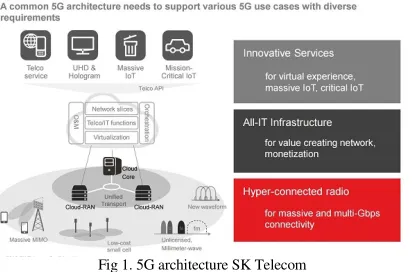
Fig 1. 5G architecture SK Telecom
Multiple access is one of the key technologies of wireless communication physical layer, which allows the radio base station to distinguish between a plurality of end-user services simultaneously. Existing systems employ orthogonal multiple access, i.e., by a plurality of users in different dimensions (frequency, time, code classification) orthogonal division of resources to the access. Multiple access OFDMA Technology employed in I 4G systems is one of them, but it is a two-dimensional orthogonal grid when the frequency
resource is divided to access different users.5G supports a rich business scenarios. Each scenario needs different waveform parameters. It’s a basic need to dynamically select and configure the waveform parameters based on the scenario, while taking into account the advantages of traditional CP-OFDM. Because the access to resources with orthogonal multiple access technology is proportional to the number of users, it can not meet the 5G capacity, massive connectivity and low latency access demand. Thus non-orthogonal multiple access will become the 5G Multiple Access research focuses access. SCMA, sparse code multiple access, is designed to generate demand should 5G a non-orthogonal multiple access technology. At the sending end SCMA coded bits are mapped to a codeword, the receiver decodes completed by multiuser detection by multi-dimensional and sparse spread modulation. Compared to the 4G OFDMA technology, it can achieve the same amount of resources in conditions, while the service more users, thus effectively improve the overall system capacity.
Fig 2. Simple Uplink SCMA System
III. ENERGYPERMANCEIN5G
TECHNOLOGIES
5G is a unique opportunity to go beyond the existing standard energy performance limits. As a major part of the energy consumption of existing technologies related to the transmission that allows devices to discover and access the system, this area has the greatest potential savings.
From the application side, the user-centric system implements the allocation of resources depending on the needs of the application is very important considering all possible use cases that will encounter 5G system. The application requirements specify an unstoppable delay that indirectly affects how aggressive energy-saving modes.
Furthermore, resources can be dynamically adapted per user to avoid overprovisioning of network resources and also to make it easier to utilize current active resources. User-centric RANs can be obtained with user-directed specific transmissions. Optimizing radio transmissions for certain users, however, should not be affected by access coverage. Systems that do not transmit anything unless there is on-going user data transactions can not support initial access access or mobility access for users. This requires additional.
Broadcast information is transmitted over a range area, eg for random access support. The optimization of the basic system functions required for initial access and mobility access across large areas is fundamentally different from the optimization of individual radio relationships between base stations and user terminals. This type of broadcasting information has traditionally been associated with cells. However, there is no function for early access and this mobility access requires cells. Instead, switching from traditional cell concepts is preferred to enable more scalable and efficient system design. Note that rethinking the cell concept will be useful for managing the repair complexity associated with advanced antenna techniques, used for special transmission data. With LTE, the multi point cooperative transmission technique has "passed" the cell concept by focusing on the point of transmission rather than on the mobile site. A 5G network will be needed to handle more sites, antennas and frequency bands with faster adaptation. Here, dynamically optimized radio links between the system and individual users become the central entity, while the concept of static cells is not widely offered. Regarding the core network nodes and other aggregated network nodes, the main challenges are scalability and improved management, to efficiently handle various uses in the future.
Ultra-lean radio design is crucial in order to achieve a very high efficient level in 5G networks.
The basic principle of Ultra-lean is that it can be described by minimizing transmissions directly related to user data. Such transmissions include signals for synchronization, network acquisition and channel estimation, as well as broadcasting of various types of systems and control information. The ultra-lean design is essential for solid deployment with a large number of network nodes and varying traffic conditions. However, lean transmission is useful for all types of applications, including macro implementation. By enabling network nodes to enter low-energy states quickly when there is no data-user transmission, ultra-lean design is an important component in delivering high-energy network performance. The ultra-lean design will also allow higher data rates to be achieved by reducing the interference from non-user-related transmissions.
Ultra-lean transmission is not only the coolest thing to do for energy performance in 5G, but also one of the coolest things to do for energy performance altogether. It needs to be separate in how to think about control and data fields, and really make sure the controls become more measurable. It will be very important to get a lean framework for 5G.
FiG 3. Technology trends
IV. SIMULATION AND RESULTS
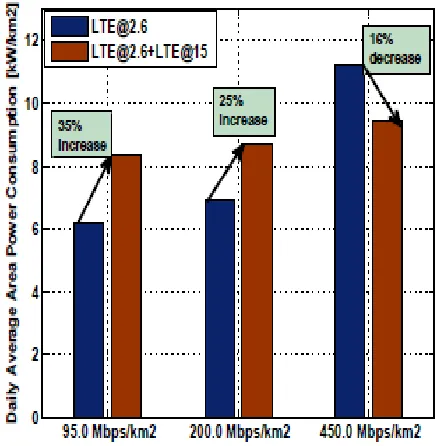
Given the fact that the system being evaluated performs differently from the same traffic conditions. On picture. 4, illustrates the average daily power consumption area of the [email protected] baseline system and carrier aggregation scenario where LTE @ 15 is deployed alongside the legacy LTE system operating at 2.6 GHz to improve user throughput with wider bandwidth. Here we assume that the static power consumption of a site will increase by 45% when the LTE @ 15 system is used because of additional RF components and PA power consumption.
Moreover assume that all BS has DTX capability which means cell can be put into sleep mode when there is no traffic. Note that at the traffic level where [email protected] can still serve traffic with an acceptable 5 percent user throughput (T = 200 Mbps / km2), carrier aggregation will increase energy consumption by more than 25 percent. This indicates that the increase in static power consumption because the new system can not be compensated by the reduction of dynamic forces due to lower utilization. On the other hand, it appears that in high traffic where the [email protected] system is highly used (T = 450 Mbps / km2), carrier aggregation provides 16% reduction in energy consumption, while at the same time providing far better returns -user performance . Note that, it has not considered the long-term sleep mechanism that allows the activation and disabling of unused operators during non-busy hours. Fig. 5 shows the daily daily power consumption variations of the
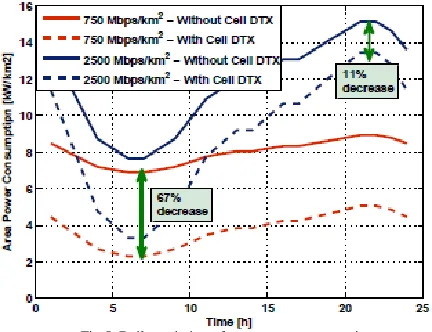
5G-NX system for two cases: i) BS does not have DTX capability (BS can not be put into sleep mode when there is no traffic); Ii) BS has DTX capability (basic power consumption of BS will be lowered when there is no traffic on the network). Here evaluate the system under two different regional traffic demands, ie, T = 750 Mbps / km2 (red curve) and T = 2500 Mbps / km2 (blue curve) representing different utilization levels in the network. It appears that regional power consumption varies significantly during the day due to the high difference between daytime traffic. Also observe that DTX cells carry significant savings in 5GNX wireless access, even at higher traffic, savings of up to 67% are feasible during peak hours for two main reasons. The first reason is that the ultra-slim design increases the DTX duration 500 times compared to the LTE system which allows much lower sleep power consumption as described in Section IV. Second, the 5G-NX wireless access provides a very high beamforming advantage and the possibility to use a very wide transmission bandwidth, which increases user throughput significantly. As a result, the same traffic is served in a shorter time compared to the LTE system, allowing longer sleep time.
Fig 5. Daily variation of area power consumption
V.CONCLUSION
In this paper, evaluate the 5GNX system's energy performance characterized by ultra-lean design and great beamforming, and compare it with LTE systems in a crowded urban (urban) scenario. Also presented a new power consumption model where sleep power is defined according to the maximum DTX period allowed by each system. The results show that the 5G-NX system delivers far better energy performance than LTE because of its ultra-lean design and high beamforming gain, which allows longer and more efficient sleep. At expected traffic levels beyond 2020, 5G-NX is shown to reduce energy consumption by more than 50% while providing a capacity of about 10 times as much. Furthermore, carrier aggregation is shown as a promising solution that combines the benefits of bandwidth and higher beamforming capabilities at 15 GHz, and better propagation conditions at 2.6 GHz. Consequently, at expected traffic levels beyond 2020, carrier aggregations with 5G-NX deliver superior performance with lower energy consumption despite efficient inefficient LTE layers. The main focus of future work is to evaluate the potential for 5G-NX energy savings at the country level by taking into account more scenarios, alternative spreads and operating frequencies.
REFERENCES
[1] A. Hashimoto, H. Yorshino, and H. Atarashi, Aug. 2008, “Roadmap of IMT-Advanced Development,” IEEE Microwave Mag., vol. 9, no. 4, pp. 80–88.
[2] A. Bleicher, Aug. 2013, “Millimeter Waves May Be the Future of 5G Phones,” IEEE Spectrum.
[3] Ericsson, January 2015, White paper: 5G systems – enabling industry and society transformation, available at: http://www.ericsson.com/co/res/docs/whitepapers/what-is-a-5g-system.pdf Frenger, Ericsson Review, February 2014, Radio Network Energy Performance:
[4] Hung Cho, C. F Lai, TK Shih, H. C Chao, "Integration of SDR and SDN for 5G", IEEE Access, vol. 2, pp. 1196?1204, 2014.
[5] Changing the Game from Power to Precision, available at: http://www.ericsson.com/res/thecompany/docs/publications/ericsson_re view/2014/er-radio-network-energy-performance.pdf
[6] J. Wannstrom, “LTE-Advanced,” 2013. [Online]. Available: http://www.3gpp.org/technologies/keywords-acronyms/97-lte-advanced. [7] E. Bjornson, E. Jorswieck, M. Debbah, and B. Ottersten, Nov 2014, “Multiobjective signal processing optimization: The way to balance conflicting metrics in 5G systems,” IEEE Signal Processing Magazine.
[8] Ericsson, Feb. 2015 ,“5G Radio Access: Technology and Capabilities,” White paper.
[9] P. Frenger, P. Moberg, J. Malmodin, Y. Jading, and I. Godor, May 2011, “Reducing Energy Consumption in LTE with Cell DTX,” in Proc. of IEEE Vehic. Technol. Conf. (VTC Spring), Budapest, Hungary. [10] F. Boccardi, R. Heath, A. Lozano, T. Marzetta, and P. Popovski, Feb.
2014, “Five disruptive technology directions for 5G,” IEEE Communications Magazine, vol. 52, no. 2.