R E S E A R C H A R T I C L E
Open Access
Association of frailty and physical function in
patients with non-dialysis CKD: a systematic
review
Simon R Walker
1, Kamalpreet Gill
1, Kerry Macdonald
1,3, Paul Komenda
1,3, Claudio Rigatto
1,3, Manish M Sood
2,3,
Clara J Bohm
3,4, Leroy J Storsley
3,4and Navdeep Tangri
1,3*Abstract
Background:Frailty is a condition characterized by a decline in physical function and functional capacity. Common symptoms of frailty, such as weakness and exhaustion, are prevalent in patients with chronic kidney disease (CKD). The increased vulnerability of frail patients with coexisting CKD may place them at a heightened risk of
encountering additional health complications. The purpose of this systematic review was to explore the link between frailty, CKD and clinical outcomes.
Methods:We searched for cross sectional and prospective studies in the general population and in the CKD population indexed in EMBASE, Pubmed, Web of Science, CINAHL, Cochrane and Ageline examining the association between frailty and CKD and those relating frailty in patients with CKD to clinical outcomes.
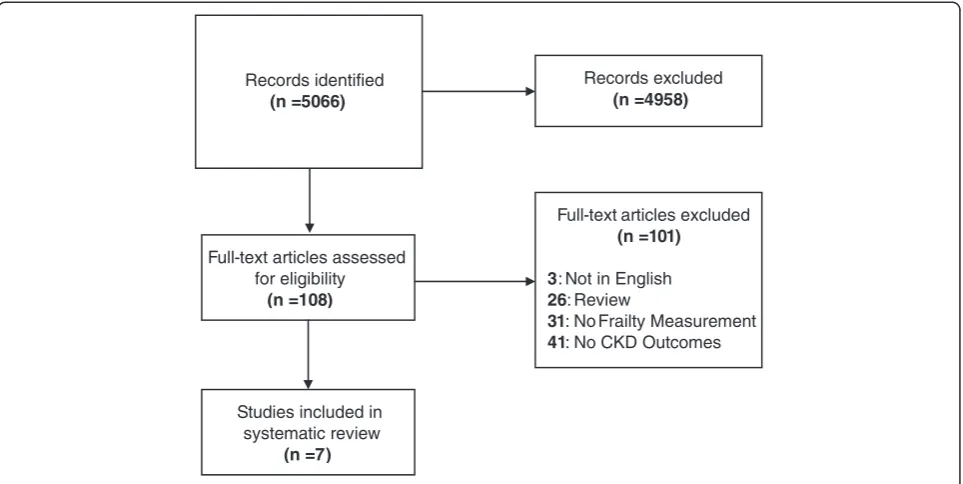
Results:We screened 5,066 abstracts and retrieved 108 studies for full text review. We identified 7 studies associating frailty or physical function to CKD. From the 7 studies, we identified only two studies that related frailty in patients with CKD to a clinical outcome. CKD was consistently associated with increasing frailty or reduced physical function [odds ratios (OR) 1.30 to 3.12]. In patients with CKD, frailty was associated with a greater than two-fold higher risk of dialysis and/or death [OR from 2.0 to 5.88].
Conclusions:CKD is associated with a higher risk of frailty or diminished physical function. Furthermore, the
presence of frailty in patients with CKD may lead to a higher risk of mortality. Further research must be conducted to understand the mechanisms of frailty in CKD and to confirm its association with clinical outcomes.
Keywords:Chronic kidney disease, Elderly, Frailty, Physical function
Background
Chronic kidney disease (CKD) is a major public health problem affecting an estimated 1.2 million Canadians [1]. Although the overall prevalence of CKD is roughly 10% in the general population, the disease increases with age, affecting more than one third of all individuals over age 65 [2]. In this population, CKD is associated with additional comorbid conditions; a higher risk of cardiovascular dis-ease and increasing prevalence of frailty and disability [3,4]. Frailty is a multidimensional syndrome characterized by loss of lean body mass (sarcopenia), weakness and
decreased endurance, leading to reduced activity and a poor response to stressors [5]. Reduced activity in turn worsens sarcopenia and weakness, causing a downward functional spiral and increasing risk of death. This is often exacerbated by social isolation and depression that reinforces behaviors leading to further inactivity, disuse and loss of function [6]. Indeed, several prospective studies have shown that measures of frailty are strongly associated with death and hospitalization in older individuals and moreover that this association is independent of other clin-ical risk factors and comorbid conditions [7].
The interrelationship between frailty, chronic diseases and adverse outcomes in older people has been recog-nized as an important focus of research in patients with cardiovascular disease (CVD) and in patients on dialysis * Correspondence:[email protected]
1
Seven Oaks Hospital, Winnipeg, Manitoba, Canada 3University of Manitoba, Winnipeg, Manitoba, Canada
Full list of author information is available at the end of the article
© 2013 Walker et al.; licensee BioMed Central Ltd. This is an open access article distributed under the terms of the Creative Commons Attribution License (http://creativecommons.org/licenses/by/2.0), which permits unrestricted use, distribution, and reproduction in any medium, provided the original work is properly cited.
[8,9]. However, studies examining frailty in non-dialysis CKD are limited. This is a significant omission given that CKD correlates with increasing age thereby afflicting a similar demographic as frailty [5]. Many of the physio-logical changes resulting from CKD are altered mineral metabolism, chronic inflammation and arteriosclerosis. These physiological changes directly or indirectly influ-ence sarcopenia and weakness, which are core domains of the frailty construct [10]. Conversely, frailty may adversely affect adaptations to the numerous health state transitions that CKD patients undergo over time. As such, individuals with coexisting frailty and CKD may be at a synergistic risk of experiencing adverse clinical outcomes. Given that frailty may be modifiable using readily available interven-tions, the study of frailty in the patient with CKD seems particularly important [11].
In order to identify the gaps in evidence in this popula-tion, we performed a systematic review to identify all rele-vant studies examining the association between frailty, physical function and CKD. We hypothesized that patients with CKD are more likely to be characterized as frail or functionally limited, and that the coexistence of the two conditions confers a higher likelihood of adverse clinical outcomes.
Methods
Search strategy and selection criteria
We aimed to identify observational studies of humans that explored the link between frailty, CKD, and clinical outcomes. The primary question of interest was the as-sociation between frailty and CKD and the likelihood of adverse clinical outcomes in frail subjects with CKD not currently on dialysis therapy. The selection criterion was broadened to include studies that looked at individual domains of frailty, such as functional limitation.
Data sources and search strategy
In collaboration with a medical librarian (K.M.), a search strategy was designed and implemented to capture all relevant studies from the available literature. The follow-ing electronic databases were searched from their date of establishment to March 2013: EMBASE, PubMed, Web of Science (WOS), CINAHL, Cochrane Database of Systematic Reviews (CDSR), Database of Abstracts of Reviews of Effects (DARE), Cochrane Central Register of Controlled Trials (CENTRAL), and AgeLine. The search strategy was tailored to each database and used a com-bination of key words such as “frailty,” “elderly,” and “kidney disease,” as well as MeSH terms (see Additional file 1: Appendix 1).
Article eligibility criteria
The eligibility for full text review of each citation was in-dependently evaluated by two reviewers (S.W. and K.G.)
on the basis of title and abstract. Any article that was deemed potentially relevant by either reviewer was re-trieved for full-text review. The reference lists of any relevant review articles were also screened to identify studies which may have potentially been missed in the search. The reviewers then independently assessed the full text articles and studies were finalized for inclu-sion in the systematic review after discusinclu-sion with a third reviewer (N.T.). Disagreements were resolved by consensus.
Data extraction
A data extraction form was created to capture relevant information from included studies. One reviewer (S.W.) independently conducted the extraction with verification by a second reviewer (K.G.). The following informa-tion was extracted for each study: 1. study characteris-tics, such as the year of publication, study design, study population, and sample size; 2. definitions of CKD and frailty (or its associated domains); and 3. patient character-istics, such as mean age, percentage of males, race and comorbidities.
Evaluation of risk of bias
We evaluated each study for risk of bias using the Newcastle-Ottawa Scale (NOS) [12] in order to assess its quality. The NOS is a quality evaluation method for non-randomized studies. The NOS criteria are split into three sections: Selection, Comparability and Outcome. Each study is designated a number of stars for each sec-tion, based on predetermined queries. The queries used in this systematic review can be found in Additional file 1: Appendix 2.
Statistical analysis
As significant clinical heterogeneity in the patient popu-lation, definitions of frailty, study methodologies and co-variate adjustment were encountered; meta-analysis was not performed. In order to assess publication bias, we created funnel plots of the risk associations (Additional file 1: Appendix 3). Cross-sectional and Cohort studies were plotted separately.
Declaration of sources of funding No specific funding.
Results
Search results and study selection
Study characteristics
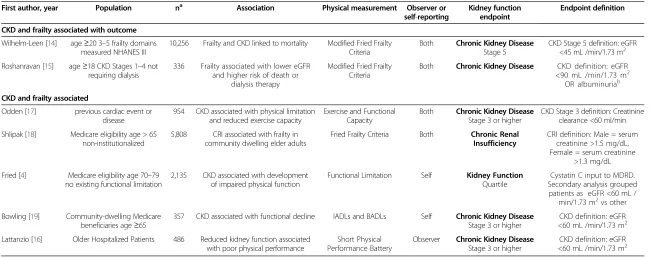
The 7 included studies encompassed a total of 20,332 patients. All 7 studies examined the relationship between CKD and frailty (or one its domains), but only two stud-ies related frailty in CKD patients to a clinical outcome [14,15]. The studies were mainly conducted in the United States and published after 2004 with the exception of one conducted in Italy, published in 2012 [16]. Two of the studies were prospective [4,15] and the remaining studies were secondary analyses [14,16-19]. All of the studies provided a measure of kidney function and a description of frailty or one of its domains. Table 1 shows the individ-ual study characteristics for the included studies.
Measures of frailty and physical function
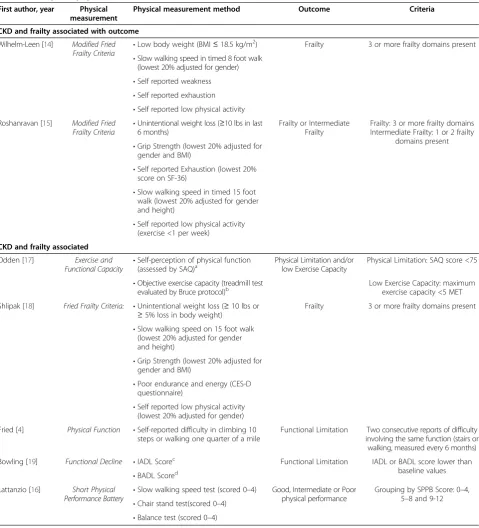
Each study used different methods for the definition and identification of frailty and physical function (Table 2). Both of the studies examining the association between frailty and adverse clinical outcomes relied on a modified version of the Fried frailty criteria. Wilhelm-Leen et al. abbreviated multiple measures and relied on single item questions to define the weakness, exhaustion and phys-ical activity domains of the frailty definition. In contrast, Roshanravan et al. used objective criteria for weakness, but defined exhaustion from the results of a survey (SF-36) and slowness from the results of a 4 meter walk test.
The studies examining an association between frailty or physical function and CKD used many different defi-nitions of decreased physical function. One study [18] used unmodified Fried frailty criteria. Two studies used standardized measurements to identify reduced physical
ability, measuring exercise and functional capacity [17] and completing a Short Physical Performance Battery [16] test. Two studies allowed patients to self-report whether they were functionally limited [4] or whether they had diffi-culty with activities of daily living [19]. A detailed descrip-tion of the frailty/physical funcdescrip-tion criteria in each study is listed in Table 2.
Association of frailty with CKD
We found 7 studies that examined the association of frailty or its individual components with CKD. The largest study in our analysis utilized data from the third National Health and Nutrition Evaluation Survey (NHANES III) and exam-ined the association between frailty as defexam-ined by the modi-fied Fried criteria and CKD defined by serum creatinine based eGFR [14]. The results suggested that patients in the early stages of CKD were at a greater than two-fold higher risk of being frail in comparison to healthy patients [CKD stage 1/2: odds ratio (OR) 2.21, 95% confidence interval (CI) 1.49-3.28; CKD stage 3a: OR 2.48, 95% CI 1.57-3.93]. Furthermore, patients with CKD at or beyond stage 3b were found to be nearly six times as likely to be frail (OR 5.88, 95% CI 3.40-10.16). A similar community based study, using the Cardiovascular Health Study population, also found consistent results, but the association was weaker (OR 1.76, 95% CI 1.28-2.41 [18]. Finally, a more re-cent study [15] , in the advanced CKD population, also showed similar findings. In this population, patients with and eGFR in the range of 30–44 mL/min/1.73 m2
were two times more likely to have the frailty phenotype (OR 2.1, 95% CI 1.0-4.7) and patients with an eGFR measurement
Records excluded
(n = 4958)
Full-text articles assessed for eligibility
(n =108)
Full-text articles excluded
(n = 101)
3: Not in English
26: Review
31: No Frailty Measurement
41: No CKD Outcomes
Studies included in systematic review
(n =7)
Records identified
(n = 5066)
Figure 1Flow Diagram of Reviewed Studies.
Walkeret al. BMC Nephrology2013,14:228 Page 3 of 9
Table 1 Characteristics of included studies
First author, year Population na Association Physical measurement Observer or
self-reporting
Kidney function endpoint
Endpoint definition CKD and frailty associated with outcome
Wilhelm-Leen [14] age≥20 3–5 frailty domains measured NHANES III
10,256 Frailty and CKD linked to mortality Modified Fried Frailty Criteria
Both Chronic Kidney Disease
Stage 5
CKD Stage 5 definition: eGFR <45 mL /min/1.73 m2
Roshanravan [15] age≥18 CKD Stages 1–4 not requiring dialysis
336 Frailty associated with lower eGFR and higher risk of death or
dialysis therapy
Modified Fried Frailty Criteria
Both Chronic Kidney Disease CKD definition: eGFR <90 mL /min/1.73 m2 OR albuminuriab
CKD and frailty associated
Odden [17] previous cardiac event or disease
954 CKD associated with physical limitation and reduced exercise capacity
Exercise and Functional Capacity
Both Chronic Kidney Disease
Stage 3 or higher
CKD Stage 3 definition: Creatinine clearance <60 ml/min
Shlipak [18] Medicare eligibility age > 65 non-institutionalized
5,808 CRI associated with frailty in community dwelling elder adults
Fried Frailty Criteria Both Chronic Renal Insufficiency
CRI definition: Male = serum creatinine >1.5 mg/dL, Female = serum creatinine
>1.3 mg/dL
Fried [4] Medicare eligibility age 70–79 no existing functional limitation
2,135 CKD associated with development of impaired physical function
Functional Limitation Self Kidney Function
Quartile
Cystatin C input to MDRD. Secondary analysis grouped patients as eGFR <60 mL /
min/1.73 m2vs other
Bowling [19] Community-dwelling Medicare beneficiaries age≥65
357 CKD associated with functional decline IADLs and BADLs Self Chronic Kidney Disease
Stage 3 or higher
CKD definition: eGFR <60 mL /min/1.73 m2
Lattanzio [16] Older Hospitalized Patients 486 Reduced kidney function associated with poor physical performance
Short Physical Performance Battery
Observer Chronic Kidney Disease
Stage 3 or higher
CKD definition: eGFR <60 mL /min/1.73 m2
BADLBasic activities of daily living,CKDChronic Kidney Disease,CRIChronic Renal Insufficiency,DMdiabetes mellitus,eGFRestimated glomerular filtration rate,IADLInstrumental activities of daily living,MDRDModification of Diet in Renal Disease equation,NHANESIII, third National Health and Nutrition Evaluation Survey,RRTrenal replacement therapy.
a
study sample size. b
Albuminuria defined as urine albumin-creatinine ratio >30 mg/g from a 12-hour urine collection.
BMC
Nephrol
ogy
2013,
14
:228
Page
4
o
f
9
ntral.com/1
of less than 30 mL/min/1.73 m2were nearly three times more likely to be frail (OR 2.8, 95% CI 1.3-6.3).
The remaining four studies largely focused on the physical function domains of frailty such as functional
limitation, exercise capacity and physical performance in relation to CKD. One of the four studies used creatinine clearance as a marker of kidney function. The remaining three studies utilized eGFR measurements to determine
Table 2 Frailty and physical function criteria
First author, year Physical measurement
Physical measurement method Outcome Criteria
CKD and frailty associated with outcome
Wilhelm-Leen [14] Modified Fried Frailty Criteria •
Low body weight (BMI≤18.5 kg/m2) Frailty 3 or more frailty domains present
•Slow walking speed in timed 8 foot walk (lowest 20% adjusted for gender) •Self reported weakness •Self reported exhaustion •Self reported low physical activity Roshanravan [15] Modified Fried
Frailty Criteria •
Unintentional weight loss (≥10 lbs in last 6 months)
Frailty or Intermediate Frailty
Frailty: 3 or more frailty domains Intermediate Frailty: 1 or 2 frailty
domains present •Grip Strength (lowest 20% adjusted for
gender and BMI)
•Self reported Exhaustion (lowest 20% score on SF-36)
•Slow walking speed in timed 15 foot walk (lowest 20% adjusted for gender and height)
•Self reported low physical activity (exercise <1 per week)
CKD and frailty associated
Odden [17] Exercise and
Functional Capacity
•Self-perception of physical function (assessed by SAQ)a
Physical Limitation and/or low Exercise Capacity
Physical Limitation: SAQ score <75
•Objective exercise capacity (treadmill test
evaluated by Bruce protocol)b Low Exercise Capacity: maximumexercise capacity <5 MET
Shlipak [18] Fried Frailty Criteria: •Unintentional weight loss (≥10 lbs or ≥5% loss in body weight)
Frailty 3 or more frailty domains present
•Slow walking speed on 15 foot walk (lowest 20% adjusted for gender and height)
•Grip Strength (lowest 20% adjusted for gender and BMI)
•Poor endurance and energy (CES-D questionnaire)
•Self reported low physical activity (lowest 20% adjusted for gender)
Fried [4] Physical Function •Self-reported difficulty in climbing 10 steps or walking one quarter of a mile
Functional Limitation Two consecutive reports of difficulty involving the same function (stairs or walking, measured every 6 months)
Bowling [19] Functional Decline •IADL Scorec Functional Limitation IADL or BADL score lower than
baseline values •BADL Scored
Lattanzio [16] Short Physical Performance Battery
•Slow walking speed test (scored 0–4) Good, Intermediate or Poor physical performance
Grouping by SPPB Score: 0–4, 5–8 and 9-12 •Chair stand test(scored 0–4)
•Balance test (scored 0–4)
BADLBasic Activities of Daily Living,BMIbody mass index,CES-DCenter for Epidemiologic Studies Depression Scale,IADLInstrumental activities of daily living,
METmetabolic equivalent tasksSPPB, Short Physical Performance Battery,SAQSeattle Angina Questionnaire. SF-36, 36-Item Short Form Health Survey.
a
SAQ scored from 0-100, High Score denotes better physical function.
b
Bruce Protocol: maximum exercise capacity determined by total number of MET achieved in test.
c
IADLs list: using the telephone, light housework, heavy housework, preparing meals, shopping and managing money.
d
BADL list: bathing, transferring out of a bed or chair, eating, toileting and dressing.
Walkeret al. BMC Nephrology2013,14:228 Page 5 of 9
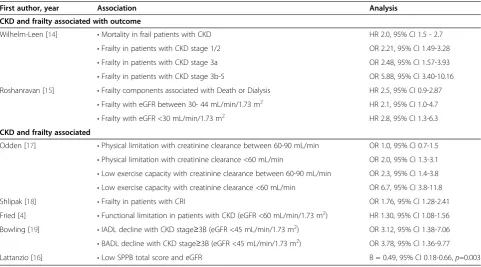
kidney function. In these four studies, CKD was consist-ently associated with a higher risk of developing a limita-tion in the physical funclimita-tion domain of frailty that each respective study examined. A summary of the associations between CKD, frailty and/or frailty domains reported by each of the studies is seen in Table 3.
Association of frailty with clinical outcomes in patients with CKD
Only two published studies related frailty in patients with CKD to an adverse clinical outcome [14,15]. One study used data from NHANES III and related frailty in patients with CKD to mortality. After adjusting for mul-tiple comorbid conditions, frailty in CKD patients was associated with a two-fold higher risk of mortality com-pared to CKD patients who were not frail [hazard ratio (HR) 2.0, 95% CI 1.5-2.7]. The second study was per-formed in a smaller population with more advanced CKD and used Death and Dialysis as the clinical outcomes. The study adjusted for age, sex, BMI, eGFR, diabetes and car-diovascular disease and found that the frailty phenotype was associated with a 2.5 fold greater risk of death or dialy-sis therapy (HR 2.5, 95% CI 0.9-2.87).
Risk of bias
The two studies associating Frailty and CKD with clin-ical outcomes had a similar risk of bias. Both studies has relatively low risk of bias in selection and comparability
domains, but had a higher risk of bias in evaluation of outcome. The remaining five studies associated frailty or physical function and CKD and all had a similar risk of bias. A detailed description of the quality assessment is described in Table 4.
Discussion
In our systematic review, we found multiple studies con-firming independent associations between frailty, dimin-ished physical function and CKD. There was an association between presence of CKD and being frail or having limita-tions of physical function. More importantly, in patients
Table 3 Associations reported within included studies
First author, year Association Analysis
CKD and frailty associated with outcome
Wilhelm-Leen [14] •Mortality in frail patients with CKD HR 2.0, 95% CI 1.5 - 2.7
•Frailty in patients with CKD stage 1/2 OR 2.21, 95% CI 1.49-3.28
•Frailty in patients with CKD stage 3a OR 2.48, 95% CI 1.57-3.93
•Frailty in patients with CKD stage 3b-5 OR 5.88, 95% CI 3.40-10.16
Roshanravan [15] •Frailty components associated with Death or Dialysis HR 2.5, 95% CI 0.9-2.87
•Frailty with eGFR between 30- 44 mL/min/1.73 m2 HR 2.1, 95% CI 1.0-4.7
•Frailty with eGFR <30 mL/min/1.73 m2 HR 2.8, 95% CI 1.3-6.3
CKD and frailty associated
Odden [17] •Physical limitation with creatinine clearance between 60-90 mL/min OR 1.0, 95% CI 0.7-1.5
•Physical limitation with creatinine clearance <60 mL/min OR 2.0, 95% CI 1.3-3.1 •Low exercise capacity with creatinine clearance between 60-90 mL/min OR 2.3, 95% CI 1.4-3.8 •Low exercise capacity with creatinine clearance <60 mL/min OR 6.7, 95% CI 3.8-11.8
Shlipak [18] •Frailty in patients with CRI OR 1.76, 95% CI 1.28-2.41
Fried [4] •Functional limitation in patients with CKD (eGFR <60 mL/min/1.73 m2) HR 1.30, 95% CI 1.08-1.56
Bowling [19] •IADL decline with CKD stage≥3B (eGFR <45 mL/min/1.73 m2) OR 3.12, 95% CI 1.38-7.06
•BADL decline with CKD stage≥3B (eGFR <45 mL/min/1.73 m2) OR 3.78, 95% CI 1.36-9.77
Lattanzio [16] •Low SPPB total score and eGFR B = 0.49, 95% CI 0.18-0.66,p=0.003
BADLBasic Activities of Daily Living,CIconfidence interval,CKDChronic Kidney Disease,CRIchronic renal insufficiency,HRhazard ratio,IADLInstrumental activities of daily living,ORodds ratio,SPPBShort Physical Performance Battery.
Table 4 Newcastle-Ottawa scale quality evaluation
First author, year Selection Comparability Outcome Total
CKD and frailty associated with outcome
Wilhelm-Leen [14] 3 2 0 5
Roshanravan [15] 2 2 1 5
CKD and frailty associated
Odden [17] 3 2 0 5
Shlipak [18] 3 2 0 5
Fried [4] 4 2 1 7
Bowling [19] 4 1 1 6
Lattanzio [16] 3 2 0 5
with CKD, the presence of frailty was associated with all-cause mortality and dialysis after adjusting for multiple co-morbid conditions. Our findings highlight the importance of frailty as both a health outcome and an independent predictor of adverse outcomes in CKD. This has important implications for the clinical care of these patients and for the design of epidemiological studies in this population. In addition, our review also confirms the paucity of literature examining the relationships between frailty, kidney func-tion and clinical outcomes.
To our knowledge, our systematic review is the first to explore frailty and physical function in the CKD popula-tion. A previous systematic review explored the associ-ation between frailty and CVD [8]. The study showed that a possible bidirectional relationship exists between frailty and CVD and found that frailty in the CVD popu-lation was a powerful predictor of mortality. The CVD review was different from ours in that the investigators adhered to strictly defined frailty criteria when choosing studies to be included in their review, rather than a more open-ended definition of frailty and physical func-tion in our study. In the kidney failure populafunc-tion, a sin-gle prospective study exploring frailty amongst patients with end-stage renal disease (ESRD) analyzed data col-lected in the Dialysis Morbidity and Mortality Study (DMMS) Wave 2 [9]. Their definition of frailty was similar to the modified Fried frailty because it incorporated poor self-reported physical functioning, exhaustion/fatigue, low physical activity and under-nutrition. They discovered that nearly two thirds of the examined cohort of dialysis pa-tients met their definition of frailty. Furthermore, they found that frailty in patients on dialysis was independently associated with mortality. In addition, the investigators conducting this analysis were also able to examine nents of frailty individually and found that each compo-nent was independently associated with mortality in patients with kidney failure.
Two of the seven studies included in our review exam-ined the association between frailty and clinical out-comes in patients with CKD, and also studied the association between prevalent CKD and frailty [14,15]. Both studies defined frailty using modified Fried criteria and utilized self-reported criteria items to define the ex-haustion and physical activity domains of frailty. Only one of the two studies followed the Fried criteria for weight loss and weakness, the other defined weight loss as a cross sectional BMI <18.5 and used self-reporting for weakness measurements [14]. The lack of standardized definitions for each of the domains, as well as retrospect-ive adaptation of questionnaires to fit the frailty domains, limits comparisons between these studies. In fact, recent studies have shown that defining frailty based on self-reported questionnaires may lead to significantly higher perceived prevalence than using measured constructs,
and therefore further study of frailty using more objective measures is needed [20].
Of the remaining five studies in our review, only one study utilized the Fried frailty criteria. This study [18] only used self-reported values for exhaustion and low physical activity measurements. The additional four stud-ies examined domains of physical ability to study the as-sociation between physical function and CKD. Two of these studies used self-reported values to assess ability to complete activities of daily living [19] and functional limitation [4] as outcomes. The remaining two studies used objective measurements to assess physical ability as exercise and functional capacity [17] or Short Physical Performance Battery tests [16]. None of the studies in our review examined alternative definitions of frailty and most did not assess potentially important domains, in-cluding mood and cognition. Alternative domains may be particularly important in patients with CKD, as both cog-nitive impairment and depressed mood can strongly in-fluence decision making about dialysis modalities for both the patient and the provider. Multiple studies in the kidney failure population have suggested that cognitive impairment and depression are exceedingly common in patients with CKD and we believe that future work on frailty in this population should include study of these potentially modifiable domains [21,22].
There are several direct clinical and research implica-tions to our findings. First, the majority of the studies in our review used questionnaires and physical function tests that can be easily administered in the inter-professional CKD clinic setting. If frailty is indeed confirmed to be inde-pendently associated with adverse outcomes in CKD, these assessments could be performed routinely in the renal clinic setting without adding significant resources or pa-tient burden. In addition, multiple studies have shown that simple nutritional and physical function interventions such as nutrition and exercise programs targeted at reducing frailty can have an impact on important functional out-comes in the general population and in patients with kid-ney failure [23-25]. Given that frailty is a modifiable risk factor in the older general population and the high preva-lence of older patients in CKD clinics, studies examining the effects of treating frailty in older patients with CKD are urgently needed.
There are several strengths of our review. Our search strategy included multiple electronic databases in an at-tempt to ensure that all of the published literature examin-ing frailty and CKD was captured. We manually searched the bibliographies of the included articles to ensure that we achieved a high sensitivity of our search strategy. We also examined the quality of each included study using vali-dated criteria and highlighted deficiencies in evidence and reporting. Finally, we broadened our search criteria to in-clude studies examining any definition of frailty and also
Walkeret al. BMC Nephrology2013,14:228 Page 7 of 9
studies looking at physical function and functional limita-tion affording the ability to assess the impact of CKD on individual domains of frailty.
Our study has some limitations. Our review was fo-cused on the published literature and it is possible that publication bias may have played a role and excluded studies showing a lack of association between frailty and CKD. Although, our funnel plots (Additional file 1: Appendix 3) did not show any obvious evidence of publi-cation bias, it is possible that residual bias remains in our study selection. Secondly, most of the studies included in our review were secondary data analyses as opposed to primary prospective studies of frailty in CKD. As such, these analyses came from studies not directly designed to explore the link between frailty and CKD, but instead, had data elements which allowed secondary analyses. Thirdly, the methods for assessing physical function, physical per-formance and frailty in the studies included in our review were heterogeneous. Conclusions about the relationship between CKD and frailty and/or physical function may be limited by the lack of comparisons between different methods in the same population. Finally, we did not in-clude studies examining frailty in patients undergoing dialysis or kidney transplant. Although frailty has been studied more extensively in the kidney failure population, the physiological alterations and morbidity associated with dialysis treatments may not be applicable to patients with CKD not on dialysis.
Conclusion
In conclusion, our systematic review confirms the inde-pendent association between frailty, CKD and adverse clinical outcomes. Frailty appears to be independently as-sociated with prevalent CKD, and the presence of frailty in CKD may be strongly associated with all-cause mortality. In addition, our review highlights the paucity of literature examining the association between CKD and frailty. Fur-ther studies examining the epidemiology of frailty in patients with CKD using objective physical and cognitive function criteria are needed, both to elucidate the under-lying mechanisms and to inform clinical trials using tar-geted interventions.
Additional file
Additional file 1:Appendix 1: Search Strategy.Appendix 2: NOS Criteria.Appendix 3: Publication Bias Funnel Plot.
Competing interests
The authors declare that they have no competing interests.
Authors’contributions
SW was involved with abstract and full text screening, extraction of data from selected articles, drafting of the manuscript and approval of final version of the manuscript. KG was involved with abstract and full text screening, extraction of data from selected articles and drafting of the
manuscript. KM was responsible for creating and applying the search strategy and retrieving selected articles. PK was involved in study design and approval of the manuscript. CR was involved in study design and approval of the manuscript. MS was involved in study design and approval of the manuscript. CB was involved in study design and approval of the manuscript. LS was involved in study design and approval of the manuscript. NT conceived of the study, and participated in its design and coordination, helped to draft the manuscript and approved the final version of the manuscript. All authors read and approved the final manuscript.
Acknowledgements
We would like to thank Jennifer Boyko and Christine Bencharski for administrative support and Stefania Zimarino for her help with collecting articles for full text review.
Author details
1Seven Oaks Hospital, Winnipeg, Manitoba, Canada.2St Boniface Hospital, Winnipeg, Manitoba, Canada.3University of Manitoba, Winnipeg, Manitoba, Canada.4Health Sciences Centre, Winnipeg, Manitoba, Canada.
Received: 14 June 2013 Accepted: 16 October 2013 Published: 22 October 2013
References
1. Zhang QL, Rothenbacher D:Prevalence of chronic kidney disease in population-based studies: systematic review.BMC Public Health2008,
8:117.
2. Coresh J, Selvin E, Stevens LA, Manzi J, Kusek JW, Eggers P, Van Lente F, Levey AS:Prevalence of chronic kidney disease in the United States. JAMA2007,298(17):2038–2047.
3. Fried LF, Unruh ML:Aging in kidney disease: key issues and gaps in knowledge.Adv Chronic Kidney Dis2010,17(4):291–292.
4. Fried LF, Lee JS, Shlipak M, Chertow GM, Green C, Ding J, Harris T, Newman AB:
Chronic kidney disease and functional limitation in older people: health, aging and body composition study.J Am Geriatr Soc2006,54(5):750–756. 5. Cook WL:The intersection of geriatrics and chronic kidney disease: frailty
and disability among older adults with kidney disease.Adv Chronic Kidney Dis2009,16(6):420–429.
6. Singh NA, Quine S, Clemson LM, Williams EJ, Williamson DA, Stavrinos TM, Grady JN, Perry TJ, Lloyd BD, Smith EU, Singh MA:Effects of high-intensity progressive resistance training and targeted multidisciplinary treatment of frailty on mortality and nursing home admissions after hip fracture: a randomized controlled trial.J Am Med Dir Assoc2012,13(1):24–30. 7. Woods NF, LaCroix AZ, Gray SL, Aragaki A, Cochrane BB, Brunner RL, Masaki K,
Murray A, Newman AB:Women's Health Initiative: frailty: emergence and consequences in women aged 65 and older in the Women's Health Initiative Observational Study.J Am Geriatr Soc2005,53(8):1321–1330. 8. Afilalo J, Karunananthan S, Eisenberg MJ, Alexander KP, Bergman H:Role of
frailty in patients with cardiovascular disease.Am J Cardiol2009,
103(11):1616–1621.
9. Johansen KL, Chertow GM, Jin C, Kutner NG:Significance of frailty among dialysis patients.J Am Soc Nephrol2007,18(11):2960–2967.
10. Abboud H, Henrich WL:Clinical practice. Stage IV chronic kidney disease. N Engl J Med2010,362(1):56–65.
11. Brown M, Sinacore DR, Ehsani AA, Binder EF, Holloszy JO, Kohrt WM:
Low-intensity exercise as a modifier of physical frailty in older adults. Arch Phys Med Rehabil2000,81(7):960–965.
12. The Newcastle-Ottawa Scale (NOS) for assessing the quality of nonrandomised studies in meta-analyses.[http://www.ohri.ca/programs/clinical_epidemiology/ oxford.asp]
13. Schulz KF, Altman DG, Moher D:CONSORT Group: CONSORT 2010 statement: updated guidelines for reporting parallel group randomised trials.BMJ2010,340:c332.
14. Wilhelm-Leen ER, Hall YN, Tamura MK, Chertow GM:Frailty and chronic kidney disease: the Third National Health and Nutrition Evaluation Survey.Am J Med2009,122(7):664–671. e2.
15. Roshanravan B, Khatri M, Robinson-Cohen C, Levin G, Patel KV, de Boer IH, Seliger S, Ruzinski J, Himmelfarb J, Kestenbaum B:A prospective study of frailty in nephrology-referred patients with CKD.Am J Kidney Dis2012,
16. Lattanzio F, Corsonello A, Abbatecola AM, Volpato S, Pedone C, Pranno L, Laino I, Garasto S, Corica F, Passarino G, Antonelli Incalzi R:Relationship between renal function and physical performance in elderly hospitalized patients.Rejuvenation Res2012,15(6):545–552.
17. Odden MC, Whooley MA, Shlipak MG:Association of chronic kidney disease and anemia with physical capacity: the heart and soul study. J Am Soc Nephrol2004,15(11):2908–2915.
18. Shlipak MG, Stehman-Breen C, Fried LF, Song X, Siscovick D, Fried LP, Psaty BM, Newman AB:The presence of frailty in elderly persons with chronic renal insufficiency.Am J Kidney Dis2004,43(5):861–867.
19. Bowling CB, Sawyer P, Campbell RC, Ahmed A, Allman RM:Impact of chronic kidney disease on activities of daily living in community-dwelling older adults.J Gerontol A Biol Sci Med Sci2011,66(6):689–694. 20. Painter P, Kuskowski M:A closer look at frailty in.Getting the measure right.
Hemodial Int: ESRD; 2012.
21. Palmer SC, Vecchio M, Craig JC, Tonelli M, Johnson DW, Nicolucci A, Pellegrini F, Saglimbene V, Logroscino G, Hedayati SS, Strippoli GF: Association Between Depression and Death in.A Meta-analysis of Cohort Studies. Am J Kidney Dis: People With CKD; 2013.
22. Sarnak MJ, Tighiouart H, Scott TM, Lou KV, Sorensen EP, Giang LM, Drew DA, Shaffi K, Strom JA, Singh AK, Weiner DE:Frequency of and risk factors for poor cognitive performance in hemodialysis patients.Neurology2013,
80(5):471–480.
23. Chan DC, Tsou HH, Yang RS, Tsauo JY, Chen CY, Hsiung CA, Kuo KN:A pilot randomized controlled trial to improve geriatric frailty.BMC Geriatr2012,
12(58). 58.
24. Strasser B, Keinrad M, Haber P, Schobersberger W:Efficacy of systematic endurance and resistance training on muscle strength and endurance performance in elderly adults–a randomized controlled trial.Wien Klin Wochenschr2009,121(23–24):757–764.
25. Binder EF, Yarasheski KE, Steger-May K, Sinacore DR, Brown M, Schechtman KB, Holloszy JO:Effects of progressive resistance training on body composition in frail older adults: results of a randomized, controlled trial.J Gerontol A Biol Sci Med Sci2005,60(11):1425–1431.
doi:10.1186/1471-2369-14-228
Cite this article as:Walkeret al.:Association of frailty and physical function in patients with non-dialysis CKD: a systematic review.BMC Nephrology201314:228.
Submit your next manuscript to BioMed Central and take full advantage of:
• Convenient online submission
• Thorough peer review
• No space constraints or color figure charges
• Immediate publication on acceptance
• Inclusion in PubMed, CAS, Scopus and Google Scholar
• Research which is freely available for redistribution
Submit your manuscript at www.biomedcentral.com/submit
Walkeret al. BMC Nephrology2013,14:228 Page 9 of 9