World Maritime University World Maritime University
The Maritime Commons: Digital Repository of the World Maritime
The Maritime Commons: Digital Repository of the World Maritime
University
University
World Maritime University Dissertations Dissertations
2000
The government's role in multimodal development and trade
The government's role in multimodal development and trade
facilitation in Tanzania
facilitation in Tanzania
S. G.I. Tumpe Mwaijande
World Maritime University
Follow this and additional works at: https://commons.wmu.se/all_dissertations
Part of the Economics Commons
Recommended Citation Recommended Citation
Mwaijande, S. G.I. Tumpe, "The government's role in multimodal development and trade facilitation in Tanzania" (2000). World Maritime University Dissertations. 365.
WORLD MARITIME UNIVERSITY
Malmö, Sweden
THE GOVERNMENT’S ROLE IN MULTIMODAL
DEVELOPMENT AND TRADE FACILITATION IN
TANZANIA.
By
S.G.I TUMPE MWAIJANDE
(
Tanzania)A dissertation submitted to the World Maritime University in partial fulfillment of the requirements for the award of the degree of
MASTER OF SCIENCE
in
SHIPPINGMANAGEMENT
2000
DECLARATION
I certify that all the material in this dissertation that is not my own work has been identified, and that no material is included for which a degree has previously been conferred on me.
The contents of this dissertation reflect my own personal views, and are not necessarily endorsed by the University.
………. (Signature) ……… (Date)
Supervised by: Name: P. Donner Associate Professor
World Maritime University
Assessor:
Name: R. Prasad Lecturer
World Maritime University
Co-assessor: Name: Hans Carl
(Visiting Professor, World Maritime University) Officer-in-Charge, Trade Infrastructure Branch Chief, Trade Facilitation Section SITE,
ACKNOWLEDGEMENT
I wish to express my sincere thanks and gratitude to The Federal Republic of German through The Carl Duisberg Gesellschaft (CDG) e.v for granting me the fellowship. Thanks are also extended to the government of The United Republic of Tanzania for nominating me to attend the course.
This space does not allow me to acknowledge all people to whom I owe a debt of gratitude and even less to name all individuals with whom I have had the contact. It’s my greatest pleasure and appreciation to extend my thanks to the World Maritime society, Professors and all Lecturers, including visiting Professors for their lectures that were not only educative but also very informative.
Above all, I am heavily indebted to my Supervisor Associate Professor Patrick Donner who assigned himself a difficult task of reviewing the initial draft. Providing me with guidance and proof reading the final draft that made possible the fulfillment of this task.
Finally, I would like to express my gratitude to my colleagues and friends who in one way or another helped me in discussions.
ABSTRACT
Title of Dissertation: The government’s role in multimodal transport development and trade facilitation in Tanzania.
Degree: MSc
The purpose of this dissertation is to examine the role of the Tanzanian government in developing multimodal transport and facilitating the movement of international trade in the country and why the government should play a major role in this development.
The study in brief, addresses the new responsibilities and duties of the government on how to manage business under fair and free market competition. It is analyzing the technical and economic capability of developing multimodal transport in the country in terms of strengths, weaknesses, opportunities and threats. It also looks into how the government could meet the global economic challenges, and how the nation could benefit from the technological development, which is changing the traditional way of doing business. The drawbacks are identified and challenges are described.
communication technology and customs regulations, procedures and practices. Safety and environment protection issues are also assessed. Problems are identified and proposed solutions are made according to national, sub regional and international scenarios. A forecast of trade movement through the Tanzanian ports is also examined.
The competence of freight transport facilitators is examined, and proposals are made on what the government should do to help the non-competent facilitators wishing to be MTOs. Special case is made as an example of what the government should consider to enhance the development of MTOs in the country.
Transport economics, quality and cost of different modes of transport is analyzed. Operational problems, which hinder a good pricing structure, are identified with suggested solutions.
Finally, the concluding chapter summarizes the study with emphasis on the Tanzanian government to consider the importance of developing the multimodal transport in the country. A number of recommendations make suggestions by taking into account the process of developing the multimodal services and improving the facilitation of trade in Tanzania.
TABLE OF CONTENTS
Declaration ii
Acknowledgement iii
Abstract iv
Table of Contents vi
List of Tables x
List of Figures x
List of Abbreviations xi
1 Introduction 1
2 The appraisal of government business environment
2. 1 Government responsibilities 7
2. 2 SWOT analysis 13
2. 2. 1 Strengths 13
2. 2. 2 Weaknesses 13
2. 2. 3 Opportunities 15
3 Developing multimodal transportation in Tanzania 19
3. 1 National and sub-regional level 21
3. 1. 1 National level 21
3. 1. 1. 1 United Nations convention on transit trade
and Landlocked countries 23 3. 1. 1. 2 International convention on the simplification
and harmonization of customs procedures 23 3. 1. 2 Sub-Regional level 24
3. 2 Road sector 26
3. 2. 1 Axle-load limit 27
3. 3 Railway sector 28
3. 3. 1 Bridges and tunnels 29
3. 3. 2 Block trains 31
3. 3. 3 Isaka Dry port 32
3. 3. 3. 1 The achievement of the block train services
and Isaka Dry port 33
3. 4 Maritime sector 35
3. 4. 1 Kurasini and Ubungo ICDs 36
3. 5 Air freight sector 37
3. 6 Information and communication technology 37 3. 6. 1 The Advanced Cargo Information system (ACIS) 38 3. 7 Safety and environment protection 40
3. 8 Movement of trade 42
3. 8. 1 Evaluation of individual country performance 42
3. 8. 1. 1 Uganda 42
3. 8. 1. 2 D. R. Congo, Burundi and Rwanda (CBR) 43
3. 8. 1. 4 Zambia 44
3. 9 Trade forecasting 46
4 Freight transport facilitators 50
4. 1 The position of freight forwarding industry in Tanzania 52 4. 1. 1 Special case: Tanzania Central Freight Bureau (TCFB) 54 4. 1. 1. 1 Negative impacts on TCFB 55 4. 2 The Malawi freight forwarding company 57 4. 3 The Zambia freight forwarding company 57
4. 4 Freight consolidators 58
4. 5 Shippers’ council 58
5 Transport cost analysis 59
5. 1 Transport economics 59
5. 1. 1 Quality of transport services 60 5. 1. 1. 1 Road transport 61 5. 1. 1. 2 Rail transport 62 5. 1. 1. 3 Inland waterway 62
5. 2 Freight rates 63
5. 2. 1 Road freight rates 63
5. 2. 1. 1 Road operational problems 64
5. 2. 2 Rail freight rates 65
6 Conclusions and Recommendations 69
6.1Conclusions 69
6.2Recommendations 71
6. 2. 1Government policies and regulatory reforms 71 6. 2. 1. 1 Customs regulations and procedures 71 6. 2. 1. 2 Promotion of new trade transaction terms 72 6. 2. 1. 3 Training policy 72 6. 2. 1. 4 Promotion of multimodal transport operations 72 6. 2. 1. 5 MTOs development policies 73 6. 2. 1. 6 Policies encouraging competition 74 6. 2. 1. 7 Regulations and policies on safety and environment74 6. 2. 1. 8 Transparency in investment policies 76 6. 2. 2. Sound and predictable financial system 76 6. 2. 3. Information technology policies 77 6. 2. 4 International agreements and co-operation 77
References 78
Appendices
Appendix 1 Container penetration in the dry general cargo trade 84
LIST OF TABLES
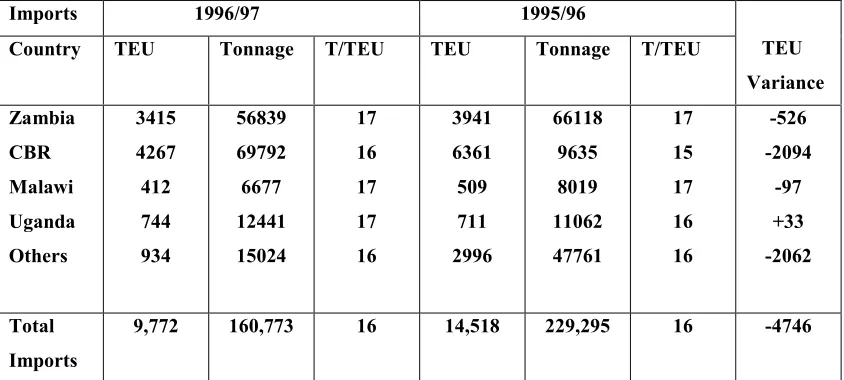
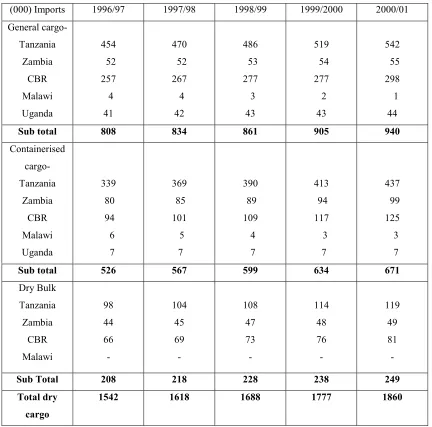
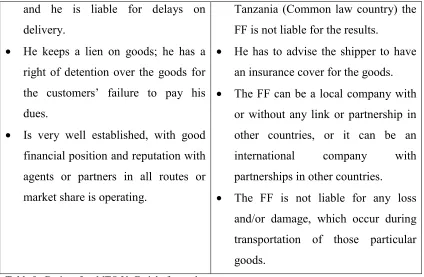
Table 1 International transport conventions 9 Table 2 Main reasons in favor of multimodal transport 20 Table 3 Existing agreements between Tanzania and LLC 25 Table 4 Block train services and transit time 32 Table 5 Imports 1996/ Vs 1995/96 44 Table 6 Exports 1996/97 Vs 1995/96 45 Table 7 Dry cargo forecasting through Tanzanian ports 46 Table 8 Imports tonnage: Actual Vs Forecast 1996/97. 48 Table 9 Duties of MTOs Vs Freight forwarders 52 Table 10 Comparison of major transport modes 63 Table 11 Road freight rates 65 Table 12 OSCAR Cost Centers 66 Table 13 Rail freight rates 67
LIST OF FIGURES
Figure 1 MTO’S relationship with various parties 4 Figure 2 The benefits of the use of information and
Communication technology 39 Figure 3 Managing transport with other logistics activities 61
MAPS
ABBREVIATIONS
ACIS Advanced Cargo Information System
CBR The Democratic Republic of Congo, Burundi and Rwanda C & F Clearing and Forwarding agents
EDI Electronic Data Interchange EEZ Exclusive Economic Zone FCL Full Container Load
GATT General Agreement on Tariffs and Trade GPS Global Positioning System
INCOTERMS International Commercial Terms IT Information Technology
ICD Inland Clearance Depots
ICT Information and Communication Technology KICD Kurasini Inland Clearance Depot
LCL Less than Container Load LLC Landlocked Countries MCC Malawi Cargo Centre MT Multimodal Transport
MTO Multimodal Transport Operator
NTTFC National Trade and Transport Facilitation Committee OSCAR Operational Simplified Costing for African Railways P & I Protection and Indemnity Club
SATCC South African Transport Coordination Committee SWOT Strengths, Weaknesses, Opportunities, Threats TAZAMA Tanzania Zambia Pipeline
TCFB Tanzania Central Freight Bureau TEU Twenty Foot Equivalent Unit THA Tanzania Harbours Authority TRC Tanzania Railway Corporation UICD Ubungo Inland Clearance Depot URC Uganda Railway Corporation
UNCTAD United Nations Conference on Trade and Development WFP World Food Program
CHAPTER 1
1. INTRODUCTION
Poor economic development, which is prevailing in most of the developing countries in the world, could be solved by increases in production and by opening their borders for international trade. In the developed countries, multimodal transport immensely contributes to the development of national economies, and most of the developing countries are following suit.
Improving transport infrastructure and adaptation of new technology in communication and information systems, formulation and harmonisation of customs procedures and regulations, which allow smooth flow of goods from one country to another are very important in facilitation of the movement of trade. As Shou Ma emphasises “that people do not need shipping, they need trade. Shipping becomes interesting just because it is part of trade chain” (6).
management services and safety and environment protection are among the interesting part of the multimodal philosophy.
The government must have a considerable interest in the movement of containerised cargo as the world sea borne trade in general cargo is dominated by container ships. The tremendous increase in container ship sizes from carrying capacity of 5000 TEU (1996) to 6,600 TEU (1999) to an expected 18,000 TEU in 2010 or earlier than the expected time, shows the importance of this type of ships. The trend shows how fast the container ships are growing in the market, and the importance of government’s to look on this trend as it has great impact on the movement of international trade to the global market. Despite that the small ports like Dar es salaam port could not be able to accommodate these big ships. Small ports have to expect an increase in the sailing frequency of feeder vessels, which will demand shorter time in ports. This will only be successful if there is more efficiency and high quality of services in ports and their hinterlands. Good information flow and smooth flow of goods to and from the hinterland supported by good integration of modes of transport will increase efficiency and productivity, decrease congestion in ports and stimulate more movement of cargo at a minimum total transport cost.
The pressure of the growth in containerisation and unitisation of general cargo to the developing countries is unavoidable. Powerful forces, which are coming from the world shipping industry, are growing very fast as a result of technological development, and integration of solutions on logistics management, which drive the world according to the standard of development.
90% of multimodal operating companies due to their experience and knowledge they have in facilitation of international trade. The government should be creative in solving such kind of problems by coming up with new ideas, which could help to solve the economic and social problems and boost the national economies. The government should prepare itself for the challenges that are going on in the global market even if today, there is inadequate volume of international cargo but the country could benefit in the coming years by raising export levels.
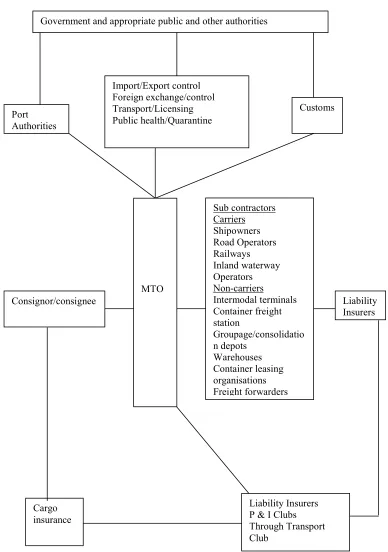
Multimodal transport is an organisational process, which is mainly concerned with the government policies and regulations in the movement of international trade. It touches many authorities like foreign trade, foreign exchange, customs authorities, insurers, port authorities, multimodal transport operators, carriers, shippers and consignees. MT has significant impact on their way of doing business that results from many changes in policies, regulations, procedures and application of new technology and practices. Changes in people’s attitudes and skills and public expectations also help to improve the level of productivity in these organisations.
Figure 1. MTO’s relationship with various parties. Source: UNCTAD secretariat (1979) Annex V.
Government and appropriate public and other authorities
Import/Export control Foreign exchange/control Transport/Licensing Public health/Quarantine Port
Authorities
Customs
MTO
Sub contractors Carriers Shipowners Road Operators Railways Inland waterway Operators Non-carriers Intermodal terminals Container freight station
Groupage/consolidatio n depots
Warehouses Container leasing organisations Freight forwarders
Liability Insurers Consignor/consignee
Liability Insurers P & I Clubs Through Transport Club
The government has a special role to play in development of multimodal transport operation. It contributes to the growth of the national economy through facilitation of import and export trade, and acts as a catalyst in creating a competitive situation in manufactured products to be exposed to the global market. It helps to reduce the foreign exchange expenditure and improves the balance of payments of the country. The introduction of new technology in communication and information systems raises the number of people involved in international trade by being acquainted with new ways and methods in securing more markets from outside. People become more skilled and demand more payment, more savings and more investment to the country. Multimodal transport also creates more job opportunities, which means the number of unemployed people will be reduced. With good, integrated transport links, the country becomes more attractive to foreign investments.
Normally, there are six modes of transport, but in this study only five modes have been looked into. These are road, railway, air, and sea transport and inland waterways. Pipeline transportation is not covered in this study because the level of investment as a mode of transport is very limited and there is only one pipeline in the country, which transports crude oil from Dar es salaam to Zambia, known as the Tanzania-Zambia pipeline (TAZAMA). The distribution of transport network in Tanzania is as shown in a map below. The landlocked countries (LLC) which use the Tanzanian coastline of about 850 km are the Democratic Republic of Congo, Burundi and Rwanda (CBR), Uganda, Malawi and Zambia.
CHAPTER 2
2. THE APPRAISAL OF THE GOVERNMENT BUSINESS ENVIRONMENT.
2.1 Government responsibilities
The government business environment is influenced by internal and external factors such as economic factors, legal factors and socio-political factors. Before de-regulation in the 1980’s the government had a monopoly in the transport industry where it owned infrastructures, equipment and operated transport entities. After de-regulation and liberalisation of trade in which fair and free competition dominates the trade, the government became a policy and regulatory body. Most of the local industries, which produce traditional commodities, gain the exposure of the international markets; this results in the growth of import and export trade. The same changes are taking place in Tanzanian neighbouring countries thus, creating the demand for good infrastructure and equipment and transparency in facilitation of efficiency and flexibility with optimum cost services to foster the international trade in the area. Therefore, it is the government’s duty to concentrate on the provision of law and order, strategic planning, policy provision, monitoring and putting in place the regulatory regime and institutional framework to facilitate the development process.
technology development, currency, measures and weights, customs regulations and procedures, tariff systems and regulations governing foreign investments.
The government has to provide highest quality inputs. In today’s global market, high quality of labour involvement in business entities is essential. To meet the requirement, the government has to be equipped enough with necessary skills and competent manpower to meet the present and future needs. It requires people with intensive knowledge in the technical, legal and commercial fields. Therefore, the government has to educate, train and fund research and developments projects.
The indigenous entities have to acquire new skills which will be used to adopt new technology and modern methods of doing business and cope with the emerging development. They have to change attitudes to the way of doing business, from traditional ways to more advanced and modern ways. It needs more effort, experience and skills to be compatible with the prevailing revolution, which changes the market regulations and global trends in relation to transport and total logistics supply chain management.
The government has a responsibility to formulate new policies in line with the economic changes, which are going on inside and outside the country: regulatory, financial and fiscal measures. The government has to look into ways to speed up the economic development of the country by amending old regulations and adding new regulations in the National Transport Policy. It has to devote all necessary organisational resources to meet the challenges of new developments, and eliminate natural and artificial barriers that could hinder the economic acceleration.
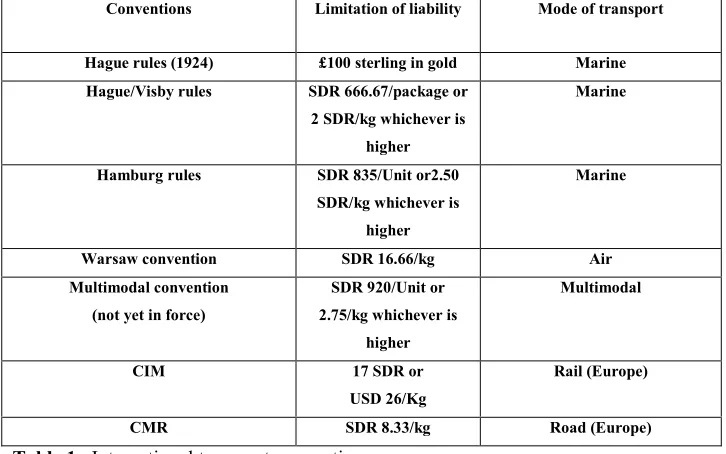
arise when goods cross the frontiers. The conflict arises because the parties concerned, living in different countries are free to bring their conflicts in the courts of their own countries. Of course, the courts of both countries may reach the same conclusions about a particular matter so that no conflict rises. The case is more difficult where the national laws are different, what is permissible in country A is illegal in country B, hence conflict of laws is inevitable. This problem has been solved by international conventions. A country, party to a convention, has to incorporate the basic framework of the rules in its domestic laws to make it enforceable. Any transport system requires basic regulations in the interest of the parties concerned, which are carriers and shippers of goods. There are problems like liabilities for loss of or damage to goods, pollution, loss of life or injuries, transportation of dangerous goods and responsibilities of each party concerned in execution of the contract of carriage of goods by sea, air, road or by rail. All these matters are subject to discussions at intergovernmental levels and lead to conclusions embodied in international conventions that are to be enacted as laws. This gives a very broad system of control and secure standardisation and comprehensiveness. Some of the prevailing international conventions are as follows:
Conventions Limitation of liability Mode of transport
Hague rules (1924) £100 sterling in gold Marine
Hague/Visby rules SDR 666.67/package or 2 SDR/kg whichever is
higher
Marine
Hamburg rules SDR 835/Unit or2.50
SDR/kg whichever is higher
Marine
Warsaw convention SDR 16.66/kg Air
Multimodal convention (not yet in force)
SDR 920/Unit or 2.75/kg whichever is
higher
Multimodal
CIM 17 SDR or
USD 26/Kg
Rail (Europe)
CMR SDR 8.33/kg Road (Europe)
In international trade, the parties concerned are sellers and buyers of goods who are assisted by the International Chamber of Commerce through provision of International commercial terms (INCOTERMS) to identify which party is responsible for what and when in the sense of cost, risk and documents. A Multimodal transport operator has nothing to do with Incorterms, but as a carrier he needs to know which Incoterm is in use in executing his duties. The carrier is liable to exercise his due diligence to take care of the goods. To fulfil this obligation he has to know the multimodal transport INCOTERMS and their applicability.
In INCOTERMS 2000, the International Chamber of Commerce provides six INCOTERMS that are tailor made to suit the multimodal transportation.
1. EXW-Ex-Works (named place) 2. FCA-Free Carrier (named place)
3. CPT-Carriage Paid To . . .(named place of destination)
4. CIP-Carriage and Insurance Paid To . . .(named place of destination) 5. DDU-Delivered Duty Unpaid . . .(named place of destination) 6. DDP-Delivered Duty Paid . . .(named place of destination).
The traditional INCOTERMS which are commonly used in the carriage of goods by sea: FOB-Free on Board and CIF-Cost Insurance and Freight, which uses the “ship’s rail” as a critical point are not compatible with multimodal transportation in which a critical point is “a named place”. In multimodal transport operation instead of buying FOB and selling CIF, the terms FCA and CIP are used respectively.
Due to these changes which are applicable in multimodal transportation, it is the government’s duty to raise awareness among all concerned parties to formulate and make amendments to cope with new documentation in banking, customs, insurance, tariffs and control of trade. The government has to update its policies and formulate other regulations that are needed to suit the changes for the benefit of the country and international trade.
The government is responsible for maintaining the business competitiveness. It is vital for the government to monitor the economic trends of the country, and to ensure that businesses can and do compete. The competitive conditions of business have to rely on suitable regulations on securities and exchange laws, companies’ acts, free and fair-trading, laws against monopolies and consumer protection.
The government has to protect natural resources. The government must have enforceable laws concerning environmental damage. It is only the government, by using its coercive powers, which can alleviate environmental damage. For example, the government action should include road safety and environment degradation regulations. This emanates from poor driving standards and poor vehicle maintenance standards that have led to smoke accumulations in cities. The government needs to establish specific levels of smoke emission, review driving codes, have definite penalties and ensure that laws are enforceable.
The government also has to provide measures to stabilise the economy. The Country’s economy is always being affected by the world business cycles that are booms and recessions. The government action is to alleviate the recessions through the monetary policy, budgets, interest rates, and control of prices and tax regimes.
the shipper’s warehouse to its final destination, that is to the consignee’s warehouse. To be able to achieve this new task of moving cargo, shipping companies are merging together to have good asset management, increase their efficiency and serve their customers in a more cost effective way.
The concept of door to door services results in the development of multimodal transportation. It is an organisational process integrating all modes of transport with more flexibility, reliability, efficiency and in the most cost-effective way, and satisfies the customer on short transit time and less damages to cargo and safe environment. The concept does not necessarily need an operator to be a shipowner or owning any means of transport. Important qualities needed to be a multimodal operator are financial strength and knowledge in international trade. In that case, all transport providers and transport facilitators with the above qualifications could be multimodal transport operators. Unfortunately, Tanzania is not a shipowning country, but have human resources that have ability and may wish to operate as multimodal transport operators. So, it should be a government strategy to develop the concept in the country as a source of foreign income and also as a catalyst for increasing the level of export trade, creation of job opportunities and other social and economic benefits.
2.2 SWOT analysis
2.2.1 Strengths
Despite the fact that Tanzania is among the poorest countries with annual per capita income of USD 570, the geographical location and political stability give the country good opportunities to develop its economy.
Tanzania has a coast of about 850 kilometres, which serves a hinterland of more than 200 million people. The land locked countries that use Tanzania as a gateway to foreign trade has only a single border crossing, which makes it easier to formulate and introduce new customs rules, regulations and procedures to increase efficiency and flexibility in processing international trade documents. The road and railway networks connecting these countries increase the chance of Tanzania being a trade transiting country. Globalisation of trade increases the pace of investment and enhances international trade in the region. What is needed now is an effective and efficient regulations and transport system to facilitate and stimulate the trade in the country and co-operation between countries in the sub-region.
2.2.2 Weaknesses
Tanzania is capable of developing its economy if the transport and information technology infrastructure and equipment are properly taken care of. Lack of seriousness, accountability and embezzlement of State projects funds cause deterioration of infrastructures to unrepairable states. Financial obstacles, bureaucracy, corruption and lack of a master plan for infrastructure development and maintenance add to the problem.
poor currency reduce the chance of attracting foreign investors, even neighbouring countries to use Tanzanian ports.
Poor transport infrastructure, equipment and cargo handling facilities, lack of enough expertise in information and communication technology and inadequate use of advanced communication systems such as Internet make the society unaware of what is going on in the transport industry today.
Lack of awareness of the importance of developing multimodal transport services is a major weakness especially for Tanzania where the government has less interest in how shippers are moving their goods. Shippers do not think logistically, what they care about is the price of transportation and safety of cargo. This problem was also seen in Spain and Pakistan as a big hindrance during the development of intermodal transport services in their countries (Containerisation international, March 1996. P. 95). Lopez Bravo, S. M. discussed the problem as psychological weakness, which made Spain to lag behind from the rest of Europe. She said “people just do not think intermodally here, and for the shippers, all they care about is price and transit times”. From this example, the government has to learn from the experiences of other countries and how other countries managed to develop this process. However, what was suitable in Spain, for example, does not mean that it will suit the Tanzanian environment because there is a big difference in economic development and geographical location of these two countries.
In summary, the strengths and weaknesses are:
STRENGTHS WEAKNESSES
1. Economic reforms 2. Political stability 3. Geographical location
4. Transport distribution network.
5. Single border crossing to landlocked countries
1. Poor transport and information infrastructure. 2. Lack of awareness of the importance of
multimodal transport.
3. Bureaucratic administrative system and corruption
2.2.3 Opportunities
The advantage of globalisation is that less developed countries get opportunities to adopt and cope with new ideas of doing business. More markets are available and even traditional goods get an opportunity to be tradable in international markets. For almost five years now, the trade to and from landlocked countries, which in the past used Tanzanian ports as their transit point, is decreasing (see the trade flow). This means that customers are not satisfied with the quality of services provided by Tanzanian ports and other transit cargo service providers. It lacks competitive criteria compared to other countries in East and South Africa.
To be competitive, Tanzania has to cope with World Trade Organisation on customs, tariffs and legislation. This is not easy for a poor country like Tanzania for which more than half of its national budget comes from import dues. The government has to change step by step by taking into consideration the economic growth of the country, and take the challenges of the world economic trends as an opportunity for national economic development. The country cannot cope with the new development of the developed world, but must be prepared for the better to come in the future.
deforestation. Then, the most affected are the manufacturing and transport sectors that are not able to find other substitutes like gas. The whole logistics supply chain, which includes materials management and physical distribution and other value added activities, is becoming expensive, which leads to high production cost, poor national economic development as a consequence of poor productivity and non-competitive market prices.
Tanzania is not oil producing country and world oil production and prices are not under the control of the government. Then, the only remedy to achieve a competitive price in the world market is application of trade-off functions between high fuel prices and cheap provision of trade facilitation services. Application and simplification of customs regulations and procedures, increases efficiency and flexibility, reliable information systems, safety and environment protection, offering high quality services and short transit time are all important. The interaction of the government, through market and price control regulations, and the private sector is needed in solving the economic problems of the country.
2.2.4 Threats
As the world is very dynamic on science and technological development, trade patterns are also changing. Markets are becoming global. The elimination of customs barriers has created an economic environment that permits the free movement of goods and freedom of service provision to achieve high quality of services, minimum total transport cost and short transit time and fair and free competition of services within the international markets.
the next technology coming into existence, developing countries are still walking towards the history of technology development. Yesterday was the era of electronic data interchange, today is Internet and we do no yet know what will come next, but with expectation of another development. What are threatening more are inadequate infrastructure and equipment in modern information technology, and the development of electronic commerce. Another problem is inadequate skilled labour in new technology. This causes most of the developing countries to delay in deciding if it is the right time to adapt to electronic commerce.
Increasing competition between East and South African ports is another threat to Tanzania. There are seven ports along the Indian coastline, which are competing to serve the same hinterland. Dar es salaam port in Tanzania and Mombassa port in Kenya are competing to serve Uganda, Rwanda and Burundi. Dar es salaam port, Nacalla, Beira and Maputo ports in Mozambique and Durban in South Africa are competing to serve Malawi, Zambia and Zimbabwe.
For a country to be competitive, ports alone cannot meet the challenges and provide customer satisfaction. Efficiency in hinterland infrastructure and good information flow are other important variables. Tanzania inland infrastructure development and operational efficiency is at lower level compared to other countries like South Africa, and, Mozambique ports and Mombassa port in Kenya are more favourable for Malawi and Zambia and Uganda cargoes respectively, due to short haul distances in comparison with Dar es salaam. Tanzania, to be able to compete in the area, needs to improve the infrastructures and integrate the transport network into one logistics supply chain to increase efficiency and flexibility in operations and shorten the transit time.
that within a very short period of time all information about international trade will be transmitted electronically, so for the developing countries, whether they like it or not, they have to cope with these new trends to be able to be part of the global market. It needs optimistic governments with courage, vision, hard working, accountability and love for their countries, to use the minimum resources available for the economic development of their countries.
In summary, the opportunities and threats are:
OPPORTUNITIES THREATS
1. Liberalisation of trade
2. High technology developments. 3. World-wide multimodal transport dev.
4. Challenges from the World Trade
Organisation (WTO)
1. Time significant factor 2. Change of trade pattern
3. Increasing competition in East and South African ports
4. Quick development of electronic-business.
CHAPTER 3
3. DEVELOPING MULTIMODAL TRANSPORTATION IN TANZANIA
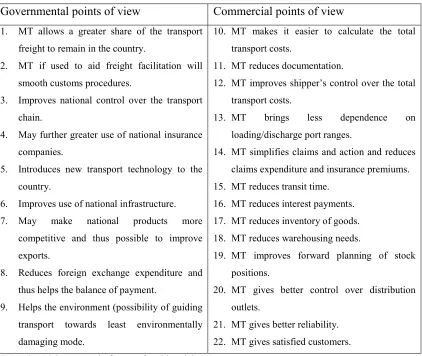
The government of Tanzania is putting great efforts into developing transport infrastructures through the International Road Projects (IRP I & II) and Railway Rehabilitation Project. The objective is to boost the output of the manufacturing and agricultural sectors by producing efficiently for the needs of people and supply competitively in the world market. To achieve this goal, the government should focus on developing safe, reliable, effective, efficient and fully integrated transport operations, which will increase productivity, lower the total transport costs and support the government strategy for economic and social development. The government’s dedication is to achieve and promote the external trade and the internal trade to have a competitive price in the global market. The development of Multimodal transport will be the suitable solution for that. The advantages of developing Multimodal transport are divided into two: Government and commercial aspects as seen from table 2 below.
that the carrier is liable for loss and damage to the goods as well as delay in delivery except if the carrier prove the contrary, that is presumed fault or neglect. GATT enhances the smooth flow of transit goods through simplification of customs formalities. So the two conventions can be used as a starting point.
Advantages of developing multimodal transportation:
Governmental points of view Commercial points of view 1. MT allows a greater share of the transport
freight to remain in the country.
2. MT if used to aid freight facilitation will smooth customs procedures.
3. Improves national control over the transport chain.
4. May further greater use of national insurance companies.
5. Introduces new transport technology to the country.
6. Improves use of national infrastructure.
7. May make national products more
competitive and thus possible to improve exports.
8. Reduces foreign exchange expenditure and thus helps the balance of payment.
9. Helps the environment (possibility of guiding transport towards least environmentally damaging mode.
10. MT makes it easier to calculate the total transport costs.
11. MT reduces documentation.
12. MT improves shipper’s control over the total transport costs.
13. MT brings less dependence on
loading/discharge port ranges.
14. MT simplifies claims and action and reduces claims expenditure and insurance premiums. 15. MT reduces transit time.
16. MT reduces interest payments. 17. MT reduces inventory of goods. 18. MT reduces warehousing needs.
19. MT improves forward planning of stock positions.
20. MT gives better control over distribution outlets.
21. MT gives better reliability. 22. MT gives satisfied customers.
Table 2. Main reasons in favour of multimodal transport. Source: Multimodal Transport Handbook (1995). P. 219
3.1 National and Sub-regional level
3.1.1 National level
To develop multimodal transport in the country, there must be an effective National Trade and Transport Facilitation Committee (NTTFC). The main purpose of this committee will be to encourage the use of modern practices and technology and promote the international trade through the development of multimodal transport in the country. The objectives of the committee will be:
A. To analyse the facilitation practices procedures, formalities and documentation used in international transport and trade. One such process is to go through all customs regulations and procedures, insurance regulations and practices, and the use of MT documents and INCOTERMS that favour multimodal transport operations.
B. To put forward for government approval the proposed draft and all amendments to be made concerning trade and transport-related regulations and practices.
C. To develop the transport policy for future investment.
D. To raise the awareness of the methods and advantages of transport and trade facilitation through organising workshops, seminars, television programmes etc.
international multimodal transportation. Short courses inside and outside the country, seminars and workshops with assistance from international agencies and donors such as UNCTAD will be fruitful for the program.
Some of the activities of the committee will be:
a) To encourage the use of information technology and ensure that the government reduces tax on importation of computers and other communication infrastructures and equipment. For example, the NTTFC could discourage the analogue system and encourage use of digital systems by setting standards and quality of equipment needed to avoid the country to be a dumping area for outdated technology.
b) To ensure that a licensing and registration body is established and set standards for the approval system of Multimodal Transport Operators.
c) To design a regulatory framework, which favours national and international co-operation.
To achieve the objectives, the National committee main task should be to co-ordinate all interested parties in trade and transport sectors. These are:
1) Ministry of Communication and Transport: Tanzania Harbours Authority, Tanzania Railway corporation, Tanzania-Zambia Railway Authority, Tanzania Communication Commission, Tanzania Central Licensing Board, Tanzania Central Freight Bureau.
2) Ministry of Finance: Tanzania Revenue Authority (Customs and Excise department), The Central Bank (Foreign exchange policy), Commercial Banks and Insurance Companies.
Freight Forwarding Association, Tanzania Shipper’s Council, and Shipping Agencies.
4) Ministry of Research and Planning-Lead the National Committee.
The National committee will be acting as an advisory body to the government, and propose recommendations on internal and external policy regarding the development of the transport and trade. From the National committee two or three members will be selected to participate in the sub-regional committee. To be successful the government has to adhere to other potential customs and transport conventions.
3.1.1.1 United Nations Convention on Transit Trade of Landlocked countries
Most of the neighbouring countries of Tanzania are landlocked which use the Tanzanian ports as the ports of nearby coastline. The United Nations Convention on the Law of the Sea (1982) provides for freedom of the high seas (article 87), and that the high seas are open to all nations who have no coastline (Article 89). Tanzania by adhering to this convention will encourage neighbouring countries to use its ports, especially for those who are contracting parties to the convention like Burundi, Rwanda and Zambia. By using Tanzanian ports their transit goods will not be subject to customs duty, which means a decrease in total transport cost and shorter delivery time, and for Tanzania enhances more trade.
3.1.1.2 International Convention on the Simplification and Harmonisation of Customs Procedures, Kyoto 1973
collude with customers and deviate transit cargo to the domestic market. This convention will also increase the quality of customer services if the country will comply with the standards and recommended practices of the convention. The contracting parties to this convention include Uganda, Burundi, Zambia, Rwanda and Zimbabwe. It will be of benefit for Tanzania to adhere to the same annexes of the convention that other neighbouring countries accept; this will enhance the smooth flow of trade.
3.1.2 Sub-Regional level
The objectives of developing multimodal transport will be more advantageous if the project will get support from neighbouring countries. Their participation in sub-regional meetings and signing of co-operation agreements will be useful. Agreements on joint use of equipment, joint pools of containers, common use of multimodal transport document, and common tariffs will boost the trade in the area and reduce the capital investment which may be used for acquisition of equipment for the individual country.
Integration of developing countries in economic ties today is more important than ever before. Some of the problems, which the sub-region is facing today, like inadequate transit traffic facilities and services and lack of co-ordination between modes of transport can be solved by, joined efforts. With courage and co-operation, countries will be able to solve some of the common problems prevailing in the area within a short period of time.
committee will take care of the national problems. The National Trade and Transport Facilitation Committee representatives in the Sub -Regional committee meeting have to encourage other representatives to sign Co-operation Agreements.
Other agreements that can facilitate the development of multimodal transport in the sub-region are trade and transport agreements that exist between Tanzania and neighbouring countries.
Country A B C D E F G
Zambia Yes Yes Yes Yes Yes Yes -Uganda - - Yes Yes Yes - -Malawi Yes - - Yes Yes Yes Yes Rwanda - - - Yes Yes - Yes Burundi Yes - - Yes Yes - Yes
Table 3. Existing Agreements between Tanzania government and neighbouring countries.
Source: MT Handbook (1995). P.241 KEY:
A = Transit Agreement, B = Railway joint ownership
C = Inter Railway Agreement, D = Bilateral Agreements Ports
E = Preferential Trade Area for eastern and Southern African States (PTA).
F = South Africa Development Community (SADC), G = Reserve port.
3.2 Road sector
Many Tanzanian roads pose a problem to transit cargo shipments because some are impassable in the wet season. The road network on the Tanzanian mainland has an estimated length of 85,000 km. The network consists of trunk roads (10,300 km), regional roads (24,700 km), district roads (20,000 km), urban roads (2,450 km) and community roads (27,550 km). Only 5% of the road network are bituminised.
The Integrated Road Project, which deals with rehabilitation and construction of highways and rural roads, was designed to improve the condition of roads. About 80% of the trunk road network and 50% of the regional road network including 3000 km of essential district and feeder roads are to be rehabilitated to good condition by the year 2000.
The fragmented functional responsibilities of the road sector involving many departments under different ministries constrain the smooth and effective development of the road sector. The solution for the problem is to integrate all activities and have a master plan that can be used as guidance by all organisations dealing with the road sector. The government has to select one body to administer the sector. These activities are:
1. Ministry of Works-Axle load control and road safety.
2. Ministry of Communication and Transport-Policy formulation and licensing. 3. Ministry of Finance-Vehicle registration and road toll.
4. Ministry of Home Affairs-Enforcement.
5. Regional administration-Regional licensing and 6. The Vice President’s office-Environment protection.
The government has to realise the importance of the road sector in economic development of the country. The government body that will be chosen to manage the sector must be free from political interference and individual government officials, who use such kind of instruments to satisfy their own interests.
Trucking in Tanzania is increasingly expensive due to high costs of new vehicles and consumables (i.e. fuel, spare parts) and poor vehicle utilisation. The government has to understand the problems of trucking companies in the country and to assist them by alleviating operational burdens by introducing regulations that protect the industry. Reduction of import dues for trucks spare parts, and introducing new methods, which will ensure the increase of vehicle capacity utilisation and setting suitable conditions for investors, will increase the manufacturing and agricultural sector output. Introduction of multimodal transport can be one of the solutions to increase vehicle capacity utilisation by decreasing the transit time for long haul journeys and minimising distances and the number of handling and to be assured of back haul cargo.
3.2.1 Axle-load limit
Due to increasing capacity of the trucks and the pressing need of the carriers to overload, so as to maximise the income per journey, the governments in the region should review the pavement standard specifications to accommodate higher axle load limits. This is important to be able to cope with the increasing volumes of heavily loaded vehicles. It is important to note that operators aspire to acquire larger and longer vehicles to benefit from economies of scale, USD/tonne/km, and manufacturers are responding to the needs positively. Hence, the long distance truck will continue to increase in size and capacity despite the road design standard limitations. This calls for review of existing road design construction standards as well as the existing axle load limits.
3.3 Railway sector
The railway network in Tanzania consists of two networks. First there is Tanzania Railway Corporation (TRC) which has 2,605 km of mainline and branch line track and 377 km of sidings with 1-M gauge. The second is Tanzania-Zambia Railway Authority (TAZARA), which has a total length of 1852 km with 1.067-M gauge. The
1. Low availability and reliability of equipment lead to poor turn around time, as a result of poor state of the fleet and long delays, waiting for spare parts and materials for repair and maintenance from suppliers.
2. Locomotive utilisation, this is another factor, which hinders achievement of good transit time of transit traffic and results in poor customer satisfaction and customer deviation to other East African, and South African ports. Most of the locomotives are old and consume more time for repair and maintenance. This makes locomotive reliability to be very poor with frequent breakdowns.
3. Lack of wagon availability is a major problem, which frustrates customers whenever it occurs. The number of wagons operated by TRC is not sufficient to cater to the needs of customers. This makes the government to allow Kenyan and Ugandan governments to employ their own wagons for state owned cargo destined to these two countries. Taking as an example the traffic moved within the week ending 31st December 1999, there were 57 wagons owned by Uganda Railway, and 70 wagons owned by Kenya Railway respectively. This kind of shared use of equipment could be a positive step for sub regional co-operation and enhancing the idea of multimodal transport development in the region.
3.3.1 Bridges and tunnels
There are no problems with the strength of bridges and measurements of tunnels with the TAZARA line. Containers are moved on this line can be moved without any hindrances. The problem lies with the TRC line, where bridges are very weak and are easily washed away during heavy rains. The network has no tunnels. So the government has to construct new strong bridges than can resist the movement of heavy containers, or rehabilitate the existing bridges by increasing the strength.
railway line connecting the TRC network to Burundi and Rwanda. According to the “East African online” of march 20, 2000, the governments of Rwanda and Burundi have a plan to build a direct railway link to the Dar es salaam port as an alternative route to the sea. This decision was reached due to increased fuel prices and the recent introduction of the axle load limits in Uganda and Kenya, which increases the transport costs and delays caused by customs procedures at Mombasa port. Rwanda and Burundi are connected by road to Uganda and Kenya with a distance of more than 700 kilometres, while it is 280 kilometres from the existing railway terminal at Rusumo in Tanzania to Burundi, and 500 kilometres from Isaka Inland Customs Clearing terminal in Tanzania to Kigali Rwanda. This project will increase the potential of the TRC network in the Central and East African countries. That means the Tanzanian government has to give all necessary assistance needed by Rwanda and
For many years and in many countries, railway administrations have had to fall back on the government for subsidies, because they have not made enough money to cater for all their needs and plough back part of their incomes to develop their infrastructures and facilities. The government finds it difficult to continue offering subsidies to the national railways. The railway corporations, therefore, need to find ways and means of delivering services at a cost to keep them afloat in the business with positive revenues.
3.3.2 Block trains
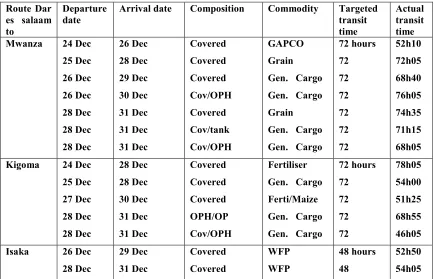
Tanzania Railway Corporation (TRC) introduced the block train service to improve turn around time, safety and reputation with customers who were starting to abandon their services. This system becomes a remedy to users with cargo that are destined to the same destination. The benefit of block train services is that it offers faster turn-around time, quick operations by eliminating depots and terminal delays, reduced en-route stoppage, increased security of cargo and therefore decreased transport cost, increased customer satisfaction and company productivity. For example, for cargoes those are going to The D. R Congo, Burundi and Rwanda there are more than four block trains per week to Isaka and Kigoma. For traffic going to Uganda and Kenya there are more than five block train services per week and one block train to Mwanza and Tanga respectively. Targeted and actual time used to move cargo to different destinations are as shown below in table 4. Terminal charges like transhipment charges, warehousing and storage charges are consolidated in total freight charges
Route Dar es salaam to
Departure
date Arrival date Composition Commodity Targetedtransit time
Actual transit time Mwanza 24 Dec
25 Dec 26 Dec 26 Dec 28 Dec 28 Dec 28 Dec 26 Dec 28 Dec 29 Dec 30 Dec 31 Dec 31 Dec 31 Dec Covered Covered Covered Cov/OPH Covered Cov/tank Cov/OPH GAPCO Grain Gen. Cargo Gen. Cargo Grain Gen. Cargo Gen. Cargo
72 hours 72 72 72 72 72 72 52h10 72h05 68h40 76h05 74h35 71h15 68h05 Kigoma 24 Dec
25 Dec 27 Dec 28 Dec 28 Dec 28 Dec 28 Dec 30 Dec 31 Dec 31 Dec Covered Covered Covered OPH/OP Cov/OPH Fertiliser Gen. Cargo Ferti/Maize Gen. Cargo Gen. Cargo
72 hours 72 72 72 72 78h05 54h00 51h25 68h55 46h05 Isaka 26 Dec
28 Dec 29 Dec 31 Dec Covered Covered WFP WFP 48 hours 48 52h50 54h05
3.3.3 Isaka Dry Port
The Tanzania Railway Corporation (TRC) manages Isaka dry port. Isaka is strategically located to serve Rwanda, Burundi, D. R Congo, Uganda and North Western Tanzania. Isaka provides a holding point for containerised and non-containerised general cargo, thus alleviating the necessity for shippers to travel to Dar es salaam. The terminal is dedicated to provide an efficient sea link at competitive tariff rates, short transit time, safety and security of cargo, easy documentation and proactive customer services. Services provided by the terminal are as follows:
a) Documentation: There are simplified and timely processing of documents, all done under one roof. TRC, THA and shipping agents do Dar es salaam port documentation and they issue a Through Bill of Lading to Isaka.
b) Shipping services: There are a number of shipping companies rendering various services for the port of Dar es salaam, and offer shipping services world-wide. c) Clearing and Forwarding Agents: There are a number of CFAs operating at Isaka.
Shippers are advised to appoint their agents who will assist them in documentation processing, customs clearance and delivering goods to final destination.
d) Tanzania Central Freight Bureau (TCFB): TCFB is a regulatory organisation for commercial shipping. It has responsibility to promote the economy through fair competition for the benefit of providers and users of shipping services. In particular, TCFB is concerned with levels of freight charges, surcharges, port productivity, container holding free time and demurrages, inland costs and research into and dissemination of information to meet the needs of stakeholders in the shipping industry.
Isaka dry port is equipped to receive and dispatch all types of cargo, and it has the following facilities:
A Container stacking ground for 300 TEUs, container-handling equipment, and two sheds for 3000Mts forklifts with various capacities, and shunting tractors.
3.3.3.1 The achievement of the block train services and Isaka dry port
Isaka achieves to some extent to provide reduced total transport costs to customers through short transit time, efficient wagon allocation, no storage charges at Dar es salaam port, no demurrage charges on wagons, more container free time, no trucks to Dar es salaam and better utilisation of trucks. Less movement of empties achieves better utilisation of containers and reduced repositioning costs, and assured safety and security of cargo.
unskilled crane drivers. The probability of pilferage to cargo may also increase due to poor security at the terminals. Then, the cargo owner has to insure his cargo against loss and damage to cargo to the final destination.
The first carrier’s liability and control of cargo ends at Isaka, Kigoma or Mwanza. The new carrier has to assume the responsibility of taking care of the cargo until its final destination. Therefore, for the cargo owner situating in Uganda, Burundi, Rwanda and the D. R. Congo, the achievement of short transit time by TRC is meaningless. The consignee still has no assurance of safety of his cargo and he does not know when he is going to receive the cargo into his custody. He is loosing a lot of time at the Isaka interface terminal and he spends more money.
Developing multimodal transport operations will solve high total transport cost. Easy to recognise the responsible carrier, known as the multimodal transport operator who will be liable for safety and time of delivery in the whole transport chain and capable to handle the above named problems in a more cost-effective way.
3.4 Maritime sector
The private sector largely controls the maritime industry both for sea and inland waterway transport, with the exceptions of Tanzania Harbours Authority (THA) and TRC marine activities. The industry has vast underlying potential for growth of domestic and international trade. Maritime transport is positioned to provide vital linkage in regional trade and is highly interdependent with rail and road transportation.
both general cargo and liquid bulk petroleum products. The economic performance and political unrest of some of the countries using Tanzanian ports, coupled with increasing competition in East and South African ports, affect the volume of transit trade.
Development of a good interface between lakes and roads is important to decrease dwelling time of containers at the terminals and increase transit capacity by having more trips to the hinterland. For example, MV Victoria performs only two trips per week between Mwanza and Port Bell in Uganda and it takes eighteen hours for a round trip. This means, with reliable vessels and wagons, good interface facilities and equipment for handling transit cargo and with regular and preventive maintenance for the vessels, it is possible to increase the frequency to three or four round trips per week.
The system of carriage across the lake is biased towards wagon ferries. It is important to ensure good integrated links of rail/road-lake-rail/road, so that the landlocked countries can increase their choice of routing without being restricted to either mode of transport. This applies to Ugandan traffic where a customer has a choice of Mombasa port in Kenya or Dar es salaam port through Mwanza port in Tanzania.
3.4.1 Kurasini Inland Clearance Depot (KICD) and Ubungo ICD (UICD)
It is customs procedure and practice not to open the container if the seal is intact or unbroken. By doing that inspection can be done without impeding the container movement. The seal remains intact from when the shipper and the customs officer at the original point put it on the container until when the consignee receives
3.5 Air freight sector
In the 1990s, Tanzania’s air transport exhibited some positive growth in the sector following the 1992 liberalisation of air transport services; more private operators have been licensed to operate. There is new policy and regulatory reforms that aim at improving the establishment of Tanzania Airports Authority as an executive agency, which takes over the operation of airports including the promotion of commercial ventures, is a big step in the development of the air transport industry in the country.
The establishment of Tanzania Civil Aviation Authority as an independent executive agency is another step forward. The agency will operate without government bureaucracy and run air traffic control systems adhering to international standards on regulations and recommended practices. The government is pulling out from business oriented activities to policy and regulatory activities to improve the services while the government is relieved from funding requirements. The Kilimanjaro International Airport has already been privatised and is being operated under a concession agreement.
3.6 Information and communication technology (ICT)
The application of Electronic Data Interchange (EDI) in the movement of goods, especially containerised cargo, is very essential to meet the customer needs. Application of EDI ranges from quick transmission and exchange of information, fleet management to documentation. Despite the fact that, the EDI technology is more expensive and complex with stringent standards and data translation, with value added networks, the technology is very secure and saves money and time when it is used in appropriate way.
The Internet evolution and especially the development of the World Wide Web, are becoming more acceptable and less expensive to both transport providers and shippers. The system includes facilities and technical operational features that can benefit the user through high accessibility, productivity and reliability. The system is more flexible, saves time and money and assures high quality of services. Both EDI and Internet are widely used in international trade.
Global positioning system (GPS) is becoming a popular and very important tool in the trucking industry. The problem of this system is that it is very expensive; a small operator could not afford to buy and fit the system in his truck.
3.6.1 The Advanced Cargo Information Systems (ACIS)
ACIS is a United Nations Conference on Trade and Development (UNCTAD) project, which tracks the cargo from before the arrival of the ship until when the cargo reaches its destination. It is being implemented in Tanzania and neighbouring countries. The system monitors port activities, rail and road but so far it concentrates on port and rail activities. The objective of ACIS is to assist and make sure that the real-time data and information is available for smooth flow of cargo and other logistics activities.
(a) By providing them with advance information for cargo expected to arrive in terminals for intermodal transfers.
(b) For port and railways it assists them to manage efficient movements of traffic in their networks by deploying their manpower and equipment optimally.
(c) For consignors and forwarding and clearing agents, it provides them with the positions of their freight in the transport networks and that can make interventions to carriers in order to reduce transit time from origins to destinations.
(d) For terminals and inland container depots and warehousemen, they can know before- hand what is expected from ports and railways and arrange for storage of cargoes in transit due to customs bond requirements or transferable liens held on goods by agents, transporters or financing banks.
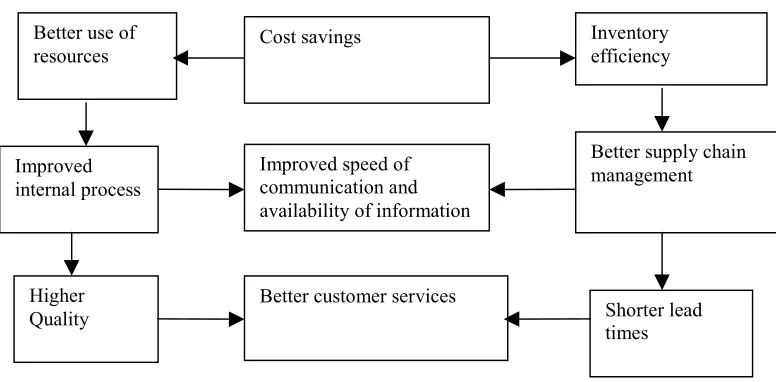
ACIS provides information to regulatory authorities, such as customs and inspection bodies who need to perform their duties promptly to avoid administration delays to cargo clearance from ports and terminals. The individual consignment is tracked along the inland transport route at regular intervals of time. Its position is known and is available to the consignor and consignee as well as to all other operators involved in through transport.
Figure 2. The benefits of the use of information and communication technology. Improved
internal process
Improved speed of communication and availability of information
Better supply chain management Better use of
resources
Higher Quality
Cost savings
Better customer services
Inventory efficiency
By February 2000, there were 6000 individual who were regular users of Internet among 30 million Tanzanians. The government has to realise the importance of information. There must be a co-ordination of efforts within the government that will enable Tanzanians to start using Internet to get decisive information. Internet will improve their effectiveness in work, raise efficiency and increase their opportunity of exploring new markets and learn new ways of doing business. Internet will help to understand where the world is heading on technology development and its impact on the economy of the country.
3.7 Safety and Environment protection
The pollution problem is increasing from the land-based sources more than from the ocean-based sources. This is caused by high population growth, rapid growth of coastal settlement, increase in number of recreational centres and the concentration of industrial development along the coast areas. Areas around the big ports of Dar es salaam and Tanga and the growing towns of Kigoma and Kyela and the city of Mwanza which are acting as interface terminals, are highly For example, the Dar es salaam population grows from 2.6 million people in 1990 to 3.8 million people by January 2000.
Poor vehicle maintenance The government needs to establish specific levels of smoke emissions for various categories of vehicles, and these should be internationally accepted and enforceable. Introducing one way traffic lanes and development of parking areas could reduce the problem of congestion.
The government has to integrate the environmental problems with social and economic development to have a basis on how to deal with the problem and have long term strategies for maintaining the environment.
The capability of the Tanzanian government to manage the current pollution and environment problem is still insufficient and this limits the future choices for meeting the challenge of sustainable development. The technical problems are significant challenges, which make the government responsibility on safety and environment protection more difficult. Non-availability and incorporation of scientific and technical information in the policy process, jurisdiction and lack of enough funds in financing the safety enhancement programmes increase the problem. This is because the country lack the scientific equipment to identify and measure the level of pollution and lack of enough skilled personnel in the particular field increases the problem in dealing with environment protection and management.
The identification of technical solutions such as national regulation and policy reforms, capacity building, public awareness, exchange of information and strengthening of regional and international co-operation will help to improve safety and the environment.
3.8 Movement of trade
It is unfortunate that movement of trade through the port of Dar es salaam is decreasing year after year. This is because of fierce competition in East and South African ports that creates variations of service provisions to shippers, such as: Total transit times, total transport costs and safety of goods, reliability and efficiency of inland modes of transport, reliability and availability of cargo handling facilities and provision of value-added services. Second, because of poor economic development in neighbouring countries which is associated with political instability in the area. A third reason is the shipper’s freedom to choose the best preferable route, which indicates that Dar es salaam has been losing in competitiveness in recent years.
3.8.1 Evaluation of individual country performance
3.8.1.1 Uganda
3.8.1.2 D.R Congo, Burundi and Rwanda (CBR)
During 1996/97, CBR traffic handled at the port totalled 304,394 tons, which is a 35.42% reduction compared to 471,348 tons handled in 1995/96. Import cargo handled in 1996/97 was 233,606 tons, a decrease of 37.59% against 374, 329 tons handled in 1995/96. Import cargo constituted 161,542 tons of general cargo, 54,641 tons of liquid bulk and 17,423 of dry bulk. The export volume was 70,788 tons in 1996/97, which was 26% less than the 97,019 tons of exports handled in 1995/96. Containerised traffic decreases to 5,207 TEU carrying 86,065 tons handled in 1996/97 from 9,755 TEU carrying 154,537 tons handled in 1995/96.
3.8.1.3 Malawi
The transit trade to Malawi is very low compared to other countries using the port of Dar es salaam. The main problem that hinders the achievement of more traffic to and from Dar es salaam port to Malawi is the long distance compared to Beira and Nacala ports in Mozambique. It is 1108 Kms from Lilongwe to Beira, and 640 Kms from Blantyre to Beira, while it is 1594 Kms and 1772 Kms from Dar es salaam to Lilongwe and Beira respectively. Despite the fact that, there were a decrease of import traffic of about 1402 tons and an increase of 1343 tons of exports, there were no significant increase in the total traffic handled in 1995/96 (8614 tons) and 1996/97 (8615 tons).