11
OPTIMIZATION OF CHAR IN THE PYROLYSIS OF PALM KERNEL SHELL
USING RESPONSE SURFACE METHODOLOGY
*
1Adeosun, O.J.,
2OlorunnisolaA.O.,
2Lucas, E.B.,
1Dairo O.U.,
1Aderinlewo, A.A,
1Ola, I.A.
1Department of Agricultural and Bio-Resources Engineering
Federal University of Agriculture Abeokuta
2Department of Agric. and Environmental Engineering University of Ibadan. Nigeria. *E-mail: [email protected]
ABSTRACT
Palm oil production yields a considerable quantity of palm kernel shell (PKS). This is locally burnt as fuel for domestic cooking as well as in blacksmith and goldsmith operations. Medium-grade fuel such as char can be derived from PKS through pyrolysis. The optimization of the char yield was investigated using a central composite design of the response surface methodology in a batch reactor. A three -factor three-level design comprising the reaction temperature and provenance were taken as quantitative variables, while varieties a qualitative variable and yield was taken as the response. This study optimized char yield from palm kernel shell (PKS)through pyrolysis. Increasing reaction temperature generally decreased char yields. Variety type, reaction temperature, and provenance all significantly (p < 0.05) affected char yields for both Dura and Tenera varieties studied. The char yield obtained from Tenera variety was greater than Dura variety. The optimized temperature for both Tenera and Dura varieties was 400oC with yield of 46.85 and 42.68 % respectively, while Odeda provenance representing derived savannah provenance was the best location producing the optimal yield.
Keywords: Palm Kernel Shell, Pyrolysis, Char yield, Optimization, Tenera, Dura
INTRODUCTION
Nigeria produces about 8 million tonnes of fresh fruit bunch of oil palm annually of which between 72 to 76% of the palm fruit bunch come out at various stages of the production process as residues (PIND, 2011). The Residues from Palm Oil Mills (POMs) could provide one of the best alternatives energy source for agriculture in Nigeria, and countries of similar environment, going by the quantity generated every year. Badmus (2002) reported that most of these residues are, Empty Palm Bunches (EPB), Pericarp Fruit Fibers (PFF) and Palm Kernel Shells (PKS), which account for over 90% of the total tonnage generated.
Landfill is one of the major methods of disposal of palm oil production waste; this has several disadvantages such as the fast accumulation of the waste in comparison to decay rate resulting in mounts of non-degradable fibres, leachate fluids which permeate into the soil and production of harmful emission into the environment.
12
not necessarily need either highly skilled labour or shredding of the feedstock and can easily be adapted in rural settings. PKS are lignocelluloseic and could better be thermally degraded to solid, liquid or gaseous fuels or a combination of these using pyrolysis (Adeosun et al., 2014).Several scientific Design of Experiments (DoE) techniques can be used to explore which variables and at what level of the variable will maximize a particular output. Chitra et al. (2005) reported these techniques have been widely used in all spheres of science from bio-technology to manufacturing industries as a means of maximizing output for a given input of resources. Optimization procedures usually applied are factorial designs, response surface methodology, uniform experimental design, Taguchi orthogonal design, one variable at a time (OVAT) method and several others.
Dairo et. al.(2013) among other researchers has been severally reported Optimization of experiments as a way of experimentation leading to useful saving of scientific resources, however, among recent works in Nigeria is the pyrolysis of municipal solid waste (Ojolo and Bamigboye, 2005), shredded plastic waste (Ojolo, 2004), wood and some agricultural refuse (Fapetu, 1994), there is scanty literature on optimization of pyrolysis process of PKS using response surface methodology, hence this work was aimed at using response surface methodology in obtaining level of pyrolysis temperature, for optimum char yield of PKS using different palm varieties and provenance.
MATERIALS AND METHOD
Palm kernel shell (PKS) of about 10 kg were collected from matured plants of two commercially
cultivated varieties of dura and tenera from three different provenances of Odeda, Ilesa, and Ado-Odo representing the derived savannah, rural rainforest and urban rainforest geographical zones respectively. Samples were randomly selected from five batches of harvest to obtain a representative sample. Palm kernel shell samples were obtained from the mixture of shell and ashes that was used to separate it from kernels, by washing it in water, drained and sundried for about five days before packing into waterproof polyethylene bag ready for use.
Pyrolysis experiment was carried out using a modified setup of Adeosun (2012) equipment as shown in Figure 1. It consists of heating (1), condensation (2) and gas collecting units (3). The heating unit was made up of a tubular furnace, leak-proof retort, heating elementand control as well as connection pipes. The condensation unit consists of cylindrical condensers inserted in a cold water bath, while the gas collection unit was made from two polymer containers using the water displacement method to determine gas quantity.
Experimental Setup.
Experimental Factors and Design
Pyrolysis temperature, variety and provenance were taken as the independent variables while the char yield given by Equation 1 was used as the response variables. The optimization of the process factors was done using the Central Composite Design (CCD) of the response surface methodology. A three-factor three level experimental design was used in terms of actual and coded levels is presented in Table 1 and the yield for all experimental levels was obtained from Equation 1.
13
Fig. 1: Orthographic Projection of the Pyrolysis
Table 1: Experimental Factors and Levels
S/N Factors Range and Levels
-1 0 +1
1 Reaction Temperature (oC) 400 450 500
2 Provenance 1 2 3
3 Varieties Tenera Dura
=( − )( − ) ∗ 100 1
Where y is the char yield (%), w1 is the weight of
empty retort (kg) w2 is the weight of the retort and the
sample (kg) and w3 is the weight of the retort and the
char (kg).
Analysis of data obtained and response surfaces graphs were generated by fitting a second order polynomial model given by Equation 2 using regression analysis in Design Expert 7.1 statistical software (Stat-Ease, 2008).
= + ∑ + ∑ + ∑ 2
Where y is the predicted response, xi and xj are the
uncoded independent variables, k is the number of factor, βo is the model constant, βiis the linear
coefficient, βijis the interaction coefficient, and βjj
the quadratic coefficient. The quality of fit for the model was determined by the coefficient of Determination R2, and the Lack of Fit value, while the F-test was used to evaluate the statistical significance of the model at 95% confidence.
Optimization
The optimization of the char yield was investigated using numerical optimization procedure of Design Expert 7.1 statistical software (Stat-Ease, 2008).
Experimental Procedure
For each runs, known weights of samples were filled into the retort, noting the weight of the empty retort and the weight of the sample and the retort. The retort cover and the flat plate already coated with furnace gum was screwed to the retort cylinder with the cog placed between to ensure air tight condition needed in the retort.
The furnace was started to provide heat to the retort and commence the pyrolysis experiment. The run was assumed to have completed when there was no further gas production indicated by the stopping of water displacement in the gas collecting unit. At this time, the furnace was stopped and time on the stopwatch noted. Thereafter, the set-up was left for about two hours to allow the condensate in the delivery pipe to drain into the condensers and cool. The condensers were then disconnected and weight while the retort was removed from the furnace to the environment to allowed faster cooling. The cooled retort was then weighted and noted after which it was opened and the char removed. The cooled char was kept in a polymer bag and stored under room temperature for further analysis. The volume of non-condensable volatiles was noted by determining the volume of water displaced in the measuring unit.
RESULTS AND DISCUSSION
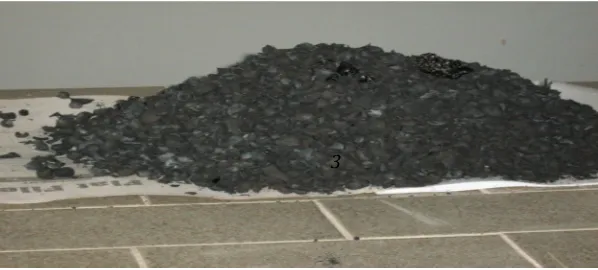
The data obtained from the experimental design for the char yield of PKS pyrolysis at all experimental points was fitted to equation 2 to obtain response surface plots depicting the effects of reaction temperature and provenance on the char yield of PKS. A sample of char produced from tenera and
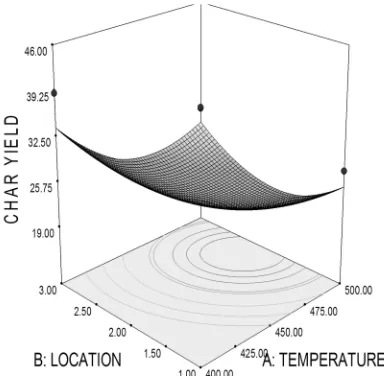
dura PKS is shown in Plate 1. The response surface plot as obtained from the analysis is presented in Fig1 and 2. There was a general decrease in char yield with increased pyrolysis temperature. Char yield decreased at a rapid rate as the reaction temperature increased from 4000C to around 4750C forboth tenera
and dura varieties.
14
Plate 1: Pyrolytic Char obtaibed from PKS
The decreased yield with temperature could be explained by the total conversion of the feedstock to its chemical constituent as observed by Mohamad (2008) and Sukiran etal. (2009) intheirstudies on sunflower oil cake and linseed respectively. The decrease in char yield with an increase in temperature could either be due to secondary decomposition of the char residues or through the greater primary decomposition of the PKS at higher temperatures (Mohamad, 2008).
Generally, char yield was higher for tenera PKS than the dura PKS from the same provenance and reaction temperature. This might be the implication of tenera
PKS containing more inorganic element than the
dura PKS as could be seen from their percentage ash content from the result of their proximate analysis reported in Adeosun et. al. (2014). Samples from Odeda, which represented the derived savannah
provenance produced the highest char yield followed by Ilesa while Ado-Odo samples had the lowest char yield for both varieties studied. These might be due to variation in soil properties and other climatic factors that vary from one provenance to another. A similar observation was reported by Yaman (2004), Sharma and Rao (1999) on their studies on pyrolysis of cassava stock and Kinetics of Pyrolysis of Rice Husk respectively. The percentage ash content of the samples, an indication of the level of inorganic composition of a sample can be related to this observation as inorganic component does not degrade during pyrolysis.
The full quadratic models comprising all the experimental variables for duraandteneraobtained in terms ofcoded and actual experimental variables are shown in Equations 3 and 4 respectively.
2 2 76 . 4 56 . 4 25 . 0 22 . 1 02 . 2 08 . 2 64 . 4 37 . 9 26 .
28 A B D AB AD BD A B
YC …2
Where: A is the Temperature (OC); B is Provenance and D is the Variety type.
Final equation in terms of actual factors:
2 76 . 4 04 . 37 89 . 1 61 .
515 A B AB B
YCT
3 2 76 . 4 04 . 0 49 . 37 84 . 1 04 .
488 A B AB B
YCD
4
Where
CT
Y
is the % char yield for tenera,Y
CD is the % char yield for dura,and other parameters were as previously defined.Fig. 1: Response surface cubic plots for char yield for tenera PKS
Fig. 2: Response surface cubic plots for char yield for dura PKS
The ANOVA revealed a highly significant model with coefficient of determination (R2) values of 0.940 and 0.965 for dura and tenera respectively at 95% confidence level. The factor levels at optimum yield
15
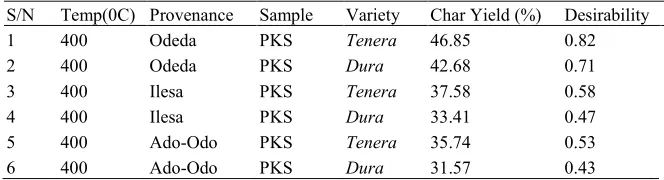
Table 3. Optimization of Char yield and desirability at all levels of factors affecting PKS pyrolysis.
S/N Temp(0C) Provenance Sample Variety Char Yield (%) Desirability
1 400 Odeda PKS Tenera 46.85 0.82
2 400 Odeda PKS Dura 42.68 0.71
3 400 Ilesa PKS Tenera 37.58 0.58
4 400 Ilesa PKS Dura 33.41 0.47
5 400 Ado-Odo PKS Tenera 35.74 0.53
6 400 Ado-Odo PKS Dura 31.57 0.43
The selected combination of factors that gave the maximum desirability of 82% and char yield of 46.85% was Tenera variety obtained from Odeda provenance pyrolyzed at 400 oC. Dura variety obtained from Odeda also gave a desirability of 71 % at optimized temperature of 400oC and a yield of 42.68%. It was also observed that the yield values obtained for Tenera were always greater than values for Dura variety.
CONCLUSION
Increasing reaction temperature generally decreased char yields. Variety type, reaction temperature, and provenance all significantly (p < 0.05) affected char yields for both Dura and Tenera varieties studied. The percentage ash content in the varieties as an indicator of non-degradable components for pyrolysis affected the char yield of samples from deferent location or provenance. The char yield obtained from Tenera variety was greater than Dura variety. The optimized temperature for both Tenera and Dura varieties was 400oC with yield of 46.85% and 42.68% respectively, while Odeda provenance representing derived savannah provenance was the best location producing the optimal yield.
REFERENCES
Adeosun, O.J., Olorunnisola, A.O., Lucas E.B. (2014) Properties of Oil Palm Bunch (Eleais guineensis Jacq), Refuse in Relation to its being Converted to Fuels and Industrial Chemicals. Journal of Science and JOSTMED. FUTMINA.
Adeosun, O.J., (2012) Thermal Conversion of Oil Palm (Eleais Guineensis Jacq), Bunch Refuse to Medium Grade Fuel. An Unpublished PhD. Thesis, Department of Agricultural and Environmental Engineering, University of Ibadan, Ibadan.
Badmus, G.A. (2002) An Overview of Oil Palm Processing in Nigeria – In 30 years of University of Ibadan Experience. Ajav, E.A., Raji A.O. and T.A. Ewemoje (Eds.) Department of Agricultural Engineering University of Ibadan. Pp 76 – 87.
Bridgewater A.V. (2009) Thermal Conversion of Biomass and Waste : the Status. Bio-Energy Research Group, Aston University, Birmingham B4 7ET, UK available on line at: httpwww.icheme.orgliteratureconferencesgasiG asification%20Conf%20PapersSession%202%2 0presentation-Bridgewater.pdf accessed on 20/10/2013
Bridgewater, A.V., and Boocock, D.G.B. (1997) Developments in Thermo-chemical Biomass Conversion Vols 1 and 2. Blackie Academic and Professional, London Bridgewater (eds). CPL Press Newbury, UK., Pp 307 – 315.
Clark, C.; Meardon, K. and Russell, D. (1991) Burning Tires for Fuel and Tire Pyrolysis: Air Implications. Technical report Pg. 238.
Available at www.p2pays.org/ref/18/17171.pdf accessed on 20/10/2013
Dairo, O. U., Olayanju, T. M. A., Ajisegiri, E. S. A., Alamu, O. J. & Adeleke A.E (2013). Optimization of in-situ Biodiesel Production from Raw Castor Oil-Bean Seed. Journal of Energy Technologies and Policy. Vol. 3(13): 14 – 19 pp. Published by International Institute for Science, Technology & Education, New York, USA.
Fapetu, O.P. (1994) Evaluation of the Thermo-chemical Conversion of some Forestry and Agricultural Biomass to Fuel and Chemicals. An Unpublished Ph.D. Thesis, Department of Agricultural Engineering, Faculty of Technology, University of Ibadan.
Ojolo, J,O. and Bamgboye A.I. (2005) Thermo-chemical Conversion of Municipal Solid Waste to Produce Fuel and Reduce Waste. Agricultural Engineering International: the CIGR EJournal. Vol. Vii: Manuscript EE, 05 006. September, 2005.
16
Overend, R.P. (2004), Thermo-chemical Conversion of Biomass, in Renewable Energy Sources Charged with Energy from the Sun and Originated from Earth-Moon Interaction, [Eds. Evald E. Shpilrain], in Encyclopedia of Life Support Systems (EOLSS), Developed under the Auspices of the UNESCO, Eolss Publishers, Oxford, UK, Available online at: http://www.eolss.net Accessed on 12/12/2013.
PIND (2011) Palm Oil Value Chain Analysis in the Niger Delta.A report of PIND. Partnership Initiatives in the Niger Delta. Available online
at:
www.pindfoundation.org/wp-content/plugins/.../download.php?id=28
accessed on 12/12/13.
Sharma, A. and Rao, T.R. (1999). Kinetics of Pyrolysis of Rice Hustk. Bioresource Tech. 67 53 – 59.
Stat-Ease, (2008) A Design of Experiment Software. Stat-Ease, Hennepin Avenue, Suite 480 Minneapolis, MN 55413.
UNILABS (1999) E n v i r o n m e n t a l Characterisation and Estimation of Dioxin and Furan Emissions from Waste Incineration Facilities Report Prepared by UNILABS, Australia Environmental (UE) commissioned by Environment Australia (EA).