A Remote Controlled Switching System with a
Sequential Power ‘ON’ Attribute
Sabuj Chowdhury, Md. Didarul Alam, and Sabrina Alam
Department of Applied Physics, Electronics and Communication Engineering, University of Chittagong, Chittagong-4331, Bangladesh
Email: {sabuj.apece, didar.apece, sabrina.apece}@cu.ac.bd
Abstract—Many essential appliances like air conditioners and refrigerators which run in our offices and homes draw a heavy starting current. When the main power resumes or turned ‘ON’ suddenly, all the loads are switched ‘ON’ at a time and a very heavy initial current is drawn from mains. The current drawn is so high that other equipments are affected. The valuable home appliances can be ruined for such an incident. Sometimes it causes short circuit effect and fire due to extensive heat. The switching system described in this paper switches ‘ON’ the loads sequentially with a steady time delay to avoid the limiting inrush current in this odd condition. Also we have shown a way to control the switching system by a remote control system. Finally, this kind of switching system can be an important tool to save the electrical home appliances from damage due to unwanted or irregular ON-OFF of the main power.
Index Terms—sequential power ‘ON’, remote control, counter, flip-flop, relay switch
I. INTRODUCTION
In our modern life, the use of electric power as well as electric equipments is increasing with a high speed. But sufficient electric power is not available in many developing countries to fulfill the increasing need. The suppliers have to distribute this small amount of power all over the country. As a result, load shedding problem occurs. Due to this load-shedding, the irregular ON-OFF of the main power happens. Sometimes we need to turn ‘OFF’ our main power for specific purposes which also create irregularity. When the main power resumes or turned ‘ON’ suddenly, almost all of us must have noticed the momentary dimming of the lights. The current drawn is so high that there is a chance of damaging valuable electrical equipments. We have succeeded to overcome this problem by implementing a switching system. The switching system switches ‘ON’ the loads one after another with a regular time delay to avoid the limiting inrush current, especially after mains power resumes. The time delay can be varied by changing the clock frequency of the counter used in the circuit. The remote control system is used to turn ON/OFF the loads by a central switch. Due to the use of remote sensing receiver, the complexity to control the switching system is reduced. The block diagram of the system is shown in Fig. 1.
Manuscript received January 14, 2014; revised May 16, 2014.
The paper is organized as follows: section 2 presents related works and background study concerning switching system. Section 3 describes the circuit analysis of the proposed switching system. Section 4 presents the results and a brief discussion on the work and section 5 concludes this paper.
II. RELATED WORKS AND METHODS
The switching system to control home appliances is a concerning topics in recent days. The work of Ajanta Palit [1] is about a switching system that turns ‘ON’ the loads sequentially. The work referenced by [2] is about remote controlled switching system for home appliances. We have tried to demonstrate a complete switching system that combines the ideas and advantages of the above mentioned papers. The remote controlled switching system has a great popularity as it can be controlled from a recommended distance easily. By concerning this point, we have constructed this switching system with a central remote control system. The work of C. K. Das et al. [3] is about remote controlled switching system which gives us estimation to come forward with this research paper. The methodology of this work can be easily understood by observing Fig. 1.
III. CIRCUIT ANALYSIS
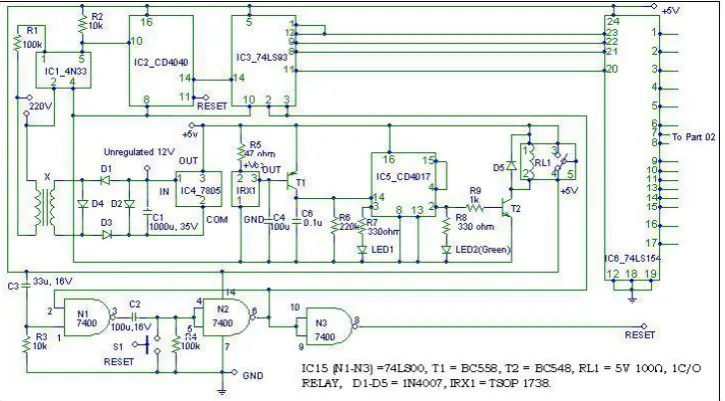
Fig. 2 and Fig. 3 show the circuit diagrams of the complete switching system with a sequential power ‘ON’ attribute. It comprises optocoupler (4N33) [4], IR receiver module (TSOP1738), decade counter (CD4017), divide-by-12 counter (CD4040) [5], [6], divide-by-16 counter (74LS93), 1-of-16 decoder (74LS154) [5], [6], set-reset flip-flop (74LS74) [5]-[7], NAND gate (74LS00) [5]-[7], regulator (7805) [4], Relay switches and a few discrete components. AC mains operating frequency is 50Hz, which is isolated through optocoupler (4N33). For better understanding, the circuit descriptions are divided into the following sections as in the block diagram shown in Fig. 1.
A. AC to DC Converter
full-wave bridge rectifier to convert AC into DC. The rectified output is then filtered to get fewer ripples. The
unregulated 12V DC voltage is applied to a 5V DC regulator (IC4-7805) to get a regulated 5V.
Figure 1. Block diagram of remote controlled sequential power ON switching system
B. Remote Controlled Switching System
Regulated 5V is connected to the remote controlled switching section to energize it. The switching system can be activated from up to 10 meters. The switching system is used to control the DC power in the next sections of the circuit. The 38 kHz infrared rays (IR) generated by the remote control are received by IR receiver module (TSOP1738) of the circuit [2]. Pin 1 of TSOP1738 is connected to ground, pin 2 is connected to the power supply through resistor R5 and the output is taken from pin 3. The output signal is amplified by transistor T1 (BC558).The amplified signal is fed to clock pin 14 of decade counter IC (IC5-CD4017). Pin 8 of IC5 is grounded, pin 16 is connected to Vcc and pin 3 is connected to LED1 (red), which glows to indicate that the total system is ‘OFF’.
The output of IC5 is taken from its pin 2. LED2 (green) connected to pin 2 is used to indicate the ‘ON’ state of the system. Transistor T2 (BC548) connected to pin 2 of IC5 drives relay RL1. Diode (D5-1N4007) acts as a freewheeling diode. The Regulated 5V DC voltage is connected between the two poles of the relay. It gets connected via normally opened (N/O) contact when the relay energizes and the DC voltage is supplied to the next
sections of the switching system. In this way the remote control section controls the total switching system. After activating the system, the loads connected with this switching system are turned ‘ON’ in a sequential manner.
C. Pulse Generator
Optocoupler (IC1-4N33) consists of a gallium-arsenide infrared LED and a silicon photo-Darlington transistor [4]. AC main power is connected to pin 1 of optocoupler via current-limiting resistor R1. During the positive half cycle, the internal LED of the optocoupler is ‘ON’ and the phototransistor is driven into saturation and pin 5 goes low. The sinusoidal wave is converted into square wave by this process. Thus IC1 provides clock pulse for IC2 (CD4040) at pin 10.
The CD4040 is a 12-stage ripple-carry binary counter. The counter advances by one count on the negative transition of each clock pulse. It resets to zero with a logical ‘high’ at the reset input, independent of the clock pulse. Each counter stage is a static toggle flip-flop. Counter (CD4040) further divides the 50Hz clock frequency by 10. Output pin 14 provides clock pulse after an interval of 20.48 seconds and also drives IC3 (74LS93).
D. Logic Control
The IC3 (74LS93) is a 4-bit binary ripple counter. It consists of 4 master-slave flip-flops internally connected to provide a divide-by two section and a divide-by eight section. Each section has a separate clock input ( and ) to initiate state changes of the counter on the ‘high’ to ‘low’ clock pulse transition. An AND gated asynchronous master reset (pins 2 and 3) is provided, which resets all the flip-flops.
Since the output from the divide-by-two sections are not internally connected to the succeeding stages in a 4-bit ripple counter, the Q0 output must be externally connected to input. The input count pulses are applied to clock input . Simultaneously, frequency divisions of 2, 4, 8 and 16 are performed at the Q0, Q1, Q2 and Q3 outputs respectively. The outputs of 47LS93 provide the address inputs to 1-of-16 decoder IC6 (74LS154).
The decoder 74LS154 accepts four active ‘high’ binary address inputs (A0 through A3) and provides 16 mutually exclusive active ‘low’ outputs ( through ). The E0 and E1 inputs enable the gates which can be used either to strobe the decoder for eliminating the normal decoding glitches on the outputs or for expansion of the decoder. The enable gate has two ANDed inputs which are made ‘low’ (by connecting them to ground) to enable the outputs. Outputs ( through ) of 74LS154 are connected to the set inputs of flip-flop 74LS74 (IC7-IC14). IC7 through IC14 (each 74LS74) are used as set-reset flip-flops to drive the relays with the help of transistors (T3 through T18). The 74LS74 is a dual, positive edge-triggered, D-type flip-flop featuring individual data, clock signal, set-reset inputs as well as true and complementary outputs. Set (S) and reset inputs (R) are asynchronous active ‘low’ inputs that operate independently of the clock input. When reset input is ‘high’ and set input is ‘low’, the Q output goes ‘high’ to energize the relay.
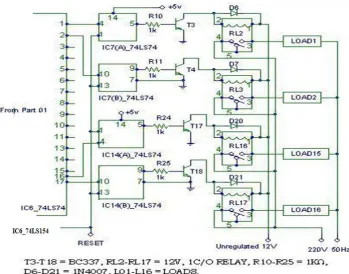
Figure 3. The switching section of remote controlled switching system with a sequential power ‘ON’ attribute (part 02)
E. Switches
The Q outputs of 74LS74 ICs are connected to the bases of transistors (T3 through T18) via resistors (R10 through R25) respectively. All the relays (RL2 through RL17) are connected to the collectors of transistors (T3 through T18) respectively. An unregulated 12V DC voltage is applied to the relay switches to provide energizing voltages for the relays. Diodes (D6 through D21) connected across relays (RL2 through RL17) respectively; act as free-wheeling diodes.
When output pin 5 of flip-flop 74LS74 (IC7_A) goes ‘high’, transistor T3 is driven into saturation and relay RL2 get energized. Similarly, the ‘high’ Q output of other flip-flops drive relays (RL3 through RL17). Loads
(LOAD 1 to LOAD 16) are connected with the relays (RL2 through RL17) respectively to control them. Here in this circuit of Fig. 3, we have shown four loads as an example to give an idea about the load connections to the readers. One can connect sixteen loads at a time with this switching system in the same manner.
Flip-flops energize relays (RL2 through RL17) randomly when mains power resumes.
IV. RESULTS AND DISCUSSIONS
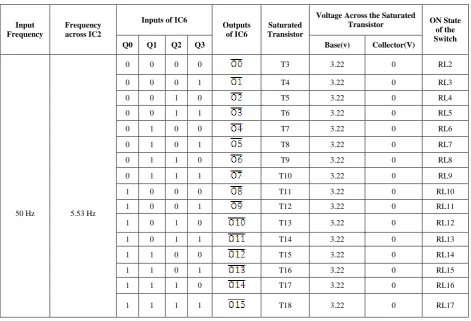
Procedures and precautions needed to construct the circuit of Fig. 2 and Fig 3, to obtain desired output, are discussed in this section. The voltages and currents of all the branches of the circuit are measured carefully with a multimeter and recorded in Table I. Table I describe different data found in different sections of the circuit. These data are significant for the proper analysis of the circuit. The resistances of the connecting wires are ignored so that they have no effect on the output.
Bases can be used for all ICs to protect them. Checking continuity between respective connections using a multimeter is a good practice. The transformer can be checked to ensure an output of 12V AC in the secondary winding which is further rectified by the bridge rectifier. The 5V regulated output was checked by measuring it with a multimeter. This 5V DC voltage is applied to all the digital ICs via the remote controlled switching system to provide biasing voltage. TV/VCD’s remote control can be used in the control section.
TABLE I. DATA ANALYSIS OF THE SWITCHING SYSTEM.
The electrical loads are connected to the 220V AC line carefully through relay contacts as shown in Fig. 3 to avoid any accident. Mains-rated cable can be used for all load connections. The loads should switch ‘ON’ sequentially with a time delay of 20 seconds. The manual reset switch (S1) is pressed if any of the sixteen loads turns ‘ON’ randomly after power resumption. The time delay can be changed by changing the input frequency of the clock pulse of binary counter (74LS93).
The optocoupler can be checked to have a pulse of 50Hz which provides the clock pulse for the divide-by twelve counter (CD4040). The 74LS90 or 74LS93 IC can be used instead of CD4040.The IC2 (CD4040) counter divides the pulse by 10 to provide clock pulse for binary counter (74LS93). The IC3 (74LS93) counter produces addresses for the 1-to-16 decoder (IC6). The outputs are checked using a digital planner board.
The functionality of the flip-flops can also be checked by the digital planner board. Table I shows that the
transistors (T3-T18) are in saturation one after another with a time delay.
The main power is disconnected while constructing the circuit to eliminate the risk of electrical shock.
Providing completion of the circuit, main power is turned ‘ON’ carefully. The loads are then turned ‘ON’ one after another sequentially. The whole process is performed automatically by the circuit. If the loads are turned ‘ON’ randomly rather than sequentially then the reset pin is pressed to reset the logic ICs.
V. CONCLUSIONS
The switching system discussed above is very effective in our daily life to save home appliances and to control them in an easier way by a remote control. It is clear from the above discussion that this switching circuit can be easily constructed as the circuit components are cheap and available in market. The installation of the system is
Input Frequency
Frequency across IC2
Inputs of IC6
Outputs of IC6
Saturated Transistor
Voltage Across the Saturated
Transistor ON State
of the Switch
Q0 Q1 Q2 Q3 Base(v) Collector(V)
50 Hz 5.53 Hz
0 0 0 0 T3 3.22 0 RL2
0 0 0 1 T4 3.22 0 RL3
0 0 1 0 T5 3.22 0 RL4
0 0 1 1 T6 3.22 0 RL5
0 1 0 0 T7 3.22 0 RL6
0 1 0 1 T8 3.22 0 RL7
0 1 1 0 T9 3.22 0 RL8
0 1 1 1 T10 3.22 0 RL9
1 0 0 0 T11 3.22 0 RL10
1 0 0 1 T12 3.22 0 RL11
1 0 1 0 T13 3.22 0 RL12
1 0 1 1 T14 3.22 0 RL13
1 1 0 0 T15 3.22 0 RL14
1 1 0 1 T16 3.22 0 RL15
1 1 1 0 T17 3.22 0 RL16
also easy. The system is tested with four loads and it provides desired output. One can connect sixteen loads with this switching system at a time. A switching system accommodating more than sixteen loads can be constructed using the same concept.
ACKNOWLEDGMENTS
The authors are grateful to Prof. Dr. Mohammad Rezaul Huque Khan, Department of Applied physics, Electronics and communication Engineering, University of Chittagong, Chittagong-4331, Bangladesh for his valuable advises. Many thanks to Mr. Subrata Sarker of Chittagong University for his help.
REFERENCES
[1] Ajanta Palit. (Jan. 2009). Construction of sequential power ‘ON’ circuit. Electronics for You. [Online]. Available: www.efymag.com.
[2] S. Mohan. (May 2005). Remote control for home appliances.
Electronics for You. [Online]. Available: www.efymag.com.
[3] C. K. Das, M. Sanaullah, H. M. G. Sarower, and M. M. Hassan, “Development of a cell phone based remote control system: An effective switching system for controlling home and office appliances,” International Journal of Electrical and Computer
Sciences IJECS-IJENS, vol. 9, no. 10, Dec. 2009.
[4] B. L Theraja and A. K. Theraja, A Textbook of Electrical
Technology, S. Chand & Company Ltd., 2004.
[5] R. j. Tocci, N. S. Widmer, and G. L. Moss, Digital Systems: Principles and Applications, 9th ed. Pearson Prentice hall, 2007.
[6] R. P. Jain, Modern Digital Electronics, 3rd ed. Tata Mcgraw-Hill
Publishing Company Limited, 2004.
[7] M. M. Mano, Digital Logic and Computer Design, Prentice Hall of India Pvt. Ltd. 2008.
Sabuj Chowdhury received B.Sc. degree and
M.S. degree in Applied Physics, Electronics and Communication Engineering from Chittagong University, Bangladesh in 2009 and 2010 respectively. His current research interests are Wireless Communication, 4G Communication Networks, Game Theory based Networking System, Electronic Circuit Design, Nano Electronics and Antenna Design. He is currently working asa lecturer in the Department of Applied Physics, Electronics and Communication Engineering, University of Chittagong, Chittagong-4331, Bangladesh.
Md. Didarul Alam received B.Sc. and M.S.
degree in Applied Physics, Electronics and Communication Engineering from University of Chittagong, Chittagong-4331, Bangladesh in 2009 and 2010 respectively. He is currently working as a Lecturer in the Department of Applied Physics, Electronics and Communication Engineering, University of Chittagong, Chittagong-4331, Bangladesh. His current research interests focus on Wireless Communication and Cognitive Radio Networks.
Sabrina Alam received B.Sc. degree and