[Elewe* 4(10): October, 2017] ISSN 2349-4506
Impact Factor: 2.785
G
lobal
J
ournal of
E
ngineering
S
cience and
R
esearch
M
anagement
ANGULAR BASED MODEL FOR RFID NETWORK PLANNING FOR
WAREHOUSE MANAGEMENT SYSTEM
Heba M. Elewe*
*Business Administration Department, AL ESRA'A UNIVERSITY, Baghdad, Iraq
DOI: 10.5281/zenodo.1034499
KEYWORDS
:
RFID Network Planning, DBFA, warehouse management, SCM.ABSTRACT
Large scale warehouses often apply the RFID Network Planning (RNP) strategy to efficiently track assets, which can lead to significant revenue gain. For this reason, this research has developed a three dimension RFID network planning model that can improve warehouse management. The mathematical model of the RFID network planning is concerned with two major issues. The first one is the correlation between the reader height and the rack levels. The second issue is to specify the optimal tag coverage based on the elliptical interrogation reader range. The DBFA algorithm is used as a method to evaluate the deterministic indicators in NP hard problems. The current work has provided much superior results for three dimension large scale condition and observed the effectiveness in traditional warehouse layout. The research has presented a new perspective in achieving maximum volumetric coverage with optimal number of deployed readers.
INTRODUCTION
[Elewe* 4(10): October, 2017] ISSN 2349-4506
Impact Factor: 2.785
G
lobal
J
ournal of
E
ngineering
S
cience and
R
esearch
M
anagement
PROBLEM FORMULATION
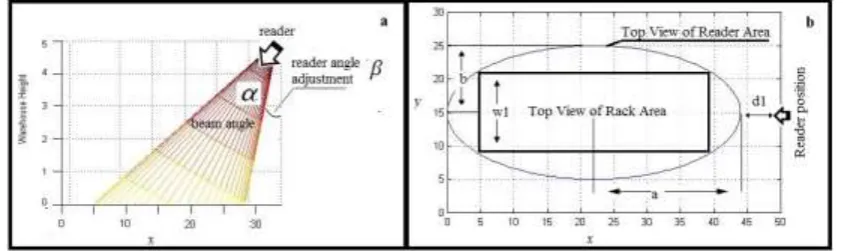
RNP network planning in warehouse management is faced with many challenges. The strategy of applying RNP depends on the functional parameters in designing the placement of RFID readers. The reliably of RFID readers depends on the relationship of the reader direction and position [9] as shown in Figure 1.
Figure 1: Propagation Shape and Direction for Axial Reader
One of the most important functional parameters is the optimal tag coverage [5]. Maximizing the performance of functional parameters results in optimal coverage and readability of the warehouse facility area and enhances the warehouse processes. The major obstacles to optimize the tag coverage involve the three dimension warehouse network which refers to the overall volume of the warehouse. The RFID reader propagation range is different from the warehouse ground and the upper surface of racks. Most researchers developed their solutions based on the ground propagation range. But in real case, this method will not cover the same propagation range in the upper level of storage. For that, the necessity to optimize coverage of the warehouse guides the researcher to a new consideration in RFID reader implementation. The researcher developed a new mathematical model using the effect of the angle of reader installation and the reader height position as shown in Figure 2.
Figure 2: Propagation Shape and Direction for Angular Reader
[Elewe* 4(10): October, 2017] ISSN 2349-4506
Impact Factor: 2.785
G
lobal
J
ournal of
E
ngineering
S
cience and
R
esearch
M
anagement
WAREHOUSE DESIGN FACTORS
Warehousing and storage design contains specific principles that qualify the knowledge necessary for the internal system of warehouse or storage facility. Warehouse design depends on many factors of the storage policy. These factors depend on the product characteristics and warehousing operations (Dukic and Opetuk, 2008). The present factors are selected to be the basics which serve the present work.
I. Aisle Length factor which specifies the aisle space and position concerned with the RFID space division. II. Size and Height factor which specify the rack height and the warehouse roof level.
THE MATHEMATICAL MODEL
Mathematical RFID System is modeled in order to analyze and predict the warehouse coverage area. The general description of the warehouse considers a square flat plane of (50x50) m2 [10] with a total height of 5m. The present model proposes novel RFID parameters which use height of the reader device position and the beam angle correlated with angle of reader direction. The present model begins with the formulation of two sub-models. These sub-models contain the RFID sub-model and DBFA sub-model [5].
RFID sub-model
The model formulation was developed under the assumption that the RFID reader generates elliptic coverage area. The characteristics of the RFID system were critical operational parameters specific to the RFID reader, the RFID tag, and the signal propagation model [11]. Also, to find the ability to cover the tags is the propagation range (rmax). Designing RFID-RNP model needs to specify the signal propagation because the uplink and downlink signals are not equal. Signal propagation follows the well-known Friis transmission formula which is used for estimating the powering region in a portal, diffraction, reflection, scattering, and shadowing may occur in signal propagation [12]. The read range of a UHF-based RFID propagation system can be calculated by the Friis free-space equation as follows:
) 1 ( 4
2
Gtag Greader r
Ptag
Preader
where Ptag: Power received at receiver (tag), Pt: Transmitted (reader) power, Gt: Transmitter (reader) antenna gain, Gr: Receiver (tag) antenna gain, r: Distance between transmitter and receiver, λ: Radio wavelength This formula can be used to calculate the minimum power required at the RFID tag's antenna based on the elliptic propagation area. The traditional formula of ellipse is applied into Friis free-space equation to calculate the reader capability of coverage area. The contribution of this paper is the use of Friis free space in three dimension environment. Therefore, path loss of the reader propagation will be taken based on two levels, the rack level and the warehouse ground level. The boundary condition is specified based on the reader beam angle and the adjustment angle as shown in Figure 3.
[Elewe* 4(10): October, 2017] ISSN 2349-4506
Impact Factor: 2.785
G
lobal
J
ournal of
E
ngineering
S
cience and
R
esearch
M
anagement
The beam angle α and the reader angle adjustment β represent effective factors in reader installation because they produce the elliptic coverage area in both levels of the warehouse. These two factors specify the optimum reader height that subjected to the boundary conditions of the effective area:
𝐿 < 2 ∗ 𝑎 (2) 𝑤1 < 2 ∗ 𝑏 (3)
here L is the aisle length, w1 is covered racks width, a is ellipse minor axis, b is the ellipse major axis, and the
boundary conditions applied on both of upper rack surface and ground level of the warehouse. In order to calculate the propagation coverage area, the height of the reader hTcan be calculated based on the beam angle α and the
reader angle adjustment β correlated with the aisle length (L) from the formula:
𝐴𝑚𝑎𝑥= 2 × (ℎ × tan (𝛼
2)) × ((ℎ × tan ( 𝛼
2)) ÷ (cos ( 𝛼
2)) (6)
Therefore, the length and width are expressed by the formula:
𝐿 = (√2 × ℎ × tan (𝛼
2)) ÷ (cos ( 𝛼
2)) (7) 𝑤1= √2 × ℎ × tan (𝛼
2) (8)
From the present equations, the distance between transmitter and receiver (r) presented in equation 1 will be specified in the maximum value between w1 and L. Therefore, the tag distance 𝑟𝑡𝑑will take place in the range of:
0 < 𝑟𝑡𝑑< {
(√2 × ℎ × tan (𝛼
2)) ÷ (cos ( 𝛼 2)) √2 × ℎ × tan (𝛼
2)
} (9)
Also, the required number of readers based on the in range tags can be calculated from the formula:
𝐶𝑜𝑣𝑖= ∑ (𝑟𝑚𝑎𝑥− 𝑟𝑡𝑑) 𝑚𝑎𝑥
𝑡=𝑅𝑆
(10)
𝑁𝑖= ∑ 𝐶𝑜𝑣𝑖 𝑘
𝑡=𝑇𝑆
(11)
where:
𝑪𝒐𝒗 : Coverage of tags group in TS range
𝑁𝑖 : Readers number 𝑡 : Tag
𝑅𝑆 : The propagation domain
𝑇𝑆 : The working domain
[Elewe* 4(10): October, 2017] ISSN 2349-4506
Impact Factor: 2.785
G
lobal
J
ournal of
E
ngineering
S
cience and
R
esearch
M
anagement
DBFA sub-model
Optimization is a process or methodology for improving functional procedures such as finding the maximum or minimum of a function in order to highest achievable performance under the given constraints. Artificial Intelligence (AI) techniques introduced an interesting application in engineering. Optimization techniques represent a powerful set of tools which can be used to find optimal solutions of many kinds of problems. In this paper, the selected algorithm presented in [5] is used to solve the multi-objective radio frequency identification (RFID) network planning problem efficiently. The solution process is to represent each firefly as a real vector with readers. The readers’ positions are applied in the first two dimensions while the propagation range takes place with the correlation of the reader height and both of the beam angle and the adjustment reader angle as shown in equations (2 to 10). The optimization technique is built based on changing the readers’ height and angles to enhance the tag coverage in three dimension condition. The current work has produced much superior results for large scale and multi-variance facility shapes. The step by step operating procedure of DBFA algorithm is described as follows:
Step 1: Generate random data series for tags layout distribution in the warehouse
Step 2: Store the set of tag positions for transfer to the firefly algorithm to find the optimal reader positions based on the RFID objective function
Step 3: Categorize the tags’ information positions into separate clusters using DBSCAN technique Step 4: apply firefly (FA) algorithm to find optimal solution.
The sequence of operation based on the present steps will specify the optimal number of readers and optimal coverage area of each reader using the elliptic propagation reader range.
RESULTS AND DISCUSSION
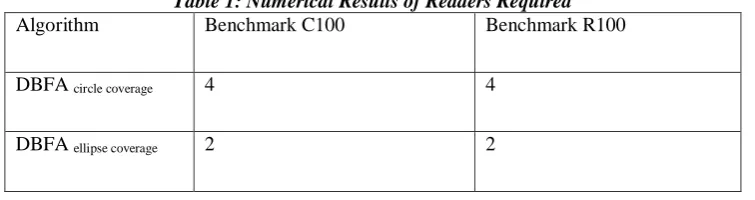
The present new formula results were obtained through applying the effect of reader beam angle and the warehouse rack height to specify the optimum reader position and adjustment angle. Several factors of the present RFID network planning (RNP) and specific parameters of each optimization technique were prepared to improve the quality of the solutions. The specific values of these parameters are: RFID Reader System Operating Frequency (915 MHz), Transmitting power range (0.1 to 2 watts), Sensitivity thresholds of tags Tt (-14 dBm), Sensitivity thresholds of Readers (dBm Tr (-80 dBm)), RFID Reader Antenna Gain Gr (6.7 dBi), RFID Tag Antenna Gain Gt (3.7 dBi). . The numerical results shown in Table 1 demonstrate the differences of the solution quality for large-scale RNP problems. The formula was able to achieve 2 readers in case of 100 tags distributed in three dimension network.
Table 1: Numerical Results of Readers Required
Algorithm Benchmark C100 Benchmark R100
DBFA circle coverage 4 4
DBFA ellipse coverage 2 2
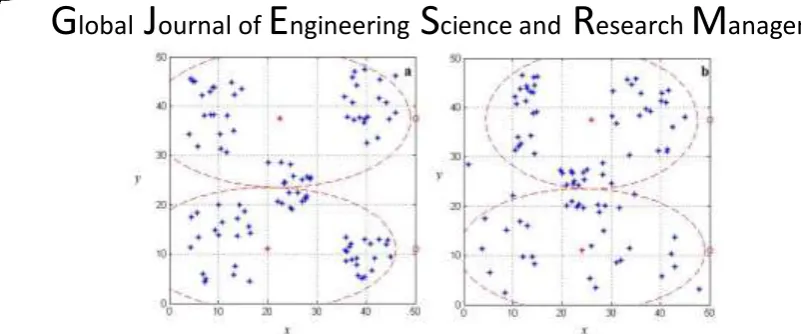
The results indicate that the RFID readers were distributed to cover all the tags as shown in Figure 4 marked by blue star “*” and the ellipse center marked by star sign. Also, the reader positions are shown as red “o”, and the interrogation elliptical range as red dashed line for coverage of the upper level. The two cases in Figure 4 represent the standard dataset for C100 and R100
Also, the result presents that the adjustment reader angle was 5o and 15o with (4.2 m) height in C100, while in
R100 the adjustment reader angle was 17o and 6o with (4.9 m) height. The simulation results observe that the
[Elewe* 4(10): October, 2017] ISSN 2349-4506
Impact Factor: 2.785
G
lobal
J
ournal of
E
ngineering
S
cience and
R
esearch
M
anagement
Figure 4: Simulation Results a) C100 Benchmark b) R100 Benchmark
CONCLUSION
In this paper, the impact of elliptical three dimension new formula RFID network planning was tested and compared using the traditional DB FA algorithm. The present method was tested against C100 and R100 standard benchmark. The elliptic propagation range effect improved the coverage efficiency and also specified the optimum installation reader height inside the warehouse, therefore, the number of readers has been reduced and more practical results observed.
REFERENCES
1. A.Mitrokotsa, M.R.Rieback, and A.S.Tanenbaum, "Classifying RFID attacks and defenses. Information Systems Frontiers" 2010, Information Systems Frontiers, 12(5), pp.491-505
2. A. Suriya and J. D. Porter, "Genetic Algorithm Based Approach for RFID Network Planning," 2014. 3. S.Aysegul, A.Nabil, and D.Stephane. "A simulation approach to evaluate the impact of introducing RFID
technologies in a three-level supply chain". 2008, Proceedings of the 40th Conference on Winter Simulation
4. Z. Ren, C. J.Anumba, and J. Tah. "RFID-facilitated construction materials management (RFID-CMM)– A case study of water-supply project". 2011.
5. A. M. Elewe, K. Bin Hasnan, and A. Bin Nawawi, "Hybridized Firefly Algorithm For Multi-Objective Radio Frequency Identification ( Rfid ) Network Planning" 2017, ARPN Journal of Engineering and Applied Sciences, vol. 12, no. 3, pp. 834–840,.
6. Z. Shijie, Yun Liu, Jiaqing Luo. "A Cube based Model for RFID Coverage Problem in Three-Dimensional Space". 2013, IEEE 9th International Conference on Mobile Ad-hoc and Sensor Networks 7. A. Nawawi, K. Hasnan & S. Ahmad Bareduan. " Correlation between RFID Network Planning ( RNP )
Parameters and Particle Swarm Optimization ( PSO ) Solutions". 2011, 1, pp.1245–1249.
8. K. Hasnan, A. Ahmed, & W. Sani. "Optimization of RFID Real-time Locating System". 2013, (Icoras). 9. A. Nawawi, K. Hasnan & S. Ahmad Bareduan. "The application of RFID technology to capture and
record product and process data for reverse logistics sorting activity". 2011.
10. M.Tuba, N. Bacanin & M. Beko."Fireworks algorithm for RFID network planning problem". 2015. Proceedings of 25th International Conference Radioelektronika, RADIOELEKTRONIKA 2015, (Iii), pp.440–444.
11. K. Hasnan, A. Ahmed, Q. Bakhsh, K. Hussain, K. Latif, U. Tun, H. Onn, P. Raja, and B. Pahat, "A Novel Optimal RFID Network Planning by MC-GPSO" 2015, vol. 8, no. August.