R E S E A R C H
Open Access
Common fixed points of ´Ciri´c-type
contractive mappings in two ordered
generalized metric spaces
M Abbas
1, YJ Cho
2and T Nazir
1**Correspondence: [email protected]
1Department of Mathematics, Lahore University of Management Sciences, Lahore, 54792, Pakistan 2Department of Mathematics Education and the RINS, Gyeongsang National University, Jinju, 660-701, Korea
Abstract
In this paper, using the setting of two ordered generalized metric spaces, a unique common fixed point of four mappings satisfying a generalized contractive condition is obtained. We also present an example to demonstrate the results presented herein.
MSC: 54H25; 47H10; 54E50
Keywords: weakly compatible mappings; compatible mappings; dominated
mappings; common fixed point; partially ordered set; generalized metric space
1 Introduction and preliminaries
The study of a unique common fixed point of given mappings satisfying certain contrac-tive conditions has been at the center of rigorous research activity. Mustafa and Sims [] generalized the concept of a metric in which a real number is assigned to every triplet of an arbitrary set. Based on the notion of generalized metric spaces, Mustafaet al.[–] obtained some fixed point theorems for some mappings satisfying different contractive conditions. The existence of common fixed points in generalized metric spaces was initi-ated by Abbas and Rhoades [] (see also [] and []). For further study of common fixed points in generalized metric spaces, we refer to [–] and references mentioned therein. Abbaset al.[] showed the existence of coupled common fixed points in two generalized metric spaces (for more results on couple fixed points, see also [–]).
The existence of fixed points in ordered metric spaces has been initiated in by Ran and Reurings [] and further studied by Nieto and Lopez []. Subsequently, several interesting and valuable results have appeared in this direction [–].
The aim of this paper is to study common fixed point of four mappings that satisfy the generalized contractive condition in two ordered generalized metric spaces.
In the sequel,R,R+andNdenote the set of real numbers, the set of nonnegative integers and the set of positive integers respectively. The usual order onR(respectively, onR+) will be indistinctly denoted by≤or by≥.
In [], Mustafa and Sims introduced the following definitions and results:
Definition . LetXbe a nonempty set. Suppose that a mappingG:X×X×X→R+
satisfies the following conditions:
(a) G(x,y,z) = ifx=y=zfor allx,y,z∈X; (b) <G(x,y,z)for allx,y,z∈Xwithx=y;
(c) G(x,x,y)≤G(x,y,z)for allx,y,z∈Xwithy=z;
(d) G(x,y,z) =G(p{x,y,z}), wherepis a permutation ofx,y,z∈X(symmetry); (e) G(x,y,z)≤G(x,a,a) +G(a,y,z)for allx,y,z,a∈X.
ThenGis called aG-metric onXand (X,G) is called aG-metric space.
Definition . A sequence{xn}in aG-metric spaceXis called:
() aG-Cauchy sequenceif, for anyε> , there existsn∈N(the set of natural
numbers) such that, for alln,m,l≥n,G(xn,xm,xl) <ε;
() G-convergentif, for anyε> , there existx∈Xandn∈Nsuch that, for all
n,m≥n,G(x,xn,xm) <ε;
() AG-metric spaceXis said to beG-completeif everyG-Cauchy sequence inXis G-convergent inX.
It is known that{xn}isG-convergent to a pointx∈Xif and only ifG(xm,xn,x)→ as
n,m→ ∞.
Proposition .[] Let X be a G-metric space. Then the following items are equivalent:
() A sequence{xn}inXisG-convergent to a pointx∈X; () G(xn,xm,x)→asn,m→ ∞;
() G(xn,xn,x)→asn→ ∞; () G(xn,x,x)→asn→ ∞.
Definition . AG-metric onX is said to besymmetricif G(x,y,y) =G(y,x,x) for all x,y∈X.
Proposition . Every G-metric on X defines a metric dGon X by
dG(x,y) =G(x,y,y) +G(y,x,x) (.)
for all x,y∈X.
For a symmetricG-metric, we have
dG(x,y) = G(x,y,y) (.)
for allx,y∈X. However, ifGis non-symmetric, then the following inequality holds:
G(x,y,y)≤dG(x,y)≤G(x,y,y) (.)
for allx,y∈X. It is obvious that
G(x,x,y)≤G(x,y,y)
for allx,y∈X.
Table 1 G-metric
(x,y,z) G(x,y,z)
(1, 1, 1), (2, 2, 2) 0 (1, 1, 2), (1, 2, 1), (2, 1, 1) 0.5 (1, 2, 2), (2, 1, 2), (2, 2, 1) 1.0
Example . LetX={, }andG:X×X×X→R+be a mapping defined by Table .
Note thatGsatisfies all the axioms of a generalized metric, butG(x,x,y)=G(x,y,y) for two distinct pointsx,y∈X.
Definition . Letf andgbe self-mappings on a setX. Ifw=fx=gxfor somex∈X, then the pointxis called acoincidence pointoff andgandwis called apoint of coincidenceof f andg.
Definition .[] Letf andgbe self-mappings on a setX. Thenf andgare said to be weakly compatibleif they commute at every coincidence point.
Definition .[] LetXbe aG-metric space andf,gbe self-mappings onX. Thenf and g are said to be R-weakly commuting if there exists a positive real numberRsuch that G(fgx,fgx,gfx)≤RG(fx,fx,gx) for allx∈X.
The mapsf andgareR-weakly commuting onXif and only if they commute at their coincidence points.
Recall that two mappingsf andgon aG-metric spaceXare said to be compatible if, for a sequence{xn}inXsuch that{fxn}and{gxn}areG-convergent to somet∈X,
lim
n→∞G(fgxn,fgxn,gfxn) = .
Definition . LetXbe a nonempty set. Then (X,,G) is called anordered generalized metric spaceif the following conditions hold:
(a) Gis a generalized metric onX; (b) is a partial order onX.
Definition . Let (X,) be a partial ordered set. Then two pointsx,y∈Xare said to be comparableifxyoryx.
Definition .[] Let (X,) be a partially ordered set. A self-mappingf onXis said to bedominatingifxfxfor allx∈X.
Example .[] LetX= [, ] be endowed with usual ordering andf:X→Xbe a map-ping defined byfx=√n
xfor somen∈N. Sincex≤xn=fxfor allx∈X,f is a dominating mapping.
Definition . Let (X,) be a partially ordered set. A self-mappingf onXis said to be dominatediffxxfor allx∈X.
Definition . A subsetKof a partially ordered setXis said to bewell-orderedif every two elements ofKare comparable.
2 Common fixed point theorems
In [], Kannan proved a fixed point theorem for a single valued self-mapping T on a metric spaceXsatisfying the following property:
d(Tx,Ty)≤hd(x,Tx) +d(y,Ty)
for allx,y∈X, whereh∈[,). If a self-mappingTon a metric spaceXsatisfies the fol-lowing property:
d(Tx,Ty)≤ad(x,y) +bd(x,Tx) +cd(y,Ty) +ed(x,Ty) +d(y,Tx)
for allx,y∈X, wherea,b,c,e≥ witha+b+c+ e< , thenThas a unique fixed point provided thatXisT-orbitally complete (for related definitions and results, we refer to []).
Afterwards, Ćirić [] obtained a fixed point result for a mapping satisfying the follow-ing property:
d(Tx,Ty)≤qmax
d(x,y),d(x,Tx),d(y,Ty),d(x,Ty) +d(y,Tx)
for allx,y∈X, where ≤q< .
In this section, we show the existence of a unique common fixed point of four mappings satisfying Ćirić-type contractive condition in the framework of two ordered generalized metric spaces.
Now, we start with the following result:
Theorem . Let(X,)be a partially ordered set and G, Gbe two G-metrics on X such
that G(x,y,z)≤G(x,y,z)for all x,y,z∈X with a complete metric Gon X. Suppose that
f , g, S and T are self-mappings on X satisfying the following properties:
G(fx,fx,gy)≤kmax
G(Sx,Sx,Ty),G(fx,fx,Sx),G(gy,gy,Ty),
G(fx,fx,Ty) +G(gy,gy,Sx)
/ (.)
and
G(fx,gy,gy)≤kmax
G(Sx,Ty,Ty),G(fx,Sx,Sx),G(gy,Ty,Ty),
G(fx,Ty,Ty) +G(gy,Sx,Sx)
/ (.)
for all comparable x,y∈X, where k∈[, ). Suppose that f(X)⊆T(X)and g(X)⊆S(X), f , g are dominated mappings and S, T are dominating mappings. If, for any nonincreasing sequence{xn}in X with ynxnfor all n∈N, yn→u implies that uxnand either
(a) f,Sare compatible,f orSis continuous andg,T are weakly compatible
(b) g,T are compatible,gorTis continuous andf,Sare weakly compatible,
then f , g, S and T have a common fixed point. Moreover, the set of common fixed points of f , g, S and T is well-ordered if and only if f , g, S and T have one and only one common fixed point.
Proof Letxbe an arbitrary point inX. Sincef(X)⊆T(X) andg(X)⊆S(X), we can define
the sequences{xn}and{yn}inXby
yn=gxn=Sxn+, yn+=fxn+=Txn+
for alln≥. By the given assumptions, we have
xn+Txn+=fxn+xn+,
xn+Sxn+=gxnxn.
Thus, for alln≥, we havexn+xn. Suppose thatG(yn,yn+,yn+) > for alln≥. If
not, then, for somem≥,ym=ym+. Indeed, ifm= k, thenyk=yk+and from (.), it
follows that
G(yk+,yk+,yk+)
=G(fxk+,fxk+,gxk+)
≤kmaxG(Sxk+,Sxk+,Txk+),G(fxk+,fxk+,Sxk+),
G(gxk+,gxk+,Txk+),
G(fxk+,fxk+,Txk+) +G(gxk+,gxk+,Sxk+)
/
=kmaxG(yk,yk,yk+),G(yk+,yk+,yk),G(yk+,yk+,yk+),
G(yk+,yk+,yk+) +G(yk+,yk+,yk)
/
≤kmaxG(yk,yk,yk+),G(yk+,yk+,yk),G(yk+,yk+,yk+),
G(yk+,yk+,yk+) +G(yk+,yk+,yk)
/
≤kmaxG(yk,yk,yk+),G(yk+,yk+,yk),G(yk+,yk+,yk+),
G(yk+,yk+,yk+) +G(yk+,yk+,yk)
/
=kG(yk+,yk+,yk+). (.)
Again, from (.), it follows that
G(yk+,yk+,yk+)
=G(fxk+,gxk+,gxk+)
≤kmaxG(Sxk+,Txk+,Txk+),G(fxk+,Sxk+,Sxk+),
G(gxk+,Txk+,Txk+),
G(fxk+,Txk+,Txk+) +G(gxk+,Sxk+,Sxk+)
=kmaxG(yk,yk+,yk+),G(yk+,yk,yk),G(yk+,yk+,yk+),
G(yk+,yk+,yk+) +G(yk+,yk,yk)
/
≤kmaxG(yk,yk+,yk+),G(yk+,yk,yk),G(yk+,yk+,yk+),
G(yk+,yk+,yk+) +G(yk+,yk,yk)
/
≤kmaxG(yk,yk,yk+),G(yk+,yk,yk),G(yk+,yk+,yk+),
G(yk+,yk+,yk+) +G(yk+,yk,yk)
/
=kG(yk+,yk+,yk+). (.)
Thus (.) and (.) imply that
G(yk+,yk+,yk+)≤kG(yk+,yk+,yk+)
and soyk+=yk+sincek< .
Similarly, ifm= k+ , then one can easily obtainyk+=yk+. Thus{yn}becomes a
constant sequence andynserves as the common fixed point off,g,SandT.
Suppose thatG(yn,yn+,yn+) > for alln≥.
Ifn∈Nis even, thenn= kfor somek∈N; then it follows from (.) that G(yn+,yn+,yn)
=G(yk+,yk+,yk)
=G(fxk+,fxk+,gxk)
≤kmaxG(Sxk+,Sxk+,Txk),G(fxk+,fxk+,Sxk+),
G(gxk,gxk,Txk),
G(fxk+,fxk+,Txk) +G(gxk,gxk,Sxk+)
/
=kmaxG(yk,yk,yk–),G(yk+,yk+,yk),
G(yk,yk,yk–),
G(yk+,yk+,yk–) +G(yk,yk,yk)
/
≤kmaxG(yk,yk,yk–),G(yk+,yk+,yk),
G(yk+,yk+,yk) +G(yk,yk,yk–)
/
≤kmaxG(yn,yn,yn–),G(yn+,yn+,yn)
,
which implies that
G(yn+,yn+,yn)≤kG(yn,yn,yn–).
Ifn∈Nis odd, thenn= k+ for somek∈N. Again, it follows from (.) that G(yn+,yn+,yn)
=G(yk+,yk+,yk+)
=G(fxk+,fxk+,gxk+)
G(gxk+,gxk+,Txk+),
G(fxk+,fxk+,Txk+) +G(gxk+,gxk+,Sxk+)
/
=kmaxG(yk+,yk+,yk),G(yk+,yk+,yk+),
G(yk+,yk+,yk),
G(yk+,yk+,yk) +G(yk+,yk+,yk+)
/
≤kmaxG(yk+,yk+,yk),G(yk+,yk+,yk+),
G(yk+,yk+,yk+) +G(yk+,yk+,yk)
/
≤kmaxG(yk+,yk+,yk),G(yk+,yk+,yk+)
=kmaxG(yn,yn,yn–),G(yn+,yn+,yn)
,
that is,
G(yn+,yn+,yn)≤kG(yn,yn,yn–)
for alln∈N. Continuing the above process, we have
G(yn+,yn+,yn)≤knG(y,y,y)
for alln∈N. Thus, for alln,m∈Nwithm>n, we have
G(ym,ym,yn)
≤G(yn,yn+,yn+) +G(yn+,yn+,yn+) +· · ·+G(ym–,ym,ym)
≤knG(y,y,y) +kn+G(y,y,y) +· · ·+km–G(y,y,y)
=knG(y,y,y) m–n–
i=
ki
≤ kn
–kG(y,y,y)
and soG(yn,ym,ym)→ asm,n→ ∞. Hence{yn}is aG-Cauchy sequence inX. SinceX
isG-complete, there exists a pointz∈Xsuch thatlimn→∞yn=z. Consequently, we have
lim
n→∞yn+=n→∞limfxn+=n→∞lim Txn+=z
and
lim
n→∞yn=n→∞lim gxn=n→∞lim Sxn+=z.
IfSis continuous and{f,S}is compatible, then
lim
n→∞S x
n+=Sz,
lim
SinceSxn+=gxnxn, (.) gives
G(fSxn+,fSxn+,gxn)
≤kmaxG(SSxn+,SSxn+,Txn),G(fSxn+,fSxn+,SSxn+),
G(gxn,gxn,Txn),
G(fSxn+,fSxn+,Txn) +G(gxn,gxn,SSxn+)
/.
Taking the limit asn→ ∞, we obtain G(Sz,Sz,z)≤kmax
G(Sz,Sz,z),G(Sz,Sz,Sz),G(z,z,z),
G(Sz,Sz,z) +G(z,z,Sz)
/
≤kmaxG(Sz,Sz,z),
G(Sz,Sz,z) +G(z,z,Sz)
/
= k
G(Sz,Sz,z) +G(z,z,Sz)
,
which further implies that
G(Sz,Sz,z)≤hG(z,z,Sz), (.)
whereh=–kk. Obviously, ≤h< . Similarly, we obtain
G(Sz,z,z)≤hG(z,Sz,Sz). (.)
From (.) and (.), we have
G(Sz,Sz,z)≤hG(z,Sz,Sz)
and soSz=zsince ≤h< . Sincegx
nxnandgxn→zasn→ ∞implieszxn, it
follows from (.) that
G(fz,fz,gxn)
≤kmaxG(Sz,Sz,Txn),G(fz,fz,Sz),G(gxn,gxn,Txn),
G(fz,fz,Txn) +G(gxn,gxn,Sz)
/
=kmaxG(z,z,Txn),G(fz,fz,z),G(gxn,gxn,Txn),
G(fz,fz,Txn) +G(gxn,gxn,z)
/,
which, taking the limit asn→ ∞, gives G(fz,fz,z)≤kmax
G(z,z,z),G(fz,fz,z),G(z,z,z),
G(fz,fz,z) +G(z,z,z)
/
Similarly, we obtain
G(fz,z,z)≤kG(z,fz,fz). (.)
Therefore, by using the above two inequalities, we havefz=z.
Sincef(X)⊆T(X), there exists a pointv∈Xsuch thatfz=Tv. SincevTv=fzz, it follows from (.) that
G(fz,fz,gv)≤kmax
G(Sz,Sz,Tv),G(fz,fz,Sz),G(gv,gv,Tv),
G(fz,fz,Tv) +G(gv,gv,Sz)
/
=kmaxG(fz,fz,fz),G(fz,fz,fz),G(gv,gv,fz),
G(fz,fz,fz) +G(gv,gv,fz)
/
≤kG(fz,gv,gv). (.)
Similarly, we get
G(fz,gv,gv)≤kG(fz,fz,gv). (.)
Thus (.) and (.) implyfz=gv. Sinceg andT are weakly compatible, we havegz= gfz=gTv=Tgv=Tfz=Tz, and sozis the coincidence point ofgandT.
Now, from (.), we have
G(z,z,gz) =G(fz,fz,gz)
≤kmaxG(Sz,Sz,Tz),G(fz,fz,Sz),G(gz,gz,Tz),
G(fz,fz,Tz) +G(gz,gz,Sz)
/
=kmaxG(z,z,gz),G(z,z,z),G(gz,gz,gz),
G(z,z,gz) +G(gz,gz,z)
/
=kmaxG(z,z,gz),
G(z,z,gz) +G(gz,gz,z)
/
≤ k
G(z,z,gz) +G(gz,gz,z)
,
that is,
G(z,z,gz)≤hG(gz,gz,z), (.)
whereh=–kk. Obviously, ≤h< . Using (.), we have
G(z,gz,gz)≤hG(z,z,gz). (.)
Combining the above two inequalities, we get
and soz=gz. Therefore,fz=gz=Sz=Tz=z. The proof is similar whenf is continuous. Similarly, if (b) holds, then the result follows.
Now, suppose that the set of common fixed points off,g,SandTis well ordered. We show that a common fixed point off,g,SandTis unique. Letube another common fixed point off,g,SandT. Then, from (.), we have
G(z,z,u) = G(fz,fz,gu)
≤kmaxG(Sz,Sz,Tu),G(fz,fz,Sz),G(gu,gu,Tu),
G(fz,fz,Tu) +G(gu,gu,Sz)
/
=kmaxG(z,z,u),G(z,z,z),G(u,u,u),
G(z,z,u) +G(u,u,z)
/
= k
G(z,z,u) +G(u,u,z)
≤
G(z,z,u) + k
G(u,u,z),
that is,
G(z,z,u)≤kG(z,u,u).
Similarly, using (.), we obtain
G(z,u,u)≤kG(z,z,u).
Combining the above two inequalities, we get
G(z,z,u)≤kG(z,z,u)
and hencez=u.
The converse follows immediately. This completes the proof.
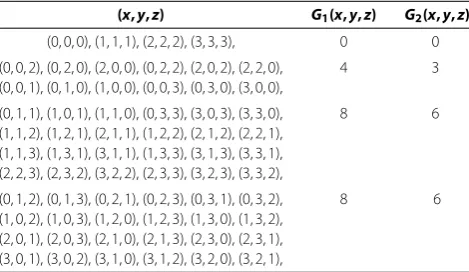
Example . LetX={, , , }be endowed with the usual ordering andG,Gbe two
G-metrics onXdefined by Table . ThenGandGare non-symmetric sinceG(, , )=
Table 2 TwoG-metrices
(x,y,z) G1(x,y,z) G2(x,y,z)
(0, 0, 0), (1, 1, 1), (2, 2, 2), (3, 3, 3), 0 0
(0, 0, 2), (0, 2, 0), (2, 0, 0), (0, 2, 2), (2, 0, 2), (2, 2, 0), (0, 0, 1), (0, 1, 0), (1, 0, 0), (0, 0, 3), (0, 3, 0), (3, 0, 0),
4 3
(0, 1, 1), (1, 0, 1), (1, 1, 0), (0, 3, 3), (3, 0, 3), (3, 3, 0), (1, 1, 2), (1, 2, 1), (2, 1, 1), (1, 2, 2), (2, 1, 2), (2, 2, 1), (1, 1, 3), (1, 3, 1), (3, 1, 1), (1, 3, 3), (3, 1, 3), (3, 3, 1), (2, 2, 3), (2, 3, 2), (3, 2, 2), (2, 3, 3), (3, 2, 3), (3, 3, 2),
8 6
(0, 1, 2), (0, 1, 3), (0, 2, 1), (0, 2, 3), (0, 3, 1), (0, 3, 2), (1, 0, 2), (1, 0, 3), (1, 2, 0), (1, 2, 3), (1, 3, 0), (1, 3, 2), (2, 0, 1), (2, 0, 3), (2, 1, 0), (2, 1, 3), (2, 3, 0), (2, 3, 1), (3, 0, 1), (3, 0, 2), (3, 1, 0), (3, 1, 2), (3, 2, 0), (3, 2, 1),
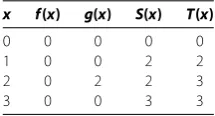
Table 3 Self maps
x f(x) g(x) S(x) T(x)
0 0 0 0 0
1 0 0 2 2
2 0 2 2 3
3 0 0 3 3
Table 4 Dominated and dominating maps
x∈X fis dominated gis dominated Sis dominating Tis dominating
x= 0 f(0) = 0 g(0) = 0 0 =S(0) 0 =T(0)
x= 1 f(1) = 0 < 1 g(1) = 0 < 1 1 < 2 =S(1) 1 < 2 =T(1)
x= 2 f(2) = 0 < 2 g(2) = 2 2 =S(2) 2 < 3 =T(2)
x= 3 f(3) = 0 < 3 g(3) = 0 < 3 3 =S(3) 3 =T(3)
G(, , ) and G(, , )=G(, , ) with G(x,y,z)≤G(x,y,z) for all x,y,z∈X. Let
f,g,S,T:X→Xbe the mappings defined by Table . Clearly,f(X)⊆T(X),g(X)⊆S(X), f,gare dominated mappings andS,T are dominating mappings, see Table .
Now, we shall show that for all comparable x,y∈X, (.) and (.) are satisfied with k=∈[, ). Note that for allx,y∈ {, , },G(fx,fx,gy) =G(fx,gy,gy) = and (.), (.) are satisfied obviously.
() Whenx= andy= , thenfx= ,gy= ,Sx= ,Ty= and so
G(fx,fx,gy) =G(, , ) =
< () =
G(, , ) =
G(gy,gy,Ty)
≤kmaxG(Sx,Sx,Ty),G(fx,fx,Sx),G(gy,gy,Ty),
G(fx,fx,Ty) +G(gy,gy,Sx)
/
and
G(fx,gy,gy) =G(, , ) =
< () =
G(, , ) =
G(gy,Ty,Ty)
≤kmaxG(Sx,Ty,Ty),G(fx,Sx,Sx),G(gy,Ty,Ty),
G(fx,Ty,Ty) +G(gy,Sx,Sx)
/.
() Whenx= andy= , thenfx= ,gy= ,Sx= ,Ty= and so
G(fx,fx,gy) =G(, , ) =
< () =
G(, , ) =
G(gy,gy,Ty)
≤kmaxG(Sx,Sx,Ty),G(fx,fx,Sx),G(gy,gy,Ty),
G(fx,fx,Ty) +G(gy,gy,Sx)
and
G(fx,gy,gy) =G(, , ) =
< () =
G(, , ) =
G(gy,Ty,Ty)
≤kmaxG(Sx,Ty,Ty),G(fx,Sx,Sx),G(gy,Ty,Ty),
G(fx,Ty,Ty) +G(gy,Sx,Sx)
/.
() Whenx= andy= , thenfx= ,gy= ,Sx= ,Ty= and so
G(fx,fx,gy) =G(, , ) =
< () =
G(, , ) =
G(Sx,Sx,Ty)
≤kmaxG(Sx,Sx,Ty),G(fx,fx,Sx),G(gy,gy,Ty),
G(fx,fx,Ty) +G(gy,gy,Sx)
/
and
G(fx,gy,gy) =G(, , ) =
< () =
G(, , ) =
G(Sx,Ty,Ty)
≤kmaxG(Sx,Ty,Ty),G(fx,Sx,Sx),G(gy,Ty,Ty),
G(fx,Ty,Ty) +G(gy,Sx,Sx)
/.
() Finally, whenx= andy= , thenfx= ,gy= ,Sx= ,Ty= and so
G(fx,fx,gy) =G(, , ) =
< () =
G(, , ) =
G(gy,gy,Ty)
≤kmaxG(Sx,Sx,Ty),G(fx,fx,Sx),G(gy,gy,Ty),
G(fx,fx,Ty) +G(gy,gy,Sx)
/
and
G(fx,gy,gy) =G(, , ) =
< () =
G(, , ) =
G(gy,Ty,Ty)
≤kmaxG(Sx,Ty,Ty),G(fx,Sx,Sx),G(gy,Ty,Ty),
G(fx,Ty,Ty) +G(gy,Sx,Sx)
/.
If we consider the same set equipped with two metrics given byd(x,y) =|x–y|and
d(x,y) =|x–y|for allx,y∈X, then forx= andy= , we have
d(fx,gy) =d(, ) = k
≤kmaxd(, ),d(, ),d(, ),
d(, ) +d(, )
/
=kmaxd(Sx,Ty),d(fx,Sx),d(gy,Ty),
d(fx,Ty) +d(gy,Sx)
/
for anyk∈[, ). So corresponding results in ordinary metric spaces cannot be applied in this case.
Theorem . can be viewed as an extension of Theorem . of [] to the case of two orderedG-metric spaces.
Since the class of weakly compatible mappings includesR-weakly commuting mappings, Theorem . generalizes the comparable results in [].
Corollary . Let(X,)be a partially ordered set and G, Gbe two G-metrics on X such
that G(x,y,z)≤G(x,y,z)for all x,y,z∈X with a complete metric Gon X. Suppose that
f , g, S and T are self-mappings on X satisfying the following properties:
G(fx,fx,gy)≤aG(Sx,Sx,Ty) +aG(Sx,Sx,fx) +aG(Ty,Ty,gy)
+a
G(Sx,Sx,gy) +G(Ty,Ty,fx)
(.)
and
G(fx,gy,gy)≤aG(Sx,Ty,Ty) +aG(Sx,fx,fx) +aG(Ty,gy,gy)
+a
G(Sx,gy,gy) +G(Ty,fx,fx)
(.)
for all comparable x,y∈X, where a+a+a + a< . Suppose that f(X)⊆ T(X),
g(X)⊆S(X)and f , g are dominated mappings and S, T are dominating mappings. If, for any nonincreasing sequence{xn}with ynxnfor all n∈N, yn→u implies that uxnand
either
(a) f,Sare compatible,f orSis continuous andg,T are weakly compatible
or
(b) g,T are compatible,gorTis continuous andf,Sare weakly compatible,
then f , g, S and T have a common fixed point in X. Moreover, the set of common fixed points of f , g, S and T is well-ordered if and only if f , g, S and T have one and only one common fixed point in X.
Example . LetX= [, ] be endowed with the usual ordering andG,G be two
G-metrics onXgiven in []:
G(a,b,c) =|a–b|+|b–c|+|c–a|,
G(a,b,c) =
Define the mappingsf,g,S,T:X→Xas
fx= x
, gx= ⎧ ⎨ ⎩
x
ifx∈[, ), x
ifx∈[ , ),
S(x) =x
, T(x) = x
for allx∈X. Clearly,f,g are dominated mappings andS, T are dominating mappings withf(X)⊆T(X) andg(X)⊆S(X). Also,f,Sare compatible,f is continuous andg,Tare weakly compatible. Now, for all comparablex,y∈X, we check the following cases:
() Ifx,y∈[,), then we have
G(fx,fx,gy) =
|x– y| ≤
(x+ y)
≤ x + y
=aG(fx,fx,Sx) +aG(gy,gy,Ty)
≤aG(Sx,Sx,Ty) +aG(fx,fx,Sx) +aG(gy,gy,Ty)
+a
G(fx,fx,Ty) +G(gy,gy,Sx)
.
() Ifx∈[,) andy∈[, ], then we have
G(fx,fx,gy) =
|x– y| ≤
(x+ y)
≤ x + y
=aG(fx,fx,Sx) +aG(gy,gy,Ty)
≤aG(Sx,Sx,Ty) +aG(fx,fx,Sx) +aG(gy,gy,Ty)
+a
G(fx,fx,Ty) +G(gy,gy,Sx)
.
() Ify∈[,) andx∈[, ], then we have
G(fx,fx,gy) =
|x– y| ≤
(x+ y)
≤ x + y
=aG(fx,fx,Sx) +aG(gy,gy,Ty)
≤aG(Sx,Sx,Ty) +aG(fx,fx,Sx) +aG(gy,gy,Ty)
+a
G(fx,fx,Ty) +G(gy,gy,Sx)
.
() Ifx,y∈[, ], then we obtain
G(fx,fx,gy) =
|x– y| ≤
(x+ y)
=aG(fx,fx,Sx) +aG(gy,gy,Ty)
≤aG(Sx,Sx,Ty) +aG(fx,fx,Sx) +aG(gy,gy,Ty)
+a
G(fx,fx,Ty) +G(gy,gy,Sx)
.
Thus (.) is satisfied witha=a= anda=a= , wherea+a+a+ a< .
Similarly, (.) is satisfied. Thus all the conditions of Corollary . are satisfied. Moreover, is the unique common fixed point off andg.
3 Application
LetX=L(), the set of comparable functions on whose square is integrable on
where= [, ], be a bounded set inR. We endowXwith the partial orderedgiven by: x,y∈X,xy⇔x(t)≤y(t), for allt∈. We consider the integral equations
x(t) =
q
t,s,x(s)ds–c(t),
y(t) =
q
t,s,y(s)ds–c(t),
(.)
whereq,q:××R→Randc:→R+, to be given continuous mappings. Recently,
Abbaset al.[] obtained a common solution of integral equations (.) as an application of their results in the setup of ordered generalized metric spaces. Here we study a sufficient condition for the existence of a common solution of integral equations in the framework of two generalized metric spaces. DefineG,G:X×X×X→R+by
G(x,y,z) =sup t∈
x(t) –y(t)+sup
t∈
y(t) –z(t)+sup
t∈
z(t) –x(t),
G(x,y,z) =
sup
t∈
x(t) –y(t)+sup
t∈
y(t) –z(t)+sup
t∈
z(t) –x(t).
Obviously,G(x,y,z)≤G(x,y,z) for allx,y,z∈X. Suppose that the following hypotheses
hold:
(i) For eachs,t∈,
q
t,s,u(s)ds≤u(s)
and
q
t,s,u(s)ds≤u(s)
hold.
(ii) There existsr:→such that
q
t,s,u(t)–q
t,s,v(t)dt≤r(t)u(t) –v(t)
for eachs,t∈withsupt∈r(t)≤kwherek∈[, ).
Proof Definefx(t) =q(t,s,x(t))dt–c(t) andgx(t) =
q(t,s,x(t))dt–c(t). Asfx(t)≤
x(t) andgx(t)≤x(t), sof andgare dominated maps. Now, for all comparablex,y∈X, G(fx,fx,gy) = sup
t∈
fx(t) –gy(t)
= sup
t∈
q
t,s,x(t)dt–
q
t,s,y(t)dt
≤sup
t∈
q
t,s,x(t)–q
t,s,y(t)dt
≤sup
t∈
r(t)x(t) –y(t)
≤ksup
t∈
x(t) –y(t)
=kG(x,y,y)
≤kmaxG(x,x,y),G(fx,fx,x),G(gy,gy,y),
G(fx,fx,y) +G(gy,gy,x)
/.
Similarly,
G(fx,gy,gy)≤kmax
G(x,y,y),G(fx,x,x),G(gy,y,y),
G(fx,y,y) +G(gy,x,x)
/
is satisfied. Now we can apply Theorem . by takingSandT as identity maps to obtain the common solutions of integral equations (.) inL().
Remarks
() If we takef =g in Theorem ., then it generalizes Corollary . in [] to a more general class of commuting mappings in the setup of two orderedG-metric spaces.
() If we takeS=T in Theorem ., then Corollary . in [] is a special case of Theo-rem ..
() IfS=T=IX(: the identity mapping onX) in Theorem ., then we obtain
Corol-lary . in [] in a more general setup.
() Corollary . of [] becomes a special case of Theorem . if we takef =gandS= T=IX.
() AG-metric naturally induces a metricdGgiven bydG(x,y) =G(x,y,y) +G(x,x,y). If
theG-metric is not symmetric, then the inequalities (.), (.), (.) and (.) do not reduce to any metric inequality with the metricdG. Hence our results do not reduce to
fixed point problems in the corresponding metric space (X,,dG).
Competing interests
The authors declare that they have no competing interests.
Authors’ contributions
All authors read and approved the final manuscript.
Acknowledgements
The authors thank the referees for their appreciation and suggestions regarding this work.
References
1. Mustafa, Z, Sims, B: A new approach to generalized metric spaces. J. Nonlinear Convex Anal.7, 289-297 (2006) 2. Mustafa, Z, Obiedat, H, Awawdeh, F: Some fixed point theorem for mapping on completeG-metric spaces. Fixed
Point Theory Appl.2008, Article ID 189870 (2008)
3. Mustafa, Z, Sims, B: Fixed point theorems for contractive mappings in completeG-metric spaces. Fixed Point Theory Appl.2009, Article ID 917175 (2009)
4. Mustafa, Z, Shatanawi, W, Bataineh, M: Existence of Fixed point Results inG-metric spaces. Int. J. Math. Math. Sci. 2009, Article ID 283028 (2009)
5. Mustafa, Z, Awawdeh, F, Shatanawi, W: Fixed point theorem for expansive mappings inG-metric spaces. Internat. J. Contemp. Math. Sci.5, 2463-2472 (2010)
6. Abbas, M, Rhoades, BE: Common fixed point results for non-commuting mappings without continuity in generalized metric spaces. Appl. Math. Comput.215, 262-269 (2009)
7. Abbas, M, Nazir, T, Radenovi´c, S: Some periodic point results in generalized metric spaces. Appl. Math. Comput.217, 4094-4099 (2010)
8. Abbas, M, Khan, SH, Nazir, T: Common fixed points ofR-weakly commuting maps in generalized metric spaces. Fixed Point Theory Appl.2011, 41 (2011)
9. Abbas, M, Cho, YJ, Nazir, T: Common fixed point theorems for four mappings in TVS-valued cone metric spaces. J. Math. Inequal.5, 287-299 (2011)
10. Chugh, R, Kadian, T, Rani, A, Rhoades, BE: PropertypinG-metric spaces. Fixed Point Theory Appl.2010, Article ID 401684 (2010)
11. Saadati, R, Vaezpour, SM, Vetro, P, Rhoades, BE: Fixed point theorems in generalized partially orderedG-metric spaces. Math. Comput. Model.52, 797-801 (2010)
12. Shatanawi, W: Fixed point theory for contractive mappings satisfying-maps inG-metric spaces. Fixed Point Theory Appl.2010, Article ID 181650 (2010)
13. Abbas, M, Khan, AR, Nazir, T: Coupled common fixed point results in two generalized metric spaces. Appl. Math. Comput.217, 6328-6336 (2011)
14. Aydi, H, Damjanovi´c, B, Samet, B, Shatanawi, W: Coupled fixed point theorems for nonlinear contractions in partially orderedG-metric spaces. Math. Comput. Model.54, 2443-2450 (2011)
15. Chang, SS, Cho, YJ, Huang, NJ: Coupled fixed point theorems with applications. J. Korean Math. Soc.33, 575-585 (1996)
16. Cho, YJ, He, G, Huang, NJ: The existence results of coupled quasi-solutions for a class of operator equations. Bull. Korean Math. Soc.47, 455-465 (2010)
17. Cho, YJ, Rhoades, BE, Saadati, R, Samet, B, Shatanawi, W: Nonlinear coupled fixed point theorems in ordered generalized metric spaces with integral type. Fixed Point Theory Appl.2012, 8 (2012). doi:10.1186/1687-1812-2012-8 18. Cho, YJ, Shah, MH, Hussain, N: Coupled fixed points of weaklyF-contractive mappings in topological spaces. Appl.
Math. Lett.24, 1185-1190 (2011)
19. Choudhury, BS, Maity, P: Coupled fixed point results in generalized metric spaces. Math. Comput. Model.54, 73-79 (2011)
20. Gordji, ME, Cho, YJ, Baghani, H: Coupled fixed point theorems for contractions in intuitionistic fuzzy normed spaces. Math. Comput. Model.54, 1897-1906 (2011)
21. Sintunavarat, W, Cho, YJ, Kumam, P: Coupled coincidence point theorems for contractions without commutative condition in intuitionistic fuzzy normed spaces. Fixed Point Theory Appl.2011, 81 (2011)
22. Ran, ACM, Reurings, MCB: A fixed point theorem in partially ordered sets and some application to matrix equations. Proc. Am. Math. Soc.132, 1435-1443 (2004)
23. Nieto, JJ, Lopez, RR: Contractive mapping theorems in partially ordered sets and applications to ordinary differential equations. Order22, 223-239 (2005)
24. Abbas, M, Nazir, T, Radenovi´c, S: Common fixed points of four maps in partially ordered metric spaces. Appl. Math. Lett.24, 1520-1526 (2011)
25. Cho, YJ, Saadati, R, Wang, S: Common fixed point theorems on generalized distance in order cone metric spaces. Comput. Math. Appl.61, 1254-1260 (2011)
26. Guo, D, Cho, YJ, Zhu, J: Partial Ordering Methods in Nonlinear Problems. Nova Science Publishers, New York (2004) 27. Huang, NJ, Fang, YP, Cho, YJ: Fixed point and coupled fixed point theorems for multi-valued increasing operators in
ordered metric spaces. In: Cho, YJ, Kim, JK, Kang, SM (eds.) Fixed Point Theory and Applications, vol. 3, pp. 91-98. Nova Science Publishers, New York (2002)
28. Nieto, JJ, Pouso, RL, Rodríguez-López, R: Fixed point theorems in ordered abstract sets. Proc. Am. Math. Soc.135, 2505-2517 (2007)
29. Nieto, JJ, Rodríguez-López, R: Existence and uniqueness of fixed points in partially ordered sets and applications to ordinary differential equations. Acta Math. Sin. Engl. Ser.23, 2205-2212 (2007)
30. Sintunavarat, W, Cho, YJ, Kumam, P: Common fixed point theorems forc-distance in ordered cone metric spaces. Comput. Math. Appl.62, 1969-1978 (2011)
31. Jungck, G: Compatible mappings and common fixed points. Int. J. Math. Math. Sci.9, 771-779 (1986) 32. Kannan, R: Some results on fixed points. Bull. Calcutta Math. Soc.60, 71-76 (1968)
33. ´Ciri´c, Lj: Generalized contractions and fixed-point theorems. Publ. Inst. Math.12(26), 19-26 (1971) 34. ´Ciri´c, Lj: Fixed points for generalized multi-valued contractions. Mat. Vesnik9(24), 265-272 (1972)
35. Abbas, M, Nazir, T, Radenovi´c, S: Common fixed point of generalized weakly contractive maps in partially ordered
G-metric spaces. Appl. Math. Comput.218, 9383-9395 (2012)
doi:10.1186/1687-1812-2012-139