1
Copyright © 2016. Vandana Publications. All Rights Reserved.
Volume-6, Issue-4, July-August 2016
International Journal of Engineering and Management Research
Page Number: 1-5
Relational Rewards: Creating a Fulfilling Workplace Environment
Pradeep Joshi
Assistant Professor, Department of e-Commerce, 'The Hermitage' Kumaun University, Nainital, INDIA
ABSTRACT
The performance and creativity of the employees can be considerably enhanced by creating a fulfilling workplace environment. Transactional rewards and pay for performance programmes have their limitations. Therefore, the introduction of a wide array of relational rewards becomes necessary for the mutual and sustained growth of the individual and the organisation. Relational rewards relate to the work situation and to the physical and psychological well being of the employees. These rewards satisfy emotional and intellectual demands enabling the employees to make better use of their talents and promote interaction with others in a supportive manner. Prominence to relational rewards in the total reward strategy can be a powerful and flexible tool for motivating employees to achieve higher performance. In this paper an attempt has been made to analyse the various dimensions of relational rewards and their role in creating a fulfilling workplace environment.
Keywords --- Relational Rewards, Transactional
Rewards, Intrinsic Rewards, Engaged Performance, Fulfilling Workplace Environment
I.
INTRODUCTION
Compensation Management has traversed an evolutionary trajectory with its theoretical underpinnings dating back to the pre-Christian era of Plato and Aristotle. Economic works of Thomas Num and Thomas R. Malthus analysed compensation and rewards from an economic perspective. These ideas were later elaborated and crystallised by David Rickardo and Adam Smith in the celebrated theory of marginal productivity. Economists of various schools including Karl Marx and John Maynard Keynes have contributed substantially spawning a number of theories in the realm of Compensation management. Of late there has been a shift from sheer economics to behaviourial sensitivities. Compensation or Reward Management is increasingly being viewed not only as a tool of performance Management but also Human Performance Enhancement (HPE) and its role in building and sustaining competitive advantages being emphasised.
An organization is formed to accomplish its stated objectives. For this it must attract and hire people having the necessary competencies in terms of knowledge, skills attitude and aptitude and offer rewards so that such people can be retained. Rewards are inclusive of all offerings which an employee cherishes and desires and the employer is willing to offer in exchange for employee contributions. Managing rewards in largely about managing expectations- what employees except from their employers in return for their contribution and what employers expect from their employees in return for these rewards. If rewards are to be meaningful for managing performance through stimulation of derived behaviours, they must meet the needs of the employees, man of which pertain to the workplace environment. The workplace environment specifically relates to the higher order needs of the employees, the fulfillment of which is being increasingly demanded as the economy and society is steadily transforming itself into a knowledge based entity.
People do not leave their lives behind when they come to work. Most employers now recognize this and the best of them openly recognize needs outside work in their working practices, in the leadership styles and in an inclusive and supporting culture. The emphasis in on valuing people rather mobilizing ‘workers’ helping employees build on their strengths and strengthening the organization. The growing emphasis on employee engagement as critical to organizational performance means that the concept of reward is exerting more and more influence on reward strategy. The annual Sunday Times ‘Best Companies to Work For’ or the Fortune’ Most Admired Companies’ have highlighted that workplace environment is a crucial reward component. Being ‘employer of choice’ matters in the board room and its matters a lot more for those who manage reward. Employees have become much more sophisticated ‘customers’ of total reward offerings and more questioning of what they contain. The rising tide of literature makes it clear that they want options and a measure of customization to their life and work style decisions.
2
Copyright © 2016. Vandana Publications. All Rights Reserved.
opportunities and rates of pay have changed and so haschanged the work environment. The conditions forcing these changes will not disappear and their impact on employee compensation and satisfaction will continue to have significant influence. Recognizing the paradox of restrictions even reducing employee wages, salaries and benefits while demanding increased employees awareness and contributions, organizations are now taking other actions to improve reward and compensation programmes. An opportunity available to all organizations is to provide employees at all levels a rewarding mix of the elements of the non compensation or the nonfinancial reward system. This directly translates to the design and construction of an encouraging a fulfilling and enabling workplace environment.
A major part of the reward system consists of non compensation or nonfinancial rewards called relational rewards. These rewards are much more difficult to classify and their components are far more complex than in the case of compensation rewards. Non compensation rewards are all the situation related rewards not include inn the compensation package. These rewards have an almost infinite number of components that relate to the work situation and to the physical and psychological well being of the employees. These rewards satisfy emotional and intellectual demands. They make people feel good about themselves, permit them to make use of their talents and promote interaction with others in a supportive manner.
II.
REVIEW OF LITERATURE
The literature on relational rewards is in conjunction with transactional rewards in the context of total rewards. The initial literature on compensation is mainly in terms of transactional rewards. Emphasis on relational rewards since 1990s has helped in the evolution of the total reward concept. This concept incorporates explicitly the critical segment of relations rewards.
Reward is the compensation which an employee receives from an organisation for services rendered. It not simply includes money and money equivalents, but also elements like favourable interpersonal relationships inside the organisation, having access to decision making involvement, the challenge and sense to achievement, preferable growth opportunities and other forms which are difficult to measure in terms of money.
Reward comprises of all the tangible benefits and provisions an employee is entitled to receive as part of' the employment relationship" Milkovich and Newman, (2004); Malhotra et al. (2007) illustrate that 'work rewards' are the benefits workers receive from their workplace and are considered the determinants of job commitment and satisfaction. Bretton and Gold (2003) define 'rewards' as all the cash, non-cash and psychological payments provided by an organization in return of their contribution. Stone et al. (2010) found that financial incentives are not always welcomed by all
employees and material incentives generally do not tend to satisfy the basic psychological needs. Gross and Friedman (2004) remark that rewards are now more than archaic concept of receiving pay checks after a week, rather they embrace the holistic value scheme that the employer recommend to the employee that includes compensation (consisting of base pay, short and long term incentives) benefits (health issues, work/life and other benefits) and career (training and development, career progression).
Chen and Hsieh (2006) indicated that traditional seniority-based trend has been changed to performance based, monetary trend into non monetary, extrinsic function into intrinsic, period reward into instantaneous, unitary rewards into deferential and independent into coordinated. Schuster and Zingheim (1992) coined the word 'new pay' and linked it to organizational and employee performance. They characterised the concept of new reward by various traits like strategy, flexibility, performance orientation, integration and distinctiveness with regard to the action of the employees and the employer. Reilly (2003) advocates that unitarist view point reflects the idea of 'new reward' is very much there in HR mainstream and the focal point is to shape the mind-set behaviour at work stressing upon the integration, elasticity and performance. However philosophical groundwork to new reward is not supporting because 'new pay' is not the combination of compensation practices rather its a contemplation about the function of reward in a multifaceted organisation. Gross and Friedman (2004) reckoned the human capital strategy for this transition, because it deals with the larger interests of employees regarding their education, skills, attitudes and the rewarding process. Human capital strategy is considered as a unique strategy because it aligns the concept of 'best fit’ instead of 'best practice', aiming at the distinctiveness of the organisation.
3
Copyright © 2016. Vandana Publications. All Rights Reserved.
Total reward is fast becoming a more and morepopular facet of compensation and has caught many scholars' attentions. As part of human resource management practice, total reward has been introduced into various enterprises so that they have the abilities to function in a fiercely competitive environment. Total reward initiatives microscopically accelerate enterprise development and macroscopically boost the advancement of social economic environment. Compared with traditional rewards system, total reward much more deeply reflects in what ways enterprises can attract, motivate and retain talents and achieve corporate goals.
Total reward encapsulates all the aspects of work that is valued by the employees whether it is related to healthy work environment, belter opportunities of learning and development or the benefits packages linked to pay. Armstrong and Stephen (2005) describe total rewards as the combination of transactional rewards, that is, tangible rewards related to pay and benefits as a result of transaction between the employee and the employer and the relational rewards that are associated with the work environment and learning and development WorldatWork (2000) considers total reward as the sum of each component of reward package an employee gets from his organization and everything that an employee perceives valuable as a result of his employment relationship. Total rewards are the mechanism that an employer uses to retain, stimulate and gratify employees. Reflecting on the expansive scope of total rewards Rumpel and Medcof (2006) observe that it is a holistic approach beyond just pay and benefits, Zingheim and Schuster (2001) reported that employees are likely to work more then ‘just for money’. Whatson and Singh (2005) contend that it takes more than merely cash to engage and retain a high quality work force. According to Giancola (2009) the total rewards notion broadens the prior concept to total compensation which usually address the high-priced benefit programmes.
The aim of total reward is to maximize the combined impact of a wide range of reward elements on motivation, commitment and job engagement. According to O.Neal (1998) a total reward strategy is critical to addressing the issues created by recruitment and retention as it creates a work experience that meets the needs of the employees and encourages them to expend more effort. Pfeffer (1998) States that the significance of total reward is in creating a challenging work-environment in which individuals are able to use their abilities to do meaningful jobs for which they are shown appreciation which further enhances motivation. Armstrong (2006) stresses that the benefits of total reward approach include a combined effect of different type of rewards that make a deeper and long-lasting impact on the motivation and commitment of employees. Also, the employment relationship created by a total reward approach makes the maximum use of relational as well as transactional reward and therefore appeal more to employees. Besides, a system of total rewards allows flexibility to meet individual needs as relational
rewards binds employees more strongly to the organization because they cater to specific individual needs. Hutcheson (2007) also stated that organisations that practice total reward strategy are able to establish a distinctive set of regards to support the organisations employment brand which enables to attract and retain qualified workforce. It provides a roadmap for the HR function to review and enrich the total reward offering and also provides a clear and consistent communication device to remind employees of the full array of rewards.
The theoretical basis and underpinnings of total reward strategy and the significance of relational rewards can be traced to the Maslow's need hierarchy theory. The higher order needs have relational rewards ramifications. Alderfer's ERG Theory assumes that people have three types of needs: existence, relatedness and growth, and is partly based on Maslow's thinking. Unlike Maslow's idea, ERG theory demonstrates that a higher-level need can be a motivator even if a lower-order need is not fully satisfied and needs at more than one level can be motivators at any time. Total reward strategy also follows Alderfer's thought, and the different components may be used depending on the organization's goals and strategies. The two-factor theory put forward by Herzberg (1966) divides job-related factors into hygiene factors and motivators, Motivation is significant when both the factors are present. This implies that different elements of the reward system must be synchronously provided by the organization to meet the employees' needs and maintain motivation at high levels. According to Chiang and Birtch (2007) the utility and enticement entrenched in reward is revealed in a variety of theoretical perspectives. The dichotomy of intrinsic and extrinsic rewards has originated from the term unilitarianism' and suggests that people's behaviours are modifiable so by providing extrinsic reward their performance can be enhanced. The term 'romanticism' refers to intrinsic motivation that boosts the innovation and creativity of the employees. These two intrinsic-extrinsic dimensions are mostly kept separate in expectancy theory and dealt in an entirely distinct psychological perspective. Expectancy theory does not distinctly differentiate between intrinsic and intrinsic rewards holding that both serve the same psychological process of initiating motivation in employees.
Azasu (2009) suggested the 'Principal-Agency Theory' in which mostly people are opportunist and always motivated through monetary rewards, while socio-economic theorists argue that people are neither inclined toward monetary reward nor they have a homogenous approach. They might be fascinated by a cocktail of monetary and nonmonetary rewards to enhance their motivation.
4
Copyright © 2016. Vandana Publications. All Rights Reserved.
great deal of other resources to run a business,employees have been identified as the most valued resource which determines the success of every business. As Milkovich and Bondreau (1988) observe that plant, equipment and financial assets are resources required by the firms but employees are particularly important because if their creative minds are taken away organisations are just pile of papers, blocks and metals. Thus, the ability of organisations to create a sustainable competitive advantage in today's dynamic business environment depends greatly on employees' ideas and innovations, making them the most valuable assets in organisational success. As rightly stated by Deeprose (1994), effective reward system improves employee motivation and increase employee productivity which contributes to better organisational performance. Hence, total reward which is a combination of both financial and non-financial rewards to gain employee commitment cannot be over emphasised. The implementation of total reward strategy improves not only employees' motivation, efficiency and performance but also their psychological contract and overall organisational behaviours. Moreover, as organisation’s success is tied to peoples innovations, rewards have become strategic which confirms why organisations whatever their size and business orientation are looking for better ways to reward their employees for a sustainable competitive advantage.
III.
FULFILLING WORKPLACE
ENVIRONMENT
The profitability of an organization depends upon the performance and productivity of its employees vis-a-vis the compensation costs. The earlier notion, that performance related pay could indefinitely increase productivity does not hold true as performance related pay operates within fixed boundaries. The focus on factors creating engaged performance which started in the late 1990's has attached increasing importance to the nonfinancial or relational rewards that are associated with the work environment and learning and development rather than financial or transactional rewards, which are about pay and employee benefits. This highlights issues about what employees value most in the shape of rewards. These include matters such as inspiration, values, reputation of the organisation and opportunities for learning, growth and development.
The growing emphasis on employee engagement as critical to organizational performance implies that the concept of total rewards with added emphasis on relational rewards is exerting more and more influence on reward strategy. The total reward concept highlights the importance of considering all aspect of reward as an integrated and coherent whole. Each of the elements of total reward- base pay, performance based pay, employee benefits and
nonfinancial rewards, which include intrinsic rewards from the employment environment and the work itself are integrated together. The holistic approach of total reward does not place reliance on singular reward mechanisms operating in isolation. Account is taken of all the ways in which employees can be rewarded and obtain satisfaction through their work. The objective is to offer a value proposition and maximize the combined impact of a wide range of reward initiatives on motivation, commitment and job engagement. As Sandra O, Neal (1998) has explained; "Total reward embraces everything that employees value in the employment relationship." WorldatWork (2000) also offer a wide definition stating that total rewards are "all of the employer's available tools that may be used to attract, retain, motivate and satisfy employees". As Paul Thompson (2002) suggests: "Definitions of total reward typically encompass not only traditional, quantifiable elements like salary, variable pay and benefits, but also more intangible non-cash elements such as scope to achieve and exercise responsibility, career opportunities, learning and development, the intrinsic motivation provided by the work itself and the quality of the work-life offered by the organisations." The total reward approach facilitates the adoption of a more emotionally intelligent way of working. It requires the use of the key competency levers of self management, social-awareness, self-awareness and relationship management in an organisational context. This approach helps in building a leadership that helps in significantly raising the production. The conceptional basis of total rewards is that of grouping or assembling so that the diverse reward processes are interrelated, complementary and mutually reinforcing. This is the basis of Hay Group Model of Engaged Performance, WorldatWork and models developed by other consulting firms. Total reward strategies are vertically integrated with business strategies and horizontally integrated with other HR strategies to achieve internal consistency.
2
Copyright © 2016. Vandana Publications. All Rights Reserved.
Fig. 1: Components of Total Rewards
Source: Reward Management: Michael Armstrong, Helen Murlis.
The total reward concept distinguishes between transactional rewards, which are financial in nature and are essential in recruiting and retaining employees and can easily be copied by competitors, and relational reward which are concerned with learning and development and the work experience and are essential to enhancing the value of transactional rewards.
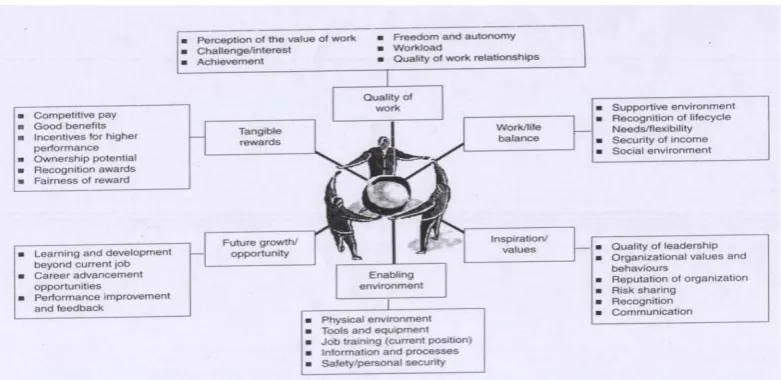
In the late 1990s Hay Group developed a model from their employee opinion and rewarding work, which while considering both transactional and relational reward focused on what employees defined as a compelling high-performance workplace. This model comprises of six elements: Tangible rewards, Inspiration and values, Future growth and opportunity, Quality of Work, Enabling environment and Work/life balance.
Fig. 2: The Hay Group Engaged Performance Model
Source: Hay Group
Tangible rewards are transactional rewards while the rest represent relational rewards. Research by Hay Group among employees in UK and elsewhere suggest that the ‘inspiration and values' cluster, followed by 'future growth and opportunity' cluster, is what employees value must, with tangible rewards coming third or fourth in priority except in those organizations where there has been a decline in salary.
IV.
RELATIONAL REWARDS
Inspiration and Values
2
Copyright © 2016. Vandana Publications. All Rights Reserved.
sources of important rewards such as recognitionthrough effective feedback, providing the scope to carry out meaningful work, and providing opportunities for development and learning. They are crucial to the success of performance management and to the values underpinning tangible rewards.
The vital importance of the core values of an organizations as a basis for creating a rewarding work environment was clearly identified by the research conducted by Purecell (2003) and his colleagues. The most successful companies had what the researchers call 'the big idea'. These companies had a clear vision and a set of values, which were embedded, enduring, collective, measured and managed. They were concerned with sustaining performance and flexibility. Clear evidence exists between positive attitude towards HR policies and practices, level of satisfaction, motivation and commitment', and operational performance.
People prefer to work for a high-reputation employer. Employees feel proud if their organisation is included in the 'Best Companies to Work For' surveys or attract favourable press coverage. The sense of shared appreciation encourages employees to improve their performance.
Employees have a strong sense of unfairness if they are asked to shoulder unacceptable levels of risk in an organisation. On the pay front this can involve being on a highly geared incentive or commission scheme where fixed pay element is very small.
Recognition is one of the must powerful methods or rewarding people. They need to know not only how well they have achieved their objectives or carried out their work, but also that their achievements are appreciated. Recognition needs are linked to the esteem needs in the Maslow's hierarchy of needs. These are defined by Maslow as the need to have a stable, firmly based, high evaluation of oneself and to have the respect of others. These needs are classified into two subsidiary sets: first, 'the desire for achievement, for adequacy, for confidence in the face of the world, and for independence and freedom' and second, 'the desire for reputation or status defined as respect or esteem from other people and manifested by attention, importance or appreciation.’
Recognition can be provided by positive and immediate feedback and praise where it is well deserved. Financial rewards closely linked to successful delivery are also an important part of mutually reinforcing systems of recognition. Recognition is also provided by managers who listen to or act upon the suggestions of
their team members and acknowledge their
contributions. Other actions, that provide recognition include promotion, allocation to a high-profile project, enlargement of the job to provide scope for more interesting and rewarding work, and other forms of status or esteem symbols. The use of status symbols has to be exercised with caution as they can be divisive. All informal rewards used without sensitivity can form a zero-sum game; one person's recognition can imply an element of non-recognition to others and the
consequences of having winners and loosers. Procedural justice is very important here and needs thought and careful management.
Communication is not just about the quality of organizational communication, transparency and honesty but an important part of the 'respect equation' called 'employee voice' Perter Boxall and John Purcell (2003) define it as; "Employee voice is the term increasingly used to cover a whole variety of processes and structures which enable and sometimes empower employees directly and indirectly to contribute to the decision making of the firm." Having a voice in the affairs of the firm is rewarding because it recognises the contribution people can make to the success of the organization or their team.
Employees can have a voice as an aspect of normal working relationships between themselves and their managers and as such it is linked closely to reward factors such as recognition, opportunities for achievement and risk sharing. The organization through its policies for involvement can provide motivation and increase commitment and engagement by putting people into situation where their views can be expressed, listened to and acted upon. This is central to Linda Gratton's (2004) concept of ‘democratic enterprise' where she focuses on the importance of adult-adult relationship, that has at its core 'the ‘quality of openness’ [that] is the communication between the individual and his or her boss as well as the involvement the individual feels in the everyday working of the organization.
Future Growth and Opportunity
Learning and development is an intrinsically satisfying and rewarding experience. Ed Lawler (1969) remarks, People enjoy learning. There's no doubt about it and it touches on an important 'treat people right’ principle for both organisations and people." Alderfer (1972) emphasized the importance of the chance to grow as a means of rewarding people and therefore motivating them. He wrote: "Satisfaction of growth needs depends on the person finding the opportunity to be what he or she is most fully and become what he or she can." Employers can offer this opportunity by providing people with a sequence of experience and training that helps equip them for whatever level of responsibility they have the ability to reach. Talented individuals can be given the guidance and encouragement they need to fulfill their potential and achieve a successful career in line with their abilities and aspirations. It helps to work within the context of a 'learning organisation' and provisions can range from planned experience gathering to formal programmes. These can take the form of management and leadership programmes, team leadership development, further skills training, mentoring and one-to-one coaching. Coaching is now making a significant contribution to fast-track learning at senior levels where very specific behaviourial issues may need tackling and where the time or inclination to go on broader leadership programmes is often lacking.
3
Copyright © 2016. Vandana Publications. All Rights Reserved.
management process. Employees especially newemployees are concerned as to how the organization manages and progresses talent. They want reassurances that processes are in place for identifying talent, for succession planning and for fair and reasonably transparent means of making promotion decisions. For the application of this rewards, organizations need to be clear what the criteria are for making lateral and diagonal moves as well as promotion. Competency framework can help a lot here since this can provide additional clarity about what matters to their organization.
Performance improvement and feedback as a means for effective performance management is a powerful way of providing total reward. It can be the basis for developing a positive psychological contract by clarifying the mutual expectations of managers and their staff in an environment focused on success, constructive feedback can be highly motivational. People who are allowed to claim their successes and review what they could do differently in an adult-adult content are given the opportunity to extend their range. Performance reviews should inform personal development planning and encourage self-managed learning. Success should breed success in the creation of a high performance culture. Poorly handled feedback, arbitrary performance rating and forced distributions, lack of follow through on performance agreements and poorly communicated recognition are the common pitfalls that should be avoided.
Quality of Work
Perception of the value of work as appreciable and worthwhile help people channel their discretionary effort into more productive work. In an increasingly knowledge-based economy very few people would be interested in doing repetitive and monotonous jobs which offer very little challenge and interest, if at all. For professionals, challenge and interest are typically critical components of their intrinsic reward package. To make jobs challenging and interesting, the contribution of job design and role development needs to be considered. Job design primarily has two objectives; first, to meet the needs of the organisation for operational efficiency, quality of product or service and productivity and second, to reward individuals by satisfying their needs for meaningful work that provides for interest, challenge and accomplishment. The roles people play at work usually develop as they respond to opportunities and changing demands, acquiring new skills and developing their competencies. Jobs and roles should be suitably modified over time by managers and team members to make the best of people's skills and capabilities to provide optimum levels of intrinsic reward. Ed Lawler (2003) identified intrinsically motivated jobs as those where individuals received meaningful feedback about their performance in roles where they had accountability for a complete process or product, or a significant part of it, and where there was scope of self evaluation. Such roles must be perceived by individuals as requiring them to use abilities they
value to perform the roles effectively and have a high degree of autonomy over setting their own goals and defining paths to these goals.
The need to achieve is felt in varying degrees by all people in all jobs. The level at which it operates depends on the orientation of the individual and the scope provided by the work to fulfill a need for achievement. Employees feel rewarded and motivated if they have the scope to achieve as well as being recognized for their achievement. If achievement motivation is high it will result in behaviour such as taking control of situations or relationships directing the course of events, creating and seizing opportunities, enjoying challenges, reacting swiftly and positively to new circumstances and relationships. People who are driven by the need to achieve are likely to be proactive, to seek opportunities and to insist on recognitions. Those whose orientations are not so strongly defined can be helped to satisfy latent and dormant achievement needs by being given the scope and encouragement to develop and use their abilities productively. Achievement motivation can be supported and developed by organizations by helping develop self-confidence and self-esteem, by sound job design and by a constructive approach to performance management.
Freedom and autonomy is desired by people and they don't prefer to work in a command and control based work environment. They expect to be treated as mature adults and given a measure of freedom and autonomy in the way they go about their work. This goes with the high-trust work places which are more likely to achieve a real performance culture. People who feel constrained or micromanaged are very unlikely to be engaged in their work, and this climate is unlikely to be one fostering much discretionary effort. Therefore, organizations have much to gain by supporting and enabling a high degree of freedom and autonomy.
The workload issue is essentially about the place of work and manageable workloads. People working on production lines where the pace of work in not under their control and not reasonable or manageable find this stressful, and work quality as well as motivation suffers. Professionals working in a long-hours culture where there is little recognition of the pressure to perform tend to feel the same. There is a marked trend for employees in high-pressure jobs who like the work, but not the constant pressure, to seek parallel rewards by restricting their time contract or take additional time off to get a real break.
4
Copyright © 2016. Vandana Publications. All Rights Reserved.
require collaboration and are typically essential to highperformance. They help good relations at work.
Enabling Environment
Physical environment makes a significant difference to how people feel about their work. Well designed and organised offices boost productivity of employees. Organisations are tailoring their work environment to match evolving work styles and be more appealing as a place to spend working hours. A shoddy work environment can give depressing messages about how much the organisation values employees and the standards it expects of them. Employees now regard access to training as a key element in their overall package. It can be particularly important in delayered organisations where upward growth through promotion can be restricted but people can still work on effectiveness in their current role or develop laterally. As jobs and rules evolve, organisations generally need to provide to help maintain and raise performance and learning. Effective training helps maintain motivation and engagement and is a clear sign of organizational investment in its people. It also fosters employability both within the organization and beyond, and enhanced employability is itself perceived as a reward.
The area of information and processes covers the information support provided as part of the work processes and nature and quality of the work processes themselves. There are links to communication and job design and similar imperatives apply. Most employees want to work with open, transparent information flows on issues affecting their work, and they generally expect bureaucracy to be minimised as far as possible. An environment should be created where knowledge sharing is more respected than a 'knowledge is power' mindset, and people can be easily demotivated by secretiveness and the lack of trust that it results in.
Work/life balance
People prefer a supportive environment at work. Most employers now recognize this and the best of them openly recognise needs outside work in their working practices, in the leadership style in use and in an inclusive and supporting culture. The emphasis is on valuing people rather than mobilizing 'workers' helping employees build on their strengths and creating a supportive environment which is critical for achieving organizational goals.
There has been a rising trend of flexible working arrangements. Maternity and paternity provisions are important in this, but also critical are employer attitudes to ongoing family responsibilities, notably childcare and eldercare issue. It is not uncommon now for employers to support and enable part-time working, flexible contracts and working from home. This is seen as an investment and talent management issue. Much depends on the level of trust and on raising these among managers who are initially skeptical. Work/life balance policies can therefore reward people by recognising their needs outside work by providing more flexible working arrangement and making it clear that people will not be rewarded simply
because they stay on after normal finishing time. It's what they deliver and not how long they work.
Organisations have widened their talent pools by having family-friendly flexible working policies, tackling long hours cultures and putting in resources to make this work. This has benefitted by gaining higher levels of motivation from those for whom flexibility makes the difference at their particular stage of life. This approach is now being further extended with the removal of fixed retirement age and introduction of flexible retirement options.
The social environment element recognises the reality that work is a social institution and that employees expect, at least to some degree, to have a work place that is some kind of community. Often these will be expressed by activities with colleagues but outside work, or social activities may take place in working time and they may be organized by the employer or otherwise. If they are largely missing and work is seen as an impersonal and unsocial environment this will have an effect on levels of engagement. For promoting and fostering this element some investment may be required, if not in financial terms then in time and leadership effort to improve the social climate.
V.
CONCLUSION
The notion of relational rewards is a basic feature of Behavioural Economic Models which started developing in the later half of twentieth century. It was acknowledged that the productivity of an organisation can be influenced significantly by management practices which incorporate need and behavioural aspects of an individual. Relational rewards assumed more importance in the transition from a manufacturing workplace to a work environment having a knowledge-driven nature. In this emerging environment, the employees make greater use of their intellectual faculties within a problem-solving and decision-making framework Since such task assignments are mentally intensive employees can derive intrinsic satisfaction and motivation in doing them. Theorising in this area become more focused with the total reward concept being defined by World at Work and further developed by The Hay Group. The hay Group's model of engaged performance constructed the various dimensions of relational rewards. This area became more interesting when it was contested that pay for performance could reduce employee motivation and block improved performance in a task with intrinsic potential to motivate. In such tasks extrinsic rewards would not be valued and could result in lower task motivation. Intrinsic reward would be more useful in such situations.
5
Copyright © 2016. Vandana Publications. All Rights Reserved.
transactional and relational rewards increase mutualleverage creating a deeper and long lasting impact on employees' performance and commitment towards sustainable organisations success. Relational rewards appear to bind employees more strongly to the organisation as they deliver a positive psychological contract that meets specific individual needs. It should however be noted that the effectiveness of a reward system being used depends upon the broad circumstances in which it is being applied and there is no one best possible way of making them effective. Rewards, both transactional and relational are significant while designing an effective and successful compensation programme. Reward mix or reward package is the main source of generating desired behaviour, productivity and motivation to the desired levels. The implication is that for adopting relational rewards in the reward package the organisation's HR policies and practices have to be people oriented.
The nature of organisations is fast becoming knowledge intensive leading to high compensation costs as a proportion of total costs. This trend shall prevail in the future and is likely to get more accentuated. Therefore, controlling compensation costs will become a very pressing imperative for all organisations. An increase in transactional rewards directly increases compensation expenses without any assurance of productivity increasing in line with the expenses. Relational rewards being non-pecuniary in nature do not add on to the compensation expenses and enhance the productivity and creativity of the employees. These rewards lead to elevated levels of motivation and also inculcate a feeling of organisational citizenship. The unique features of relational rewards can be adopted by all organisations for performance management and enhancement. Incorporation and total reward system can make the compensation practices more broad based and flexible leading to a win-win situation for both employees and employers.
REFERENCES
[1] Alderfer, C.P. 1972. Existence, Relatedness and Growth: Human Needs in Organizational Settings. The Free Press, New York.
[2] Armstrong, M., and Murlis, H. 2004. A Handbook of Salary Administration. Kogan Page, London
[3] Armstrong, M., and Stephen, P. 2005. A Handbook of Employee Reward Management and Practice. Kogan Page, London.
[4] Azasu, S. 2009. Rewards and Performance of Swedish Real Estate Firms. Compensation Benetits Review. 19-28.
[5] Boxall, P., and Purcell, J. 2003. Strategic Human Resource Management. Routledge, London.
[6] Bretton, J., and Gold, J. 2003. Human Resource Management: Theory and Practice Palagrave Macmilan, New York.
[7] Chen, H.M., and Hsich, Y.H. 2006. Key Trends of the Total Reward System in the 21st
[30] Worldatwork, 2000. Total Rewards: From Strategy to Implementation, Worldatwork, Scottsdale.
Century. Compensation Benefits Review, 64-70.
[8] Chiang, F., and Britch, T. 2007. The Transferability of Management Practices: Examining Cross-National Differences in Reward Performances. Human Relations, 1293-1330.
[9] De Charms, R. 1968. Personal Causation: The Internal Affective Determinants of Behaviour. Academic Press, New York.
[10] Deci, E.L. 1971. Effects of Externally Motivated Rewards on Intrinsic Motivation. Journal of Personality and Social Psychology.
[11] Deci, E.L., and Ryan, R.M. 1985. Intrinsic Motivation and Self-Determination in Human Behaviour. Plenum, New York.
[12] Deeprose, D. 1994. How to Recognize and Reward Employees. Amacom, New York, USA.
[13] Giancola, F.L. 2009. Is Total Reward a Passing Fad? Compensation Benefits Review, 29-35.
[14] Gratton, L. 2004. The Democratic Enterprise: Liberating Your Business with Freedom, Flexibility and Commitment. Prentice Hall, London.
[15] Herzberg, F. 1966. Wok and the Nature of Man. World Publishing, Cleveland.
[16] Hutcheson, K. 2007. The Complete Package. HR Horizons, 1-5.
[17] Lawler, E.E. 1969. Job Design and Employee Motivation. Personnel Psychology, 22.
[19] Lawler, E.E. 2003. Treat People Right. Jossey-Bass Inc. San Francisco.
[20] Milkovich, G.T, and Boundreau, J.W. 1998. Human Resource Management. Business Publications Inc, Texas, USA.
[21] Mintzberg, H. 1987. Crafting Strategy, Harvard Business Review, 66-74
[22] Murlis, H. 1996. Pay at the Crossroads, IPD, London.
[23] O'Neal, S. 1998. The Phenomenon of Total Rewards. ACA Journal.
[24] Pfeiffer, J. 1998. The Human Equation: Building Profits by Putting People First. Harvard Business School Press, Boston, MA.
[25] Purcell, J. 2003. Inside the Black Box: How People Management Impacts on Organistional Performance. CIPD, London.
[26] Reilly, P. 2003. New Approaches in Reward: Their Relevance to the Public Sector. Public Money Management, 245-252.
[27] Rumpel, S. and Medcof, J.W. 2006. Total Rewards: Good Fit for Technical Workers, Technological Managemnt, 27-35.
[28] Schinder, B., Smith, D.B., and Sipe, W.P. 2000. Personnel Selection Psychology. Multilevel Considerations, Jossey-Bass, San Fransisco.