100
Copyright © 2018. IJEMR. All Rights Reserved.
Volume-8, Issue-3, June 2018
International Journal of Engineering and Management Research
Page Number: 100-108
Can Automation Eliminate Human Intervention?
Dr. K. R. Subramanian
Professor of Management & Senior, Consultant – Operations, Credait.com, INDIA
Corresponding Author: [email protected]
ABSTRACT
As the competition intensifies in the market for products and services and the need for recognition, companies in their effort to reduce operating costs see automation as a solution. While how much of and to what extent the process is to be automated to avoid the deployment of manpower is still engaging the attention of corporate and researchers. While automation provides predictable, consistent performance, it lacks judgment, adaptability and logic. While humans provide judgment, adaptability and logic, they are unpredictable, inconsistent and subject to emotions and motivation. To optimize performance in an organization, do we minimize human input and lose efficient, consistent, error-free system performance from automated the process? The present paper will seek to answer the question "how can we minimize human error while still maximizing system performance? What is the right human-machine mix? While we would all like to minimize human error and maximize performance in any system, the decision to automate or of how much to automate is still in the domain of human decision making. There are a number of factors to be considered while planning a system that requires a combination of human input and automated control.
Keywords--- Technical Advancements, Automated Controls, Human Judgment, Logic and Adaptability, How Can We Maximize System Performance With Minimum Human Intervention?
I.
INTRODUCTION
Some reasons for the decision to automate a system are; relieve humans of time-consuming and laborious tasks (Parasuraman et al. 1997), speed the operation, increase production rates, extend an operation to a longer shift or even to continuous production, reduce system inefficiencies or ensure physical specifications are consistently maintained. Automated operations are considered to be more efficient, reliable and accurate than those carried out with human interaction and is often assumed that a machine can perform a particular function at a lower cost than a human being. While many of these reasons are true to some extent and context,
humans still provide the valuable roles of decision-making, planning and creative thinking. These higher cognitive functions, while still being further explored (artificial intelligence and neural networks), can be assigned to humans better than machines. As mentioned in the abstract, humans are an interactive component in the overall system and adapt, specialize and fill many roles in a system's operation, but this variability can be both positive and negative.
Figure 1: The automatic coffee maker
101
Copyright © 2018. IJEMR. All Rights Reserved.
II.
OBJECTIVES & METHODOLOGY
As is evident from the introduction, the methodology is easily determined to desk research, as it was found convenient and also adequate data was available from published sources in print and other electronic media. While the overriding objective is to answer the research question as to whether automation can entirely eliminate the human interaction is easily answered in one word, it is not as easy as it looks. One has to look into the various aspects of development and progress of human settlements and their current and futuristic outlook. In the current environment it is difficult to make man do more and more work as it is considered drudgery, particularly repetitive cores. This is where automation has scored over manual intervention and will continue to do so. But the moot question is where to mark the line of separation as it is becoming more and more difficult to do so. With these considerations in view, the following specific Objectives have been identified for the current research:
1. An over view of the business environment up to the present.
2. Environmental Factors contributing to industrial automation.
3. Is Automation, the right answer to all situations?
4. Current developments in automation and future outlook.
5. Conclusions and Recommendations
The above mentioned specific objectives have been identified for the current research, since the field is large so that a focused attention can be given to the identified Questions. A lot of research work has been done and I compliment all researchers for their contribution in enhancing and understanding the attention that the topic deserves. At the end of the day as a researcher, one finds satisfaction that some new thoughts and ideas have been suggested for better understanding and further
exploration. I would like to wish all the researchers, current and future, the best for their success and continued efforts.
III.
REVIEW OF LITERATURE
Automation can be simply defined, as a business process which can operate without human intervention and often with very little interference. The Automation consists of identifying various decision points in a process and makes the flow continue efficiently with the least human interference or interface. It means the creation of logical structures in a way that makes the input and output data Mutually Exclusive and Collectively Exhaustive (MECE) so that the process continues without the need to make any decision.
102
Copyright © 2018. IJEMR. All Rights Reserved.
Figure 2: Automating Process
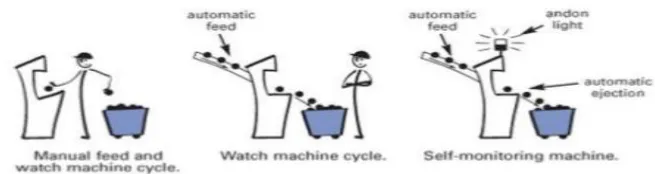
Unless a process is completely automated without any need for intervention, the balance between the automated and non- automated portions of the process has to be maintained. JIDOKA (A Japanese system by Toyota) operates within this continuum till the
process is completely automated without a need for human intervention.
Figure 3: Illustration of Jidoka system
JIDOKA or the ‗intelligent automation‘ system as it is called consists of four principles, which are followed for implementing the system.
These are
1. Detect any abnormality in the existing system. 2. Stop the process.
3. Take immediate corrective action. 4. Analyze the root cause and find a permanent solution.
103
Copyright © 2018. IJEMR. All Rights Reserved.
called the ‗closing the feedback loop‘ (LISTEN, ANALYSE AND ACT). In the absence of completely automated system, JIDOKA is to be instituted till full automation without human intervention is possible. Jidoka ensures cost savings in partially automated systems. When properly implemented this will reduce a large amount of costs, reduce labor and improve overall productivity. This means that as and when production stops, root causes may be analyzed to find permanent solution to the problem. Jidoka provides active feedback during the process of automation till the objective is realized. True automation is not achieved suddenly and Jidoka is a system that helps accelerating the process of automation. In spite of saying this small or partial processes can be fully automated where the errors are minimal and can be tolerated.
The difference between manufacturing with labor intensive process and making the same with machines has profound distributive implications! Moreover, these implications are entirely independent of activities of labor union and their influence on management. Now suppose we replace all the workers with machines, Questions of distributive fairness disappear! When you have the ownership of machines; you do not owe anything to workers! Of course, the principal reason to go automate is not that machines don't slack off, become indignant in the face of injustice like the workers, who may go on strike.
VI.
THE DISTRIBUTIVE
CONSEQUENCES OF AUTOMATION
Union power will not suffice to maintain broadly shared prosperity in the face of increasing automation.
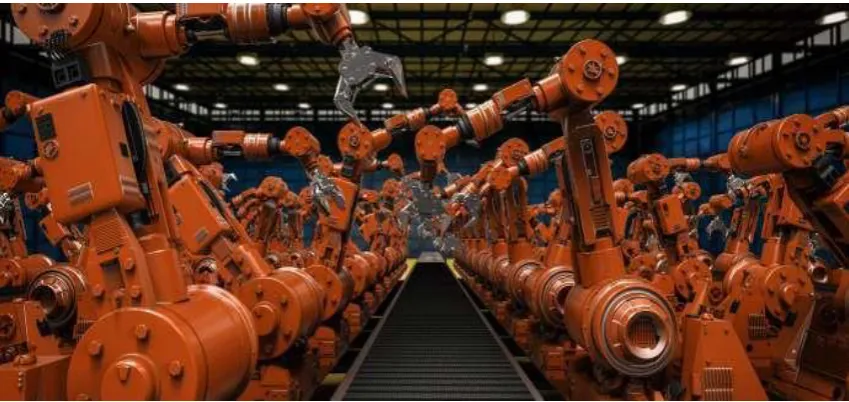
THERE have been a number of stimulating blogs and posts in response to the stimulating Paul Krugman writings, regarding which classes of workers can and cannot be replaced by mindless automaton, and the implications of this on policy making. Krugman advises direct interventions to more equitable distribution of wealth. So workers are slowly squeezed out of manufacturing by automation, and the squeeze continues. This squeeze has many implications; one of them being that here is an important sector of the economy in which more or less all the gains accrue to the owners of capital and none to the working class, simply because the working class doesn't work here anymore. By inference, the distributive upshot of such developments is that the owners of robots become a bit richer than they were when they employed workers, and that the robot-owning class moves up a bit relative to the no-longer-manufacturing working class, even if the efficiencies of increasing automation, together with that of other innovations, have given the working class, now employed in "services", a steady or slightly rising real standard of living.
Figure 4: Industrial Automation through Robots
This little tale is of course rife with oversimplification, but technological change shifts the distribution of income and wealth in ways that have nothing to do with (a) the decline of union power or (b) structural injustice. When the nature of production in a large chunk of the economy changes, a lot of things change with it. Sometimes, trends in income growth and inequality are among those changes. Of course, it's never this simple, but one certainly sees danger in the possibility of extreme stratification between owners and non-owners of capital. Eventually, a society of
adequately shared prosperity not based on constant, disruptive, inefficient redistributive intervention will need to be based on universal ownership of claims to the output of robots.
104
Copyright © 2018. IJEMR. All Rights Reserved.
intelligence algorithms can process thousands more documents – and then act faster – than any human and are free from human biases. The Centre for Strategic Futures, a think-tank within the Singapore Government, and the Ministry of Manpower in Singapore, are conducting a study similar to Frey and Osborne‘s using Singapore labor data, to explore some of these issues. One interesting question the study has raised so far is whether some professions might face ―broken career ladders‖, where entry-level workers no longer have a clear path for career progression because the tasks they would traditionally perform in order to progress have been automated.
The traditional approach of helping workers upgrade by ―up-skilling‖ will not necessarily reduce a worker‘s susceptibility to being displaced by the new wave of automation. Workers will need to develop new skills to take on very different kinds of jobs, possibly in different industries. Presently, most governments dedicate resources towards helping low-skilled workers secure better jobs through training and education. Yet this shift will affect workers across the employment spectrum. Thus, governments need to work with stakeholders to rethink the kind of pre-employment and post-employment training institutions should offer to enable professionals to keep pace with these developments. What are the new job opportunities that may emerge? How can we ensure that the benefits accrue to a broad spectrum of society and not only to the most highly skilled and well-resourced? At times, it may seem as if technology is a force greater than humans, forcing workers and businesses to adapt – or perish. Yet governments play a key role in shaping how technology advances. The sooner governments, in partnership with the rest of society, examine the future impact of this structural shift, the sooner they can act to ensure the shift benefits society.
Robotics and machine learning have improved productivity and enhanced the economies of many nations. Artificial intelligence (AI) has advanced into
finance, transportation, defense, and energy
management. In all of this, there is a possibility of a new era that could improve the lives of many people; yet
amid these possible benefits, there is widespread fear that robots and AI will take jobs and throw millions of people into poverty. A pew research center study asked 1,896 experts about the impact of emerging technologies
and found ―half of these experts (48 percent) envision a future in which robots and digital agents [will] have displaced significant numbers of both blue- and white-collar workers—with many expressing concern that this will lead to vast increases in income inequality, masses of people who are effectively unemployable, and breakdowns in the social order.‖ These fears have been echoed by detailed analyses showing anywhere from a
14 to 54 percent automation impact on jobs. For example, a bruegel analysis found that ―54% of EU jobs are at risk of computerization.‖Using European data, they argue that job losses are likely to be significant and people should prepare for large-scale disruption.
105
Copyright © 2018. IJEMR. All Rights Reserved.
Figure 5: Estimates of loss of jobs due to Automation
While some dispute the dire predictions on grounds new positions will be created to offset the job losses, the fact that all major studies report significant workforce disruptions should be taken seriously. If the employment impact falls at the 38 percent mean of these forecasts, Western democracies likely could resort to authoritarianism as happened in some countries during the Great Depression of the 1930s in order to keep their restive populations in check. If that happened, wealthy elites would require armed guards, security details, and gated communities to protect themselves, as is the case in poor countries today with high income inequality. The United States would look like Syria or Iraq, with armed bands of young men with few employment prospects other than war, violence, or theft.
The problem with this rose-tinted view of automation, however, is its focus on big averages that take little account of individual experiences, that is little consolation to someone who loses their job in a Midlands car plant to a robot and discovers most of the new openings are far afield in the coffee bars and hotels of London. Nor do studies of what has gone before allow for the fact that the pace of technological change will probably be quicker in the future. In other words, evolutions that took place over previous decades may
well have been gradual enough for most people to find new ways of making a living, with varying degrees of difficulty. But faster and more widespread technological changes in the future are unlikely to be so easy to adapt to. For governments, this imposes a pressing need to step in and ensure the rise of the robots is not accompanied by a further rise in inequality. As tempting as it may be to pour money into boosting automation in return for the long-awaited boost to productivity and headline economic growth, doing so without having a clear plan for retraining displaced workers would cause untold harm to millions of individuals.
106
Copyright © 2018. IJEMR. All Rights Reserved.
equipping people to adapt as automation shakes up their workplaces. If the government fails to act, the result could all too easily be a spike in unemployment and
poverty in places with the lowest skilled workers – a very high price to pay for a bit of average productivity growth.
Figure 6: Automation Technology & impact on Employment
There is considerable interest, if not consternation, about the potential effects of emerging technologies such as robotics and artificial intelligence on employment. There is also considerable confusion about the interaction between automation, technology, and jobs. Automation is here to stay, as more and more processes can be changed to avoid or reduce human intervention. Though there is truth in automation displacing humans from their current occupation, it is the fond hope and the carrot extended by capitalists that they will find other occupations which the machines still cannot do. This is a moot question which only the future can answer.
IV.
ANALYSIS AND CONCLUSION
That the business environment changes constantly and offers new challenges is understood easily, but how the humans cope with the changes is the matter of concern for many of us. Since the future is so uncertain and we cannot stop for a moment without thinking about it, we get into some worries and concerns which are genuine but will get solved by human ingenuity and constant evolution.
The challenges of the business environment are never ending and so we move from one to another challenge in our process of evolution. One remarkable feature of the current business environment is that the dynamic changes are happening at a faster pace for us to cope with. We need to run faster or else we would stumble and fall. From the day of the invention of the wheel to the present there has been no respite to the fast process of evolution needing the humans to adapt continuously. During this futuristic and evolutionary journey sometimes we feel stumbled by the enormity and speed of change.
One such challenge in the life history of humans is the development of automatic processes. Man has been preoccupied with concerns of productivity that is how to make things with less and less resources to input. Most of the industrial processes, since the industrial revolution developed to reduce the need for frequent human intervention so that the process could continue uninterrupted. This was a need of the times, and so productivity improvements aimed at reducing manpower and redeploying the same elsewhere to improve profitability and industrial growth. The scale of operation became a serious issue with globalization of business leading the way to large scale automation.
With the progress of automation started large scale displacement of industrial labor who could not find alternative employment. This is because they were not only unprepared but untrained to take up within their industry or in others because manufacturing technology had advanced in the meantime needing very little manpower which were better qualified and trained. The workers who faced displacement was middle aged with families and children and were found difficult to migrate to a new place and environment. This is the point at which people started reflecting on the pace of automation and if it was good.
107
Copyright © 2018. IJEMR. All Rights Reserved.
an opportunity to make more money with less and less for distribution. This has further increased the speed of automation and consequently the world over there is recognition, though slowly but steadily that all is not honky dory with the fast pace of automation. Humans are being reduced to sub-humans!
RECOMMENDATION
Mankind has gone through the evolutionary cycle successfully earlier. The difference between the
changes are taking place. The Political ramifications of these changes have been the subject of discussion in various conferences and seminars. Many thinkers feel that man is worst enemy. Mindless Automation it is
because they do not have to negotiate with unions and their new found power may have a corruptive influence in society. More than the economic consequences, it is felt and there is a growing body who think in these lines.
Many thinkers and analysts, mostly from a social point of view and not from a business perspective really dread the consequences of the current wave of automation. Many around the world who have seen the world wars and the genesis of the same feel that automation will lead to concentration of Financial Power and eventually economic power in the hands of a few which would make them the despots that history has seen. Many consultants do not favor and may not favor this view because the rich and powerful and the capitalists pay them to write their stories. The author would like to conclude that this subject needs further in depth research by scientists from different nationalities with a world view of welfare.
REFERENCES
A. BOOKS, PERODICALS AND MAGAZINES
[1] Anjana Meel, Warren D, Seider, & Ulku Oktem. (2007). Analysis of management actions, human behavior and process reliability of chemical plants, impact of management actions. Process Safety Progress, 27(1), 7-14.
[2] Haight, J.M. & Kecojevic, V. (2005). Automation vs. human intervention: What is the best fit for the best performance? Process Safety Progress Journal, American Institute of Chemical Engineers,24(1), 45–51. [3] Haight, J.M. & Caringi, R.G. (2007). Automation vs. human intervention: What is the best mix for optimum system performance? A case study. International Journal Risk Assessment and Management, 7(5), 708– 721.
[4] Hammond, K.R. (1996). Human judgment and social
policy: Irreducible uncertainty, inevitable error,
unavoidable injustice. New York, USA: Oxford
University Press.
[5] Petersen, D. (1996). Human error reduction and safety management. (3rd ed.). New York, USA: Van Nostrand Reinhold.
[6] Aaron Smith & Janna Anderson. (2014 August 6). AI, robotics, and the future of jobs. Pew Research Center, Available at:
http://www.pewinternet.org/2014/08/06/future-of-jobs/
[7] Carl Benedict Frey & Michael Osborne. (2013). The future of employment: How susceptible are jobs to computerization? Oxford University paper, 1-72. Available at:
https://www.oxfordmartin.ox.ac.uk/downloads/academic
[8] Waterson, P.E., Older Gray, M.T. & Clegg, C.W. (2002). A sociotechnical method for designing work
Factors and Ergonomics Society, 44(3), 376–391.
automation: Use, misuse, disuse and abuse. Human
[11] Dzindolet, M. T., Pierce, L. G., Beck, H. P., Dawe, L. A., & Anderson, B. W. (2001). Presenting misuse and disuse of combat identification systems. Military Psychology, 13(3), 147-164.
[12] Degani, A. & Heymann, M. (2002). Formal verification of human-automation interaction. Human Factors, The Journal of the Human Factors and Ergonomics Society, 44(1), 28–43.
[13] Haight, J.M.& Kecojevic, V. (2005). Automation vs. human intervention: What is the best fit for the best performance? Process Safety Progress Journal, American Institute of Chemical Engineers, 24(1), 45–51. [14] Kirlik, A. (1993). Modeling strategic behavior in human-automation interaction: Why an ‗Aid‘ can (and should) go unused. Human Factors; The Journal of the Human Factors and Ergonomics Society, 35(2), 221– 242.
[15] Molloy, R. & Parasuraman, R. (1996). Monitoring an automated system for a single failure: Vigilance and task complexity effects. Human Factors; The Journal of
the Human Factors and Ergonomics Society,38(2), 311–
322.
[16] Peters, G. (1966). Human error: Analysis and control. The Journal of the American Society of Safety Engineers, 11(1), 9–15.
[17] Bailey NR & Scerbo MW. (2007). Automation-induced complacency for monitoring highly reliable systems: The role of task complexity, system experience, and operator trust. Theoretical Issues in Ergonomics Science, 8(4), 321–348.
[18] Hogg, D.N., Folleso, K., Strand-Volden, F., & Torralba, B. (1995). Development of a situation awareness measure to evaluate advanced alarm systems in nuclear power plant control rooms. Ergonomics,38
(11), 2394- 2413
.
.[19] Endsley MR, & Kaber DB. (1999). Level of automation effects on performance, Situation awareness and workload in a dynamic control task. Ergonomics in
earlier times and the present is the speed at which the
predicted may find new capitalist lords emerging
/The_Future_of_Employment.pdf
systems. Human Factors, The Journal of the Human
[9] Jay P. shah, KrutikY. Shah, & Dipak Tarbada. (2017). Improve the process of wheel bearing fixture system by
automation. IJEMR, 7(6), 169-173.
[10] Parasuraman, R. & Riley V. (1997). Humans and
Factors, The Journal of the Human Factors and
108
Copyright © 2018. IJEMR. All Rights Reserved.
Design: The Quarterly of Human Factors Applications,42(3), 462–492.
[20] Hancock PA, Jagacinski RJ, Parasuraman R, Wickens CD, Wilson GF, & Kaber DB. (2013). Human-automation interaction research: Past, present, and future. Ergonomics in Design: The Quarterly of Human Factors Applications, 21(2), 9–14.
[21] Kaber DB, Endsley MR. (2004). The effects of level of automation and adaptive automation on human performance, Situation awareness and workload in a dynamic control task. Theoretical Issues in Ergonomics Science,5(2), 113–153.
[22] Lee JD & See KA. (2004). Trust in automation: Designing for appropriate reliance. Human Factors and Ergonomics Society, 46(1), 50–80.
[23] McBride SE, Rogers WA, & Fisk AD. (2011). Understanding the effect of workload on automation use for younger and older adults. Human Factors, 53(6), 672–686.
[24] Moray N. (2003). Monitoring, complacency, skepticism and eutectic behavior. International Journal of Industrial Ergonomics, 31(3), 175–178.
[25] Muir BM. (1994). Trust in automation: Part I. Theoretical issues in the study of trust and human intervention in automated systems. Ergonomics, 37(11), 1905–1922.
[26] Sarter NB, Woods DD, & Billings CE. (1997). Automation surprises. Handbook of human factors and ergonomics. (2nd ed.). New York, USA: Wiley. 1926– 1943.
[27] Wickens CD, Li H, Santamaria A, Sebok A, & Sarter NB. (2010). Stages and levels of automation: An integrated meta-analysis. Proceedings of the Human Factors and Ergonomics Society 54th Annual Meeting. 5(1), 389–393.
[28] Wiener EL, & Curry RE. (1980). Flight-deck automation: Promises and problems. Ergonomics, 23(10), 995–1011.
[29] Rouse, W. B., Cannon-Bowers, J. A., & Salas, E. (1992). The role of mental models in team performance in complex systems. IEEE Transactions on Systems, Man, and Cybernetics, 22(6), 1296-1308.
[30] Jian, J., Bisantz, A. M., & Drury, C. G. (2000). Foundations for an empirically determined scale of trust in automated systems. International Journal of Cognitive Ergonomics, 4(1), 53-71.
B. WEB REFERENCES
[1] https://ssrn.com/abstract=1290223, [2]