Picasso
: A Sparse Learning Library for High Dimensional
Data Analysis in
R
and
Python
∗Jason Ge† [email protected]
Xingguo Li§ [email protected]
Haoming Jiang [email protected]
Han Liu‡ [email protected]
Tong Zhang‡ [email protected]
Mengdi Wang† [email protected]
Tuo Zhao [email protected]
†Department of Operations Research and Financial Engineering, Princeton University
§Computer Science Department, Princeton University
School of Industrial and Systems Engineering, Georgia Tech
‡Tencent Artificial Intelligence Lab
Editor:Cheng Soon Ong
Abstract
We describe a new library named picasso 1, which implements a unified framework of pathwise coordinate optimization for a variety of sparse learning problems (e.g., sparse linear regression, sparse logistic regression, sparse Poisson regression and scaled sparse linear regression) combined with efficient active set selection strategies. Besides, the library allows users to choose different sparsity-inducing regularizers, including the convex `1, nonvoncex MCP and SCAD regularizers. The library is coded inC++and has user-friendly
R andPython wrappers. Numerical experiments demonstrate that picasso can scale up to large problems efficiently.
1. Overview
Sparse Learning arises due to the demand of analyzing dimensional data such as high-throughput genomic data (Neale et al., 2012) and functional Magnetic Resonance Imaging (Liu et al., 2015). The pathwise coordinate optimization is undoubtedly one the of the most popular solvers for a large variety of sparse learning problems. By leveraging the solution sparsity through a simple but elegant algorithmic structure, it significantly boosts the computational performance in practice (Friedman et al., 2007). Some recent progresses in (Zhao et al., 2017; Li et al., 2017) establish theoretical guarantees to further justify its computational and statistical superiority for both convex and nonvoncex sparse learning, which makes it even more attractive to practitioners.
∗. Jason Ge and Xingguo Li contributed equally. Tuo Zhao is the corresponding author. 1. More details can be found in our Github page: https://github.com/jasonge27/picasso
c
We recently developed a new library namedpicasso, which implements a unified toolkit of pathwise coordinate optimization for solving a large class of convex and nonconvex reg-ularized sparse learning problems. Efficient active set selection strategies are provided to guarantee superior statistical and computational preference. Specifically, we implement sparse linear regression, sparse logistic regression, sparse Poisson regression and scaled sparse linear regression (Tibshirani, 1996; Belloni et al., 2011; Sun and Zhang, 2012). The options of regularizers include the `1, MCP, and SCAD regularizers (Fan and Li, 2001;
Zhang, 2010). Unlike existing libraries implementing heuristic optimization algorithms such
as ncvreg or glmnet (Breheny, 2013; Friedman et al., 2010), our implemented algorithm
picasso have strong theoretical guarantees that it attains a global linear convergence to a
unique sparse local optimum with optimal statistical properties (e.g. minimax optimality and oracle properties). See more details in Zhao et al. (2017); Li et al. (2017).
2. Algorithm Design and Implementation
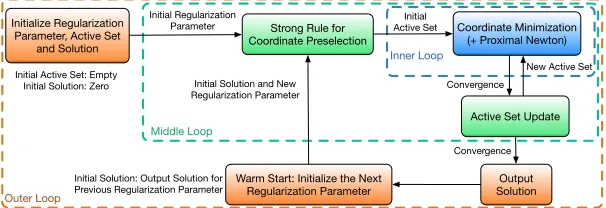
The algorithm implemented inpicassois mostly based on the generic pathwise coordinate optimization framework proposed by Zhao et al. (2017); Li et al. (2017), which integrates the warm start initialization, active set selection strategy, and strong rule for coordinate prese-lection into the classical coordinate optimization. The algorithm contains three structurally nested loops as shown in Figure 1:
(1) Outer loop: The warm start initialization, also referred to as the pathwise optimiza-tion scheme, is applied to minimize the objective funcoptimiza-tion in a multistage manner using a sequence of decreasing regularization parameters, which yields a sequence of solutions from sparse to dense. At each stage, the algorithm uses the solution from the previous stage as initialization.
(2) Middle loop: The algorithm first divides all coordinates into active ones (active set) and inactive ones (inactive set) by a so-called strong rule based on coordinate gradient thresholding (Tibshirani et al., 2012). Then the algorithm calls an inner loop to optimize the objective, and update the active set based on efficient active set selection strategies. Such a routine is repeated until the active set no longer changes
(3) Inner loop: The algorithm conducts coordinate optimization (for sparse linear regres-sion) or proximal Newton optimization combined with coordinate optimization (for sparse logistic regression, Possion regression, scaled sparse linear regression, sparse undirected graph estimation) only over active coordinates until convergence, with all inactive coordi-nates staying zero values. The active coordicoordi-nates are updated efficiently using an efficient “naive update” rule that only operates on the non-zero coefficients. Better efficiency is achieved by the “covariance update” rule. See more details in (Friedman et al., 2010). The inner loop terminates when the successive descent is within a predefined numerical precision. The warm start initialization, active set selection strategies, and strong rule for co-ordinate preselection significantly boost the computational performance, making pathwise coordinate optimization one of the most important computational frameworks for sparse learning. The numerical evaluations show that picassois highly scalable and efficient.
The implementation is modularized so that the algorithm in src/solver/actnewton.cpp
works with popular sparsity-inducing regularizer functions and any convex objective func-tion that exhibits restricted strong convexity property (Zhao et al., 2017). Users can easily extend the package by writing customized objective function subclass and regularizer func-tion subclass following the virtual funcfunc-tion interfaces of class ObjFunction and class
RegFunctionininclude/picasso/objective.hpp.
Initialize Regularization Parameter, Active Set
and Solution
Strong Rule for
Coordinate Preselection Coordinate Minimization(+ Proximal Newton)
Active Set Update
Output Solution Warm Start: Initialize the Next
Regularization Parameter
Convergence
Convergence
New Active Set Initial
Active Set
Initial Solution and New Regularization Parameter
Inner Loop
Middle Loop
Outer Loop
Initial Regularization Parameter
Initial Active Set: Empty Initial Solution: Zero
Initial Solution: Output Solution for Previous Regularization Parameter
Figure 1: The pathwise coordinate optimization framework with 3 nested loops: (1) Warm start initialization; (2) Active set selection, and strong rule for coordinate preselection; (3) Active coordinate minimization.
3. Example of R User Interface
We illustrate the user interface by analyzing the eye disease data set in picasso.
> library(picasso); data(eyedata) # Load the data set
> out1 = picasso(x,y,method="l1",type.gaussian="naive",nlambda=20,
+ lambda.min.ratio=0.2) # Lasso
> out2 = picasso(x,y,method="mcp", gamma = 1.25, prec=1e-4) # MCP regularizer
> plot(out1); plot(out2) # Plot solution paths
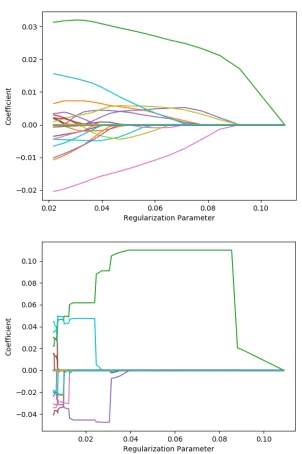
The program automatically generates a sequence of regularization parameters and esti-mate the corresponding solution paths based on the`1 and MCP regularizers respectively.
For the `1 regularizer, we set the number of regularization parameters as 20, and the
min-imum regularization parameter as 0.2*lambda.max. For the MCP regularizer, we set the concavity parameter as γ = 1.25, and the pre-defined accuracy as 10−4. Herenlambda and
lambda.min.ratio are omitted, and therefore set by the default values (nlambda=100and
lambda.min.ratio=0.05). We further plot two solution paths in Figure 2.
4. Numerical Simulation
To demonstrate the superior efficiency of our library, we comparepicassowith a popularR
libraryncvreg(version 3.9.1) for nonconvex regularized sparse regression, the most popular
Rlibraryglmnet(version 2.0-13) for convex regularized sparse regression, and twoRlibraries
scalreg-v1.0 and flare-v1.5.0 for scaled sparse linear regression. All experiments are
and d is the dimension of the parameter vector. We tests the algorithms for both well-conditioned cases and ill-well-conditioned cases. The details of data generation can be found in theRlibrary vignette. Here is our summary:
(1) For sparse linear regression using any regularizer and sparse logistic regression using the `1 regularizer, all libraries achieve almost identical optimization objective values, and
picasso slightly outperformsglmnetand ncvregin the timing performance.
(2)For sparse logistic regression using nonconvex regularizers,picassoachieves comparable objective value with ncvreg, and significantly outperforms ncvregin timing performance. We also remark that picasso performs stably for various settings and tuning parameters. However, ncvregmay converge very slow or fail to converge for sparse logistic regression using nonconvex regularizers, especially when the tuning parameters are relatively small (corresponding to denser estimators), as the ill-conditioned SCAD case shows.
(3) For scaled Lasso, in order to make other competitors (flare and scalreg) converges in resonable time, we swtich to a smaller problem size (n= 1000, d= 10000). We see that
picasso much more time saving thanflareand scalreg.
Table 1: Average timing performance (in sec-onds) with standard errors in the parentheses and achieved objective values.
Sparse Linear Regression
well-conditioned ill-conditioned
`1
picasso 1.61(0.03)s 27.691 3.62(0.02)s 32.543
glmnet 4.15(0.03)s 27.692 9.43(0.01)s 32.537
ncvreg 5.92(0.01)s 27.690 6.66(0.01)s 32.536
SCAD picasso 1.56(0.01)s 27.668 3.74(0.01)s 33.133
ncvreg 5.61(0.01)s 27.673 7.05(0.01)s 33.156
MCP picasso 1.47(0.02)s 27.161 1.89(0.02)s 32.468
ncvreg 4.07(0.03)s 27.161 2.56(0.01)s 32.468 Sparse Logistic Regression
`1
picasso 2.03(0.01)s 0.363 2.10(0.03)s 0.327
glmnet 16.32(0.12)s 0.363 20.31(0.02)s 0.327
ncvreg 4.04(0.01)s 0.363 62.89(0.04)s 0.327
SCAD picasso 4.25(0.01)s 0.227 4.35(0.02)s 0.172
ncvreg 11.47(0.04)s 0.278 error (>300s)
MCP picasso 4.32(0.01)s 0.221 4.38(0.02)s 0.165
ncvreg 9.37(0.08)s 0.248 6.99(0.01)s 0.242 Scaled Lasso
`1
picasso 0.36(0.01)s 4.454 0.15(0.01)s 5.495
flare 5.23(0.06)s 5.188 297.36(2.77)s 5.959
scalreg 40.20(0.63)s 4.492 49.12(10.98)s 5.507
Figure 2: The solution paths of `1
(up) and MCP (down) regularizers.
5. Conclusion
Thepicassolibrary demonstrates significantly improved computational and statistical
References
A. Belloni, V. Chernozhukov, and L Wang. Square-root lasso: pivotal recovery of sparse signals via conic programming. Biometrika, 98(4):791–806, 2011.
P Breheny. ncvreg: Regularization paths for scad-and mcp-penalized regression models. R package version, pages 2–6, 2013.
J. Fan and R. Li. Variable selection via nonconcave penalized likelihood and its oracle properties. Journal of the American Statistical Association, 96(456):1348–1360, 2001.
J. Friedman, T. Hastie, H. H¨ofling, and R. Tibshirani. Pathwise coordinate optimization.
The Annals of Applied Statistics, 1(2):302–332, 2007.
Jerome Friedman, Trevor Hastie, and Rob Tibshirani. Regularization paths for generalized linear models via coordinate descent. Journal of statistical software, 33(1):1–13, 2010.
Ga¨el Guennebaud, Benoˆıt Jacob, et al. Eigen v3. http://eigen.tuxfamily.org, 2010.
Xingguo Li, Jian Ge, Haoming Jiang, Mengdi Wang, Mingyi Hong, and Tuo Zhao. Boosting pathwise coordinate optimization in high dimensions: Sequential screening and proximal sub-sampled newton algorithm. Technical report, Georgia Tech, 2017.
Han Liu, Lie Wang, and Tuo Zhao. Calibrated multivariate regression with application to neural semantic basis discovery. Journal of Machine Learning Research, 16:1579–1606, 2015.
Benjamin M Neale, Yan Kou, Li Liu, Avi Ma’Ayan, Kaitlin E Samocha, Aniko Sabo, Chiao-Feng Lin, Christine Stevens, Li-San Wang, Vladimir Makarov, et al. Patterns and rates of exonic de novo mutations in autism spectrum disorders. Nature, 485(7397):242, 2012.
T. Sun and C.H Zhang. Scaled sparse linear regression. Biometrika, 2012. to appear.
R. Tibshirani. Regression shrinkage and selection via the lasso. Journal of the Royal Statistical Society, Series B, 58(1):267–288, 1996.
R. Tibshirani, J. Bien, J. Friedman, T. Hastie, N. Simon, J. Taylor, and R. Tibshirani. Strong rules for discarding predictors in lasso-type problems. Journal of the Royal Sta-tistical Society: Series B (StaSta-tistical Methodology), 74(2):245–266, 2012.
C. Zhang. Nearly unbiased variable selection under minimax concave penalty. The Annals of Statistics, 38(2):894–942, 2010.