129
Copyright © 2011-15. Vandana Publications. All Rights Reserved.
Volume-5, Issue-3, June-2015
International Journal of Engineering and Management Research
Page Number: 129-133
The Impact of Brand Ambassador on the Cosmetic Consumers: A Case
Study in the Sivakasi Region
R.S. Devi
Assistant Professor, Department of Commerce (CA), ANJA College, Sivkasi, INDIA
ABSTRACT
Normally, a popular figure would be chosen as a brand ambassador for the company in order of promotional and marketing activities. Celebrities are getting popularity especially through mass communication Medias, who would normally be chosen as brand ambassador with the hope that public can be drawn to attention bit easily for the messages that they deliver. Thus, by transferring or captivating their image values for attention gaining, likeable and impactful to convince and perhaps improve sales and profit. However, it is noticed that on reality there exist very minimum research for the impact of ambassadors’ endorsements on consumers. This is the thrust for framing the problem of studying the influence of brand ambassador on the cosmetic consumers in the Sivakasi region. A total of 60 respondents have finally been considered to survey. Statistical techniques have been adopted to ensure the reliability of data and for analysis of the data. The analysis revealed that the brand ambassadors make significant impact on adolescence in choosing the cosmetic product, however for long standing the quality of the product play a vital role. Further analysis revealed that irrespective of income of several age groups did not disturb the purchasing power of cosmetic products.
Keywords— Brand ambassador, Chi-square test, Cosmetic items, Garrett’s ranking.
I.
INTRODUCTION
Marketing in the present day through brand ambassador or celebrities perhaps considered to be an omnipresent feature [1]. The corporate firms or companies invest substantial amounts of money to align brand name and their products with popular celebrity in the belief that they can drag attention to the proposed products and transfer their image values to these products. Mass media in general cover up with celebrity images and shower with the information about them, this results into elevate their
high profiles, distinctive qualities and dazzling images in the view of the social and public context. Making use of this attributes on public recognition granted on them, celebrities will be chosen as brand ambassador who would frequently appear in advertising in association with consumer products. Brand ambassador endorsement has proven to be a valuable strategy to create high recall rates, distinct product images and generate sales and profits [2]. It is well known that celebrities from sports, films, politics, television etc., will eventually be used by the multinational corporations to give icon image as brand ambassador for their brand and products [3]. With the hope to infringe into consumers’ consciousness and to deliver particular image-laden messages, advertisers make use of the brand ambassador in their communications campaigns to be highly effective. These campaigns are used in the context of marketing communications to attract the mass of customers to promote the social causes and to sell diverse products. Although the popularity of a person could be better used for advertising, it is believed that the success of it is farfetched, such as consumers would be influenced on the brand or the product yet purchasing the product could be studied in a given region. As brand ambassadors resonance the symbolic meanings and values that are closely tied to the social culture on which they could have attained their reputation, the choice of brand ambassadors and the creative execution for the advertising strategy should expose the fundamental cultural orientations and the societal values.
130
Copyright © 2011-15. Vandana Publications. All Rights Reserved.
natural ingredients [6]. However in the present scenario,the consumer or public in general, have a tendency that the cosmetics are more prepared using chemicals instead of natural ingredients; consequently, it may cause more damage to their skin rather than to serve its intended purpose if it is used for long period. Indeed after the information technology pervaded to the public they become more aware and they need more detailed information about the product that they use. Thus, corporate companies would more be invested in marketing their products than even to manufacture the products. In other words, there are heavy investments in marketing strategies to promote their products and to reach the customers successfully. One of the widely accepted strategies is to use celebrities as brand ambassador for their brand and products. Thus, this project has been framed to study the brand ambassadors’ influence on the customers in regards to the cosmetic products. Several branded cosmetic products have been taken into account along with five different corporations and their brand ambassadors such as Unilever, P&G, Cavincare, Yardley & Co. and L’Oreal and their ambassadors’ P. Chopra, S. Shetty, Genelia, K. Kaif and A. Bacchan respectively for the present investigation especially to conduct study in the Sivakasi region during the year December 2010 and January 2011. In particular, the brand ambassadors and the branded products have been used to study that how it impacts on consumers to choose the cosmetic product, but not which brand or brand ambassadors are best in it. The project formulation is discussed in the methodology section.
II.
METHODOLOGY
It is apparent that female celebrities are highly used in promoting the cosmetic products to reach customer. In the present investigation, how effective the promotional activities to reach customer has been taken into account in a broader sense. Thus, the problem in this research is formulated specifically on the impact of the brand ambassadors on the cosmetic consumer in the Sivakasi region. The questionnaire has been set to initially observe the demographic profile and various cosmetic products of the consumers’ interest in general, for which nearly 100 respondents have been approached. This preliminary survey has further been used to narrow down to choose most widely used cosmetic products and so the number of respondents for further analysis is restricted to 60. Further set of questionnaire has been framed to understand the relationship between income of different age group in buying their desired cosmetic items and the age group on which the brand ambassador makes maximum impact. The consumers’ preference of cosmetic items has also been ranked using Garret’s method. The reasons for cosmetic usage and the frequency of its usage have also been analysed. Thus, the primary data is
collected by questionnaires through direct cosmetic consumers in the Sivakasi region and the secondary data had been collected from magazines, advertisements in television, literatures and websites. This survey has been conducted during December 2010 and January 2011.
The collected data is in general are framed a relationship between two parameters, it is called a statement about a parameter. If some relationship is given to those, then it can be termed as null hypothesis, failure to that relationship for the statement is alternative hypothesis, and the decision making procedure about the hypothesis is called hypothesis testing [7]. If the population distribution is unknown or random then it is better to use chi-square test [8]. In the present investigation, a chi square test is adopted to test the hypothesis. The test statistic for the chi-square test is follows:
(1)
The sample size ‘n’ from the population is having ‘k’ intervals, where ‘Oi’ is the observed frequency, ‘Ei’ is the expected frequency and the ‘ ’ is the test statistic. The null hypothesis is rejected at the ‘α‘ level of
significance if . Where, ‘α‘ is the 0.05
level of significance and ‘k-p-1’ is the number of degrees of freedom and the ‘p’ represents the number of parameters of the hypothesized distribution estimated by sample statistics.
In order to do the ranking of data on a particular case, the Garrett’s ranking technique is employed. It is calculated as percentage score and the scale value can be obtained by using scale conversion table. The expression to calculate percentage (%) score is [9]:
(2)
Where, ‘Rij’ is the rank given for ‘ith’ item by the ‘jth’ sample consumers and ‘nj’ is the total rank by the ‘jth
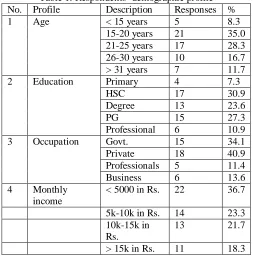
Table 1 is the summary of the demographic composition of the respondents. Under education category, it can be observed from Table 1 that nearly 91.7% are literate and the remaining is non-literate. The non-literate were also been considered in the present study. Similarly, in the occupation category nearly 73.3% of respondents were employed, whilst remaining 27.7% were
’ sample consumers. The percentage score is then converted into scale values using scale conversion table. The score value can be calculated for each factor by multiplying the number of respondents with respective scale values. The total score can be found by sum of the score values of each rank of every factor. Finally, the mean score can be calculated to make the order of preference provided by the respondents, with respect to which, the overall rank can be assigned for each category.
131
Copyright © 2011-15. Vandana Publications. All Rights Reserved.
unemployed, which were also been considered in thepresent study. Under the unemployed category, students’ housewives and job seekers were the respondents. Out of which students’ take nearly of 56.3% and the housewives comes nearly of 31.3% and the rest are filled by job seekers. Though, nearly 28% are unemployed and they come under the category of less than 5000 Rs., income, which is observed as their pocket money; on which they would be used for their cosmetic items. Further, it is noted that this research limited to female gender, as the cosmetic products and brand ambassador have been chosen in such a way that it is more relevant on the female gender.
Table 1: Respondents’ demographic profile
No. Profile Description Responses %
1 Age < 15 years 5 8.3
15-20 years 21 35.0
21-25 years 17 28.3
26-30 years 10 16.7
> 31 years 7 11.7
2 Education Primary 4 7.3
HSC 17 30.9
Degree 13 23.6
PG 15 27.3
Professional 6 10.9
3 Occupation Govt. 15 34.1
Private 18 40.9
Professionals 5 11.4
Business 6 13.6
4 Monthly
income
< 5000 in Rs. 22 36.7
5k-10k in Rs. 14 23.3
10k-15k in Rs.
13 21.7
> 15k in Rs. 11 18.3
Although, it is observed that all the 60 respondents are found to be using cosmetics, the frequency of its usage differs as per the observation in Table 2, which is constructed for cosmetic usage frequency, causes of its usage and preference of cosmetic products. It is observed nearly 50% using on every day, but interestingly 36.7% of them are using only when it is necessary. Most of the consumers are preferred on skin care items under the preference of cosmetic products followed by other usual items as shown in the table. It is also observed that initially in order to choose a product for their purpose, they given most importance on quality, in fact they presume that the quality of product is certain if it is promoted by their favourite celebrities, on the other hand obviously on the price tag that should be affordable. The well-educated or beauty conscious consumers are much preferred to look at the ingredients on which the cosmetic items are made.
Table 2: Frequency of cosmetic usage, causes of its use and preference of cosmetics
No. Category Description Responses %
1 Frequency of cosmetic usage
Daily 30 50.0
Often 8 13.3
Occasional 22 36.7
2 Reasons for cosmetic usage
Aesthetic look
15 25.0
Feel young 18 30.0
Trend 15 25.0
Gain confidence
12 20.0
3 Preference of cosmetic items
Skin care 26 43.3
Hair care 13 21.7
Perfumes 13 21.7
Make-up items
8 13.3
The study is also concentrated on understanding the importance of brand ambassador’s influence on preferring their cosmetic items, the research revealed nearly 95% feels the necessity of it and the rest are not much bothered about the brand ambassador. It does not mean the rest of the group really doesn’t want to see any brand ambassador; however on given condition they do have preference. The survey had also been done to understand the customers’ preference in general to see what type of celebrities as the brand ambassador to their beloved cosmetics. Mostly revealed as film stars, which taken up nearly 80% followed by sports icons and other categories such as models, singers etc.
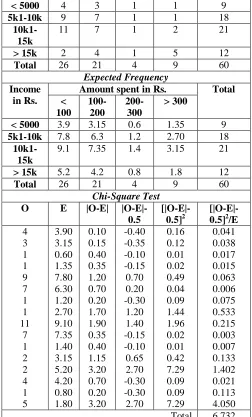
Further the influence of brand ambassadors on various groups have been studied and the results revealed that up to 66.7% are influenced on the adolescence and the rest are in very young, middle age and old age carry 3.5%, 8.8%, and 1.7% respectively. The hypothesis has been created to test whether the income influence on buying power and the brand ambassadors influence on the adult age group. For which, a chi-square test has been adopted and the following are the tables (Table 3 and Table 4) that represents the test results.
H0: there is no significant relationship between the income
and the amount spent on purchasing the cosmetic items. H1
Income in Rs.
: there is a significant relationship between income and the amount spent on purchasing the cosmetic items.
Table 3
Income and the amount spent, its expected frequency and its chi-square test
Amount spent in Rs. Total <
100
100-200
200-300
132
Copyright © 2011-15. Vandana Publications. All Rights Reserved.
< 5000 4 3 1 1 9
5k1-10k 9 7 1 1 18
10k1-15k
11 7 1 2 21
> 15k 2 4 1 5 12
Total 26 21 4 9 60
Expected Frequency
Income in Rs.
Amount spent in Rs. Total < 100 100-200 200-300 > 300
< 5000 3.9 3.15 0.6 1.35 9
5k1-10k 7.8 6.3 1.2 2.70 18
10k1-15k
9.1 7.35 1.4 3.15 21
> 15k 5.2 4.2 0.8 1.8 12
Total 26 21 4 9 60
Chi-Square Test
O E |O-E| |O-E|-0.5 [|O-E|-0.5] [|O-E|-0.5] 2 2 /E 4 3 1 1 9 7 1 1 11 7 1 2 2 4 1 5 3.90 3.15 0.60 1.35 7.80 6.30 1.20 2.70 9.10 7.35 1.40 3.15 5.20 4.20 0.80 1.80 0.10 0.15 0.40 0.35 1.20 0.70 0.20 1.70 1.90 0.35 0.40 1.15 3.20 0.70 0.20 3.20 -0.40 -0.35 -0.10 -0.15 0.70 0.20 -0.30 1.20 1.40 -0.15 -0.10 0.65 2.70 -0.30 -0.30 2.70 0.16 0.12 0.01 0.02 0.49 0.04 0.09 1.44 1.96 0.02 0.01 0.42 7.29 0.09 0.09 7.29 0.041 0.038 0.017 0.015 0.063 0.006 0.075 0.533 0.215 0.003 0.007 0.133 1.402 0.021 0.113 4.050 Total 6.732
For the 9 degrees of freedom that can be calculated by the product of number of column minus one and the number of row minus one at 5% level of significance, it can be observed in the statistical table as 16.92, which is far higher than the calculated value as 6.732, thus the null hypothesis is accepted as there is no significant relationship exist between the income and the amount spent on the purchasing the cosmetic items. In other words, this can also be stated that irrespective of the income, it is all by will and desire that influence the decision of buying power.
Similarly the hypothesis has been created for influence of brand ambassador or the celebrities are not really making any impact on the adolescence.
H0
H
: Adolescence not influenced by the brand ambassador on purchasing of particular brand cosmetic items.
1: Adolescence does influence by the brand ambassador
on purchasing of particular brand of cosmetic items.
Table 4
Chi-square test for adolescence
Category O E |O-E| |O- E|-0.5 [|O-E|-0.5] [|O-E|-0.5] 2 2 /E
Very young 2 15 13 12.5 156.25 10.42
Adolescence 38 15 23 22.5 506.25 33.75
Middle age 5 15 10 9.5 90.25 6.02
Old age 1 15 14 13.5 182.25 12.15
Total 62.34
For 3 degrees of freedom at 5% level of significance, it is noted from the statistical table as 7.81 which are far less than the calculated value of 62.34; therefore the null hypothesis is rejected. As a consequence it can be inferred as the brand ambassador does influence the adolescence on choosing their cosmetic items significantly. Further analysis has been done on the cosmetic products that the brand ambassador really making an impact.
The respondents are given range of widely used items that is inferred from Table 2 and identified as five different cosmetics along with the preferences. The result is shown in table 5.
Table 5
Brand ambassadors influence on a range of widely used cosmetic items
No. Cosmetics Preferences Total
I II III IV V
1 Fairness cream 22 18 11 3 6 60
2 Shampoo 15 21 13 7 4 60
3 Perfume 7 5 19 21 8 60
4 Talcum powder 10 12 9 15 14 60
5 Lipstick 6 4 8 14 28 60
Total 60 60 60 60 60 300
The Table 5 is used as source information on which, the Garrett ranking method had been applied in order to identify the particular cosmetic items that could secure really the attention of or influence of brand ambassador in choosing the cosmetic item for the consumers. The results of Garret ranking for cosmetic products are shown in Table 6.
Table 6
Garrett ranking for cosmetic products
No. Cosmetics Garrett
score
Average score
Garrett Rank
1 Fairness
cream
3544 59.07 I
133
Copyright © 2011-15. Vandana Publications. All Rights Reserved.
3 Perfume 2807 46.78 IV
4 Talcum
powder
2856 47.60 III
5 Lipstick 2322 38.70 V
It can be concluded from the Table 6, that fairness cream secures first position, on which the brand ambassadors are really making an impact in influencing the consumers followed by shampoo and so on.
IV.
LIMITATIONS AND FUTURE
RESEARCH
The project work has been concentrated in researching the influence of brand ambassador on choosing the cosmetic products in regards to female gender in particular under the Sivakasi region. However this may not be limited to female gender, thus it opens up the future research on concentrating both the gender. Indeed the purchasing power could be higher for male gender as compared to female, and also the cosmetics usage may not be limited to gender based. A similar research could be extended to other regions within the Virudhunagar district itself that helps to understand the market in a way and made use of it for promotional purpose. The cosmetic ranges of products were also limited up to few varieties in the present work, which can be extended to wide range that is in the market for future work. Perhaps the number of respondents could be increased to get the more relevant and factual perceptions about this work in future.
V.
CONCLUSIONS
In the present market trend and condition, even though the product is made with high quality, to reach customer is a cumbersome. Thus, there exist the marketing division for any companies and heavy investment to promote and reach customer through several innovative and creative means. The one of the internationally practiced approach is to promote through favourite celebrities. Despite such attempt there may or may not be success in reaching customer, thus an attempt had made in the present work to research the influence of brand ambassador on consumer in choosing the cosmetic products. The research revealed the major findings, such as, celebrities are really making an impact on adolescence of nearly 67%; irrespective of income level of any age groups does not affect the purchasing power or will of cosmetic items for their use. It is also interesting to note that through brand ambassador, majority of respondents can be influenced to choose their suitable products; however the quality of it prevails long standing. In fact most of the respondents or consumers are advising that the celebrities or brand ambassadors should have knowledge of the product that they are promoting, provided they
should have used and then should have come for promotional advertisements. Finally out of several cosmetics, the fairness cream and shampoo had taken highest priority in reaching the customers through the brand ambassadors’.
REFERENCES
[1] C. Kurzman, C. Anderson, C. Key, Y.O. Lee, M. Moloney, A. Silver and M.W.V. Ryan, Celebrity Status, Sociological Theory, 25(4): 347-367, 2007.
[2] B.Z. Erdogan, Celebrity endorsement: A Literature Review, Journal of Marketing Management, 15(4): 291-314, 1999.
[3] L. Ambroise, G.P. Sohier, P.V. Florence and N. Albert, From Endorsement to Celebrity Co-branding: Personality Transfer, Journal of Brand Management, 21: 273-285, 2014.
[4] Available in: http://cosmeticsinfo.org/Ancient-history-cosmetics, 2015.
[5] Available in:
www.projectmadurai.org/pm_etexts/pdf/pm0278_01, 2015.
[6] K.B. Patkar, Herbal Cosmetics in Ancient India, Indian Journal of Plastic Surgery, 41: 134-137, 2008.
[7] N. Bajpai, Business Statistics, Pearson Education India, 2009.
[8] D.C. Montogomery, G.C. Runger and N.F. Jubele, Engineering Statistics, Wiley Publisher, 2012.