
Scalable Computing: Practice and Experience
Volume 20, Number 2, pp. 259–283. http://www.scpe.org
ISSN 1895-1767 c
⃝2019 SCPE
GREEN AND SUSTAINABLE HIGH-PERFORMANCE COMPUTING WITH SMARTPHONE CROWD COMPUTING: BENEFITS, ENABLERS, AND CHALLENGES
PIJUSH KANTI DUTTA PRAMANIK∗, SAURABH PAL†, AND PRASENJIT CHOUDHURY‡
Abstract. The introduction of the Internet of Things (IoT) and Big Data applications have garnered a massive amount of digital data. Processing and analysing these data demand vast computing resources, proportionately. The major downside of producing and using computing resources in such volumes is the deterioration of the Earth’s environment. The production process of the electronic devices involves hazardous and toxic substances which not only harm human and other living beings health but also contaminate the water and soil. The production and operations of these computers in largescale also results in massive energy consumption and greenhouse gas generation. Moreover, the low use cycle of these devices produces a huge amount of not-easy-to-decompose e-waste. In this outlook, instead of buying new devices, it is advisable to use the existing resources to their fullest, which will minimize the environmental penalties of production and e-waste. This paper advocates for using smartphones and smartphone crowd computing (SCC) to ease off the use of PCs/laptops and centralized high-performance computers (HPCs) such as data centres and supercomputers. The paper aims to establish SCC as the most feasible computing system solution for sustainable computing. Detailed comparisons, in terms of environmental effects (e.g., energy consumption, greenhouse gas generation, etc.), between SCC and supercomputers and other green computing initiatives such as Grid and Cloud Computing, are presented. The key enablers of SCC are identified and discussed. One of them is today’s computationally powerful smartphones. A comprehensive statistical survey of the various commercial CPUs, GPUs, SoCs for smartphones is presented confirming the capability of the SCC as an alternative to HPC. The challenges involved in realizing SCC are also considered. One of the major challenges is handling the issue of limited battery in smartphones. The reasons for battery drain are recognized with probable measures. An exhaustive survey is presented on the present and optimistic future of the continuous improvement and research on different aspects of smartphone battery and other alternative power sources which will allow users to use their smartphones for SCC without worrying about the battery running out.
Key words: Green computing, Sustainable computing, Mobile computing, Grid computing, Smartphone computing, HPC, Cloud computing, Data centre, Energy efficiency, Smartphone battery, Battery research, Future battery, Non-conventional energy, Wireless charging, Alternative power source
AMS subject classifications. 68M14, 68W10
1. Introduction. In line with the massive increase in data from innumerable sources, the need for high-performance computing (HPC) has increased enormously. But this has impacted the global environment badly through various forms such as excessive energy consumption, carbon and greenhouse gas emission, heat gener-ation, use of toxic materials in production, harmful industrial discharge, non-degradable waste genergener-ation, etc. Device production and operations consume huge energy. For example, nearly 30,000 megajoules of energy is used in the manufacturing of an average computer. The energy consumption demands more energy production, which increases the carbon footprint [64]. More requirement of computers leads to more productions and more uses of computers which means more environmental hazards and pollution. The various environmental hazards caused by the production and operations of computing devices are listed in Fig 1.
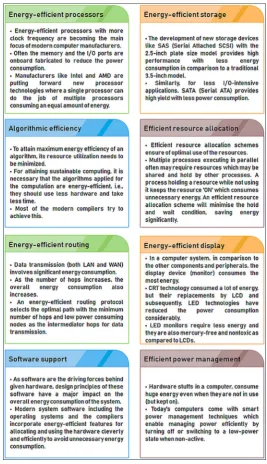
To mitigate the environmental hazards due to computing devices, we need to concentrate on green and sustainable computing. Several computational measures, as shown in Fig 1, are adopted that helps in min-imising the energy consumption of the computers. But this is not sufficient for realising sustainable computing absolutely. One of the strategies to attain sustainable computing to utilise the existing resources optimally and fully which will minimise the requirement of new devices which ultimately reduce the problems due to the production process as well as the e-waste. Several approaches have been opted in this regard as mentioned in Table 1. Among them, Grid and Cloud computing are the most prominent initiatives which have minimised the requirement of owning personal computer systems considerably. They have also replaced the need for cen-tralised HPC systems such as supercomputers and mainframes to some extent. Though Grid computing intends to fully utilise the existing resources (desktops), Cloud computing is not that successful in this aspect. Cloud computing needs additional resources to provide cloud services. The centralised resources such as data centres, at the cloud service providers end, consumes massive energy, leading to greenhouse gas emission substantially.
∗National Institute of Technology, Durgapur, India ([email protected]) †Bengal Institute of Technology, Kolkata, India
‡National Institute of Technology, Durgapur, India
Fig. 1.1.Environmental hazards of the computing devices.
In fact, data centres capture the one-third share of the total energy consumption of ICT. A well-known report [45] of the year 2010 stated that the electricity consumption by data centres had risen by 56% in five years; whereas, during the same period, the overall increase in U.S. electricity usage was only 36%. This statistic reflects the seriousness of the energy requirements of the data centres, which has become more severe in recent years. If the right measures are not taken in due course, data centres are sure to become a grave threat to the environment. Many companies and organizations are doing their best to tackle the energy appetite of the data centres by adopting different measures. For example, Apple has the largest solar installation for powering its data centre. Facebooks data centre in Iowa uses wind energy to meet the energy requirements of its data centre. Google has placed its data centre in Hamina, Finland under the sea for cooling, thus curbing the energy requirements significantly. Google is using AI for optimizing the energy requirements and consumptions in its data centres.
The problem with Grid computing is that the desktops are losing popularity; in fact, the same for laptops. Instead, smartphones are gaining huge acceptance as the new computer with the computing power they offer thanks to the power-packed hardware. The technological progress of smartphones such as powerful SoCs with multicore CPUs and GPUs has made them favourable as the primary computing device to many people. In-dustries are also showing interest in this direction. Initiatives such as Microsofts Continuum1 and Samsungs DeX2are striving to bring the desktop experience on the smartphone. Microsoft has endeavoured to run its full version of Windows 10 on the ARM chipsets, the most popular chipset for smartphones.
And the great thing about smartphones is that they have become indispensable to our lifestyle. It is not feasible to restrain ourselves from using that. So, why dont we use these devices of its optimal potential, i.e., for computing purposes as well? If these abundantly available public-owned powerful smartphones are used as
1
https://www.microsoft.com/en-in/windows/continuum 2
Fig. 1.2.Measures adopted to minimise energy consumption of the computing devices.
computing resources by forming, like desktop grids, a grid of smartphones, the generated computing power can well be compared to other HPC systems. We call this computing paradigm as smartphone crowd computing (SCC). SCC refers to the approach of utilizing the public-owned smartphones (crowd of smartphones) to yield an HPC facility anywhere and ad hoc basis. A number of powerful smartphone devices, collectively, can offer huge computing capability. A satisfactory HPC may be achieved by making a grid of smartphones. The cumulative computing power achieved by such grids of smartphones can tail off the dependency on the data centres and low-end supercomputers as well [63].
device operation will be minimized significantly. Due to smaller in size, the less raw material will be used in production means less exposure to harmful elements and less pollution due to e-waste. If organizations can avoid buying computing resources, they can save a significant IT investment and operational cost. And less device in production and operation means a direct benefit to the environment.
Contribution of the paper: This paper offers a fourfold contribution as mentioned below:
• The environmental hazards of the growing computing devices and centralised HPC systems are impec-cably identified.
• SCC has been attempted to be established as a better alternative to the existing HPC systems in terms of sustainable computing.
• A detailed survey is presented on the modern smartphones computing capability, highlighting the capabilities and specifications of the prominent commercial CPUs, GPUs, and SoCs for mobile devices.
• An exclusive and state-of-the-art survey has been presented on the recent developments (research and commercial) on different aspects of smartphone batteries.
Organisation of the paper: Section 2 discusses the environmental hazardous factors especially for cen-tralised HPCs, in addition to the usual hazards of computers as mentioned in Fig. 1. Section 3 asserts the focal essence of this paper. It establishes the role of SCC in sustainable computing. In Section 4, the major factors that are supposed to make the idea of SCC feasible are identified. To endorse that, a comprehensive statistical review of todays smartphones processing capability is presented in this section. The major challenges faced in the successful deployment of SCC are recognized in Section 5. Among others, the foremost challenge is the battery concern. The major reasons for battery drain are identified in Section 6. In this section, a detailed survey is projected that covers the continuous research and improvement on different aspects of smartphone battery which should help users to use their smartphone without worrying about the battery drain. The recent developments, in different segments, towards enhanced energy sources for smartphones are also discussed. And finally, Section 7 concludes the paper.
2. Factors Behind Environmental Hazards in Centralized HPC Systems like Cloud, Main-frame, and Supercomputers. Centralized computing facilities such as Cloud services and data centres, mainframes, and supercomputers have become a real threat to the environment. For instance, the data centres are responsible for 17% of the global carbon footprint [61]. These large computing systems are notorious for energy consumption. It is projected that data centres in the US only would be consuming 73 kWh in 2020. Nearly 30 billion watts of electric power is needed to run the data centres. Among the amount of electricity consumed by data centres, the servers waste 90% of their total power consumption in keeping the systems running for the entire day. Besides the operational energy consumption, there are several other factors that are associated with environmental hazards of the big centralised computing systems, as mentioned below [46]:
Coolant: Computing and allied infrastructures in the data centre produce enormous heat, and this requires heavy cooling. Most of the air conditioning or cooling system uses coolant for quick and deep cooling. The coolants used earlier for air conditioning systems are freon/halocarbon or chlorofluorocarbon. These coolants are mildly toxic in nature and have caused ozone depletion significantly. The new coolants hydrofluorocar-bon currently used in all air conditioning system is not risky to the ozone layer, but they significantly cause atmospheric warming. This coolant traps the heat within the atmosphere and causes global warming.
Batteries: Data centres require huge batteries for power backup. These batteries make sure the power flow is constant, and provide an electric power supply for a few minutes to hours based on the power cut or power fluctuation. These batteries have a limited life span of 3 to 4 years. The batteries used more often are the lead-acid battery. These batteries may cause an adverse effect on human health and the environment. The fumes emitted from the battery are dangerous to human health. Whereas the lead used in batteries is highly toxic, and if they are not properly disposed of, they may contaminate the soil and water. Presently, in most power backup systems, dry batteries are used. These batteries use heavy metals like mercury, nickel, cadmium, and silver. The metals, mercury, nickel, and cadmium are toxic and have a fatal effect on human health. These batteries cannot be dumped into the open and need to be properly recycled. It is necessary that the batteries are properly disposed of. There are multiple companies which recycle UPS batteries. 80% of leading manufacturing units in the U.S. undergo battery recycling.
Table 1.1
Sustainable computing approaches, their advantages and problems in terms of sustainability
Working principles Environmental advantages Problems Grid
com- pu-ting
The unused computing resources of the con-nected computers are used opportunistically providing a massive virtual computing fa-cility [62]
Utilising of existing idle resources fa-cilitates less energy consumption and minimise environmental hazards due to the manufacturing and operation of the computing systems required otherwise.
Needs fast and reliable LAN and WAN connections. In the volunteered grid, it is difficult to motivate the resource owner to lend their resources.
In the case of the non-volunteered grid (e.g., commercial grids), the services might be costly.
Not only setting up and managing the grid resources but also accessing them often require expertise.
Cloud com- pu-ting
Facilitates a shared pool of configurable computing resources along with quality services which can be rapidly provided on-demand basis [65]
Eliminates the need for private comput-ers, servcomput-ers, and data centres which has significantly contributed to energy sav-ing.
The data centres, comprising the large servers and com-puters, and associated cooling systems consume massive power.
Accessing the cloud service depends on the internet con-nection. The instability/unreliability and unavailability of connection hold back accessing the cloud.
Involves security and privacy issues.
It is true that the cloud computing eradicates the big upfront investment on computing resources but access-ing the right service is not that cheap either.
Involves data transfer cost.
Since cloud services are typically generic they lack in flexibility.
The user/client has minimal control of their own ap-plications as the cloud service infrastructure is entirely owned, managed and monitored by the service provider. Switching or migrating to a different cloud service provider is often complex or infeasible.
Ser- ver-less com- pu-ting Consumers borrow a third-party server when needed; thus, doing away with purchasing and main-taining own server exclusively [36].
Saves the energy requirement for run-ning privately-owned servers.
It also scales down quickly by shutting resources down when they are not in use. This saves a lot of energy con-sumption.
Serverless codes not necessarily be run in any specific server. Hence, the serverless applications can be deployed in the edge of the network, i.e., close to the end users [18]. This will not only reduce the latency but also saves a significant amount of energy by elim-inating the need for unnecessary data transmission [65].
Not suitable for real-time applications which require low latencies.
Also, not suitable for applications which need long exe-cution times.
Everything operates in stateless fashion; hence, han-dling state using stateless functions is a real issue. After some time of being idle, the function will require to go through a cold start which not only takes up to a few seconds but also consumes energy.
Using ter-minal ser-vers
The use of terminal server along with the thin clients gives users a feel of computation being taking place in the very same terminal, while the actual com-putation takesplace in the terminal server.
The processing and storage require-ments for client machines are minimal because a terminal server hosts all the application logic which also runs on the server.
The thin client uses up to the 1/8th amount of energy in comparison to workstations and thus considerably re-duces energy consumption.
Running applications on a remote server always involve performance issues.
There are chances for terminal servers getting bottle-necked with overloaded requests. Hence, the terminal server needs to be powerful enough to be able to handle all connections.
If the terminal server is not backed up, there is a high risk of downtime due to a single point of failure. If the communication network is not reliable, the system will be affected harshly.
Vir- tua- liza-tion
A single physical server is logically partitioned into multiple virtual servers or server in-stances, sharing the same hardware re-sources and allows processing multiple applications or jobs on different virtual servers.
Effective resource utilisation leads to fewer production and less e-wastage. A single physical server acting as multi-ple server instances consumes consider-ably less energy in comparison to sepa-rate dedicated servers.
It requires quantitatively less hardware to run similar application than dedi-cated systems which leads to fewer de-vice production and less e-wastage. The absence of the usage of the local hardware or software cuts the overall energy consumption.
The required hardware specification (e.g., memory, pro-cessor, etc.)is much higher for the same task executed in a native computer.
Involves complex troubleshooting, in case of failure. Degraded performance than a physical server.
Dusting and cleaning require special material that minimizes static discharge and are safe for electronics. Varieties of cleaning solution are available, and most of them are toxic as they contain bleach, ammonia, or chlorine. These toxic cleaning solutions have an adverse effect on human health.
Diesel fuel: Another measure of overcoming power failure is the diesel fuel-based power generator. In a location where there is a recurrent power failure, the data centres heavily depend upon the power generators for a constant supply of power. Diesel fuel-based power backup is the primary solution for powering data centres since battery technology is incapable of producing power for long times. Diesel fuel produces an enormous amount of CO2 and other chemicals which have an adverse effect on human and does global warming.
Electronic waste: Electronic equipment have a finite lifespan. Even for functional equipment, the per-formance degrades with time. Conventionally, the IT products in business firms and data centres such as a server rack, UPS, desktop computers, servers, monitors, hard drives, etc., are replaced after every 3 to 5 years. Globally, the scrapped IT equipment for the last 20 years are enormously huge, and it is increasing day-by-day. The e-wastes are harmful to the environment if dumped on the open landfills. The monitor, CPU, UPS, etc., are made up of materials which have negative effects on the environment. It is the responsibility of the business organizations to either reuse or sell/donate the reusable equipment or recycle them properly.
Fire suppression: It is important to have data intact and safe with the service providers. Due to the fact, the data centres are dealing with high voltage, and hence, there is a chance of short-circuiting and fire. All data centres carry extensive and fast fire suppression system which may be environmentally negative. Various chemicals employed for the fire system may be harmful to the environment contributing to effects like ozone layer depletion and global warming. These chemicals are toxic and may find its way to underground water or to rivers, thus, contaminating the water resources. However, as these systems are not used or tested regularly, the chemical harm is minimized.
Packaging: Business organizations like IT firms and data centres import huge IT equipment every year. Customers and data centres ship equipment and supplies to and from data centres frequently. The equipment comes with packaging material like boxes, cardboard, plastic bags, foams, thermocols adds huge waste every year. A large data centre processes literally tons of boxes each year. Packaging materials like cardboard boxes can be recycled and are biodegradable, but other materials like foams, thermocols, plastic bag, and plastic support accessories are nonbiodegradable and need proper recycling. Dumping these on the open area may harm the environment.
Office zones: IT business firm and data centre office area contribute a lot to emissions and wastes. This includes wastes due to the inappropriate use of electricity and water resources. Running air conditioners, heating equipment, and lights throughout the office for the entire day, even if it is not required, causes considerable electricity wastage. Similarly, unmonitored use of water resources in washrooms and kitchen lead to wastage of water. Besides, daily office chores produce lots of paper, plastics, and packaging wastes. Floor cleaning, glass pane, computers, and carpets also produce chemical wastes. Even the fluorescent bulbs used by offices also carry toxic matters like mercury, lead, etc., and may cause environmental and health hazards.
Overall, it can be said that the centralised HPC systems have a negative impact with respect to nature and natural resources. But as said there is always room for improvement, which may range from minimizing the toxic chemicals used to practising the policies of reuse-reduce-recycle across wherever possible. As technology is developing, new products are coming which causes less emission, less environment hazard and lowers the greenhouse gas emissions.
3. Smartphone Crowd Computing as a Solution Towards Sustainable HPC. Whatsoever the negative impacts of computers have on the environment, we cannot head them off from our livings. We need them in every step of our daily life. Actually, we need more and more powerful computers day by day for various purposes. In view of that, we need to consider seriously to minimize the environmental externalities of producing and using computers.
Since the smartphones are getting close to the sophisticated computers in terms of resources and computing ability, much like desktop Grid Computing, if a number of such smartphones are connected through a network and make them act as a virtual single unit of computing resources, it can match the power of high-end powerful computing systems such as supercomputers and data centres. Like volunteer computing, instead of buying the required number of smartphones, public-owned smartphones are exploited on a need basis. Hence, this computing paradigm is termed as smartphone crowd computing (SCC) [63, 67].
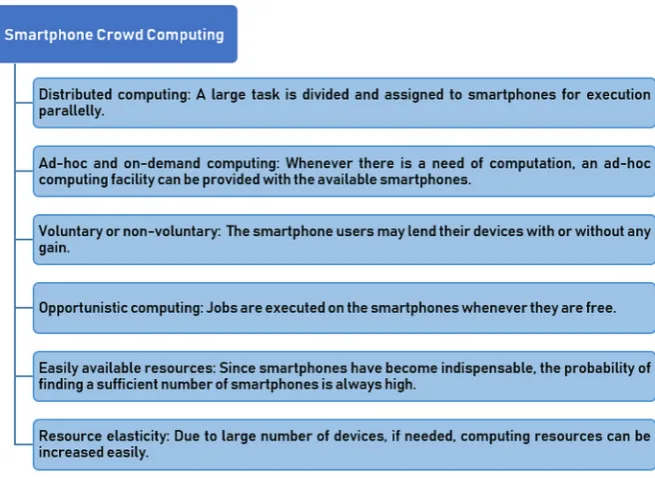
3.1. Smartphone Crowd Computing. SCC is a distributive computing framework where a large job is divided and distributed to the peoples smartphones (hence, crowd computing) to be executed. The philosophy of SCC is to combine computation power of numerous distributed smartphones to escalate the overall computation power. SCC paradigm shares the CPU cycle of multiple smartphones in a voluntary or involuntary basis to resolve a high computational task. The concept is to process a computationally big task by segmenting the task into smaller microtasks, and each micro-task is processed on the smartphones individually. The processing is typically carried out opportunistically, i.e., whenever the host smartphone is idle, the crowd computing application installed on the smartphone will assign the task to the smartphone processor (CPU or GPU). Even though the computation power of smartphone devices is less, the cumulative processing power of smartphones is quite high enough to execute complex computational jobs. Fig 3.1 lists the highlights of SCC.
In SCC, a designated coordinator, may be fixed (a desktop computer) or mobile (a smartphone), hosts the crowd computing application. The coordinator is responsible for dividing and distributing the job, finding suitable resources (smartphones), allocating and scheduling the jobs to the smartphones, monitoring for fault-tolerance and collecting the results from each resource. The coordinator keeps microtasks in the job pool, ready to be dispatched. For distributing the tasks, available crowd devices (smartphones) are searched, and a set of suitable devices are being selected as crowdworkers (computing resources) for processing the jobs. After the execution of these tasks, each node submits the completed task with results to a centralized master device, where all the results are gathered, checked for error to get the final result. It is the job of the master device (coordinator) to check the error and validity of each task execution.
Since the devices are mobile, the reliability of an available device for a long time is very thin. The coordinator makes a task group among smartphones which either voluntarily or involuntarily joins the group. SCC provides quite a flexibility in terms of job allocation and execution as a small task group could be established, comprising a few available smartphones. Even without an internet connection, the smartphones in the task group can communicate using Hotspots or Bluetooth. This makes SCC as the ideal alternative of centralised HPCs where these HPCs are not available or not accessible. The ubiquity and flexibility of SCC is an ideal candidate for providing the computing facility to applications such as pervasive computing [68] and cognitive IoT [66], where the data need to be processed near the data source as well as sink.
3.2. How Can Smartphone Crowd Computing Minimize Environmental Hazards?. Object-oriented programming brought the revolution in software development by introducing the concepts of reusability and polymorphism, which allow software modules to be used multiple times for multiple purposes. This saves a significant amount of man-hours and cost. The same is true for crowd computing. Already existing devices are used for computational and other purposes. This reduces the requirement of buying IT infrastructure separately because the public will buy phones for their own purposes, anyway. Moreover, the utilization of already existing smartphones to achieve SCC instead of traditional HPC will reduce the requirement for dedicated large computers.
If smartphones and SCC are employed in a wide-ranging computing requirement, due to the substantial reuse, the need for new devices will be much lower. That means unnecessary production is avoided which will, in turn, minimize the environmental externalities of producing computing devices. The reduction in the production, operation, and degradation of unnecessary devices will reduce the amount of global e-waste considerably. In addition to that, being much smaller in size, smartphones produce less e-waste.
Fig. 3.1.Highlights of Smartphone Crowd Computing
Hence, it is apparent that smartphones and SCC will significantly help in protecting the environment along with saving resources and minimized organizational IT expenditure.
3.3. Environment-friendliness of Smartphone Crowd Computing in Comparison to Other HPC Systems. In line with our argument that SCC is a viable alternative to the costly HPC systems, in this section, we shall check out how SCC is more environment-friendlier than other HPC systems viz. desktop Grid Computing, data centre, and supercomputers.
Due to their computing capacity and power, the energy requirements of supercomputers are gigantic and might well be equivalent to that of a small city. The correct response relates to electricity; specifically, 17.8 megawatts (MW) of power is required to run Tianhe-2, one of the Top500 ranking supercomputer, boasting 33.9-petaflop through 3.12-million processors. An exaflop (1,000 petaflops) computer needs approximately 500 MW, which is equivalent of the total output of an average-size coal plant, and enough electricity to cater the needs of all the households in a city like San Francisco [35].
[5]. The efficiency of the data centre is measured in terms of Power Usage Effectiveness (PUE). PUE compares the non-computing energy to the amount of energy to power actual machines. Data centres operate at 70% of overhead energy. It means another 0.7 units are used behind the infrastructure of the data centres. So, the total PUE goes up to 1.7 [61]. Typically, the PUE of the common data centres is about 2.0 [43].
As mentioned in Sect. 1, the desktop Grid is an affordable option for sustainable computing. Here, the existing devices are used as computing resources instead of buying dedicated HPC. This helps the environment as this will minimize the requirement for producing extra dedicated HPC systems. Grid Computing can lower the environmental externalities of supercomputers and data centres considerably. SCC promises to minimize it further.
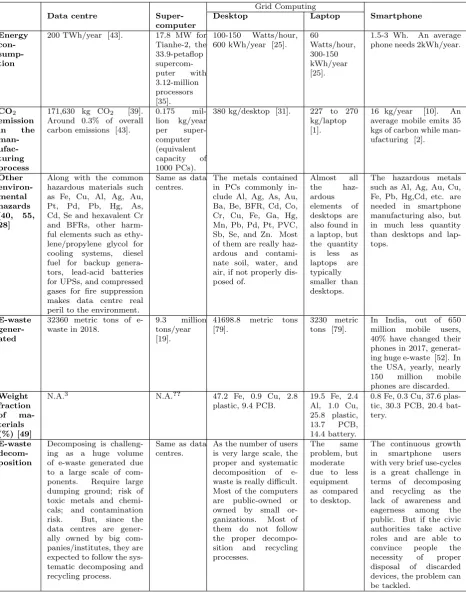
Due to the much smaller size, smartphones have much less negative environmental impact than desktops and laptops and obviously than supercomputers and data centres. So, a grid of smartphones (SCC) will be more environment-friendly. As people will buy smartphones anyway, SCC can use the existing devices without requiring additional device production. The environmental advantages of SCC can be summarized as follows:
• No need for explicit production of computing devices as people will use smartphones anyway.
• Production of smartphones is much environment-friendly compared to large computers.
• Due to the small size, the e-waste will be lesser and can be handled more efficiently.
• No dedicated cooling systems are required.
• No power backups, such as large batteries and generators are required.
• Smartphone processors are typically energy-efficient. As a result, they consume much less energy than other computing systems to perform the same operation.
Table 3.1 statistically demonstrates the advantages of smartphones, in terms of environment-friendliness, compared to desktops and laptops (Grid Computing), data centres, and supercomputers.
The excessive number of smartphones may be advantageous to SCC, but it is really worrisome considering the amount of e-waste generated. Therefore, it is extremely crucial to opt for the proper disposal of discarded devices and try to recycle as much as possible. Fig. 3.2 lists the responsibilities of the smartphone user suggesting what to be done when they discard their smartphones.
Fig. 3.2. Smartphone users’ responsibility towards e-waste management [51].
4. The Enablers of Smartphone Crowd Computing. In this section, we shall look into the key factors that have helped SCC to be a feasible HPC solution.
Table 3.1
Environmental externalities comparison of smartphones with data centres, supercomputers, and Grid Computing (desktops and laptops)
Grid Computing
Data centre
Super-computer
Desktop Laptop Smartphone
Energy con- sump-tion
200 TWh/year [43]. 17.8 MW for Tianhe-2, the 33.9-petaflop supercom-puter with 3.12-million processors [35]. 100-150 Watts/hour, 600 kWh/year [25].
60
Watts/hour, 300-150 kWh/year [25].
1.5-3 Wh. An average phone needs 2kWh/year.
CO2 emission in the man- ufac-turing process
171,630 kg CO2 [39].
Around 0.3% of overall carbon emissions [43].
0.175 mil-lion kg/year per super-computer (equivalent capacity of 1000 PCs).
380 kg/desktop [31]. 227 to 270 kg/laptop [1].
16 kg/year [10]. An average mobile emits 35 kgs of carbon while man-ufacturing [2]. Other environ-mental hazards [40, 55, 28]
Along with the common hazardous materials such as Fe, Cu, Al, Ag, Au, Pt, Pd, Pb, Hg, As, Cd, Se and hexavalent Cr and BFRs, other harm-ful elements such as ethy-lene/propylene glycol for cooling systems, diesel fuel for backup genera-tors, lead-acid batteries for UPSs, and compressed gases for fire suppression makes data centre real peril to the environment.
Same as data centres.
The metals contained in PCs commonly in-clude Al, Ag, As, Au, Ba, Be, BFR, Cd, Co, Cr, Cu, Fe, Ga, Hg, Mn, Pb, Pd, Pt, PVC, Sb, Se, and Zn. Most of them are really haz-ardous and contami-nate soil, water, and air, if not properly dis-posed of. Almost all the haz-ardous elements of desktops are also found in a laptop, but the quantity is less as laptops are typically smaller than desktops.
The hazardous metals such as Al, Ag, Au, Cu, Fe, Pb, Hg,Cd, etc. are needed in smartphone manufacturing also, but in much less quantity than desktops and lap-tops.
E-waste gener-ated
32360 metric tons of e-waste in 2018.
9.3 million tons/year [19].
41698.8 metric tons [79].
3230 metric tons [79].
In India, out of 650 million mobile users, 40% have changed their phones in 2017, generat-ing huge e-waste [52]. In the USA, yearly, nearly 150 million mobile phones are discarded.
Weight fraction of ma-terials (%) [49] N.A.3
N.A.?? 47.2 Fe, 0.9 Cu, 2.8
plastic, 9.4 PCB.
19.5 Fe, 2.4 Al, 1.0 Cu, 25.8 plastic, 13.7 PCB, 14.4 battery.
0.8 Fe, 0.3 Cu, 37.6 plas-tic, 30.3 PCB, 20.4 bat-tery.
E-waste decom-position
Decomposing is challeng-ing as a huge volume of e-waste generated due to a large scale of com-ponents. Require large dumping ground; risk of toxic metals and chemi-cals; and contamination risk. But, since the data centres are gener-ally owned by big com-panies/institutes, they are expected to follow the sys-tematic decomposing and recycling process.
Same as data centres.
As the number of users is very large scale, the proper and systematic decomposition of e-waste is really difficult. Most of the computers are public-owned or owned by small or-ganizations. Most of them do not follow the proper decompo-sition and recycling processes.
The same problem, but moderate due to less equipment as compared to desktop.
Fig. 4.1. Worldwide smartphone shipments forecast from 2018 to 2022 [76].
The number of active smartphone connections, worldwide, will reach 6 billion by 2020 [34]. The huge adoption of smart mobile devices across the world has put a big platform for crowd computing [63, 67].
Factors driving the smartphone market: There is a number of factors influencing the growth of smartphone use in the global market as mentioned below [34]:
• Rapidly falling price of smartphones has accelerated the customers to move from basic and standard feature phones to smartphones.
• Developing smartphone technology has a reason for the increase in the sale of low-end smartphones.
• The increasing availability of the highspeed 3G/4G spectrum with increased mobile broadband connec-tions all around the world.
• The availability of highspeed data-centric services and low tariffs have increased the adoption of smart-phones in both developed and developing societies. Further, the availability of cheap data tariffs tailored as per the customers needs has also reasoned for smartphone adoption in developing countries.
• The concept of tailoring the data tariffs for cost-conscious prepaid consumers can be linked with the selling rate of smartphones.
• Efficient retail channels and supply chain have helped manufacturers to reach customers from every corner across the globe.
• The government policies in support of the growth of the smartphone and subsidiary industries have a significant role in price slicing and the growth of mobile networks.
4.2. Powerful Smartphones. Over the last couple of years, the smartphone industry has seen an un-precedented focus on its hardware. Be it CPUs or GPUs or even DSPs, the processing capability of smartphones, to meet various purposes, has been increased exceptionally. The CPU and memory architectures are designed and tuned to boost heterogeneous computing. The GPUs are also engineered to enhance general purpose GPU (GPGPU) computing performance. Advancement on each module, though separately, makes the smartphones, as a whole unit, a great possibility to become a powerful computing platform. Let us have a run up on the latest developments on the smartphone hardware.
4.2.1. Powerful CPUs. The first multicore smartphone, announced at the end of 2010, was the LG Optimus 2X, loaded with the Tegra 2 processor from NVIDIA, with a maximum frequency up to 1.2 GHz [80, 57]. Since then all smartphone manufacturers have been in a war to load their products with an increasing number of cores. To buttress this exigence, SoC makers are coming out with more and more powerful smartphone processors quite regularly.
(nearly 30 times better than the smartphones of that period) of ARMv7-A4
based smartphones have resulted in an increase in smartphone sales colossally since its introduction in 2009 [6]. ARMs latest architecture, ARMv8-A5
, having state-of-the-art 64-bit instruction set with superior 64-bit programming model, is the pertinent extension of its predecessor. It supports the 64-bit general purpose and floating-point registers, each of 32 numbers, promising enhanced performance [6]. ARMs Cortex-A536 and Cortex-A577 are the first ARMv8-A based big.LITTLE8 pair. As the big processor, Cortex-A57 produces an exceptional degree of performance by harvesting techniques like out-of-order execution, wide multi-issue capacities with large memories, whereas the Cortex-A53 focuses on power-efficient operations by means of a simpler pipeline in a smaller configuration while still delivering handsome performance. In the context of energy efficiency, it is worth mentioning of the Cortex-A359
which is designed for the next-generation smartwatches and probably has set a new standard in energy efficiency for mobile processors [36]. In 2015, the ARM came with Cortex-A7210
, based on 64-bit ARMv8-A, to thrust the performance up for the next generation of phones. The Cortex-A7311
, the smallest ARMv8-A based processor, has been 30% faster and 20% energy efficient than A72. A7512
came with significantly improved integer and floating-point performance, and better memory workload management. The latest Cortex-A7613 is designed to deliver laptop-class performance with mobile efficiency. In comparison to the A75, it offers 35% better performance with 40% more power efficiency. The development of ARM processors, in terms of competence in floating point performance, has made them a serious contender in consideration for a range of scientific applications. In fact, due to their energy efficiency, the ARM processors are going to be used in the futures supercomputers also.
4.2.2. Powerful GPUs. In this section, we shall check out some of the latest and most powerful GPUS for smartphones. Imagination PowerVR: The PowerVR14 Series7XT15 family drives GPU performance of mobile devices to new heights which can deliver up to 1.6 TFLOPS by employing multiple clusters (2 to 16). All the GPUs in this family are offered in two modes FP32 and FP16. The significant 8 clustered GT7800 has 256 FP32 ALU cores or 512 FP16 ALU cores. At the clock rate of 800 MHz, the FP32 cores deliver 820 GFLOPS while the FP16 cores deliver 410 GFLOPS. The highest rung in the series, the GT790016
has 16 clusters either of 512 FP32 cores that deliver 800 GFLOPS at a clock rate of 800 MHz (for 16nm FinFET+) or of 1024 FP16 cores, capable of delivering an imposing 1.6 TFLOPS at the same clock rate [77]. The company has provided an optional FP64 ALU for every pipeline that can be added to designs to deal with high-end supercomputing like applications.
Qualcomm Adreno: Snapdragon 810’s Adreno 43017
GPU has a whopping 288 numbers of shader cores. It has a clock rate of 600 630 MHz, and it delivers 388.8 408 GFLOPS. The Adreno 53018
packed in Snapdragon 820 and 820A works in the range of 510 - 624 MHz offering 407.4 - 498.5 GFLOPS. It can achieve 588 GFLOPS working at 736 MHz.
NVIDIA Tegra: Tegra K119
, has 192 Kepler cores running at 850 MHz and delivering 326.4 GFLOPS. The Tegra X120
features impressive 256 Maxwell cores. Though it has fewer shader cores than Adreno 430, it outsmarts the latter in ground performance. The clock speed of Tegra X1’s GPU touches 1 GHz, and it delivers 512 GFLOPS.
4
https://developer.arm.com/docs/ddi0406/latest 5
https://developer.arm.com/docs/den0024/latest/armv8-a-architecture-and-processors/armv8-a 6
https://developer.arm.com/products/processors/cortex-a/cortex-a53 7
https://developer.arm.com/products/processors/cortex-a/cortex-a57 8
https://developer.arm.com/technologies/big-little 9
https://developer.arm.com/products/processors/cortex-a/cortex-a35 10
https://developer.arm.com/products/processors/cortex-a/cortex-a72 11
https://developer.arm.com/products/processors/cortex-a/cortex-a73 12
https://developer.arm.com/products/processors/cortex-a/cortex-a75 13
https://developer.arm.com/products/processors/cortex-a/cortex-a76 14
https://www.imgtec.com/graphics-processors/ 15
https://www.imgtec.com/graphics-processors/powervr-series7xt/ 16
https://www.extremetech.com/gaming/199933-powervr-goes-4k-with-gt7900-for-game-\\consoles 17
https://www.notebookcheck.net/Qualcomm-Adreno-430.146784.0.html 18
https://www.notebookcheck.net/Qualcomm-Adreno-530.156189.0.html 19
https://www.nvidia.com/object/tegra-k1-processor.html 20
ARM Mali: The Mali GPUs from ARM are not really well-known for their performance. Though they work at the higher clock rate, the GFLOPS output from them, comparatively, on the lower side. The Mali-T880 MP4 used in Helio X25 runs at 850 MHz but offers merely 115.6 GFLOPS while the same GPU used in Kirin 950/955 runs at 900 MHz and offers 122.4 GFLOPS [3]. The Mali-T880 MP12 used by Samsung Exynos 8890 clocks at 650 MHz offering 265.2 GFLOPS. The latest of the series, the Mali-G7121 is 50% faster than the Mali-T880, attributed to 32 shader cores, twice the amount used on the Mali-T880 while at the same time it is 20% more power efficient [4, 37].
4.2.3. Powerful SoCs. In this section, we shall have a glimpse of some of the latest and most powerful smartphone processors and SoCs.
Qualcomm Snapdragon: Snapdragon22
is a family of mobile SoC processor, architected and marketed by Qualcomm Technologies. It leapt a significant step in mobile computing by introducing the first 1 GHz mobile processor ever which featured in Toshiba TG01 in the year 2009 [42]. Since then there is no stopping from this SoC leader. Qualcomm Snapdragon 800 processor, launched in the year 2013, packed with four Krait 400 CPU cores and providing up to 2.45 GHz clock speed, outperformed all other processors in the mobile segment [72]. Next in the line, the octa-core Snapdragon 810 follows the big.LITTLE concept from the ARM and arranged in two clusters of different clock frequencies, providing an overall performance of 2.7 GHz [50]. The performance-oriented cluster of four 64-bit ARM Cortex-A57 runs at 1.958 GHz, and an energy-efficient cluster of four ARM Cortex-A53 runs at 1.555 GHz [72]. It also has one of the highly powerful GPUs, the Adreno 430. The Snapdragon 820, a 64-bit CPU that uses the ARMv8-A instruction set has four custom Kryo cores arranged as two dual-core setups - one for highly demanding tasks and the other for relatively low-profile tasks [54]. The performance-oriented cluster clocks at up to 2.15 GHz and the energy-saving cluster runs at 1.6 GHz. The Snapdragon 820 also packs Adreno 530 GPU, the new Hexagon 680 DSP and the 14-bit Qualcomm Spectra ISP [70]. The integration of these powerful chips is expected to provide high-performance mobile computing. To reinforce effective heterogeneous computing, the Adreno GPUs are devised to perform seamlessly with the Snapdragon CPUs, DSPs, and ISPs to accomplish processing-intensive GPGPU compute tasks. The new Snapdragon 82123
, loaded with the Qualcomm Kryo quad-core CPU, delivers 10% better performance than the 820, topping speeds up to 2.4 GHz. The Snapdragon 83524
is 35% smaller and uses 25% less power than its predecessors. The Snapdragon 84525
having an Octa-core CPU (Qualcomm Kryo 385) provides a clock speed of 2.8 GHz. It also incorporates the Qualcomm Adreno 630 GPU. The latest Snapdragon 85526
, built on a 7nm27
technology from Taiwan Semiconductor (TSMC), have an eight-core (one of 2.84 GHz, three of 2.42 GHz, and four of 1.80 GHz) Qualcomm Kryo 485 CPU and an Adreno 640 GPU.
NVIDIA Tegra: NVIDIA has been the most prominent SoC makers in the market with their powerful Tegra series. The company has redefined mobile processing with their incredibly advanced SoC, the Tegra K1, launched in 2014. It encompasses 192 supercomputer-class GPU cores, based on the Kepler architecture that has accelerated some of the worlds most powerful supercomputers [15]. These prodigious powerful GPUs generate unbelievable extent of computing potential within an incredibly tiny package with remarkable power efficiency. As mentioned earlier, NVIDIA compares their latest product the Tegra X1 as yesteryears first teraflop supercomputer. As part of the CPU, it boasts eight 64-bit ARM cores, divided into two different clusters of four each to exploit ARM’s HMP scheme. The first cluster is of ARM Cortex-A57 (for enhanced performance) and the second one of ARM Cortex-A53 (for energy efficiency) cores. At 16-bit floating point operations, the Tegra X1 nails a peak 1024 GFLOPS. Undoubtedly, the NVIDIA Tegra X1 is the most advanced SoC for any mobile device by far and considered well ahead of time.
Samsung Exynos: The Exynos series of SoCs is developed by Samsung, indigenously, for their sophis-ticated high-end smartphones. Samsung Exynos 742028
, the octa-core SoC, features four Cortex-A57 cores at
21
https://developer.arm.com/products/graphics-and-multimedia/mali-gpus/mali-g71-gpu 22
https://www.qualcomm.com/products/mobile-processors 23
https://www.qualcomm.com/products/snapdragon-821-mobile-platform 24
https://www.qualcomm.com/products/snapdragon-835-mobile-platform 25
https://www.qualcomm.com/products/snapdragon-845-mobile-platform 26
https://www.qualcomm.com/products/snapdragon-855-mobile-platform 27
https://www.tsmc.com/english/dedicatedFoundry/technology/7nm.htm 28
2.1 GHz and four Cortex-A53 cores at 1.5 GHz along with the ARM Mali-T760 MP8, at 772 MHz, as a 12 core GPU which delivers 210 GFLOPS [3]. The latest Exynos 889029
, also an octa-core processor, has four power-efficient A53 running at 1.586 GHz and four Exynos M1 running at 2.29 GHz, the highest in the segment. If only 1-2 cores are used at a time, the Exynos M1 can peak up to 2.60 GHz [30], which is more than an Intel Core i5 chip (Intel i5 4302Y30) that has a clock speed of 2.3 GHz. As GPU, Exynos 8890 boasts the Mali-T880 MP1231 which has a clock speed of 650 MHz and delivers astonishing 265.2 GFLOPS.
Apple A9x: Apple Inc. also did not want to be behind in the race as they came up with their indigenous SoCs, the Apple A series. They have showcased their sophisticated product Apple A9X32
, a 64-bit ARMv-8A based SoC, into their iPad Pro, which was released on November 11, 2015. The A9X features a 2.26 GHz dual-core CPU, called Twister. It boasts PVR 12 cluster Series7 GPU (GT7800 model has 8 dual-cores while GT7900 has 16). The A9X also has the M9 motion coprocessor embedded in it. The Apple A10 is claimed to have better CPU and GPU performance compared to the Apple A9 by 40% and 50% respectively. The successor of A10, A11 Bionic33 incorporates six cores; out of which two have 25% better performance than A10 while the performance of the rest is up to 70% better than A10. Additionally, the three-core GPU offers 30% faster graphics performance than the A10. In the A12 Bionic34, out of six cores, the two performance cores are 15%, and four energy-efficient cores are 50% better than their counterparts in A11. The four-core GPU of A12 is up to 50% faster than A11s three-core GPU.
MediaTek’s Helio: High performance in the low-budget is the hallmark of the SoCs from this Chinese company. It has produced the first-ever deca-core SoC, the Helio X2035
which runs at 2.3 GHz, also featuring Mali-T880 MP4 GPU of 780 MHz that delivers 106 GFLOPS. Helio X2536 has a Mali-T880 MP437 GPU of 8500 MHz, delivering 115.6 GFLOPS. The latest X3038, also a ten-core chip, is made up of four Cortex-A72 cores at 2.5 GHz, two Cortex-A72 cores at 2.0 GHz, two Cortex-A53 cores at 1.5 GHz and two Cortex-A35 cores with 1.0 GHz.
Huawei HiSilicons Kirin: HiSilicons Kirin 95039
, the first smartphone SoC equipped with ARMs new Cortex A72 processor is an octa-core 64-bit chip. Following ARM’s big.LITTLE architecture, it boasts four Cortex-A72, clocking at 2.3 GHz for high performance and four 1.8 GHz Cortex-A53 for power efficiency. The SoC also bundles a four-core Mali T880MP6 GPU, which is purposefully architectured to process large blocks of data in parallel. This prodigious GPU runs at 900 MHz, offering 122.4 GFlops. In Kirin 95540, the clock rate of A72 processors is increased to 2.5 GHz, though the rest of the architecture in this SoC remains the same as its predecessor [21]. The latest in the league, Kirin 98041, claimed as the first commercial SoC built on the 7nm42(TSMC) and also the first SoC to adopt Cortex-A76, has an eight-core CPU (two A76 of 2.6 GHz, two A76 of 1.92 GHz, and four A55 of 1.8 GHz). Kirin 980 offers a 75% better performance while being 58% more energy efficient than its predecessor Kirin 970. Its Mali G76 GPU also performs 76% better than Kirin 970. Moreover, Huawei claims that the performance of its innovative dual Neural Processing Unit (NPU) which is capable of processing 4500 pictures per minute, is almost two and three times greater than Snapdragon 845 and Apple A11 respectively.
4.2.4. Final Verdict. In the foreseeable future, more powerful processors with more cores are anticipated. With 7nm like technologies, more muscle can be put up in a single core which will enable shoving more computing capacity without compromising the chip size. The future smartphones loaded with these powerful SoCs will be,
29
https://www.samsung.com/semiconductor/minisite/exynos/products/mobileprocessor/exynos-8-octa-8890/ 30
http://cpuboss.com/cpu/Intel-Core-i5-4302Y 31
https://www.notebookcheck.net/ARM-Mali-T880-MP12-Benchmarks.160645.0.html 32
https://www.anandtech.com/show/9766/the-apple-ipad-pro-review/2 33
https://www.apple.com/newsroom/2017/09/iphone-8-and-iphone-8-plus-a-new-generation-of-iphone/ 34
https://www.apple.com/iphone-xs/a12-bionic/ 35
https://www.mediatek.com/products/smartphones/mt6797-helio-x20 36
https://www.mediatek.com/products/smartphones/mt6797t-helio-x25 37
https://www.notebookcheck.net/ARM-Mali-T880-MP4.159590.0.html 38
https://www.mediatek.com/products/smartphones/mediatek-helio-x30 39
http://www.hisilicon.com/en/Products/ProductList/Kirin 40
https://www.notebookcheck.net/HiSilicon-Kirin-955-Octa-Core-SoC-Benchmarks-and-Specs.163438.0.html 41
https://consumer.huawei.com/en/campaign/kirin980/ 42
in the true sense, the little computing giants.
5. Challenges for Smartphone Crowd Computing. This section describes several challenges that are faced, in general, in using a smartphone as a computing device. Below, some of the rudimentary issues are mentioned.
Motivating the crowd: The challenge to motivate the crowd is always the primary concern of the vendors. As more people are motivated and participate in SCC, the greater will be the benefit. What one can do, one must do. Contributing to a social cause gives a person to achieve a feeling of self-actualization. One can perceive a self-satisfaction by doing what he/she can do within his/her capability. In this process, others may be benefitted. In other words, the implication of this realization of potential philanthropic results in the greater good.
Adopting a balanced and effective incentive policy: To attract people to actively participate in SCC, suitable and attractive incentive policies need to be formulated. The incentive policies should be according to the particular SCC application rather than generalised.
Security and privacy concerns: Mobile devices hold numerous personal information like financial data, email, location updates, social media information, and other user id and passwords. For using the mobile as a crowd computing device, it is utmost important that mobile data are secured from tracking, phishing or destroyed. The user must be given a sense of data security and privacy. It is this concern for which people are going to volunteer their devices for SCC. The SCC applications for the mobile devices should have a secured architecture which ensures confidence that the application is in no way sharing or have access to memory location and services of other apps.
Variable wireless network: With the majority of wireless services having a variety of different rate of transmission, both the average rate and rate of oscillation are vital metrics to measure the performance. It is quite challenging to determine the apt rate of oscillation a service can tolerate obtaining a high average rate. Here the service satisfaction for a smartphone user may be quantified with an increase in the concave utility function of the instantaneous transmission rate.
Designing middleware: As per consumer/market demand, smartphone companies are launching new products very regularly. These devices are widely heterogeneous in terms of hardware platform (CPU, GPU, SoC, no. of cores, signalling module, etc.), system and application software, manufacturer specifications, user interface, etc. This diverseness poses a great challenge in designing a generalised middleware and client ap-plication. The enhancement of interoperability among both the SCC server and the participant smartphones by incorporating the appropriate middleware that can handle smartphones irrespective of their hardware and software specification and support efficiently, to be developed and managed.
Maintaining QoS: Alike other distributed and networked computing systems, maintaining the quality of service (QoS) is challenging in SCC too. It is more challenging in SCC considering the factors such as device mobility, variable communication quality, diverseness in resources, etc. The criteria of satisfactory QoS have a vital contribution to the overall success of the SCC applications.
Heat: For smartphones, extreme hot or cold conditions are potentially damaging. The cell phone battery can be damaged due to excessive heat dissipated. If the CPU is busy for a long time, the phone will be heated. This may deter users from participating in SCC.
Limited memory: Smartphones have a limited internal memory which cannot be increased or reduced by the user. They have no additional expansion slots. The external memory option is not present in all the available smartphones. Therefore, it is vital to use the limited phone memory space intelligently so that it would not affect the other apps running in memory while importing jobs through SCC.
6. Future Battery Technologies will Encourage Smartphone Crowd Computing: An Opti-mistic Study. The most concerning facet regarding smartphone computing is the limitation and fast draining of battery power. While portable computers, smartphones, wearable computers, and other mobile devices are growing ever more advanced, both technologically and architecturally, they are still limited by power. The battery or energy technology has not moved at par in decades, which pulls back the pervasive & ubiquitous computing revolution. And it is only going to get worse as next-generation 4G networks come online, giving the phones access to high-speed, always-on connections and torrents of data. The battery is unarguably the biggest obstacle to smartphone computing. In a recent survey, nearly 70% of respondents stated that battery life is the single biggest limitation of their mobile phone and most of them are willing to pay more for the phones which offer extended power [27]. Present smartphone batteries are struggling to keep up with users active and ever-increasing smartphone usage demands. In spite of several limitations like slow charging, volatility, and degradation the current Lithium-ion batteries have served us well so far, since its first commercial release by Sony and Asahi Kasei 25 years ago. But this technology is approaching its limits after which no enhancement can be made out. According to researchers, potentially it can reach a maximum of 30% above current levels [23]. Though other classes of battery technologies, especially the lithium-sulphur (Li-S) and the lithium-air (Li-air) have potential to surpass the lithium-ion, they are not in the mainstream production and uses due to some fundamental challenges in these technologies.
6.1. Major Battery Drainers. The main reasons for the majority of battery drainage are:
Screen: The major culprit in consuming power in a smartphone is its vibrant screen. The phones are coming with higher resolutions resulting in more power consumption. Lower-power display technology like OLED (Organic LED) is expected to take over LCD displays in the coming years, resulting in better battery life. And as people are more inclined to larger screens (most of the Indians prefer phablets); it indirectly paves to better battery performance. A larger screen would consume more energy, certainly, but it will allow fitting a larger battery also. If a phone of the same architecture has a 20% larger screen size, will run 40% longer period because of the bigger battery.
Power savvy processor: Akin to PCs, the processing capacity of smartphone processors also has increased consistently by Moors law. But it is not achieved, as it may seem, at the expense of additional battery power. Actually, improvement in processor technologies has rendered more processing power per watt. For example, as compared to mid-1980s processors which would consume 100-watt power, todays high-end processors can carry out more than 100,000 times MIPS, consuming the same amount of watt [56]. So, modern processors have become not only more powerful but more power-efficient as well. For example, thanks to a proprietary technology called Asynchronous Multiprocessing (ASMP), Snapdragon processors can dynamically adjust the voltage and speed of each CPU core independently that leads to decrease in wasted power and heat [6]. Another major factor which influences power efficiency, especially in mobile devices, is the SoC. SoCs offer smartphones a better power management capability by making able to put into sleep that particular power-consuming hardware which is not required at that time; thus, saving a considerable amount of battery power [56].
Signalling module: Similar to processor technology radio/wireless technologies are also improving signif-icantly. Todays 4G network allows users to talk much longer than earlier older mobile networks by disbursing equal watt. Another basis of reduced battery drain is lesser transmitting distance. As the number of mobile phone users has grown enormously, the number of cellular network base stations has been greater than before. That means transmitting signals must travel a shorter distance from phone to base stations; which results in less power consumption [56]. Alongside mobile devices and mobile networks, the number of Wi-Fi routers also has escalated, and it should be noted that Wi-Fi connections consume significantly less energy compared to 3G mobile networks [78] and of course, even more, less than 4G. By eating up the same amount of power, Wi-Fi can transfer more than twice the volume of data as 3G [44]. This fact should go in favour of our view of that the smartphones who participate in volunteer computing should use the local wireless network for necessary message passing (no one would voluntarily offer their data pack balance for the purpose which least bothers him, at least immediately).
6.2. Other Causes. The various reasons responsible for the battery drain are [11, 17]:
determine the mobile position on Earth. Since the GPS satellite signal is a week, the processor needs to perform a hard task to eliminate noise and decoding the signal; this makes the mobile device to consume energy faster. The energy consumption increases as mobile user travel and could deplete the battery in one or two hours.
Wi-Fi variations: A major source of battery power consumption comes from the Wi-Fi interface. The power consumption of the mobile device depends upon how signal strength it receives, weaker the signal more energy it consumes. The receiving Wi-Fi signal strength varies with the distance from Wi-Fi base station and also gets affected by obstructions like a wall, door, etc., in between the path of the signal.
The constant search for Wi-Fi networks: Constantly searching for a Wi-Fi station and connecting to the chosen router through the jungle of signals needs more power; this drains the battery significantly. The energy consumption increase as the person moves and the mobile device constantly searches for Wi-Fi base station for networking. Switching off the Wi-Fi interface while not in use would significantly increase the battery life.
LTEs high data rates: Huge battery is consumed when the phone is used for calling or e-mailing using the GSM, 3G, or LTE (4G). The smartphone hooks on to a single base station at a time, picking the one that offers the strongest signal and communicates even when the phone is also not being used. Mobile devices change the communicating base station for an incoming or outgoing call and for data communication while on the move. The handing over of communication services from one base station to another takes more energy. The network handover may also happen even in indoor locations. While moving from one room to another, there may be a loss of signal strength or network communication due to signal obstructions by walls or other things; this enforces the devices to search and connect to other base station available for communication causing more energy consumption. In another case, while the mobile device is not communicating directly, but apparently it is busy in the background for data communication. Many apps loaded in device get updated in the background by pulling and pushing data from the web. As this data updation happens in the background it does access data communication lines without the knowledge of the user. This consumes a lot of network data and thus enforces mobile devices to continually search and connect to various network connections and hence consumes a lot of energy. One way to restrict this power drain is to disable LTE, 3G, and Wi-Fi communication when not used and turning off automatic notifications of apps which are not used much.
The screen brightness is set too high: High screen brightness is a major source of battery consumption. The brightness can be managed easily by changing the screen brightness level as per the surroundings. For indoor where surrounding light is very less a low screen brightness is sufficient to view. Whereas at outdoors, where the surrounding luminosity is high, the screen brightness can be changed as per suitability. The other way of reducing the amount of battery power consumption is shortening the display time and turning off the display when not used.
Apps are staying busy in the background: One of the major reasons for profuse battery drain in a smartphone is the apps that run in the background. Mobile applications like memory booster, file cleaning, Facebook, email, etc., run in the background continually. This keeps draining the battery. The apps such as email, news and the apps for social media keep refreshing themselves in the background, discharging the battery automatically. Even the battery saver applications do not help; most of them actually consume more power than they save. While an application is installed, the background refresh change setting should be changed from automatic to manual. This will skip the automatic data update or feed every time the application starts and will improve the mobile battery life.
Using resource-intensive apps: One of the major sources of battery drain is continuously using resource-intensive applications for a long time. Gaming applications which are resource resource-intensive in terms of processor cycle, display, sound, memory, and network keep continuously consuming energy. Frequent use of heavy apps such as weather apps and the Google Map which constantly locate users locations causes power leakage. The same happens in the case of overusing the apps which require GPS. Also, changing the application setting for refresh and updates frequently, does not help in battery conservation. To save battery life, the resource intensive application must be constraints for longer use.
The phone has a hardware issue: A phone suffering from hardware glitches is prone to quick battery drain.
Battery-draining activities: Phones that are over-engaged with battery-drainer activities are bound to drop battery power quickly. For example, the constant use of hotspot, Wi-Fi, and Bluetooth or continuous streaming of music and videos are the major reasons for faster batter loss. Also, making phone calls while travelling needs frequent hands-off, which requires energy. Other battery-losing activities are watching videos and playing graphics-heavy games for a long duration, using the phone camera frequently, etc.
Automatic syncing of the apps and data: The auto backup of the data (e.g., photos, videos, or documents) and synchronization of apps account for huge battery drain.
Notifications are going off all day: Constant lighting, vibration, or ringing notification sounds may be a reason why the battery dies quickly. The constant stream of notification sound is annoying; hence users often prefer to substitute it by vibration resulting in rapid battery drain.
Charging using a slower charger or a faulty cable: Charging a mobile device using a faulty or cheap cable or slower charger or a replica charger for a long time could harm the battery. This reduces the charge retention capability of the battery and could lead to excessive power draining. Therefore, to increase the battery life, it is required to charge the phone with the original charger or the charger which is shipped with the mobile device.
Killing recent apps or using task managers to free memory or kill apps: The recent Android version dynamically allocates memory to all apps running in the background. In these versions, the memory of apps is managed dynamically. For if the system requires memory, it automatically takes the memory allocated to apps running in the background without taking too much of the resources. Closing an app which is running in the background may close some of the system processes with the app. This causes the application to be restarted again from scratch next time when the application is started. This would cause unnecessary wastage of CPU resources and thus consumes battery. Hence, it is better to keep the application running in the background than to restart it again.
Using a ton of widgets, third-party customizations and health trackers: Using a huge number of widgets on an Android home screen may experience a drain of battery in smartphones. For example, widgets like step counters, calorie burn calculators, etc. are quite notorious as a battery burner.
Live wallpapers or bright wallpapers on AMOLED displays: Live wallpapers or bright wallpapers on AMOLED display look amazing, but they consume a great deal of battery power. Using sharp contrast and vivid coloured wallpapers on the AMOLED screen definitely juice more battery power. LCD, in contrast to AMOLED, consumes less battery power, no matter what wallpaper is displayed.
Unnecessary push notifications: The push notifications from different corners of the digital world are being hurled every day, which causes the phone to light up multiple times and make the transceiver antenna busy which consumes battery.
Replace the original old battery with a nonstandard one: Smartphones older by 2 or 3 years many often have issues with the battery. The battery either dies out or retains a charge for very less time. Replacing the old battery with a replica or nonstandard one is often cost-effective but may have serious problems. The nonstandard battery goes faulty very quickly and does not retain charge much longer; this needs frequent recharging, causing a lot of power consumption. Replacing the original battery with nonstandard ones is not an effective solution for the long run and may also cause harm to the mobile device also.
6.3. Advancement in Battery Technologies. It is untoward that the lack of advancement in the field of battery technologies has prevented smartphones being used as per their potential. But the good news is that we are on the verge of a power revolution. Research groups in universities and organizations are coming up with innovative ideas either to extend battery life or to minimize the recharging time and may be to accomplish both. Some are experimenting with alternate power sources like solar, body heat or air. In this section, we shall explore some of the promising new developments (present and future) which may encourage users to use their mobile devices more comprehensively without worrying about power limitation.
• Intelligent Energy, a British energy technology company, aspires to revolutionize smartphones by re-placing traditional lithium-ion batteries with hydrogen fuel cells. They are developing cells based on embedded fuel cell technology which will keep smartphones powered for more than a week after just a single charge [26].
• Rechargeable lithium metal batteries offer nearly 10 times of energy capacity than lithium-ion batteries. A Li-metal anode batterys capacity could be as high as 3,860 mAh/g, whereas a typical Li-ion battery with graphite on the anode can store around 380 mAh/g [41]. But these batteries could not be used in mobile devices so far due to safety hazards [29]. Scientists at Cornell University have developed a new safe way to use rechargeable lithium metal batteries at room temperature, an achievement which may lead to significantly extended power backup in mobile devices [69].
• The solid-state batteries found by MIT scientists along with Samsung offer more power and last longer. In these batteries, power density is improved by 20 to 30% which means more power to the device. The founders claim that the life of these batteries is thousands of cycles before degrading [24].
• Fuji Pigment has come out with their exciting aluminium-air Alfa batteries which have 40 times more capacity than lithium-ion and can be recharged by simply being topped up with water (with or without salt) [24]. According to the company, these batteries should last up to 14 days.
• Samsung also has claimed that they may have figured out a way to nearly double the battery life of smartphones by adding graphene on top of silicon anodes. When paired with a commercial lithium cobalt oxide cathode, the silicon carbide-free graphene coating allows the full cell to reach volumetric energy densities of 972 and 700 Wh at first and 200th cycle, respectively, 1.8 and 1.5 times higher than those of current commercial lithium-ion batteries [73].
• To tackle with the battery consumption by the smartphone screen, the main culprit as battery killer, a British start-up has come up with smart glass, a unique and innovative technology where the display will no longer rely on the battery to illuminate the screen, as it will use electrical pulses instead, allowing a device’s battery life to last for a week [48]. Dr. Peiman Hosseini, founder of Bodle Technologies, enlightened that the smart glass technology, based on the technology that is used for rewritable DVDs, uses electrical pulses to create vivid, hi-tech displays that require no power and can be viewed clearly, even in direct sunlight [14].
6.3.2. Larger Capacity and Longer Battery Life. Larger battery capacity is one way to ensure the mobile devices run a long time without frequent recharging. Manufacturers are now going for batteries with a larger capacity which can hold huge power and thus less recharging. Companies are coming up with batteries with huge capacities. A couple of such examples is given below:
• Oukitel has introduced battery with a capacity of 10000mAh and which is increasingly on the standard battery capacity of 2000-3000mAh. The Oukitel battery of 10000mAH once charged can go 15 days without recharging.
• A group of physicists from the University of Missouri has developed a material with a unique structure (a honeycomb lattice) that are claimed to enable increasing the life of batteries by more than a hundred times [74].
Batteries with larger capacity are bigger in size and thus making the mobile device bigger in size. Companies are struggling to keep a balance between battery size and battery power. New battery technology is needed which seriously increases the battery power without compromising the battery size and thus the mobile design [7].
6.3.3. Faster Charging. Battery capacities are increasing, but the time it takes for charging makes the manufacturer and the users frustrating alike. Everybody hates waiting incessantly to charge ones mobile phone. Who has the time for this pesky task! Contentedly for us, we’re starting to get smartphone batteries that not only last longer but also recharge awfully fast. Fortunately, the researchers are working and exploring a new way to charge batteries in faster ways. In the near future, we are going to have a breakthrough in charging technology.


![Fig. 3.2. Smartphone users’ responsibility towards e-waste management [51].](https://thumb-us.123doks.com/thumbv2/123dok_us/8743771.1746824/9.595.129.468.441.626/fig-smartphone-users-responsibility-e-waste-management.webp)
![Fig. 4.1. Worldwide smartphone shipments forecast from 2018 to 2022 [76].](https://thumb-us.123doks.com/thumbv2/123dok_us/8743771.1746824/11.595.177.420.119.231/fig-worldwide-smartphone-shipments-forecast.webp)
