The Journal of Threatened Taxa (JoTT) is dedicated to building evidence for conservation globally by publishing peer-reviewed articles online every month at a reasonably rapid rate at www.threatenedtaxa.org. All articles published in JoTT are registered under Creative Commons Attribution 4.0 International License unless otherwise mentioned. JoTT allows allows unrestricted use, reproduction, and distribution of articles in any medium by providing adequate credit to the author(s) and the source of publication.
www.threatenedtaxa.org
ISSN 0974-7907 (Online) | ISSN 0974-7893 (Print) Building evidence for conservation globally
Journal of Threatened Taxa
For Focus, Scope, Aims, Policies, and Guidelines visit https://threatenedtaxa.org/index.php/JoTT/about/editorialPolicies#custom-0 For Article Submission Guidelines, visit https://threatenedtaxa.org/index.php/JoTT/about/submissions#onlineSubmissions For Policies against Scientific Misconduct, visit https://threatenedtaxa.org/index.php/JoTT/about/editorialPolicies#custom-2 For reprints, contact <[email protected]>
Communication
Food composition of Indian Eagle Owl Bubo bengalensis
Franklin (Aves: Strigiformes: Strigidae) from
Tiruchirappalli District, Tamil Nadu, India
Tamilselvan Siva, Periyasamy Neelanarayanan & Vaidyula Vasudeva Rao
26 March 2019 | Vol. 11 | No. 5 | Pages: 13545–13551 DOI: 10.11609/jott.4416.11.5.13545-13551
Partner
Member
Threatened Taxa
Publisher & Host
PLATINUM OPEN ACCESS
13545
Communica
tion
DOI:https://doi.org/10.11609/jott.4416.11.5.13545-13551 | ZooBank: urn:lsid:zoobank.org:pub:E75E53D9-1F48-467F-B89F-8CE84D8BC0E8
Editor: Reuven Yosef, Ben Gurion University of the Negev, Eilat, Israel. Date of publication: 26 March 2019 (online & print)
Manuscript details: #4416 | Received 18 July 2018 | Final received 08 February 2019 | Finally accepted 02 March 2019
Citation:Siva, T., P. Neelanarayanan & V.V. Rao (2019). Food composition of Indian Eagle Owl Bubo Bengalensis Franklin (Aves: Strigiformes: Strigidae) from Tiruchi -rappalli District, Tamil Nadu, India. Journal of Threatened Taxa 11(5): 13545–13551. https://doi.org/10.11609/jott.4416.11.5.13545-13551
Copyright: © Siva et al. 2019. Creative Commons Attribution 4.0 International License. JoTT allows unrestricted use, reproduction, and distribution of this article in any medium by adequate credit to the author(s) and the source of publication.
Funding: Indian Council of Agricultural Research (ICAR) – A Voluntary Research Centre on “All India Network Project on Vertebrate Pest Management” (AINP on VPM) – “Agricultural Ornithology” (Period: November 2014- March 2017).
Competing interests:The authors declare no competing interests.
Author details: T. Siva, research scholar who works on owls for his PhD programme. Dr. P. Neelanarayanan, PhD is an Associate Professor of Zoology and Guides research work on owls. Dr. V. Vasudeva Rao, PhD is a Professor and Co-Coordinator of “All India Network Project on Vertebrate Pest Management” (AINP on VPM).
Author contribution: TS collected and analysed Data. PNN and VVR prepared the article.
Acknowledgements: The financial assistance rendered by ICAR, New Delhi, for carrying out this research work is gratefully acknowledged. We are highly indebted to the Principal and the Management of Nehru Memorial College (Autonomous) for their help and encouragement. We thank Mr. N. Saravanan, Mr. G. Lakshmanan and Mr. T. Mohanraj, UG students of Zoology department of Nehru Memorial College, for their help during many of our field trips.
Food composition of Indian Eagle Owl Bubo bengalensis
Franklin (Aves: Strigiformes: Strigidae) from
Tiruchirappalli District, Tamil Nadu, India
Tamilselvan Siva 1 , Periyasamy Neelanarayanan 2 & Vaidyula Vasudeva Rao 3
1,2 Research Department of Zoology, Nehru Memorial College (Autonomous), Puthanampatti, Tiruchirappalli District,
Tamil Nadu 621007, India.
3 Co-Coordinator, All India Network Project on Vertebrate Pest Management - Agricultural Ornithology,
PJTS Agricultural University, Rajendra Nagar, Hyderabad, Telangana 500030, India.
1 [email protected] (corresponding author), 2 [email protected], 3 [email protected] Journal of Threatened Taxa | www.threatenedtaxa.org | 26 March 2019 | 11(5): 13545–13551
Abstract: The diet of the Indian Eagle Owl was studied from April to September 2017 in Tiruchirapalli District, Tamil Nadu, India. Analysis of 1082 regurgitated pellets yielded 2077 prey items; the mean prey items/ pellet was 1.91. The diet constituted 65.1% of rodent prey and the remaining 34.83% of other groups of both vertebrate and invertebrate animals. The mean percentage of prey composition was 31.15% Millardia meltada Soft-furred Field Rat, 12.95% Bandicota bengalensis Lesser Bandicoot Rat, 10.25% Mus booduga Indian Field Mouse, and 10.24% of other rodent species. Of the 34.83% of non-rodent prey, the owls ingested insects (Rhinoceros beetles, 9.58%), Arachnida (Solifugae or Sun spider, Galeodes sp., 9.58%), reptiles (Calotes sp., 3.7%), amphibians (3.56%), shrews (Suncus murinus, 2.84%), and others (5.57%). The Indian Eagle Owls consumed more than one prey per day and chiefly foraged in agricultural crop fields and consumed both small mammals and insects of agricultural importance under crop ecosystems.
Keywords: Amphibians, arachnid, Bandicota bengalensis, insects, Millardia meltada, pellet analysis, prey composition, reptiles, rodents, shrew.
ISSN 0974-7907 (Online) ISSN 0974-7893 (Print)
Journal of Threatened Taxa | www.threatenedtaxa.org | 26 March 2019 | 11(5): 13545–13551
Food composition of Indian Eagle Owl Siva et al.
13546
INTRODUCTION
Owls are nocturnal birds and there are 241 (BirdLife International 2017) living species in the world. The Indian Eagle Owl Bubo bengalensis is one of the nocturnal raptors distributed only in the Indian subcontinent. Owls have evolved with many adaptations to occupy the top of the food chain in the ecological niche. Owls feed mainly on field rats, mice, shrews, bats, birds, reptiles, frogs, crabs, scorpions, and insects. The Indian Eagle Owls are terrestrial nesters of rocky hillocks of hill slopes, earth cuttings and bushes. Their hunting grounds consist of agricultural crop fields, water bodies, hills and rural habitats. Regurgitated pellets of owls have undigested body parts of prey like bones, fur of vertebrate and exoskeleton of invertebrate animals. These undigested food materials are oval in shape and greenish black or grey coloured and dropped in the nesting and roosting/ perching sites of owls. Regurgitated pellets are analyzed to understand and document the prey composition of Indian Eagle Owls and to find out the variations in their food habits over a period of time. Earlier studies have been carried out on Indian Eagle Owls such as information on the long call (Ramanujam 2003); methods of analyzing rodent prey (Ramanujam 2004); auditory and visual communicatory traits (Ramanujam 2007), morphometric development of young Indian Eagle Owl (Penteriani et al. 2005; Ramanujam & Murugavel 2009; Pande & Dahanukar 2011a); breeding biology, nesting habitat, and diet (Ramanujam 2006; Pande et
al. 2011; Pande & Dahanukar 2011b); spread-winged
agonistic displays (Ramanujam 2010); the time budget and behavioural traits of young and adult (Ramanujam 2015); and a comparative study on the diet (Ramanujam & Singh 2017). In India, prey spectrum of this species have been studied and reported from Tamil Nadu – Puducherry (ravines and gullies habitats) in southern India (Ramanujam 2006, 2015) and Maharashtra (Pande et al. 2011; Pande & Dahanukar 2011b) in central India. It is understood from the review of literature that there is limited published information on the diet composition of Indian Eagle Owls from Tamil Nadu and hence the present study.
MATERIALS AND METHODS
The Study Area
The present study was carried out in Musiri Taluk of Tiruchirappalli District, Tamil Nadu. The area consists of many hillocks, interspersed with villages and agricultural fields (Image 1). In the past, studies by Nagarajan et
al. (1993), Taylor (1994) and Santhanakrishnan (1995) suggested use of indirect signs such as regurgitated pellets, milky white droppings and prey remains of Barn Owls for the identification of roosting/nesting sites. The same indirect signs were utilized in the present study for the identification of Indian Eagle Owls’ nesting/ roosting sites. Information given by the local residents was also useful in locating the roosting/nesting sites of Indian Eagle Owls. It is apparent from the survey that the hillocks are the prime nesting and roosting/
Food composition of Indian Eagle Owl Siva et al.
Journal of Threatened Taxa | www.threatenedtaxa.org | 26 March 2019 | 11(5): 13545–13551 13547
perching habitats of Indian Eagle Owls (Image 2). The pellets of Indian Eagle Owls were collected from hillocks near three villages - Veliyanur (11.0490N & 78.5860E),
Thuraiyur-Puthupatti-Pulikaradu (11.0430N & 78.5800E)
and Thuraiyur-Puthupatti (11.0370N & 78.5680E) (Fig.
1) between April and September 2017. In total, 1082 pellets were collected during the study period.
Pellet Analysis
The pellets (Images 3 & 4) were collected once a month, and bagged in separate polybags, labelled and brought to the laboratory for analysis. Before analysis, the pellets were kept in an oven at 70oC for 24h to kill the
associated invertebrate parasites (Neelanarayanan et al. 1995; Santhanakrishnan 1995). The pellets were then placed in separate washing cups, containing 8% NaOH (by weight) sodium hydroxide solution, and then analysed (Neelanarayanan et al. 1998). Fur and other debris were dissolved in the 8% NaOH solution leaving only the osteous and chitinous remains of vertebrates and invertebrates, respectively. The solution was then carefully decanted by using a filter and the osteous remains were collected, oven dried at 60°C, labelled, bagged and preserved for prey species identification.
Vertebrate prey items were identified on the basis
of lower jaws, skull, limb bones and pectoral and pelvic girdles (Neelanarayanan et al. 1998; Talmale & Pradhan 2009). We determined the number of prey individuals consumed per pellet based upon the number of skulls, lower jaws, or fore and hind limb bones found in each pellet. One set of lower jaws (left and right) (Image 5) or one skull or one pair of fore and hind limb bones were counted as remains of one prey item. In the absence of mandibles, other bones like skulls, limb bones, pectoral and pelvic girdles and synsacra (in the case of birds) were useful, especially for identifying and quantifying the mammalian, avian and amphibian prey (Neelanarayanan 2007). Insect prey items were identified up to order level on the basis of undigested pieces such as chitinous exoskeleton, heads, wings, legs, and stings (Images 6 & 7). A hand lens or low power binocular microscope was employed to identify insect exoskeleton (Marti 1987; Neelanarayanan 2007). In order to know the contribution of each prey species in the Indian Eagle Owl’s diet, they were converted into proportions and presented in tables. The mean prey items per pellet were calculated as follows:
Total no. of prey items observed in a month
Mean prey items/pellet = –––––––––––––––––––––––––––––––––––
Total no. of pellets collected in a month
Journal of Threatened Taxa | www.threatenedtaxa.org | 26 March 2019 | 11(5): 13545–13551
Food composition of Indian Eagle Owl Siva et al.
13548
RESULTS AND DISCUSSION
Analysis of 1082 regurgitated pellets yielded 2077 prey items (Table 1). The analyzed pellets revealed— small mammals such as Bandicota bengalensis, B. indica, Funambulus palmarum, Millardia meltada, Mus
booduga, Rattus rattus, Suncus murinus & Tatera indica,
and bats;amphibians; reptiles; birds; and invertebrates such as Rhinoceros beetle Oryctes rhinoceros, Galeodes indicus, Scorpion—the constituents of the diet of Indian Eagle Owls. Of these 2077 prey items, rodents constituted 1353 of the prey and the remaining 724 of other prey species like S. murinus, amphibians, reptiles, birds, bats, Rhinoceros beetle, among others.
Earlier, Pande & Dahanukar (2011b) and Pande et al. (2011) reported B. bengalensis, B. indica, M. meltada,
R. rattus, T. indica, M. musculus and Golunda ellioti
as the major constituents of the Indian Eagle Owls’ diet in terms of frequency, proportion and biomass. Besides these they also reported Rhinoceros beetles, long-horned beetles, grass hoppers, mantids, snakes, scorpions formed the diet of Indian Eagle Owl. The diet of the Indian Eagle Owl in and around Puducherry and a part of Tamil Nadu comprised of prey such as S. murinus, T. indica, Chiroptera, F. palmarum, R. rattus,
M. meltada, B. indica, B. bengalensis, Mus spp., Lepus
nigricollis, Aves, Varanus bengalensis, Amphiesma stolata, Anura, Paratelphusa sp., Heterometrus swammerdami, Scolopendra morsitans, Orthoptera, Coleoptera (Ramanujam 2006; Ramanujam & Singh 2017). The results of these studies corroborate the findings of the present study. It is obvious from the results of the present investigation that these owls hunt both commensal and field rodent pests and insect pests (particularly Rhinoceros beetle) from agricultural crop fields around their nesting/roosting habitats.
The Rhinoceros beetle is found on Coconut palms, occurring throughout the country and many regions of the world. Detection can be difficult due to the beetles’ nocturnal activity within the trees. In the present study, rhinoceros beetle accounted for 9.58% of the Indian Eagle Owl’s diet. In Maharashtra, 11.9% of this beetle was recorded in the owl diet (Pande & Dahanukar 2011b). Galeodes indicus was found to be 9.58% of the diet in this study, however, Pande & Dahanukar (2011b) reported it at 0.2%. The presence of the diurnal Three-striped Palm Squirrel F. palmarum in the diet may be due to the owls hunting behaviour during day time. Bats are also potential prey of owls, not surprising considering that both these animal groups are nocturnal (Marks et al. 1999). The other prey species groups like birds, reptiles including Calotes sp., amphibians, and scorpion Image 2. A pair of Indian Eagle Owl observed in the Thuraiyur Puthupatti-Pulikaradu hillock.
Food composition of Indian Eagle Owl Siva et al.
Journal of Threatened Taxa | www.threatenedtaxa.org | 26 March 2019 | 11(5): 13545–13551 13549
Image 3. A pellet of Indian Eagle Owl observed in its roosting site. Image 4. Different sizes of Indian Eagle Owls’ pellets collected during the present study. Table 1. Prey composition (month-wise) of Indian Eagle Owls revealed from pellet analysis.
Month and Year April 2017 2017May 2017June 2017July August 2017 September 2017 Total
Percentage
Proportion of rodents, insects & other prey
Proportion of major prey groups
(pest & non-pest) Prey species/ total
number of pellets 158 177 191 207 167 182 1082
Bandicota bengalensis 46 42 47 38 53 43 269 12.95
65.1
74.68
Millardia meltada 93 108 126 111 89 120 647 31.15
Mus booduga 18 27 36 53 36 43 213 10.25
Tatera indica 2 5 4 11 7 9 38 1.82
Rattus rattus 0 0 1 1 0 0 2 0.096
Bandicota indica 0 2 1 6 0 2 11 0.52
Funambulus palmarum 0 1 0 2 1 1 5 0.24
Unidentified Rodents 28 21 31 38 21 29 168 8.08
Rhinoceros beetle 23 51 42 34 17 32 199 9.58 9.58
Galeodes indicus 36 47 44 23 17 32 199 9.58
25.25 25.25
Scorpion 2 1 4 2 5 2 16 0.77
Amphibians 17 10 4 16 22 5 74 3.56
Reptiles Calotes sp. 12 7 9 21 18 10 77 3.7
Others 7 2 6 12 14 8 49 2.35
Birds 3 5 9 17 8 5 47 2.26
Suncus murinus 4 11 6 17 9 12 59 2.84
Bats 0 1 2 0 1 0 4 0.19
Grand Total 291 341 372 402 318 353 2077 100 100 100
were rarely hunted by owls.
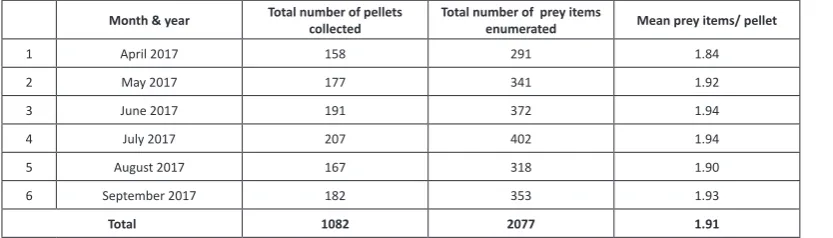
In the present study, a maximum of 1.94 prey items/ pellet was observed during June and July 2017 while a minimum of 1.84 prey items/pellet was observed during April 2017 (Table 2). The results of the present study indicate that the Indian Eagle Owls consumed more than one prey per day.
CONCLUSION
In conclusion, the results of the present study reveal that the Indian Eagle Owls are hunters of both rodent and insect pests. Steps should be initiated to protect and conserve Indian Eagle Owls in their natural habitats to increase their population and make use of their services in managing the pest populations in cropping ecosystems.
Journal of Threatened Taxa | www.threatenedtaxa.org | 26 March 2019 | 11(5): 13545–13551
Food composition of Indian Eagle Owl Siva et al.
13550
Image 5. The lower jaws or mandibles of rodents, an insectivore and Calotes sp.
Image 6. Entire exoskeleton of Rhinoceros Beetle observed in the
pellets. Image 7. Chelicerae of Owl pellets. Galeodes indicus observed in the Indian Eagle
© T. Siva
Food composition of Indian Eagle Owl Siva et al.
Journal of Threatened Taxa | www.threatenedtaxa.org | 26 March 2019 | 11(5): 13545–13551 13551
Table 2. Mean prey items/ pellet observed during the study period.
Month & year Total number of pellets collected Total number of prey items enumerated Mean prey items/ pellet
1 April 2017 158 291 1.84
2 May 2017 177 341 1.92
3 June 2017 191 372 1.94
4 July 2017 207 402 1.94
5 August 2017 167 318 1.90
6 September 2017 182 353 1.93
Total 1082 2077 1.91
REFERENCES
Marks, J.S., R.J. Cannings, H. Mikkola, D.H. Holt, R. Berkley & C. Deppe (1999). Family Strigidae (typical owls), pp34–243. In: del
Hoyo, J., A. Elliott & J. Sargatal (eds.). Handbook of the Birds of The World - Vol. 5 Barn-owls to hummingbirds. Lynx Edicions, Barcelona.
Marti, C.D. (1987). Raptor food habit studies, pp67–79. In: Pendleton,
B.G., B.A. Millsap, K.W. Kline & D.A. Bird (eds). Raptor Management Techniques Manual. National Wildlife Federation Scientific Technical Service, No.10, Washington D.C.
Nagarajan, R., P. Neelanarayanan & R. Kanakasabai (1993). Tips
for the identification of Common Barn Owl nests. Newsletter for
Birdwatchers 33(5): 93.
Neelanarayanan, P. (2007). Diet of Barn Owl Tyto alba stertens,
Hartert, (1929) in a portion of Cauvery delta, Tamil Nadu, India.
Zoos’ Print Journal 22(8): 2777–2781. https://doi.org/10.11609/ JoTT.ZPJ.1670.2777-81
Neelanarayanan, P., R. Nagarajan & R. Kanakasabai (1995). The
Common Barn Owl, Tyto alba: a potential predator of rodent pests.
Pestology 19(9): 34–37.
Neelanarayanan, P., R. Nagarajan & R. Kanakasabai (1998). Studying
diet of Barn owl (Tyto alba stertens) by Pellet analysis, pp125–131. Proceedings of the First National Symposium on Birds in Agricultural Ecosystem, A.N.G.R. Agricultural University, Hyderabad.
Pande, S., & N. Dahanukar (2011a). Ecological effects on morphometric
development of the Indian Eagle Owl Bubo bengalensis. Journal of Threatened Taxa 3(4): 1677–1685. http://doi.org/10.11609/JoTT. o2609.1677-85
Pande, S., & N. Dahanukar (2011b). The diet of Indian Eagle Owl Bubo bengalensis and its agronomic significance. Journal of Threatened Taxa 3(8): 2011–2017. https://doi.org/10.11609/JoTT.o2536.2011-7 Pande, S., A. Pawashe, M. Mahajan, A. Mahabal, C. Joglekar & R.
Yosef (2011). Breeding biology, nesting habitat, and diet of the Rock
Eagle-Owl (Bubo bengalensis). Journal of Raptor Research 45(3):
211–219. https://doi.org/10.3356/JRR-10-53.1
Penteriani, V., M.M. Delgado, C. Maggio, A. Aradis & F. Sergio (2005).
Development of chicks and predispersal behaviour of Young in the Eagle Owl bubo bubo. Ibis 147: 155–168.
Ramanujam, M.E. (2003). On the “Long Call” of the Indian Great Horned
or Eagle-owl Bubo bengalensis (Franklin). Zoos’ Print Journal 18(7):
1131–1134. http://doi.org/10.11609/JoTT.ZPJ.18.7.1131-4
Ramanujam, M.E. (2004). Methods of analyzing rodent prey of
the Indian Eagle Owl Bubo bengalensis (Franklin) in and around Pondicherry, India. Zoos’ Print Journal 19: 1492–1494. http://doi. org/10.11609/JoTT.ZPJ.1117a.1492-4
Ramanujam, M.E. (2006). On the prey of the Indian Eagle Owl Bubo bengalensis (Franklin, 1831) in and around Pondicherry, southern India. Zoos’ Print Journal 21(5): 2231–2240. http://doi.org/10.11609/ JoTT.ZPJ.1425.2231-40
Ramanujam, M.E. (2007). A catalogue of auditory and visual
communicatory traits in the Indian Eagle Owl Bubo bengalensis
(Franklin, 1831). Zoos’ Print Journal 22(8): 2771–2776. http://doi. org/10.11609/JoTT.ZPJ.1572.2771-6
Ramanujam, M.E. (2010). Some observations on the spread-winged
agonistic displays of the Indian Eagle Owl Bubo bengalensis
(Franklin, 1831). Journal of Threatened Taxa 2(9): 1147–1152.
https://doi.org/10.11609/JoTT.o2249.1147-52
Ramanujam, M.E. (2015). Time budget and behavioural traits of
adult and young Indian Eagle Owl Bubo bengalensis (Franklin, 1831) in and around a nesting site: a preliminary report. Journal of Threatened Taxa 7(14): 8139–8147.https://doi.org/10.11609/ jott.2429.7.14.8139-8147
Ramanujam, M.E., & T. Murugavel (2009). A preliminary report on
the development of young Indian Eagle Owl Bubo bengalensis
(Franklin, 1831) in and around Puducherry, southern India. Journal of Threatened Taxa 1(10): 519–524. https://doi.org/10.11609/JoTT. o1762.519-24
Ramanujam, M.E & T. Singh (2017). A comparative study of the diet
of the Indian Eagle Owl Bubo bengalensis (Franklin, 1831) from two distinct habitats in the Tamil Nadu - Puducherry area, southern India. Journal of Threatened Taxa 9(3): 9892–9902. https://doi. org/10.11609/jott.2438.9.3.9892-9902
Santhanakrishnan, R. (1995). Ecology of Barn Owl, Tyto alba (Scopoli) with special reference to its population, feeding and breeding in Mayiladuthurai, Tamil Nadu, south India. PhD dissertation, Bharathidasan University, Tiruchirappalli, South India.
Talmale, S.S., & M.S. Pradhan (2009). Identification of some small
mammal species through owl pellet analysis. Records of the Zoological Survey of India, Occasional Paper No. 294: 1–44.
Taylor, I.R. (1994). Barn Owls: Predator Prey Relationships and
Conservation. Cambridge University Press, Cambridge, U.K., 303pp.
ISSN 0974-7907 (Online) | ISSN 0974-7893 (Print)
March 2019 | Vol. 11 | No. 5 | Pages: 13511–13630 Date of Publication: 26 March 2019 (Online & Print)
DOI: 10.11609/jott.2019.11.5.13511-13630
www.threatenedtaxa.org
The Journal of Threatened Taxa (JoTT) is dedicated to building evidence for conservation globally by publishing peer-reviewed articles online every month at a reasonably rapid rate at www.threatenedtaxa.org. All articles published in JoTT are registered under Creative Commons Attribution 4.0 International License
unless otherwise mentioned. JoTT allows allows unrestricted use, reproduction, and distribution of articles in any medium by providing adequate credit to the author(s) and the source of publication.
Article
Factors affecting diversity and distribution of threatened birds in Chitwan National Park, Nepal
– Jagan Nath Adhikari, Bishnu Prasad Bhattarai & Tej Bahadur Thapa, Pp, 13511–13522
Communications
Encounter rates and group sizes of diurnal primate species of Mole National Park, Ghana
– Edward Debrah Wiafe, Pp. 13523–13530
Estimating Leopard Panthera pardus fusca (Mammalia: Carnivora: Felidae) abundance in Kuno Wildlife Sanctuary, Madhya Pradesh, India
– Devavrat Pawar, Howard P. Nelson, Divya R.L. Pawar & Sarika Khanwilkar, Pp. 13531–13544
Food composition of Indian Eagle Owl Bubo bengalensis Franklin (Aves: Strigiformes: Strigidae) from Tiruchirappalli District, Tamil Nadu, India
– Tamilselvan Siva, Periyasamy Neelanarayanan & Vaidyula Vasudeva Rao, Pp. 13545–13551
Short Communications
Sunda Pangolin Manis javanica (Mammalia: Pholidota: Manidae) of Gaya Island, Sabah
– Jephte Sompud, Cynthia Boon Sompud, Kurtis Jai-Chyi Pei, Nick Ching-Min Sun, Rimi Repin & Fred Tuh, Pp. 13552–13556
Distribution and morphometric measurements of Blanford’s Fox Vulpes cana (Mammalia: Carnivora: Canidae) of the Kingdom of Saudi Arabia
– Abdulhadi Aloufi & Ehab Eid, Pp. 13557–13562
Sebaceous gland adenoma in a free-ranging Baird’s Tapir Tapirus bairdii (Tapiridae: Perissodactyla)
– Randall Arguedas, Maricruz Guevara-Soto & Jorge Rojas-Jiménez, Pp. 13563–13566
Recent records of the Banded Racer Argyrogena fasciolata (Shaw, 1802) (Reptilia: Squamata: Colubridae) from southern Coromandel Coast, peninsular India
– Janani Sagadevan, Sumaithangi Rajagopalan Ganesh, Nitesh Anandan & Raveen Rajasingh, Pp. 13567–13572
A new species of Simulium (Simulium) (Diptera: Simuliidae), with keys to S. striatum species-group from India
– Sankarappan Anbalagan, Suryliyandi Vijayan, Chellapandian Balachandran & Sundaram Dinakaran, Pp. 13573–13578
New host records of polyphagous Lepidoptera on Ban Oak Quercus leucotrichophora A. Camus (Fabaceae) in the Garhwal Himalaya, India
– Arun Pratap Singh, Kalpana Bahuguna & Gaurav Chand Ramola, Pp. 13579–13591
A preliminary study of the hawkmoth diversity (Lepidoptera: Sphingidae) of Kanyakumari District, Tamil Nadu, India
– Geetha Iyer & Ian James Kitching, Pp. 13592–13604
Calamus pseudoerectus (Arecaceae), a new species from the eastern Himalaya, India
– Sujit Mondal, Shyamal K. Basu & Monoranjan Chowdhury, Pp. 13605–13610
Weed diversity in rice crop fields of Fatehgarh Sahib District, Punjab, India
– Yadvinder Singh & Rai Singh, Pp. 13611–13616
Observations on the female flowers and fruiting of Tape Grass Enhalus acoroides from South Andaman Islands, India
– Vardhan Patankar, Tanmay Wagh & ZoyaTyabji, Pp. 13617–13621
Notes
First records of Agnidra vinacea (Moore, 1879) (Lepidoptera:
Drepanidae: Drepaninae) from the western Himalaya, extending its known range westwards
– Pritha Dey & Sanjay Sondhi, Pp. 13622–13624
Pollinators of Sikkim Mandarin Orange Citrus reticulata (Sapindales: Rutaceae)
– Urbashi Pradhan & M. Soubadra Devy, Pp. 13625–13628
Book Review
A holistic look on birds in urban areas
– S. Suresh Ramanan & Lalit Upadhyay, Pp. 13629–13630