http: // www.ijrtsm.com© International Journal of Recent Technology Science & Management 10
ISSN : 2455-9679
[Akash et al. , 4(3), Mar 2019] Impact Factor : 2.865
IJRTSM
INTERNATIONAL JOURNAL OF RECENT TECHNOLOGY SCIENCE & MANAGEMENT
“UTILIZATION OF PARTIAL REPLACEMENT OF BITUMEN WITH PLASTIC WASTE AND
CRUMB RUBBER IN HOT MIX”
Aakash Bariya 1, Aakash Ved 2 , Ganesh Chouhan 3, Lalit Yadav 4, MD Nadeem Ali 5, Naveen Nayak 6, Rahul Surage 7, Jayati Nagar 8, Aditi Agrawal Shinde 9
1-7 B. Tech. Scholar, Dept. of Civil Engineering, Malwa Institute of Technology Indore, Mp, India 8Assistant Professor, Dept. of Civil Engineering, Malwa Institute of Technology Indore, Mp, India
9HOD, Dept. of Civil Engineering, Malwa Institute of Technology Indore, Mp, India
ABSTRACT
Plastic waste is one such resource, a major component of solid waste which is abundantly available and disposed of
without proper treatment. There has been an exponential growth in municipal plastic waste disposal especially in
urban areas which deteriorates the beauty of the landscape. Plastic was found to be an effective binder for bitumen
mixes used in flexible pavements. Use of plastic waste and crumb rubber i.e. the rubber obtained from the waste tyre
of vehicles , in the construction of flexible pavement is gaining importance. This efficient method helps the
pavements to resist higher temperature by minimizing the formation of cracks and reducing rainwater infiltration
which otherwise leads to the development of potholes. These pavements have shown improved crushing and
abrasion values and reduced water seepage. It consists of waste plastic and crumb rubber or bitumen (used as a
binder) and mineral aggregate which is mixed together & laid down in layers then compacted and In this project, we
are going to partially replace bitumen with plastic waste (8%, 10%,12%,14%) and crumb rubber (3% to 14%) .
Keyword: Plastic waste,crumb rubber, bitumen plastic road, low density polyethylene (LDPE).
I.
I
NTRODUCTION1. Waste Plastic:-Disposal of waste plastic consumer bags from the domestic has become a major problem to the
agencies in the town and cities. The waste plastic bags available in the domestic waste mainly consist of low density
polyethylene (LDPE). Plastic bags dumped in the dustbins find their way into the drainage system and clog them.
Often, the severe burnt along the road side, which produces fumes causing air pollution. Industrial wastes from
polypropylene (PP) and polyethylene terephthalate (PET) were studied as alternative replacements of a part of the
conventional aggregates of concrete. Five replacement levels 10%, 20%, 30%, 40% & 50% by volume of aggregates
were used for the preparation of the concretes. India plastic processing has been carried out on a large scale. Up to 60%
of industrial and municipal plastic waste comes from a variety of sources. The use of plastic waste for coating
aggregates of the bituminous mix found to improve the performance of the pavement improving abrasion, slip
http: // www.ijrtsm.com© International Journal of Recent Technology Science & Management 11
ISSN : 2455-9679
[Akash et al. , 4(3), Mar 2019] Impact Factor : 2.865
30% of 2.36 - 5mm aggregates showed 250% increase in Marshall stability and the mix density reduced to 16% and in
addition to it the Indirect Tensile Strength (ITS) was also improved. On heating at 100-160’C polythene, polypropylene
and polystyrene soften and exhibit good binding properties. Indian mass production of plastic waste, with great
economic value, so the recovery of plastic waste plays an important role in employment. This helps the country's
economic development.
TABLE:1 WASTE PLASTIC AND ITS SOURCES
S.NO. WASTE PLASTIC ORIGIN
1 Low density poly –ethylene (LDPE) Carry bags , milk pouches ,sacks,
cosmetic and detergent bottles
2 High density poly-ethylene (HDPE) Carry bags , bottle cap, house hold
articles etc.
3 Polyethylene Tery-phthalate (PET) Drinking water bottles etc.
4 Polypropylene (pp) Bottle cap, biscuit vapors pockets etc.
5 Polystyrene (ps) Clear egg packs, food trays egg box etc.
6 Polyvinyl Chloride (pvc) Toys, pipe, mineral water bottles, credit
card etc.
2. Crumb Rubber :- Crumb rubber is actually small pieces of waste tyre scrapped from light motor vehicles and
whose disposal is a serious menace. The annual capacity for procured tyres retreading is 4.8 million for bus and truck
tyres and 4.5 million for car and jeep tyres .The crumb rubber is made by shredding scrap tire, which is a particular
material free of fiber and steel. The rubber particle is graded and found in many sizes. The crumb rubber is described or
measured by the mesh screen or sieve size through which it passes during the production process. To produce crumb
rubber, generally, it is important to reduce the size of the tires.Nowadays disposal of different wastes from different
Industries is a great problem. These materials pose environmental pollution in the nearby locality because many of
them are non-biodegradable. Natural material being exhaustible in nature, its quantity is declining gradually. Also, cost
of extracting good quality of natural material is increasing. Concerned about this, the scientists are looking for
alternative materials for highway construction, by which the pollution and disposal problems may be partly reduced.
Keeping in mind the need for bulk use of these solid wastes in India, it was thought expedient to test these materials
and to develop specifications to enhance the use of waste tyres in road making in which higher economic returns be
possible.
II.
M
ATERIALU
SED1. Aggregate
Aggregate is a collective term for the mineral materials such as sand . gravel , and crushed stone that are used with a
binding medium ( such as water , bitumen , Portland , cement, lime , etc.) to from compound materials ( such as
http: // www.ijrtsm.com© International Journal of Recent Technology Science & Management 12
ISSN : 2455-9679
[Akash et al. , 4(3), Mar 2019] Impact Factor : 2.865
bituminous concrete and about 70 to 80 percent of Portland cement concrete . Aggregate is also used for base and
sub-base courses for both flexible and rigid pavement . Aggregate can either be natural or manufactured . Natural aggregate
are generally extracted from larger rock formations through an open excavation (quarry) . Extracted rock is typically
reduced to usable sizes by mechanical crushing . Manufactured aggregate is often a bye product of other manufactured
industries.
Aggregate used in surface course can be divided into two types according to their size coarse aggregate and fine
aggregate . Coarse aggregate are generally defined as those retained on the 2.36 mm sieve. Fine aggregate are those that
pass through the 2.36 mm sieve and are retained on the 0.075 mm sieve . Aggregate required for the research work will
be procured from the local market.
Test of Aggregate
S. No. Description Permissible limit % Result IS Code
1 Aggregate impact value test 35 4.53% IS 2386-IV-1963
2 Los Angeles Abrasion test 45 18.23% IS 2386-IV-1963
3 Water absorption test 2.5 0.4 % IS 2386-III-1963
4 Flakiness Index 35 24.5% IS 1211-1978
5 Elongation Index 45 18.17% IS 1211-1978
2. Bitumen
Bitumen acts as binding agent for aggregate in bituminous mixes. Generally in India bitumen used in road construction
of flexible pavement is of grades 60/70 or 80/100 penetration grade . Both the grade of bitumen confirming to BIS
standard will be used for the present studies.
Today the availability of the waste plastics is enormous as the plastic material have become part and parcel of daily life.
They either get mixed with municipal solid waste and / or thrown over land area . If not recycled , their present disposal
is either by land filling or by incineration. Both the processes have certain impact on the environment . Under this
circumstance , an alternate use for the waste plastic is also the needed .
Thinner polythene carry bags are most abundantly disposed of wastes, which do not attract the attending rag pickers for
collection for onward recycling, for lesser value. Again, these polythene/ polypropylene bags are easily compatible
with bitumen at specified condition. The waste polymer bitumen blend can be prepared and a study of the properties
can throw more light on their use for road laying. We are use 80/100 grade of bitumen in our project.
Test of Bitumen
S. No. Description Result IS Code
1 Penetration Test 82.33 mm IS : 1203 -1978
2 Ductility test 66 cm IS : 1208 -1978
3. Plastic waste
Another plastic that is considered a low hazard, Low Density Poly-ethylene is used in bags for bread, newspapers,
fresh produce, household garbage and frozen foods, as well as in paper milk cartons and hot and cold beverage cups,
milk pouches, sacks carry bags ,cosmetics and detergent bottles . While LDPE does not contain BPA, it may pose risks
http: // www.ijrtsm.com© International Journal of Recent Technology Science & Management 13
ISSN : 2455-9679
[Akash et al. , 4(3), Mar 2019] Impact Factor : 2.865
4. Rubber
Sources of waste rubber are the various commercial vehicles like trucks, busses, and trailers.In this study,waste tyre of
buseswas used as rubber waste. Collectedrubber waste has beenpowdered bythe grinding machine andsubjected to
mechanical sieve analysis to get the desired particle size passes from 4.75 mm sieves.
PenetrationTest on partially replace bitumen with plastic waste and crumb rubber.
S.N
O.
% of Crumb
Rubber
Penetration (mm)
8% of platic 10% of platic 12% of platic 14% of platic Penetration
time
1 3% 60 55 50 42 5 sec
2 6% 58.68 53.2 47 40 5 sec
3 8% 57.89 50 44 38.5 5 sec
4 10% 56.89 48.5 41.5 35.5 5 sec
5 12% 54.75 47 39 32 5 sec
6 14% 53 45 37.5 30 5 sec
Ductilitytest on partially replace bitumen with plastic waste and crumb rubber.
S.N
O.
% of Crumb
Rubber
Ductility Test (cm)
8% of platic 10% of platic 12% of platic 14% of platic
1 3% 60 53 46 35
2 6% 54 50.32 42.6 33.3
3 8% 51.4 47.8 40 29
4 10% 49 45 37.1 25.8
5 12% 47.6 41.6 34 23.2
6 14% 45 39.6 30 19.84
III.
M
ETHODOLOGY1. Process of Preparation Of Road
Basic Process
a. Segregation :- Plastic waste collected from various sources must be separated form other waste.
Maximum thickness of 60 microns.
b. Cleaning Process:-The plastic waste get cleaned and dried. For better mixing and removal of moisture
from the waste plastic.
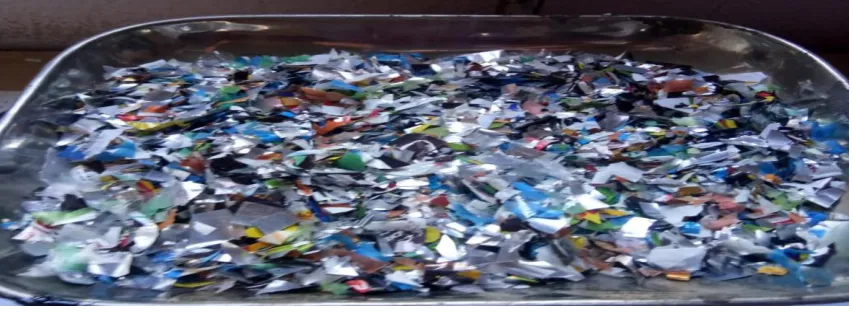
c. Shredding Process:- The waste plastic should be will shredded and cut into small pieces. The well
shredded or different plastic then mixed together.
d. Collection Process of plastic waste:- The well shredded plastic then sieved, the wasting retained in
http: // www.ijrtsm.com© International Journal of Recent Technology Science & Management 14
ISSN : 2455-9679
[Akash et al. , 4(3), Mar 2019] Impact Factor : 2.865
e. Collection Process of Crumb Rubber:- The well shredded crumb rubber then sieved, the wasting
passing in 4.75 mm sieve is collected.
2. Method of road Construction or field trial.
a. Dry process :-For the flexible pavement, hot stone aggregate (170oC) is mixed with hot bitumen (160oC) and the mix is used for road laying. The aggregate is chosen on the basis of its strength, porosity and moisture absorption capacity as per IS coding. The bitumen is chosen on the basis of its
binding property, penetration value and viscoelastic property. The aggregate, when coated with
plastics improved its quality with respect to voids, moisture absorption and soundness. The coating of
plastic decreases the porosity and helps to improve the quality of the aggregate and its performance in
the flexible pavement. It is to be noted here that stones with 2% porosity only allowed by the
specification.
b. Wet process :-Waste plastic is ground and made into powder; 6 to 8 % plastic is mixed with the
bitumen. Plastic increases the melting point of the bitumen and makes the road retain its flexibility
during winters resulting in its long life. Use of shredded plastic waste acts as a strong “binding agent”
for tar making the asphalt last long. By mixing plastic with bitumen the ability of the bitumen to
withstand high temperature increases. The plastic waste is melted and mixed with bitumen in a
particular ratio. Normally, blending takes place when temperature reaches 45.5°c but when plastic is
mixed, it remains stable even at 55°c. The vigorous tests at the laboratory level proved that the
bituminous concrete mixes prepared using the treated bitumen binder fulfilled all the specified
Marshall mix design criteria for surface course of road pavement. There was a substantial increase in
Marshall Stability value of the mix, of the order of two to three times higher value in comparison with
the untreated or ordinary bitumen. Another important observation was that the bituminous mixes
prepared using the treated binder could withstand adverse soaking conditions under water for longer
duration.
3. Dry Process of laying of plastic road
a. Process Step 1:- Plastics waste (Carry bags , milk pouches ,sacks, cosmetic) made out of LDPE cut into size
between 2.36mm to 4.75mm using shredding machine.
http: // www.ijrtsm.com© International Journal of Recent Technology Science & Management 15
ISSN : 2455-9679
[Akash et al. , 4(3), Mar 2019] Impact Factor : 2.865
b. Process Step 2:- The aggregate are heated to 165oc.
Figure No. 2 Step 2 Heating Process of Aggregate
C.Process Step 3:- The shredded plastic waste and crumb rubber is to be added hot aggregate . It get coated
uniformly over the aggregate within 30 to 60 seconds .
Figure No. 3 Step 3 Mix Of Shredded Plastic and crumb rubber
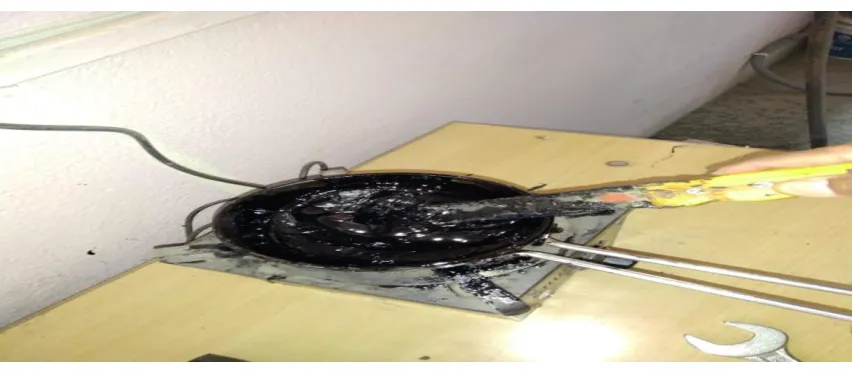
d. Process Step 4:- The bitumen is to be heated up to a maximum of 160oc .At the mixing a bitumen in hot aggregate.
http: // www.ijrtsm.com© International Journal of Recent Technology Science & Management 16
ISSN : 2455-9679
[Akash et al. , 4(3), Mar 2019] Impact Factor : 2.865
Figure No. 4 (b) Step 4 Mixing Process of Bitumen
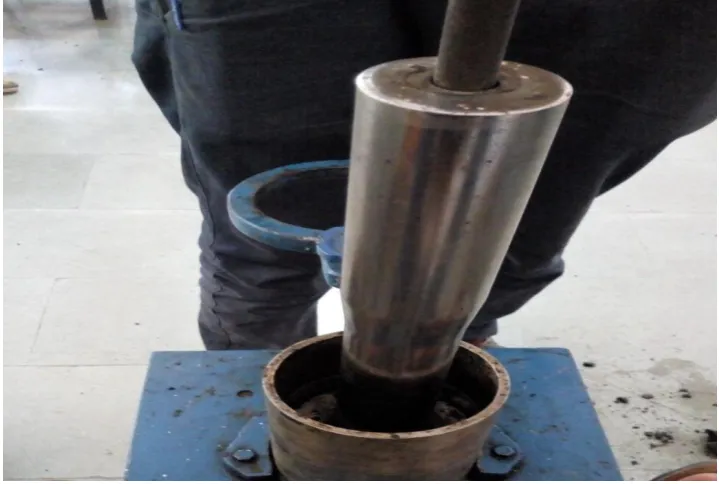
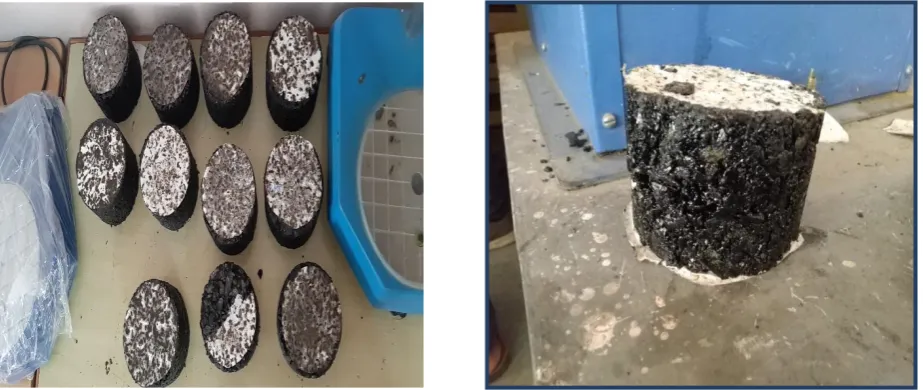
a. 5 Process Step 5:- The plastic waste coated
aggregate is mixed with got bitumen and the
resulted mix is used for block . The block laying
temperature is between 110oc to 120oc .
Figure No.Step 5 (b) Material Compact by Rammer
http: // www.ijrtsm.com© International Journal of Recent Technology Science & Management 17
ISSN : 2455-9679
[Akash et al. , 4(3), Mar 2019] Impact Factor : 2.865
IV.
O
BSERVATION ANDC
ALCULATION Marshall Stability TestA. Optimum Bitumen Content
The Marshall Test result conducted on mixes with varying bitumen percentages are show in table. After conducting
Marshall Tests on the Marshall specimens, the Marshall Stability value was found out to be
Table :- Optimum Binder Content Tabulations
Sample Binder
content
Marshal
Stability value
in kg
Flow Value
in 0.25 mm
unit
Bulk
Specific
Gravity
Air Voids
%
Voids Filled
by bitumen
%
A 5 1034.691 8.5 2.316 5.08 68
B 5.5 3071.45 10.15 2.316 4.64 71.51
C 6 3149.94 12.20 2.316 3.9 79.14
Graphs are plotted to determine the Stability value, unit weight and flow value; Based on which the Optimum Binder
Content (OBC) is determined. OBC was found out to be 6%
A. Optimum Plastic Content
The Marshall Test results conducted on mixes with varying LDPE content are shown as shown in table. After conducting Marshall Tests on the Marshall specimens, LDPE replace bitumen content 6% (72 gm )by weight .
http: // www.ijrtsm.com© International Journal of Recent Technology Science & Management 18
ISSN : 2455-9679
[Akash et al. , 4(3), Mar 2019] Impact Factor : 2.865
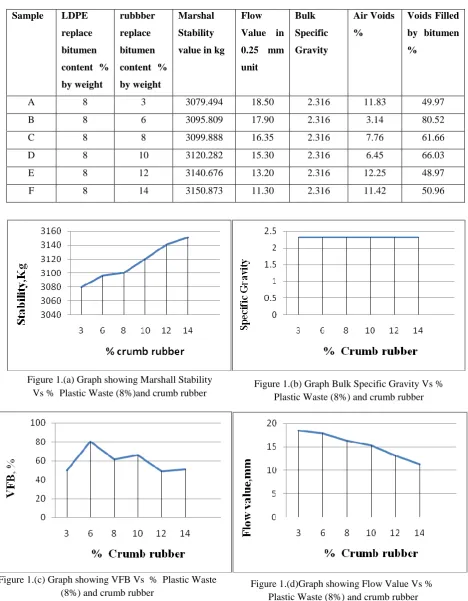
Figure 1.(a) Graph showing Marshall Stability Vs % Plastic Waste (8%)and crumb rubber
Figure 1.(c) Graph showing VFB Vs % Plastic Waste (8%) and crumb rubber
Table 1 :- Optimum Plastic Content Tabulations (8%)
Sample LDPE
replace
bitumen
content %
by weight
rubbber
replace
bitumen
content %
by weight
Marshal
Stability
value in kg
Flow
Value in
0.25 mm
unit
Bulk
Specific
Gravity
Air Voids
%
Voids Filled
by bitumen
%
A 8 3 3079.494 18.50 2.316 11.83 49.97
B 8 6 3095.809 17.90 2.316 3.14 80.52
C 8 8 3099.888 16.35 2.316 7.76 61.66
D 8 10 3120.282 15.30 2.316 6.45 66.03
E 8 12 3140.676 13.20 2.316 12.25 48.97
F 8 14 3150.873 11.30 2.316 11.42 50.96
Figure 1.(b) Graph Bulk Specific Gravity Vs % Plastic Waste (8%) and crumb rubber
http: // www.ijrtsm.com© International Journal of Recent Technology Science & Management 19
ISSN : 2455-9679
[Akash et al. , 4(3), Mar 2019] Impact Factor : 2.865
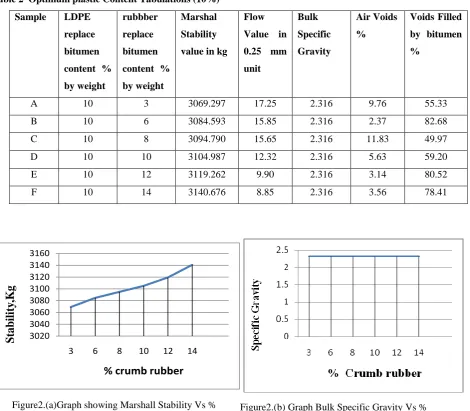
Figure2.(a)Graph showing Marshall Stability Vs % Plastic Waste (10%)and crumb rubber
Figure1.(e) Graph showing Vvvs % Plastic Waste (8%) and crumb rubber
Table 2 Optimum plastic Content Tabulations (10%)
Sample LDPE
replace
bitumen
content %
by weight
rubbber
replace
bitumen
content %
by weight
Marshal
Stability
value in kg
Flow
Value in
0.25 mm
unit
Bulk
Specific
Gravity
Air Voids
%
Voids Filled
by bitumen
%
A 10 3 3069.297 17.25 2.316 9.76 55.33
B 10 6 3084.593 15.85 2.316 2.37 82.68
C 10 8 3094.790 15.65 2.316 11.83 49.97
D 10 10 3104.987 12.32 2.316 5.63 59.20
E 10 12 3119.262 9.90 2.316 3.14 80.52
F 10 14 3140.676 8.85 2.316 3.56 78.41
3020 3040 3060 3080 3100 3120 3140 3160
3 6 8 10 12 14
S
tabi
li
ty
,K
g
% crumb rubber
http: // www.ijrtsm.com© International Journal of Recent Technology Science & Management 20
ISSN : 2455-9679
[Akash et al. , 4(3), Mar 2019] Impact Factor : 2.865
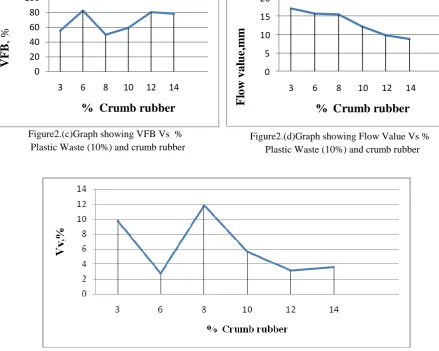
Figure2.(c)Graph showing VFB Vs % Plastic Waste (10%) and crumb rubber
0 20 40 60 80 100
3 6 8 10 12 14
V
F
B
, %
% Crumb rubber
0 5 10 15 20
3 6 8 10 12 14
F
low
val
u
e,m
m
% Crumb rubber
Figure 2.(e).Graph showing Vvvs % Plastic Waste (10%) and crumb rubber
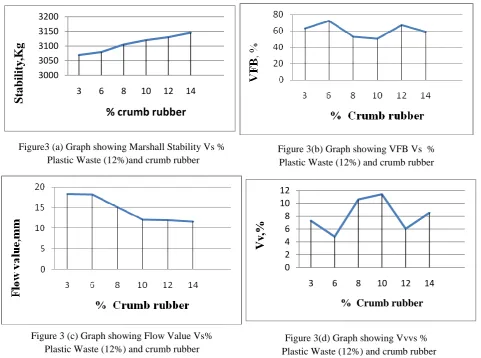
Table 3. Optimum plastic Content Tabulations (12%)
Sample
LDPE
replace
bitumen
content %
by weight
rubbber
replace
bitumen
content %
by weight
Marshal
Stability
value in kg
Flow
Value in
0.25 mm
unit
Bulk
Specific
Gravity
Air Voids
%
Voids
Filled
by
bitumen %
A
12
3
3069.297
18.25
2.316
7.28
63.066
B
12
6
3079.494
18.10
2.316
4.8
72.66
C
12
8
3104.987
15.10
2.316
10.59
53.08
D
12
10
3120.282
12.10
2.316
11.42
50.46
E
12
12
3130.479
11.95
2.316
6.04
97.56
F
12
14
3145.775
11.65
2.316
8.52
58.99
http: // www.ijrtsm.com© International Journal of Recent Technology Science & Management 21
ISSN : 2455-9679
[Akash et al. , 4(3), Mar 2019] Impact Factor : 2.865
Figure3 (a) Graph showing Marshall Stability Vs % Plastic Waste (12%)and crumb rubber 3000
3050 3100 3150 3200
3 6 8 10 12 14
Stabil
ity
,K
g
% crumb rubber
0 2 4 6 8 10 12
3 6 8 10 12 14
Vv
,%
% Crumb rubber
Table 4 Optimum plastic Content Tabulations (14%)
Sample LDPE
replace bitumen content % by weight rubbber replace bitumen content % by weight Marshal Stability
value in kg
Flow Value in 0.25 mm unit Bulk Specific Gravity Air Voids % Voids Filled by bitumen %
A 14 3 3110.035 20.50 2.316 12.25 48.97
B 14 6 4099.194 19.60 2.316 8.52 58.99
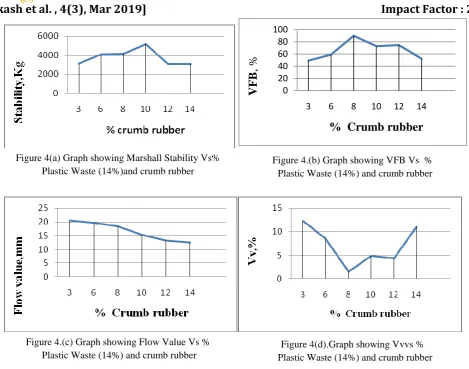
C 14 8 4139.982 18.40 2.316 1.49 89.85
D 14 10 5149.485 15.20 2.316 4.80 72.66
E 14 12 3071.336 13.20 2.316 4.38 74.53
F 14 14 3079.494 12.50 2.316 11.0 52.02
Figure 3(b) Graph showing VFB Vs % Plastic Waste (12%) and crumb rubber
Figure 3 (c) Graph showing Flow Value Vs% Plastic Waste (12%) and crumb rubber
http: // www.ijrtsm.com© International Journal of Recent Technology Science & Management 22
ISSN : 2455-9679
[Akash et al. , 4(3), Mar 2019] Impact Factor : 2.865
0 20 40 60 80 100
3 6 8 10 12 14
VF
B
, %
% Crumb rubber
V.
C
ONCLUSIONPlastic and crumb rubber coating on aggregates is used for the better performance of roads. This helps to have a better
binding of bitumen with plastic waste and crumb rubber coated aggregate due to increased bonding and increased area
of contact between polymers and bitumen. The polymer coating also reduces the voids. This prevents the moisture
absorption and oxidation of bitumen by entrapped air. The addition of waste plastic and crumb rubber modified
bitumen shows good result when compared to standard result. The optimum content of waste plastic and crumb rubber
to be used is between the range of 8% to 14% and 3% to 14% in this project. Marshall Stability and Flow value of
waste plastic and crumb rubber hot mix have good result as compared to normal bitumen hot mix. The problems like
bleeding are reduce in hot temperature region. We can reduce waste plastic and crumb rubber by using waste plastic
and crumb rubber. Plastic and crumb rubber will increase the melting point of the bitumen. Use of the innovative
Technology not only strength the road contraction but also increased the road life. Help to improve the environment .
Plastic road would be a boon for india’s hot and extremely humid climate where durable and eco-friendly roads witch
will relive the earth from all type of plastic road. In this project, the stability value of waste plastic (14%) and crumb
rubber (10%) are very maximum to unmodified bitumen. So we can be use modified bitumen in flexible pavement for
increase stability.
Figure 4(a) Graph showing Marshall Stability Vs% Plastic Waste (14%)and crumb rubber
Figure 4.(b) Graph showing VFB Vs % Plastic Waste (14%) and crumb rubber
Figure 4.(c) Graph showing Flow Value Vs % Plastic Waste (14%) and crumb rubber
http: // www.ijrtsm.com© International Journal of Recent Technology Science & Management 23
ISSN : 2455-9679
[Akash et al. , 4(3), Mar 2019] Impact Factor : 2.865
REFERENCES
1. Anusha G Krishna (November 7,2018) Waste Plastic and Crumb Rubber In Flexible Pavement.
2. Islam Sk Sohel “Role of Waste Plastic and Waste Rubber on Dense Bituminous Macadam Layer of Flexible
Pavement” (International Journal of Scientific & Engineering Research), Volume 7, Issue 4, April-2016,
pp77-82
3. Somani Parakash, “ Strengthen of Flexible Pavement by Using Waste Plastic and Rubber “ (International
Journal of Civil Engineering) ( vol.3 , PP. 246-250 , 5 may 2016)
4. Imran M. Khan, Procedia Engineering 145( 2016), Asphalt Design Using Recycled Plastic and Crumb Rubber
Waste for Sustainable Pavement Construction.
5. Dr Sowmya N J (May - Jun. 2015) Bituminous Modification with Waste Plastic and Crumb Rubber.
6. Athira R Prasad, (May - Jun. 2015) Bituminous Modification with Waste Plastic and Crumb Rubber.
7. Sasane Neha B. , (03 June-2015) “Application of waste plastic as an effective construction material in flexible pavement”.
8. Dr. Abhaykumar S Wayal (7, July 2013) Use of Waste Plastic and Waste Rubber in Aggregate and Bitumen
for Road Materials.
9. Rokade S, 28 (2012),Use of Waste Plastic and Waste Rubber Tyres in Flexible Highway Pavements.
10. Sabina, November 2009, Performance evaluation of waste plastic/polymer modified bituminous concrete
mixes.
11. IRC : SP: 98-2013, Guidelines for the use of waste plastic in hot bituminous Mixes in wearing courses.
12. IRC : 111-2009, Specifications for dense graded bituminous mixes.
13. The physical property of aggregate were considered according IS :2386 (1963).