IJPAR |Vol.8 | Issue 3 | Jul - Sep - 2019 Journal Home page: www.ijpar.com
Research article Open Access
Method development & validation of a drug ritonavir by RP-HPLC method
Dr.V.Uma Maheshwar Rao
1, G.Surekha
1*, Zeba Fatima
1, B.Chamanthi
1, Ch.Purnima
1,
G.Vishwambhar
1, D.R.Siril Kumar
1, C.Rani Madhuri
11
Department Of Pharmaceutical Analysis ,TRR college of pharmacy, Meerpet, Saroornagar (M),
Rangareddy (D), Hyderabad, Telangana, India.
Corresponding Author: G.Surekha
ABSTRACT
A simple, rapid, precise, accurate and sensitive reverse phase liquid chromatographic method has been developed for the determination of Ritonavir in bulk and pharmaceutical dosage form dosage form. The chromatographic method was standardized using Develosil ODS HG-5 RP C18, 5µm, 15cm x 4.6mm i.d. column with UV detection at 210 nm and Acetonitrile: Methanol with 68:32 ratio at a flow rate of 1.0 ml/ min. The proposed method was successfully applied to the determination of Ritonavir in bulk and pharmaceutic al dosage form. The method was linear over the range of 6 -14µg/ml. The recovery was in the range of 98% to 102% and limit of detection was found to be 0.09 µg/ml and quantification was found to be 0.27 µg/ml. Different analytical performance parameters such as precision, accuracy, limit of detection, limit of quantification and robustness were determined according to International Conference on Harmonization (ICH) guidelines.
Keywords:
RP-HPLC, Ritonavir, Method development and validation, ICH Guidelines.INTRODUCTION
Ritonavir is an HIV protease inhibitor that interferes with the reproductive cycle of HIV.[1]
used as a booster of other protease inhibitors and is available in both liquid formulation and as capsules.[8-11] While ritonavir is not an active antiviral agent against hepatitis C virus (HCV)
such as Paritaprevir and overall drug exposure.[18-20] American Association for the Study of Liver Diseases (AASLD) and the Infectious Diseases Society of America (IDSA) guidelines recommend ritonavir-boosted combination therapies as a first-line therapy for HCV Genotype 1a/b and 4
treatment-naïve patients with or without cirrhosis [21-23].
The IUPAC Name of Ritonavir is 1,3-thiazol-5-ylmethyl N-[(2S,3S,5S)-3-hydroxy-5-[(2S)-3- methyl-2-{[methyl({[2-(propan-2-yl)-1,3-thiazol-4- yl]methyl})carbamoyl]amino}butanamido]-1,6-diphenylhexan-2-yl]carbamate[4]
Fig 1: Chemical Structure of Ritonavir[25]
MATERIALS AND METHODS
HPLC Instrumentation & Conditions
The HPLC system employed was HPLC with Empower2 Software with Isocratic with UV-Visible Detector.
Standard & sample preparation for
UV-spectrophotometer analysis
25 mg of Ritonavir standard was transferred into 25 ml volumetric flask, dissolved & make up to volume with mobile phase. Further dilution was done by transferring 0.2 ml of the above solution into a 10ml volumetric flask and make up to volume with mobile phase. The standard & sample
stock solutions were prepared separately by dissolving standard & sample in a solvent in mobile phase diluting with the same solvent. (After optimization of all conditions) for UV analysis. It scanned in the UV spectrum in the range of 200 to 400nm. This has been performed to know the maxima of Ritonavir, so that the same wave number can be utilized in HPLC UV detector for estimating the Ritonavir. While scanning the Ritonavir solution we observed the maxima at 210nm. The UV spectrum has been recorded on
T60-LABINDIA make UV – Vis
Fig 2: UV Spectrum
Optimized Chromatographic Conditions
Column: Develosil ODS HG-5 RP C18, 5m,15cmx4.6mm i.d..
Mobile Phase: Acetonitrile: Methanol (68:32 v/v).
Flow Rate : 1.0ml/minute Wave length : 210 nm Injection volume : 20µl Run time: 06 mins.
Column temperature : Ambient Sampler cooler : Ambient
MOBILE PHASE PREPARATION
Mobile phase was prepared by taking Acetonitrile: Methanol (68:32 v/v). Mobile phase
was filtered through 0.45 m membrane filter and degassed under ultrasonic bath prior to use. The mobile phase was pumped through the column at a flow rate of 1.0 ml/min.
SAMPLE & STANDARD
PREPARATION FOR THE ANALYSIS
25 mg of Ritonavir standard was transferred into 25 ml volumetric flask, dissolved & make up to volume with mobile phase. Further dilution was done by transferring 0.5 ml of the above solution into a 10ml volumetric flask and make up to volume with mobile phase.
RESULT AND DISCUSSION
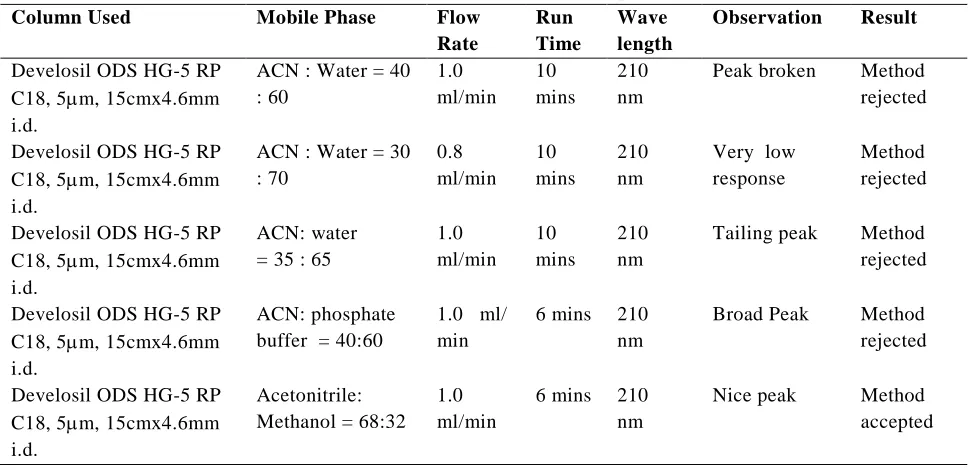
Table-1:Trials for method development
Column Used Mobile Phase Flow
Rate
Run Time
Wave length
Observation Result
Develosil ODS HG-5 RP C18, 5m, 15cmx4.6mm i.d.
ACN : Water = 40 : 60 1.0 ml/min 10 mins 210 nm
Peak broken Method rejected
Develosil ODS HG-5 RP C18, 5m, 15cmx4.6mm i.d.
ACN : Water = 30 : 70 0.8 ml/min 10 mins 210 nm
Very low response
Method rejected
Develosil ODS HG-5 RP C18, 5m, 15cmx4.6mm i.d.
ACN: water = 35 : 65
1.0 ml/min 10 mins 210 nm
Trial-1
Trial-2
Trial-3
2.
68
7
3.
36
7
AU
0.0000 0.0002 0.0004 0.0006 0.0008
Minutes
1.00 2.00 3.00 4.00 5.00 6.00 7.00 8.00 9.00 10.00
2.
15
0
2.
46
3 2.
68
9
4.
62
7
AU
-0.0005 0.0000 0.0005 0.0010 0.0015 0.0020 0.0025 0.0030
Minutes
1.00 2.00 3.00 4.00 5.00 6.00 7.00 8.00 9.00 10.00
3
.3
0
8
AU
0.0000 0.0002 0.0004 0.0006 0.0008
Minutes
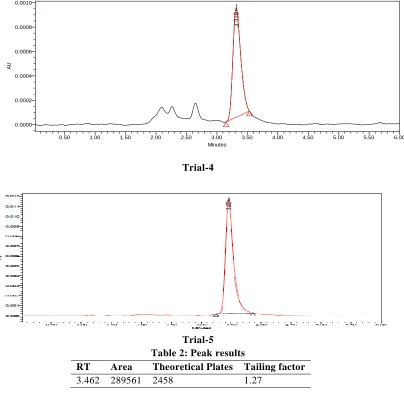
Trial-4
Trial-5 Table 2: Peak results
RT Area Theoretical Plates Tailing factor
3.462 289561 2458 1.27
METHOD VALIDATION
Accuracy: Recovery study: To decide the exactness of the proposed strategy, recuperation thinks about were completed by including diverse sums (80%, 100%, and 120%) of unadulterated
medication of Ritonavir were taken and added to the pre-dissected detailing of fixation 10µg/ml. From that rate recuperation esteems were ascertained. The outcomes were appeared in Table-3.
Table-3: Accuracy Readings Sample ID Concentration (g/ml)
Peak Area
% Recovery of Pure drug
Statistical Analysis Amount
Added
Amount Found
S1 : 80 % 8 8.157 595625 101.962 Mean= 101.387%
S.D. = 0.516599 % R.S.D.= 0.509532
S2 : 80 % 8 8.099 591457 101.237
S3 : 80 % 8 8.077 589875 100.962
3
.3
1
9
AU
0.0000 0.0002 0.0004 0.0006 0.0008 0.0010
Minutes
Precision
Repeatability
The precision of each method was ascertained separately from the peak areas & retention times
obtained by actual determination of six replicates of a fixed amount of drug. Ritonavir (API) the percent relative standard deviations were calculated for Ritonavir is presented in the Table-4.
Table-4: Repeatability Results of Precision HPLC Injection
Replicates of Ritonavir
Retention Time Peak Area
Replicate – 1 3.461 726541
Replicate – 2 3.461 724857
Replicate – 3 3.462 723541
Replicate – 4 3.461 725268
Replicate – 5 3.459 728984
Replicate -6 3.459 725745
Average 3.4605 725822.7
Standard Deviation 0.001224745 1841.86
% RSD 0.0353921 0.253762
Intra day & Inter day: The intra & inter day variation of the method was carried out & the high values of mean assay & low values of standard
deviation & % RSD (% RSD < 2%) within a day & day to day variations for Ritonavir revealed that the proposed method is precise.
Table-5: Results of Intra day & Inter day Conc. Of Ritonavir (API)
(µg/ml)
Observed Conc. Of Ritonavir (µg/ml) by the proposed method
Intra day Inter day
Mean (n=6) % RSD Mean (n=6) % RSD
8 8.02 1.05 7.96 1.06
10 10.10 0.96 10.06 0.99
12 11.89 0.85 12.03 0.92
Linearity and Range
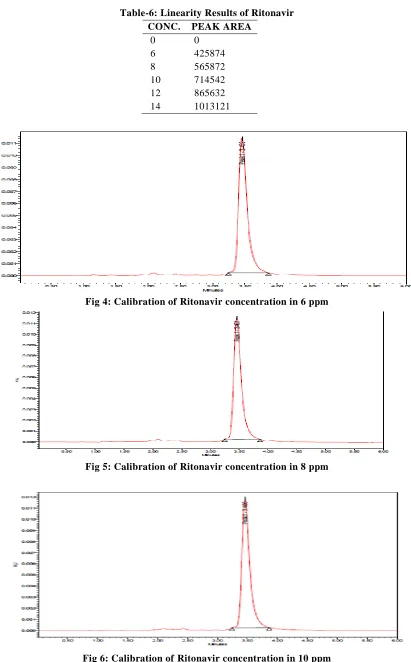
Linearity range was found to be 6-14µg/ml for Ritonavir. The correlation coefficient was found to
be 0.999, the slope was found to be 72353 and intercept was found to be 5437 for Ritonavir [21].
Fig-3: Calibration curve of Ritonavir (API) y = 72353x - 5437.5
R² = 0.9998
-500000 0 500000 1000000 1500000
0 5 10 15
P
eak
A
rea
Conc. in ppm
Calibration Curve of Ritonavir
Series1
Table-6: Linearity Results of Ritonavir CONC. PEAK AREA
0 0
6 425874
8 565872
10 714542
12 865632
14 1013121
Fig 4: Calibration of Ritonavir concentration in 6 ppm
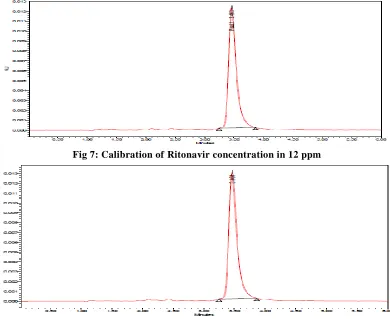
Fig 7: Calibration of Ritonavir concentration in 12 ppm
Fig 8: Calibration of Ritonavir concentration in 14 ppm
LOD & LOQ
The Minimum concentration level at which the analyte can be reliable detected (LOD) & quantified (LOQ) were found to be 0.09 & 0.27 µg/ml respectively.
CONCLUSION
A delicate and specific, sensitive RP-HPLC strategy has been created and approved for the investigation of Ritonavir API.
Facilitate the proposed RP-HPLC strategy has amazing affectability, exactness and reproducibility.
REFERENCES
[1]. "Ritonavir". The American Society of HealthSystem Pharmacists. Archived from the original on 2015 -10-17. Retrieved Oct 23, 2015.
[2]. "FDA approves Viekira Pak to treat hepatitis C". Food and Drug Administration. December 19, 2014. Archived from the original on October 31, 2015.
[3]. "Ritonavir Pregnancy and Breastfeeding Warnings". drugs.com. Archived from the original on 7 September 2015. Retrieved 23 October 2015.
[4]. British National Formulary 69. Pharmaceutical Pr. March 31, 2015. 426. ISBN 9780857111562.
[5]. Hacker, Miles (2009). Pharmacology principles and practice. Amsterdam: Academic Press/Elsevier. p. 550. ISBN 9780080919225.
[6]. Fischer, Jnos; Ganellin, C. Robin (2006). Analogue-based Drug Discovery. John Wiley & Sons. p. 509. ISBN 9783527607495.
[8]. "Ritonavir". International Drug Price Indicator Guide. Archived from the original on 10 May 2017. Retrieved 23 October 2015.
[9]. Norvir Archived 2007-06-27 at the Wayback Machine, rxlist.com [10]. Ritonavir Archived 2008-04-30 at the Wayback Machine, Merck Manual
[11]. P.D. Sethi, HPLC Quantitative Analysis Pharmaceutical Formulations, CBS Publishers and distributors, New Delhi, 7-22, 38-43, 2001, 94-105.
[12]. R. Snyder, J. Kirkland, L. Glajch, Practical HPLC Method Development, john Wiley and sons International publication, II Edn., 2011.
[13]. S. Ashutoshkar, Pharmaceutical Drug Analysis 2nd Edn, New Age International Private L imited Publishers, 2005: 452-474.
[14]. H. Beckett and J.B. Stenlake, Practical Pharmaceutical Chemistry, 4th End., C.B.S.Publishers and Distributors’, New Delhi.: 1-9, 157-167.
[15]. H.H.Williard, L.L.Merit, F.A.Dean, F.A.Settle, Instrumental Methods Of Analysis, 6 th Edn, C.B.S. Publishers and Distributors, New Delhi.: 430-440, 495-504,529-545.
[16]. B.K. Sharma, Instrumental Methods of Chemical Analysis. GOEL Publishing House, Meerut: 286 -300. [17]. Instant notes on analytical chemistry by D.Kealy and P.J.Haines, © BIOS Scientific Publishers Limited,
2002,UK,6-7.
[18]. Gurdeep R. Chatwal, Sham K. Anand, Instrumental methods of Chemical Analysis,5th edition, Himalaya Publishing House(Mumbai),2005, P-2.566
[19]. Gurdeep R. Chatwal, Sham K. Anand, Instrumental methods of Chemical Analys is,5th edition, Himalaya Publishing House(Mumbai),2005, P-2.567
[20]. Gurdeep R. Chatwal, Sham K. Anand, Instrumental methods of Chemical Analysis,5th edition, Himalaya Publishing House(Mumbai),2005, P-2.624
[21]. Gurdeep R. Chatwal, Sham K. Anand, Instrumental methods of Chemical Analysis,5th edition, Himalaya Publishing House(Mumbai), P-2.570
[22]. Dr. S. Ravishankar , Textbook of pharmaceutical analysis, 5th edition,Rx Publication (Tirunelveli),2006, P-18-6
[23]. Dr. S. Ravishankar , Textbook of pharmaceutical analysis, 5th ed ition,Rx Publication (Tirunelveli), 2006,P-18-3
![Fig 1: Chemical Structure of Ritonavir[25]](https://thumb-us.123doks.com/thumbv2/123dok_us/8868747.1812570/2.612.186.440.167.372/fig-chemical-structure-of-ritonavir.webp)