The Thirty-Third AAAI Conference on Artificial Intelligence (AAAI-19)
Fine-Grained Search Space Classification for
Hard Enumeration Variants of Subset Problems
Juho Lauri, Sourav Dutta
Nokia Bell Labs, Ireland{juho.lauri, sourav.dutta}@nokia-bell-labs.com
Abstract
We propose a simple, powerful, and flexible machine learning framework for (i) reducing the search space of computation-ally difficult enumeration variants of subset problems and (ii) augmenting existing state-of-the-art solvers with informative cues arising from the input distribution. We instantiate our framework for the problem of listingallmaximum cliques in a graph, a central problem in network analysis, data mining, and computational biology. We demonstrate the practicality of our approach on real-world networks with millions of ver-tices and edges by not only retaining all optimal solutions, but also aggressively pruning the input instance size result-ing in several fold speedups of state-of-the-art algorithms. Fi-nally, we explore the limits of scalability and robustness of our proposed framework, suggesting that supervised learning is viable for tackling NP-hard problems in practice.
1
Introduction
Computationally challenging (i.e., NP-hard) problems are ubiquitous and arise naturally in several domains like scheduling, planning, and design and analysis of networks. In particular, several such important problems are subset problems: given an input, what is the largest/smallest sub-set with a particular property? One of the most central of such problems is themaximum clique problem. In this prob-lem, we are given an undirected graphG, and asked for the largest subset of vertices that are pairwise adjacent, i.e., form aclique. An even harder and more general variant of a sub-set problem is itsenumerationvariant, in which the goal is to list alloptimal solutions. This variant of the maximum clique problem is known as themaximum clique enumera-tion(MCE) problem. Note that we consider the problem of listing of allmaximumcliques and notmaximalcliques.
The MCE problem has numerous applications such as so-cial network analysis (Faust and Wasserman 1995), study of structures in behavioral networks (Bernard, Killworth, and Sailer 1979), statistical analysis of financial networks (Bo-ginski, Butenko, and Pardalos 2005), and clustering in ci-tation and dynamic networks (Stix 2004). Moreover, MCE is also closely tied to various applications in computa-tional biology (Abu-Khzam et al. 2005; Eblen et al. 2012;
Copyright c2019, Association for the Advancement of Artificial Intelligence (www.aaai.org). All rights reserved.
Yeger-Lotem et al. 2004), including the detection of protein-protein interaction complex, clustering protein-protein sequences, searching for common cis-regulatory elements (Baldwin et al. 2004), and others (Bomze et al. 1999).
Unfortunately, in the worst case, NP-hard subset prob-lems like maximum clique are inherently complex even for small datasets and lack scalable algorithms. To make mat-ters worse, high-throughput data typically creates extremely large graphs in e.g., data mining and computational biol-ogy (Eblen et al. 2012). State-of-the-art solvers employ var-ious heuristics that are effective when the input graph has certain structural properties, but the detection of such struc-ture can be costly in practice. In addition, the solvers are general purpose, and are unable to exploit information con-cerning the input distribution.
We argue that practically relevant problem instances typ-ically come from the same distribution due to e.g., human nature or laws of physics governing the process the input models. For instance, it is plausible that humans connect in similar ways on a social network, or that different human lungs respond similarly to cigarette smoke. Can we aug-ment existing state-of-the-art solvers to cheaply and auto-matically leverage such information about the input distribu-tion, which we cannot even describe? In particular,can ma-chine learning be used to cheaply detect and exploit struc-ture in practically relevant instances ofNP-hard problems that come from the same distribution?
To the best of our knowledge, our work is the first attempt at using machine learning to reduce the search space of a computationally difficult enumeration problem.
1.1
Related work
graph sizes (up to 1200 vertices).
Direct approaches By a “direct approach” we refer to an approach that can solve a hard problem by itself. Vari-ous researchers proposed approaches for solving TSP (Hop-field and Tank 1985; Fort 1988; Durbin and Willshaw 1987). However, these methods can not compete with direct algo-rithmic methods for TSP like the Concorde solver (Apple-gate et al. 2006). Similarly, there has been interest in study-ing the power of neural networks for solvstudy-ing hard prob-lems (Bruck and Goodman 1988; Yao 1992).
Recently, there has been interest in bringing advance-ments from deep learning and game-playing to combina-torial optimization (Vinyals, Fortunato, and Jaitly 2015; Bello et al. 2016; Nowak et al. 2017). These approaches ap-ply for small graph sizes (up to only 200 vertices), whereas direct methods handle instances with several tens of thou-sands of vertices (Applegate et al. 2009).
Another approach for solving hard problems is via su-pervised learning, by treating a classifier as a decision or-acle (Devlin and O’Sullivan 2008; Xu, Koenig, and Kumar 2018). The challenge in making use of such an oracle is that one is rarely satisfied by merely an affirmative answer, but demands a witness as well.
The MCE problem The maximum clique problem is heavily studied and is well-known to be NP-complete with other strong hardness results known as well (Zuckerman 2006; Chen et al. 2006). The MCE problem is at least as hard as the maximum clique problem, since its solution in-cludes all maximum cliques.
Unlikemaximal clique enumeration, MCE has received significantly less attention. Since any algorithm that enu-merates all maximal cliques also enuenu-merates all maximum cliques, it is natural to approach MCE by adapting the ex-isting maximal clique enumeration algorithms (Bomze et al. 1999). However, this approach quickly becomes infeasible for large dense graphs.
Existing approaches for maximal clique enumeration problem can be broadly classified into two strategies: iter-ative enumeration (Kose et al. 2001; Zhang et al. 2005) and backtracking (Akkoyunlu 1973; Bron and Kerbosch 1973; Cazals and Karande 2008; Tomita, Tanaka, and Takahashi 2006), with other approaches as well (Bul´o, Torsello, and Pelillo 2009; Wan et al. 2006; Modani and Dey 2008; Cheng et al. 2011; 2012; Schmidt et al. 2009; Wu et al. 2009); for a comprehensive discussion on the related liter-ature see (Cazals and Karande 2008; Bomze et al. 1999).
1.2
Our contribution
Our contribution overcomes the following challenges: 1. Whole-instance classification:a classifier can be used as
a decision oracle for a decision problem. More precisely, one can apply the notion of self-reducibility to iteratively close-in on a solution.1However, it is challenging to make
practicaluse of such an oracle.
1
For instance, given a graphG, imagine an oracle which answer positively iffGhas ak-clique. If the oracle answers negatively on
2. Cost of optimal labels:(Bello et al. 2016, Section 4) ar-gue that learning from examples is undesirable for NP-hard problems since “getting high-quality labeled data is expensive and may be infeasible for new problem state-ments”. We show, however, that if the labeled data points are representative enough of the input distribution, we can mitigate the need for labeling costly data points due to the generalizability of our classifier.
In summary, our major contributions are as follows.
• A novel machine learning framework for reducing the search space of computationally hard enumeration vari-ants of subset problems with instances drawn from the same distribution.
• Specifically, we instantiate our framework for listingall
maximum cliques in a graph by applying computationally cheap graph-theoretic and statistical features for search space pruning via fine-grained classification of vertices.
• We show that our framework retains all optimal solu-tionson large, real-world networks with millions of ver-tices and edges, with significant (typically over 90 %) reductions in the instance size, resulting in several fold speedups of state-of-the-art algorithms for the problem.
• We explain the high accuracy of our framework by ex-ploring its limits in terms cheap trainability, scalability, and robustness on Erd˝os-R´enyi random graphs.
2
Proposed framework
We instantiate our framework for the MCE problem, but stress that the approach works in principle for any subset problem or its enumeration variant.
Fine-grained search space classification In our case, we assume the instance is represented as an undirected graph G= (V, E). Moreover, in contrast to previous approaches, we viewindividual verticesofGas classification problems as opposed toGitself. That is, the problem is to induce a mappingγ:V → {0,1}from a set ofLtraining examples T ={hf(vi), yii}Li=1, wherevi∈V is a vertex,yi∈ {0,1} a class label, andf :V →Rd a mapping from a vertex to
ad-dimensional feature space. We keepdsmall and ensure thatf can be computed efficiently to ensure practicality.
Search strategies To learn the mappingγfromT, we use a probabilistic classifierP which outputs a probability dis-tribution over{0,1} for a givenf(u)for u∈ V. We give two parameterized search strategies for enhancing a search algorithmAbyP. Define aconfidence thresholdq∈[0,1].
• Probabilistic preprocessing: delete from G each vertex predicted by P to not be in a solution with probability at leastq, i.e., let G0 = G\V0, whereV0 = {u | u ∈ V ∧P(u= 0)≥q}. ExecuteAwithG0as input instead
ofG.
• Guiding by experience:Define a set ofhints H = {u | u∈V∧P(u= 1)≥q}and use them to guide the search effort ofAexecuted on inputG.
The purpose ofqis to control the error and pruning rate of preprocessing: (i) it is more acceptable to not remove a ver-tex that isnotin a solution than to remove a vertex thatisin a solution, and (ii) a lower value ofqtranslates to a possibly higher pruning rate.
We observe that the probabilistic preprocessing strategy is aheuristic, i.e., it is possible the cost of an optimal solution inG0differs from that inG. However, the second strategy of guiding by experience isexact, i.e., given enough time,A will finish with a globally optimal solution. It is also possi-ble to combine the strategies by preprocessing first, and then executingAwithHdefined onG0. For the remainder of this
work, we only focus on probabilistic preprocessing.
3
Computational features
In this section, we describe the vertex features which can be computed efficiently and also capture fine-grained, localized structural properties of the graph. Specifically, we employ the following features based ongraph measuresand statisti-cal properties.
Graph measure based features We use the following graph-theoretic features:(F1)number of vertices,(F2) num-ber of edges,(F3)vertex degree,(F4)local clustering coef-ficient, and(F5)eigencentrality.
Features (F1), (F2), and (F3) capture the crude informa-tion regarding the graph, providing a reference for the classi-fier for generalizing to different distributions from which the graph might have been generated. Feature (F3), thedegreeof v, denoted bydeg(v), is the number of edges incident tov.
Feature (F4), the order-3 local clustering coefficient
(LCC) of a vertex is the fraction of its neighbors with which the vertex forms a triangle, encapsulating thesmall world(Watts and Strogatz 1998) phenomenon. In general, the order-k local clustering coefficient of v, denoted by Ck(v), is computed as Ck(v) = Wk(v)/ deg(k−1v)
, where Wk(v)is the number of (k−1)-cliques in G[N(v)], i.e., the subgraph ofGinduced by the neighborhood of v (ex-cludingvitself). For computational efficiency, we limit our feature set to only order-three LCC.
Feature (F5), theeigencentrality, represents a high degree of connectivity of a vertex to other vertices, which in turn have high degrees as well. Theeigenvector centrality~vis the eigenvector of the adjacency matrixAofGwith the largest eigenvalueλ, i.e., it is the solution ofA~~v=λ~v. Theith entry of~v is theeigencentralityof vertex v. In other words, this feature provides a measure of local “denseness”. A vertex in a dense region shows higher probability of being part of a large clique.
Statistical features. Intuitively, for a vertex v present in a large clique, its degree and the local clustering coeffi-cient would deviate from the underlying expected distribu-tion characterizing the graph. Similarly, the neighbors ofv
also present in the clique would demonstrate such a prop-erty. Interestingly, statistical features are not only compu-tationally cheap but are also inherently robust in approxi-mately capturing the local graph structural patterns as shown in (Dutta, Nayek, and Bhattacharya 2017).
The above intuition is captured by the following features: (F6)the chi-squared value over vertex degree,(F7)average chi-squared value over neighbor degrees,(F8)chi-squared value over LCC, and (F9)average chi-squared value over neighbor LCCs.
Statistical significance can be captured by the notion of p-value (Read and Cressie 1988). ThePearson’s chi-square statistic,χ2, is a good estimate (Read and Cressie 1989) of
the p-value, and for features (F6)-(F9) it is computed as
χ2=X
∀i h
(Oi−Ei)
2
/Ei i
, (1)
whereOiandEi are the observed and expected number of occurrences, of the possible outcomesi.
Classification framework To solve the problem de-scribed in Section 2, we experiment with various (even non-probabilistic) classifiers viaauto-sklearn(Feurer et al. 2015) which is an automated system for algorithm selection and hyperparameter tuning (for a list of its classifiers, in-cluding non-linear ones, see (Feurer et al. 2015, Table 1)). We observe highest accuracy with linear models, with neg-ligible differences between logistic regression and (linear) support vector machines.
Thus, we use a linear classifier (logistic regression) trained for 400 epochs with stochastic gradient descent. We use a standard L2 regularizer, and use 0.0001 as the regularization term multiplier determined by a grid search. We use a standard implementation (SGDClassifier) from
scikit-learn(Pedregosa et al. 2011).
4
Experimental results
In this section, we demonstrate that supervised learning is viable for solving large structured instance of NP-hard prob-lems, whereas previous approaches relying have only scaled up to instances with 200 vertices. Furthermore, as mentioned in (Eblen et al. 2012), it is well-known that the topology of real-world networks differ from that of random graphs. Hence, we show scalability to large real-world networks.
4.1
Exact clique-finding algorithms
We use the following state-of-the-art algorithms:
• igraph(Csardi and Nepusz 2006) software
implemen-tation of a modified Bron-Kerbosch algorithm (Eppstein, L¨offler, and Strash 2010).
• EmMCE (Cheng et al. 2011), an external memory
algo-rithm focusing on low I/O complexity.
• cliquer (Niskanen and ¨Osterg˚ard 2003), using the
branch-and-bound algorithm of ( ¨Osterg˚ard 2002).
Table 1: Pruning ratios and speedups. The column “fmc(ω)” is the maximum clique size found by thefmcheuristic, followed by the true maximum clique sizeωin parenthesis. The columnPd is the pruning ratio obtained by the degree method, while
Pois the pruning ratio of our framework. The columns “cliquer(d)” and “cliquer(o)” give the runtimes ofcliqueron
onlydegree-pruned instances and on instances pruned by our framework, respectively. The confidence thresholdq= 0.55, all results are averaged over 3 runs and include feature computation time, and the clique accuracy remains one. In the last four columns, the parenthesis show the speedup while an out of memory for the original instance is marked with *.
Instance |V| |E| fmc(ω) Pd Po igraph EmMCE cliquer(d) cliquer(o)
socfb-A-anon 3 M 24 M 23 (25) 0.85 0.94 101.97 (20.84) 113.90(44.82) 1337.85 (*) 211.06 (*) socfb-B-anon 3 M 21 M 23 (24) 0.86 0.94 86.64 (22.26) 96.34 (41.96) 1038.59 (*) 193.50 (*) socfb-Texas84 36 K 2 M 44 (51) 0.37 0.76 56.88 (1.29) 48.62 (1.28) 4.10 (2.19) 1.87(4.79) bio-WormNet-v3 16 K 763 K 90 (121) 0.68 0.90 4400.12 (1.22) 4593.47 (1.26) 1.04 (6.69) 0.89(7.87) web-wikipedia2009 2 M 5 M 31 (31) 0.98 0.99 1.50 (412.79) 1.98 (1574.39) 8.86 (*) 3.96 (*) web-google-dir 876 K 5 M 44 (44) 0.97 0.98 0.39 (150.20) 0.67 (991.52) 4.40 (*) 2.07 (*) soc-flixster 3 M 8 M 29 (31) 0.97 0.99 23.71(54.66) 18.64 (20.25) 44.27 (*) 9.52 (*) soc-google-plus 211 K 2 M 56 (66) 0.94 0.97 6620.77 (1.09) 6711.56 (1.32) 1.50 (214.20) 1.04(310.40) soc-lastfm 1 M 5 M 14 (14) 0.92 0.97 9.47 (16.79) 9.12 (31.23) 65.04 (*) 11.61 (*)
thatigraphandEmMCEsolve the more general problem of
maximalclique enumeration.
We also experimented with theMoMCsolver of (Li, Jiang, and Many`a 2017), but it reported out of memory for large networks. Runs on this solver are thus omitted. The experi-ments for real-world networks (Subsection 4.2) are executed on an Intel Core i7-4770K CPU (3.5 GHz), 8 GB of RAM, running Ubuntu 16.04. As an exception, we run experiments
forcliqueron Intel Xeon E5-2680 and 102 GB of RAM.
4.2
Real-world networks
To demonstrate the practicality and usefulness of our frame-work, we use real-world networks from Network Repos-itory (Rossi and Ahmed 2015) (http://networkreposRepos-itory. com/). In particular, we consider biological networks, Face-book networks, social networks, and web networks, which contain 36, 114, 57, and 27 networks, respectively. For train-ing, we choose from the biological networks 32 smallest net-works, from the Facebook networks 109 smallest netnet-works, from the social networks a small sample of 32 networks, and from the web networks a small sample of 11 networks. For reasons of space, we omit the exact details of the training networks. For testing, we use from each domain some of the largest networks by edge count, detailed in Table 1.
Setup and accuracy measures We implement the proba-bilistic preprocessing strategy of Section 2 with the classifier P as described in Section 3. We fix the confidence thresh-old q = 0.55. We consider the following accuracy mea-sures. Thepruning ratiois the ratio of the number of ver-tices predicted byP to not be in a solution with probability at leastqto the number of verticesnin the original instance. Theclique accuracyis one iff the number ofallmaximum cliques of the instanceGis equal to the number of all maxi-mum cliques of the reduced instanceG0andω(G) =ω(G0), whereω(G)is the size of a maximum clique inG.
Preprocessing and comparison A safe preprocessing strategy is thedegree method: find a clique of sizek, and
delete every vertex with degree less thank−1. We imple-ment this by using Fast Max-Clique Finder (Pattabiraman et al. 2013) (fmc), a state-of-the-art heuristic for finding a maximum clique, designed for real-world networks, typ-ically finding near-optimal solutions (see Table 1). Thefmc
heuristic runs in less than 2 seconds for each network. We make use of the degree method in two ways. First, being a well-known preprocessing method, we compare our method against it. Second, the degree distributions of some real-world networks follow a power law. That is, such net-works have many low degree vertices. In such cases it might not be surprising that an algorithm learns to remove many vertices. Thus, to avoid such a situation from impacting our results, we preprocess each training and test instance first us-ing the degree method. This helps our framework to discard non-trivial vertices, going beyond the degree method.
Features, classifier, and vertex classification accuracy We train four classifiers that we namebio31,socfb107,
soc32, andweb13 using the mentioned networks. More
precisely, for each network Gi in the training set of the three domains, we list all maximum cliques Ci = {C1, C2, . . . , C`} in Gi, use as label-0 examples the ver-tices inH =S`i=1V(Ci), and to create a balanced dataset, sample uniformly at random|H|vertices fromV(Gi)\H and use them as label-1 examples. The final training set is obtained by computing the feature vectors of each vertex. We use the features described in Section 3. In particular,
bio31 is trained with 2178 feature vectors, socfb107
with 10746 feature vectors,soc32with 2008 feature vec-tors, andweb11with 2556 feature vectors. A 4-fold cross validation over the 2178 feature vectors gives an average
vertex classification accuracy of 0.96, the same over the 10746 feature vectors results in an average of 0.93, the same over the 2008 feature vectors results in an average of 0.97, and the same over the 2556 feature vectors results in an av-erage of 0.80.
0.7 0.8 0.9 1
10 11 12 13 14 15 16 17 18
Vertex classification accuracy
Size of planted clique (k) n= 64
n=128 n=256
(a) Vertex acc. 0.2 0.4 0.6
10 11 12 13 14 15 16 17 18
Pruning ratio
Size of planted clique (k) n=64
n=128 n=256
(b) Pruning ratio
0.2 0.4 0.6 0.8 1
10 11 12 13 14 15 16 17 18
Clique accuracy
Size of planted clique (k) n=64
n=128 n=256
(c) Clique acc.
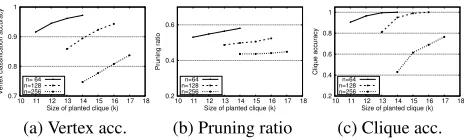
Figure 1: The vertex accuracy, pruning ratio, and clique accuracy of our framework when trained with G(n,1/2)
with three different parameter pairs(64,10),(128,12), and
(256,13). The predictions are for independent, distinct sam-ples with the samen, but growing planted clique sizek.
Pruning ratios and speedups We show the pruning ra-tios and solve times along with solver speedups in Table 1. For each graph,we retain all optimal solutions (i.e., the clique accuracy is one), and obtainspeedups as large as 300x, even for the branch-and-bound strategy ofcliquer. It can also be seen that our strategy speeds upcliquerby around 6x more than the degree method alone (compare two last columns in Table 1). Also importantly, our framework safely prunes away around 90 % or more of the vertices, con-siderably shrinking the input sizes which is a fundamental issue in applications in e.g., computational biology (Eblen et al. 2012). This alleviates memory issues with state-of-the-art algorithms as reported in (Cheng et al. 2011).
We stress that our approach workswithout any knowl-edge or dependence on an estimate ofωat runtime, while the quality of the degree method crucially depends on it.
5
On supervised learning for hard problems
The goal of this section is two-fold: (i) to explain the high ac-curacy of our proposed framework, even when it was trained with small instances, and (ii) as a consequence, argue that supervised learning is a viable approach for solving struc-tured instances of certain hard problems.To ensure that the input instances are, at some point, “structure-free” we turn to the following heavily-studied variant of the maximum clique problem. This serves as a representative of theworst-case inputfor our preprocessing strategy. Also, observe that in case the input graph has a unique maximum clique, MCE is equivalent to finding the (single) maximum clique.
5.1
Planted clique
In theplanted clique problem(Jerrum 1992; Kuˇcera 1995), we are given an Erd˝os-R´enyi random graph (Erd¨os and R´enyi 1959)H := G(n, p), i.e., an n-vertex graph where the presence of each edge is determined independently with probabilityp. In addition, the problem is parameterized by an integerksuch that a random subset ofkvertices has been chosen fromH and a clique added on it. On this input, the task is to identify (with the knowledge of the value ofk) the kvertices containing the planted clique.
The problem is easy for k ≤ log2(n). In particular, as shown in (Bollob´as 2013), the clique number ofG(n, p)as n→ ∞is almost surelyworw+ 1wherewis the greatest
natural number such that
n
w
p(w2)≥log(n), (2)
wherewis roughly2 log2(n). Even when a clique of such size is known to exist (whp), we only know how to find a clique of sizelog2(n)efficiently,2 and also solve the prob-lem in polynomial-time whenkis large enough. Specifically, it is known that several algorithmic techniques such as spec-tral methods (see e.g., (Feldman et al. 2017) for more) pro-duce efficient algorithms for the problem whenk= Ω(√n). However, settling the complexity of the problem is a no-torious open problem whenkis between2 log2(n)and√n. Next, we will focus precisely on this difficult region.
5.2
Pushing the limits of preprocessing
In this subsection, we explore the limits of scalability and robustness of our framework on the planted clique problem. All experiments are done on an Intel Core i5-6300U CPU (2.4 GHz), 8 GB of RAM, running Ubuntu 16.04, differing only slightly from the earlier hardware configuration. For all experiments here, we use only theigraphalgorithm.
Generation of synthetic data We use thegenrang util-ity program (McKay and Piperno 2014) to sample a random graphH :=G(n, p). To plant a clique of sizek, we sample uniformly at randomkvertices, denoted byK, fromHand insert all corresponding at most k2missing edges intoH.
For each H, we compute the features described in Sec-tion 3 with the following differences: we add (F10) the four LCC and modify (F8) and (F9) to consider order-four LCC instead of the LCC. As explained in Section 3, this brings more predictive power while still remaining compu-tationally feasible for small graphs. The valuesEi in Equa-tion 1 for (F6) and (F7) are the expected degreen·p, while for (F8) and (F9) they are the expected order-kLCC given as nk−1−1
p(k2)·1/ np
k−1
. To ensure a balanced dataset, we sample (i)klabel-0 examples fromKand (ii)klabel-1 ex-amples fromG\K, both uniformly at random.
For training, we consider n ∈ {64,128,256,512} be-cause the clique number grows roughly logarithmically with n(see Equation 2). We fixp= 1/2. For everyn, we com-putewfrom Equation 2, and sample graphsG(n, p)with a planted clique of sizek∈ {w+ 2, . . . , w+ 6}such that each pair(n, k)gives a dataset of size at least 100K feature vec-tors. When planting a clique of size at leastw+ 2, we try to guarantee the existence of a unique maximum clique in the graph. However, this procedure does not always succeed due to randomness, but we do not discard such rare outcomes.
Vertex classification accuracy We study the accuracy of our classifiers for distinguishing vertices that are and are not in a maximum clique. Specifically, we train a classifier for each pair(n, k) ∈ {(64,10),(128,12),(256,12)}, and
2
It is conjectured (Karp 1976; Feldman et al. 2017) that there is no polynomial-time algorithm for finding a clique of size(1 +
Table 2: Robustness and speedups with fixednand increasingk. The leftmost two columns show the data(n, k)used to train a classifierP. For each planted clique sizek+ 1,k+ 2, andk+ 3, we show the average pruning ratio (column “Pruned”), the average clique accuracy (column “Acc.’), the average runtime ofigraphon the reduced instance obtained from our framework usingP (column “Time (s)”), and the average speedup over executing the same algorithm on the original instance.
k+ 1 k+ 2 k+ 3
n k Pruned Acc. Time (s) Speedup Pruned Acc. Time (s) Speedup Pruned Acc. Time (s) Speedup
64 10 0.530 0.905 0.068 0.132 0.548 0.965 0.068 0.135 0.564 0.995 0.068 0.135 128 12 0.506 0.710 0.301 0.759 0.517 0.875 0.296 0.774 0.525 0.935 0.297 0.784 256 13 0.489 0.170 3.261 3.264 0.493 0.190 3.233 3.304 0.493 0.310 3.260 3.315 512 15 0.492 0.05 70.587 12.994 0.492 0.05 70.086 12.816 0.491 0.100 70.562 12.722
9 10 11 12 13 14 15 0.0050.045
0.22 0.71
0.02
10 11 12 13 14 15 0.47
0.345 0.17
0.015
11 12 13 14 15 16 17 0.05 0.05
0.7
0.1 0.1
(a)(128,13) (b)(256,13) (c)(512,16)
Figure 2: Distribution of extracted maximum clique size, with black bars denoting the size of the planted clique. Both (a) and (b) are over 200 samples, while (c) is over 20 sam-ples. In each, the predicting classifier has been trained with 64-vertex random graphs with a planted clique of size 10.
test for unseen graphs with the samenbut growing planted clique sizek0 =k+ 1, . . . , k+ 4. The results are shown in Figure 1 (a). As expected, the classification task becomes easier once k0 increases. This is also supported the fact that multiple algorithms solve the planted clique problem in polynomial-time for large enoughk0 (see Subsection 5.1). In addition, asngrows larger, we see accuracy deterioration caused by the converge of the local properties towards their expected values. Especially for small values ofk0, the injec-tion of the planted clique is not substantial enough to cause significant deviations from the expected values.
Pruning ratio and clique accuracy We study the effec-tiveness of our framework as a probabilistic preprocessor for the planted clique instances. We fix the confidence threshold q = 0.55and use the same set of classifiers and test data. The average pruning ratios over all instances are shown in Figure 1 (b). We see pruning ratios as high as at most 0.6, while always discarding more than 40 % of the vertices.
Now, it is possible thatP makes an erroneous prediction causing the deletion of a vertex, which in turn lowers the size of a maximum clique in the instance (although recall that this wasnotobserved in Section 4 for real-world networks). The average clique accuracies over all instances are shown in Figure 1 (c). Here, we see that forn = 256, the vertex accuracy (Figure 1 (a)) is still above 0.7, but the clique ac-curacy drops to above 0.4. As the vertex acac-curacy decreases, the probability of deleting a vertex present in a maximum clique increases, translating to a higher chance of error in ex-tracting a maximum clique. However, while not completely error-free, we observe that even in the case of(256,13)we always delete at most two members of a maximum clique,
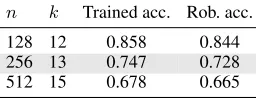
Table 3: Deviation in vertex classification accuracy.
n k Trained acc. Rob. acc.
128 12 0.858 0.844 256 13 0.747 0.728 512 15 0.678 0.665
whereas in the case of(512,16), 95 % of the time, we ex-tract a maximum clique of size at least 13 (see Figure 2).
Robustness and speedups The robustness and speedups obtained using theigraphalgorithm are given in Table 2. Here, the clique accuracy and runtime are obtained as the av-erage over 200 samples for each(n, k)except for(n, k) = (512,15)for which there are 20 independent samples. We see the drop in clique accuracy when a classifierPis trained with(n, k) ∈ {(256,12),(512,15)} and is predicting for the samenbut increasingk. The clique accuracy is a strict measure, so to quantify the severeness of the erroneous pre-dictions made by P we show the distributions of the ex-tracted maximum clique sizes in Figure 2 for some pairs
(n, k). Again, we observe the effects of growingncausing the convergence of local properties, consequently decreas-ing the predictive power ofP. For(n, k) = (128,13), 73 % of the runs still produce an optimal solution (here, one can also observe the rare event of having a maximum clique of size 14 when the planted clique was of size 13).
The case for supervised learning on intractable problems Asngrows, the instances get increasingly time-consuming to solve even for state-of-the-art solvers for suitable k, as there is no exploitable structure. Consequently, obtaining optimally labeled data becomes practically impossible for large enoughn. However, up to a point, random graphs with n= 64andk= 10are representative of the input for large graphs as well, and obtaining the optimal label for such a small graph is fast.
We show the deviation in vertex classification accuracy in Table 3. The column “Trained acc.” corresponds to the accuracy of the classifier trained with the values nand k mentioned in the two first columns, while the column “Rob. acc.” is the accuracy of a classifier trained with smaller
the specified(n, k)with planted clique sizek+ 1. A key ob-servation is that the difference between the two accuracies in a single row in Table 3 is small enough not to warrant train-ing on larger instances. This offers an explanation for the perfect clique accuracy with limited training, as observed in Section 4 for real-world networks. This observation reduces the need of labeling costly data points for training.
6
Discussion and conclusions
We proposed a simple, powerful, and flexible machine learn-ing framework for (i) reduclearn-ing the search space of computa-tionally difficult enumeration problems and (ii) augmenting existing state-of-the-art solvers with informative cues aris-ing from the input distribution. In particular, we focused on a probabilistic preprocessing strategy, which retained
allmaximum cliques on a representative selection of large real-world networks from different domains. We showed the practicality of our framework by showing it speeds up the execution of state-of-the-art solvers on large graphs without compromising the solution quality. In addition, we demon-strated that supervised learning is a viable approach for tack-ling NP-hard problems in practice.
For future work, we will perform more extensive experi-ments on a wider set of instances, and provide a deeper anal-ysis of our model.
References
Abu-Khzam, F. N.; Baldwin, N. E.; Langston, M. A.; and Samatova, N. F. 2005. On the relative efficiency of maxi-mal clique enumeration algorithms, with applications to high-throughput computational biology. InInternational Confer-ence on Research Trends in SciConfer-ence and Technology. Akkoyunlu, E. A. 1973. The enumeration of maximal cliques of large graphs.SIAM Journal of Computing2(1):1–6. Applegate, D.; Bixby, R.; Chv´atal, V.; and Cook, W. 2006. Concorde TSP solver.
Applegate, D. L.; Bixby, R. E.; Chv´atal, V.; Cook, W.; Es-pinoza, D. G.; Goycoolea, M.; and Helsgaun, K. 2009. Cer-tification of an optimal TSP tour through 85,900 cities. Op-erations Research Letters37(1):11–15.
Baldwin, N. E.; Collins, R. L.; Langston, M. A.; Leuze, M. R.; Symons, C. T.; and Voy, B. H. 2004. High perfor-mance computational tools for Motif discovery. InParallel and Distributed Processing Symposium.
Bello, I.; Pham, H.; Le, Q. V.; Norouzi, M.; and Bengio, S. 2016. Neural combinatorial optimization with reinforcement learning.arXiv preprint arXiv:1611.09940.
Bernard, H. R.; Killworth, P. D.; and Sailer, L. 1979. In-formant accuracy in social network data iv: a comparison of clique-level structure in behavioral and cognitive network data.Social Networks2(3):191–218.
Boginski, V.; Butenko, S.; and Pardalos, P. M. 2005. Statis-tical analysis of financial networks.Computational Statistics and Data Analysis48(2):431–443.
Bollob´as, B. 2013. Modern graph theory, volume 184. Springer Science & Business Media.
Bomze, I.; Budinich, M.; Pardalos, P.; and Pelillo, M. 1999. The Maximum Clique Problem. InHandbook of Combina-torial Optimization, volume 4. Kluwer Academic Publishers. 1–74.
Bron, C., and Kerbosch, J. 1973. Algorithm 457: finding all cliques of an undirected graph. Communications of the ACM 16(9):575–577.
Bruck, J., and Goodman, J. W. 1988. On the power of neural networks for solving hard problems. InNeural Information Processing Systems, 137–143.
Bul´o, S. R.; Torsello, A.; and Pelillo, M. 2009. A game-theoretic approach to partial clique enumeration. Image and Vision Computing27(7).
Cazals, F., and Karande, C. 2008. A note on the problem of reporting maximal cliques. Theoretical Computer Science 407:564–568.
Chen, J.; Huang, X.; Kanj, I. A.; and Xia, G. 2006. Strong computational lower bounds via parameterized complexity. Journal of Computer and System Sciences72(8):1346–1367. Cheng, J.; Ke, Y.; Fu, A. W.-C.; Yu, J. X.; and Zhu, L. 2011. Finding maximal cliques in massive networks. ACM Trans-actions on Database Systems (TODS)36(4):21.
Cheng, J.; Zhu, L.; Ke, Y.; and Chu, S. 2012. Fast Algorithms for Maximal Clique Enumeration with Limited Memory. In KDD, 1240–1248.
Csardi, G., and Nepusz, T. 2006. The igraph software pack-age for complex network research. InterJournalComplex Systems:1695.
Devlin, D., and O’Sullivan, B. 2008. Satisfiability as a classi-fication problem. InProc. of the 19th Irish Conf. on Artificial Intelligence and Cognitive Science.
Durbin, R., and Willshaw, D. 1987. An analogue approach to the travelling salesman problem using an elastic net method. Nature326(6114):689.
Dutta, S.; Nayek, P.; and Bhattacharya, A. 2017. Neighbor-Aware Search for Approximate Labeled Graph Matching us-ing the Chi-Square Statistics. InInternational Conference on World Wide Web (WWW), 1281–1290.
Eblen, J. D.; Phillips, C. A.; Rogers, G. L.; and Langston, M. A. 2012. The maximum clique enumeration problem: al-gorithms, applications, and implementations. InBMC bioin-formatics, volume 13, S5. BioMed Central.
Eppstein, D.; L¨offler, M.; and Strash, D. 2010. Listing all maximal cliques in sparse graphs in near-optimal time. InInternational Symposium on Algorithms and Computation (ISAAC), 403–414.
Erd¨os, P., and R´enyi, A. 1959. On random graphs, I. Publi-cationes Mathematicae (Debrecen)6:290–297.
Faust, K., and Wasserman, S. 1995.Social network analysis: Methods and applications. Cambridge University Press. Feldman, V.; Grigorescu, E.; Reyzin, L.; Vempala, S. S.; and Xiao, Y. 2017. Statistical algorithms and a lower bound for detecting planted cliques. Journal of the ACM64(2):8:1– 8:37.
Feurer, M.; Klein, A.; Eggensperger, K.; Springenberg, J.; Blum, M.; and Hutter, F. 2015. Efficient and robust auto-mated machine learning. InAdvances in Neural Information Processing Systems (NIPS). 2962–2970.
Fitzgerald, T.; Malitsky, Y.; and O’Sullivan, B. 2015. Re-ACTR: Realtime Algorithm Configuration through Tourna-ment Rankings. InIJCAI, 304–310.
Gomes, C. P.; Selman, B.; Crato, N.; and Kautz, H. 2000. Heavy-tailed phenomena in satisfiability and constraint sat-isfaction problems. Journal of Automated Reasoning 24(1-2):67–100.
Gomes, C. P.; Selman, B.; and Kautz, H. 1998. Boosting com-binatorial search through randomization.AAAI/IAAI98:431– 437.
He, H.; Daume III, H.; and Eisner, J. M. 2014. Learning to search in branch and bound algorithms. InAdvances in Neural Information Processing Systems (NIPS), 3293–3301. Hopfield, J. J., and Tank, D. W. 1985. “Neural” computation of decisions in optimization problems.Biological cybernetics 52(3):141–152.
Hutter, F.; Hoos, H. H.; Leyton-Brown, K.; and St¨utzle, T. 2009. ParamILS: an automatic algorithm configura-tion framework. Journal of Artificial Intelligence Research 36:267–306.
Jerrum, M. 1992. Large cliques elude the Metropolis process. Random Structures & Algorithms3(4):347–359.
Karp, R. M. 1976. The probabilistic analysis of some combi-natorial search algorithms. Algorithms and complexity: New directions and recent results1:19.
Khalil, E. B.; Le Bodic, P.; Song, L.; Nemhauser, G. L.; and Dilkina, B. N. 2016. Learning to branch in mixed integer programming. InAAAI, 724–731.
Khalil, E.; Dai, H.; Zhang, Y.; Dilkina, B.; and Song, L. 2017. Learning combinatorial optimization algorithms over graphs. InAdvances in Neural Information Processing Sys-tems, 6351–6361.
Kose, F.; Weckwerth, W.; Linke, T.; and Fiehn, O. 2001. Visualizing plant metabolomic correlation networks using clique-metabolite matrices. Bioinformatics 17(12):1198– 1208.
Kuˇcera, L. 1995. Expected complexity of graph partitioning problems.Discrete Applied Mathematics57(2):193–212. Li, C.-M.; Jiang, H.; and Many`a, F. 2017. On minimization of the number of branches in branch-and-bound algorithms for the maximum clique problem. Computers & Operations Research84:1–15.
Liang, J. H.; Ganesh, V.; Poupart, P.; and Czarnecki, K. 2016. Learning rate based branching heuristic for SAT solvers. In International Conference on Theory and Applications of Sat-isfiability Testing, 123–140. Springer.
Loreggia, A.; Malitsky, Y.; Samulowitz, H.; and Saraswat, V. A. 2016. Deep learning for algorithm portfolios. InAAAI, 1280–1286.
McKay, B. D., and Piperno, A. 2014. Practical graph isomor-phism, II.Journal of Symbolic Computation60(0):94–112. Modani, N., and Dey, K. 2008. Large maximal cliques enu-meration in sparse graphs. InCIKM, 1377–1378.
Niskanen, S., and ¨Osterg˚ard, P. R. 2003. Cliquer User’s Guide: Version 1.0. Helsinki University of Technology Helsinki, Finland.
Nowak, A.; Villar, S.; Bandeira, A. S.; and Bruna, J. 2017. A note on learning algorithms for quadratic assignment with graph neural networks.arXiv preprint arXiv:1706.07450.
¨
Osterg˚ard, P. R. 2002. A fast algorithm for the maximum clique problem. Discrete Applied Mathematics120(1):197– 207.
Pattabiraman, B.; Patwary, M. M. A.; Gebremedhin, A. H.; Liao, W.-k.; and Choudhary, A. 2013. Fast algorithms for
the maximum clique problem on massive sparse graphs. In Algorithms and Models for the Web Graph (WAW), 156–169. Pedregosa, F.; Varoquaux, G.; Gramfort, A.; Michel, V.; Thirion, B.; Grisel, O.; Blondel, M.; Prettenhofer, P.; Weiss, R.; Dubourg, V.; Vanderplas, J.; Passos, A.; Cournapeau, D.; Brucher, M.; Perrot, M.; and Duchesnay, E. 2011. Scikit-learn: Machine learning in Python. Journal of Machine Learning Research12:2825–2830.
Read, T. R. C., and Cressie, N. A. C. 1988. Goodness-of-fit statistics for discrete multivariate data. Springer.
Read, T., and Cressie, N. 1989. Pearson’sχ2and the likeli-hood ratio statisticG2: a comparative review. International Statistical Review57(1):19–43.
Rossi, R. A., and Ahmed, N. K. 2015. The network data repository with interactive graph analytics and visualization. InAAAI.
Schmidt, M. C.; Samatova, N. F.; Thomas, K.; and Park, B. H. 2009. A scalable, parallel algorithm for maximal clique enumeration.Journal of Parallel Distributed Comput-ing69(4):417–428.
Stix, V. 2004. Finding all maximal cliques in dynamic graphs. Computational Optimization and applications27:173–186. Tomita, E.; Tanaka, A.; and Takahashi, H. 2006. The worst-case time complexity for generating all maximal cliques and computational experiments. Theoretical Computer Science 363(1):28–42.
Vinyals, O.; Fortunato, M.; and Jaitly, N. 2015. Pointer net-works. InAdvances in Neural Information Processing Sys-tems (NIPS), 2692–2700.
Wan, L.; Wu, B.; Du, N.; Ye, Q.; and Chen., P. 2006. A new algorithm for enumerating all maximal cliques in complex network. InADMA, 606–617.
Watts, D. J., and Strogatz, S. H. 1998. Collective dynamics of ‘small-world’ networks.Nature393(6684):440.
Wu, B.; Yang, S.; Zhao, H.; and Wang, B. 2009. A distributed algorithm to enumerate all maximal cliques in MapReduce. InInternational Conference on Frontier of Computer Science and Technology, 45–51.
Xu, H.; Koenig, S.; and Kumar, T. S. 2018. Towards effective deep learning for constraint satisfaction problems. In Inter-national Conference on Principles and Practice of Constraint Programming, 588–597. Springer.
Yao, X. 1992. Finding approximate solutions to NP-hard problems by neural networks is hard.Information Processing Letters41(2):93–98.
Yeger-Lotem, E.; Sattath, S.; Kashtan, N.; Itzkovitz, S.; Milo, R.; Pinter, R. Y.; Alon, U.; and Margalit, H. 2004. Net-work motifs in integrated cellular netNet-works of transcription– regulation and protein–protein interaction.Proceedings of the National Academy of Sciences of the United States of Amer-ica101(16):5934–5939.
Zhang, Y.; Abu-Khzam, F. N.; Baldwin, N. E.; Chesler, E. J.; Langston, M. A.; and Samatova, N. F. 2005. Genome-scale computational approaches to memory-intensive applications in systems biology. InSupercomputing.