www.adv-radio-sci.net/13/73/2015/ doi:10.5194/ars-13-73-2015
© Author(s) 2015. CC Attribution 3.0 License.
A high throughput architecture for a low complexity soft-output
demapping algorithm
I. Ali, U. Wasenmüller, and N. Wehn
Microelectronic Systems Design Research Group, University of Kaiserslautern, 67663 Kaiserslautern, Germany
Correspondence to: I. Ali ([email protected])
Received: 5 January 2015 – Revised: 15 May 2015 – Accepted: 11 August 2015 – Published: 3 November 2015
Abstract. Iterative channel decoders such as Turbo-Code and LDPC decoders show exceptional performance and therefore they are a part of many wireless communication receivers nowadays. These decoders require a soft input, i.e., the logarithmic likelihood ratio (LLR) of the received bits with a typical quantization of 4 to 6 bits. For computing the LLR values from a received complex symbol, a soft demap-per is employed in the receiver.
The implementation cost of traditional soft-output demap-ping methods is relatively large in high order modulation sys-tems, and therefore low complexity demapping algorithms are indispensable in low power receivers. In the presence of multiple wireless communication standards where each stan-dard defines multiple modulation schemes, there is a need to have an efficient demapper architecture covering all the flexi-bility requirements of these standards. Another challenge as-sociated with hardware implementation of the demapper is to achieve a very high throughput in double iterative systems, for instance, MIMO and Code-Aided Synchronization.
In this paper, we present a comprehensive communica-tion and hardware performance evaluacommunica-tion of low complex-ity soft-output demapping algorithms to select the best algo-rithm for implementation. The main goal of this work is to design a high throughput, flexible, and area efficient archi-tecture. We describe architectures to execute the investigated algorithms. We implement these architectures on a FPGA de-vice to evaluate their hardware performance. The work has resulted in a hardware architecture based on the figured out best low complexity algorithm delivering a high throughput of 166 Msymbols/second for Gray mapped 16-QAM modu-lation on Virtex-5. This efficient architecture occupies only 127 slice registers, 248 slice LUTs and 2 DSP48Es.
1 Introduction
In transmitter, a constellation mapper takes groups of bits and maps them to particular constellation points. A specific magnitude and phase represents a certain combination of bits in the transmitted symbol. Due to distortion by the wireless channel, an error occurs in the position of each transmitted constellation point. In the receiver, the phase and magnitude of each received symbol is extracted, and a decision is made about what combination of bits the transmitter sent.
In the receiver, bit level demapping can be performed such that the output of demapper is “hard”, i.e., either a logi-cal value 1 or 0. Alternatively, the demapper output can be “soft”; a soft-value indicating the probability, that the modu-lated bit associated with a given demapper output is to be of logical value 1 or 0. The soft-output (LLR) of thekth bitck in noisy received symbol sequenceris
LLR(ck|r)=ln
p(ck=1|r)
p(ck=0|r)
(1) wherepdenotes probability.
If modulating bits are uncoded or algebraic coded such as RS-codes or BCH codes, the demapper output is typi-cally hard. If modulating bits are coded with a convolutional, LDPC, or Turbo-Code encoder the demapper output must be soft in order to yield superior performance. Consequently, soft-output demappers are an integral part of many modern communication receivers.
points Li et al. (2009); Su et al. (2011); Lin et al. (2010); Ryoo et al. (2003); Li and Shi (2014) and Lee et al. (2011). The computational complexity of suboptimal methods is fur-ther reduced in so-called low complexity soft-output demap-ping algorithms. A large number of works in this domain have focused on theoretical/simulation aspects of the algo-rithms aiming to attain superior frame error rate (FER) per-formance. Little attention has been paid to the actual imple-mentation of such algorithms that look to deliver more than 100 Msymbols/second.
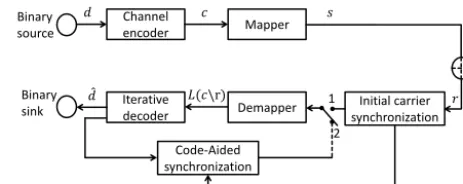
Usually the demapping function is executed only once on each burst in the receiver. However, the double iterative sys-tems such as MIMO and Code-Aided Synchronization en-gage the demapper in their outer iteration. Consequently, the demapping function is executed multiple times on each burst in the receiver. Accordingly, the double iterative sys-tems require very high throughput demapper. In this regard, consider the needs of gateway of Second Generation Digi-tal Video Broadcasting Interactive Satellite System which is typically 20 Msymbols/second DVB (2014). In case of uti-lizing code-aided synchronization, typically 8 outer itera-tions are performed (see Fig. 1) to achieve the desired com-munications performance as reported in Ali et al. (2014). In such system, the demapper must deliver a throughput of 8-times 20 Msymbols/second. Therefore, we decided to set a minimum 160 Msymbols/second throughput specifications for this work.
In the presence of multiple wireless communication stan-dards where each standard defines multiple modulation schemes, there is a need to have single demapper architec-ture covering all the flexibility requirements of these stan-dards. We focus on popular Gray mappingM-PSK andM -QAM modulation schemes in this work which are specified in many wireless communication standards. The architec-tures reported in Altera (2007); Park et al. (2008); and Jafri et al. (2010) support multiple modulation schemes. How-ever, they do not satisfy the throughput requirement outlined above.
Based on the results of a thorough literature search and deep analysis, we find the following algorithms having remarkable reduced complexity without compromising on quality of communications performance: (1) the algorithm reported in Lin et al. (2010) identifies the two required constellation points to compute one LLR in a very simple way and (2) The algorithms reported in Tosato and Bisaglia (2002); Ryoo et al. (2003); Kim et al. (2006); Arar et al. (2007); and Sun and Zeng (2011) are quite similar to each other and provide a very simple approach to compute LLR. We call this approach as decision threshold algorithm in this sequel.
The computational complexity of the aforementioned al-gorithms have been examined in the literature by counting number of operations required which is not a sufficient mea-sure to derive realistic complexity for hardware implementa-tion. Instead, hardware complexity metrics are: throughput,
Channel
encoder Mapper
1
2 Binary
source
Demapper Iterative
decoder Binary
sink
Code-Aided synchronization
𝑛
𝑑 𝑐 𝑠
𝑟 𝐿(𝑐\r)
𝑑 Initial carrier
synchronization
Figure 1. Baseband model of iterative channel decoding based sys-tem.
latency, resource utilization, and power. We investigate the hardware performance of the considered algorithms by real-izing FPGA/ASIC implementations under the constraint of above specified throughput. At the conclusion of our work, we identify a demapping algorithm having the lowest imple-mentation complexity.
This paper is structured as follows. In Sect. 2, we de-scribe the system model as well as optimal and traditional suboptimal algorithms while Sect. 3 explains low complexity suboptimal algorithms. The communications performance of the algorithms is shown in Sect. 4. The hardware architec-tures and their implementation complexity are compared in Sect. 5, and Sect. 6 concludes this work.
2 System model
The system model comprising channel encoder, iterative channel decoder, mapper, demapper, initial carrier synchro-nization, and Code-Aided synchronization is shown in Fig. 1. The “Channel encoder” processes binary signald and pro-duces the encoded signalc. Then, the “Mapper” block maps
Mcoded bitsc0, c1, . . ., cM−1∈ {0,1}to a complex symbol susing the mapping functions=map(c0, c1, . . ., cM−1). The
Additive White Gaussian Noise (AWGN) channel adds noise
nin the signal. Discrete-time baseband signal at the receiver can be represented as
r(k)=s(k)·ej (2π kfoT+8)+n(k) k=0,1, . . ., K−1 (2)
wheres(k) is the transmitted signal,K is the length of the received signal, T is the symbol duration, fo is frequency
offset,8is phase offset, andn(k)is a sequence of complex white Gaussian noise samples with varianceσ2.
In the receiver after performing automatic gain control, frame detection, timing synchronization, and initial car-rier synchronization (phase/frequency) the resulting data se-quence is transferred to “Demapper”. The demapping mod-ule demodulates the complex channel symbols and extracts
offset from the received burst. Afterwards, the newly cor-rected burst is passed to “Demapper” and subsequently the next iteration of “Iterative decoder” is performed. Hence, in this double iterative system demapping function is performed after each iteration of the decoder. After presenting the sys-tem model, we discuss about the demapping algorithms. The soft-output demapping methods are classified into two major categories optimal and suboptimal which are explained in the subsequent sections.
2.1 Optimal soft demapping
ForM-ary modulation scheme, the demapper needs to cal-culate log-likelihood ratios on the coded bitsc0, c1, . . ., cM−1
for each incoming received symbol. The channel information of the coded bitckconditioned on the received symbolrcan be calculated as follows.
LLR(ck|r)=ln 2M−1−1
P
i=0
exp
− 1 2σ2
r−sk(1,i) 2
2M−1−1
P
i=0
exp
− 1 2σ2
r−sk(0,i) 2
(3)
where σ2 is variance of AWGN channel,sk(1,i) and sk(0,i) represent the constellation points whosekth bits are one and zero respectively andMrepresents the number of bits in one modulated symbol. In 16-QAM modulation, four bits consti-tute a symbol so in this caseM=4.
It can be clearly seen in Eq. (3) that the optimal demap-ping method involves logarithmic and exponential functions to compute LLR. Because of these computationally complex mathematical operations, the optimal demapping method is not suitable for hardware implementation. This computa-tional complexity is reduced in suboptimal demapping meth-ods which is described in the following section.
2.2 Suboptimal soft demapping
In order to eliminate the logarithmic and exponential func-tions in Eq. (3), the suboptimal algorithms adopt an approx-imation. Since the sum term in Eq. (3) is dominated by the largest term, it can be simplified as reported in Robertson et al. (1995). The simplification can be formally expressed as lnX
j
exp(−aj)≈max(−aj)=min(aj) (4)
whereaj>=0. With this approximation, LLR can be com-puted as follows.
LLR(ck|r)= 1 2σ2·
h min
i (r
−sk(0,i))2−min i (r
−sk(1,i))2 i
(5) wherei=0,1, . . .,2M−1−1.
It is evident from Eq. (5) that the suboptimal demapping algorithm significantly reduces the computational complex-ity by avoiding logarithmic and exponential functions as op-posed to the optimal algorithm. Despite this simplification,
𝐼 𝑄
0001 0000 0010
0011
0111
0110
0101
0100 1110
1111 1011 1010 1000
1001
1101
1100
1 3 -1
-3
1 3
-1
-3 b0
b1 b2 b3
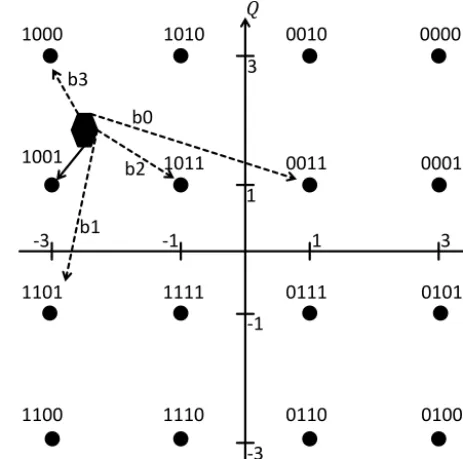
Figure 2. Lin algorithm illustration for Gray mapped 16-QAM modulation. The black color circles denote constellation points whereas the black color hexagon represents the received symbol
the suboptimal demapping algorithm involves computation of all possible Euclidean distances and then an exhaustive search to determine the two nearest constellation points. This complexity is considerably prominent in high order modula-tion schemes. This computamodula-tional complexity can be further reduced by adopting some simple techniques as explained in the subsequent section.
3 Low complexity suboptimal demapping algorithms This section explains two low complexity suboptimal demap-ping algorithms which are applicable to popular Gray mapped modulation schemes: (1) Lin algorithm and (2) de-cision threshold algorithm.
3.1 Lin algorithm
The magnitude of the received symbol in the complex plane is (−2.5, 1.5) in the considered example. At first, the Cartesian coordinates of the received symbol are rounded to the coordinates of its nearest constellation point (NCP). The magnitude of real part of the received signal is−2.5 which is closer to−3 as compared to−1. Similarly, the imaginary part of the received symbol is 1.5 which is closer to 1 instead of 3. Therefore, the NCP of the received symbol is (−3,1) in the constellation diagram. The corresponding bit mapping of the NCP is “1001”. This NCP is used to compute the first squared distance from the received symbol. Afterwards, four nearest constellation points are identified with respect to this computed CP where kth bit of the formers is flipped corre-sponding to thekth bit of the latter. We call the former con-stellation points as Flipped Concon-stellation Points (FCPs).
For the considered case, the first bitb0(MSB) in the NCP
(1001) is “1”. Now we want to compute the FCP whose first bit is “0”, i.e., flipped with respect to the first bit of NCP. This can be accomplished by using a simple transformation
x0x1x. In this transformation term x0 means flip the corre-sponding bit,xrepresent no change in the corresponding bit, and 1 means replace the corresponding bit by 1. Using this transformation, the computation of FCP for MSB of NCP (1001) results in “0011” which is highlighted in Fig. 2 for bitb0. The second squared distance is computed between the
received symbol and this FCP. Similarly, the remaining three FCPs are computed corresponding to the second b1, third b2 and fourth b3 bits using the transformations xx0x1, xxx0x
andxxxx0respectively.
Finally, LLR of one bit is computed by using the two cal-culated squared distances, i.e., squared distance between the received symbol and the NCP, and squared distance between the received symbol and its corresponding FCP. Remark, the first computed squared distance can be utilized for LLR cal-culation of the remaining three bits of the received symbol. In short, for a 16-QAM modulated symbol five squared dis-tances are computed to calculate LLR of four bits, whereas for the same case the traditional sub-optimal demapper needs to compute 16 squared distances.
It is very important to mention that the abovementioned mathematical transformations to compute FCP are specific to the mapping scheme shown in Fig. 2. If the mapping scheme is changed, these mathematical transformations to compute FCP also need to be modified accordingly. Furthermore, this technique is applicable to only Gray mapping modula-tion schemes, including PAM, PSK, and square QAM. Un-der these constraints, the algorithm computes the distances which are exactly needed in Eq. (5) as claimed in Lin et al. (2010).
3.2 Decision Threshold Algorithm
In order to reduce the computational complexity, this algo-rithm adopts a simple decision threshold comparison
mech-𝐼 𝑄 0001 0000 0010 0011 0111 0110 0101 0100 1110 1111 1011 1010 1000 1001 1101 1100
1 3 -1
-3 1
3
-1
-3
𝑏𝐼, 1(𝑐1)
0001 0000 0010 0011 0111 0110 0101 0100 1110 1111 1011 1010 1000 1001 1101 1100
1 3 -1
-3 1
3 -1 -3 0001 0000 0010 0011 0111 0110 0101 0100 1110 1111 1011 1010 1000 1001 1101 1100
1 3 -1
-3 1
3 -1 -3 0001 0000 0010 0011 0111 0110 0101 0100 1110 1111 1011 1010 1000 1001 1101 1100
1 3 -1
-3 1
3
-1
-3
𝑏𝐼, 2(𝑐3)
𝑏𝑄, 1(𝑐2)
𝑏𝑄, 2(𝑐4) 𝑆𝑄,2(1)
𝑆𝐼,1(0)
𝑆𝐼,1(1)
𝑆𝐼,2(1)
𝑆𝐼,2(0) 𝑆𝐼,2(0)
𝑆𝑄,1(0)
𝑆𝑄,1(1)
𝑆𝑄,2(0)
𝑆𝑄,2(0)
𝐼
𝐼 𝐼
𝑄
𝑄 𝑄
Fig. 3 A: Fig. 3 C:
Fig. 3 B: Fig. 3 D:
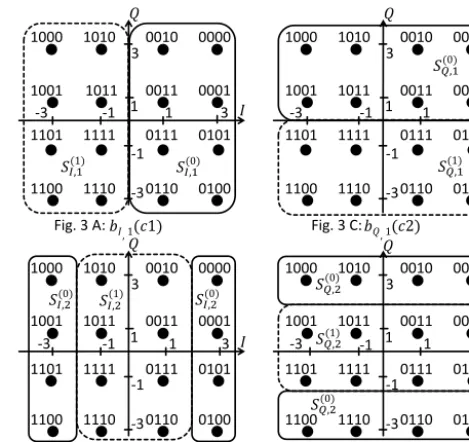
Figure 3. Partitions of the 16-QAM constellation used in decision threshold algorithm
anism, and thus a single distance computation accomplishes the soft demapping.
In the case of 16-QAM constellation, the partitions (SI,k0 ,SI,k1 ) are shown for the generic in-phase components of the complex signalbI,k(c1, c2) in Fig. 3a and b. The par-titions (SQ,k0 ,SQ,k1 ) for the quadrature component of the com-plex signalbQ,k (c3, c4) are shown in Fig. 3c and d. The MSB c1 is always 1 in the left half section and 0 in the right half section (see Fig. 3a). The second bit c2 is always 1 in the lower half section and 0 in the upper half section (see Fig. 3c). The third bit c3 is always 1 in the middle section and 0 in the outer section (see Fig. 3b). The LSB bit c4 is always 1 in the middle section and 0 in the outer section (see Fig. 3d). The decision threshold algorithm exploits this prop-erty of Gray mapping and provides very simple expression to calculate the LLR.
As discussed that components of the complex signal are delimited by either horizontal or vertical boundaries. There-fore, the two symbols within the two subsets, nearest to the received signal, always lie in the same row if the partition boundaries are vertical (bitsbI,1andbI,2in Fig. 3a and b) or
in the same column if the boundaries are horizontal (bitsbQ,1
andbQ,2in Fig. 3c and d). The same observation holds true
LLR(c1|r)=
2
σ2·
h
xi (6)
LLR(c2|r)=
2
σ2·
h
yi (7)
LLR(c3|r)=
2
σ2·
|x| −C+D 2
(8)
LLR(c4|r)=
2
σ2·
|y| −C+D 2
(9)
where two positive constantsCandDrepresent the mag-nitudes of I andQcomponents of 16-QAM symbol which are 1 and 3 in this example. The termsxandyrepresent the distances of real and imaginary parts of the received symbol from the origin respectively in the complex plane. Regarding term 2
σ2, the detailed derivation can be found in Ryoo et al.
(2003). The above described equations show that computing LLR(c1|r)and LLR(c2|r) require no distance calculation,
whereas the computation of LLR(c3|r)and LLR(c4|r)
re-quire calculating two absolute values and two simple subtrac-tions. It is worth mentioning that the expressions Eqs. (13) to () are specific to the mapping scheme shown in Fig. 3. If the mapping scheme is changed, these mathematical ex-pressions also need to be modified accordingly. Furthermore, this technique is applicable to only Gray mapping modula-tion schemes.
For a given constellation diagram of Gray coded 8-PSK modulation, LLR of the constituting bits can be computed as follows.
LLR(c1|r)=
2
σ2·
h
x
i
(10) LLR(c2|r)=
2
σ2·
h
yi (11)
LLR(c3|r)=
2
σ2·
h
|x| − |y|i (12)
For a given constellation diagram of Gray coded 64-QAM modulation, LLR of the constituting bits can be computed as follows.
LLR(c1|r)=
2
σ2·
h
xi (13)
LLR(c2|r)=
2
σ2·
h
− |x| +4i (14)
LLR(c3|r)=
2
σ2·
−
|x| −4
+2
(15)
LLR(c4|r)=
2
σ2·
h
yi (16)
LLR(c5|r)=
2
σ2·
h
− |y| +4i (17)
LLR(c6|r)=
2
σ2·
−
|y| −4
+2
(18)
9.5 10 10.5 11
10−4 10−3 10−2 10−1 100
SNR Es/N
0 dB
FER
Optimal Demapper Lin et al.
Decision Threshold
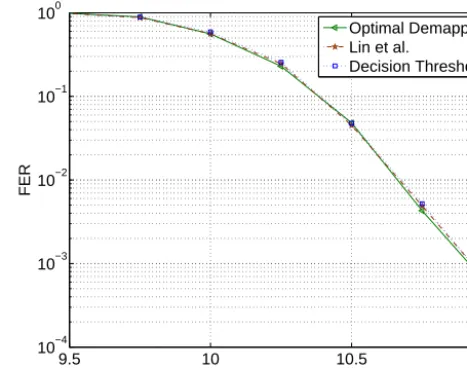
Figure 4. FER performance of Turbo-Code decoder after 8 itera-tions. The length of 16-QAM modulated burst is 536 symbols and code rate is 3/4. Three different demapping algorithms are applied: 1- optimal, 2- Lin algorithm, and 3- decision threshold algorithm
4 Communications performance
We compare the communications performance of optimal al-gorithm, Lin algorithm and decision threshold algorithm in Fig. 4. The simulations were carried out with bit true mod-els of the hardware units to take into account quantization losses. We used 9 bit quantization each for input real and imaginary component, 6 bit for 2
σ2, and 6 bit for output LLR.
We used a 16-state duo-binary Turbo-Code decoder in our simulations having Max-Log-Map with 0.75 extrinsic scal-ing factor, 8 iterations, and 7 bit for the extrinsic LLR. Both initial carrier synchronization and Code-Aided synchroniza-tion are performed to compensate the phase and frequency offsets. The FER graph clearly shows that the performance of all investigated algorithms is nearly identical. In short, by set-ting appropriate value of 2
σ2 the investigated suboptimal
al-gorithms show similar communications performance to that of optimal algorithm. Remark that the simplified mathemati-cal expressions Eqs. (6) to (9) adopted in decision threshold algorithm are equivalent to Eq. (5) adopted in Lin algorithm.
5 Hardware performance
In this section, we describe the architectures for abovemen-tioned low complexity suboptimal demapping algorithms and compare their implementation performance. We used synthesizable VHDL to model the architectures.
5.1 Architecture for Lin algorithm
modula-Rounding to the nearest CP
Squared distance calculation (1)
Comp. no. to Gray mapping
CPs calculation for flip bits
Gray mapping to comp. no.
Squared distance calculation (2)
Squared distance calculation (3) 2x18
LLR0
+/-
+/-
Input symbol
18 18 20
4 4x4
4x18
2x18
18 20
20
6 6
18
6
LLR1 6
LLR2 6 LLR3
6 2/σ2
2/σ2
Figure 5. Proposed architecture for Lin algorithm.
tion scheme for evaluation purpose but in reality the Lin al-gorithm can be applied to all Gray mappedM-PSK andM -QAM modulation schemes.
In the architecture, the rounding of the input received sym-bol towards the NCP is carried out in “Rounding to the nearest CP” block according to the procedure explained in Sect. 3.1. Then first squared distance is computed between the NCP and the received input symbols in “Squared dis-tance calculation (1)” block to implement one term of Eq. (5). This result is used either first or second term of this equa-tion depending upon the value of the corresponding bit. The NCP which is a complex number, is mapped to a predefined Gray code in “Comp. no. to Gray mapping” block. The re-sulting Gray code of the NCP is used to compute the near-est FCP. With respect to 16-QAM modulation scheme, four FCPs are computed. This operation is performed in “CPs cal-culation for flip bits”. The resulting Gray codes of four FCPs are converted into complex numbers in “Gray mapping to comp. no.”. The squared distances are computed between the resulting complex numbers of four FCPs and the received symbol in “Squared distance calculation (2)” and “Squared distance calculation (3)”. To save and reutilize the hardware units (multiplier and adder), we compute only two squared distances at a time and therefore we use a multiplexer and a demultiplexer at the input and output of the multipliers.
The results of “Squared distance calculation (1)”, and ei-ther “Squared distance calculation (2)” or “Squared distance calculation (3)” are used to compute LLR of each bit. All in all, only two squared distances are used to compute LLR of each bit. Finally, 2
σ2 is multiplied to compute LLR. The
quantization bitwidths adopted in this work are mentioned in the figure. We compute two LLRs per clock cycle to achieve the aforementioned throughput.
5.2 Architecture for decision threshold algorithm We present the architecture for decision threshold algorithm in Fig. 6. The proposed architecture provides flexibility to
Input Symbol
18
2´s Comp.
Abs
2´s Comp.
2´s Comp.
2´s Comp.
Abs
Abs
2
2
4
4
2
2 4
4
LLR0 6 LLR1
6 LLR2
6 LLR3
6 LLR4
6 LLR5
6 real
imag 9 9
2/σ2
6
6 64-QAM
16-QAM 8-PSK
Modulation Type 2/σ2
Figure 6. Proposed architecture for decision threshold algorithm
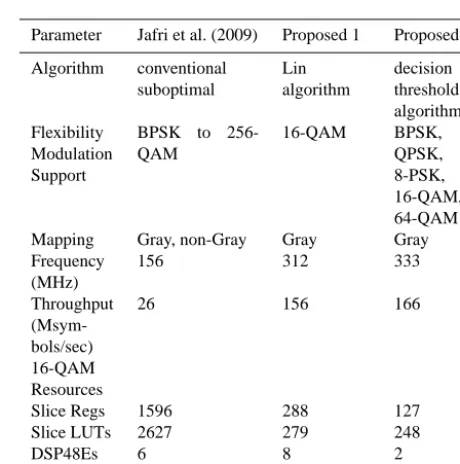
Table 1. FPGA (Virtex-5) Place-and-Route results comparison.
Parameter Jafri et al. (2009) Proposed 1 Proposed 2
Algorithm conventional suboptimal
Lin algorithm
decision threshold algorithm Flexibility
Modulation Support
BPSK to 256-QAM
16-QAM BPSK,
QPSK, 8-PSK, 16-QAM, 64-QAM Mapping Gray, non-Gray Gray Gray Frequency
(MHz)
156 312 333
Throughput (Msym-bols/sec) 16-QAM
26 156 166
Resources
Slice Regs 1596 288 127
Slice LUTs 2627 279 248
DSP48Es 6 8 2
BRAM 8 0 0
5.3 FPGA implementation results
We compare the implementation results of our proposed ar-chitectures with a state-of-the-art demapper Jafri et al. (2010) in Table 1. As the latter design is implemented on a Xil-inx Virtex-5 FPGA, so we used the same FPGA device (xc5vlx330-2ff1760) for implementation of our architectures to make a fair comparison.
The implementation results show that our proposed archi-tectures achieve a much higher clock frequency and con-sequently deliver almost 6 times higher throughput besides occupying almost 10 times less resources as compared with state-of-the-art implementation. These results also show that the architecture based on decision threshold algorithm has less implementation complexity than that of Lin algorithm. The former saves 56 % slice registers, 12 % slice LUTs and 75 % DSP48Es than the latter. In summary, decision thresh-old algorithm has the lowest implementation complexity among the investigated architectures.
5.4 ASIC implementation results
Because the architecture described for decision threshold algorithm shows the lowest implementation complexity on FPGA, we selected this architecture for ASIC implementa-tion. We implemented it on a 65 nm low power CMOS li-brary. We used Synopses tools to perform Synthesis and, P&R. This efficient design occupies only 0.006 mm2 area (2886 gates) after P&R and with worst case process param-eters (1.1V, 125◦C). The design achieves a high clock fre-quency of 645 MHz, and therefore it delivers a very high throughput of 322 Msymbols/second with 16-QAM modula-tion. The design consumes only 3.85 mW power at nominal case.
6 Conclusions
Our investigation reveals that the decision threshold algo-rithm is a clear winner among the investigated demapping algorithms from the point of view of communications and implementation performance. The communications performance achieved by this algorithm costs only a tiny fraction of the computational effort required to achieve the same communications performance using the optimal and traditional sub-optimal algorithms. We have presented a very high throughput, area efficient, low power, and flexible architecture based on this algorithm. Our proposed architec-ture delivers almost 6 times higher throughput and requires about 10 times less resources on a FPGA as compared with state-of-the-art implementation.
Edited by: J. Anders
Reviewed by: two anonymous referees
References
Digital Video Broadcasting (DVB): Secocond Generation DVB, In-teractive Satellite System (DVB-RCS2), Part 2: Lower Layers for Satellite standard, ETSI EN 301 545-2 V1.2.1, 2014.
Ali, I., Wasenmüller, U., and Wehn, N.: Hardware Implementa-tion Issues of Carrier SynchronizaImplementa-tion for Pilot-Symbol Assisted Bursts: A Case Study for DVB-RCS2, in: 8th IEEE International Conference on Signal Processing and Communication Systems, Gold Coast, Australia, doi:10.1109/SPC.2013.6735092, 2014. Altera: Constellation Mapper and Demapper for WiMAX, Tech.
rep., http://www.altera.com/literature/an/an439.pdf, May 2007. Arar, M., Amours, C. D., and Yongacoglu, A.: Simplified LLRs
for the Decoding of Single Parity Check Turbo Product Codes Transmitted Using 16QAM, Research Letters in Communica-tions, p. 4, doi:10.1155/2007/53517, 2007.
Jafri, A. R., Baghdadi, A., and Jezequel, M.: Rapid design and pro-totyping of universal soft demapper, in: IEEE International Sym-posium on Circuits and Systems (ISCAS), 3769–3772, 2010. Kim, K. S., Hyun, K., Yu, C. W., Park, Y. O., Yoon, D., and Park,
S. K.: General Log-Likelihood Ratio Expression and its Imple-mentation Algorithm for Gray-Coded QAM Signals, ETRI Jour-nal, 28, 291–300, 2006.
Lee, J. H., Sunwoo, M. H., Kim, P. S., and Chang, D.-I.: Low com-plexity soft-decision demapper for DVB-S2 using phase selec-tion method, in: Proceedings of the 5th Internaselec-tional Conference on Ubiquitous Information Management and Communication, p. 45, ACM, 2011.
Li, J. and Shi, Y.: Simplified Soft-output Demapper Based on a Lin-ear Transformation Technique for M-ary PSK., Sensors & Trans-ducers, 181, 1726–5479, 2014.
Li, M., Nour, C., Jego, C., and Douillard, C.: Design of rotated QAM mapper/demapper for the DVB-T2 standard, in: IEEE Workshop on Signal Processing Systems, SiPS 2009, 018–023, doi:10.1109/SIPS.2009.5336265, 2009.
Lin, D., Xiao, Y., and Li, S.: Low Complexity Soft Decision Tech-nique for Gray Mapping Modulation, Wireless Personal Commu-nications, 52, 383–392, 2010.
Park, J. W., Sunwoo, M. H., Kim, P. S., and Chang, D.-I.: Low complexity soft-decision demapper for high order modulation of DVB-S2 system, in: International SoC Design Conference (ISOCC ’08), vol. 02, II–37–II–40, 2008.
Robertson, P., Villebrun, E., and Hoeher, P.: A comparison of opti-mal and sub-optiopti-mal MAP decoding algorithms operating in the log domain, in: Communications, 1995. ICC ’95 Seattle, IEEE International Conference on “Gateway to Globalization”, vol. 2, 1009–1013, doi:10.1109/ICC.1995.524253, 1995.
Ryoo, S., Kim, S., and Lee, S. P.: Efficient soft demapping method for high order modulation schemes, in: CDMA International Conference (CIC), Seoul, Korea, 2003.
Su, J., Lu, Z., Yu, X., and Hu, C.: A novel low com-plexity soft-decision demapper for QPSK 8PSK demodula-tion of DVB-S2 systems, in: Internademodula-tional Conference of Electron Devices and Solid-State Circuits (EDSSC), 1–2, doi:10.1109/EDSSC.2011.6117701, 2011.