Journal of Caring Sciences 2019; 8 (2), 105-110 doi:10.15171/jcs.2019.015
http:// journals.tbzmed.ac.ir/ JCS
© 2019 The Author(s). This work is published by Journal of Caring Sciences as an open access article distributed under the terms of the Original Article
The Effect of Oral Health Promotion Program on Early Dental
Decay in Students: a Cluster Randomized Controlled Trial
Vahid Naseri-Salahshour
1, Hamid Abredari
2, Mahbobeh Sajadi
3, Masoumeh Sabzaligol
4, Mahmood
Karimy
5*1Department of Medical-Surgical Nursing, Faculty of Nursing and Midwifery, Arak University of Medical Sciences, Arak, Iran 2Department of Medical-Surgical Nursing, Faculty of Nursing and Midwifery, Iran University of Medical Sciences, Tehran, Iran 3Department of Pediatric Nursing, Faculty of Nursing and Midwifery, Arak University of Medical Sciences, Arak, Iran
4Department of Medical-Surgical Nursing, Faculty Nursing and Midwifery, Tehran University of Medical Sciences, Tehran, Iran 5Department of Social Determinate Health Research Center, Faculty of Nursing and Midwifery, Saveh University of Medical Sciences,
Saveh, Iran
ARTICLE INFO ABSTRACT
Article type: Original article Article History:
Received: 18 Jun. 2018 Accepted: 4 Aug. 2018 ePublished: 1 Jun. 2019
Introduction: The use of different models play a significant role in health education and its promotion. Therefore, the present study aims to investigate the effect of the Theory of Planned Behavior (TPB) on early dental decay in elementary students.
Methods: This study was a single-blinded, cluster randomized controlled trial, in which 470 elementary students in the fourth, fifth and sixth grades in Saveh, Iran were participated. A demographic questionnaire and a 5-item questionnaire consisting of questions on awareness, attitude, practice, tooth brushing, diet and referring to dentist, were used to data collection. The samples of the intervention (n=234) and control (n=236) groups filled out the questionnaires before intervention (pre-test), immediately after intervention and one month after intervention. The educational intervention based on the TPB was held in three 45-minute sessions. Finally, the data were analyzed, using the SPSS version 13. For analyzing, the Independent t-test, Chi-square, and repeated measures ANOVA were used.
Results: This study showed that there is a significant difference in the mean scores obtained from knowledge, attitude, subjective norm, perceived behavioral control, behavioral intention and behavior among students in the experimental group (immediately after and one month after the intervention) and students in the control group.
Conclusion:The results of this study showed that using of TPB, as a framework for providing behavior-led training, can be effective in promoting oral and dental health of students. Nurses as an important member of the treatment team can use the results of this study in school health programs.
Keywords:
Oral health, Dental decay, Nursing education, prevention, Health promotion
*Corresponding Author:
PhD in health education and promotion, Email:
Citation: Naseri-Salahshour V, Abredari H, Sajadi M, Sabzaligol M, Karimy M. The effect of oral health promotion program on early dental decay in students: a theory based study. J Caring Sci 2019; 8 (2): 105-110.doi:10.15171/jcs.2019.015
Introduction
Oral health can affect the life quality of individuals, their
families, as well as, communities.1 Oral health and its
relationship with a healthy life is a multidimensional concept that covers systemic functioning, as well as
mental and economic health.2 Tooth caries is one of the
most common infectious diseases that affects all races,
ages, sexes and geographical areas.1,3 According to the
available statistics, the prevalence of dental caries among 12-year-old Iranian students is higher than the global average and, if left untreated, may lead to loss of
teeth.4 Given the importance of the teeth role from a
variety of perspectives, attempts should be made to prevent dental Caries, gum diseases and tooth loss. The World Health Organization recommends that each country have regular careful oral and dental health
programs to check the oral health status every 5 years.5
Various indicators are used to evaluate oral and dental
health. Decayed, Missing, Filled, Teeth (DMFT) scale (in permanent teeth) and DMFT scale (in temporary teeth) are considered the best epidemiologic indicators in dentistry and can indicate the status of oral health in the
community.6 Dental problems are more severe in
developing countries. The results of the studies on the oral health status show that Iranian children have 2 and 5 decayed teeth at the age of 3-5. The indicators reflecting the state of oral health in Iran during the years 1995, 1998 and 2005, are equivalent to 1, 1.5 and 1.8,
respectively.7 According to a study conducted in 2011 by
Shariat et al., on elementary school students in Saveh, the mean value of this indicator was equal to 2.3 (8.7)
percent.8 Wrong dietary behaviors, for example, high
sugar, sweets and chocolate consumption and low consumption of dairy products will lead to a relatively
higher prevalence of dental caries in older ages.9
Moreover, failure to institutionalize habits such as
tooth brushing and flossing leads to high prevalence of dental caries in children; thus it is necessary to make attempts to discover the origin of such problems and make interventional measure to reduce wrong
nutritional and health behaviors.10 Enabling people to
properly use tooth brush and flossing and reducing the physical and psychological barriers in this regard, is the best strategy to encourage people to observe oral
health.11 Recent studies in the United States (U.S) have
106 | Journal of Caring Sciences, June 2019; 8 (2), 105-110
dental caries over the past few decades.12 Health
education researchers have developed different models with different psychological and social applications in
order to change behaviors.13 Various trials on different
aspects of health have demonstrated that, most of the interventional measures based on behavior change models have been more successful in achieving their objectives, and the efficiency of these models in behavior
changing has already been proven.3,14 The promotion of
good oral health through evoking behavior changes requires a good insight in the determinants of the
behaviors relevant to oral health.15
TPB is a Social-cognitive decision-making model that provides a useful framework to predict and explain
health behaviors.16,17 According to this model,
individuals’ plans to show a specific behavior are predicted by three factors: attitude toward behavior,
subjective norms, and the perceived behavioral control.18
Subjective norms are normally formed under the influence of two factors known as normative beliefs and motivation for compliance. These norms tend to be largely influenced by the important people in the community, such as parents, teachers, doctors, religious leaders, etc. The perceived behavioral control shows the extent to which a person feels free to perform a particular behavior of their own accord. This factor, in turn, consists of two further factors known as the control
beliefs and perceived ability.19 The behavioral intention
is one of the most basic constructs of the TPB through which we can realize the extent to which people tend to do a particular action or make an effort to plan for
performing a particular behavior.20 One of the most
important approaches used to develop the education system and promote the dental health in the society is the design and implementation of the targeted educational and preventive programs in the society through preventive health and dentistry approach, using
effective educational models.20
The most important way to reduce dental Caries is to turn to preventive measures and the first step in prevention is to promote the culture of health among
people.18 Selecting a training model starts the program
in the correct direction and directs it in the right direction. This model, with components such as behavioral intention, increases the sensitivity of individuals to the problem and can multiply the effect of education. Thus, the aim of this study was to investigate the effects of TPB on the oral health behaviors among the elementary school students.
Materials and methods
This study was a single-blinded, cluster randomized
controlled trial, in which 470 elementary students in the fourth, fifth and sixth grades in Saveh, Iran were participated. The sample size was determined (n=516) (with probability of lost of 10% of samples) according to similar study (α= 0.05, β= 0.2, power= 80% and Deff=
1.7).20 After obtaining permission from the Education
Department of Saveh, the sampling was done by a multi-stage sampling method, using cluster sampling. First, the clusters were selected from different regions of
the city (north, south, east, west and center), then four schools were randomly selected from each cluster (20%). In each cluster, two schools were considered as
intervention groups (n=234) and two schools were
considered as control (n=236) groups using simple
random allocation method. In the intervention group
schools, all eligible students (fourth, fifth and sixth grades) were assigned to the intervention group and in control group schools, all students (fourth, fifth and
sixth grades) were assigned to the control group. For
making sequences, the heads surface of coin was assigned to the intervention group, and the tails surface of coin was assigned to the control group. This study was single-blinded and the data analyzer was not informed from the intervention and control groups. Present study was approved by the ethics committee
of Saveh University of Medical Sciences
(IR.SAVEHUMS.REC.139407). Moreover, this study was registered in the Iranian Registry of Clinical Trial (IRCT2017012831522N5).Before intervention the purpose and process of study were explained to students, their families, and authorities of schools. Questionnaires were completed confidentially, without name and ID of participants.
Participants were informed that they could withdraw from the study at any time without loss of benefits. After completing the forms and completing the pretest, the educational intervention was held three times a week (Sunday, Monday and Wednesday), based on the TPB, during the 45 minute training sessions via lecture and
group discussions.21,22 The first session was held to raise
students' awareness and attitude of the booklet through group discussions and Q and A technique. In the second session, based on the role and importance of the perceived behavioral control in empowering individuals to achieve the stage of behavior, role playing and practical work was used. The third session included a practical demonstration of the use of toothbrushes and dental floss, using dental arches, and with students practicing them on their teeth. The teachers attended all educational sessions held for the students. The booklet included materials such as dental work, the causes of dental caries, useful and harmful food for teeth, the use of toothbrushes and dental floss to make the topic more interesting with related stories and coloring. The control group received the standard training provided by school health coaches. A questionnaire was filled immediately after the intervention, and another one month after the
intervention.20,22 The data gathering tool was a
demographic questionnaire and a questionnaire about oral health designed and developed by Rad and colleague for assessing knowledge, attitude and practice
of 12-year-old Iranian children.23 Internal consistency
was performed using Cronbach's alpha (0.85)
coefficients for reliability testing.In order to evaluate the
face validity, the questionnaire was completed by 26
students and the questions were controlled in terms of
comprehensibility. To determine the validity of the demographic information questionnaire, the face and content validity method was used. A questionnaire was
developed, using authoritative scientific sources15,18,20,22
experts and professors. The reliability of the uestionnaire was also verified by the internal correlation (α= 0.87). The questionnaire included a series of questions in five different domains (eight questions about knowledge, nine questions about attitude, five questions about the tooth brushing, eight questions about diet and
a question about referring to the dentist). The range of
knowledge, attitude and practice (tooth brushing, dietary regime and referring to dentist) items are 8, 0-12 and 0-60, respectively. Finally, the collected data were analyzed, using Statistical Package for the Social
Sciences, developed by IBM co. (SPSS) version 13.
Independent t-test, Chi-square, and repeated measures ANOVA were used. The Kolmogorov-Smirnov test was also used to check the normality of data. To compare effectiveness of educational intervention between the two groups, independent t-test was used. In addition, the repeated measures test was used to determine the effectiveness of the intervention over time. The significance level was considered 0.05.
Results
The samples included 470 elementary school students in Saveh city (in fourth, fifth and sixth grades), with an average age of 12.00 (0.6) , who were sampled on the
basis of standardized reporting in clinical trials,24 using
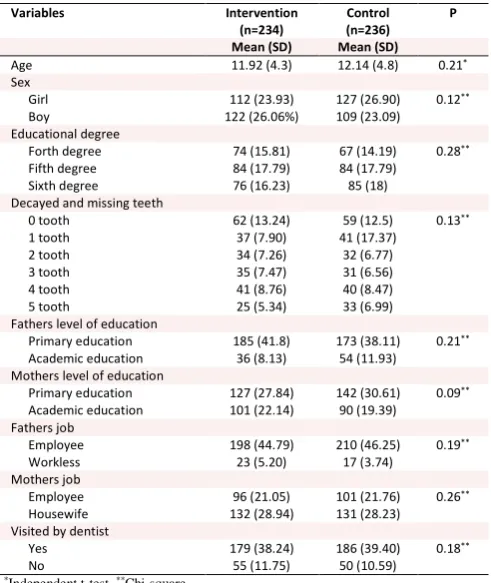
consort check list and were then randomly divided into intervention (n= 234) and control (n= 236) groups (Figure 1). 35.58% (n= 168), 34.23% (n= 161) and 30% (n= 141) of students were fifth, sixth and fourth grade students, respectively. Also, 74.26% of the students had 1 to 5 decayed teeth and 25.74% of students did not have any decayed teeth. 77.6% of them visited dentists for periodic or annual examination. 58.45% of the mothers had elementary education and 41.55% had higher education. 79.91% of the fathers had elementary and 20.09% had higher education. 42.81% of the mothers and 91.04% of the fathers of the students were employed. 50.83% were female students and 49.17% were male students. (Table 1)
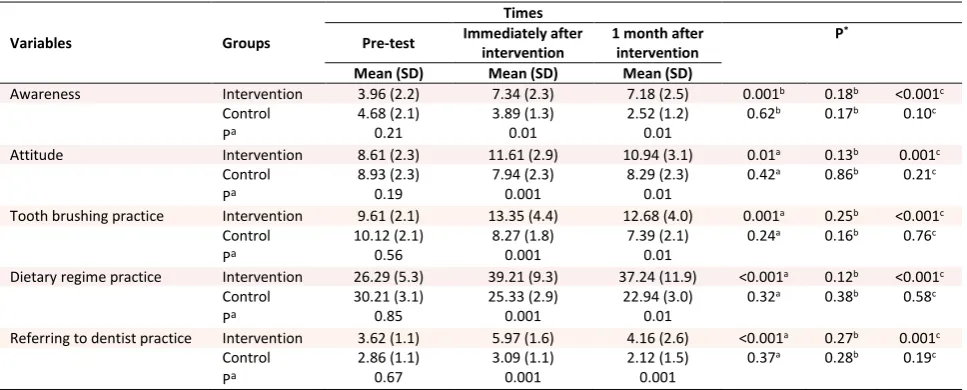
The statistical analyses results (analysis of variance with repeated measures) showed no significant differences between the intervention and control groups
in the pre-test stage (P˃0.05). However, a statistically
significant difference was observed between the intervention and control groups, immediately and one month after the intervention, In other words, the results of the study showed that the educational intervention had a positive effect on promoting attitude and leading
to behavior (P˂0.05) (table 2).
The results of this study showed that there were no significant differences between the intervention and control groups in terms of field variables age, sex, and level of education, employment, and etc. (P>0.05).
Figure 1. Consort flow diagram of the participants
Table 1. Demographic information of the intervention and control group samples.
Variables Intervention
(n=234)
Control (n=236)
P
Mean (SD) Mean (SD)
Age 11.92 (4.3) 12.14 (4.8) 0.21*
Sex
Girl 112 (23.93) 127 (26.90) 0.12**
Boy 122 (26.06%) 109 (23.09)
Educational degree
Forth degree 74 (15.81) 67 (14.19) 0.28** Fifth degree 84 (17.79) 84 (17.79)
Sixth degree 76 (16.23) 85 (18)
Decayed and missing teeth
0 tooth 62 (13.24) 59 (12.5) 0.13**
1 tooth 37 (7.90) 41 (17.37)
2 tooth 34 (7.26) 32 (6.77)
3 tooth 35 (7.47) 31 (6.56)
4 tooth 41 (8.76) 40 (8.47)
5 tooth 25 (5.34) 33 (6.99)
Fathers level of education
Primary education 185 (41.8) 173 (38.11) 0.21** Academic education 36 (8.13) 54 (11.93)
Mothers level of education
Primary education 127 (27.84) 142 (30.61) 0.09** Academic education 101 (22.14) 90 (19.39)
Fathers job
Employee 198 (44.79) 210 (46.25) 0.19**
Workless 23 (5.20) 17 (3.74)
Mothers job
Employee 96 (21.05) 101 (21.76) 0.26**
Housewife 132 (28.94) 131 (28.23)
Visited by dentist
Yes 179 (38.24) 186 (39.40) 0.18**
No 55 (11.75) 50 (10.59)
108 | Journal of Caring Sciences, June 2019; 8 (2), 105-110
Table 2. Comparison of the intervention and control groups in terms of the TPB structural component
*Repeated measure ANOVA, at-test, bpre-test and immediately after intervention, cimmediately after intervention and 1 month after intervention, dpre-test and 1 month
after intervention
Discussion
The aim of this study was to determine the effect of oral health promotion program on early dental decay in students, using TPB. Analysis of variance with repeated measurements implies the effectiveness of education based on the TPB in promoting the scores in the awareness, attitude, subject norm, perceived behavioral control, intention and behavior among the intervention group students in comparison with the control group immediately and one month after the intervention. In this regard, the results of Peyman et al., study showed that the mean scores of TPB constructs in oral health education of students in the intervention group after the
educational intervention increased significantly
(P≤0.05).20
Goodarzi et al., also studied the effect of education on
improving the level of oral and dental health in students. The results of the study showed that there was a significant improvement in health performance of students immediately and one month after the school
education compared with the previous one.25 It can be
concluded that TPB-based education has a positive effect on improving the level of knowledge, attitude and
practice (P˂0.05). The study by Seon et al., also showed
the positive effect of TPB-based education on oral and dental health of alcoholic patients. In this study, covariance analysis showed that oral health education by using the theory led to the improvement of explanatory
abilities of the individuals from 60.3% to 96.6%.26 The
results of this study which are in line with the results Seon et al., seem to highlight the fact that education and its importance as part of an intervention related to the change of behavior is undeniable. Enabling people to have the necessary knowledge to change their lifestyles can make them prepared to accept the recommended changes. Expressing the benefits of a beneficial behavior or the dangers of an inappropriate behavior through different educational models provides a basis for
changing the attitude about and the intention of doing a behavior. In this regard, the results of Peyman et al.,'s research on the use of health belief model in oral health education among elementary school students should be mentioned, too. The results of that study showed that the behavior of the students in the intervention group was significantly improved compared to that of the control
group (P≤0.05) (P<0.05).27 These findings are also
consistent with the results of the study by Jeyhooni et al., Their study showed that health education based on the health belief model was effective on oral health behaviors in pregnant women in Fasa. The results of their study indicated that the level of knowledge, perceived susceptibility, perceived severity, perceived benefits, self-efficacy, signs of action and function were improved four
months after the intervention in the intervention group.28
The similarity of their study to the present study is in
using an educational model on oral health. Many studies have been done on the effects of using educational models on improving the level of knowledge, attitude
and practice of the elementary students.29 The results of
these studies have shown that the use of different health models has been effective in improving the performance
of the students.29,30 In a study by Haque et al., the effect of
oral hygiene education in school was on preventing tooth decay and increasing knowledge, attitude and practice among adolescents in Bangladesh. The results of their study showed that education significantly influenced the improvement of the students' knowledge, attitude and practice (P <0.001), and the prevalence of dental caries
decreased significantly (42.6%) after the intervention.30
This finding is also congruent with the results of the
present study. Research’s has shown that the most effective educational programs are theoretically-based approaches based on the patterns of behavior change. These patterns are useful to program designers, because
they offer specific aspects for educational interventions.31
The limitations of this study include the time limit for its implementation and the close relationship between the
Variables Groups
Times
Pre-test Immediately after
intervention
1 month after intervention
P*
Mean (SD) Mean (SD) Mean (SD)
Awareness Intervention 3.96 (2.2) 7.34 (2.3) 7.18 (2.5) 0.001b 0.18b <0.001c Control 4.68 (2.1) 3.89 (1.3) 2.52 (1.2) 0.62b 0.17b 0.10c
Pa 0.21 0.01 0.01
Attitude Intervention 8.61 (2.3) 11.61 (2.9) 10.94 (3.1) 0.01a 0.13b 0.001c Control 8.93 (2.3) 7.94 (2.3) 8.29 (2.3) 0.42a 0.86b 0.21c
Pa 0.19 0.001 0.01
Tooth brushing practice Intervention 9.61 (2.1) 13.35 (4.4) 12.68 (4.0) 0.001a 0.25b <0.001c Control 10.12 (2.1) 8.27 (1.8) 7.39 (2.1) 0.24a 0.16b 0.76c
Pa 0.56 0.001 0.01
Dietary regime practice Intervention 26.29 (5.3) 39.21 (9.3) 37.24 (11.9) <0.001a 0.12b <0.001c Control 30.21 (3.1) 25.33 (2.9) 22.94 (3.0) 0.32a 0.38b 0.58c
Pa 0.85 0.001 0.01
Referring to dentist practice Intervention 3.62 (1.1) 5.97 (1.6) 4.16 (2.6) <0.001a 0.27b 0.001c Control 2.86 (1.1) 3.09 (1.1) 2.12 (1.5) 0.37a 0.28b 0.19c
Journal of Caring Sciences, March 2019; 8 (1), 105-110
|
109students of the two groups and the probability of transferring the contents between the intervention and control groups. Therefore, further studies with longer run times are suggested. It also seems that conducting the studies, using other health education models, especially native models, is essential.
Conclusion
The results of the present study highlighted the effect of oral health promotion on the students through educational programs based on the TPB. Therefore, it appears that the TPB could be an appropriate theoretical framework for designing and implementing oral health interventions. Interventions based on educational models proved to be more effective in achieving their goals associated with education and behavioral change in the
society.Nurses as an important member of the treatment
team can use the results of this study in school health programs.
Acknowledgments
The present study is the result of a research project approved by the Saveh University of Medical Sciences. The authors would like to thank the Vice-Chancellor for Research, the honorable professors of Nursing and Midwifery faculty, students and their parents for their sincere contribution to the completion of this study.
Ethical issues
None to be declared.
Conflict of interest
There are no any conflict of interest between the authors.
References
1. Bazrafshan E, Kamani H, Kord Mostafapour F, Mahvi AH.
Determination of the decayed, missing, filled teeth index in iranian students: a case study of zahedan city. Health Scope 2012; 1 (2): 84-8.doi: 10.5812/jhs.5120.
2. Nagarajappa R, Kakatkar G, Sharda AJ, Asawa K, Ramesh
G, Sandesh N. Infant oral health: Knowledge, attitude and practices of parents in Udaipur, India. Dental Research Journal 2013; 10 (5): 659-665.
3. Parvizi Z, Jalili Z, Masoudi G, Zareban I, Shahrakipour M.
Study the knowledge, attitude and performance of the
health and cure centers staff regarding using
communication skills in interacting with clients in zahedan city, 2012. Health Scope 2013; 1 (4): 189-93. doi: 10.1779 5/jhealthscope-7784.
4. Pakpour AH, Hidarnia A, Hajizadeh E, Kumar S, Harrison
AP. The status of dental caries and related factors in a sample of Iranian adolescents. Med Oral Patol Oral Cir Bucal 2011; 16 (6): 822-7. doi: 10.4317/medoral.17074.
5. Organization WH. Oral health surveys: basic methods:
World Health Organization; 2013.
6. Nokhostin MR, Siahkamari A, Akbarzadeh Bagheban A.
Evaluation of oral and dental health of 6-12 year-old students in Kermanshah city. Iranian South Medical Journal 2013; 16 (3): 241-9.(Persian)
7. Virtanen JI, Muikku T, Similä T, Cinar AB, Pohjola V.
Physical activity, BMI and oral health behaviour among adolescents: Finnish school health promotion study. European Journal of Public Health 2018; 29 (2): 296-302. doi.org/10.1093/eurpub/cky193.
8. Yao K, Yao Y, Shen X, Lu C, Guo Q. Assessment of the
oral health behavior, knowledge and status among dental and medical undergraduate students: a cross-sectional study. BMC Oral Health 2019; 19 (1): 26. doi; 10.1186/ s12903-019-0716-6.
9. Zareban I, Niknami S, Hidarnia A, Rakhshani F, Karimy
M, Shamsi M. The effect of education program based on health belief model on decreasing blood sugar levels in diabetic type 2 patients in zahedan. Health Scope 2013; 2 (2): 73-8. doi: 10.17795/jhealthscope-8690.
10. Keikhaee R, Rakhshani F, Izadi S, Hashemi Z. Survey of
oral health behaviors and its associated factors in female students of primary schools in Zabol based on health belief
model. Journal of Zabol University of Medical Sciences
and Health Services 2012, 4 (2): 33-41. (Persian)
11. Buglar ME, White KM, Robinson NG. The role of
self-efficacy in dental patients' brushing and flossing: testing an extended health belief model. Patient Education and Counseling 2010; 78 (2): 269-72. doi:10.1016/ j.pec. 2009. 06. 014.
12. Reid GJ, Webb GD, McCrindle BW, Irvine MJ, Siu SC.
Health behaviors among adolescents and young adults with congenital heart disease. Congenital Heart Disease 2008; 3 (1): 16-25. doi: 10.1111/j.1747-0803.2007.00161. x.
13. Mohammadi ZI, Pakpour HA. Effect of educational
intervention on oral health self-care behaviors in diabetic patients. J Isfahan Dent Sch 2014. 10 (3): 202-14. (Persian)
14. Larkin L, Kennedy N, Gallagher S. Promoting physical
activity in rheumatoid arthritis: a narrative review of behaviour change theories. Disability and Rehabilitation
2015; 37 (25): 59-66. doi: 10.3109/09638288.2015.1019
011.
15. Van den Branden S, Van den Broucke S, Leroy R,
Declerck D, Hoppenbrouwers K. Measuring determinants of oral health behaviour in parents of preschool children. Community Dent Health 2013; 30 (1): 19-25. doi:10. 1922/CDH_2897Branden07.
16. Mohammadi Zeidi I, Pakpor A, Mohammadi Zeidi B. The
effect of an educational intervention based on the theory of planned behavior to improve safety climate. Iran Occupational Health 2013; 9 (4): 30-40. (Persian)
17. Ghasemi S, Nazari M, Vafaei H, Fararouei M. The impact
of educational intervention based on the theory of planned behavior in choosing delivery mode in primigravida pregnant women. International Journal of Women's Health
and Reproduction Sciences 2017; 5 (1): 47-54. doi: 10.152
96/ijwhr.2017.09.
18. Dumitrescu AL, Wagle M, Dogaru BC, Manolescu B.
Modeling the theory of planned behavior for intention to improve oral health behaviors: the impact of attitudes, knowledge, and current behavior. Journal of Oral Science 2011; 53 (3): 369-77. doi: 10.2334/josnusd.53.369.
19. Glanz K, Rimer BK, Viswanath K. Health behavior and
health education: theory, research, and practice. 4TH
Edition. San Francisco: John Wiley & Sons; 2008.
20. Peyman N, RoudiK S. The effect of education based on the
110 | Journal of Caring Sciences, June 2019; 8 (2), 105-110
21. Ajzen I. The theory of planned behavior. Organizational
Behavior and Human Decision Processes 1991; 50 (2): 179-211. doi: 10.1016/0749-5978(91)90020-T.
22. Delshad Noghabi A, Moshki M. The Impact of education
on the basis of the theory of planned behavior on the level and method of supervision of their parents on watching television by students. Journal of Health Chimes 2014; 1 (4): 7-17. (Persian)
23. Rad M, Shahravan A, Haghdoost A. Designing a valid
questionnaire on oral health related knowledge, attitude and practice in 12-year old children in Iran. Journal of
Mazandaran University of Medical Sciences 2015; 25
(126): 130-3. (Persian)
24. Hopewell S, Hirst A, Collins GS, Mallett S, Yu LM,
Altman DG. Reporting of participant flow diagrams in
published reports of randomizedtrials. Trials 2011; 12 (1):
253. doi:10.1186/1745-6215-12-253.
25. Goodarzi A, Heidarnia A, Tavafian SS, Eslami M.
Predicting oral health behaviors among Iranian students by using health belief model. J Educ Health Promot 2019; 8: 10. doi: 10.4103/jehp.jehp_10_18.
26. Kim S, Kim H, Nam S. Effect of oral health education on
the planned behavior theory variables among hospitalized alcoholic patients using structural equation model.
Biomedical Research 2017; 28 (19):8316-8320.
27. Peyman N, Pourhaji F. The effects of educational program
based on the health belief model on the oral health behaviors of elementary school students. Modern Care Journal 2015; 12: 74-8. (Perisan)
28. Khani Jeihooni A, Hidarnia A, Kaveh MH, Hajizadeh E.
The effect of a prevention program based on health belief model on osteoporosis. Journal of Research in Health Sciences 2015; 15 (1): 47-53. (Persian)
29. Ghaderi N, Ahmadpour M, Saniee N, Karimi F, Ghaderi C,
Mirzaei H. Effect of education based on the Health Belief Model (HBM) on anemia preventive behaviors among iranian girl students. Int J Pediatr 2017; 5 (6):5043-52. doi: 10.22038/IJP.2017.22051.1844.
30. Haque SE, Rahman M, Itsuko K, Mutahara M, Kayako S,
Tsutsumi A, et al. Effect of a school-based oral health education in preventing untreated dental caries and increasing knowledge, attitude, and practices among adolescents in Bangladesh. BMC Oral Health 2016; 16 (1): 44. doi: 10.1186/s12903-016-0202-3.
31. Riebl SK, Estabrooks PA, Dunsmore JC, Savla J, Frisard