_____________________________ Abstract
The aim of this study was to explore internalizing and externalizing problems in adolescent children of veterans of the war in Kosovo (1998-1999). The results of this study are quite interesting from the perspective of the dilemma for the state of the children of veterans even 15 years after the war ended. Parents’ emotional problems affect the functioning of the family in general and children in particular. Children can react to symptoms of parents by developing different symptoms as trouble sleeping, appetite loss, emotional instability or even problems in development, according to research done on children's reactions to the problems of parents explained by interactions between environment, brain and behaviour driven by trauma.
The results of this study have shown that the internalizing problems have not shown gender differences, meantime externalizing problems were found higher in male participants. An interesting finding of this study was the highest scores of emotional problems in children born before and during the war, compare to those born after the war ended. We also found that anxiety problems in children [R2= .83, p < .001] were a
significant predictor of internalizing problems. The assessment of the scale of positive qualities [R2= .19, p < .001] was also
found to be a significant predictor for externalizing problems.
MA. Eglantina KRAJA, Dr.sc. Adelina AHMETI
Internalizing and Externalizing Problems
in Children of War Veterans in Kosovo
_____________________________
Only 0.8% of the variance of internalizing problems was explained by the income.
Considering that the subject of this study were adolescent children of war veterans of the 1999 conflict in Kosovo, we must take into account that the post-traumatic stress disorder is a very frequent problem among war veterans and that its impact on their personal and family life cannot be overlooked.
Key Words: Internalizing, Externalizing, Adolescents, Veterans, Regre-ssion, ANOVA, Total of problems.
1. Internalizing and Externalizing Problems in Children of War Veterans in Kosovo
Emotional disorders are quite widespread among persons who have faced severe traumatic events such as murder, torture, witnessing murders or the missing of family members or war combats, or missing family members for a long time. According to Dekel and Goldblatt (2008), clinical observations and empirical research have shown that the consequences of traumatic events are not limited to the person immediately exposed to the event, and that they often affect family and friends. In a meta-analysis involving 42 studies, Lambert et al. (2014) suggested the importance of considering the family context of the trauma survivors. Psychological problems of children with traumatized parents should be considered from the perspective of genetic predisposition, secondary traumatisation, difficulties in family functioning, or other challenges associated with living with a traumatized parent.
_____________________________
more psychopathological symptoms, physical symptoms and adverse experiences in childhood (Pedras and Pereira, 2014). The process of the transfer of trauma symptoms from veterans to their children may occur through avoidance (Ancharoff, Munroe and Fisher, 1998), 1998., dentification (Rosenheck and Fontana (1998), and may be transmitted indirectly from dysfunctional relations within the family (Galovski and Lyons, 2004).
In a study conducted in Bosnia and Herzegovina children of veterans with PTSD demonstrated significantly higher levels of fear, problems in school, and a higher level of depression, emotional problems and dysfunctional behaviour in comparison to children of veterans who did not have PTSD, which in the longer term affected children’s personality (Klaric, et.al., 2008). In similar studies conducted in Croatia, USA and other countries, children of veterans reported to have been more likely to harm themselves intentionally in comparison to children of non-veterans (Franic, et.al., 2012), to have suicidal thoughts, depression, and low self-esteem (Reed, Bell and Edwards, 2011; Marsanic et.al., 2014), more psychopathology (Vaage, et.al., 2011), internalizing problem (Boricevic, et.al., 2014), emotional and behavior problems (Jordan, et.al., 1992; Selimbasic, Sinanovic and Avdibegovic, 2012), academic problems, hopelessness about the future and clinical depression (Kinzie, Boehnlein and Sack, 1998), increase in physical accidents and neglect by their parents (Dias, et.al., 2014), higher level of anxiety, greater concerns related to stress and less capacity for intimacy (Dinshtein, Dekel and Polliack, 2011),
Subject of this study were adolescent children of veterans of the 1999 war in Kosovo. This study analyzed the connection between a number of variables and internalizing and externalizing problems in adolescent children of veterans.
2. Methodology
_____________________________
those veterans had a child of age 11- 18. All the questionnaires were self-administered after the adolescents gave oral consent. The Medical University of Prishtina (Ethical Review Committee) has given the Ethical approval. The procedures proposed complied with the Helsinki Declaration of 1975, as revised in 2008.
The instruments used for the propose of this paper were a demographic questionnaire prepared for the purposes of this research and Youth Self Report(YSR) (Achenbach and Rescorla, 2001) The 2001 problem scales for the YSR were computed from the 112 problem items: three broad-band scales (Internalizing, Externalizing, and Total Problems); eight empirically based syndromes (Anxious/Depressed, Withdrawn/Depressed, Somatic Complaints, Social Problems, Thought Problems, Attention Problems, Rule-Breaking Behaviour, and Aggressive Behaviour.
Cronbach’s alphas Internal consistencies of the 20 YSR scales were
examined using Cronbach’s alphas. The internal consistency for this questionnaire had the following values for: total problems (α = 0.94), internalizing problems (α = 0.86) and externalizing problems (α = 0.84).
Meanwhile, no gender based differences were found in reporting α
coefficients on YSR scales. The highest α coefficients were reported on the scales of aggressive behaviour (α = 0.82), while the lowest was reported on the scale of mental problems (α = 0.64). In this sample’s reporting this coefficient was from very good to excellent.
3. Results
Participants were 568 Kosovar adolescents aged 11 to 18 (Mean = 14.1, SD = 1.9), who completed the Youth Self-Report (YSR; Achenbach and Rescorla, 2001) in 2014. This study involved 571 adolescents (male: female 52.3% vs. 47.7%), of age 11-18 (M = 15.8 years, SD = 2.3, range 7). The participants were 52.3% (N = 297) males and 47.7 (N = 271) females (χ2(1) =
1.4, p = .225).
The majority of the parents of the participants had primary and secondary education (26.4% vs. 44.2%), while only three of the parents had no education at all (1.4%). 28% of the parents had higher education. Adolescents reported that 60.1% of their parents were not working and 39.8% having a job (χ2(1) = 0.06, p = .505). The average income of the
_____________________________
3.1 The influence of socio-demographic variables on YSR scales
The highest mean was recorded for the scale of aggressive behaviour M = 5.1, (SD = 4.5); and the scale of anxiety M = 4.8,(SD = 3.5), while the lowest mean was reported on the scale of somatic problems M = 2.2, (SD = 2.4). The mean value reported for total problems was M = 46.5 (SD = 24.8), for internalizing problems M = 11.7 (SD = 7.7), and for externalizing problems M = 10.9 (SD = 6.9),(table 1).
Table 1: Mean and standard deviation for eight empirical scales of YSR and Three Broad Scales
N Mean Std. Deviation
Anxious/Depressed 568 4.8 3.5
Withdrawn/Depressed 568 3.9 2.7
Somatic Complaints 568 2.2 2.4
Social problems 568 3.7 3.1
Thoughts problems 568 2.1 2.6
Attention Problems 568 3.1 2.8
Rule-breaking Behaviour 568 2.4 2.8
Aggressive
Behaviour 568 5.1 4.5
Internalizing problems 568 11.7 7.7
Externalizing problems 568 10.9 6.9
Total Problems 568 46.5 24.8
Source: Authors’ own work
_____________________________
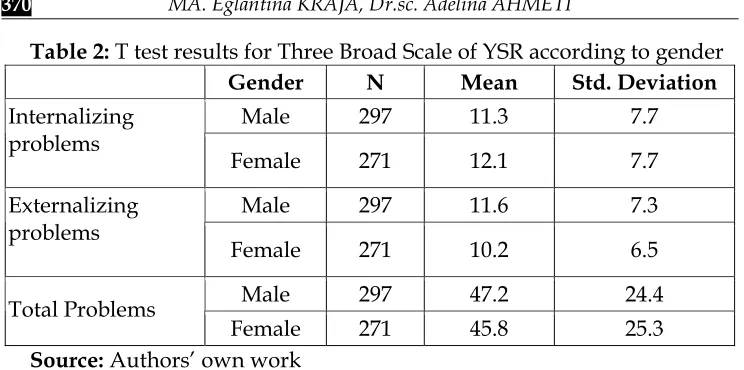
Table 2: T test results for Three Broad Scale of YSR according to gender
Gender N Mean Std. Deviation
Male 297 11.3 7.7
Internalizing problems
Female 271 12.1 7.7
Male 297 11.6 7.3
Externalizing problems
Female 271 10.2 6.5
Male 297 47.2 24.4
Total Problems
Female 271 45.8 25.3
Source: Authors’ own work
One-way ANOVA was used to see whether the age of adolescents affected the variance of the three main YSR scales. No significant differences were found in the variance of total problems, internalizing and externalizing problems in relation to age. Post-hoc analysis was used to identify the influence of the age and it was found that age 16 had significant differences with age 11 on the scale of internalizing problems (I-J = 3.4, p = .028) and with age 13 on the scale of externalizing problems (I-J = 3.3, p = .021). Meanwhile, on the scale of total problems there were significant differences between age 16 and age 11 (I-J = 10.1, p = .042) and age 13 (I-J = 12.6, p = .014).
Two-way ANOVA (2 x 6) was performed to test whether gender and age of participants affected the experience of total, internalizing and externalizing problems. No interaction effect was found between gender and age (F(7) = 0.81, p = .576, η2 = 0.01) and total problems, internalizing
problems 7) = 0.42, p = .890, η2 = 0.005), and externalizing problems (F(7) =
0.52, p = .817, η2 = 0.007).
The T-test data are reported in Table 3. T- Test was performed in order to compare the mean of participant reporting on eight empirical scales between the group of female participants and the group of male participants.
_____________________________
Table 3: T test results for the eight empirical scales according to gender 95% Confidence Interval of
the Difference
t df Sig. (2-tailed) Lower Upper
Anxious/
Depressed -1.852 566 .065 -1.14760 .03370
Withdrawn/
Depressed .403 566 .687 -.35577 .53963
Somatic
Complaints -1.421 566 .156 -.69617 .11175
Social
problems .037 566 .970 -.48982 .50875
Thoughts
problems .824 566 .410 -.25285 .61870
Attention
Problems 1.187 566 .236 -.18434 .74788
Rule-breaking
Behaviour 3.036 566 .003 .25222 1.17695
Aggressive
Behaviour 1.664 566 .097 -.11342 1.36947
Source: Authors’ own work
_____________________________
When we dichotomized age into the age group 11-14 years (1), namely children who were born immediately after the war and the age group 15-18 years (2), children born at the beginning or during the war, we found that age group (2) had a higher reporting mean in all the fields, however those differences reach significance in reporting somatic problems (F (566)= 3.8, p .03), with the children born before the beginning and during the war having a higher mean (M = 2.3, SD = 2.5) in comparison to those born immediately after the war (M = 1.8, SD = 2.2).
Table 4: T test results for the eight empirical scales according to group age
95% Confidence Interval of the Difference
t df (2-tailed) Sig. Lower Upper
Anxious/
Depressed -1.329 566 .185 -1.08710 .20986
Withdrawn/
Depressed -1.778 566 .076 -.93259 .04645
Somatic
Complaints -2.162 566 .031 -.92818 -.04451
Social problems -.215 566 .830 -.60735 .48735
Thoughts
problems -1.722 566 .086 -.89482 .05874
Attention
Problems -1.381 566 .168 -.86998 .15157
Rule-breaking
Behaviour -1.415 566 .158 -.87761 .14259
Aggressive
Behaviour -.551 566 .582 -1.04309 .58615
Source: Authors’ own work
_____________________________
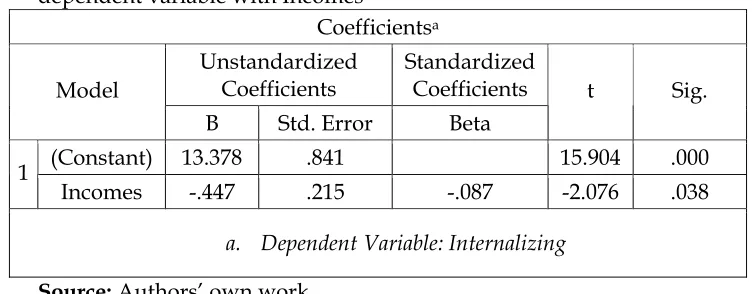
together. A significant negative, but not strong correlation was found only between income and internalizing problems (r= -.087, p = .03). Negative, but not significant correlation was found between the three scales and education background. We performed a regression analysis in order to find how much of a predictor income is for the internalizing problems R=.008. Only 0.8% of the variance of internalizing problems was explained by the income.
Table 5: Results of Regression Analysis for Internalizing Problems as a dependent variable with Incomes
Coefficientsa
Unstandardized
Coefficients Standardized Coefficients Model
B Std. Error Beta
t Sig.
(Constant) 13.378 .841 15.904 .000
1
Incomes -.447 .215 -.087 -2.076 .038
a. Dependent Variable: Internalizing
Source: Authors’ own work
If we add the child’s gender in the model, we see that 1.7% of the variance of internalizing problems is explained by child’s gender and income. Gender is a significant predictor (p =.002). We also found that anxiety problems in children [R2= .83, p < .001] were a significant predictor
of internalizing problems. The assessment of the scale of positive qualities [R2= .19, p < .001] was also found to be a significant predictor for
externalizing problems.
4. Conclusions
_____________________________
Those results are also consistent with the results found in the community (Shahini et al 2014).
This study did not find that internalizing problems were more manifested among female children and that externalizing problems were more manifested in male children. Income and education background were not found to be predictors for internalizing and externalizing problems. One interesting data was that positivity was a significant predictor for internalizing and externalizing problems.
The Kosovo society has not treated veterans properly, leaving them in a very unfavourable situation. The results show that more than half of them live under the optimum of living conditions. They seem to have organized themselves within the family circle, disabling themselves to express emotional problems. This speculation may be supported by the fact that the study has found that adolescents of age 15-18 have more somatic problems than those of younger age. This fact, coupled with the lack of specific services for veterans and their families, makes one part of adolescents more prone to experiencing anxiety or more predisposed to developing emotional and behaviour problems.
Previous studies on children of veterans have given inconsistent results. Children of veterans according to these studies reported higher levels of conflict in their families but no significant differences on measures of psychological distress from control groups (Westerink and Giarratano 1999). Findings from Ruscio, Weathers, King, and King (2002) showed that emotional numbing was the only aspect of PTSD uniquely associated with veterans’ perceived relationships with their children.
_____________________________ List of References
Achenbach, T. M., and Rescorla, L. A. (2001). Manual for the ASEBA School-Age Forms and Profiles. Burlington, University of Vermont. Research Center for Children, Youth, and Families.
Ancharoff, M. R., Munroe, J. F., and Fisher, L. (1998). The legacy of combat trauma: Clinical implications of intergenerational transmission. In Y. Danieli (Ed.), International handbook of multigenerational legacies of trauma
(pp. 257–279). New York: Plenum Press.
Boricevic, M. V., Aukst, M. B., Jukic, V., Matko, V., and Grgic, V. (2014). Self- reporter emotional and behavioural symptoms, parents- adolescent bonding and family functioning in clinically referred adolescent
off-sprig of Croatian PTSD war veterans. European Child and Adolescent
Psychiatry. 23(5): 295-306.
Dekel, R., and Goldbalt, H. (2008). Is there Intergenerational Transmission
of Trauma? The Case Combat Veterans’ Children. American Journal of
Orthopschiatry. Vol. 78, No. 3, 281-289.
Dias, A., Sales, L., Cardoso, R. M., and Kleber, R. (2014). Childhood maltreatment in adut offspring of Portuguese war veterans with and without PTSD. European Journal of Psychotraumtology. 5: 20198.
Dinshtein, Y., Dekel, R., and Pollicak, M. (2011). Secondary Traumatization Among Adult children of PTSD Veterans: The Role f Mothers – Child Relationship. Journal of Family Social Work, 14:109-124.
Franic, T., Kardum, G., Prizmic, I. M., Pavletic, N., and Marcinko, D. (2012). Perental involvement in the war in Croatia 1991-1995 and suicidality in Croatia male Adolescents. Croat med Journal. 53: 244-53.
Galovski, T., and Lyons, J. A. (2004). Psychological sequelae of combat violence: A review f the impact of PTSD on the veteran’s family and possible interventions. Aggression and Violent Behavior. Vol. 9, pp. 477- 501.
Herzog, J. R., Everson, R. B., and Whitworth, J. D. (2011). Do Secondary Trauma Symptoms in Spouses of Combat-Exposed National Guard Soldiers Mediate Impacts of Soldiers’ Trauma Exposure on Their Children. Child and Adolescent Social Work Journal, 28(6), 459–473. doi:10.1007/s10560-011-0243.
_____________________________
veterans with posttraumattic stress disorder. Journal of Consulting and Clinical Psychology, 60, 916–926.
Kinzie, J., Boehnlein, J., Sack, W. (1998). The Effects of Massive Trauma on Cambodian Parents and Children. In Danieli, Y. (Ed.), The International Handbook of Multigenerational Legacies of Trauma (p.211-221). Neë York, Neë York: Plenum Press.
Klaric, M., Franciskovic, T., Klaric, B., Kvesic, A., Kastelan, A., Graovac, M., and Lisica, I. D. (2008). Psychological Problems in children of War Veterans with Posttraumatic Stress Disorder in Bosnia and Herzegovina: Cross- Sectional Study. Croat Med Journal. 48: 481-8.
Klaric, M., Kvesic, A., Mandic, V., Petrov, B., and Franciskovic, T. (2013).
Secondary Traumatisation and Systemic Traumatic Stress. Medicina
Academica Mostariensia. Vol. 1, No. 1, pp. 29-36.
Lambert, J, Holzer, J, and Hasbun, A.(2014). Association Between Parents’ PTSD Severity and Children’s Psychological Distress: A Meta-Analysis.
Journal of Traumatic Stress, 27, 1–9.
Marsanic, B. V., Aukst, M. B., Ozanic, B. S., Duretic, I., Knieëald, H., Jukic, T., and Paradzik, L. (2014). Non-suicidal self- injury among psychiatric outpatient adoleshent offspring of Croatian posttraumatic stress disorder male war veterans: Prevalence and psychoscial correlates. The international journal of social psychiatry, pii: 0020764014541248.
Pedras, S., and Pereira, G. (2014). Secondary Traumatic Stress Disorder in Ëar Veterans’ Adult Offspring. Military Behavioral Healt. 2: 52–58.
Reed, S. C., Bell, J. F., and Edwards, T. C. (2011). Adolescent Well- Being in Washington State Millitary Families. American Journal of Public Health.
Vol 101, No. 9.
Rosenheck, R., and Fontana, A. (1998b). Trans-generational effects of abusive violence on the children of Vietnam combat veterans. Journal of Traumatic Stress, 11, 731–741.
Selimbasic, Z., Sinanovic, O., and Avdibbegvic, E. (2012). Emotional and Behavioural problems in children of ëar veterans with posttraumatic stress disorder. The Journal of the European Psychiatric Association. Vol. 27, pp.1.
Shahini, M., Rescorla, L. A., Ahmeti, A. P., Begovac, I., Dobrean, A., Markovic, J. et al. (2014). Parent-reported behavioural and emotional problems in Albanian Kosovar children. Epidemiol.Psychiatr.Sci., 1-8. Vaage, A. B., Thomsen, P. H., Rousseau, C., Wentzel-Larsen, T., Ta, TH. V.,
_____________________________
of Vietnamese refugees. Child and Adolescent Psychiatry and Mental Health,
5: 2.
Westerink, J. and Giarratano, L. (1999). The impact of posttraumatic stress disorder on partners and children of Australian Vietnam veterans.