The Brie
1School of Hu
Corresponden
Received: Sep doi:10.11114/j
Abstract The aim of t language. Dat the study have of the data. Th subscale: Som = .81), Anxiety = .65). The 9 f Keywords: br 1. Introductio According to groups accoun been an upwa years. It is con and economic that could be and reliability languages. Recently, the self-reporting Brief Sympto screening sev and research. inventory is u The BSI has b Ryan, 2007), I Bragado, & C & Kaplan, 19 Panayiotu& K The translatio and for facilit millions of ref Therefore, the among young In this article,
ef Sympto
umanities and S nce:MelekKerim
ptember 21, 20 jets.v4i12.200
this research w ta were collect e been selected he Cronbach’s matization (α =
ty (α = .82), Ho factor structure rief symptom i on
official data o nt for slightly ard trend in th
nsidered that t c difficulties co
rapidly admin y of the Brief
importance of scales are spe m Inventory ( eral psycholog According to sed in 1700 stu been translated Italian (De Le Carrasco, 2000 994; Gilbar, & Kokkinos) and on and adaptati tating new res fugees, Azerba e aim of the st
peoples. the authors re
om Invent
Social Science mova, School
016 Acc 0 U
was to adapt ted from309 co d separately. T s Alpha (α) int = .80), Obsess Hostility (α = .8 e of the invent inventory, Aze
of Azerbaijan’ over 2.6 mill he growth of n the war with A ontinue to imp nistered to eva f Symptom In
f assessment of cified as time (BSI) is a self gical symptom o Medline, BS udies (Maanse d and adapted o, Frisoni, Roz ; Ruipérez, Ib & BenZur, 20
Persian (P. Mo ion of BSI into search options
aijan needs to tudy is to adap
eport on the psy
tory:A va
Az
Melek Kerimo es, Khazar Uniof Humanities
cepted: Novem URL: http://dx
Brief Sympto ollege student The package pr
ternal consisten sive-Compulsiv 81), Phobic anx tory was tested erbaijani cultur
s State Statisti lion people or neurological d Armenia and its
act the youth p aluate the psyc nventory as an
f individuals w saving, useful f-reporting sca ms in a short ti
SI has been em e Hoe & John S for different c zzini, & Trabu áñez, Lorente, 002), Scottish ohammadkhan o Azerbaijani . Moreover, a analyze psych pt easily defin
ychometric pro
153
alidity-rel
zerbaijan
ova1, Nermin O iversity, Baku, s and Social Sc
mber 17, 2016 x.doi.org/10.11
om Inventory s to determine rograms of SP ncy coefficien ve (a = .70), I xiety (α = .60) d through CFA re, reliability, v
ics Committee r 28% of Azer disorders amon s implications, population. Th chological sym n instrument
with reliable an , practical and ale, which me me span. Ther mployed in 26 S.Brekke, 2008 cultures, includ ucchi, 1993), T
, Moro,Ortet, 2 h (Schwannau ni, 2010), and u
culture is imp as a country th hological probl ed and practic
operties and di
Jo
liability S
Osmanli1 Azerbaijan ciences, Khaza Online 1114/jets.v4i12 developed by e psychometricSS 18.0 and L nt was calculate
Interpersonal ), Paranoid ide A.
validity
e, the country’ rbaijan’s popu ng this group o
, including inte his has given ri mptoms among that has been
nd valid scales d supportive in easures nine ps refore, it is us 60 studies sinc
8).
ding into Briti Turkish (Shahi 2001; Pereda er & Chetwy used as a tool portant as a too hat has been a
lems among its cal BSI scale f
imensional stru
ournal of Educa Vol. 4, N ISSN 2324-8 Published
URL
Study of a
ar University, B
Published: No 2.2000
Derogatis (1 c properties of Lisrel 8.80 wer ed for the scal Sensitivity (α
eation (α = .61
s youth popul ulation (www.s of population ernal displacem ise to a need fo g them. This s n translated an
s has increased defining preve sychological s ed extensively ce 2000. As P
ish (Francis, R n & Durak, 19 et al.,2007), Is ynd, 2007), G
of valid and re ol of data colle affected by a w
s population an for the evaluat
ructure of BSI
ation and Trainin No. 12; Decem 805XE-ISSN 2 by Redfame P L: http://jets.redf
a Sample
Baku, Azerbaij
ovember 20, 20
983) into Az f inventory. Sa re used for the le (α=.95) and = .65), Depre 1) and Psycho
lation in the 14 stat.gov.az). T
compared to ment of the po or tests and inv study tests the nd adapted in
d in mental hea entive approac symptoms. BS y in clinical ev Psycho info ci
Rajan, & Turne 994), Spanish ( sraeli (Canetti, Greek (Louitsio eliable measur ection for field war with Arm
nd preventive tion of general
Azerbaijani ve ng Studies mber 2016 324-8068 Publishing fame.com
from
jan. 016 erbaijani mples in analysis for each ession (αticism (α
2. Method 2.1Sample
Data collected from the Khazar University in Azerbaijan for academic year 2014-2015. The sample of the study consists of 309 university students, who were recruited by random cluster sampling. Participants ranging in age from 17 to 28 years old (M=19.64; SD=1.73) were included in the study. Out of 309 participants men consist of (N=104) 37.7%, women (N=205) 66.3%.
2.2 Data Collection Tools
In order to obtain the demographic data on the participants, the authors developed “Personal Information Questionnaire”.
2.3 Brief Symptom Inventory
The BSI, a short form of the Symptom Checklist-90 (Derogatis, 1977), is a 53-item self-report measure of symptoms of psychological distress (Derogatis, 1993).The BSI is prevalent in the studies among adults. The instrument consists of 9 subscales (‘Somatisation’, ‘Obsessive–Compulsive’, ‘Interpersonal Sensitivity’, ‘Depression’, ‘Anxiety’, ‘Hostility’, ‘Phobic Anxiety’, ‘Paranoid Ideation’ and ‘Psychoticism’) and 3 global indices (General Severity Index (GSI),the Positive Symptom Distress Index (PSDI)and the Positive Symptom Total (PST). The items consist of physical and psychological symptoms that occurred during the last week (Derogatis and Melisaratos, 1983). The BSI is a Likert-type scale, which rates items on a 5-point system of distress (0–4), ranging from ‘not at all’ to ‘extremely’.
Three different studies show that the internal consistency coefficient of 9 subscales ranged from .71 to .85. Correlation coefficients as a result of the test retest reliability study ranged as follows: .68-.91 for the 9 subscale, .90 for the GSI, .87 for the PSDI, and .80 for the PST (Derogatis & Spencer, 1982, Şahin & Durak, 1994).
3. Procedure 3.1 Translation
The original scale was translated into the Azerbaijani language by two bilinguals, of both Azerbaijani and English languages, as experts of psychologists. Then, the translated scale was administered on 25 students from various departments and revised based on feedback from the individuals, to complete the process.
3.2 Data Analysis for CFA
First correlations among the BSI scales were computed as Cronbach alpha coefficients for the full global severity index and each of its nine subscales to examine the internal reliability of the scale. The goodness-of-fit indices for the model tested through CFA was determined with the help of 2 (Chi-Square Goodness-of-Fit), GFI (Goodness-of-Fit Index), AGFI (Adjusted Goodness-of-Fit Index), CFI (Comparative Fit Index), NFI (Normed Fit Index), NNFI (Not-Normed Fit Index), RMR (Root Mean Square Residuals), SRMR (Standardized Root Mean Square Residuals) and RMSEA (Root Mean Square Error of Approximation) indices. For the analysis of the data, the package programs of SPSS 18.0 and Lisrel 8.80 (Jöreskog & Sörbom, 2006) were used for descriptive statistics and confirmatory factor analysis, respectively.
4. Findings
4.1Findings Regarding the Adaptation of Brief Symptom Inventory
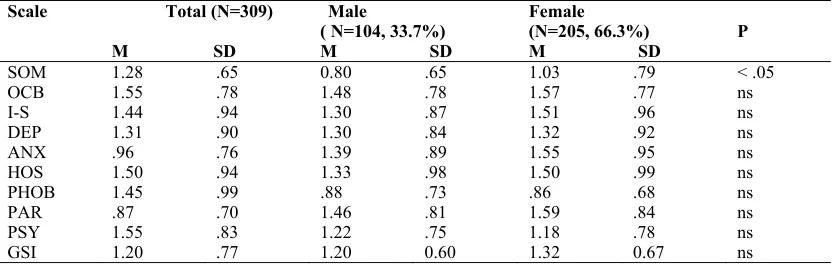
Table 1. Means(M) and standard deviations(SD) by gender for the Azerbaijani version of the BSI Scale Total (N=309)
M SD
Male
( N=104, 33.7%) M SD
Female (N=205, 66.3%)
M SD P
SOM 1.28 .65 0.80 .65 1.03 .79 < .05
OCB 1.55 .78 1.48 .78 1.57 .77 ns
I-S 1.44 .94 1.30 .87 1.51 .96 ns
DEP 1.31 .90 1.30 .84 1.32 .92 ns
ANX .96 .76 1.39 .89 1.55 .95 ns
HOS 1.50 .94 1.33 .98 1.50 .99 ns
PHOB 1.45 .99 .88 .73 .86 .68 ns
PAR .87 .70 1.46 .81 1.59 .84 ns
PSY 1.55 .83 1.22 .75 1.18 .78 ns
Journal of Education and Training Studies Vol. 4, No. 12; December 2016
155 Table 2. Mean scores on the BSI in different studies
Subscales British (N=376) community sample (Francis, Rajan& Turner, 1990) M (SD)
Scottish (N=459) psychologist sample (Schwannauer &Chetwynd, 2007) M (SD)
Greek (N=818) community sample (Loutsiou-Ladd, Panayıotou,& Kokkinos,2008 ) M (SD)
Israil(N=510)
community sample (Gilbar&Ben-Z ur, 2002) M (SD)
Iranian (N=354) depressed patients (Mohammadkha ni, 2010) M (SD)
Psychiatric Outpatients (N=1002) (Derogatis& MelisaratoS, 1992) M (SD) Somatization 0.43 (0.57) 1.09 (0.94) 0.77 (.79) .62 (.68) 1.34 (.94) .83 (.79) Obsessive-com
pulsive 0.59 (0.63) 1.69 (1.08) 1.34 (.83) .94 (.79) 1.70 (.85) 1.57 (1.00) Interpersonal
sensitivity 0.58 (0.72) 1.75 (1.22) 1.12 (.90) .68 (.71) 1.53 (.96) 1.58 (1.05) Depression 0.42 (0.65) 1.68 (1.14) .92 (.81) .70 (.69) 1.83 (1.01) 1.80 (1.08) Anxiety 0.45 (0.60) 1.90 (1.13) 1.06 (.85) .85 (.71 ) 1.42 (.91) 1.70 (1.00) Hostility 0.44 (0.60) 1.30 (1.14) .93 (.78) .72 (.70) 1.18 (.84) 1.16 (.93) Phobic anxiety 0.24 (0.50) 1.21 (1.16) .53 (.64) .46 (.61) .90 (.78) .86 (.88) Paranoid
ideation 0.54 (0.65) 1.29 (1.06) 1.14 (.83) .91 (.78) 1.52 (.92) 1.14 (.95) Psychotism 0.27 (0.48) 1.27 (0.98) .72 (.70) .57 (.62) 1.37 (.84) 1.19 (.87) GSI 0.44 (0.47) 1.47 (0.85) .94 (.65) .72 (.59) 1.32 (.70) 1.32 (.72) Descriptive statistics of participants are presented in Table 1. Out of 309 participants 37.7% (N=105) were male and 66.3% were female (N=204). The differences between the men and women were evaluated with a series of Independent Samples t Tests. Except for the “Somatisation” subscale, none of the differences between male and female respondents were significant at the level of p < .05. As can be seen from the Table 1 and Table 2, mean scores were found to be higher than in other countries, especially for community samples.
Table 3. Pearson Correlations Coefficients among the nine subscales and GSI
Scales SOM OC IS DEP ANX HOS PHOB PAR PSY
SOM - .57 .56 .53 .71 .55 .61 .46 .51
OC .57 - .56 .63 .66 .53 .55 .55 .58
IS .46 .56 - .68 .67 .48 .55 .63 .61
DEP .53 .63 .68 - .74 .57 .62 .63 .70
ANX .71 .66. .67 .74 - .66 .70 .65 .66
HOS .55 .53 .48 .57 .65 - .50 .56 .55
PHOB .61 .55 .55 .62 .70 .50 - .57 .63
PAR .46 .55 .63 .63 .65 .56 .57 - .67
PSY .51 .58 .61 .70 .66 .54 .63 .67 -
GSI .64 .59 .63 .61 .68 .59 .60 .56 .58
*p <.001
As presented in Table 3 correlations among the BSI sub-factors and Global Severity Index (GSI) were found to be significantat p < .001.
4.2 Internal Consistency
Cronbach’s alpha internal consistency coefficient for the Global Severity Index (GSI) were identified asα = .95. Internal consistency coefficient for each subscale was calculated as follows: Somatization (α = .80), Obsessive-Compulsive (a = .70), Interpersonal Sensitivity (α = .65), Depression (α = .81), Anxiety (α = .82), Hostility (α = .81), Phobic anxiety (α
= .60), Paranoid ideation (α = .61) and Psychoticism (α = .65). 4.3 Confirmatory Factor Analysis (CFA)
The BSI structure was made up of 53 and nine-factor items. As the data set demonstrated a normal distribution, the authors used parameter estimation method Maximum Likelihood Method and the data matrix Covariance Matrix in CFA.
The traditiona Chi-Square ( p value is sign thatother fit in 1930.52and d Tabachnick & When the fit as .058. It sho determined to square residua 059. Suitabilit Bentler, 1999) found .97. Hi Thompson, 20
al measure for 2). An insignif nificant at 0.05 ndices should degree of freed & Fidell, 2007). statistic of Ro ows good fit p o be (.79) sma
al (RMR) and ty index value ). When exam igher suitabilit 008).
F r structural eq ficant result at 5 level. Howev
be evaluated dom as df= 95
.
oot Mean Squa providing that aller than .90 w d standardized
es less than .05 mined, the Non
ty values than
Figure 1. Stan quation modeli t a 0.05 thresho
ver, significan too (Tabachn 52. It is perfe
are Error of A t RMSEA ≤ .0 which means p root mean squ 5 were accepte n-Normed Fit I
n .95 represent
dardized Path ing is Chi-Squ old shows goo nt is normal for nick & Fidell, ect fit if the ra
Approximation 08 (Hooper, e poor fit (Hoop uare residual ( ed as perfect f Index (NNFI) t perfect fit (H
Diagram uare. First valu
d fit (Hooper e r large sizes o
2007). The C atio of 2/df (
(RMSEA) wa t al. 2008). Th per et al, 2008 (SRMR) were fit and less tha CFI (Compara Hu & Bentler,
ue to be exam et al. 2008). A
f samples. The Chi-Square val
(2.02) is lower
as analyzed, th he goodness o 8; Hu & Bent
found as: RM an .08 good fit ative fit index , 1999; Tabac
mined isp leve According to th erefore, it is su lue was found
r than 3 (Klin
he fit index w of fit index (G tler, 1999). Ro MR=.080 and S
t (Brown, 200 ), NNFI and C chnick & Fide
l for the e results, uggested as 2 = ne, 2011;
Journal of Education and Training Studies Vol. 4, No. 12; December 2016
157
As a result, perfect or good fit values were found for all fit indices except for the GFI. This indicates that the nine-dimensional structure of scale was confirmed.
5. Conclusion and Discussion
In this study, “Brief Symptom Inventory” developed by Derogatis (1993), was adapted into the Azerbaijani language. In this sense, instead of developing a new measure, it was considered expedient based on cultural and language similarities to use a measure with validity and reliability proven in many other studies. As this research project is the first and would be a pioneer for future studies, it is expected to significantly contribute, particularly to the national scholarly literature in psychology.
Students were randomly selected from different majors, through stratified sampling. Data were obtained from 309 students in the sample of the Khazar University.
The Cronbach’s Alpha (α) internal consistency coefficient of the scale was calculated as α= .95. Reliability coefficient of 9 sub-factors, regarding the scale, was found as follows: α=. 80 for Somatisation, α=.70 for Obsessive Compulsive,
α=. 65 for Interpersonal Sensitivity, α=. 81 Depression, α=. 82, Anxiety, α=. 81, Hostility, α=. 60 for Phobic Anxiety,
α=.61 for Paranoid Ideation. Additionally, the differences in gender attitudes in Somatisation subscale could have resulted from cultural manners. Based on these results, the scale structure is shown to be robust enough to be used in Azerbaijan.
The mean gained from subscales are higher than the community sample. (Francis, V. M., Rajan, P., & Turner, N. 1990) This results shows that from not everyone benefits the mental services and it is not widely spread.
The nine factor structure of the scale was tested through CFA. As a result of CFA, the fit indices were generally observed as good or perfect in 9 subscale BSI. Although international literature presents some findings on these factors, they may have different effect levels based on cultural differences. In this context, the BSI adapted within this study could be used as a diagnosis tool in clinical settings, despite the fact that required data was garnered from a university sample. Thus, investigating various demographic variables in different sample groups in Azerbaijan (presumably in clinical sample) and evaluating the results following this process would present data that are more robust. Another limitation of this study is the fact that data was collected from one university. Even though, the number of sample was enough, a more comprehensive study could be conducted in Azerbaijan to reveal the psychological distress among adults with more clarity. The focus of this research paper has been on developing a measurement tool tailored to Azerbaijan. Although, dearth lack of empirical studies in Azerbaijan prevented data collection from universities, introducing a measurement tool through this study will contribute to an increase in the scope of future empirical research in the country.
References
Boulet, J., & Boss, M. W. (1991). Reliability and validity of the Brief Symptom Inventory. Psychological Assessment: A Journal of Consulting and Clinical Psychology, 3(3), 433. https://doi.org/10.1037/1040-3590.3.3.433
Brown, T. A. (2006). Confirmatory factor analysis for applied research. New York, NY: Guilford. Browne, M. W., & Cudeck, R. (1993).Alternative ways of assessing model t. KA Bollen & JS Long.
Canetti, L., Shalev, A. Y., & De-Nour, A. K. (1994). Israeli adolescents' norms of the Brief Symptom Inventory (BSI). Israel journal of psychiatry and related sciences.
Cheng, D., Leong, F. T., & Geist, R. (1993). Cultural differences in psychological distress between Asian and Caucasian American college students. Journal of Multicultural Counseling and Development, 21(3), 182-190. https://doi.org/10.1002/j.2161-1912.1993.tb00598.x
Cochran, C. D., & Hale, W. D. (1985).College student norms on the Brief Symptom Inventory. Journal of Clinical Psychology. https://doi.org/10.1002/1097-4679(198511)41:6<777::AID-JCLP2270410609>3.0.CO;2-2
Çokluk, Ö.,Şekercioğlu, G., &Büyüköztürk, Ş. (2012). Sosyalbilimleriçinçokdeğişkenli SPSS ve LİSREL uygulamaları (2.Baskı). PegemAkademiYayınları.
Derogatis, L. R., & Melisaratos, N. (1983). The Brief Symptom Inventory: An Introductory report. Psychological medicine, 13(03), 595-605. https://doi.org/10.1017/S0033291700048017
Derogatis, L. R., & Spencer, M. S. (1982). The Brief Symptom Inventory (BSI): Administration, scoring, and procedures manual-I. Baltimore, MD: Johns Hopkins University School of Medicine, Clinical Psychometrics Research Unit
Francis, V. M., Rajan, P., & Turner, N. (1990). British community norms for the Brief Symptom Inventory. British Journal of Clinical Psychology, 29(1), 115-116.https://doi.org/10.1111/j.2044-8260.1990.tb00857.x
Gilbar, O., & Ben-Zur, H. (2002). Adult Israeli community norms for the Brief Symptom Inventory (BSI).International Journal of Stress Management, 9(1), 1-10. https://doi.org/10.1023/A:1013097816238
Hale, W. D., Cochran, C. D., & Hedgepeth, B. E. (1984). Norms for the elderly on the brief symptom inventory.Journal of Consulting and Clinical Psychology, 52, 321–322. https://doi.org/10.1037/0022-006X.52.2.321
Hambleton, R. K., &Patsula, L. (1999). Increasing the validity of adapted tests: Myths to be avoided and guidelines for improving test adaptation practices. Journal of Applied Testing Technology, 1(1), 1-13.
Hoe, M., & Brekke, J. S. (2008). Cross-Ethnic Measurement Invariance of the Brief Symptom Inventory for Individuals with Mental Illness. Social Work Research, 32(2), 71-78. https://doi.org/10.1093/swr/32.2.71
Hooper, D., Coughlan, J., & Mullen, M. (2008). Structural equation modeling: Guidelines for determining model fit. Articles, 2.
Hu, L. T., & Bentler, P. M. (1999). Cutoff criteria for fit indexes in covariance structure analysis: Conventional criteria versus new alternatives. Structural equation modeling: a multidisciplinary journal, 6(1), 1-55.
https://doi.org/10.1080/10705519909540118
Internet World Stats. (2015). Retrieved from http://www.internetworldstats.com/stats.html
Kerimova, M., & Gunuc, S. (2016). Adaptation of Internet Addiction Scale in Azerbaijani Language: A Validity-Reliability and Prevalence Study. Journal of Education and Training Studies, 4(1), 39-48.
Kline, R. B. (2011). Principles and practice of structural equation modeling (3th ed.) New York: The Guilford Press. Lang, A. J., Norman, S. B., Means-Christensen, A., & Stein, M. B. (2009). Abbreviated brief symptom inventory for
use as an anxiety and depression screening instrument in primary care. Depression and Anxiety, 26(6), 537-543. Leo, D., Frisoni, G. B., Rozzini, R., & Trabucchi, M. (1993). Italian community norms for the Brief Symptom
Inventory in the elderly. British journal of clinical psychology, 32(2), 209-213. https://doi.org/10.1111/j.2044-8260.1993.tb01045.x
Loutsiou-Ladd, A., Panayiotou, G., & Kokkinos, C. M. (2008). A review of the factorial structure of the Brief Symptom Inventory (BSI): Greek evidence. International Journal of Testing, 8(1), 90-110.
https://doi.org/10.1080/15305050701808680
Melek, K. (2000). Some psychological symptoms in high school students in respect to some variables”, Master Thesis, Hacettepe University.
Parvaneh, M., Keith, S., Dobson, M. A., & Fatemeh, H. G. (2010). Psychometric properties of the Brief Symptom Inventory in a sample of recovered Iranian depressed patients. International Journal of Clinical and Health Psychology ISSN 1697-2600, 1(10), 541-551.
Pereda, N., Forns, M., &Peró, M. (2007).Dimensional structure of the Brief Symptom Inventory with Spanish college students. Psicothema, 19(4), 634-639.
Ramírez, N. A., Álvarez, M. C. B., & Galán, I. C. Fiabilidad Y Estructura Factorial Del «InventarioBreve De Síntomas» (Brief Symptom Inventory, Bsi) En Adultos
Ryan, C. (2007). British outpatient norms for the Brief Symptom Inventory. Psychology and Psychotherapy: Theory, Research and Practice, 80(2), 183-191. https://doi.org/10.1348/147608306X111165
Sahin, N., & Durak, A. (1994). A study of the Brief Symptom Inventory in Turkish Youth. [Turkish]. Turk PsikolojiDergisi, 9(31), 44-56.
Sahin, S. (2011).The Relationship between Instructional Leadership Style and School Culture (Izmir Case). Educational Sciences: Theory and Practice, 11(4), 1920-1927.
Slaughter, J., Johnstone, G., Petroski, G., &Flax, J. (1999). The usefulness of the Brief Symptom Inventory in the neuropsychological evaluation of traumatic brain injury. Brain Injury, 13(2), 125 -130.
Statistics, A. (2010). Retrieved from http://www.stat.gov.az/menu/6/statistical_yearbooks/
Tabachnick, B. G., &Fidell, L. S. (2007). Experimental designs using ANOVA. Thomson/Brooks/Cole.
Journal of Educ
Aşağıda zaman diqqətlə oxuyun narahat etdiyini
1. Hirslilik, iç 2. Baş gicəllə 3. Hər hans 4. Problemlər 5. Hadisələri 6. Asanlıqla 7. Sinə və 8. Küçədə və 9. Həyatınıza 10. İnsanların 11. İştahanın 12. Heç bir 13. Nəzarət ed 14.Başqalarıyl 15.Görüləcək 16. Yalqızlıq h 17. Özünü 18. Heçnə 19. Özünü 20. Asanlıqla 21. İnsanların 22. Özünü 23. Mədə a 24. Digər 25. Yuxuya 26. Gördüyünü 27. Qərar verə 28. Avtobus,q 29. Nəfəs alma 30. Soyuq və i 31. Sizi qorxu 32. Beyninizin 33. Bədəninizi 34. Səhvləriniz 35. Gələcəklə 36.Diqqəti cəm 37. Bədənin 38.Özünü g 39.Ölmə və 40. Bir başqas 41. Ətrafdaki 42. Digər in 43. Çox ins 44. Başqa i 45. Dəhşət 46. Tez-tez 47. Tək qal 48. Başqaların 49. Özünü 50. Dəyərsizlik 51. İcazə v 52. Gunahkarl 53. Ağlınızla
This work is l
cation and Train
n zaman hərkə n. Sonra bu vəz i qeyd edin. çinin titrəməsi ənməsi və bayılm sı bir insanın fik
rinizdə başqalar yada salmaqda hirslənib ö
ürək hissə açıq ərazilərdə a son vermə fikir
çoxuna inanılm pozulması səbəbi olma də bilmədiyiniz ö
la birlikdə oland işləri ertələmə h hissi
kefsiz, kədərli h ilə maraql kövrək hiss etm incimə, dəym
size sevm digər insanla ağrıları, ürək
insanların si getmədə çət üz işi bir ya da b ə bilməmək qatar, metro kimi
ada çətinlik istilik basması udan müəyyən n bomboş qalm
in bəzi yerlərind zə görə cə əlaqədar mləşdirməkdə bəzi bölgəl gərgin və
ölüm üzərin sını vurmaq,zərə
nələri isə nsanların yan san olan m insanlara heç
və panica mübahisəyə landar hirslili nın size u çox narahat k hissi verəcəyiniz lıq hissi
əlaqədar
icensed under
ning Studies
QISA SİMP əsdə görülə bil ziyyətin size bu
ma
kirlərinizə hakim rını günahlandırm
çətinlik özündən çıxm əsində ağrılar
qorxu hissi rləri
ayacağı hissi ayanani qorxu
özündən çıxmal da belə təklik his hissi
hiss etmə anmamaq mə
mədüşərlik mədiyinə,sizə
ardan əksik h bulanma izi izlədiyi
tinlik
bir neçə dəfə yo i minik vasitəl davranış,yer və ması
də iynələnmə ha əza verilməsi ümutsizlik d
çətinlik lərində zəifl
narahat hiss etm nə düşüncələ ər vermək,yarala qırıb ,tök nında ikən məkanda nara ç yaxınlıq hi
hissi girmək ik hissi uğurlarınıza g
t hiss etmə təqdirdə ins tərəddüdlər.
a Creative Co
PTOM TESTİ (Q lən sıxıntılar sır gün də daxil olm
m olacağı hissi maq ma r
ular
ar (hirs partlayış ss etmə
pis davrand hiss etmə
ya da haqqınız xlamaq lərinə minməq əəşyalardan qaçm alı
i fikri duyguları flik,gücsüzlük mə
ər
amaq hissi kmə istəyi
səhv birşey ahatçılıq h iss etməmə
görə qiym sanların sizdə
ommons Attrib
159 QST)
ralanmaşdır. Xa maq şərtiilə son
şları)
dığına inanma zda danışdığı
qorxusu ma hissi
y etməməyə hissi
ətləndirməmələr ən istifadə e
ution 3.0 Licen
ahiş olunur hər n 1 ay ərzində n
a ı hissi
çalışmaq
ri
edəcəyi fikri
nse.
Vol. 4,
r birini nə qədər
Heç
No. 12; Decem
Ç ox az Orta səviyy