Open Access
Research
The reliability and validity of a Japanese version of symptom
checklist 90 revised
Mitsunao Tomioka*
1, Midori Shimura
2, Mikio Hidaka
3and Chiharu Kubo
1Address: 1Department of Psychosomatic Medicine, Kyushu University Hospital, 3-1-1 Maidashi, Higashi-ku, Fukuoka City, 812-8582, Japan, 2Karibe CLINIC, SOTSU BLD. 2F, 1-3 Honmachi, Naka-ku, Yokohama City, 231-0005, Japan and 3Faculty of Literarure, Kurume University, 1635 Mii-machi, Kurume City, Fukuoka Prefecture, 839-8502, Japan
Email: Mitsunao Tomioka* - [email protected]; Midori Shimura - [email protected]; Mikio Hidaka - [email protected]; Chiharu Kubo - [email protected]
* Corresponding author
Abstract
Objective: To examine the validity and reliability of a Japanese version of the Symptom Checklist 90 Revised (SCL-90-R (J)).
Methods: The English SCL-90-R was translated to Japanese and the Japanese version confirmed by back-translation. To determine the factor validity and internal consistency of the nine primary subscales, 460 people from the community completed SCL-90-R(J). Test-retest reliability was examined for 104 outpatients and 124 healthy undergraduate students. The convergent-discriminant validity was determined for 80 inpatients who replied to both SCL-90-R(J) and the Minnesota Multiphasic Personality Inventory (MMPI).
Results: The correlation coefficients between the nine primary subscales and items were .26 to .78. Cronbach's alpha coefficients were from .76 (Phobic Anxiety) to .86 (Interpersonal Sensitivity). Pearson's correlation coefficients between test-retest scores were from .81 (Psychoticism) to .90 (Somatization) for the outpatients and were from .64 (Phobic Anxiety) to .78 (Paranoid Ideation) for the students. Each of the nine primary subscales correlated well with their corresponding constructs in the MMPI.
Conclusion: We confirmed the validity and reliability of SCL-90-R(J) for the measurement of individual distress. The nine primary subscales were consistent with the items of the original English version.
Background
The Symptom Checklist 90 Revised (SCL-90-R) developed by L.R. Derogatis [1] has been widely used as a clinical assessment and research tool in many countries and is cited in many articles. The scale can assess nine primary psychological symptoms as follows: Somatization (SOM), Obsessive-Compulsive (O-C), Interpersonal Sensitivity (INT), Depression (DEP), Anxiety (ANX), Hostility
(HOS), Phobic Anxiety (PHOB), Paranoid Ideation (PAR), and Psychoticism (PSY).
Although this scale was developed in the late 1970's [2,3], it can still be helpful for understanding psychiatric dis-eases as classified in the latest version of the diagnostic cri-teria of DSM-IV[4] and ICD-10 [5].
Published: 28 October 2008
BioPsychoSocial Medicine 2008, 2:19 doi:10.1186/1751-0759-2-19
Received: 9 June 2008 Accepted: 28 October 2008
This article is available from: http://www.bpsmedicine.com/content/2/1/19
© 2008 Tomioka et al; licensee BioMed Central Ltd.
Many studies have reported that a patient presenting one functional somatic disorder also has symptoms related to psychiatric disorders. For example, Juang et al. [6] reported comorbidity of depressive and anxiety disorders in chronic headache. Seventy-eight percent of patients with migraine had psychiatric comorbidity, including major depression (57%), dysthymia (11%), panic disor-der (30%), and generalized anxiety disordisor-der (8%). Sixty four percent of patients with chronic tension-type head-ache had psychiatric comorbidity, including major depression (51%), dysthymia (8%), and panic disorder (22%). Comorbidity of major depression and panic disor-der has often been reported [7,8].
It has been shown that some medicines are effective against multiple psychiatric diseases. For example, selec-tive serotonin reuptake inhibitors (SSRI) are antidepres-sants that can also be effective against obsessive-compulsive disorder [9], panic disorder [10] and social anxiety disorder [11].
Multi-dimensional assessment tools for psychiatric condi-tions are needed for the diagnosis of patients in psychoso-matic or psychiatric settings.
The only inventory that includes most aspects of emo-tional disturbances within a comprehensive classification of psychiatric diseases in Japan is the Minnesota Mul-tiphasic Personality Inventory (MMPI)[12]. However, this scale can become a considerable burden to patients because there are a great many questions. More compact scales for measuring multiple psychiatric dimensions are needed.
In this paper we report the development of a Japanese ver-sion of SCL-90-R (SCL-90-R(J)). In study 1 the original English version of the SCL-90-R was translated into Japa-nese and factorial validity and internal consistency were calculated to confirm reliability. Study 2 was done to determine the test-retest reliability of the SCL-90-R(J) by testing psychosomatic medicine outpatients and healthy persons. The aim of study 3 was to investigate the relation-ship between SCL-90-R(J) and existing scales currently used to measure psychological symptoms in Japan. This investigation was done to show the convergent-discrimi-nant validity of the primary nine subscales of SCL-90-R(J).
Methods
Subjects
The SCL-90-R(J) was distributed to 1,200 people living in the suburbs of Fukuoka City who reported for a free med-ical examination given by the municipal government. The completed forms were returned by mail. Available for analysis were 460 complete forms of 507 (42%) residents
who replied (143 men, average age 59.6 years, and 317 women, average age 50.9 years) in study 1.
118 patients visiting the Department of Psychosomatic Medicine at Kyushu University Hospital who gave informed consent to the study and were given guarantees of protection of private data in the possession their doc-tor. The SCL-90-R(J) was administered at one visit, and a retest was administrated at the next visit. Available for analysis were 104 inventories completed within 35 days (34 men, average age 39.4 years, and 70 women, average age 40.0 years) in study 2. As for the primary diseases of 104 patients, 70.2% were mental diseases and 29.8% were physical diseases. When classified by the mental diseases mentioned in the patients' medical record, 40.4% were diseases related to depression, including diagnosis of depression, neurotic depression, dysthymic disorder. 22.1% were diseases related to anxiety, including anxiety disorder, panic disorder, posttraumatic stress disorder (PTSD), and anxiety neurosis. 4.8% were somatoform dis-orders, including pain disorder, body dysmorphic disor-der and psychogenic aphonia. Two patients had eating disorders and one patient had sleep disorder. As for phys-ical diseases, 13.5% were vegetative syndrome, 6.7% were irritable bowel syndrome, and 2.9% were bronchial asthma. Atopic dermatitis and hyperventilation syndrome were 1.9% each. Functional dyspepsia, hypertendion and combined headache were suffered by one patient each.
In study 2, also analyzed were the SCL-90-R(J) test/retest results of 124 healthy undergraduate students (28 men, average age 19.3 years, and 96 women, average age 19.1 years) who attended a psychological guidance lecture at a university in Fukuoka prefecture. The period between test and retest was a week.
chronic fatigue syndrome were experienced by one patient each.
SCL-90-R(J)
Permission was obtained from the copyright holder to translate the original version of SCL-90-R to Japanese. The translation to Japanese was done by two psychologists. The Japanese version was then back-translated to check for correspondence with the English version. The respondents were asked to describe how much each of 90 problems had distressed or bothered them in the past seven days, including that day. The descriptors were as fol-lows: not at all (0), a little bit (1), moderately (2), quite a bit (3), extremely (4).
MMPI
The MMPI is often used in Japan to assess the psycholog-ical state and is commonly used in other countries. Stud-ies of the reliability and validity of this scale have been reported in many articles. To validate the SCL-90-R(J), not only the 10 standard clinical scales (C), but also Wiggins [13] content scales (W) and Tryon's [14] cluster scales (T) were scored.
Data analysis
The Statistical Analysis System (SAS) was used for data analysis. In study 1, confirmative factor analysis was done by the Calis Procedure for covariance structure analysis. Cronbach's alpha coefficients were calculated by Corr Pro-cedure to examine the internal consistencies of each of the nine subscales. In study 2, Pearson's correlation coeffi-cients between the first and second test administrations were calculated using the Corr Procedure to examine the test-retest reliability. In study 3, Pearson's correlation coefficients between subscale scores of SCL-90-R(J) and MMPI scores were calculated.
Results
Factorial validity and internal consistency (Study 1)
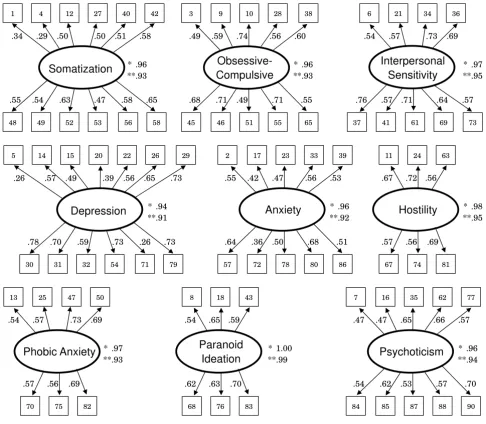
The results of confirmative factor analysis are shown in Figure 1. The analysis was done for each of the nine fac-tors. All values of the goodness of fit index (GFI) and adjusted GFI for the nine primary symptoms were over .90. Except for two items on SOM and two items on DEP, the correlation coefficients between each factor and item were over .35.
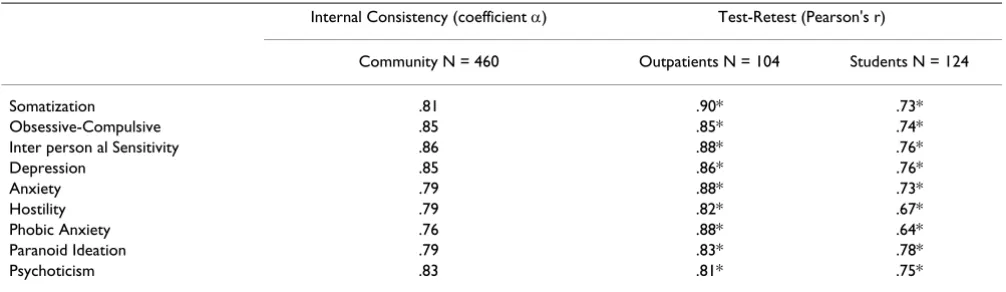
Cronbach's alpha coefficients were .76 (PHOB) to .86 (INT)(Table 1).
Test/retest reliability (Study 2)
Correlations between test and retest were calculated for outpatients and students (Table 2). Pearson's correlation coefficients were .81 (PSY) to .90 (SOM) for the outpa-tients and .64 (PHOB) to .78 (PAR) for the student group.
Convergent-discriminant validation (Study 3)
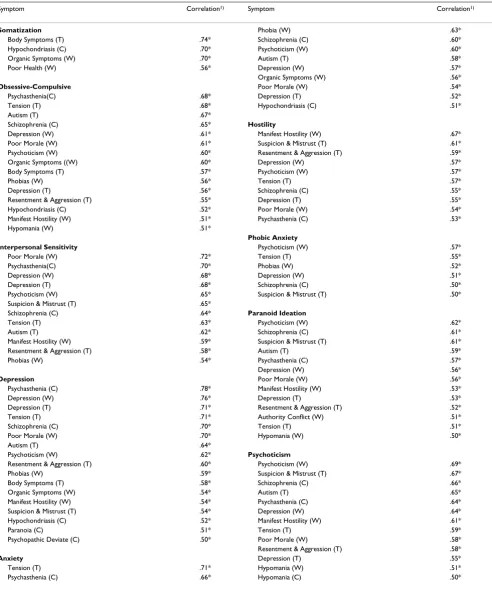
Pearson's product-moment correlation coefficients were calculated between the nine primary subscales of SCL-90-R(J) and the multidimensional subscale of MMPI (Table 2).
The SOM scale showed high correlations with Body Symp-toms (T) and Hypochondriasis (C). The SOM scale showed correlation coefficients lower than 0.20 (p > .05) with Masculinity-Femininity (C), Social Introversion (C), Social Maladjustment (W), Feminine Interest (W) and Religious Fundamentalism (W).
The O-C scale showed high correlations with Pshchasthe-nia (C), Tension (T), and Autism (T). The O-C scale showed correlation coefficients lower than 0.20 (p > .05) with Hysteria (C), Masculinity-Femininity (C) and Femi-nine Interest (W).
The INT scale showed high correlations with Poor Morale (W), Psychasthenia (C), and Depression (W, T). The INT scale showed correlation coefficients lower than 0.20 (p > .05) with Hysteria (C), Masculinity-Femininity (C), Fem-inine Interest (W) and Religious Fundamentalism (W).
The DEP scale showed high correlations with Psychasthe-nia (C), Depression (W, T), and Tension (T). The DEP scale showed correlation coefficients lower than 0.20 (p > .05) with Hysteria (C), Masculinity-Femininity (C), Social Maladjustment, Feminine Interest (W) and Religious Fun-damentalism (W).
The ANX scale showed high correlations with Tension (T), Psychasthenia (C), and Phobia (W). The ANX scale showed correlation coefficients lower than 0.20 (p > .05) with Masculinity-Femininity (C), Feminine Interest (W) and Religious Fundamentalism (W).
The HOS scale showed high correlations with Manifest Hostility (W), Suspicion and Mistrust (T), and Resent-ment and Aggression (T). The HOS scale showed correla-tion coefficients lower than 0.20 (p > .05) with Hysteria (C), Masculinity-Femininity (C), Feminine Interest (W) and Religious Fundamentalism (W).
The PHOB scale showed high correlations with Psychoti-cism (W), Tension (T), and Phobias (W). The PHOB scale showed correlation coefficients lower than 0.20 (p > .05) with Hysteria (C), Masculinity-Femininity (C), Social Introversion (C, T), Social Maladjustment (W), Feminine Interest (W), Religious Fundamentalism (W) and Family Problems (W).
(T). The PAR scale showed correlation coefficients lower than 0.20 (p > .05) with Depression (C), Hysteria (C), Masculinity-Femininity (C) and Feminine Interest (W).
The PSY scale showed high correlations with Psychoticism (W), Suspicion and Mistrust (T), and Schizophrenia (C). The PSY scale showed correlation coefficients lower than 0.20 (p > .05) with Depression (C), Hysteria (C), Mascu-linity-Femininity (C), Social Maladjustment (W), Femi-nine Interest (W) and Religious Fundamentalism (W).
Gender differences
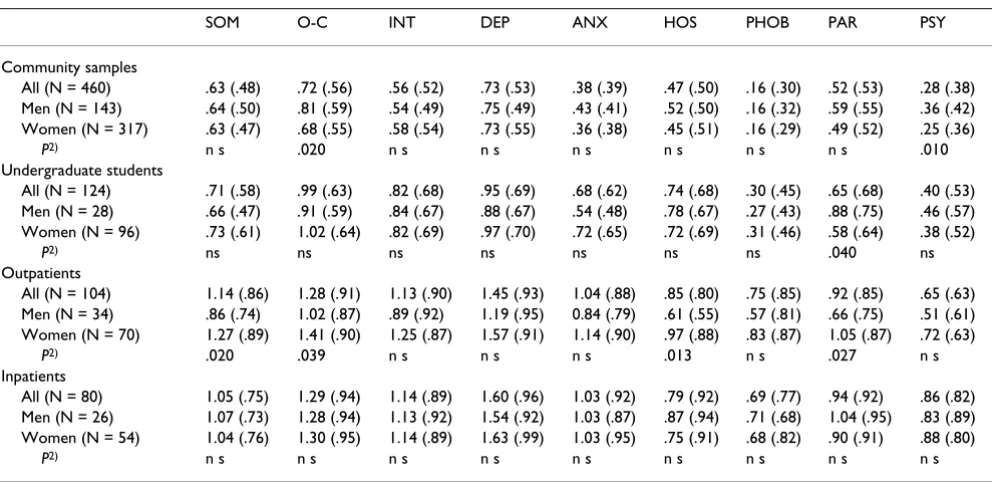
The scores of the nine subscales for all subjects of this study are displayed in Table 3. Gender differences are also examined in this table. In the community sample, gender differences were found in O-C (t(458) = 2.32, p = .020) and PSY (t(241) = 2.58, p = .010). In the student sample, gender difference was found in PAR (t(122) = 2.08, p = .040). For outpatients, gender differences were found in SOM (t(102) = 2.35, p = .020), O-C (t(102) = 2.09, p = .039), HOS (t(95.6) = 2.53, p = .013) and PAR (t(102) = 2.24, p = .027). For inpatients, no gender difference was found among the nine subscales.
Confirmative factor analysis of the nine primary symptom constructs of SCL-90-R(J)1) Figure 1
Confirmative factor analysis of the nine primary symptom constructs of SCL-90-R(J). Numbers in boxes accord with the item number of SCL-90-R(J), please see references [1] and [3]. *Goodness of Fit Index(GFI), **Adjusted GFI(AGFI).
Somatization
48 49 52 53 56
* .96 **.93
.55 .54 .63 .47 .58 .65
58 1 4 12 27
.34 .29 .50 .50 .51 .58
42
40 3 9 10
45 46 51 55
* .96 **.93
Obsessive-
Compulsive
.68 .71 .49 .71 .55
.49 .59 .74 .56 .60
65 38
28 6 21 34
.69 .73 .54 .57
Interpersonal
Sensitivity
.76
73 69 61 41 37
.57 .64 .71
.57
36
* .97 **.95
5 14 15 20 22
30 31 32 54 71
Depression
.78 .70 .59 .73 .26 .73
.26
* .94 **.91
.57 .49 .39 .56 .65 .73
79
26 2 17 23 33
57 72 78 80
* .96 **.92
Anxiety
.64 .36 .50 .68 .51
.55 .42 .47 .56 .53
86
39 11 24
67 74
Hostility
.56 .72 .67
.56 .69 .57
81 63 29
* .98 **.95
70 75
* .97 **.93
13 25 47
.54 .57 .73 .69
50
Phobic Anxiety
.69 .57 .56
82
8 18
68 76
Paranoid
Ideation
.59 .65 .54
.63 .70 .62
83
43 7 16 35 62
84 85 87 88
* .96 **.94
Psychoticism
.54 .53.62 .57 .70
.47 .47 .65 .66 .57
90 77
Discussion
The validity and reliability of SCL-90-R(J)
We examined the validity and reliability of SCL-90-R(J) for use as a psychometric scale.
SCL-90-R(J) was consistent with the nine primary scales of the original version (Study 1). The data showed that each subscale consisted of items similar enough to the English version that each scale had sufficient internal consistency, indicating its reliability for psychometric testing.
Test-retest reliability was sufficient for the outpatient group. The student group indicated moderate but lower reliability coefficients than the outpatient group (Study 2). The students may have responded according to their mood at the time they filled out the questionnaire rather than to their symptoms, while the patients responded to their symptoms. Because the retest was done by the stu-dents at a shorter interval than the patients, the results for the students were of higher reliability than those of the patients. The results were the reverse to our expectations, suggesting that this scale will show a superior perform-ance when used for patients than for healthy persons such as students.
Convergent-discriminant validation demonstrates that measures of interest show strong correlations with inde-pendent measures of the same construct and show weak or no correlation with measures of dissimilar constructs. The primary nine subscales of SCL-90-R(J) were strongly correlated with the MMPI subscales of the same or similar construct (Study 3). In addition, dissimilar subscales of MMPI had lower correlation with the SCL-90-R(J) sub-scales. These results also suggest that the SCL-90-R(J) has convergent and discriminant validity and that the scale is able to assess the constructs that it is intended to measure.
Because we translated the English checklist into Japanese, it was possible that an individual item had a weak
rela-tionship with the subscale in the original version. First, we examined whether or not the nine primary scales of the Japanese version consisted of items the same as the origi-nal version (study 1). Confirmative factor aorigi-nalysis showed that almost all items highly correlated with each factor (symptoms) contained in the items in the original version. The data showed that our nine subscales of the Japanese version consisted of the same items as in the English original version. Confirmative factor analysis also demonstrated that each factor had high validation.
Research that would benefit from the use of SCL-90-R(J) includes comparative cross-cultural studies. Several stud-ies have been published that have compared the psycho-pathology between countries using the SCL-90-R [15,16]. These studies need to be consistent in their use of the same scale from the same items. Our version has this nec-essary condition with good validation.
Convergent-discriminant validation was demonstrated by contrasting the subscale scores of SCL-90-R(J) with scores from the MMPI. As summarized in Table 2, nine subscales were consistent with the corresponding scales from MMPI. The tendency of the correlation coefficients was similar to the data of Derogatis et al. [17]. In their article, they reported that O-C was not well correlated with MMPI constructs because there was no directly comparable scale on the MMPI. Although this was not changed essentially in our design, the O-C subscale had a moderate relation-ship with the subscale from MMPI, which would explain the clinical symptoms of obsessive-compulsive disorder in our results.
SCL-90-R is a good tool for researching individual psycho-logical distress. Because this psychopsycho-logical scale can eval-uate multidimensional psychopathological aspects simultaneously, it is effective as a screening test for medi-cal examination and treatment. It is also effective for an effect judgment of drug efficacy, such as SSRI against
anx-Table 1: Internal consistency and test-retest reliability coefficients of SCL-90-R(J)
Internal Consistency (coefficient ) Test-Retest (Pearson's r)
Community N = 460 Outpatients N = 104 Students N = 124
Somatization .81 .90* .73*
Obsessive-Compulsive .85 .85* .74*
Inter person al Sensitivity .86 .88* .76*
Depression .85 .86* .76*
Anxiety .79 .88* .73*
Hostility .79 .82* .67*
Phobic Anxiety .76 .88* .64*
Paranoid Ideation .79 .83* .78*
Psychoticism .83 .81* .75*
Table 2: Correlations between SCL-90-R(J) primary symptom dimensions and MMPI Clinical(C), Wiggin s(W), and Tryon-Stein-Chu (T) scales
Symptom Correlation1) Symptom Correlation1)
Somatization Phobia (W) .63*
Body Symptoms (T) .74* Schizophrenia (C) .60*
Hypochondriasis (C) .70* Psychoticism (W) .60*
Organic Symptoms (W) .70* Autism (T) .58*
Poor Health (W) .56* Depression (W) .57*
Organic Symptoms (W) .56*
Obsessive-Compulsive Poor Morale (W) .54*
Psychasthenia(C) .68* Depression (T) .52*
Tension (T) .68* Hypochondriasis (C) .51*
Autism (T) .67*
Schizophrenia (C) .65* Hostility
Depression (W) .61* Manifest Hostility (W) .67*
Poor Morale (W) .61* Suspicion & Mistrust (T) .61*
Psychoticism (W) .60* Resentment & Aggression (T) .59*
Organic Symptoms ((W) .60* Depression (W) .57*
Body Symptoms (T) .57* Psychoticism (W) .57*
Phobias (W) .56* Tension (T) .57*
Depression (T) .56* Schizophrenia (C) .55*
Resentment & Aggression (T) .55* Depression (T) .55*
Hypochondriasis (C) .52* Poor Morale (W) .54*
Manifest Hostility (W) .51* Psychasthenia (C) .53*
Hypomania (W) .51*
Phobic Anxiety
Interpersonal Sensitivity Psychoticism (W) .57*
Poor Morale (W) .72* Tension (T) .55*
Psychasthenia(C) .70* Phobias (W) .52*
Depression (W) .68* Depression (W) .51*
Depression (T) .68* Schizophrenia (C) .50*
Psychoticism (W) .65* Suspicion & Mistrust (T) .50*
Suspicion & Mistrust (T) .65*
Schizophrenia (C) .64* Paranoid Ideation
Tension (T) .63* Psychoticism (W) .62*
Autism (T) .62* Schizophrenia (C) .61*
Manifest Hostility (W) .59* Suspicion & Mistrust (T) .61*
Resentment & Aggression (T) .58* Autism (T) .59*
Phobias (W) .54* Psychasthenia (C) .57*
Depression (W) .56*
Depression Poor Morale (W) .56*
Psychasthenia (C) .78* Manifest Hostility (W) .53*
Depression (W) .76* Depression (T) .53*
Depression (T) .71* Resentment & Aggression (T) .52*
Tension (T) .71* Authority Conflict (W) .51*
Schizophrenia (C) .70* Tension (T) .51*
Poor Morale (W) .70* Hypomania (W) .50*
Autism (T) .64*
Psychoticism (W) .62* Psychoticism
Resentment & Aggression (T) .60* Psychoticism (W) .69*
Phobias (W) .59* Suspicion & Mistrust (T) .67*
Body Symptoms (T) .58* Schizophrenia (C) .66*
Organic Symptoms (W) .54* Autism (T) .65*
Manifest Hostility (W) .54* Psychasthenia (C) .64*
Suspicion & Mistrust (T) .54* Depression (W) .64*
Hypochondriasis (C) .52* Manifest Hostility (W) .61*
Paranoia (C) .51* Tension (T) .59*
Psychopathic Deviate (C) .50* Poor Morale (W) .58*
Resentment & Aggression (T) .58*
Anxiety Depression (T) .55*
Tension (T) .71* Hypomania (W) .51*
Psychasthenia (C) .66* Hypomania (C) .50*
iety symptoms [10,11] as well as a depressive mood [18,19]. For example, co-morbidity of major depression and panic disorder has often been reported [7,8], which indicates that SCL-90-R(J) is suitable for the evaluation of patients having such plural diseases. This scale would also be useful for researching the correlation between physical diseases and psychological dysfunction. Mikocka-Walus et al. [20] used this scale to examine the relationship between mental distress and relapse in patients with dis-eases of the digestive tract.
Gender differences
Gender differences in SCL-90-R have been reported [21-24]. Previous articles reported that there was a tendency toward higher scores for females than males on the nine subscales. Most of the gender differences on the nine sub-scales were statistically significant. The trend was particu-larly notable for the outpatient sample of this study. But, the gender differences in this study were small when com-pared with previous studies. There were no significant dif-ferences in any of the subscales in the inpatient sample. Though this may be characteristic of Japan, further research to examine a larger sample and data from many institutions will be necessary.
Limitations of this study
This study has several limitations. We did not gather the data of psychiatric patients in this study. Data collection
for a group of psychiatric patients will be necessary in future study. When a cut-off point is set, utility is high for clinical application.
Also, our data was collected in only one area of Japan. This might include the possibility of local bias. Future research will include comparative studies of the data from several Japanese areas.
Conclusion
We examined the validity and reliability of SCL-90-R(J). Almost of all of the correlation coefficients between the nine primary subscales and items were over .35. Cron-bach's alpha coefficients were from .76 (Phobic Anxiety) to .86 (Interpersonal Sensitivity). Pearson's correlation coefficients between test-retest scores were from .81 (Psy-choticism) to .90 (Somatization) for the outpatients and were from .64 (Phobic Anxiety) to .78 (Paranoid Idea-tion) for the students. Each of the nine primary subscales correlated well with their corresponding constructs in the MMPI. We confirmed the validity and reliability of SCL-90-R(J) for the measurement of individual distress. Because the nine primary subscales were consistent with the items of the original English version, this SCL-90-R(J) will be useful for comparative cross-culture study. Also, this psychological scale can evaluate multidimensional psychopathological aspects simultaneously, which makes it useful as a screening test for medical examination and
Table 3: The basic data and gender differences of the nine primary scales for community, student, out patient, and inpatient samples1)
SOM O-C INT DEP ANX HOS PHOB PAR PSY
Community samples
All (N = 460) .63 (.48) .72 (.56) .56 (.52) .73 (.53) .38 (.39) .47 (.50) .16 (.30) .52 (.53) .28 (.38)
Men (N = 143) .64 (.50) .81 (.59) .54 (.49) .75 (.49) .43 (.41) .52 (.50) .16 (.32) .59 (.55) .36 (.42)
Women (N = 317) .63 (.47) .68 (.55) .58 (.54) .73 (.55) .36 (.38) .45 (.51) .16 (.29) .49 (.52) .25 (.36)
P2) n s .020 n s n s n s n s n s n s .010
Undergraduate students
All (N = 124) .71 (.58) .99 (.63) .82 (.68) .95 (.69) .68 (.62) .74 (.68) .30 (.45) .65 (.68) .40 (.53)
Men (N = 28) .66 (.47) .91 (.59) .84 (.67) .88 (.67) .54 (.48) .78 (.67) .27 (.43) .88 (.75) .46 (.57)
Women (N = 96) .73 (.61) 1.02 (.64) .82 (.69) .97 (.70) .72 (.65) .72 (.69) .31 (.46) .58 (.64) .38 (.52)
P2) ns ns ns ns ns ns ns .040 ns
Outpatients
All (N = 104) 1.14 (.86) 1.28 (.91) 1.13 (.90) 1.45 (.93) 1.04 (.88) .85 (.80) .75 (.85) .92 (.85) .65 (.63)
Men (N = 34) .86 (.74) 1.02 (.87) .89 (.92) 1.19 (.95) 0.84 (.79) .61 (.55) .57 (.81) .66 (.75) .51 (.61)
Women (N = 70) 1.27 (.89) 1.41 (.90) 1.25 (.87) 1.57 (.91) 1.14 (.90) .97 (.88) .83 (.87) 1.05 (.87) .72 (.63)
P2) .020 .039 n s n s n s .013 n s .027 n s
Inpatients
All (N = 80) 1.05 (.75) 1.29 (.94) 1.14 (.89) 1.60 (.96) 1.03 (.92) .79 (.92) .69 (.77) .94 (.92) .86 (.82)
Men (N = 26) 1.07 (.73) 1.28 (.94) 1.13 (.92) 1.54 (.92) 1.03 (.87) .87 (.94) .71 (.68) 1.04 (.95) .83 (.89)
Women (N = 54) 1.04 (.76) 1.30 (.95) 1.14 (.89) 1.63 (.99) 1.03 (.95) .75 (.91) .68 (.82) .90 (.91) .88 (.80)
P2) n s n s n s n s n s n s n s n s n s
SOM:Somatization, O-C: Obsessive-Compulsive, INT: Interpersonal Sensitivity, DEP: Depression, ANX: Anxiety, HOS: Hostility, PHOB: Phobic Anxiety, PAR: Paranoid Ideation, PSY: Psychoticism.
1) Means (SD)
Publish with BioMed Central and every scientist can read your work free of charge "BioMed Central will be the most significant development for disseminating the results of biomedical researc h in our lifetime."
Sir Paul Nurse, Cancer Research UK
Your research papers will be:
available free of charge to the entire biomedical community
peer reviewed and published immediately upon acceptance
cited in PubMed and archived on PubMed Central
yours — you keep the copyright
Submit your manuscript here:
http://www.biomedcentral.com/info/publishing_adv.asp
BioMedcentral treatment. For example, it will be useful for judging drug
efficacy, such as SSRI for anxiety and depression.
Competing interests
This study was supported by a grant from Smoking Research Foundation.
Authors' contributions
MT conceptualized and designed the study, collected the data, performed analysis and interpreted the data, and drafted the manuscript. MS designed the study and trans-lated the SCL-90-R to Japanese. MH collected the data. CK supervised the design of the study and the writing of the manuscript. All authors read and approved the final man-uscript.
Acknowledgements
We gratefully thank the doctors of department of psychosomatic medicine, Kyusyu University Hospital for introduced their patients to us.
References
1. Derogatis LR: SCL-90-R: Administration, Scoring, and Procedures Manual
Third edition. Minneapolis: National Computer Systems, Inc; 1994. 2. Derogatis LR, Cleary PA: Factorial invariance across gender for
the primary symptom dimension of the SCL-90. Br J Soc Clin Psychol 1977, 16:347-356.
3. Derogatis LR, Cleary PA: Confirmation of the dimensional structure of the SCL-90; A study in construct validation. J Clin Psychol 1977, 33:981-989.
4. American Psychiatric Association: Diagnostic and Statistical Manual of Mental Disorders. Washington D.C 4th edition. 1994.
5. World Health Organization: International Statistical Classification of Dis-eases and Related Health Problems, 10th Revision. Geneva 1992. 6. Juang KD, Wang SJ, Fuh JL, Lu SR, Su TP: Comorbidity of
depres-sive and anxiety disorders in chronic daily headache and its subtype. Headache 2000, 40:818-823.
7. Johnson MR, Lydiard RB: 1998 Comorbidity of major depression and panic disorder. J Clin Psychol 1998, 54:201-210.
8. Biederman J, Petty C, Faraone SV, Hirshfeld-Becker D, Pollack MH, Henin A, Gilbert J, Rosenbaum JF: Moderating effects of major depression on patterns of comorbidity in patients with panic disorder. Psychiatry Res 2004, 126:143-149.
9. Riddle MA, Reeve EA, Yaryura-Tobias JA, Yang HM, Claghorn JL, Gaff-ney G, Greist JH, Holland D, McConville BJ, Pigott T, Walkup JT: Flu-voxamine for children and adolescents with obsessive-compulsive disorder: a randomized, controlled, multicenter trial. J Am Acad Child Adolesc Psychiatry 2001, 40:222-229.
10. Black DW, Wesner R, Bowers W, Gabel J: A comparison of flu-voxamine, cognitive therapy, and placebo in the treatment of panic disorder. Arch Gen Psychiatry 1993, 50:44-50.
11. Stein MB, Chartier MJ, Hazen AL, Kroft CD, Chale RA, Cote D, Walker JR: Paroxetine in the treatment of generalized social phobia: open-label treatment and double-blind placebo-con-trolled discontinuation. J Clin Psychopharmacol 1996, 16:218-222. 12. Friedman AF, Webb JT, Lewak R: Psychological assessment with the MMPI. New Jersey: Lawrence Erlbaum Associates, Inc; 1989. 13. Wiggins JS: Substantive dimension of self-report in the MMPI
item pool. Volume 80. Psychological Monographs: General and Applied; 1966:1-42. Whole No.630
14. Tryon RC: Unrestricted cluster and factor analysis with appli-cation to the MMPI and Holzinger-Harman problems. Multi-variate Behav Res 1966, 1:229-244.
15. Barker-Collo SL: Culture and validity of the Symptom Check-list-90-Revised and Profile of Mood State in a New Zealand student sample. Cultural Diversity and Ethnic Minority Psychology
2003, 9:185-196.
16. Hendriks VM, Steer RA, Platt JJ, Metzger DS: Psychopathology in Dutch and American heroin addicts. Int J addict 1990,
25:1051-1063.
17. Derogatis LR, Rickels K, Rock A: The SCL-90 and the MMPI: A step in the validation of a new self report scale. Brit J Psychiat
1976, 128:280-289.
18. Conti L, Dell'Osso L, Re F, Musetti L, Cassano GB: Fluvoxamine maleate: double-blind clinical trial vs. placebo in hospitalized depressed patients. Curr Ther Res 1988, 43:468-480.
19. Porro V, Fiorenzoni S, Menga C, De Cristofaro A, Bertolino A: Sin-gle-blind comparison of the efficacy of fluvoxamine versus placebo in patients with depressive syndrome. Curr Ther Res
1988, 43:621-629.
20. Mikocka-Walus AA, Turnbull DA, Moulding NT, Wilson IG, Holt-mann GJ, Andrews JM: Does psychological status influence clin-ical outcomes in patients with inflammatory bowel disease (IBD) and other chronic gastroenterological diseases: An observational cohort prospective study. Biopsychosoc Med
2008, 2:11.
21. Bonicatto S, Dew MA, Soria JJ, Seghezzo : Validity and reliability of symptom checklist '90 (SCL90) in an Argentine popula-tion sample. Soc Psychiatry Psychiatr Epidemiol 1997, 32:332-338. 22. Schmitz N, Hartkamp N, Kiuse J, Franke GH, Reister G, Tress W:
The symptom check-list-90-R (SCL-90-R): A German valida-tion study. Qual Life Res 2000, 9:185-193.
23. Binder J, Dobler-Mikola A, Angst J: An epidemiological study of minor psychiatric disturbances. A field study among 20-year-old females and males in Zurich. Soc Psychiatry 1981, 16:31-41. 24. Buddeberg-Fischer B, Bernet R, Schmid J, Buddeberg C:
Relation-ship between Disturbed eating behavior and other psychoso-matic symptoms in adolescents. Psychother Psychosom 1996,