ISSN Online: 2333-9721 ISSN Print: 2333-9705
DOI: 10.4236/oalib.1105604 Sep. 17, 2019 1 Open Access Library Journal
On Standard Concepts Using ii-Open Sets
Beyda S. Abdullah, Amir A. Mohammed
Department of Mathematics, College of Education for pure Sciences, University of Mosul, Mosul, Iraq
Abstract
Following Caldas in [1] we introduce and study topological properties of
ii-derived, ii-border, ii-frontier, and ii-exterior of a set using the concept of
ii-open sets. Moreover, we prove some further properties of the well-known notions of ii-closure and ii-interior. We also study a new decomposition of
ii-continuous functions. Finally, we introduce and study some of the separa-tion axioms specifically T0ii, T1ii.
Subject Areas
Mathematical Analysis
Keywords
α-Open Set, ii-Open Set, Separation Axioms
1. Introduction
The notion of α-open set was introduced by Njastad in [2]. Caldas in [1] intro-duced and studied topological properties of α-derived, α-border, α-frontier,
α-exterior of a set by using the concept of α-open sets. In this paper, we intro-duce and study the same above concepts by using ii-open sets. A subset A of X is called ii-open set [3] if there exists an open set G in the topology τ of X, such that: G≠φ,X , A CL A G⊆
(
)
and Int A( )
=G , the complement of anii-open set is an ii-closed set. We denote the family of ii-open sets in
(
X,τ
)
byii
τ
. It is shown in [4] that each ofτ τ
⊂ ii andτ
ii is a topology on X. Thisproperty allows us to prove similar properties of α-open set. Also, we define
ii-continuous functions and we study the relation between this type of function and continuous, semi-continuous, α-continuous and i-continuous functions. Finally, we introduce a new type of separation axioms namely T0ii, T1ii. We
prove similar properties and characterizations of T0 and T1.
How to cite this paper: Abdullah, B.S. and Mohammed, A.A. (2019) On Standard Concepts Using ii-Open Sets. Open Access Library Journal, 6: e5604.
https://doi.org/10.4236/oalib.1105604
Received: July 15, 2019 Accepted: September 14, 2019 Published: September 17, 2019
Copyright © 2019 by author(s) and Open Access Library Inc.
This work is licensed under the Creative Commons Attribution International License (CC BY 4.0).
http://creativecommons.org/licenses/by/4.0/
DOI: 10.4236/oalib.1105604 2 Open Access Library Journal
2. Preliminaries
Throughout this paper,
(
X,τ)
and(
Y,σ)
(simply X and Y) always mean to-pological spaces. For a subset A of a space X, Cl (A) and Int (A) denote the clo-sure of A and the interior of A respectively. We recall the following definitions, which are useful in the sequel.Definition 2.1. A subset A of a space X is called 1) Semi-open set [5] if A CL Int A⊆
(
( )
)
. 2) α-open set [2] if A Int CL Int A⊆(
(
( )
)
)
.3) i-open set [3] if there exist an open set G in the topology τ of X, such that i)
G
≠
φ
,
X
ii) A CL A G⊆
(
)
The complement of an i-open set is an i-closed set.
4) ii-open set [4] if there exist an open set G in the topology τ of X, such that
i)
G
≠
φ
,
X
ii) A CL A G⊆(
)
iii) Int A( )
=GThe complement of an ii-open set is an ii-closed set.
5) int-open set [4] if there exist an open set G in the topology τ of X and
,
G
≠
φ
X
such that Int A( )
=G. The complement of int-open set is int-closed set.6) αo (X), So (X), io (X), iio (X), into (X) are family of α-open, semi-open,
i-open, ii-open, int-open sets respectively.
7)
τ
i,τ
ii denote the family of all i-open sets and ii-open sets respectively.Definition 2.2. [3] A topological space X is called
1) T0i if a, b are to distinct points in X, there exist an i-open set U such that
either a U∈ and b U∉ , or b U∈ and a U∉ .
2) T1i if
a b X
,
∈
and a b≠ , there exist i-open sets U, V containing a, brespectively, such that b U∉ and a V∉ .
Definition 2.3. A function f X:
(
,τ
) (
→ Y,σ
)
is called1) Continuous [6], if f−1
( )
G is open in(
X,τ
)
for every open set G of(
Y,σ
)
.2) α-continuous [6], if f−1
( )
G is α-open in(
X,τ
)
for every open set G of(
Y,σ)
.3) Semi-Continuous [5], if f−1
( )
G is semi-open in(
X,τ
)
for every open set G of(
Y,σ
)
.4) i-Continuous [3], if f−1
( )
G is i-open in(
X,τ
)
for every open set G of(
Y,σ
)
.3. Applications of
ii
-Open Sets
Definition 3.1. Let A be a subset of a topological space
(
X,τ
)
. A derived set of A denoted by D(A) is defined as follows:( )
{
:(
) { }
\ ,}
DOI: 10.4236/oalib.1105604 3 Open Access Library Journal point of A if it satisfies the following assertion:
(
∀G∈τii)
(
x G∈ ⇒(
G A) { }
\ x ≠φ)
. The set of all ii-limit points of A is called the ii-derived set of A and is denoted by D Aii( )
. Note that x X∈ is notii-limit point of A if and only if there exist an ii-open set G in X such that (x G∈ and
(
G A) { }
\ x =φ
).Theorem 3.2. For subsets A, B of a space X, the following statements hold: 1) D Aii
( )
⊂D A( )
2) If A B⊆ , then Dii
( )
A ⊆Dii( )
B3) Dii
( )
A Dii( )
B ⊂Dii(
AB)
and Dii(
A B)
⊂Dii( )
A Dii( )
B4) Dii
(
Dii( )
A)
\A⊂Dii( )
A5) Dii
(
ADii( )
A)
⊂ADii( )
AProof. 1) Since every open set is ii-open [4], it follows that D Aii
( )
⊂D A( )
.2) Let x∈Dii
( )
A . Then G is ii-open set containing x such that(
A G) { }
\ x ≠φ
(3.1) Since A B⊆ we get(
A G) (
⊆ B G)
, it implies that(
A G) { } (
\ X ⊆ B G) { }
\ X ≠φ
, from (3.1) we get(
B G) { }
\ X ≠φ
. Hence, x∈Dii( )
B . Therefore Dii( )
A ⊆Dii( )
B .3) Since
A A B
⊆
andB A B
⊆
, from (2) we get Dii( )
A ⊆Dii(
A B)
,( )
(
)
ii ii
D B ⊆D A B .
This implies to Dii
( )
A Dii( )
B ⊂Dii(
AB)
.We shall prove that Dii
(
A B)
⊂Dii( )
A Dii( )
B . SinceA B A
⊆
,A B B
⊆
, from (2) we get Dii(
A B)
⊂Dii( )
A and Dii(
A B)
⊂Dii( )
B .ThereforeDii
(
A B)
⊂Dii( )
A Dii( )
B .4) If x∈D Dii
(
ii( )
A)
\A and G is an ii-open set containing x, then( ) { }
(
ii \)
G D A X ≠φ . Let y∈G
(
Dii( ) { }
A \ x)
. Then, since y∈Dii( )
Aand
y G
∈
, G(
A Y\{ }
)
≠φ. Let z G∈ (
A Y\{ }
)
. Then, z x≠ for z A∈ and x A∉ . Hence, G(
A X\{ }
)
≠φ. Therefore, x∈Dii( )
A .5) Let x∈Dii
(
ADii( )
A)
. If x A∈ , the result is obvious. So, let,( )
(
)
\ii ii
x∈D AD A A then for ii-open set G containing x,
( ) { }
(
)
(
G ADii A \ x)
≠φ. Thus, G(
A X\{ }
)
≠φ or( ) { }
(
ii \)
G D A x ≠φ.Now, it follows similarly from (4) that G
(
A X\{ }
)
≠φ. Hence, x∈Dii( )
A . Therefore, in any case, Dii(
ADii( )
A)
⊂ADii( )
A .In general, the converse of (1) may not true and the equality does not hold in (3) of theorem 3.2.
Example 3.3. Let X =
{
a b c, ,}
and τ={
φ, ,X b{ }
}
. Thus,( )
{
, ,{ } { } { }
, , , ,}
iio x = φ X b a b b c . Take the following:
1) A=
{ }
c . Then, D A( ) { }
= a b, and D Aii( )
=φ
. Hence, D A( )
⊄Dii( )
A ;2) C=
{ }
a b, and E={ }
c . Then D cii( ) { }
= a c, and D Eii( )
=φ
. Hence(
)
( )
( )
ii C E ii C ii
D ≠D D E .
Theorem 3.4. For any subset A of a space X, CLii
( )
A =ADii( )
A .Proof. Since Dii
( )
A ⊂CLii( )
A , ADii( )
A ⊂CL Aii( )
. On the other hand,DOI: 10.4236/oalib.1105604 4 Open Access Library Journal
G containing x intersects A at a point distinct from x; so x∈Dii
( )
A . Thus,( )
( )
ii A A ii
CL ⊂ D A , which completes the proof.
Definition 3.5. A point x X∈ is said to be ii-interior point of A if there ex-ist an ii-open set G containing x such that G⊂A. The set of all ii-interior points of A is said to be ii-interior of A and denoted by Int Aii
( )
.Theorem 3.6. For subset A, B of a space X, the following statements are true: 1) Int Aii
( )
is the union of all ii-open subset of A2) A is ii-open if and only if A=Intii
( )
A3) Int Intii
(
ii( )
A)
=Int Aii( )
4) I tnii
( )
A A \= D X Aii(
\)
5) X \Intii
( )
A =CL Xii(
\A)
6) X \CLii
( )
A =Intii(
X A\)
7) If A B⊆ , then Intii
( )
A ⊆Intii( )
B 8) Intii( )
A Intii( )
B ⊆Intii(
AB)
9) Intii
( )
A Intii( )
B ⊇Intii(
AB)
Proof. 1) Let
{
G iiii\ ∈ ∧}
be a collection of all ii-open subsets of A. If( )
ii
x∈Int A , then there exist
j
∈ ∧
such that x∈Gj⊆A . Henceii ii G
x∈
∈∧ , and so Intii( )
A ⊆
ii∈∧Gii. On the other hand, if y∈
ii∈∧Gii,then y∈Gk ⊆A for somek∈ ∧. Thus y∈Intii
( )
A , and
ii∈∧Gii ⊆Int Aii( )
.Accordingly,
ii∈∧Gii ⊆Int Aii( )
.2) Straightforward.
3) It follows from (1) and (2).
4) If x∈A D\ ii
(
X A\)
, then x∉D Xii(
\A)
and so there exist an ii-open setG containing x such that G
(
X A\)
=φ
. Thus, x G∈ ⊂A and hence( )
ii
x∈Int A . This shows that A\Dii
(
X A\)
⊂Int Aii( )
. Now let x∈Intii( )
A .Since
( )
iiii A
Int ∈τ and Intii
( ) (
A X \A)
=φ
. We havex∉D Xii(
\A)
.There-fore, Intii
( )
A =A\Dii(
X \A)
.5) Using (4) and Theorem (3.4), we have
( )
(
(
)
)
(
)
(
)
(
)
\ ii \ \ ii \ \ ii \ ii \
X Int A =X A D X A = X A D X A =CL X A . 6) Using (4) and Theorem (3.4), we get.
(
\) (
\)
\( )
\(
( )
)
\( )
ii X A X A ii A X A ii A iiInt = D = D = X CL A
7) Since A B⊆ and Int Aii
( )
⊆A, Int Bii( )
⊆B, we get( )
( )
ii ii
Int A ⊆Int B .
8) Since A⊆
(
A B)
and B⊆(
A B)
, from (7) we get( )
(
)
ii ii
Int A ⊆Int A B , Intii
( )
B ⊆Intii(
A B)
. Therefore( )
( )
(
)
ii ii ii
Int A Int B ⊆Int AB .
9) Since
A B A
⊆
andA B B
⊆
, from (7) we get(
)
( )
ii A B ii
Int ⊆Int A , Intii
(
A B)
⊆Int Bii( )
. Therefore(
)
( ) ( )
ii A B ii A B
Int ⊆Int .
Definition 3.7. bii
( )
A =A nt\I ii( )
A is said to be the ii-border of A.Theorem 3.8. For a subset A of a space X, the following statements hold: 1) b Aii
( )
⊂b A( )
where b A( )
denotes the border of ADOI: 10.4236/oalib.1105604 5 Open Access Library Journal 3) Intii
( )
A bii( )
A =φ
4) b Aii
( )
=φ
if and only if A is ii-open set5) b Int Aii
(
ii( )
)
=φ6) Int b Aii
(
ii( )
)
=φ7) b bii
(
ii( )
A)
=bii( )
A8) bii
( )
A =ACLii(
X \A)
9) bii
( )
A = ADii(
X \A)
Proof.
1) Since Int
( )
A ⊂Intii( )
A , we have( )
\( )
\( ) ( )
ii A A ii A A In
b = Int ⊆ t A =b A . 2) and (3). Straightforward.
4) Since Int Aii
( )
⊆A, it follows from Theorem 3.6 (2). That A is ii-open ⇔( )
ii
A=Int A ⇔ bii
( )
A =A nt\I ii( )
A =φ
.5) Since Int Aii
( )
is ii-open, it follows from (4) that b Int Aii(
ii( )
)
=φ.6) If x I∈ ntii
(
bii( )
A)
, then x∈bii( )
A . On the other hand, sinceb Aii( )
⊂A,( )
(
)
( )
ii ii ii
x∈Int b A ⊂Int A . Hence, x∈Intii
( )
A bii( )
A . Which contradicts (3). Thus Int b Aii(
ii( )
)
=φ.7) Using (6), we get b bii
(
ii( )
A)
=bii( )
A \Int bii(
ii( )
A)
=bii( )
A .8) Using Theorem 3.6 (6), we have
( )
\( )
\(
\(
\)
)
(
\)
ii ii ii ii
b A = A Int A =A X CL X A =ACL X A 9) Applying (8) and the Theorem (3.4), we have
( )
(
\)
(
(
\)
(
\)
)
(
\)
ii A A ii X A A X A ii ii
b = CL = D X A =AD X A .
Example 3.9. Consider the topological space
(
X,τ
)
given in Example (3.3).If A=
{ }
a b, , then b Aii( )
=φ
and b A( ) { }
= a . Hence, b A( )
⊄bii( )
A , that is,in general, the converse Theorem 3.9 (1) may not be true.
Definition 3.10. Frii
( )
A =CLii( )
A \Intii( )
A is said to be the ii-frontier of A.Theorem 3.11. For a subset A of a space X, the following statements hold: 1) Frii
( )
A ⊂Fr A( )
where Fr A( )
denotes the frontier of A2) CLii
( )
A =Intii( )
A Fr Aii( )
3) Intii
( )
A Frii( )
A =φ
4) bii
( )
A ⊂Frii( )
A5) Frii
( )
A =bii( )
A Dii( )
A6) Frii
( )
A =D Aii( )
if and only if A is ii-open set7) Frii
( )
A =CLii( )
A CLii(
X A\)
8) Frii
( )
A =Frii(
X A\)
9) Fr Aii
( )
is ii-closed10) Fr Fii
(
rii( )
A)
⊂Frii( )
A11) Frii
(
Intii( )
A)
⊂Frii( )
A12) Fr Cii
(
Lii( )
A)
⊂Frii( )
A13) Intii
( )
A =A\Frii( )
AProof.
1) Since CLii
( )
A ⊆CL A( )
and Int( )
A ⊆Intii( )
A , it follows that( )
( )
\( )
( )
\( )
( )
\( )
( )
ii A ii A ii A CL A ii A
DOI: 10.4236/oalib.1105604 6 Open Access Library Journal 3) Intii
( )
A Frii( )
A =Intii( )
A (
CLii( )
A \Intii( )
A)
=φ.4) Since A⊆CLii
( )
A , we have( )
\( )
( )
\( )
( )
ii A ii ii ii ii
b =A Int A ⊆CL A Int A =Fr A .
5) Since Intii
( )
A Frii( )
A =Intii( )
A bii( )
A D Aii( )
,( )
( )
( )
ii A ii A ii
Fr =b D A .
6) Assume that A is ii-open. Then
( )
( )
( )
\( )
(
( )
\)
( )
\(
\)
ii ii ii ii ii ii iiFr A =b A D A Int A =φ D A A =D A A=b X A , by using (5), Theorem 3.6 (2), Theorem 3.8 (4) and Theorem 3.8 (9).
Conversely, suppose that Frii
( )
A =bii(
X A\)
. Then( )
\(
\)
(
( )
\( )
)
\(
\)
\(
\)
\( )
ii ii ii ii ii ii
Fr A b X A CL A Int A X A Int X A A Int A
φ= = = .
by using (4) and (5) of Theorem 3.6, and so A⊆Intii
( )
A . Since Int Aii( )
⊆Ain general, it follows that Int Aii
( )
= A so from Theorem 3.6 (2) that A isii-open set.
7) Frii
( )
A =CLii( )
A \Intii( )
A =CLii( )
A (
CLii(
X A\)
)
.8) It follows from (7).
9)
(
( )
)
(
( )
)
(
(
)
)
( )
(
)
(
(
)
)
( )
\
\ .
ii ii ii ii ii
ii ii ii ii ii
CL Fr CL CL CL C
A A X A
A X A
L CL CL CL Fr A
=
⊂ =
Hence, Fr Aii
( )
isii-closed.
10)
(
( )
)
( )
(
)
(
\( )
)
(
( )
)
( )
ii ii
ii ii ii ii ii ii ii
A
A X A
Fr Fr
CL Fr CL Fr CL Fr A Fr A
= ⊂ = .
11) Using Theorem 3.6 (3), we get
( )
(
)
(
( )
)
\(
( )
)
( )
\( )
( )
ii ii A ii ii A ii ii A ii ii ii
Fr Int =CL Int Int Int ⊆CL A Int A =Fr A .
12)
(
( )
( )
)
( )
(
( )
( )
)
\(
( )
)
( )
\(
( )
)
\ .
ii ii ii ii ii ii ii ii ii
ii ii ii
Fr CL CL CL Int CL CL Int CL CL In
A A A A A
A t A Fr A
= =
= =
13) A\Frii
( )
A =(
A\CLii( )
A)
\I tnii( )
A =Intii( )
A .The converses of (1) and (4) of Theorem 3.11 are not true in general, as shown by Example
Example 3.12. Consider the topological space
(
X,τ
)
given in Example 3.3. If A={ }
c , then Fr A( ) { } { }
= a c, ⊄ c =Frii( )
A , and if B={ }
a b, , then( ) { }
( )
ii B c ii
Fr = ⊄b B .
Definition 3.13. Extii
( )
A =Intii(
X A\)
is said to be an ii-exterior of A.Theorem 3.14. For a subset A of a space X, the following statements hold: 1) Ext
( )
A ⊂Extii( )
A where Ext A( )
denotes the exterior of A2) Ext Aii
( )
isii-open3) Extii
( )
A =Intii(
X A\)
=X\CL Aii( )
4) Ext Extii
(
ii( )
A)
=Int CL Aii(
ii( )
)
5) If A B⊆ , then Extii
( )
A ⊃Extii( )
B6) Extii
(
A B)
⊂Extii( )
A Extii( )
B7) Extii
(
A B)
⊃Extii( )
A Extii( )
B8) Ext Xii
( )
=φ
9) Extii
( )
φ
=XDOI: 10.4236/oalib.1105604 7 Open Access Library Journal 11) Intii
( )
A ⊂Ext Extii(
ii( )
A)
12) X =Extii
( )
A Extii( )
A Frii( )
AProof. 1) It follows from Theorem 3.6 (1). 2) It is straightforward by Theorem 3.6 (6).
3)
(
( )
)
(
( )
)
( )
(
)
(
( )
)
\ \ \
ii ii ii ii
ii ii ii ii
Ext Ext Ext CL
Int CL I
A X A
X X A nt CL A =
= = .
4) Assume that A B⊂ . Then
( )
(
\)
(
\)
( )
ii B ii X B ii X ii
Ext =Ext ⊆Ext A =Ext A , by using Theorem 3.6 (7).
5) Applying Theorem 3.6 (8), we get
(
)
(
(
)
)
(
(
) (
)
)
(
)
(
)
( )
( )
\ \ \
\ \ .
ii ii ii
ii ii ii ii
A B X A B X A X
Ext Int Int
Int Int Ext Ext
B
X A X B A B
= =
⊆ =
6) Applying Theorem 3.6 (9), we obtain
(
)
(
(
)
)
(
(
) (
)
)
(
)
(
)
( )
( )
\ \ \
\ \ .
ii ii ii
ii ii ii ii
A B X A B X A X
Ext Int Int
Int Int Ext Ext
B
X A X B A B
= = ⊃ = . 7) Straightforward. 8) Straightforward.
9)
(
( )
)
(
(
)
)
(
(
(
)
)
)
(
)
(
)
(
)
( )
\ \ \ \ \ \
\ \ .
ii ii ii ii ii ii
ii ii ii ii
Ext X Ext A Ext X Int X A Int X X I X A X A
nt Int Int Int X A Ext A
= =
= = =
10)
( )
(
( )
)
(
(
)
)
( )
(
)
(
( )
)
\ \
\ .
ii ii ii ii ii
ii ii ii ii
A A X X
Int Int CL Int Int Int Ext Ext Ext
A
X A A
⊂ =
= =
Example 3.15. Let X =
{
a b, , ,c d}
and τ={
φ,X c d,{ }
,}
. Thus,( )
{
, ,{ } {
, , , , , , ,} {
}
}
iio x = φ X c d b c d a c d . If A=
{ }
a and B={ }
b . Then( )
( )
ii A
Ext ⊄Ext A . Extii
(
A B)
≠Extii( )
A Extii( )
B and(
)
( )
( )
ii ii ii
Ext A B ≠Ext A Ext B .
4. A New Decomposition of
ii
-Continuity
We begin by the following definition:
Definition 4.1. A function f X:
(
,τ
) (
→ Y,σ
)
is called ii-continuous if( )
1f− G is ii-open set in
(
X,τ
)
for any open set G of(
Y,σ
)
. Theorem 4.2. Let f X:(
,τ
) (
→ Y,σ
)
be a function then:1) Every continuous function is an ii-continuous, 2) Every ii-continuous function is an i-continuous, 3) Every α-continuous function is an ii-continuous.
Proof. 1) Let G be open set in
(
Y,σ
)
. Since f is continuous, it follows that( )
1
f− G is open set in
(
X,τ
)
. But every open set is ii-open set [4]. Hence( )
1f− G is ii-open set in
(
X,τ
)
. Thus f is ii-continuous.2) Let G be open set in
(
Y,σ
)
. Since f is an ii-continuous, it follows that( )
1
f− G is an ii-open set in
(
X,τ
)
. But every ii-open set is i-open set [4]. Hence f−1( )
G is i-open set in(
X,τ
)
. Thus f is i-continuous.DOI: 10.4236/oalib.1105604 8 Open Access Library Journal
( )
1
f− G is α-open set in
(
X,τ
)
. But every α-open set is ii-open set [4]. Hence( )
1f− G is ii-open set in
(
X,τ
)
. Thus f is an ii-continuous. The converse need not be true by the following example. Example 4.3. Let{
a b, , ,}
X = c d , τ=
{
φ,X,{ } { } { }
a , b , ,ab}
and{
a b, , ,}
Y = c d , σ =
{
φ,Y,{ } { } { } { } {
a b a b a, , , , , , , ,d a b d}
}
and( )
{
, ,{ } { } { } { } {
, , , , , , , , , , ,} {
}
}
iio x = φ X a b a b a d a b c a db ,( )
{
{ } { } { } { } { } { } { }
{
} {
} {
} {
}
}
, , , , , , , , , , , , , , , , , , , , ,
,
, , , ,
io x a b a b a c a d b c b d a b c a b d a c d b
X
c d φ
=
( )
{
, ,{ } { } { } {
, , , , , ,} {
, , ,}
}
o x φ X a b a b a b c a b dα = .
Let f X:
(
,τ
) (
→ Y,σ
)
be the identity function then f−1( )
{ }
a ={ }
a ,{ }
( )
{ }
1
f− b = b , f−1
( )
{ }
c ={ }
c , f−1( )
{ }
d ={ }
d . Then f is ii-continuous, but fis not α-continuous, since for the open set
{ }
a d, in(
Y,σ
)
,{ }
(
)
{ }
1 a d, ,
f− = a d is not α-open in
(
X,τ
)
and f is not continuous, since for the open set{ }
a d, in(
Y,σ
)
, f−1(
{ }
a d,)
={ }
a d, is not open in(
X,τ
)
.Now when f X:
(
,τ
) (
→ Y,σ
)
be defined by f−1( )
{ }
a ={ }
b , f−1( )
{ }
b ={ }
a ,{ }
( )
{ }
1
f− c = c , f−1
( )
{ }
d ={ }
d we get f is i-continuous, but f is notii-continuous, since for the open set
{ }
a d, in(
Y,σ
)
, f−1(
{ }
a d,)
={ }
b d, isnot ii-open in
(
X,τ
)
.Theorem 4.4. Let f X:
(
,τ
) (
→ Y,σ
)
be a function then everysemi-continuous function is an ii-continuous.
Proof. Let G be open set in
(
Y,σ
)
. Since f is semi-continuous, it follows that( )
1f− G is semi-open set in
(
X,τ
)
. But every semi-open set is ii-open set [4]. Hence f−1( )
G is ii-open set in(
X,τ
)
. Thus f is an ii-continuous.Definition 4.5. A function f X:
(
,τ
) (
→ Y,σ
)
is called int-continuous if( )
1f− G is int-open set in
(
X,τ
)
for any open set G in(
Y,σ
)
. Theorem 4.6. Let f X:(
,τ
) (
→ Y,σ
)
be a function then:1) Every continuous function is int-continuous, 2) Every ii-continuous function is int-continuous, 3) Every α-continuous function is int-continuous.
Proof. 1) Let G be open set in
(
Y,σ
)
. Since f is continuous, it follows that( )
1
f− G is open set in
(
X,τ
)
. But every open set is int-open set [4]. Hence( )
1f− G is int-open set in
(
X,τ
)
. Thus f is int-continuous.2) Let G be open set in
(
Y,σ
)
. Since f is ii-continuous, it follows that( )
1
f− G is an ii-open set in
(
X,τ
)
. But every ii-open set is int-open set [4]. Hence f−1( )
G is int-open set in(
X,τ
)
. Thus f is int-continuous.3) Let G be open set in
(
Y,σ
)
. Since f is α-continuous, it follows that( )
1
f− G is α-open set in
(
X,τ
)
. But every α-open set is int-open set [4]. Hence( )
1DOI: 10.4236/oalib.1105604 9 Open Access Library Journal Example 4.7. Let X =
{
a b c, ,}
, τ={
φ, ,X{ } { }
a b c, ,}
and Y ={
a b c, ,}
,{ } { }
{
, ,Y a a c, ,}
σ = φ and into x
( )
={
φ,X,{ } { } { } { }
a a b b, , , ,c a c, ,}
,( )
( )
{
, ,{ } { }
, ,}
iio x =αo x = φ X a bc . Let f X:
(
,τ
) (
→ Y,σ
)
be the identityfunction then f−1
( )
{ }
a ={ }
a , f−1( )
{ }
b ={ }
b , f−1( )
{ }
c ={ }
c . Then f isint-continuous, but f is not ii-continuous, since for the open set
{ }
a c, in(
Y,σ
)
, f−1(
{ }
a c,)
={ }
a c, is not ii-open in(
X,τ
)
and f is not continuous,since for the open set
{ }
a c, in(
Y,σ
)
, f−1(
{ }
a c,)
={ }
a c, is not open in(
X,τ
)
and f is not α-continuous, since for the open set{ }
a c, in(
Y,σ
)
,{ }
(
)
{ }
1 a c, ,
f− = a c is not α-open.
Definition 4.8. A subset A of X is called weakly ii-open set if A is ii-open set and A CL Int A⊆
(
( )
A)
.Theorem 4.9. A subset A of a space X is α-open set if and only if A is weakly
ii-open.
Proof. Let A be α-open set. Since A Int CL Int A⊆
(
(
( )
)
)
and A CL A⊆( )
. Therefore A CL Int A⊆(
( )
)
CL A( )
, this implies that A CL Int A⊆(
( )
A)
. Now, put G Int A=( )
whereG
≠
φ
,
X
, then A is ii-open set. Therefore, A is weakly ii-open set.Conversely, Let A be weakly ii-open set, then there exist an open set
,
G
≠
φ
X
, such that G Int A=( )
satisfying A CL Int A⊆(
( )
A)
and A isii-open set. Since A CL Int A⊆
(
( )
A)
, this implies that A CL Int A⊆(
( )
)
and( )
(
(
( )
)
)
Int A ⊆Int CL Int A . Since A is ii-open set, using (2) from Theorem (3.6), we get A Int A=
( )
. Therefore A Int CL Int A⊆(
(
( )
)
)
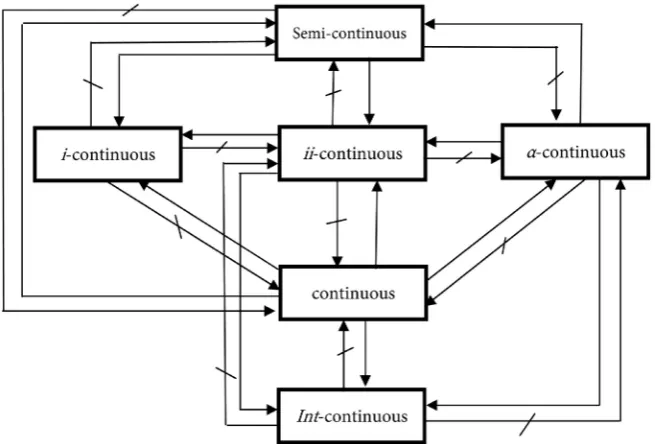
. Thus A is α -open set.As a summary the following Figure 1 shows the relations among
[image:9.595.210.538.469.691.2]semi-continuous, ii-continuous, i-continuous, int-continuous, α-continuous and continuous.
Figure 1. Relations among semi-continuous, ii-continuous, i-continuous, int-continuous,
DOI: 10.4236/oalib.1105604 10 Open Access Library Journal Corollary 4.10. A function f X:
(
,τ
) (
→ Y,σ
)
is α-continuous if and only ifit is weakly ii-continuous.
Proof. Clear from Theorem 4.9.
5.
ii
-Separating Axioms
In this section we define T0ii and T1ii spaces for ii-open sets and we determine
them by giving many examples. Specially, we define T1, T1α and T1i spaces to
compare them with T1ii space.
Definition 5.1. A topological space X is called
1) T0ii if a, b are to distinct points in X, there exists ii-open set U such that
either a U∈ and b U∉ , and b U∈ and a U∉ .
2) T1ii if
a b X
,
∈
and a b≠ , there exist ii-open sets U, V containing a, brespectively, such that b U∉ and a V∉ .
Example 5.2. Let X =
{ }
a b, , τii = =τ{
φ, ,X{ } { }
a , b}
(
X,τ
)
and(
X,τii)
are topological spaces.
1)
a b X
,
∈
(a b≠ ) there exists{ }
a ∈τii such that a∈{ }
a , b∉{ }
a .Therefore
(
X,τ
)
is T0ii.2)
a b X
,
∈
(a b≠ ) there exists{ } { }
a b, ∈τii such that a∈{ }
a , b b∈{ }
.Therefore
(
X,τ
)
is T1ii.Theorem 5.3.
1) Every T0-space is T0ii-space,
2) Every T1-space is T0ii-space,
3) Every T1-space is T1ii-space,
4) Every T1ii-space is T0ii-space.
Proof. (1), (2), (3) and (4) follow using the fact that every open set is ii-open [4]. The converse needs not to be true by the following example.
Example 5.4. Let
{
, ,}
X = a b c , τ=
{
φ, ,X a{ }
}
and τii ={
φ,X,{ } { } { }
a a, ,b , ,ac}
.(
X,τ
)
and(
X,τii)
are topological spaces.(
X,τ
)
is not T0-space because,b c X
,
∈
(b c≠ ) there is no open set G such that b G∈ , c G∉ .(
X,τ
)
is T0ii-space because,a b X
,
∈
(a b≠ ) there exists{ }
a ∈τii suchthat a∈
{ }
a , b∉{ }
a .,
a c X∈ (a c≠ ) there exists
{ }
a ∈τii such that a∈{ }
a , c∉{ }
a .,
b c X
∈
(b c≠ ) there exists{ }
a b, ∈τii such that b∈{ }
a b, , c∉{ }
a b, .(
X,τ
)
is not T1-space because,a b X
,
∈
(a b≠ ) there exists X∈τ such that a X∈ , b X∈ .(
X,τ
)
is not T1ii-space because,b a X
,
∈
(a b≠ ) there exists{ }
a b, ∈τiisuch that a∈
{ }
a b, , b∈{ }
a b, .Theorem 5.5. Every T1α-space is T1ii-space.
DOI: 10.4236/oalib.1105604 11 Open Access Library Journal b V∈ . Since every α-open set is ii-open set [4], U, V is an ii-open set in X. Hence X is T1ii-space.
Theorem 5.6. Every T1ii-space is T1i-space.
Proof. Let X be a T1ii-space. Let a, b be two distinct points in X. Since X is
1ii
T -space there exist two ii-open sets U, V in X such that a U∈ , b U∉ , a V∉ , b V∈ . Since every ii-open set is i-open set [4], U, V is an i-open set in X. Hence X is T1i-space.
The converse needed not to be true by the following example. Example 5.7. Let X =
{
a b c, ,}
, τ={
φ, ,X{ } { }
a b c, ,}
and.{ } { } { } { }
{
, , , , , ,}
i X a b c bc
τ = φ . τii =
{
φ,X a b c,{ } { }
, ,}
.(
X,τ
)
and(
X,τii)
are topological spaces.(
X,τ
)
is T1i-space because,a b X
,
∈
(a b≠ ) there exists{ } { }
a b, ∈τisuch that a∈
{ }
a , b∉{ }
a and b b∈{ }
, a∉{ }
b .,
a c X∈ (a c≠ ) there exists
{ } { }
a , c ∈τi such that a∈{ }
a , c∉{ }
a and{ }
c∈ c , a∉
{ }
c .,
b c X
∈
(b c≠ ) there exists{ } { }
c b, ∈τi such that c∈{ }
c , b c∉{ }
and{ }
b b∈ , c b∉
{ }
.(
X,τ
)
is not T1ii -space because,b c X
,
∈
( c b≠ ) there exists{ } { }
b c, ∈τii such that c∈{ }
b c, , b∈{ }
b c, .Theorem 5.8. A space X is T0ii if and only if CLii
( )
{ }
x ≠CLii( )
{ }
y forevery pair of distinct points x, y of X.
Proof. Let X be a T0ii-space. Let
x y X
,
∈
such that x y≠ , then there existsan ii-open set U containing one of the points but not the other, then x U∈ and
y U
∉
. Then X U\ is ii-closed set containing y but not x. But CLii( )
{ }
y isthe smallest ii-closed set containing y. Therefore CLii
( )
{ }
y ⊂X U\ and hence{ }
( )
ii
x∉CL y . Thus CLii
( )
{ }
x ≠CLii( )
{ }
y .Conversely, Suppose for any
x y X
,
∈
with x y≠ , CLii( )
{ }
x ≠CLii( )
{ }
y . Let z X∈ such that z∈CLii( )
{ }
x but z∉CLii( )
{ }
y . If x∈CLii( )
{ }
y then{ }
( )
( )
{ }
ii ii
CL x ⊂CL y and hence z∈CLii
( )
{ }
y . This is contradiction. There-fore x∉CLii( )
{ }
y . That is x∈X\CLii( )
{ }
y . Therefore X CL\ ii( )
{ }
y is ii-open set containing x but not y. Hence X is an T0ii-space.Theorem 5.9. A space
(
X,τ
)
is T1ii-space if and only if the singletons areii-closed sets.
Proof. Let X be T1ii-space and let x X∈ , to prove that
{ }
x is ii-closed set.We will prove X x\
{ }
is ii-open set in X. Let y∈X\{ }
x , implies x y≠ and since X is T1ii-space then their exist two ii-open sets U, V such that x U∉ ,{ }
\
y V∈ ⊂ X x . Since y V∈ ⊂X x\
{ }
, then X x\{ }
is ii-open set. Hence{ }
x is ii-closed set.Conversely, Let
x y X
≠ ∈
then{ } { }
x , y are ii-closed sets. That is X x\{ }
is ii-open set clearly, x X x∉ \
{ }
and y X x∈ \{ }
. Similarly X y\{ }
is ii-open set, y X y∉ \{ }
and x X y∈ \{ }
. Hence X is an T1ii-space.As a consequence the following Figure 2 shows the relations among T0, T0ii,
1
DOI: 10.4236/oalib.1105604 12 Open Access Library Journal Figure 2. Relations among T0, T0ii, T1, T1ii and T1α.
Conflicts of Interest
The authors declare no conflicts of interest regarding the publication of this pa-per.
References
[1] Caldas, M. (2003) A Note on Some Applications of α-Open Sets. International Journal of Mathematics and Mathematical Sciences, 2, 125-130.
https://doi.org/10.1155/S0161171203203161
[2] Njastad, O. (1965) On Some Classes of Nearly Open Sets. Pacific Journal of Mathe-matics, 15, 961-970.https://doi.org/10.2140/pjm.1965.15.961
[3] Askander, S.W. (2016) Oni-Separation Axioms. International Journal of Scientific and Engineering Research, 7, 367-373. https://www.ijser.org
[4] Mohammed, A.A. and Abdullah, B.S. (2019) II-Open Sets in Topological Spaces.
International Mathematical Forum, 14, 41-48.
https://doi.org/10.12988/imf.2019.913
[5] Levine, N. (1963) Semi-Open Sets and Semi-Continuity in Topological Spaces. The American Mathematical Monthly, 70, 36-41.https://doi.org/10.2307/2312781 [6] Mashhour, A.S., Hasanein, I.A. and Ei-Deeb, S.N. (1983) α-Continuous and α-Open