© Medwell Journals, 2019
Optimized Structure Investigation of Platinum Complex (VI) using DFT
Lekaa Hussain Khdaim and Abbas Abd-Ali Draea
Department of Chemistry, College of Science, University of Babylon, 51002 Hillah, Babylon, Iraq
Abstract: Optimized structure investigation of (bis (methoxyamino) bis ((methoxycarbamoyl) oxy) platinum
(VI) chloride) (MMP chloride) has been achieved using DFT at B3LYP/Lanl2DZ level of theory. Gaussian packaged program G09 has been used with the relationship between their molecular and electronic structure of platinum complex (VI). The electronic properties such as HOMO, LUMO, Egap, thermodynamic properties such as ΔG, ΔH, ΔS and global reactivity descriptors such as hardness, softness, ionization potential, electron affinity, electro gravity, chemical potential, electro philicity and electronic charge were calculated for Pt (VI) complex. Reactivity of the MMP chloride is always governed but its electronic properties and kinetic and thermodynamic stability. Theoretical spectrograms for the IR and NMR spectrum were also constructed in RHF but UV spectrum in UHF at B3LYP levels. They found the symmetry of Pt (VI) complex form is C1 refer to asymmetrical distribution in the Pt (VI) complex. Large values of the energy gap of platinum complex (VI) that’s imply high electronic stability and then low reactivity when low values imply that it will be easy to remove an electron from HOMO orbital to LUMO as indication of reactivity. Thermodynamic calculation of complex A by using DFT/B3Lyp/LanL2DZ which is endothermic and nonspontaneous (195.8446, 135.7806 kCal/MoL) and energy gap is 0.07754 kCal/mol. The stabilized structure of MMP chloride comes out by total energy which equal to -1209.074 a.u.
Key words: Optimized structure, DFT, MMP chloride, B3LYP, theoretical spectra, stabilized
INTRODUCTION
Anticancer activity of cisplatin complexes have been discovered great deal attention, since, drawn to platinum compound of Pt (II) and Pt (VI) (Burda and Leszczynski, 2003). Pt (II) and MMP chlorides are widely used compounds with cytotoxic activity. Pt (II) complexes readily react with DNA to form intrastrand cross links (Pinto and Lippard, 1985). Cisplatin has been widely used in medicine with regard to its antitumor properties including the treatment of various solid tumors (Dolezel and Kuban, 2002). Platinum drugs are used for treatment of specific cancer, testicular, ovarian, bladder, head and neck, esophageal small or non-small cell lung breast cervical, stomach and prostate cancers (Abu-Surrah and Kettunen, 2006). Side effects of platinum therapy include general cell damaging effects, vomiting, nausea, decreased blood cell and platelet production in bone marrow and decreased response to infection (Boyiadzis, 2007; Kelland, 2007; Ko et al., 2008). Platinum (II) complex in the main or side chains have attached much attention because of their unique electronic properties. Internal charge transfer from an electron rich unit to an electron deficient unit has been extensively used to obtain the low band gap of the molecules (Fitri et al., 2014; Sadiki et al., 2014;
Belghiti et al., 2014). Also platinum group elements can be naturally found only at very low concentration (Sikorova et al., 2011). Platinum compounds are still the most effective cytostatic drugs such as Ru (II), Os (II), Ir (II) have quite similar properties (Dhahagani et al., 2014). Equation of the leaving groups chloride for cisplatin, carboxylate for carboplatin, generates reactive cisplatin which cisplatin react readily with purine nucleobase in DNA (Wilson and Lippard, 2011). The stable of MMP chloride their low spin d6 electronic configuration,
aids in their survival of the acidic environment of the stomach before being absorbed to the blood stream (Wilson and Lippard, 2011). Approaches to finding such agents often depend on novel design strategies employ bioactive vectors such as intercalates, amino acid, sugars, bile acids, folates and estrogen analogues (Ho et al., 2003).
MATERIALS AND METHODS
Experimental details: The optimized geometry been
done in the vibrational frequency calculation at the RHF through DFT method to characterize all stationary points as minima (Fig. 1). The vibrational frequency assignments were made with a high degree of accuracy with the help Gaussain 98 suite of program (Frisch et al., 2010).
J. Eng. Applied Sci., 14 (Special Issue 7): 9936-9945, 2019
Pt Pt
H COHN3 H COHN3
H COHN3
H COHN3
C1
C1 C1
C1
+2 HOCONHOCH3
OCONHOCH3
OCONHOCH3
+H2
Fig. 1: (VI) complex from cisplatin in gas phase (Wilson and Lippard, 2011) The H1, C13 chemical shifts of bis (methoxyamino) bis
((methoxycarbamoyl) oxy) platinum (VI) chloride (MMP chloride) was calculated using RHF and DFT calculation with LanL2DZ basis set but UHF which using UV spectra was calculated. The HOMO and LUMO were studied to calculate the energy gap (E) (Adnan et al., 2014; Abbas and Nadia, 2012). Thermodynamic parameters were calculated by DFT method B3LYP at level of theory level. The B3LYP, aversion of the DFT method using Becke’s three parameter functional (B3) and including a mixture Hartree-fock with DFT exchange terms associated with the gradient corrected correlation functional of Lee, Yang, Parr (LYP (Adnan et al., 2014).
RESULTS AND DISCUSSION
Structural and electronic properties have been calculated and can be discuses as follow:
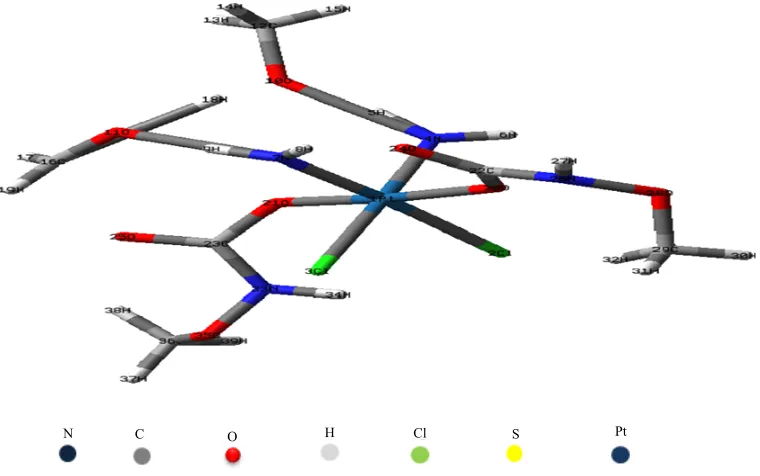
Eometry optimization: Figure 2 represented the
optimized structure of Pt (VI) complex they found some of selected mean bounds of complexes such as bond lengths in the MMP chloride and bond angle and dihedral angle of complex in the ground state in Table 1.
The bond length between Pt atom and O, N, Cl atoms are very important in the load transfer charge between donor and acceptor group in the compound, it the bond length favors in the intramolecular charge transfer when is shorter.
Thermodynamic
Properties: Thermodynamic properties were calculated
using DFT and were obtained from the output of Gaussian programs. The stability of a molecular structure is determined o f total energy of the molecule is low. The ZPE is the lowest possible energy that quantum mechanical system can have. The enthalpy values for bis (methoxyamino) bis ((methoxycarbamoyl) oxy) platinum (VI) chloride (MMP chloride) is not meaningful rather bond dissociated energy are considered better description of stability of the compound and entropy value is not random but Gibbs free energy is non spontaneous for bis (methoxyamino) bis ((methoxycarbamoyl) oxy) platinum (VI) chloride (MMP chloride) in Table 2.
Energy levels: The energy of the frontal molecular orbital
such as EHOMO, ELUMO and Egap for MMP chloride were calculated by the DFT with B3LYP/Lanl2DZ. The energy of EHOMO is often associated with the electron donating ability of the molecules whereas the energy of ELUMO is associated with the electron accepting ability of the molecules (Abbas and Nadia, 2012). The high value of the EHOMO indicates a high tendency to donate electrons to suitable acceptor molecule with low empty molecular orbital energy also the value of the LUMO indicate a high tendency to accept electrons from the metal. The results given in Table 3, show which the bis (methoxyamino) bis ((methoxycarbamoyl) oxy) platinum (VI) chloride (MMP chloride) has the higher energy of HOMO. The energy gap between the HOMO and LUMO energy levels of MMP chloride (Khalil et al., 2013). Large values of the energy gap imply high electronic stability and then low reactivity when low values imply that it will be easy to remove an electron from HOMO orbital to LUMO which can be good result in reactivity. The electronic dipole moment which measure of bond properties also indicate higher dipole moment (6.337 Debye) (Bourass et al., 2015) (Fig. 3 and 4).
Global reactivity: Global reactivity description were
[image:2.612.150.443.99.144.2]Pt H COHN3
H COHN3
C1 C1
OCONHOCH3
[image:3.612.128.508.96.334.2]OCONHOCH3
Fig. 2: Geometry optimized structure of bis (methoxyamino) bis ((methoxycarbamoyl) oxy) platinum (VI) chloride (MMP chloride) by DFT/B3Lyp/LanL2DZ (5 D, 7 F) at level of theory
Table 1: Name and molecule structure of MMP chloride
Abbreviation Structure IUPAC name
[image:3.612.70.544.478.546.2]MMP chloride Bis (methoxyamino) bis ((methoxycarbamoyl) oxy) platinum (VI) chloride
Table 2: Theoretical parameter of bond length and bond angle bis (methoxyamino) bis ((methoxycarbamoyl) oxy) platinum (VI) chloride (MMP chloride) by using DFT/B3Lyp/LanL2DZ at level of theory
Bond types Length bond (nm) Angle type Bond angle (Å) Dihedral types Dihedral
Pt1-N4 1.98 Pt1-N4-O10 90.0 Cl17-O16-Pt1-Cl2 180
Pt1-Cl2 2.29 Pt1-O10-C11 120 O5-N4-Pt1-Cl2 -90
Pt1-O10 1.94 Cl17-O16-Pt1 120 C6-O5N4-Pt1 180
Cl17-O16 1.34 O5-N4-Pt1 120
O5-N4 1.32 N7-Pt1-N4 82.2
C6-O5 1.40 C6-O5N4 1.20
Table 3: Thermodynamic calculation of bis (methoxyamino) bis ((methoxycarbamoyl) oxy) platinum (VI) chloride (MMP chloride) by using DFT/B3Lyp/Lan2DZ at 298.150 K at levels of theory
ΔH ΔG ΔS ZPE Imaginary Total energy- Degree of Full point
Functions kcalmolG1 kcalmolG1 calmolG1 kcalmolG1 frequencies E (a.u) freedom group
MMP chloride 195.8446 135.7806 201.4556 169.4268 + 1209.074 111 C1
Table 4: Energy levels for bis (methoxyamino) bis ((methoxycarbamoyl) oxy) platinum (VI) chloride (MMP chloride) at DFT/B3LYP/LanL2DZ (5 D, 7 F) at levels of theory
Functions ELUMO (kcalmolG1) EHOMO (kcalmolG1) ΔE gap (kcalmolG1) Dipole moment (D)
[image:3.612.70.544.681.725.2]MMP chloride 0.01665 -0.06104 0.07754 6.337
Table 5: Physical properties for bis (methoxyamino) bis ((methoxycarbamoyl) oxy) platinum (VI) chloride (MMP chloride) at DFT/B3LYP/LanL2DZ (5 D,7 F) at levels of theory
Ionization Electron Absolute Chemical Chemical Absolute Global Additional
Physical Potential Affinity Electronegativity hardness Softness Potential softness electrophilicity electronic
properties (IP) (EA) (X) (η) (S) (π) (σ) (ω) charge (ΔN)
Values 0.0610 kJmolG1 -0.0167 kJmolG1 -0.0395 eV -0.0777 eV -6.50 eV 0.0395 eV -12.87 -9.811×10G3 0.5
J. Eng. Applied Sci., 14 (Special Issue 7): 9936-9945, 2019
[image:4.612.130.488.347.535.2]Fig. 3: Frontial molecular orbital’s of 3D for bis (methoxyamino) bis ((methoxycarbamoyl) oxy) platinum (VI) chloride (MMP chloride) by DFT/ B3Lyp/LanL2DZ (5 D, 7 F) at level of theory
Fig. 4: Frontal molecular orbital of 2D for bis (methoxyamino) bis ((methoxycarbamoyl) oxy) platinum (VI) chloride (MMP chloride) by DFT/B3Lyp/LanL2DZ (5 D, 7 F) at level of theory
Table 6: Energies value of chemical reaction of bis (methoxyamino) bis ((methoxycarbamoyl) oxy) platinum (VI) chloride (MMP chloride) by DFT/B3Lyp/LanL2DZ (5d,7f) at level of theory
Chemical species Total energy IR freq. ZPE kCal.mol-1 ΔH kCal.mol-1 ΔG kCal.mol-1 ΔS Cal.mol-1
PtCl4 178.039 - 2.7410 7.241 -16.9200 81.040
2NH3 111.740 + 43.4800 50.060 22.6400 91.960
PtCl4(NH3)2 292.280 - 46.2500 58.030 19.5500 129.060
PtCl2(NH3)2 262.290 + 49.8500 57.980 29.6500 95.020
Cl2 918.870 + 0.7040 2.941 -13.0500 53.630
CH3OCl 574.404 - 29.0273 34.224 5.8345 95.219
PtCl2(NH2OCH3)2 491.197 + 88.1163 100.732 63.8640 123.655
H2O2 150.690 - 16.2800 19.330 3.0600 54.580
PtCl2(NH2OCH3)2(OH)2 642.059 + 103.3680 119.131 76.4230 143.243
2HOCONHOCH3 358.480 + 57.3190 66.126 33.1160 110.716
PtCl2(NH2OCH3)2(OCONHOCH3)2 1209.080 + 169.9200 195.843 135.7910 201.420
2H2O 75.580 + 26.2500 32.000 5.1700 89.980
HOMO-LLUMO
LUMO 0.0
∆Egap 0.0
HOMO -0. 1665
07754
[image:4.612.72.540.598.724.2]Fig. 5: Mullikan chargefor bis (methoxyamino) bis ((methoxycarbamoyl) oxy) platinum (VI) chloride (MMP chloride) by DFT/B3Lyp/LanL2DZ (5 D, 7 F) at level of theory
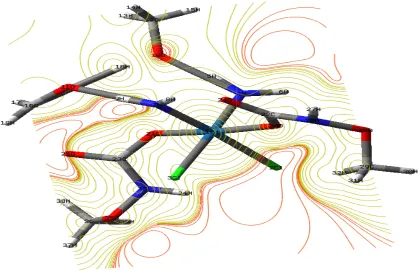
Fig. 6: Total density of 2D for bis (methoxyamino) bis ((methoxycarbamoyl) oxy) platinum (VI) chloride (MMP chloride) by DFT/B3Lyp/LanL2DZ (5 D, 7 F) at level of theory
The electron density is typically showed a comparison of the identified electron density with that predictable by spherical models of the atoms and is called distortion electron density. The negative charge are remarked by red color are distribution on the oxygen atoms in carbonyl groups and the nitrogen in amine group due to high value of electronegativity (Obi-Eghedi et al., 2011). The positive charge are remarked by green color are distribution on carboneatoms (Kooh et al., 2014). The Mullikan atomic charges give a positive value for C and H and negative values for O, N, Cl atoms.
Figure 5-7 represent of Mullikan charge electron density and ESP, respectively (Adnan et al., 2014).
Reaction of PtCl4 with NH3: The chemical reaction
of PtCl4 with NH3 can be occurs through multistep to give
final product to obtained the net equation of reaction. Table 6 and Scheme 1 shows the total energies values of chemical species that’s participating in the reaction. The net equation consisted from one mole of PtCl4 with
two mole of NH3. The reaction is exothermic ΔHnet
J. Eng. Applied Sci., 14 (Special Issue 7): 9936-9945, 2019
PtCl +2NH4 3 PtCl (NH )4 3 2 (1)
PtCl4(NH )3 2 PtCl (NH ) +Cl2 3 2 2 (2)
Pt(NH ) Cl +2CH COCl Pt(NH OCH ) Cl +2HCl (3)3 2 2 3 2 3 2 2
Pt(NH OCH )2Cl +H O2 3 2 2 2 Pt(NH OCH ) Cl (OH)2 3 2 2 2 (4)
Pt(NH2OCH ) Cl (OH) +2HOCONHOCH Pt(NH OCH ) Cl (OCONHOCH ) +2H O (5)3 2 2 2 3 2 3 2 2 3 2 2
Rate = k [PtCl ][NH ]1 4 3 2
= k [PtCl (NH ) ]]1 4 3 2
Rate = k [PtCl (NH ) ]2 4 3 2
= k [PtCl (NH ) ][Cl ]2 2 3 2 2
Rate = k [PtCl (NH ) ][CH COCl]3 2 3 2 3 2
= k [PtCl (NH OCH ) ](HCl) ]3 2 2 3 2
-Rate = k [PtCl (NH OCH ) ][H O ]4 2 2 3 2 2 2
= k [[PtCl (NH OCH ) (OH)4 2 2 3 2 2
Rate = k [PtCl (NH OCH ) (OH) ][HOCONHOCH ]5 2 2 3 2 2 3 2
= k [[PtCl (NH OCH ) (OCONHCOCH )5 2 2 3 2 3 2[H O]2 2
k1
k1
k2
k2
k3
k3
k4
k4
k5
k5
d[PtCl ](NH )4 3 2
dt = k [PtCl ][NH ] -k [PtCl (NH ) ]-k [PtCl (NH ) ]+k [PtCl (NH ) ][Cl ] = 01 4 3 2 1 4 3 2 2 4 3 2 2 2 3 2 2
d[PtCl (NH ) ]2 3 2
dt = k [PtCl ][NH ] -k [PtCl (NH ) ][Cl ]+k [PtCl (NH ) ][CH COCl] + (7)2 2 3 2 2 4 3 2 2 3 2 3 2 3
2-k [PtCl (NH3 2 2OCH3 2) ][HCl] = 0
2
(6)
According to rate constant values, the rate determining step have been suggested depending on the steady state approximation. Scheme 1, represent the determination of effective concentration on the reaction
[image:6.612.96.516.162.432.2]rate can be derived of reaction rate law for the reaction mechanism according to the steady state approximation, the net rate of change equal zero for intermediates (Izet et al., 2012):
Fig. 7: Energy surface potential of 2D for bis (methoxyamino) bis ((methoxycarbamoyl) oxy) platinum (VI) chloride (MMP chloride) by DFT/B3Lyp/LanL2DZ (5 D, 7 F) at level of theory
Reaction rate law of BBMP as shown:
k [PtCl ][NH ] -k [PtCl (NH ) ]-k [Pt(NH OCH )Cl (OH) ][HOCONHOCH ]+1 4 3 2 1 4 3 2 5 2 3 2 2 3
k [Pt(NH OCH ) Cl (OCONHOCH ) )][H O] = 05 2 3 2 2 3 2 2
2
[PtCl (NH ) ] = (10) 4 3 2
Rate = k [PtCl (NH ) ] (11)2 4 3 2
k [PtCl ][NH ] -k [Pt(NH OCH ) Cl (OCONHOCH ) ]1 4 3 2 5 2 3 2 2 3 2
k +k [Pt(NH OCH )Cl (OH) ][HOCONHOCH ]1 5 2 3 2 2 3
Rate = k [PtCl ][NH ] +K [Pt(NH OCH ) Cl (OCONHOCH ) ]1 4 3 2 5 2 3 2 2 3 2
k1
Rate = k [PtCl ][NH ] +K [Pt(NH OCH ) Cl (OCONHOCH ) ]1 4 3 2 5 2 3 2 2 3 2 K [Pt(NH OCH )Cl (OH) ][HOCONHOCH ]5 2 3 2 2 3
(13) Rate = k3 . (12)
k [PtCl ][NH ] +K [Pt(NH OCH ) Cl (OCONHOCH ) ]1 4 3 2 5 2 3 2 2 3 2
k +K [Pt(NH OCH )Cl (OH) ][HOCONHOCH ]1 5 2 3 2 2 3 By substitution Eq. 10-11 get on:
Equation (4-113) is consisted from two different probabilities: The first probability is to impose k5
(6.09141×10¹²> . (6.3508×10⁻¹²), the equation will be as follow:
1 k
The secondary probability is to impose k1 (6.3508×10⁻¹²)>k5 (6.0914×10¹²), the equation will be as follow:
Scheme 1: The net equation of reaction PtC14 with NH3 in vacuum
k1 is very small and can be ignored, therefore, the
predominant probability is k5>k1 and the rate
determination step as follow in Eq. 1-13.
Vibrational band analysis: The position of the important
bands of the Pt (VI) complex are shown Fig. 8. According to theoretical calculations of bis (methoxyamino) bis ((methoxycarbamoyl) oxy) platinum (VI) chloride (MMP chloride) energy structure belongs to the C1 point group symmetry. The scaling factors 0.964 for DFT and RHF values and the complex these band of the following: v (Pt-O) Asy = 369.17 cm-1, v (Pt-Cl) Asy = 324.28 cm-1,
v (Pt-N) Asy = 552.65 cm-1, v (C-O) Asy = 757.87 cm-1,
v (N-H) sym = 3546.39 cm-1, v (N-O) Asym = 881.0 cm-1,
v (C-N) sym = 1392.31 cm-1, v (C-H) sym =
3314.77 cm-1.
Electronic properties: The model of electronic properties
of bis (methoxyamino) bis ((methoxycarbamoyl) oxy) platinum (VI) chloride (MMP chloride) as seam in Fig. 9, display density of the electron clouds at different energy levels. The information related where the electron clouds are concentrated will be useful to predict whether the electron transfer electron system is efficient (Mendoza-Huizar, 2014). The result indicate lowest single electronic excitation is σ-σ* and n-σ*.
Chemical shift: Chemical shifts of 13C and 1 H-NMR
in MMP chloride were investigated as shown in Fig. 10 (a, b). The chemical shifts of 13 C and 1 H-NMR in bis (methoxyamino) bis ((methoxycarbamoyl) oxy) platinum (VI) chloride (MMP chloride) as referred by TMS were separated around 28-192 and 1.75-12.5 ppm, respectively. This behavior was influenced by magnetic shielding effect on the bis (methoxyamino) bis ((methoxycarbamoyl) oxy) platinum (VI) chloride (MMP chloride). The separated chemical shifts of 13 C and 1 H-NMR were caused by nuclear spin interaction in carbon and proton atoms on bis (methoxyamino) bis ((methoxycarbamoyl) oxy) platinum (VI) chloride (MMP chloride). The chemical shift was mainly caused by hybridization of d spin in metal. The chemical shifts of 13 C and 1 H NMR MMP chloride depended on the electron density distribution with a slight deviation of charge density on bis (methoxyamino) bis ((methoxycarbamoyl) oxy) platinum (VI) chloride (MMP chloride) (Suzuki and Oku, 2016).
Significance: Molecular modeling of platinum complex
J. Eng. Applied Sci., 14 (Special Issue 7): 9936-9945, 2019
[image:8.612.97.520.315.480.2]Fig. 8: Theoretical vibrational spectrum of bis (methoxyamino) bis ((methoxycarbamoyl) oxy) platinum (VI) chloride (MMP chloride) by DFT/B3Lyp/LanL2DZ (5 D, 7 F) at level of theory (IR spectrum)
Fig. 9: Theoretical electronic transition spectrum of bis (methoxyamino) bis ((methoxycarbamoyl) oxy) platinum (VI) chloride (MMP chloride) by DFT/B3Lyp/LanL2DZ (5 D, 7 F) at level of theory (UV-VIS spectrum)
Fig. 10: Continue
0 20 30 40 50 60 70 Ep si lon 0 00 00 00 00 00 00 00
4000 3500 3000
Freq 2500 2000
quency (cm-1)
0 1500 1000 5000 0
D (1
0
-4
0) e
su
2 cm 2) 0 500 1000 1500 2000 2500 -500 Ei l 200 180 160 140 120 100 80 60 40 20 0 Ep sil on
25000 20000 150000 10000 5000 0 Excitation energy (n
-5000 nm)
-10000 -150000 -20000 0.0035 0.0030 0.0025 0.0020 0.0015 0.0010 0.0005 0.0000 5 0 5 0 5 0 5 0 Os ci ll at or s tre ng
H1 NMR
4.0 3.0 2.0 1.0 0.0 Degene racy 18 (a) 8-H
16 14
9-H 6-H
12
-H
SCF G
10 Shift (ppm) GIAO magnetic shieldin
8 6
[image:8.612.103.511.533.702.2]Fig. 10: Theoretical spectrum for bis (methoxyamino) bis ((methoxycarbamoyl) oxy) platinum (VI) chloride (MMP chloride) by DFT/B3Lyp/LanL2DZ (5 D, 7 F) at level of theory; a) H1 NMR and C13 NMR
CONCLUSION
The geometry optimized structure of Pt (VI) complex have been calculated using DFT based on B3Lyp/LanL2DZ at level of theory in vacuumed. The symmetry of Pt (VI) complex form is C1 refer to asymmetrical distribution in the Pt (VI) complex. The output of this Pt (VI) complex gave C1 symmetry which is wrong symmetry.
Thermodynamic calculation of complex A by using DFT/B3Lyp/LanL2DZ which is endothermic and nonspontaneous 195.8446, 135.7806 kCalmolG1
respectively and energy gap value is 0.07754 kCalmolG1.
The stabilized structure of bis (methoxyamino) bis ((methoxycarbamoyl) oxy) platinum (VI) chloride (MMP chloride) comes out by total energy which equalto-1209.074 a.u.
ACKNOWLEDGEMENTS
I am highly obligated to Prof. Dr. Abbas Abed Ali Drea for extending to me his all-out academic support throughout the course of this research. His keen interest in this work fructified as valuable guidance and positive criticism without which many constructive changes could not have directed this study also teaching me a new field of knowledge. My research ability has been enhanced by his in-depth knowledge. Also, I have learned and practiced conducting research in a systematic way under his supervision. My written communication skills have been improved significantly through his assistance.
I wish to thank university of Babylon, the college of science and the department of chemistry for giving me a chance to get this degree. I would like to extend my
sincere appreciation to my mother and sister for their sacrifice, encouragement and inspiration. Without their generosity, it was not possible for me to conduct and complete this endeavor. Also, my great thanks Dr. Bahjat Razak Jaafar, Bahjat Mohammed Ali Said and Yahya Fahim for helping me. Finally, i would like to thank my family who have encouraged me throughout the past 3 years.
REFERENCES
Abbas, A.D. and I. Nadia, 2012. Estimation study of mechanism and kinetic for the reactions of ethane in vacuum using DFT. J. Photocatalysis Sci., 2: 49-59.
Abu-Surrah, A.S. and M. Kettunen, 2006. Platinum group antitumor Chemistry: Design and development of new anticancer drugs complementary to Cisplatin. Curr. Med. Chem., 13: 1337-1357.
Adnan, H., S.A. Aowda and A.A.A. Drea, 2014. Simulation study of alkylation reaction of resorcinol. J. Appl. Chem., 3: 2365-2371.
Belghiti, N., M. Bennani, M. Hamidi, S.M. Bouzzine and M. Bouachrine, 2014. New compounds based on anthracene for organic solar cells applications. Mater. Environ. Sci., 5: 2191-2197.
Bourass, M., A.T. Benjelloun, M. Benzakour, M. Mcharfi and M. Hamidi et al., 2015. Theoretical studies by using the DFT and TD-DFT of the effect of the bridge formed of thienopyrazine in solar cells. J. Mater. Environ. Sci., 6: 1542-1553.
Boyiadzis, M.M., 2007. Hematology-Oncology Therapy. Vol. 487, McGraw-Hill Education, New York, USA., ISBN:9780071434973, Pages: 899.
1.0
0.0
Degene
racy
200 1
16-C
(b)
180 160
22-C 23-C C13 NMR
140 SCF G
120 100 Shift (ppm) GIAO magnetic shielding
80 g
60 40
12-C
J. Eng. Applied Sci., 14 (Special Issue 7): 9936-9945, 2019
Burda, J.V. and J. Leszczynski, 2003. How strong can the bend be on a DNA helix from cisplatin? DFT and MP2 quantum chemical calculations of cisplatin-bridged DNA purine bases. Inorg. Chem., 42: 7162-7172.
Dhahagani, K., S.M. Kumar, G. Chakkaravarthi, K. Anitha and J. Rajesh et al., 2014. Synthesis and spectral characterization of schiff base complexes of Cu(II), Co(II), Zn(II) and VO(IV) containing 4-(4-Aminophenyl) morpholine derivatives: Antimicrobial evaluation and anticancer studies. Spectrochim. Acta Part A. Mol. Biomol. Spectrosc., 117: 87-94.
Dolezel, P. and V. Kuban, 2002. Mass spectrometric study of Platinum complexes based on Cisplatin. Chem. Pap., 56: 236-240.
Fitri, A., A.T. Benjelloun, M. Benzakour, M. Mcharfi and M. Hamidi et al., 2014. Theoretical investigation of new thiazolothiazole-based D-π-A organic dyes for efficient dye-sensitized solar cell. Spectrochim. Acta Part A. Mol. Biomol. Spectrosc., 124: 646-654.
Frisch, M.J., G.W. Trucks, H.B. Schlegel, G.E. Scuseria and M.A. Robb et al., 2010. Gaussian 09, Revision B.01. Gaussian Inc., Wallingford, Connecticut,. Ho, Y.P., S.C.F. Au Yeung and K.K.W. To, 2003.
Platinum based anticancer agents: Innovative design strategies and biological perspectives. Med. Res. Rev., 23: 633-655.
Izet, N., A. Abbas and A. Drea, 2012. Theoretical investigation on mechanism reaction of methane gas with hydroxyl free radical. Basrah J. Sci., 30: 92-104. Kelland, L., 2007. The resurgence of platinum-based cancer chemotherapy. Nat. Rev. Cancer, 7: 573-584. Khalil, S.M., E.E. Ali-Shattle and N.M. Ali, 2013. A theoretical study of carbohydrates as corrosion inhibitors of iron. Z. Naturforsch. A., 68: 581-586. Khudhair, A.M., F.N. Ajeel and M.H. Mohammed, 2017.
DFT Investigations for sensing capability of a single-walled Carbon nanotube for adsorptions H2,
N2, O2 and CO molecules. Intl. J. Nano Dimension,
8: 82-88.
Ko, A.H., M. Dollinger and E.H. Rosenbaum, 2008. Everyones Guide to Cancer Therapy: How Cancer is Diagnosed, Treated and Managed Day to Day. 5th Edn., Andrews McMeel Publishing, Kansas City, Missouri, USA., ISBN:9780740768576, Pages: 989. Kooh, M.R.R., V.N. Yoong and P. Ekanayake, 2014. Density Functional Theory (DFT) and Time-Dependent Density Functional Theory (TDDFT) studies of selected ancient colourants as sensitizers in dye-sensitized solar cells. J. Nat. Sci. Found. Sri Lanka, 42: 169-175.
Mendoza-Huizar, L.H., 2014. A theoretical study of chemical reactivity of tartrazine through DFT reactivity descriptors. J. Mex. Chem. Soc., 58: 416-423.
Obi-Eghedi, N.O., I.B. Obot, M.I. El-Khaiary, S.A. Umoren and E.E. Ebenso, 2011. Computational simulation and statistical analysis on the relationship between corrosion inhibition efficiency and molecular structure of some phenanthroline derivatives on mild steel surface. Intl. J. Electrochem. Sci., 6: 5649-5675.
Pinto, A.L. and S.J. Lippard, 1985. Binding of the antitumor drug cis-diamminedichloroplatinum (II) (Cisplatin) to DNA. Biochim. Biophys. Acta BBA. Rev. Cancer, 780: 167-180.
Sadiki, Y.A., M. Bouachrine, L. Bejjit, M. Hamidi and S.M. Bouzzine et al., 2014. New organic materials based on π-conjugated molecules and N-methylcarbazole for photovoltaic applications. DFT. Study. Adv. Chem. Eng., 2: 1-8.
Sikorova, L., R. Licbinsky and V. Adamec, 2011. Platinum group elements from automobile catalysts in the environment. Chem. Listy, 105: 361-366.
Suzuki, A. and T. Oku, 2016. Theoretical study of NMR, infrared and Raman spectra on triple-decker phthalocyanines. AIP. Conf. Proc., 1709: 020013-1-020013-8.