Original citation:
ap Siôn, Tania. (2017) Creating a place of prayer for the ‘other’ : a comparative case study in Wales exploring the effects of re-shaping congregational space in an Anglican cathedral. Journal of Empirical Theology, 30 (2). pp. 218-235.
Permanent WRAP URL:
http://wrap.warwick.ac.uk/93384
Copyright and reuse:
The Warwick Research Archive Portal (WRAP) makes this work by researchers of the University of Warwick available open access under the following conditions. Copyright © and all moral rights to the version of the paper presented here belong to the individual author(s) and/or other copyright owners. To the extent reasonable and practicable the material made available in WRAP has been checked for eligibility before being made available.
Copies of full items can be used for personal research or study, educational, or not-for-profit purposes without prior permission or charge. Provided that the authors, title and full
bibliographic details are credited, a hyperlink and/or URL is given for the original metadata page and the content is not changed in any way.
Publisher’s statement:
http://doi.org/10.1163/15709256-12341356
A note on versions:
The version presented here may differ from the published version or, version of record, if you wish to cite this item you are advised to consult the publisher’s version. Please see the ‘permanent WRAP URL’ above for details on accessing the published version and note that access may require a subscription.
Creating a place of prayer for the ‘other’: An experimenta comparativel case
study in Wales exploring the effects of re-shaping congregational space in an Anglican cathedral
Tania ap Siôn*
Associate Professor in Education and the Social Significance of Religion, Warwick Religions and Education Research Unit, University of Warwick, Coventry, UK.
*Correspondence
The Revd Dr Tania ap Siôn St Mary’s Centre
Llys Onnen Abergwyngregyn Gwynedd
Wales, UK LL33 0LD
Abstract
Provision of spaces for personal prayer and reflection has become a common
phenomenon within historic churches and cathedrals in England and Wales, offering
an example of devotional activity that operates largely outside that of traditional
gathered congregations, but also in relationship with them. Over the past decade, the
apSAFIP (the ap Siôn Analytic Framework for Intercessory Prayer) has been
employed to examine the content of personal prayer requests left in various
church-related locations, mapping similarities and differences in pray-ers’ concerns. Building
on this research tradition, the present study examines whether experimental changes
to physical environment in an Anglican cathedral in Wales has an effect on the
personal prayer activity occurring within it, with a particular focus on intercessory
prayer requests.
Keywords: intercessory prayer, personal prayer, congregational studies, sacred place,
Introduction
Significance of place
The significance of place, in a physical and geographical sense, for human wellbeing
(and, for some, wellbeing of the natural world) is explored and taken seriously from
the perspectives of many disciplines. In Spaces for the sacred: Place, memory and
identity, Philip Sheldrake (2001, pp. 2ff) draws on contemporary scholarship from
human geography, anthropology, philosophy, psychology, history, architectural
theory, literature, and theology, for example, to demonstrate the range of
contributions to the study of place and to argue that today the ‘human sense of place
is a critical theological and spiritual issue’ (p.1).
A position that is articulated frequently in this literature is the need for
recognition of the contemporary importance of place for both individuals and
communities, as well as recognition of the major shifts in Western societies that have
affected relationship with place and the emerging consequences of that. Western
post-modern societies are variously defined as ‘technological’, ‘global’, ‘networked ’,
sceptical of universal truth claims, focused on individualism, and highly mobile;
while negatively phrased attributes include terms such as ‘rootless’ and ‘dis-placed’
(see, for example, Best & Kellner, 2001; Hassan, 1985).
In this portrayal of contemporary Western societies, spiritual quests for
meaning, however, are seen as both persistent and distinctively shaped by the
environments in which they are immersed. Such contemporary spiritual questing may
be encountered in a variety of contexts. On the one hand, there is the growth of
‘online religion’ (Helland, 2000) which has been interpreted as ‘part of a [broader] shift in society towards ‘personal communities’ and ‘networked individualism’, with
support and relationships increasingly provided through ever-changing, loosely-tied
webs of connections maintained through digital communications’ (Hutchings, 2010,
p.18). On the other hand, there is growth in spiritual and religious tourism (Stausberg,
2011; Sharpley & Jepson, 2011; Sharpley & Sundaram, 2005) as well as other kinds
of significant spiritual connection with physical sacred place through activities like
pilgrimage or visiting churches and cathedrals outside normal service times for
opportunities to reflect and to pray, for example. This latter expression of spiritual
sacred place and the various claims being made on such sacred place by the local
inhabiting congregations and by others outside these communities.
Belonging and sacred place
Walker’s (2006) approach to ‘belonging’ is especially relevant to this discussion
because it has emerged from and been created for church-related contexts, taking
seriously the complexity of different expressions of belonging with their challenges
and opportunities in a range of empirical studies (Walker, 2009, 2010).
In ‘Belonging to rural church and society’, Walker (2006) sets out four kinds
of belonging, which are grounded theologically and then applied to belonging as
observed in rural church contexts, namely: belonging with people; belonging with
activities; belonging with events; and belonging with places. In the present study,
when drawing on this model, ‘belonging with places’ is of primary concern, alongside
awareness of the relational factors also present with other kinds of belonging.
‘Belonging with activities’ involves connecting primarily through activities
‘that take place on a regular and frequent basis and where individuals are expected to engage not just on a specific occasion but with the series’. Examples of these types of
activities include, for example, Sunday services and various church groups and
meetings. ‘Belonging with people’ involves connecting primarily through ‘individuals
who are associated with the church in the minds of others …What they do is, to a greater or lesser extent, seen as the church doing it.’ These people are described as
including, for example, those who have formal positions in church and the local
ministry team as well as the more informal. ‘Belonging with events’ involves
connecting primarily through ‘a range of events that engender belonging’. Examples
of such events include the occasional offices, major festivals, fetes and other annual
or one-off events. ‘Belonging with places’ involves connecting primarily with the
physical place of church or churchyard. These places are often visibly located in the
heart of the whole community, providing a sense of permanence that connects people
with both the past and the future. They may be seen as spiritual or sacred places that
draw people to them as part of their own spiritual quests, outside the activities and
events offered. ‘Belonging with places’ is also often the most significant for those
who do not live in the area and visit churches and churchyards for a wide variety of
reasons (Walker, 2006, pp. 92-96).
from one another, ‘belonging with places’ is described as important to all categories
of belonging, and as such many claims are made on place in church contexts. In
addition, it is often one kind of belonging, ‘belonging with activities’, which is largely
responsible for shaping physical place and space, and for facilitating access to it.
Those who primarily belong with activities are the gathered congregations; those who
most frequently inhabit the church and most likely to be signed up members. Within
this context, the relationship between one largely invisible group of people (who
belong through places and are drawn to sacred places for personal pray and reflection)
with a visible dominant group of people (who belong through activities) may be
identified as being of particular significance and an area for further exploration.
Personal prayer and sacred place
Since 2007 a collection of empirical studies has focused on informing understanding
of the largely invisible visitors who seek opportunities for personal prayer and
reflection in church-related contexts. Within this literature two aspects have been
explored which are of particular relevance to the current study because of what they
postulate about the complex relationships between physical sacred place and personal
prayer and reflection.
The first aspect concerns the relationship between sacred place and personal
prayer content which has been investigated by the application of the ap Siôn Analystic
Framework for Intercessory Prayer (apSAFIP) to the content of personal prayers left
in churches, cathedrals, hospital chapels, on the street, and online. Results have
indicated that prayer content, in terms of prayer reference (who is prayed for), prayer
intention (what is prayed for) and prayer objective (articulated prayer outcomes), has
certain distinctive features that vary according to the place in which they are left (ap
Siôn, 2015a, 2015b). In addition, prayers left in physical sacred places stand apart as
being different in significant ways from prayers left online, on a church-related prayer
website, for example (ap Siôn, 2012, 2016). This kind of mapping activity, enabled
through multiple replications of prayer content studies, has raised significant
questions concerning why these differences are discernable and in what ways these
differences may be related to the specificity of place.
The second aspect explores the relationship between local church
congregations and their provision of opportunities for personal prayer and reflection
and writing prayers’ (ap Siôn, In Press) surveyed twenty churches in North Cornwall
to examine whether and how these churches provided ‘intentional’ spaces for visitors
to engage in personal prayer and reflection outside their usual congregational service
or other activity times. Results showed that among the churches surveyed there was a
rich presence and diversity of practice in relation to opportunities for personal prayer
and reflection, with just over half of the churches making some kind of explicit
provision in the form of written prayer requests, votive candles, and memorial books,
and this figure rose to nearly two thirds of the churches when ‘other’ possible
examples of ‘intentional’ provision were included. The study concluded that the
churches surveyed were exhibiting some kind of awareness of a relationship with and
a ministry to those who visited their sacred places outside service times, and by its
very nature, this awareness was specifically related to a sense of physical place.
Research question
Previous empirical research has demonstrated that the content of written intercessory
prayer requests changes according to physical place. It has also been shown that there
are a wide-range of different kinds of spaces created for personal prayer and reflection
in churches. What is not known, however, is whether shaping the physical space in
which prayer requests are written may also have an effect on the prayers left in
churches and cathedrals. The present study seeks to compare prayer request activity in
a cathedral over a four-year period in five key areas: prayer frequency, prayer length,
prayer type, prayer relationships, and prayer content (using the apSAFIP), where
space for prayer and reflection has been experimentally shaped. The opportunity to
operationalize this research question arose from changes effected in Bangor
Cathedral.
Location
Bangor Cathedral is situated in a central location on the High Street of the City of
Bangor, in the northern part of this Anglican diocese. Within the Cathedral’s Lady
Chapel in the South aisle, visitors are offered the opportunity to pause, to reflect, and
to pray, which includes the offering of personal written prayer requests. Although
areas for personal prayer and reflective are present with votive candle stands placed
variously around the main body of the cathedral at different times, the Lady Chapel in
over a decade prior to the commencement of the study. The Lady Chapel is also the
location of the aumbry containing the Blessed Sacrament.
The aim of the study is to explore whether shaping the physical space in which
prayer requests are written has an effect on the prayers left in the Lady Chapel. The
research context, therefore, sought to establish and delineate between two distinct
shapings of sacred space for personal prayer and reflection, which are differentiated
by their primary focus or orientation. Both shapings of the same space were
implemented over a four-year period.
The first kind of sacred space was identified as ‘congregational space’. Within
‘congregational space’, congregational activity is the primary focus or orientation of
the physical presentation of space. This may be manifested in a style of presentation
where consideration for congregational activities such as worship and meetings
dominate. Although opportunities for personal prayer and reflection may also be
present in such a space, their position appears secondary to the congregational focus.
The second kind of sacred space was identified as ‘space for personal prayer
and reflection’. Within ‘space for personal prayer and reflection’, personal religious
or spiritual activity is the primary focus or orientation of the physical presentation of
space. This may be manifested in a style of presentation where consideration for
personal religious or spiritual activities such as sitting, lighting votive candles and
writing prayer requests are given dominance. Although opportunities for
congregational activities may also be present in such a space, their position appears
secondary to the personal prayer and reflection focus.
In relation to the research context of the Lady Chapel, ‘congregational space’
was the normal style of presentation, as evidenced by key features present at the
beginning of the study. The whole area of the Lady Chapel was filled with and
dominated by numerous chairs with kneelers positioned in rows and orientated
towards the altar on the East wall, suggesting that the primary focus in the Lady
Chapel was Eucharist services. Additional and related furniture included three
prie-dieu, a heavy oak chair, a credence table, and portable shelves and books (for use in
services). Opportunities for personal prayer and reflection were also evident, although
placed in secondary positions. The prayer board and a prayer pebble pool was placed
in the rear corner of the Lady Chapel by the War Memorial, while votive candles by a
As the ‘congregational space’ was the normal kind of presentation in the Lady
Chapel, a ‘space for personal prayer and reflection’ was created by removing all
portable items from the Lady Chapel in order to provide a tabula rasa free of the
usual arrangements and coding as a basis for shaping ‘space for personal prayer and
reflection’. In this shaping of space, a different altar was brought into the Lady
Chapel and placed in a freestanding location more towards the centre of the Chapel
and the moveable statue of Our Lady was placed on the East wall, standing under the
mediaeval relief sculpture of the crucifixion which itself was positioned immediately
beneath the painted resurrection scene on the road to Emmaus. This move established
links involving altar (Eucharist), Mary (Incarnation), Crucifixion and Resurrection.
Votive candle stands were placed on either side of the stature of Our Lady. A
well-proportioned table, a comfortable padded stool, and a spiral-bound book for written
prayer prayers, together with a written prompt were introduced adjacent to the north
end of the east wall. The printed prompt contained the message that all prayers within
the prayer-request book would be offered upon the altar during a Eucharist every
week. A single row of unobtrusive seating was provided along three sides of Lady
Chapel for prayer and reflection. Finally, at the entrance to the Lady Chapel a simple
notice announced the Lady Chapel to be a place for personal prayer and reflection.
While the Lady Chapel was still accessible to particular types of congregational
worship such as the small weekday Eucharist services or meditative vigils of Holy
Week, for example, this space could no longer be readily used for other kinds of
congregationally focused activity, such as meetings, choir practice or piano lessons,
for example, without causing noticeable disruption to the space.
Full written and photographic records were made of both the ‘congregational space’ and the ‘space for prayer and reflection’. Over the four-year study period, the ‘congregational space’ was observable in the Lady Chapel in year 1 (2013), year 3 (2015), and year 4 (2016), while the ‘space for prayer and reflection’ was observable
in year 2 (2014).
METHOD Sample
The sample of prayers for analysis was drawn from the written prayer requests left in
the Cathedral’s Lady Chapel over a four-year period. For each year prayers left during
comparable data across the period of study. In 2013 the prayers were taken from what
was identified as the original ‘congregational space’ and were pinned onto a prayer
board. In 2014 the prayers were taken from the created experimental ‘space for
personal prayer and reflection’ and were written in a spiral-bound book provided for
this purpose. In 2015 and 2016 the prayers were taken from the return to
‘congregational space’ and were also written in the spiral-book used in 2014.
Analysis
The written prayers requests were analysed according to five selected areas of interest
recognised in the research tradition concerned with the empirical study of written
prayer request content. These five areas of interest include prayer frequency, prayer
length, prayer type, prayer relationships, and petitionary prayer content. Prayer
frequency was recorded for all four years of the study, while the remaining four areas
of interest, namely prayer length, prayer type, prayer relationships, and petitionary
prayer content were examined in year 1 (2013) and year 2 (2014) only.
Prayer frequency recorded the number of prayers left from May through to
August in each of the four years of study. In research related to written prayer
requests, noting the number of prayers left within a specified period of time is the
most basic category in an analysis. No study, however, has sought to compare prayer
frequency as it occurs through time and place.
Prayer length recorded the word count for each prayer in year 1 and year 2 of
the study, and this is an aspect of prayer not usually recorded in the research
literature. Prayer length was considered to be of relevance in the present study,
however, to test whether shaping the physical space in which prayer requests were
written and the kind of writing materials available (prayer request board or
spiral-bound book) had an effect on how much people wrote to express their prayers.
Prayer type was recorded for each prayer in year 1 and 2 of the study and
divided into three components articulated as questions: Is a prayer petitionary,
thanksgiving, adoration, or confession? Does a prayer include a ‘thank you’ for
prayer? Does a prayer refer to ‘answered prayer’? Various categorisations of prayer
are used in the prayer request literature and from these a basic and classic
differentiation between prayer which is petitionary, thanksgiving, adoration or
confession was selected because previous studies have shown that these are easily
have suggested, through exemplification of prayers, that there is also a different kind
of ‘thanksgiving’ in prayer requests, which is oriented towards those providing the
opportunity to write prayer requests (ap Siôn, 2015c, p. 141). In the present study, it
was recognised that this common aspect is not captured in the aforementioned classic
definitions of prayer types but is a significant recurring feature in written prayer
requests, and for this reason, noting the frequency of prayers that say ‘thank you’ in
this particular way was included. References to prayers that have been ‘answered’
have featured in various studies of prayer request content either in terms of frequency
of occurrence or within exemplified material (ap Siôn, 2015a, pp. 176-177).
Prayer relationships was concerned with identifying the addressees of prayer
(those to whom the prayers were addressed) for each prayer in year 1 and year 2 of
the study, and comprised three main groupings: Community (either the cathedral
community providing the prayer request facility or the community of fellow pray-ers
who write and leave prayers on the prayer board or in the prayer book); The Divine
(for example, God, Jesus, Spirit, saints, or prayers which are not explicitly directed
through a human ‘intercessor’); and Others, living or dead, whom the prayer author
addresses directly in prayer.
Petitionary prayer content was examined in year 1 and 2 of the study using
the ap Siôn Analytic Framework for Intercessory Prayer (apSAFIP). The apSAFIP
has been widely used and tested in a variety of church-related contexts for identifying
trends in written prayer requests in relation to three core components styled as prayer
reference, prayer intention, and prayer objective.
In the apSAFIP prayer intentiondistinguishes among eleven key areas with
which the individual authors are concerned: health and illness, death, growth, work,
relationships, conflict or disaster, sport or recreation, travel, housing, open intention,
and general. As a broad guide the intention categories may exhibit the following
features. ‘Health and illness’ includes prayers for physical and mental illness, addiction, pregnancy and birth, and continued good health. ‘Death’ includes prayers
for people who have died and their families, and also long life. ‘Growth’ includes
prayers for spiritual, religious, moral (that is, non-physical or material) growth.
‘Work’ includes prayers for jobs-related issues, education (such as school or
university), exams or tests, unemployment, money, and legal cases. ‘Relationships’
includes prayers for partners and partnerships, explicit wider relationship concerns, as
wars, disasters, accidents, poverty, and the natural environment. ‘Sport or recreation’
includes prayers for sport-related issues, hobbies and other recreational interests.
‘Travel’ includes prayers for holidays and travelling away from home, and transport. ‘Housing’ includes prayers for moving home, housing concerns, and lack of home (homelessness). ‘Open intention’ includes prayers that indicate the recipient for the
prayer but include no other contextualising information. ‘General’ includes prayers
that either have an affective intention only, without any concrete intention or are too
non-specific to be placed in any other ‘intention’ category.
Prayer referencedistinguishes among four key foci with which the individual
authors are concerned: self (the prayer author), other people (friends, family and
others known to the prayer author), animals (companion animals known to the prayer
author), and the world or global context (people, animals, the natural world, events,
for example, which have a wider global reference point beyond the personal and local
community).
Prayer objective distinguishes between two effects that the individual authors
envisaged as a consequence of their petitionary prayers: primary control (where
desired outcomes of the request are stated) and secondary control (where no desired
outcomes are stated). The primary control component of prayer objective was further
delineated between prayer authors who requested material changes to the physical
world and those who requested affective changes. The former is labelled primary
control one (PC1) and the latter is labelled primary control two (PC2). Secondary
control is referred to as SC.
Results Comparing prayer frequency
The number of prayers left from May through to August for each of the four years of
the study is presented in Table 1. In year 1 (2013) 162 prayers were pinned on a
prayer board within ‘congregational space’. In year 2 (2014) 254 prayers were written
in a spiral-bound book within experimentally-shaped ‘space for prayer and
reflection’, showing an increase of 57% when compared with year 1. In year 3 (2015)
and year 4 (2016) 184 prayers and 172 prayers respectively were written in a
spiral-bound book within re-established ‘congregational space’, showing an initial decrease
of 28% in year 3, followed by a further decrease to 32%, in year 4. The results may
point to the presence of a baseline for written prayer activity (when prayers are left in
effect of changingexperimental intervention when space orientation is changed to ‘space for prayer and reflection’. In addition, the presence of the spiral-bound book
for written prayer requests across both kinds of space in three years of the study
appears not to challenge this contention.
Comparing prayer length
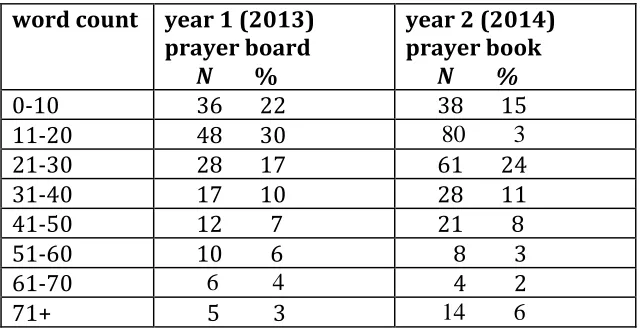
The word counts for individual prayers left from May through to August for year 1
(2013) and year 2 (2014) are collated in Table 2. The percentage figures show that the
word count brackets above 30 words displayed only slight variation according to
whether the prayers were pinned on a prayer board within ‘congregational space’ or
whether they were written in a spiral-bound book within experimentally-shaped
‘space for prayer and reflection’. There was more differentiation, however, in the
word count brackets below 30 words, which show that the shortest prayers (no longer
than 10 words) were more likely to be pinned on the prayer board in ‘congregational
space’, accounting for 22% of the total prayer board prayers compared with 15% of
the spiral-bound book prayers. At the same time, however, the most frequent word
count for prayers left in both kinds of space was between 11-20 words, which
accounted for around 30% of prayers. In addition, in both kinds of space, around 70%
of all prayers left had word counts of no more than 30 words.
Comparing prayer type
The prayer type of prayers left from May through to August for year 1 (2013) and
year 2 (2014) are collated in Table 3. The percentage figures show that there was only
slight variation among the categories of prayer described as petitionary, thanksgiving,
or adoration according to whether the prayers were pinned on a prayer board within
‘congregational space’ or whether they were written in a spiral-bound book within
experimentally-shaped ‘space for prayer and reflection’. In terms of prayers classified as ‘confession’, however, a major difference was discernable with 8% of all prayers
left in the spiral-bound book displaying an element of ‘confession’, while there were
no examples of this type of prayer among prayers pinned on the prayer board. As
expected of written prayer requests left in a church-related building, the majority of
prayers left in both kinds of space included petitionary elements (over 90%), although
board and 18% for the spiral-bound book) when compared with previous studies (for
example, ap Siôn, 2015a, p. 174).
The proportion of prayers that included a ‘thank you’ for the offering or
receiving of a prayer was similarly high for both kinds of space, and particularly so
for prayers left in the spiral-bound book where 22% of prayers said ‘thank you’
compared with 17% for the prayer board prayers.
References made to prayers that had been answered were equally low in both
kinds of spaces.
Comparing prayer relationships
An overview of the nature of the prayer relationships visible in prayers left from May
through to August for year 1 (2013) and year 2 (2014) is presented in Table 4.
Comparison of the two years highlights major differences in prayer relationships
found in year 1 with the prayer board prayers and year 2 with the spiral-bound book
prayers. As the results indicate, these differences are particularly evident in areas
which show awareness of a prayer relationship involving community, with a stronger
sense of ‘community’ manifested in the year two spiral-bound book prayers. In
addition, for year 2, 18% of the prayers involving ‘community’ explicitly recognised
the presence of other pray-ers within the spiral-bound book prayer community, which
accounted for 9% of the total number of prayers written.
A more detailed analysis of the prayers reveals the presence of multiple prayer
relationships in some individual prayers. With reference to the prayer relationships
articulated in the prayer board prayers of year 1 (2013), of the 162 prayers, 148 (91%)
articulated only one explicit prayer relationship conceived of as being with the Divine
in 101 prayers (62%), or with the Cathedral community in 23 prayers (14%), or with
Others living or dead in 5 prayers (3%), while 19 prayers (12%) expressed no explicit
prayer relationship. The remaining 14 prayers (9%) articulated two explicit prayer
relationships conceived of as being with the Divine and the Cathedral community in 8
prayers (5%) or with the Divine and Others living or dead in 6 prayers (4%).
With reference to the prayer relationships articulated in the spiral-bound book
prayers of year 2 (2014), of the 254 prayers, 211 (83%) articulated only one explicit
prayer relationship conceived of as being with the Cathedral community/prayer book
community in 107 prayers (42%), or with the Divine in 101 prayers (40%), or with
prayer relationship. The remaining 24 prayers (9%) articulated two explicit prayer
relationships conceived of as being with the Cathedral community/prayer book
community and the Divine in 22 prayers (9%) or with the Cathedral
community/prayer book community and Others living or dead in 2 prayers (1%).
Comparing prayer content using the apSAFIP
The ap Siôn Analytic Framework for Intercessory Prayer (apSAFIP) was applied to
prayers left from May through to August for year 1 (2013) and year 2 (2014) and the
results are presented in Table 5, Table 6 and Table 7. In order to apply the apSAFIP to
the prayers, the prayers were separated into individual prayer petitions. Of the 162
prayers left in year 1, there were 196 petitions, and of the 254 prayers left in year 2,
there were 333 petitions.
Table 5 compares the prayer reference (which identifies for whom the prayer
is intended) of the petitions in year 1 and 2. Although there is minor variation in the
results for ‘other people’ known to the prayer author and ‘animals’ known to the
prayer author and no difference at all in terms of prayer for ‘self’, there is a marked
difference in the prayers with a ‘global’ reference, with 25 petitions (13%) among the
prayer board prayers of year 1 and 70 petitions (21%) among the spiral-bound book
prayers of year 2. Part of this increase may be attributed to petitions for other pray-ers
in the book, which were categorized as ‘global’ in reference because those being
prayed for were not directly known by the prayer authors.
Table 6 compares the prayer intention (which identifies the areas for which the
prayer authors were concerned) of the petitions in year 1 and year 2. The distribution
and frequency of the results for both years are very similar, apart from some
variations in petitions for ‘relationships’ (4% in year 1 compared with 9% in year 2), ‘general’ concerns (24% in year 1 and 20% in year 2), and ‘disaster conflict’ (5% in
year 1 and 8% in year 2).
Table 7 compares the prayer objective (which identifies the prayer author’s
envisaged consequence of prayer) of the petitions in year 1 and year 2. The results
show that although ‘primary control’ (directing the outcome of the prayer) was most
prevalent in the petitions for both years, it was greater in year 1 (82%) than in year 2
(74%), and within ‘primary control’ there was also a slight preference in year 1 for
Conclusion
This study has been set within the two broad contexts of physical sacred place as
typified by the historic churches and cathedrals in England and Wales and different
kinds of belonging in relation to sacred place as defined by Walker (2006).
Recognising the complexity of relationships among place, congregations, and those
who are drawn to churches and cathedrals for personal prayer and reflection outside
congregational services and activities, this study set out to explore whether the
shaping of sacred space by churches and cathedrals had any effect on the prayers left
by those who are made visible predominantly by what they leave behind.
In the four-year study, two different kinds of space were established in the
Lady Chapel of an Anglican Cathedral in Wales, where personal written prayer
requests were left either on a prayer board or in a spiral-bound book. One space was
identified as ‘congregational space’ with congregational activity as the primary focus
or orientation of the presentation of space, and the other space was identified as
‘space for personal prayer and reflection’, with personal religious or spiritual activity
as the primary focus or orientation of the presentation of space. Personal written
prayer left in both kinds of space were analysed and compared according to prayer
frequency, prayer length, prayer type, prayer relationships, and prayer content (using
the ap SAFIP).
Five main conclusions are drawn from the results of these analyses, which
build on existing research concerned with sacred place and prayer and have
implications for cathedrals and churches in terms of enriching understanding and
informing development of their provision for personal prayer and reflection. First,
cathedrals and churches offer significant spaces for personal prayer and reflection for
those outside gathered congregations, and there is evidence to suggest that the way
physical space is shaped has observable effects on the written prayer requests, and by
implication on those who write them. These effects were apparent in relation to prayer
frequency, prayer type, prayer relationships, and aspects of prayer content.
Second, in terms of prayer frequency, it was observed that when space had
been intentionally created with personal prayer and reflection as the primary focus,
the number of prayers left in that space saw a marked increase when compared with
the number of prayers left in the normal default position of ‘congregational space’.
This may raise questions about whether a space explicitly shaped for and identified as
welcome in that space and that the cathedral recognises and takes seriously its
ministry in relation to them.
Third, in terms of prayer type, it was observed that 8% of prayers left in ‘space
for prayer and reflection’ and in the spiral-bound book had a confessional element, which was an element wholly absent from prayers left in ‘congregational space’ and
on the prayer board. It is unclear why this was the case. Perhaps the more formal and
‘permanent’ presentation of the prayers in the book, accompanied by a notice
signaling that the prayers would be offered at a weekday Eucharist service prompted
the appearance of this prayer type. It is also possible that the more focused and
reflective environment in which people found themselves prompted such
introspection. In addition, it would appear that those using the prayer facilities in
‘space for prayer and reflection’ were slightly more inclined to offer prayers of
thanksgiving and more likely to show recognition of the presence and intentions of
the cathedral community by saying ‘thank you’.
Fourth, in terms of prayer relationships, considerable differences were
observed between written prayers left in the two kinds of spaces. Those leaving
prayers in ‘space for prayer and reflection’ and in the spiral-bound book were much
more likely to recognise explicitly that they were in some kind of relationship with
the cathedral community and other pray-ers who were also writing prayer requests.
This heightened sense of community is particularly interesting because it challenges
and enriches understanding about what it may mean for this largely invisible group of
people to belong to church. In addition, these results may encourage cathedral and
church communities to reflect critically on how they shape space, knowing that their
efforts in this expression of ministry may be both recognised and appreciated by those
who engage with it.
Fifth, in terms of prayer content (using the apSAFIP) one of the main
differences between the payers left in the two kinds of spaces was concerned with
prayer reference (which identifies for whom the prayer is intended). Considerably
more prayers left in the ‘space for prayer and reflection’ had a global reference (that
is, they had a reference point beyond the immediate daily lives of the prayer authors)
when compared with prayers left in ‘congregational space’. This may be a reflection
of a broader and more complex sense of relationships that has been stimulated by the
To conclude, Walker (2006, p. 92) argues that ‘belonging as a theological
concept is sufficiently powerful to demand the church pays full attention to it, both
responding appropriately to its manifestations and promoting it at various levels of its
work.’ The results of this study help to enable the Church to listen carefully and make
an informed response to a group of people who belong in a distinctively hidden but
present way, made visible by the signs that they leave behind in churches and
cathedrals around England and Wales. By consciously creating ‘a place of prayer for
the other’, which is sensitive to and respectful of the differences of the other,
cathedral and church communities may be creatively challenged both in their
perceptions of the depth of faith within alternative kinds of belonging and in how they
act as key to enabling this faith to exist and to thrive.
Notes
This study is part of the Sacred Space and Prayer Project based at the University of
Warwick and the St Mary’s Centre, Wales and jointly led by the Revd Dr Tania ap
References
ap Siôn, T. (2015a). Prayer requests in an English cathedral, and a new analytic framework for intercessory prayer. In G. Giordan & L.Woodhead (Eds.), A sociology of prayer (pp. 169–190). Farnham, Ashgate.
ap Siôn, T. (2015b). Prayers from the inner city: Listening to the prayer board in Southwark Cathedral. Research in the Social Scientific Study of Religion, 26, 99–119.
ap Siôn, T. 2015c. Ministry of the cathedral prayer-board. In L. J. Francis (Ed.), Anglican cathedrals in modern life: The science of cathedral studies (pp. 131–153). New York (NY): Palgrave Macmillan.
ap Siôn, T. (2016). The Church of England’s Pray One for Me intercessory prayer site: A virtual cathedral? Journal of Beliefs and Values, 37 (1), 78-92.
ap Siôn, T., & Edwards, O. (2012). Praying ‘online’: The ordinary theology of prayer intentions posted on the internet. Journal of Beliefs and Values, 33, 95–109.
ap Siôn, T. (In Press). Lighting candles and writing prayers: Observing spiritual practices in churches in rural Cornwall. Research in the Social Scientific Study of Religion.
Best, S. & Kellner, D. (Eds.) (2001). The postmodern adventure: Science,
technology and cultural studies at third millennium. New York, The Guilford Press.
Hassan, I. (1985). The culture of postmodernism. Theory, Culture and Society, 2 (3), 119-131.
Helland, C. (2000). Online religion/religion online and virtual communitas. In J. K. Hadden & D. E. Cowan(Eds.), Religion on the internet: Research prospects and promises (pp. 205–224). New York (NY): JAI Press.
Hutchings, T. (2010). The internet and the church: An introduction. The Expository Times,122, 11–19.
Sharpley, R. & Jepson, D. (2011). Rural tourism: A spiritual experience? Annals of Tourism Research, 38 (1), 52-71.
Sharpley, R. & Sundaram, P. (2005). Tourism: a sacred journey? The case of ashram tourism, India. International Journal of Tourism Research, 7 (3), 161-171.
Sheldrake, P. (2001). Spaces for the sacred: Place, memory, and identity. London, SCM Press.
Stausberg, M. (2011). Religion and tourism: Crossroads, destinations and encounters. London, Routledge.
Walker, D. S. (2009). The social significance of Harvest festivals in the countryside: An empirical enquiry among those who attend. Rural Theology, 7 (1), 3-16.
Table 1. Prayer frequency (years 1-4, May-August)
Table 2. Prayer length (year 1 – 2013 prayer board N=162; year 2 – 2014 prayer book N=254)
Table 3. Prayer type (year 1 – 2013 prayer board N=162; year 2 – 2014 prayer book N=254)
* Note: one or more types of prayer may be present in one prayer.
prayer year prayer number
year 1 (2013) 162 year 2 (2014) 254 year 3 (2015) 184 year 4 (2016) 172
word count year 1 (2013) prayer board
N %
year 2 (2014) prayer book N % 0-10 36 22 38 15 11-20 48 30 80 3 21-30 28 17 61 24 31-40 17 10 28 11 41-50 12 7 21 8 51-60 10 6 8 3 61-70 6 4 4 2 71+ 5 3 14 6
prayer ‘type’ * year 1 (2013)
prayer board
N %
year 2 (2014) prayer book
N %
petitionary 151 93 243 96 thanksgiving 24 15 46 18 adoration 3 2 9 4 confession 0 0 20 8
[image:21.595.89.463.582.725.2]Table 4. Prayer relationships (year 1 – 2013 prayer board N=162; year 2 – 2014 prayer book N=254)
relationship* year 1 (2013)
prayer board
N %
year 2 (2014) prayer book
N %
God/saint/direct 115 71 123 48 community A: cathedral 31 19 131 52 community B: board/book 0 0 24 18 others living and dead 11 7 5 2 no reference 19 12 19 7
[image:22.595.87.509.346.446.2]* Note: one or more relationships may be present in one prayer.
Table 5. apSAFIP prayer reference (year 1 – 2013 petitions N=196; year 2 – 2014 petitions N=333)
prayer reference year 1 (2013)
prayer board
N %
year 2 (2014) prayer book
N %
other people 123 63 189 57
self 44 22 73 22
global 25 13 70 21
animals 4 2 1 <1%
Table 6. apSAFIP prayer intention (year 1 – 2013 petitions N=196; year 2 – 2014 petitions N=333)
prayer intention year 1 (2013)
prayer board
N %
year 2 (2014) prayer book
N %
[image:22.595.91.509.517.717.2]Table 7. apSAFIP prayer objective (year 1 –2013 petitions N=196; year 2 – 2014 petitions N=333)
prayer objective year 1 (2013)
prayer board
N %
year 2 (2014) prayer book
N %