ISSN Online: 2327-5227 ISSN Print: 2327-5219
Parameter Estimation of Maneuvering Target
Using Maximum Likelihood Estimation for
MIMO Radar with Colocated Antennas
Hai Li, Ling Xu, Zhe Zhang
Tianjin Key Lab. for Advanced Signal Processing, Civil Aviation University of China, Tianjin, China
Abstract
The estimation of target parameters in MIMO radar signal processing is one of the most important research topics. An efficient implementation of the Maximum Likelihood estimator is presented in this paper to estimate the DOA (Direction of Arrival), initial velocity and acceleration of a maneuvering target in colocated MIMO radar. The target’s DOA is estimated in the first place, then a Maximum-Likelihood (ML) estimation based on peak search is applied to a two-dimensional grids providing estimation of initial velocity and acceleration. Simulations show that the MIMO radar has a better performance in DOA estimation than the phased array radar. By means of Monte Carlo simulations, the estimation error of initial velocity and acceleration on differ-ent SNRs are calculated. The results also suggest the effectiveness of this me-thod.
Keywords
MIMO Radar, Parameter Estimation, Maximum Likelihood Estimation
1. Introduction
The Multiple-Input Multiple-Output (MIMO) Radio Transmission Technology, has the potential to enhance system capacity and improve spectral efficiency without requiring extra emission signal bandwidth or transmission power [1] [2]. The overwhelming popularity of MIMO systems draws radar researchers’ atten-tion to engage MIMO techniques in radar systems implementaatten-tion.
MIMO radar employs multiple elements at both transmitting and receiving antennas as the phased array radar does, on flip side, MIMO radar transmits or-thogonal or partially correlated waveforms. According to the antenna configura- tion, MIMO radar systems can be classified into two categories: collocated
(co-How to cite this paper: Li, H., Xu, L. and Zhang, Z. (2017) Parameter Estimation of Maneuvering Target Using Maximum Like- lihood Estimation for MIMO Radar with Colocated Antennas. Journal of Computer and Communications, 5, 69-74.
https://doi.org/10.4236/jcc.2017.53008 Received: March 2, 2017
herent) MIMO radars are those with closely spaced antennas [3]. While distri-buted MIMO radars, also known as non-coherent MIMO radars, whose anten-nas are placed far from each other [4]. The latter configuration exploits the ran-dom fluctuation of the targets’ Radar Cross Section (RCS). This fluctuation causes spatial decorrelation between target echoes, which prevents coherent processing. It is known that spatial resolution can be improved by taking advan-tage of coherent processing introduced by coherent MIMO radar. Several me-thods have been proposed for DOA estimation offering significant estimate per-formance without considering Doppler effects [5] [6]. As shown in [7] and [8], parameters of moving target can be measured by the maximum likelihood esti-mator for distributed MIMO radar. There are many efforts have been made on joint DOA and Doppler frequency estimation [9] [10], while few studies have yet been conducted on maneuvering targets.
This paper considers parameters estimation of maneuvering target in colo-cated MIMO radar by developing a maximum-likelihood estimator. The MUl-tiple SIgnal Classification (MUSIC) is applied in the first place to estimate DOA, followed by a two-dimensional search applied to estimate the velocity and acce-leration. Performance of estimation for phased array radar and MIMO radar are compared under the same condition. The root mean square errors (RMSE) of the ML estimation of target parameters are obtained by Monte Carlo simulations. Numerical results demonstrate that MIMO radar has better angle estimation performance compared with conventional phased array radar and verify the ef-fectiveness of this method as well.
2. MIMO Radar Signal Model
Let’s consider a MIMO radar system in which there are M transmitting an-tennas and N receiving antennas, with inter-element spacing of dt and dr, respectively. Radar working wavelength is λ.The signal emitts from the m-th antenna, is defined as sm
( )
l =[sm( ) ( )
1 ,sm 2 ,,sm( )
L ] ,T m=1, 2,,M, where L is the length of coded pulse signal, with( )
⋅T denoting the transpose of ma-trices. Assuming the different transmitting signals are orthogonal, then transmit steering vector of the array towards direction θ can be denoted as( )
2 cos 2 ( 1) cos1, , ,
t t T
d d
j j M
T e e
θ θ
π π
λ λ
θ = −
a (1)
and the receive steering vector is
( )
2 cos 2 ( 1) cos1, , ,
r r T
d d
j j N
R e e
θ θ
π π
λ λ
θ = −
a (2)
Assuming that the target has a reflection coefficient β θ
( )
, moves with an in-itial radial velocity v and an acceleration a.The received signal at antenna n and time index l can be described by( )
( )
2 ( 1) cos 2( )
2 ( 1) cos( )
1
t r
d
d
d M
j n j f l j m
n m n
m
y l e e s l e w l
θ θ
π π π
λ λ
β θ − −
=
where fd represents Doppler shift caused by the maneuvering target, and
( )
n l
w is the noise components approximated by complex white Gaussian sam-ples at the n-th receiver. From (3) the received space-time matrix can be ex-pressed as
( )
( )
( ) ( ) ( )
2 d( )
T
j f l T
R
l =β θ ⋅ θ θ ⋅s l ⋅e π + l
y a a w (4)
The total L samples can be collected into a single matrix
( ) ( )
( )
fd β θ θ= ⋅ ⋅ ⋅ +
Y A S D W (5)
where
( )
( ) ( )
TT R
θ = θ θ
A a a ,
( )
(
1, jwt, , j L( -1)wt)
d
f =diag e e
D is an L L×
diagonal matrix, 2
2 / =2 2 / + 2 /
t fd fr v Tp a Tp
ω = π π⋅ ⋅ λ π⋅ ⋅ λ ,where Tp is the
pulse width, and W is an N×L noise matrix with a variance of σw2.
3. Maximum Likelihood Estimation
Let ψ =
[
θ v a]
T be the vector denoting the unknown parameters that need to be estimated. We use data Y as stated in (5) and be vectorized, then the re-ceived data vector y can be obtained, which follows a Gaussian probability density function whose mean is γ ψ( )
=vec(
β θ( ) ( )
A θ ⋅ ⋅S D( )
fd)
. Since a maneuvering target is discussed, the Doppler frequency fd involves two va-riables: initial velocity v and acceleration a.The probability density function of y is
(
)
2( ( )) ( ( ))1 2 1 , H w d NL NL
P f e
ψ ψ σ θ π σ − − −
= y y
y
γ γ
(6)
where
( )
H⋅ denotes the conjugate transpose. The corresponding log-Likelihood
function for radar data can then be described as
( )
21
, , , ,
H H H H
d d d d
w
P ψ C θ f θ f θ f θ f
σ
′ = − (y y−y γ( )−γ( ) y+γ( ) (γ )) (7)
where C is a constant which does not depend on ψ . To estimate the value of θ and fd, the cost-function to be maximized is given by
( )
{
}
ˆ arg max
arg min{ H H , d , d H , d H , d} P
f f f f
ψ
ψ
ψ ψ
θ θ θ θ
′ =
= y y−y γ( )−γ( ) y+γ( ) (γ ) (8)
The first term H
y y in (8) does not depend on ψ . The final term
,fd H ,fd
θ θ
( ) ( )
γ γ is constant with respect to fd and θ. By exploiting the rela-tion vec
(
ASD)
=(
DT⊗A)
vec( )
S , where ⊗ denotes Kronecker product, we have
( ) ( ) ( )
(
)
(
( ) ( ) ( )
)
( )
( )
(
)
( )
(
( )
( )
)
( )
( )
(
( )
( )
)
(
( )
( )
)
( )
( )
(
( ) ( )
)
(
( ) ( )
)
, , H Hd d d d
H
T T
d d
H H T
d d
H T H
d d
f f vec f vec f
f vec f vec
vec f f vec
vec f f
θ θ β θ θ β θ θ
θ θ θ θ θ θ ∗ ∗ = = ⊗ ⊗ = ⊗ ⊗ = ⊗
A SD A SD
D A S D A S
S D A D A S
S D D A A
( ) ( )
γ γ
( )
( )
(
( ) ( )
)
( )
(
2)
H H L L L L vec vec vec N L θ θ × × = ⊗ = × ⋅ SS I A A S
I
It can be easily shown that the product in (9) yields a diagonal matrix with diagonal elements maintain a constant which equals to 2
N L. Therefore the cost-function in (8) can be simplified as
(
) (
)
{
}
ˆ arg max H , , H
d d
f f
ψ
ψ = y γ θ +γ θ y (10)
In order to find the maximum likelihood estimations of the unknown meters, it is necessary to perform a three-dimensional (3-D) search in the para-meter space. From a practical point of view, such a 3-D search, for all possible values of DOA, velocity and acceleration of a target, can cause tremendous computational burden. Therefore, we propose a two-stage sequential estimation process.
As we simplify the target moving scenario by assuming the target is moving along a certain direction, a classical sub-space method, multiple signal classifica-tion, is used to estimate the DOA of the target which can be treated as static or relatively static. Then the estimation of initial velocity and acceleration can be obtained when the cost function in (10) achieves its maximum.
4. Simulations
We consider a MIMO radar with 6 antennas both on transmitting and receiving ends. Antennas are uniformly spaced with an distance of λ/ 2 , where
0.23 m
λ = . Each transmitter transmits different Hadamard codes with the same carrier frequency. The code length is set to L=64 and code duration is
4 5 10 p
T = × − s. The azimuth of the target is θ =45, the initial velocity of the
maneuvering target is v=24.01m s/ and acceleration is a=99.9 m s/ 2.
Ini-tial velocity searching range is from 0m s/ to 40m s/ , acceleration searching
range is from 2
70m s/ to 2
130m s/ , the step for searching of initial velocity
and acceleration are set to 0.25m s/ and 0.05m s/ 2, respectively.
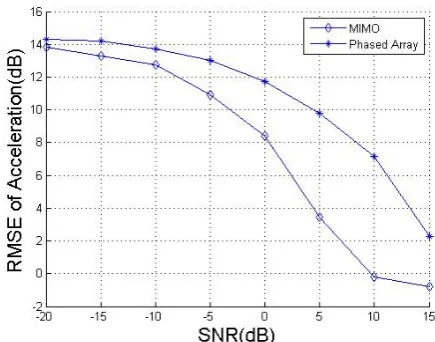
Monte Carlo simulations with 200 trials per signal-to-noise ratio (SNR) were conducted to acquire the RMSE of the ML estimation. The RMSE of DOA is shown in Figure 1, which indicates that MIMO radar has better angular estima-tion performance than phased array radar. The RMSE of initial velocity is shown in Figure 2, and that of acceleration is shown in Figure 3. Under various SNRs, MIMO radar and phased array radar both can obtain excellent estimation per-formance in estimating initial velocity and acceleration of maneuvering targets.
5. Conclusions
This paper studies the performance of parameters estimation of maneuvering target in coherent MIMO radars with the application of maximum likelihood es-timation. Numerical simulation results show that MIMO radar has a better an-gular resolution than conventional phased array radar. The effectiveness of maximum likelihood estimator is also verified through the simulations.
Acknowledgements
Figure 1. RMSE of DOA.
Figure 2. RMSE of initial velocity.
Figure 3. RMSE of acceleration.
[image:5.595.263.481.470.641.2]References
[1] Goldsmith, A., Jafar, S.A., Jindal, N. and Vishwanath, S. (2003) Capacity Limits of MIMO Channels. IEEE Journal on Selected Areas in Communications, 21, 684-702.
https://doi.org/10.1109/JSAC.2003.810294
[2] Cui, S.G., Goldsmith, A.J. and Bahai, A. (2004) Energy-Efficiency of MIMO and Cooperative MIMO Techniques in Sensor Networks. IEEE Journal on Selected Areas in Communications, 22, 1089-1098.
https://doi.org/10.1109/JSAC.2004.830916
[3] Li, J. and Stoica, P. (2007) MIMO Radar with Colocated Antennas. IEEE Signal Processing Magazine, 24, 106-114.https://doi.org/10.1109/MSP.2007.904812
[4] Haimovich, A.M., Blum, R.S. and Cimini, L. (2008) MIMO Radar with Widely Se-parated Antennas. IEEE Signal Processing Magazine, 25, 116-129.
https://doi.org/10.1109/MSP.2008.4408448
[5] Dang, X.F., Ma, K., Chen, B.X. and Yang, M.L. (2016) Direction of Arrival Estima-tion for Monostatic MIMO Radar Using Reduced-dimension RISR Algorithm. 11th International Symposium on Antennas, Propagation and EM Theory (ISAPE), Gui-lin, China, 18-21 October 2016, 607-611.
[6] Hokiguchi, M., Kikuma, N. and Sakakibara, K. (2016) Target Direction Estimation by MIMO Radar Using Root-MUSIC with Minimum Redundancy Array, Interna-tional Symposium on Antennas and Propagation (ISAP), Okinawa, Japan, 24-28 October 2016, 1036-1037.
[7] He, Q., Blum, R.S., Godrich, H. and Haimovich, A.M. (2010) Target Velocity Esti-mation and Antenna Placement for MIMO Radar with Widely Separated Antennas. IEEE Journal of Selected Topics in Signal Processing, 4, 79-100.
https://doi.org/10.1109/JSTSP.2009.2038974
[8] Jiang, M., Huang, J.G. and Hou, Y.S. (2010) MIMO Radar Joint Estimation of Tar-get Location and Velocity with Multiple Subcarrier Signals. IEEE International Symposium on Phased Array Systems and Technology. Boston, 12-15 October 2010, 398-402. https://doi.org/10.1109/ARRAY.2010.5613338
[9] Sajjadieh, M.H.S. and Asif, A. (2015) Compressive Sensing Time Reversal MIMO Radar: Joint Direction and Doppler Frequency Estimation. IEEE Signal Processing Letters, 22, 1283-1287.https://doi.org/10.1109/LSP.2015.2396650
[10] Wang, N., Wang, W.G., Zhang, F. and Yuan, Y.N. (2014) The PARAFAC-MUSIC Algorithm for DOA Estimation with Doppler Frequency in a MIMO Radar System. International Journal of Antennas and Propagation, 2014, 1-5.
https://doi.org/10.1155/2014/684591
Submit or recommend next manuscript to SCIRP and we will provide best service for you:
Accepting pre-submission inquiries through Email, Facebook, LinkedIn, Twitter, etc. A wide selection of journals (inclusive of 9 subjects, more than 200 journals)
Providing 24-hour high-quality service User-friendly online submission system Fair and swift peer-review system
Efficient typesetting and proofreading procedure
Display of the result of downloads and visits, as well as the number of cited articles Maximum dissemination of your research work
Submit your manuscript at: http://papersubmission.scirp.org/