Short-range action and long-range action of the
electrostatic forces within atomic nuclei
Dragia Ivanov, Kiril Kolikov*
Plovdiv University “Paisii Hilendarski”, Plovdiv, Bulgaria; *Corresponding Author: [email protected]
Received 30 January 2013; revised 28 February 2013; accepted 15 March 2013
Copyright © 2013 Dragia Ivanov, Kiril Kolikov. This is an open access article distributed under the Creative Commons Attribution License, which permits unrestricted use, distribution, and reproduction in any medium, provided the original work is properly cited.
ABSTRACT
We study the interaction forces in atomic nuclei based on our expressions for the electrostatic interaction between spheres of arbitrary radii and charges. We prove that at small distances the proton-neutron electrostatic attraction forces are short-range-acting and the proton-proton electrostatic repulsion forces are long-range- acting. We obtain that these forces are com- mensurate with the nuclear forces. The proton- neutron electrostatic attraction forces and the proton-proton electrostatic repulsion forces at the same distance between nucleons differ in absolute value by about an order of magnitude. It follows that based on electromagnetic inter- actions the neutrons are the binding building blocks in nuclear structures.
Keywords:Nucleon; Electrostatic Force of Interaction; Strong Interaction; Long-Range-Acting Forces; Short-Range-Acting Forces
1. INTRODUCTION
Let 1 and 2 be two point electric charges and R be the distance between them. Then, according to Cou- lomb’s law the magnitude of the interaction force be- tween them in vacuum is
q q
2 1 2 4π 0
Fq q R (0 is the dielectric constant of vacuum). Thus the Coulomb forces are inversely proportional to R2
F~ 1R2
and de- crease slowly with the increase of the distance R. There- fore they are so-called long-range-acting forces.For dimensional objects however, it is possible that electrostatic forces be short-range-acting. A typical ex- ample in this regard is the attraction and repulsion force between molecules. These forces are electrostatic in na- ture and change very fast with distance. At small dis- tances between molecules the attraction forces (van der
Waals forces) are inversely proportional to the seventh power of distance
F~ 1 R7
, and the repulsion forces are inversely proportional to the thirteenth power
F~ 1 R13
. So the intermolecular forces are short-range-acting.
As is well known from numerous experiments, one of the main features of the forces acting inside the nucleus between protons and neutrons (so-called nuclear forces) is their short-range action. From various scattering ex- periments it has been determined that the radius of inter- action between nucleons is of the order of 10−15 m. It is claimed that at such distances the nuclear forces are sub- stantially bigger than electromagnetic forces. Moreover, inside the nucleus these forces are huge, but to its outside even in close proximity they are insignificant. With the increase of the distance between nucleons the nuclear forces decrease significantly faster than electromagnetic forces.
Back in 1956 Hofstadter [1] conducted experiments showing that protons and neutrons have a complex in- ternal electric structure. Studies with fast electrons al- lowed uncovering distribution of the charges along the radius of nucleons [2]. The proton possesses an elemen-
tary positive charge [3].
The neutron has both a positive and a negative charge, which cancel out so that the neutron can be considered as electrically neutral, i.e. has a charge of .
19 1.6021764874 10 C
p
0 C n
The structure of nucleons and the fact that they are lo- cated at very small distances between each other inside the nucleus presents a strong argument to model them as dimensional objects, whose charges can redistribute wi- thin their volumes when they interact with external char- ges. This assumption is completely natural if we assume that the charges of the proton and the neutron are made up of quarks.
D. Ivanov, K. Kolikov / Natural Science 5 (2013) 508-513 509
in the most general way exact analytical expressions for the magnitude of the force and the binding energy of their interaction. We also determine the potential in an arbitrary point of the electromagnetic field created by the two spheres. These results can be applied with some ap- proximation to non-spherical bodies with a single center of symmetry by modeling them with spheres of equiva- lent surface area [4].
Through the general formulas we have obtained, it is possible to determine for the first time the force and en- ergy of interaction between two charged spheres located at a distance significantly smaller than their radii. In [5,6] we have used these results to determine the electrostatic interaction between nucleons in atomic nuclei.
At the root of intermolecular forces lies the electro- static interaction, while the magnetic forces play an in- significant role. In our considerations, we can assume with some approximation that the magnetic force be- tween the nucleons will not play a significant role, so that the electrostatic forces are dominant in the interac- tion. This assumption is justified by the results we have obtained in [5,6].
The experimentally measured radii of the proton and neutron are rp = 0.84184 × 10⁻¹⁵ m [7] and rn = 1.1 ×
10−15 m [2], respectively. Therefore, we consider the nu- cleon couples at a distance of between their surfaces.
15 10 m
We prove that in atomic nuclei authoritative are the short-range-acting proton-neutron electrostatic attraction forces as well as the long-range-acting proton-proton electrostatic repulsion forces. We also obtain that these forces are commensurate with the nuclear forces.
2. QUANTIFICATION OF THE
ELECTROSTATIC INTERACTION
FORCES BETWEEN NUCLEONS
MODELED AS SPHERES
We consider the nucleons as spheres similar to their representation in the standard model [8-10]. Let us de- note with Sp the sphere that models the proton and
with n—the sphere modeling the neutron. Based on
the assumption that the charges of the proton and the neutron can be redistributed within their volumes, we shall assume with some approximation that
S
p S
2
and n
are conducting spheres. Following the procedure outlined in [4], we find the interaction force
S
1,
p p
F S S between the spheres 1
p S , 2
p
S (modeling two protons), and the force F S S
p, n
between the spheres Sp, n (model-ing a proton and a neutron) as a function of the distance between their centers R.
S
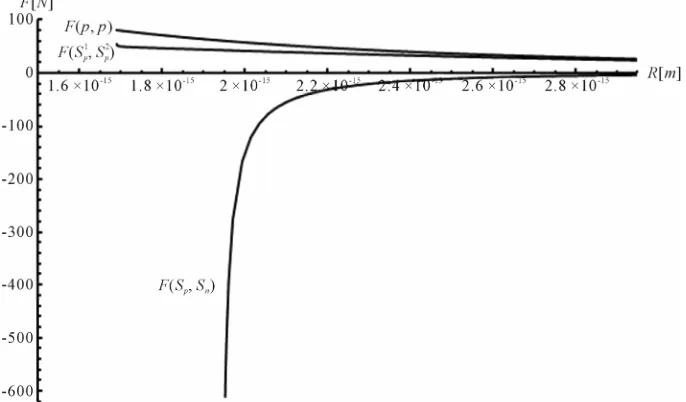
The results are presented on Figure 1. For the sake of
demonstrability and clear comparison, we have also plot- ted the force F p p
,
between two protons assumed as point charges according to Coulomb’s law.The curve representing interaction force for the pro- ton-neutron system is displaced to the right along the R axis, because the radius rn = 1.1 × 10⁻¹⁵ m and the radius rp = 0.84184 × 10⁻¹⁵ m so n p.
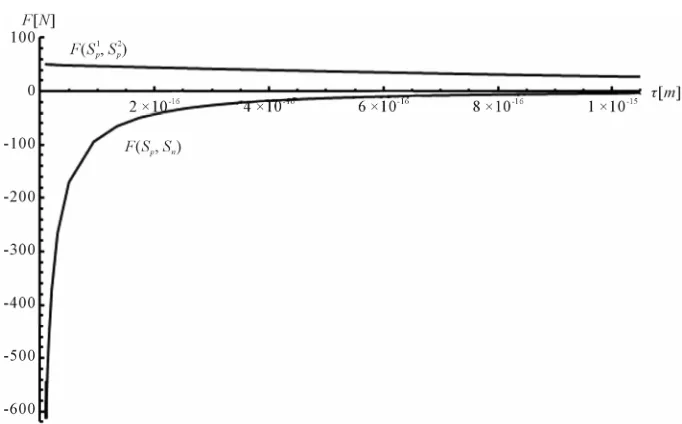
For better clarity in the comparison between the inter- action forces we present on Figure 2 the dependence of
the forces
R r r
1, 2
p p
F S S and F S S
p, n
on the distance 17m;1 1015
1 10 m
between the surfaces of the nucleon modeling spheres.
Close examination of the curves depicted in Figures 1
Figure 1. Example plot of the interaction forces F p p
,
, F S S
1p, 2p
and F S S
p, n
1
de- pending on the distance R between: point charges p, p; the centers of spheres Sp
2
, Sp; the
[image:2.595.127.470.485.686.2]Figure 2. Plot of the forces between the spheres S1p,
2
p
S and Sp, Sn depending on the dis-
tance τ between their surfaces.
and 2 leads to some very interesting and quite unex-
pected conclusions about the electrostatic forces between nucleons (modeled as conducting spheres) within the nuclei:
1) The proton-proton repulsion force
1, 2
p p F S S is long-range-acting, with its plot lying even lower than the force F p p
,
between protons assumed to be point charges (Figure 1);2) The proton-neutron attraction force F S S
p, n
is short-range-acting with characteristic radius of the order of 10−15 m between the centers of the spheres, and is practically zero at distances greater than this radius (Figure 1).3) At small distances between the proton and the neu- tron the attraction force F S S
p, n
rapidly increases in absolute value (Figures 1 and 2).4) At the same small distances between the surfaces of the interacting nucleons the proton-neu- tron attraction force
17 10 m
p, n
F S S
1 2
is one order of magni- tude larger in absolute value than the proton-proton re- pulsion force F S S
p, p (Figure 2).It is worthwhile to note that according to Figure 1 one
can assume (with some approximation) that the forces
1, 2
p pF S S and F p p
,
are equal, i.e. for proton- proton interactions we can assume the proton charge to be point-like. However, when we calculate the interac- tion between a proton and a neutron, as we proved in [5], the proton should not be considered as a point charge.For , based on [4] as well as in [5], we can determine the potential energy of interaction
17 15
10 m,10 m
1, 2
p p andW S S W S S
p, n
1 correspondingly between the spheres Sp
2
, Sp and the spheres Sp, n. The nu-
meric values for the force and potential energy for dif-
ferent distances
S
between the nucleon surfaces are presented in Table 1.
For the force and interaction energy in- crease in absolute value.
17 10 m
Taking into account the shape of the curve for the pro- ton-neutron attraction force F S S
p, n
from Figure 1,we shall assume that
1, ~
p Sn , i.e.
p, n
A F S S
R
,
F S
R
where Aconst. Then, if F1F S S1
p, n
A R1 and
2 2 p, n 2
F F S S A R , it follows that 2 1
1 2
F R
F R
, or
equivalently
12 12
ln ln
F F R R
.
Since R1 rp rn 1 and R2 rp rn 2
17 16
, then ac- cording to Table 1 for 10 m;10 m we ob-
tain that 76, i.e. F~ 1R76. This perfectly proves that at small enough distances the proton-neutron electro- static attraction force is strongly short-range-acting.
In [5] we have shown that the interaction energy
1, 2
p p
W S S W p p, . We have also found that the binding energy W S
p,Sn
between the spheres Sp and n can take values within the range of the known binding energy of the deuteron 12H .
However, based on the standard model it is not possible to obtain the larger binding energies of the triton, hellion,
S
13 3.5642 10 J
W
D. Ivanov, K. Kolikov / Natural Science 5 (2013) 508-513 511
Table 1. Force and interaction energy between the spheres S1p,
2
p
S and Sp, Sn.
m
1, 2 p p
F S S
N
p, n
F S S
N
1, 2
p p W S S
J
p, n
W S S
J
17
10 51.7264 −610.6788 1.1310 −1.7097
16
10 47.2967 −88.1231 1.0680 −0.53086
15
10 27.9881 −3.7940 0.80694 −0.050642
explains all the basic experimental results.
3. DETERMINING THE ELECTROSTATIC
INTERACTION FORCES BETWEEN
NUCLEONS MODELED AS TORI
We consider the nucleons as tori spinning with con- stant angular velocity around an axis z, passing through their center of masses (geometrical center) O and per- pendicular to their plane of rotation (Figure 3).
Denote by 1 p
T , 2 p
T the tori of the two protons and assume that the force
1, 2
p p ,
F T T F p p
p p,
and the energy
1,T2
W , that is in the case of pro-p p
W T
ton-proton interactions we assume their charges as point- like situated in the centers of the tori.
Let the proton and neutron be two tori Tp and Tn,
respectively, where the charge of Tp is p and the charge
of Tn is 0. The centers of the tori we denote as Op and n. Moreover, we assume that the central circles of
O Tp
and Tn with corresponding radii Rp and n lie in
parallel or coinciding planes and spin in the same or op- posite direction with constant angular velocities
R
around an axis z, passing through Op and and per-
pendicular to their plane of rotation. If n O
p n
O O h, then (Figure 4).
0
h
The radii of the proton Tp and the neutron Tn are
correspondingly rp = 0.84184 × 10⁻¹⁵ m and rn = 1.1 ×
10−15 m. Let us denote with the radius of the circle of the empty part of the torus
0
p q
p
T of the proton, i.e. 2
p p p
q R r .
We remodel the proton Tp with a sphere Sp, and the
neutron n with a torus N, equivalent in area. In addi-
tion,
T T
P
S and TN have the same centers and stand at
the same distance as in the case of Tp and
(Figure 5).
n
T
We apply a similar reasoning [5] for the interaction between conducting spheres. Therefore, for different val- ues of the radius qp of the empty part of Tp and the
distance between the surfaces of the nucleons, we ob- tain the following results for the forces and interaction energies between nucleons, which are presented in Table 2.
For qp0.6rp, or 1017m the force and binding
Figure 3. Toroidal model of a nu-
cleon.
Figure 4. Cross-section of a pro-
ton-neutron system.
Figure 5. Cross-section of the re-
duced model of a proton-neutron system.
Table 2. Force and interaction energy between the tori Tp1,
2
p
T and Tp, Tn, remodeled respectively as point charges p, p
and surface-equivalent sphere SP, torus TN.
p
q
m
1, 2 p p
F T T
N
p, n
F T T
N
1, 2
p p
W T T
J
p, n
W T T
J
17
10 869.51 −6486.05 4.4789 −7.7951
16
10 630.09 −251.04 3.8127 −0.7769
0.4rp
15
10 101.84 −2.06 1.5328 −0.0188
17
10 1242.42 −7120.70 5.3538 −7.9408
16
10 850.20 −252.18 4.4289 −0.7480
0.5rp
15
10 114.27 −1.85 1.6237 −0.0163
17
10 1918.95 −7772.87 6.6537 −8.1703
16
10 1209.55 −253.98 5.2825 −0.7151
0.6rp
15
10 129.11 −1.61 1.7259 −0.0137
[image:4.595.309.537.532.733.2]Figure 6. Plot of the interaction forces between the tori Tp1,
2
p
T and Tp, Tn, remodeled cor-
respondingly as point charges p, p and surface equivalent sphere SP, torus TN depending on the
distance τ between the tori for qp = 0.5rp.
energy increase in absolute value.
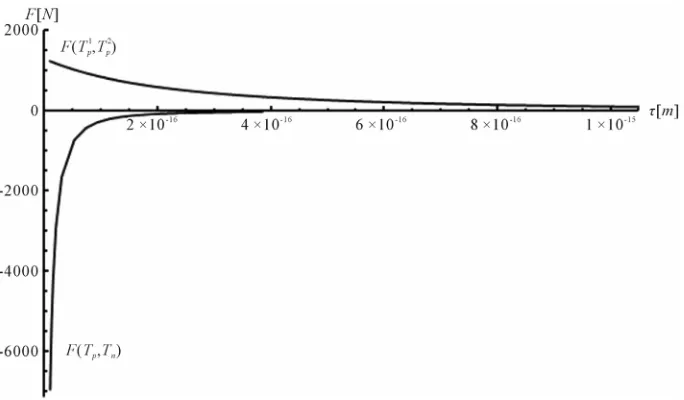
For qp0.5rp
and on
Figure 6 are presented the curves of
17 15
1 10 m;1 10 m
p, n F T T and
1, 2
p p ,
F T T F p p as a function of the distance be- tween the objects.
From the curves plotted on Figure 6 can be drawn
conclusions for the short-range scope of the electrostatic force of interaction F between a proton and a neutron modeled as tori, which are similar to those when mod- eled as spheres (see Figure 2). For in the order of
10−17 m, according to
Tables 1 and 2, the absolute value
of F in the toroidal model is an order of magnitude larger than that in the standard model.
From the values of the binding energy and the interac- tion force between the proton and neutron modeled as tori it follows that the nuclear interactions may have an electromagnetic nature.
4. DISCUSSION
Atomic nuclei are characterized by short-range-acting proton-neutron electrostatic attraction forces as well as long-range-acting proton-proton electrostatic repulsion forces.
The presence of a proton in immediate proximity to a neutron disrupts its neutral electrical structure. Due to its charge redistribution, it also interacts with other neutrons. Thus, the entire nucleus acts as a unified complexly in- teracting electrostatic system. But the short-range-acting nature and the large values of the attraction forces show that the neutrons are the binding particles in nuclear structures!
As is well known, with the exception of protium, all
nuclei are made up of protons and neutrons. According to the Segre diagram [11], if A is the mass number of the nucleus, then the stability of the nucleus depends on the parameter
A N p
NpN Nn p, that is the ratio be-tween the number of neutrons n and the number of
protons
N p
N . The light nuclei for which N Nn p1 are the most stable. With the increase of the mass number A the multiplication of the electrostatic repulsion between the protons is ever more manifested and the area of sta- bility is shifted to values N Nn p1. For the heaviest nuclei, the parameter n p1.5. The latter once again underlines the huge role of the neutrons for the sta- bility of atomic nuclei.
N N
As can be seen from the plots on Figures 1 and 3 the
proton-neutron forces of attraction are short-range-acting on distances of the order of 10−15 m. This interval covers the experimentally observed interval for short-range ac- tion of nuclear forces which is commonly accepted.
When kernels of proton and neutron penetrate each other, a huge force of repulsion occurs between them. This force can also be explained on the basis of our the- ory, taking into account the complex distribution of the internal charge in the nucleons. This will be done by us in the next article.
D. Ivanov, K. Kolikov / Natural Science 5 (2013) 508-513 513
range-acting they permeate the entire volume of the nu- cleus. Thus every proton in the nucleus interacts with all other protons and the repulsion force is multiplied as opposed to the attraction force. It turns out that the long- range action between protons is very effective. Because of that in heavy nuclei the number of neutrons is larger than the number of protons.
In more complicated nuclei very indicatively is being observed the action of the universal law of unity and struggle of opposites. Balance between the opposing forces—of attraction (short-range-acting) and repulsion (long-range-acting) leads to the unity—the presence of nuclei of chemical elements.
It is hardly the case that in the nucleus the short-range- acting electrostatic forces of attraction are combined with short-range-acting forces of a completely different nature —the so-called nuclear forces.
5. CONCLUSIONS
Based on our results for the short-range-acting char- acter of the proton-neutron electrostatic forces the basic properties of nuclear forces can be explained. Eloquent example is the property of “saturation of nuclear forces”. It is important to mention that the electromagnetic forces between two nucleons depend on whether they spin in the same or opposite directions, that is on the orientation of their spins.
The binding energies for the nuclei of deuterium—
1 2H
W = −3.5642 × 10⁻¹³, tritium— = −13.5895 ×
1 3H
W
13
10 J, helium-3— 2 and he-
3
13 He 12.352 10
W
13
J lium-4— 2
4He , obtained in [6] are
known and commonly accepted values. The binding en- ergy—one of the most important nuclear characteristics has been obtained from solely electrostatic considera- tions. We believe this fact cannot be due to an insignifi- cant coincidence.
32.92 23 10 J
W
In conclusion, we can assume that the nuclear forces have an electromagnetic nature.
6. ACKNOWLEDGEMENTS
The authors express their gratitude to the computer specialist Stefan
Bozhkov, who with the help of Wolfram Mathematica 7.0 performs the calculations in this article. The results of the present studies are pub- lished with the financial support of the Fund for Scientific Research with the Ministry of Education and Science under contract DTC No. 02/35.
REFERENCES
[1] Hofstadter, R. (1956) Electron scattering and nuclear structure. Reviews of Modern Physics, 28, 213.
doi:10.1103/RevModPhys.28.214
[2] Sardin, G. (1999) Fundamentals of the orbital conception of elementary particles and of their application to the neutron and nuclear structure. Physics Essays, 12, 204.
doi:10.4006/1.3025378
[3] Mohr, P., Taylor, B. and Newell, D. (2008) CODATA recommended values of the fundamental physical con- stants: 2006. http://arxiv.org/abs/0801.0028
[4] Kolikov, K., Ivanov, D., Krustev, G., Epitropov, Y. and Bozhkov, S. (2012) Electrostatic interaction between two conducting spheres. Journal of Electrostatics, 70, 91-96.
doi:10.1016/j.elstat.2011.10.008
[5] Kolikov, K., Ivanov, D. and Krustev, G. (2012) Electro- magnetic nature of the nuclear forces and a toroid model of nucleons in atomic nuclei. Natural Sciense, 4, 47-56.
doi:10.4236/ns.2012.41008
[6] Kolikov, K., Ivanov, D. and Krustev, G. (2012) Electro- magnetic nature of the nuclear forces and toroid structure of the deuteron and triton. Natural Sciense, 4, 123-130.
doi:10.4236/ns.2012.42018
[7] Sick, I. (2003) On the rms-radius of the proton. Physics Letters B, 576, 62-67.
[8] Standard model.
http://en.wikipedia.org/wiki/Standard_Model.
[9] Standard model. University of Tennessee.
http://electron6.phys.utk.edu/phys250/modules/module% 206/standard_model.htm
[10] Fehling, D. The standard model of particle physics: A Lunchbox’s guide.
http://www.pha.jhu.edu/~dfehling/
[11] http://www.meta-synthesis.com/webbook/33_segre/segre.