
Ames Laboratory Conference Papers, Posters, and
Presentations Ames Laboratory
2000
Dislocation Processes and Deformation Behavior
in <001>-Oriented FeX-Ni60–X-Al40 Single
Crystals
P. S. Brenner Ohio State University
R. Srinivasan Ohio State University
R. D. Noebe
National Aeronautics and Space Administration
Thomas A. Lograsso
Iowa State University, [email protected]
M. J. Mills Ohio State University
Follow this and additional works at:http://lib.dr.iastate.edu/ameslab_conf Part of theMetallurgy Commons
This Conference Proceeding is brought to you for free and open access by the Ames Laboratory at Iowa State University Digital Repository. It has been accepted for inclusion in Ames Laboratory Conference Papers, Posters, and Presentations by an authorized administrator of Iowa State University Digital Repository. For more information, please [email protected].
Recommended Citation
Brenner, P. S.; Srinivasan, R.; Noebe, R. D.; Lograsso, Thomas A.; and Mills, M. J., "Dislocation Processes and Deformation Behavior in <001>-Oriented FeX-Ni60–X-Al40 Single Crystals" (2000).Ames Laboratory Conference Papers, Posters, and Presentations. 42.
Dislocation Processes and Deformation Behavior in <001>-Oriented
FeX-Ni60–X-Al40 Single Crystals
Abstract
The mechanical properties and dislocation microstructure of single crystals with a range of compositions within the Fex-Ni60–x-Al40pseudobinary system have been investigated, with the purpose of bridging the
behavior from FeAl to NiAl. Experiments are focused on the compression testing of <001> oriented single crystals with compositions where x = 10, 20, 30, 40, and 50 (in atomic percent). Observations of a<111> dislocation morphologies at room temperature and both a<111> and non-a<111> dislocation activity at elevated temperatures are reported and discussed. Measurements of the yield strength, elastic modulus and strain hardening rates are reported, and the variation of strength with composition is correlated with dislocation dissociation and overall dislocation morphology.
Disciplines
Metallurgy
Comments
Dislocation Processes and Deformation Behavior in <001>-Oriented FeX-Ni60-X-Al40 Single Crystals
P. S. Brenner, R. Srinivasan, R. D. Noebe*, T. Lograsso** and M. J. Mills
Department of Materials Science and Engineering, The Ohio State University, Columbus, OH 43210 *NASA Glenn Research Center, Cleveland Ohio 44135
**111A Metals Development, Ames Laboratory, Ames, IA 50011
ABSTRACT
The mechanical properties and dislocation microstructure of single crystals with a range of
compositions within the Fex-Ni60-x-Al40 pseudobinary system have been investigated, with the purpose of bridging the behavior from FeAl to NiAl. Experiments are focused on the compression testing of <001> oriented single crystals with compositions where x = 10, 20, 30, 40, and 50 (in atomic percent). Observations of a<111> dislocation morphologies at room temperature and both a<111> and non-a<111> dislocation activity at elevated temperatures are reported and discussed. Measurements of the yield strength, elastic modulus and strain hardening rates are reported, and the variation of strength with composition is correlated with dislocation dissociation and overall dislocation morphology.
1. INTRODUCTION
Extensive research has been conducted with respect to the binary NiAl and FeAl intermetallic compounds having the B2 crystal structure [1-3]. Their attractive high temperature properties, relatively high yield strengths, and resistance to oxidation and corrosion have piqued interest in these systems. Unfortunately, poor low-temperature ductility, inadequate fracture toughness, and rapid loss of strength at high temperatures have been critical negatives for potential applications. Nevertheless, from a fundamental viewpoint, these alloys represent an ordered intermetallic system in which complex point defect and dislocation behavior play a strong role in governing the deformation mechanisms. NiAl alloys show higher room temperature yield strengths than FeAl, but little-to-no room temperature tensile ductility. Their deformation via a[001] dislocations provides only three independent slip systems, falling short of the five slips systems required for plastic flow (in polycrystals) by the Von Mises criterion. FeAl deforms with a lower room temperature yield strength, and exhibits significant (although somewhat variable) ductility. The larger ductility has been explained by the fact that active a<111> dislocations provide sufficient slip systems to satisfy the Von Mises criterion. There is also evidence that hydrogen embrittlement and weak grain boundaries are also important factors limiting the overall ductility [3].
Of particular interest in this study is the effect of large solute additions on the properties of ternary compositions within the (Ni,Fe)-40Al pseudobinary system, with which we are able to bridge the behavior from NiAl to FeAl binary B2 compounds. In early (Ni,Fe)-Al psuedobinary work by Nagpal and Baker [4], the hardness as a function of composition was measured for alloys containing 45%Al. A dramatic influence of quenching rate for Fe-rich compositions was also observed. Patrick, et al [5] performed a TEM study of dislocation structures in polycrystals over a range of compositions with 40%Al. They determined that a change from <111> to <100> slip occurs in the composition range between 30Fe-30Ni-40Al and 50Fe-10Ni-40Al. Most recently, Pike [6-7] has determined the site occupancy, point defect concentration, and hardness as a function of composition. Furthering these (Ni,Fe)-40Al pseudobinary studies with the correlation of mechanical properties and dislocation mechanisms should provide significant insight into the parameters that control deformation, and may provide solutions to the critical drawbacks inherent in the FeAl and NiAl systems. The present studies have focused on the behavior of a<111> dislocations in hard oriented [001] single crystals as a function
of composition, both at room temperature and elevated temperatures. Motion of a<111> dislocations in [001] oriented crystals is induced because there is no resolved shear stress for the glide of the <001> slip vectors dominant in polycrystalline NiAl deformation. As the a<111> dislocation is the desired slip vector for ductility, a characterization of its nature versus composition and temperature is crucial to understand and optimize the mechanical properties of the pseudobinary system. A complementary set of polycrystalline samples are also being investigated in order to investigate their corresponding strengths and potential for ductility.
2. EXPERIMENTAL
Single crystals in the Fex-Ni60-xAl40 composition range were prepared at the Materials Preparation Facility of the AMES Laboratory at Iowa State University using the Bridgman method. Note that all compositions will be in atomic percent. Following homogenization at 1000oC for 72h, [001] oriented compression samples were electro-discharge machined in the form of 3 x 3 x 8 mm parallelepipeds. The side faces were {010} oriented and electropolished to facilitate optical slip trace analysis after
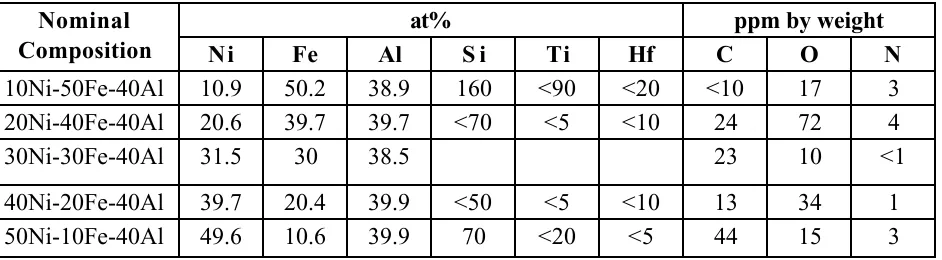
[image:4.612.62.533.334.464.2]mechanical testing. The compositions investigated were 10Fe-50Ni-40Al, 20Fe-40Ni-40Al, 3030Ni-40Al, 4020Ni-40Al, and 5010Ni-40Al. Single crystal mechanical data for Ni-40Al and Fe-40Al from Noebe [8] and Yoshimi [9] are reported for comparison purposes. The actual compositions and impurity levels for the single crystals are given in Table 1.
Table 1: Nominal and actual compositions and impurity levels for the single crystals.
at% ppm by weight
Nominal
Composition Ni Fe Al Si Ti Hf C O N
10Ni-50Fe-40Al 10.9 50.2 38.9 160 <90 <20 <10 17 3
20Ni-40Fe-40Al 20.6 39.7 39.7 <70 <5 <10 24 72 4
30Ni-30Fe-40Al 31.5 30 38.5 23 10 <1
40Ni-20Fe-40Al 39.7 20.4 39.9 <50 <5 <10 13 34 1
50Ni-10Fe-40Al 49.6 10.6 39.9 70 <20 <5 44 15 3
Compression samples of the Fe-rich compositions (ranging from 10-30 % Fe) were sealed in quartz tubes evacuated (to 10-6 torr) and backfilled with high purity argon. These samples were subjected to vacancy reducing heat treatments at 450°C of varying durations (10-40 days), and hardness variations were monitored with microhardness measurements in order to insure that an equilibrium vacancy content had been obtained [10]. These vacancy annealing conditions have been previously established by Schneibel,et al. [11] as an effective treatment. Following suitable vacancy reducing heat treatment, the samples were tested in an ambient environment using an Instron model 1362 equipped with a MAR-M246 compression cage. Displacement was measured with LVDT’s mounted on the plattens of the cage. The tests were all performed at a constant strain rate of 10-4/s to a final plastic strain of 1-4%.
3. RESULTS
3.1 Mechanical Behavior
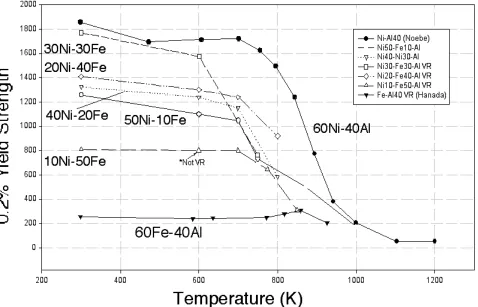
The 0.2% yield strengths for each composition versus testing temperature is shown in Figure 1, along with the aforementioned data from Noebe [8] and Yoshimi [9]. This graph reveals the high yield strength of the 30Fe composition, the high to moderate yield strength of the 20Ni, 40Ni, and 50Ni compositions, and the moderate strength of the 10Ni composition. While the data as a function of temperature is rather sparse, it is clear that the variation of the yield strength with temperature is relatively modest at lower temperatures for all compositions. In addition, all five ternary alloys demonstrated a “knee” in yield strength at elevated temperatures, above which the temperature dependence is significantly larger. The appearance of such a “knee” has previously been correlated with a transition from <111> dislocations at lower temperatures to non-<111> activity at higher temperatures [12-15]. As discussed below, a similar transition appears to be occurring in the present case. The pronounced decrease in yield strength is evident in the approximate temperature window from about 600 to 850K; with the initial transition temperature varying significantly with composition. It is indeed interesting to note that all alloys show the slip transition (associated with the sharp
decrease in yield strength) in a narrow temperature window, even though there are significant
differences in the dislocation configurations in these alloys at lower temperatures, as will be discussed below. Finally, it is noted that in this temperature regime the ternary compositions are all significantly softer than the binary Ni-40Al compound.
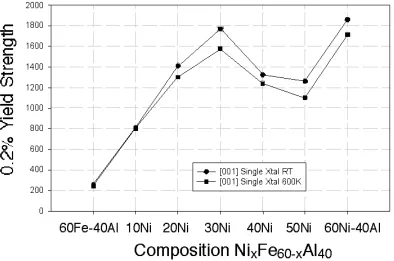
[image:5.612.67.545.340.647.2]In order to more clearly see the variation of lower temperature strength with composition, Figure 2 presents the single crystal yield strength versus composition at both room temperature and 600K. At
both temperatures, there are several striking features to this variation. First is the remarkably strong increase in yield strength for Fe-rich compositions. Second is the peak in yield strength observed at the 30Fe-30Ni-40Al composition. The third prominent feature is the clear solute softening observed for for compositions between Ni-40Al and 10Fe-50Ni-40Al. This variation in yield strength with
composition is much more complicated than that observed in isomorphous, binary disordered systems such as Cu-Ni and Au-Ag [16]. In these cases, solute strengthening is always observed upon alloying the pure metals, and the increase in yield strength is classically understood in terms of both size and modulus misfit, based on the Fleisher solid solution model [17]. As discussed below, this model appears incapable of explaining the behavior observed at either extreme of the Fe-Ni-Al pseudobinary system.
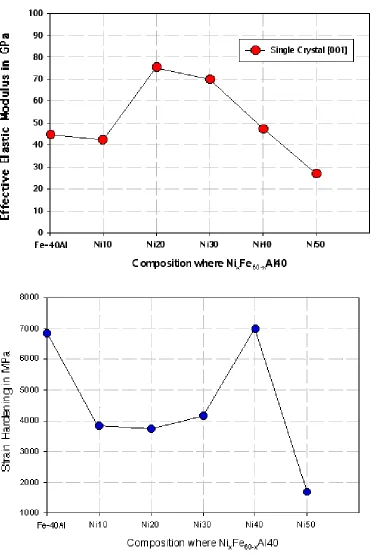
Relative measurements of elastic modulus and strain hardening rates were taken from the room temperature compression stress strain curves, but have not been normalized with respect to the inherent moduli of the testing apparatus and compression cage. Elastic constant measurements are presently being conducted, and will be reported elsewhere. Nevertheless, all tests were performed in the same apparatus and thus should provide accurate relative comparisons. As shown in Figure 3a, the elastic modulus increases substantially for the 20Fe and 30Fe compositions relative to the Fe- and Ni-rich compositions. It is interesting to note that this maximum in the modulus values corresponds roughly with the maximum observed in the measured yield strength. The work hardening rates shown in Figure 3b were all measured at a plastic strain of about 2%. It should be noted that strain hardening
was nearly linear for most compositions. With the exception of the binary Ni-40Al composition, the strain hardening rates are large for all compositions (ranging from ~ E/6 for Fe-40Al, ~E/10 for 20Fe-40Ni-40Al and ~ E/20 for 40Fe-20Ni-40Al).
[image:7.612.90.460.65.619.2]3.2 Dislocation Observations
Dislocation analysis was performed to examine morphologies at both room temperature and elevated temperatures. A brief summary of these results is provided here. For all compositions, the
deformation microstructures at room temperature and 600K consisted of a<111> dislocations, with typically several slip systems operative in a given region, as expected for this high symmetry zone axis in the absence of strong latent hardening effects. There are two noteworthy variations in a<111> behavior with composition. First, upon the addition of Ni to Fe-40Al, there is a dramatic decrease in the dissociation distance. Previous work has shown that a<111> dislocations in Fe-40Al are
dissociated into a/2<111> partials [18-19]. TEM observations by Savage [19], and in this work, have shown that the dissociation distance decreases from 3.5nm for Fe-40Al to 1.9nm for 50Fe-10Ni-40Al. No resolvable dissociation of the a<111> dislocations has been detected for the 40Fe-20Ni-40Al composition, nor for more Ni-rich compositions. Thus, Ni appears to profoundly increase the APB energy, as expected from simple consideration of the relative ordering energies of NiAl and FeAl.
A second noteworthy change with composition is in the preferred line direction of the a<111>
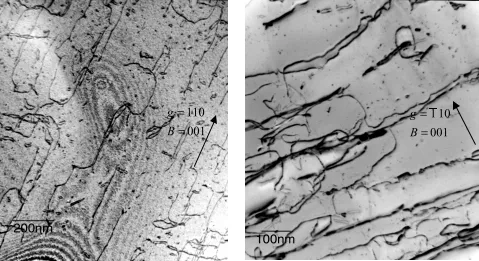
dislocations. TEM images for compositions ranging from Fe-40Al to 30Fe-30Ni-40Al reveal a<111> dislocations predominantly near screw orientation (see Figure 4a). Somewhere between Ni30 and Ni50 there is a transition from observed <111> screws to <111> edge line lengths, as exemplified by the image in Figure 4b. This implies that the edge lengths are most mobile in Fe-rich samples, while the screw line direction is more mobile for Ni-rich compositions. This tendency is observed at both room temperature and 600K.
001 110 = =
B g
001 10 1
= = B g
Figure 4: (a) 40Fe-20Ni-40Al single crystal {112} glide plane cut after 2% plastic strain in compression at room temperature. a<111> dislocations predominantly in screw orientation. (b) Ni50Fe10Al single crystal {001} compression axis cut after 2% plastic strain in
[image:8.612.65.544.72.333.2]Several transitions are also observed as a function of temperature, the first involving the predominant slip plane. While the Fe-40Al and 50Fe-10Ni-40Al samples deform via slip on {110} planes at both room temperature and 600 K, all compositions with greater Ni content showed a predominance of {112} slip planes at room temperature. However, at 600 and 700K respectively, a transition to slip on {110} type planes is seen for the 40Fe-20Ni-40Al and 10Fe-50Ni-40Al compositions. This transition to {110} slip planes at higher temperatures is believed to be a trend for all Ni-rich alloys.
The second important transition with temperature is that from <111> slip at lower temperatures to a<100> climb at higher temperatures. This transition, which is common to all the ternary
compositions, is exemplified by the dislocation structure shown in Figure 5 for the 10Fe-50Ni-40Al composition deformed at 750K, where several families of a<100> dislocations are observed. Note that this sample was deformed at a temperature only about 50K higher than the apparent temperature of the “knee” seen in the yield strength versus temperature plot of Figure 1, and yet no a<111> dislocations are present. The common transition to a<001> climb should be contrasted with previous
work that has proven the operation of a<110> glide as the dominant deformation process for binary Ni-rich compositions [20]. Thus, the significantly larger yield strengths for Ni-40Al in the temperature range from 600K to 900K appears to be directly related to differences in the a<111> decomposition process, as well as to differences in the deformation mode above the “knee”.
4. DISCUSSION
[image:9.612.59.296.330.602.2]The very large solute strengthening observed upon the addition of Ni to Fe-40Al, which persists up to 30% Ni additions is clearly associated with the influence of Ni on the critical resolved shear stress for a<111> dislocations. Note that these compositions have been carefully annealed in order to minimize the effect of quenched-in vacancies which is known to produce significant strengthening in FeAl [18,21-22]. The strengthening due to Ni does not appear to be consistent with a classical solute interaction for several reasons. Based on ALCHEMI measurements [23], Ni is expected to substitute for Fe on the Fe sublattice. However, there is only a modest size misfit between Ni and Fe based on their Goldschmidt radii [24]. In the Fleischer solute strengthening model [17], the effective misfit due to atomic size and
Figure 5: 10Fe-50Ni-40Al single crystal with foil normal parallel to [001] compression axis after 1.5% plastic strain at 750K. The dominant Burgers vector is a<001>.
001 0 1 1 = =
modulus, εs, is given by: εs = |εG–βεb|, where εG is the modulus misfit, εb is the size misfit and β is a term which accounts for the greater elastic interaction for dislocations with edge character. In this context it is noteworthy that in this composition range a<111> screw dislocations are the dominant line direction, indicating their limited mobility. In addition, the overall increase in the elastic modulus in this regime indicates that the shear modulus should also increase. Since the βεb term is by convention taken as positive, adding an elastically “stiffer” atom will actually tend to reduce the value of εs.
The low mobility of screw dislocations, as evidenced by their long lengths in TEM observations, suggests that a classical Peierls mechanism is operative. It is tempting to further hypothesize that Ni may be altering the core structure of the a<111> dislocations, and thus changing the Peierls stress. A second observed trend however argues against this interpretation. For all compositions, the yield strength is only weakly dependent on temperature below the “knee”. The observation of such yield strength “plateaus” which have large stress levels, is difficult to reconcile on the basis of a simple Peierls model for which it is expected that strength will continuously decrease with increasing temperature.
Takeuchi [25] has presented a modification of the Peierls mechanism in the smooth kink regime for dissociated dislocations. He has considered two cases: one in which kink-pair nucleation is correlated on the partial dislocations, and one in which kink pairs are nucleated independently. While in the former case, the yield strength falls continuously with temperature, in the latter case a critical, athermal stress is predicted. This critical stress is associated with the creation of a small additional fault area between a kink-pair on the leading partial dislocation in the case of uncorrelated kink-pair formation. For the present case of an a<111> dislocation dissociated into a/2<111> superpartials with an APB in between, this critical stress is given by:
τc = (Gbd/4πwe 2
){1 + 2(d/we) }
where G is the shear modulus, d is the period length of the Peierls potential and we is the equilibrium
separation between partials. It can be seen that the critical stress varies roughly as the inverse of the square of dissociation distance. Recalling the observed decrease in dissociation distance upon the addition of Ni to Fe-40Al, this model is qualitatively consistent with the increase in the nearly plateau-like yield strength and the observed line orientation of the dislocations. The predicted increase in critical stress is however significantly less than that observed, particularly between Fe-40Al and 50Fe-10Ni-40Al compositions. The Takeuchi model is based on continuum elasticity, and does not include possible changes to the superpartial core structures. Thus, it would appear that the observed strengthening deserves further investigation from an atomistic approach. Nonetheless, the relatively simple model of Takeuchi [25] also appears to have some merit in explaining several aspects of the strengthening effect of Ni.
size in these compounds appears to offer important, additional insight with regards to the magnitude of the softening due to Fe additions.
Only a preliminary explanation can be offered at this time for the composition dependence of the yield strength variation with temperature. With the exception of the 30Fe-30Ni-40Al composition, the transition from a<111> glide to a<100> climb appears to occur at about 700K. It should be noted that we have not yet determined the yield strength and microstructure for 30Fe-30Ni-40Al at 700K, however the knee clearly lies somewhere between 600K and 775K. Thus, a similar “knee” temperature may be exhibited by all of the ternary compositions, in spite of the radically different CRSS values for a<111> activity at lower temperatures.
These results indicate that the most significant improvement in strength at intermediate temperatures is offered by Ni antisite defects in the Ni-rich, binary compounds. The “knee” is delayed to significantly higher temperatures in comparison to all of the ternary compositions, which accounts for the higher strength in this regime. In Ni-44Al, it has been conclusively shown that the “knee” is associated with a decomposition of a<111> dislocations into a<110> and a<001> dislocations [20], and that a<110> dislocation glide processes dominate above the “knee” [28]. In contrast, in the ternary compounds, a<100> climb appears to dominate, even at temperatures just above the “knee”. In this respect, the mechanism of the slip transition in the ternary compounds appears to be similar to that observed in binary, stoichiometric Ni-50Al. The position of the “knee” and the deformation processes at higher temperature should be strongly affected by vacancy content and mobility, since both a<100> climb and a<110> “glide” are diffusion mediated processes (the latter involving coordinated climb/glide of coupled a<100> dislocations, as described in detail elsewhere [28-30]). The importance of vacancy kinetics is emphasized by considering the recent work of Collins and co-workers [31]. Using the perturbed-angular correlation of gamma rays (PAC) method, they have determined that vacancies become mobile in Ni-50Al at about 623°C, which corresponds very well with its “knee” temperature. This favorable correlation suggests that a complete understanding of the effect of composition (including ternary additions) on the slip transition, the “knee” temperature and the deformation processes at higher temperature will require additional understanding of vacancy content and kinetics in these alloys.
5. CONCLUSIONS
The variation of yield strength with composition for <100> oriented, B2 single crystals in the Fex-Ni
ACKNOWLEDGEMENTS
This research has been supported by the US Department of Energy, Office of Basic Energy Sciences, Materials Sciences Division under Contract No. DE-FG0296ER45550 (for PRB, SR, MS and MJM), and Office of Basic Energy Sciences, and Contract No. W-7405-ENG-82 ( for TL).
REFERENCES
1. D.B. Miracle, Acta Metall Mater, 41, 649 (1993).
2. R.D. Noebe, R. R. Bowman and M. V. Nathal, Int. Mater. Rev.38, 193 (1993). 3. I. Baker and P. R. Munroe, Int. Mater. Rev.42, 181 (1997).
4. P. Nagpal and I. Baker, Metall. Trans. A, 21A, 2281 (1990).
5. D. K. Patrick, K. M. Chang, D. B. Miracle and H. A. Lipsitt, MRS Proceedings, 213, 267 (1991). 6. L. M. Pike, Jr., PhD. Thesis, University of Wisconsin-Madison, (1997).
7. L. M. Pike, Y. A. Chang and C. T. Liu, Intermetallics, 5, 601 (1997). 8. R. D. Noebe, NASA TM 106534 (1992).
9. K. Yoshimi, S. Hanada, and M. H. Yoo, Acta metall. mater. 43, 4141 (1995). 10. P. S. Brenner, M. S. Thesis, The Ohio State University (2000).
11. J.H. Schneibel, P.R. Munroe, and L.M. Pike, Materials Research Society, 460, (1996). 12. R. T. Pascoe and C.W.A. Newey, Metal Sci. J. 5, 50 (1971).
13. M. H. Loretto and R. J. Wasilewski, Phil. Mag. 23, 1311 (1971). 14. J. T. Kim, PhD. Thesis, University of Michigan (1990).
15. E. P. George and I. Baker, Phil. Mag. A77, 737 (1998).
16. R. W. K. Honeycomb, The Plastic Deformation of Metals (Edward Arnold, London, 1984). 17. L. Fleischer, Acta metall., 9, 996 (1963).
18. M.A. Crimp and K.M. Vedula, Phil. Mag. A., 63, 559 (1991).
19. M. F. Savage, R. Srinivasan, M. S. Daw, T. A. Lograsso and M. J. Mills, Mater. Sci. and Eng. A
258, 20 (1998).
20. R. Srinivasan, J. Brown, M. S. Daw, R. D. Noebe and M. J. Mills, Phil. Mag. A, 80, 2841 (2000). 21. P. Nagpal and I. Baker, Metall. Trans. A, 21A, 2281 (1990).
22. P. Monroe, Intermetallics, 4, 5 (1996).
23. I. M. Anderson, Acta mater., 45 3897 (1997).
24. F. Laves, Theory of Alloy Phases (ASM Publication, Cleveland, 1956). 25. S. Takeuchi, Phil. Mag. A71, 1255 (1995).
26. M. J. Mills, R. Srinivasan, M. F. Savage, R. D. Noebe, T. Lograsso and M. S. Daw, Interstital and Substitutional Effects in Intermetallics, eds. I. Baker, R. D. Noebe and E. P. George (TMS
Publications, Warrendale, 1998), p. 99.
27. C. T. Liu, C. L. Fu and J. H. Schneibel, MRS Proceedings, this volume.
28. R. Srinivasan, M.S. Daw, R.D. Noebe and M. J. Mills, Phil. Mag. A, submitted for publication. 29. M. J. Mills and D. B. Miracle, Acta Metall. Mater., 41, 86 (1993).
30. M. J. Mills, R. Srinivasan, M. S. Daw, Phil. Mag. A, 77, 801 (1998).
![Figure 5: 10Fe-50Ni-40Alsingle crystal with foil normalparallel to [001] compressionaxis after 1.5% plastic strainat 750K](https://thumb-us.123doks.com/thumbv2/123dok_us/8111963.236723/9.612.59.296.330.602/figure-alsingle-crystal-foil-normalparallel-compressionaxis-plastic-strainat.webp)
