Accepted Manuscript
User mobility aware task assignment for mobile edge computing
Zi Wang, Zhiwei Zhao, Geyong Min, Xinyuan Huang, Qiang Ni, Rong Wang
PII: S0167-739X(17)31858-7
DOI: https://doi.org/10.1016/j.future.2018.02.014
Reference: FUTURE 3985
To appear in: Future Generation Computer Systems
Received date : 17 August 2017 Revised date : 26 January 2018 Accepted date : 8 February 2018
Please cite this article as: Z. Wang, Z. Zhao, G. Min, X. Huang, Q. Ni, R. Wang, User mobility aware task assignment for mobile edge computing,Future Generation Computer Systems(2018), https://doi.org/10.1016/j.future.2018.02.014
User Mobility Aware Task Assignment for Mobile Edge
Computing
Zi Wanga, Zhiwei Zhao∗,a,c, Geyong Minb, Xinyuan Huanga, Qiang Nid, Rong Wange
aSchool of Computer Science, University of Electronic Science and Technology of China, China bCollge of Engineering, Mathematics and Physical Sciences, University of Exeter, UK cthe Research Institute of Information Technology and National Laboratory for Information Science and
Technology (TNList), Tsinghua University, China
dSchool of Computing and Communications, Lancaster University, UK eCollege of Computer Science, Zhejiang University, China
Abstract
Mobile Edge Computing (MEC) has emerged as a prospective computing paradigm to provide pervasive computing and storage services for mobile and big data applications. In MEC, many small cell base stations (sBSs) are deployed to establish a mobile edge network (MEN). These sBSs can be usually accessed directly by mobile users. The computational tasks are first offloaded from mobile users to the MEN and then executed in one or several specific sBSs in the MEN. While the offloading decision has been well studied, the task execution delay on the MEN side is overlooked. This paper aims at reducing the task execution delay by task scheduling in MENs. Specifically, we jointly consider the task properties, the user mobility and network constraints. The problem is formalized as a constraint satisfaction problem and a lightweight heuristic solution is proposed for fast scheduling. We conduct simulation experiments to study the performance of the proposed work. The results show that our work is able to significantly reduce the task execution delay in MENs and thus reduces the end-to-end delay for MEC tasks.
Keywords: Mobile Edge Computing, Task Assignment, User Mobility, Offloading
1. Introduction
Modern mobile devices are becoming more and more powerful and the mobile ap-plications are becoming increasingly computation-intensive and delay-sensitive, such as real-time online gaming [1], augmented/virtual reality (AR/VR) [2], image/video processing APPs [3] and the vehicle networking systems [4]. These applications can often introduce a large amount of traffic and computational workload, which can
∗Corresponding author
Email addresses:[email protected](Zi Wang),[email protected](Zhiwei Zhao∗,),
[email protected](Geyong Min),[email protected](Xinyuan Huang),
potentially cause the battery drain problem on mobile devices [5]. To deal with the resource constraints of mobile devices, Mobile Edge Computing (MEC) has emerged as a promising computing paradigm. In MEC, a number of small cell base stations (sBSs) with computation and storage capability [3] are deployed to construct a network termed as the mobile edge network (MEN). The MENs provide computation and storage services in close proximity to subscribers to meet the high-workload and low-latency requirements [6]. Some projects such as TROPIC[7] and SESAME[8] introduce powerful sBSs, like picocells or femtocells, to share their enhanced high performance computing capabilities for high-performance edge computing. In the MEC paradigm, computational tasks are first offloaded from mobile users to the MENs and then executed in one or several specific sBSs in the network. Compared to traditional cloud computing, MEC is more close to users and incurs much less computational and transmission delay. The deployment of MEC can also provide more flexible resource scheduling for the mobile tasks.
The current research works on MEC often focus on the offloading decision problem
on mobile devices [9, 10]. For example, X. Chenet al.[9] employed a game-theoretic
computation offloading approach for multi-user systems. S. Guoet al.[10] proposed a
dynamic offloading and resource scheduling policy to reduce energy consumption and the application completion time. Some other works such as [11] aimed at utilizing the synergy between the computation resources of MEC and the mobile devices. These works can effectively reduce the computational delay on mobile devices. Although the user-end delay is reduced, we notice that much delay is consumed at the MEC end. Different from the traditional cloud computing where execution delay is stable [12], it can be highly diverse in MEC because the tasks may be executed in different sBSs which have different resource situations. There are several research works on optimizing the task execution delay in MENs [13, 14]. Among the problems, the task assignment in the MENs plays an essential role in reducing the execution delay, i.e., assigning the tasks to appropriate sBSs to achieve minimized execution delay in MENs. The user mobility, which is a fundamental characteristic in MEC, have a large impact on the task execution in two ways. First, mobile users lead to time-varying workload distribution. Different sBSs have different numbers of connected mobile users. Second, mobile users often upload tasks and receive results via different sBSs, involving in-MEN communications and computation workload. However, the existing works often overlook the impact of user mobility and assign tasks to the directly connected sBSs. Some works consider mobility based on intuitive models, which may not reflect the exact impact of user mobility and thus yield inefficient task executions [13].
can significantly reduce the execution time of tasks in MEC networks. The major contributions of this paper are summarized as follows:
1. We formally model the problem of task assignment as a constraint satisfaction problem, which jointly considers the user mobility, task properties and the resource distributions in the MEC network.
2. We propose a lightweight algorithm for the problem, which supports fast delay estimation of the execution delay.
3. Based on the proposed assignment, we propose an accurate delay estimation scheme which can support accurate offloading decisions on mobile devices. 4. We conduct simulation experiments and show that the proposed work
outper-forms the existing works in terms of task execution delay.
This rest of the paper is organized as follow. Section 2 summarizes the related works. Section 3 presents the proposed model and algorithm. Section 4 presents the evaluation of the proposed work. Section 5 concludes this work and points future directions.
2. Related Work
A large number of existing works have studied the optimization problems on mobile edge computing. Most of these works focus on the decision making problem for task offloading at the user end. These works will first estimate the expected delay or energy consumption for target tasks and then offload them to the mobile edge if the delay or energy consumption is reduced. According to the optimization goal, we divide these works into two categories: works on optimizing energy consumption and works on reducing the task delay. Our work falls into the second category and differs from the existing works in that our aim is to reduce the delay at the network end instead of the user end.
Works on optimizing energy consumption. K. Zhang et al. [17] presented
a multi-device computation offloading framework for MEC and formulated an optimization problem that minimized the device energy consumption. A three-stage offloading scheme was proposed to obtain the sub-optimal solution, which 1) classified the mobile device, 2) determined the priority and 3) allocated the radio resource. X.
Chenet al.[9] further considered the interference and collisions when there were too
many users trying to offload tasks to the same sBS, which can significantly increase the energy consumption of mobile devices. The offloading was formulated as a
multi-user game, which was proved always admitting a Nash equilibrium. W. Labidiet al.
[18] considered the time varying channel state for wireless offloading and proposed a scheduling scheme for task offloading, which tried to make the best use of wireless channels and user buffers to reduce the energy consumption.
Works on reducing the task delay. J. Liu et al. [11] tried to minimize the
execution delay for single users with one-dimensional search algorithm. The algorithm outputted a policy for offloading decision according to the application buffer queuing state. Besides, the characteristics of wireless channels were also considered. Y.
power allocation problem to reduce the offloading delay. Plachyet al. [20] took the spatial diversity of the sBSs into account in the offloading process. The sBS that was responsible for task execution was chosen by the users. Then the results would be returned to the users via the sBS with the highest RSSI of the wireless links. However, the work was designed for single task offloading.
There are also some works that jointly optimize both energy and task delay. Reducing task delay often adds additional energy consumption in MEC, especially for the tasks that execute faster on mobile devices than on mobile edges. Some works set an energy threshold and then minimize the execution delay without exceeding the energy
threshold. For example, Y. Maoet al. [14] proposed a dynamic offloading scheme
for single user to minimize the execution delay for energy harvesting devices, where the energy harvesting technique added complexity to the offloading algorithms. A lightweight approximation approach was proposed to achieve a good tradeoff between
complexity and the delay minimization. J. Yang et al. [21] used a multi-stage
sequential game model to meet the energy and delay requirements at the same time. Different from the aforementioned works, our work emphasizes on minimizing the delay within the MENs. The delay in MENs not only adds to the overall task execution delay but also impacts the decision making process at the user end. We propose a novel in-network task scheduling approach to reduce the task execution delay, where task information, resource information and user mobility are jointly considered. Different from the [13] which used the contact rate to capture user mobility, our work is built on top of the user trajectory prediction [15, 16], which can accurately capture user mobility in most MEC scenarios such as airports, shopping malls, etc. Besides, to deal with the impact on offloading decision, we propose a novel delay estimation scheme for mobile devices.
3. Mobility Aware Task Assignment for MEC
In this section, we present the application scenario for MEC, the motivation of mobility aware design and the main algorithm design for task assignment in MEC.
3.1. Impact on task execution
sBS1
sBS2
sBS3
sBS4
sBS5
sBS6 ...
User 1
User 2
User 4
User 3
User 5
[image:6.595.130.472.103.389.2]User 6
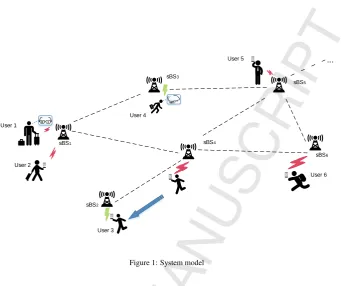
Figure 1: System model
executed within the period of the user’s stay at the corresponding sBS, the task should be executed immediately at the sBS and then returned to the mobile user. When the tasks are heavyweight and cannot be finished in the stay period of the user, the tasks should be split into many sub-tasks and transfer some tasks to the successive sBSs along the user’s trajectory. As a result, many tasks can be processed in parallel and the user can keep receiving the task results along the path without waiting for the task executions. In a nutshell, all the sBSs along the user’s path can be utilized for executing the offloaded tasks. Therefore, the delay can be reduced compared to the case where only one specific sBS is selected for executing all tasks.
3.2. Impact on the offloading decisions
Apparently, if the tasks are dynamically scheduled at the MEN end, the current delay estimation on the execution delay is no longer applicable. The challenge for the mobile user to estimate the task execution delay lies in that the resource at the MEN end is unknown to the mobile users. Therefore, different from the existing schemes, we need to either estimate the resource usage at the MEN end or establish a feedback mechanism to notify the mobile user about the resources or execution delay information. Besides, there may be other users that offload multiple tasks to the MEN, which also has a large impact on the delay estimation at the user end.
3.3. Design
The MEC system is illustrated in Figure 1 for the indoor scenario. The mobile users offload their computation-intensive and delay-sensitive tasks to the mobile edge
networks which consist of a number of sBSs. In the system, we consider a setN= {1,
data distribution in the network. All the sBSs are capable for receiving, executing and transferring the offloaded tasks. We also assume software-defined network architecture is used in the MEN. All sBSs are controlled and monitored by a central controller. The users move round the area and their trajectories can be predicted using existing approaches [16, 23]. Our goal is to minimize the execution time in the MEN end by scheduling the multiple tasks from multiple users. The task offloading information is first uploaded to the sBSs and then collected to the central controller. After that, the central controller computes the best strategy for scheduling the offloaded tasks. Before presenting the model, we first summarize the notations as in Table 1.
Table 1: Input & Output
Parameter Description
si The size of data for offloading taski
ci CPU cycles required for taski
tl
i The local execution time for taski(on the user’s device)
Pi The set of sBSs on useri’s path
Ti The set of tasks of useri
U The set of all users with offloading tasks
di,j The offloading decision for task jof useri,di,j∈ {0,1}
de
(i,j),k The task assignment for task jof userion sBSk,d(ei,j),k∈ {0,1}
De The task assignment set for all sBS,De={de
(i,j),k|i∈U,j∈Ti,k∈Pi}
fi The CPU frequency for executing taski
sBSi Thei-th small base station
tiedge,j The total time spent on the edge sBSs for taskti,j
te
(i,j),k The execution time of taskion sBS jon sBSk
t(qi,j),k The queuing time for task(i,j)on sBSk
tt
i,j The task transferring time forti,j
rui The uploading transmission rate for taski
rdi The downloading transmission rate for taski
rti The transmission rate for task transfer among sBSs
ηi The ratio of input/output data size for taski
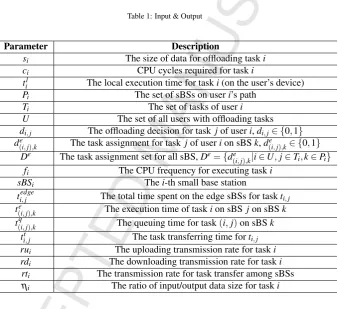
We consider a set of usersU and each userihas a bunch of computation tasksTi=
ti,j|j=1,2, ...|Ti|, which can be offloaded to the MEN. For each useri, the trajectoryPi
consists of a number of sBSs. To reduce the delay at the user end, the tasks at the users are offloaded to the MEN. Next we need to assign the offloaded tasks from multiple
users to the sBSs along the corresponding paths.de
(i,j),k=1 if the task(i,j)is assigned
to the sBSsBSk.
Our aim now is to find the most appropriateDe={de
(i,j),k|i∈U,j∈Ti,k∈Pi}to
the task scheduling can be modeled as an optimization problem as follows:
max
De
1
|U|i
∑
∈Uj∑
∈Tidi,j(til,j−tiedge,j )
s.t. ∀ti,j,
∑
k∈Pid(ei,j),k≤1 (1)
As depicted in the above equations, each task(i,j)should be executed no more than
once along the useri’s trajectoryPi. Our job now is to determined(ei,j),kfor alli∈U,
j∈Tiandk∈Pi.
The time spent on the edgestiedge,j is given by:
tiedge,j =
∑
k∈Pi
t(qi,j),k+t(ei,j),k+tit,j (2)
where the task transferring timett
i,jis given by:
tt i,j=rusi,j
i,j+
ηi,jsi,j
rdi,j + (k
∑
∈Pi(w(i,j),ksi,jηi,j
rti,j + (1−w(i,j),k)
si,j
rti,j)−
si,j
rti,j) (3)
where the first item denotes the time for task uploading, the second item denotes the time for results downloading, the last item denotes the time for in-MEN task transfer. It
is worth noting thatrui,jandrdi,jare determined by the specific sBSs that are selected
for uploading and downloading the tasks. w(i,j),kis an indicator to check whether task
(i,j)has already been executed before arrivingsBSk. w(i,j),k=1 if the task has been
executed beforesBSkandw(i,j),k=0 otherwise. The output data size is calculated as
ηi,jsi,j. As the first item already accounts the time of task transfer from the user to the
first sBS, we need to eliminate an extra in-MEN task transfer time (as calculated in the last item).
The queuing time for task(i,j)onsBSkequals to the time of the execution time for
all tasks that are beforet(i,j),k. and is given by:
t(qi,j),k=
idx(t(i,j),k)
∑
n=1tne (4)
whereidx(t(i,j),k)denotes the index for task(i,j)insBSk.tnedenotes the execution time
for tasknand is given by ln
fk.lndenotes the execution load of tasknandfkdenotes the
CPU frequency ofsBSk.
3.4. The heuristic algorithm
The above optimization problem is a constraint satisfaction problem, which is NP-complete [24]. To solve the problem, we propose a heuristic as follows.
the lowest delay. During the process of updating the queue time on a sBS, the criteria of choosing which task that will be served preferentially when the conflict happens is to select the task with minimal execution time. If the task execution delay with the best sBS is still larger than the local execution time, the task will be rejected and executed locally. When all tasks have been assigned an sBS or rejected, the assignment progress is finished. The above algorithm is shown in Alg. 1.
Algorithm 1The Assignment Scheme
Input:
1. The task information for each task(i,j):
the local execution time{tl
i,j};the input data size and the output ratio, si,j and
ηi,j;
2. The sBS information:
the involved sBSs along useri’s trajectoryPi; the CPU frequency for each sBSi,
fi; the transmission ratesru,rd,rt;
Output: The decision matrix for all tasks and all sBSs,De
1 foreach i∈U do
2 foreach j∈Tido
3 foreach k∈Pido
4 de(i,j),k=0 //initiation before assignment
5 end
6 kt=argkmintiedge,j
iftiedge,j < tl i,jthen 7 de(i,j),kt =1
8 end
9 else
10 de(i,j),k
t =0 //the task will not be offloaded to the MEN
11 end
12 end 13 end
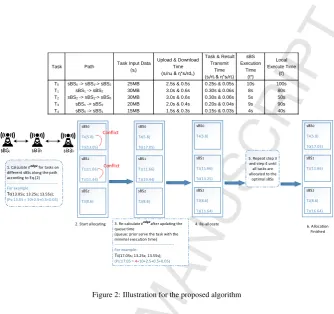
Next we use an illustrating example in Figure 2 to elaborate our scheme. There are
three sBSs and five tasks(t0∼t4)which need to be assigned. The task information is
shown in the table, and the queue buffer is left empty before assignment.
At first, we calculate thetedge for each task on all sBSs along its path and then
select the sBS with the minimaltedgeto allocate the task. Next, we check the conflict
when more than one tasks are allocated to the same sBS. For example, in Figure 2 step
2, we can see theT4is conflicted withT0 andT1is conflicted withT3. So, we need to
update the queue time and re-calculate thetedgefor those conflict tasks. The sBS will
choose the task with minimal execution time as a prior one. Therefore, the queue time can be updated through Eq.(4). After updating the queue time, we need to re-calculate
Task Path Task Input Data (si)
Upload & Download Time (si/rui & ƞ*si/rdi,)
Task & Result Transmit
Time (si/rti & ƞ*si/rti)
sBS Execution
Time (te)
Local Execute Time
(tl)
T0 sBS0 -> sBS1-> sBS2 25MB 2.5s & 0.5s 0.25s & 0.05s 10s 100s T1 sBS1 -> sBS2 30MB 3.0s & 0.6s 0.30s & 0.06s 8s 80s T2 sBS2 -> sBS1-> sBS0 30MB 3.0s & 0.6s 0.30s & 0.06s 5s 50s T3 sBS1 -> sBS2 20MB 2.0s & 0.4s 0.20s & 0.04s 9s 90s T4 sBS0 -> sBS1 15MB 1.5s & 0.3s 0.15s & 0.03s 4s 40s
1. Calculate t for tasks on different sBSs along the path according to Eq.(2)
---For example: T0(13.05s; 13.25s; 13.55s);
(Ps:13.05 = 10+2.5+0.5+0.05)
edge
2. Start allocating
sBS0
T4(5.8)
T0(17.05)
sBS1
T1(11.66)
T3(19.44)
sBS2
T2(8.6)
4. Re-allocate sBS0
T4(5.8)
sBS1
T1(11.66)
T0(13.25)
sBS2
T2(8.6)
T3(11.64)
sBS0
T4(5.8)
T0(17.05)
sBS1
T1(11.66)
sBS2
T2(8.6)
T3(16.64)
sBS0
T4(5.8)
T0(13.05)
sBS1
T1(11.66)
T3(11.44)
sBS2
T2(8.6)
Conflict
Conflict
3. Re-calculate t after updating the queue time
(queue: prior serve the task with the minimal execution time)
---For example:
T0(17.05s; 13.25s; 13.55s);
(Ps:17.05 = 4+10+2.5+0.5+0.05) edge
6. Allocation Finished 5. Repeat step 3
and step 4 until all tasks are allocated to the
[image:10.595.130.465.106.420.2]optimal sBSs
Figure 2: Illustration for the proposed algorithm
re-allocated to the more optimal sBSs after updating theirtedgein step 4, and then the
process repeats above steps until all tasks are allocated to the optimal sBSs. Finally,T4
andT0are executed atsBS0,T1is executed atsBS1,T2andT3are executed atsBS2.
Studies in [15] and [16] presented the user mobility prediction which can achieve an accuracy about 90% to map a moving path for users with their proposed algorithm by
using Lagrange0s interpolation and non-parametric approach based on kernel density
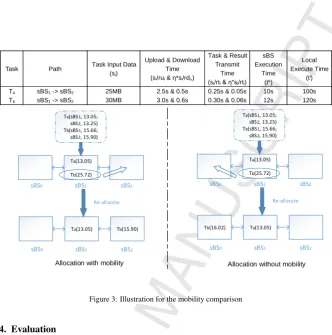
estimation, respectively. These methods may be more accurate under an indoor scene like our scenario. In Figure 3, we illustrate the comparison between the allocation considering mobility and that without considering mobility. In the left part, at first, two tasks will be allocated to the sBS according to our algorithm based on the mobility prediction, and the tasks are finally allocated to the sBSs along the user moving path with minimal delays. In the right part, the same tasks will be allocated to the sBS according to the random sBS selection algorithm, which does not consider the user
mobility.TachoosessBS1as the serving sBS. The servingsBS1computes the execution
delays, and it chooses it own as computing sBS due to the shortest delay. However,Tb
choosessBS1 as the serving sBS and randomly selectssBS0as the computing sBS to
avoid the queue time which is caused bysBS1 executingTa. As a result, the delays of
TaandTbby using the method which does not consider the user mobility is larger than
Task Path Task Input Data (si)
Upload & Download Time (si/rui & ƞ*si/rdi,)
Task & Result Transmit
Time (si/rti & ƞ*si/rti)
sBS Execution
Time (te)
Local Execute Time
(tl)
Ta sBS1 -> sBS2 25MB 2.5s & 0.5s 0.25s & 0.05s 10s 100s
Tb sBS1 -> sBS2 30MB 3.0s & 0.6s 0.30s & 0.06s 12s 120s
Ta(13.05)
Tb(25.72)
Ta(13.05) Tb(15.90) Ta(sBS1, 13.05;
sBS2, 13.25) Tb(sBS1, 15.66; sBS2, 15.90)
sBS0 sBS1 sBS2
sBS0 sBS1 sBS2 Re-allocate
Ta(13.05)
Tb(25.72)
Tb(16.02) Ta(13.05) Ta(sBS1, 13.05; sBS2, 13.25) Tb(sBS1, 15.66; sBS2, 15.90)
sBS0 sBS1 sBS2
sBS0 sBS1 sBS2
Re-allocate
[image:11.595.131.464.109.445.2]Allocation with mobility Allocation without mobility
Figure 3: Illustration for the mobility comparison
4. Evaluation
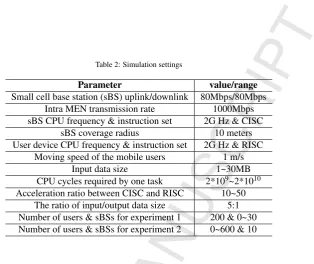
In this section, we use simulation experiments to numerically evaluate our proposed work. Table 2 shows the parameters used for the simulation. These settings are in line with the recommendations for small cell networks defined by 3GPP and the open source data from telecom operators [25].
Given the small coverage of small cell base station and the Multi-Hop Cognitive Radio Networks in [26], we consider the Orthogonal Frequency-Division Multiple Access (OFDMA) used for communication in downlink and the Single-Carrier Frequency-Division Multiple Access (SC-FDMA) used for uplink. As a result, the interference among users could be ignored. We assume that the input data size of each task ranges from 1MB to 30MB, and the CPU cycles requirement ranges from
2∗109cycles per task (cpt) to 2∗1010cpt for different type of applications. Besides
the different CPU frequency between sBS and user device, we additionally consider the impact of acceleration rate on CISC and RISC for different type of devices. Based on the parameter presented in Table 2, we assume that user mobility is a constant speed
following the predicted pathPthat we describe in 3.3 . The users upload their tasks to
the closest sBS with the best wireless link quality and obtain the results from the output sBS according to the assignment result.
Table 2: Simulation settings
Parameter value/range
Small cell base station (sBS) uplink/downlink 80Mbps/80Mbps
Intra MEN transmission rate 1000Mbps
sBS CPU frequency & instruction set 2G Hz & CISC
sBS coverage radius 10 meters
User device CPU frequency & instruction set 2G Hz & RISC
Moving speed of the mobile users 1 m/s
Input data size 1~30MB
CPU cycles required by one task 2*109~2*1010
Acceleration ratio between CISC and RISC 10~50
The ratio of input/output data size 5:1
Number of users & sBSs for experiment 1 200 & 0~30
Number of users & sBSs for experiment 2 0~600 & 10
and the assignment itself is not considered in the simulation because the amount of the summary information is very small and the assignment is done in the powerful central controller. Although we do not assume the wireless information from different users, the problem can be solved using the existing solutions [27, 28, 29]. Since we consider the end-to-end uploading/downloading delay in the model, the existing works on collision resolution can be directly incorporated in our model. The only difference
will be the estimation of the uploading and downloading ratesruandrd.
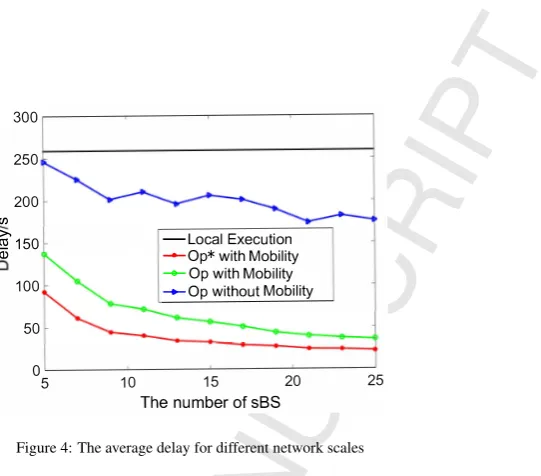
We use four different policies for comparison. 1. All tasks are executed at the user end.
2. Optimized assignment without considering the user mobility (trajectories). The tasks executed at the task uploading sBS and the results are sent to the user via sBSs along the user path (can be directly connected to users).
3. Optimized assignment considering mobility with maximal optimized execution time (maximizing the optimization time) for each task.
4. Our scheme - Optimized assignment considering mobility with prior serving the task with minimal execution time.
It is worth noting that the sequence for processing the tasks has important impact on the end-to-end performance. The third policy uses a criteria for first executing the task with maximal difference between the local and the edge. We repeat our experiments for 100 times to get the average execution time under different conditions.
en
〉、
300
250
200
豆ω 150
100
50
0
5 10
-一
Local Execution-←
Op* with Mobility-←
Op with Mobility-←
Op without Mobility15 20
[image:13.595.202.473.106.344.2]The number of sBS 25
Figure 4: The average delay for different network scales
mobility is considered and multiple sBSs are utilized along the user trajectory, the delay can be further reduced. 2) The delay reduction increases as the network scale increases. The reason is that when there are more sBSs, more resources can be utilized to enhance the performance for mobile devices. 3) The speed for delay reduction decreases as the network scale increases. This is because that as more and more tasks from mobile devices are offloaded to the MEN, there are fewer resources left to be used for optimization. As a result, the speed of reduction is reduced. 4) The third policy achieves sub-optimal result. The reason is that different sequence for task assignment may cause that some computation-intensive tasks are assigned to resource constrained sBSs and lightweight tasks are assigned to more powerful sBSs or be rejected, which is a waste of MEC resource.
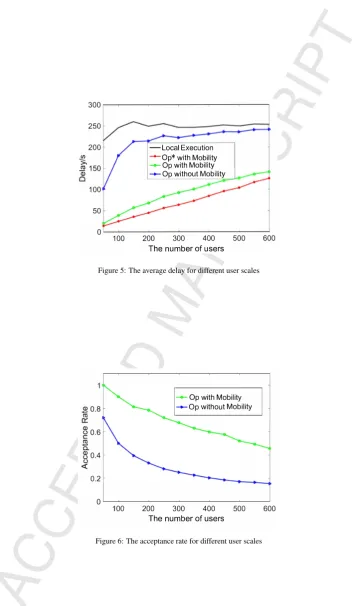
Figure 5 shows the averaged delay for different user scales with the same MEN. The MEN consists of ten sBSs. The user size grows from 50 to 600 and the trajectories are randomly generated. It can be inferred that as there are more and more users, the delay reduction becomes less. This is because there will be less resource available for each task as the number of users keeps growing. This simulation result can also be used to guide the sBS deployment for a given number of mobile users. We can also compared to the case with fixed number of users (Figure 4), the delay reduction of optimization considering mobility compared to optimization without mobility is enlarged. The reason is that when there are multiple tasks and multiple users, the parallelism of the sBSs can have more optimization space compared to that with small number of tasks and users.
en 〉、
300
250
200
豆ω 150
'100
50
。
100
--←
-←
-←
Local Execution
Op* with Mobility
Op with Mobility Op without Mobility
200 300 400 500
[image:14.595.118.473.102.709.2]The number of users 600
Figure 5: The average delay for different user scales
2 0.8 何
� 0.6
c
何
c.. � 0.4 〈
0.2
。
100 200-←
Op with Mobility-←
Op without Mobility300 400 500
[image:14.595.199.475.106.357.2]The number of users 600
when there are 600 users for optimization without considering mobility. Therefore, our scheme is more appropriate for the dense MEN with more users.
5. Conclusion
In this paper, we investigate the problem of task assignment in Mobile Edge Computing for multi-task multi-user scenarios. We model the assignment as a constraint satisfaction problem and propose a lightweight algorithm, where the task information, small base station information and the user mobility are jointly considered. We conduct simulation experiments to study the performance of the proposed work. The results show that compared to the works without considering user mobility, the proposed work can greatly reduce the task execution delay. We will focus on finding the optimal sequence for task assignment and further optimize the task delay by considering the wireless collisions among different users.
Acknowledgment
This work was supported by the National Natural Science Foundation of China (No. 61602095), the National Key Research and Development Program of China (2017YFB1400102), the Fundamental Research Funds for the Central Universities (No. ZYGX2016KYQD098 and No. ZYGX2016J079), the Quancomm Research Fund (Tsinghua), National Postdoctoral Program for Innovative Talents of China, and the EU FP7 CLIMBER project under Grant Agreement No. PIRSES-GA-2012-318939.
References
[1] D. Meilander, F. Glinka, S. Gorlatch, L. Lin, W. Zhang, X. Liao, Bringing mobile online games to clouds, in: Computer Communications Workshops (INFOCOM WKSHPS), 2014 IEEE Conference on, IEEE, 2014, pp. 340–345.
[2] W. Barfield, Fundamentals of wearable computers and augmented reality, CRC Press, 2015.
[3] P. Mach, Z. Becvar, Mobile edge computing: A survey on architecture and computation offloading, IEEE Communications Surveys & Tutorials.
[4] Y. Wu, G. Min, L. T. Yang, Performance analysis of hybrid wireless networks under bursty and correlated traffic, IEEE Transactions on Vehicular Technology 62 (1) (2013) 449–454.
[5] X. Ma, P. Huang, X. Jin, P. Wang, S. Park, D. Shen, Y. Zhou, L. K. Saul, G. M. Voelker, edoctor: Automatically diagnosing abnormal battery drain issues on smartphones., in: NSDI, Vol. 13, 2013, pp. 57–70.
[7] F. E. Project, Distributed computing, storage and radio resource allocation over cooperative femtocells (tropic), Available:http://www.ict-tropic.eu/, [Online] (2012).
[8] H. E. Project, Small cells coordination for multi-tenancy and edge services (sesam), Available:http://www.sesame-h2020-5g-ppp.eu/, [Online] (2015). [9] X. Chen, L. Jiao, W. Li, X. Fu, Efficient multi-user computation offloading for
mobile-edge cloud computing, IEEE/ACM Transactions on Networking 24 (5) (2016) 2795–2808.
[10] S. Guo, B. Xiao, Y. Yang, Y. Yang, Energy-efficient dynamic offloading and resource scheduling in mobile cloud computing, in: Computer Communications, IEEE INFOCOM 2016-The 35th Annual IEEE International Conference on, IEEE, 2016, pp. 1–9.
[11] J. Liu, Y. Mao, J. Zhang, K. B. Letaief, Delay-optimal computation task scheduling for mobile-edge computing systems, in: Information Theory (ISIT), 2016 IEEE International Symposium on, IEEE, 2016, pp. 1451–1455.
[12] D. Huang, et al., Mobile cloud computing, IEEE COMSOC Multimedia Communications Technical Committee (MMTC) E-Letter 6 (10) (2011) 27–31. [13] C. Wang, Y. Li, D. Jin, Mobility-assisted opportunistic computation offloading,
IEEE Communications Letters 18 (10) (2014) 1779–1782.
[14] Y. Mao, J. Zhang, K. B. Letaief, Dynamic computation offloading for mobile-edge computing with energy harvesting devices, IEEE Journal on Selected Areas in Communications 34 (12) (2016) 3590–3605.
[15] T. M. T. Do, O. Dousse, M. Miettinen, D. Gatica-Perez, A probabilistic kernel method for human mobility prediction with smartphones, Pervasive and Mobile Computing 20 (2015) 13–28.
[16] B. Li, H. Zhang, H. Lu, User mobility prediction based on lagrange’s interpolation in ultra-dense networks, in: Personal, Indoor, and Mobile Radio Communications (PIMRC), 2016 IEEE 27th Annual International Symposium on, IEEE, 2016, pp. 1–6.
[17] K. Zhang, Y. Mao, S. Leng, Q. Zhao, L. Li, X. Peng, L. Pan, S. Maharjan, Y. Zhang, Energy-efficient offloading for mobile edge computing in 5g heterogeneous networks, IEEE Access 4 (2016) 5896–5907.
[18] W. Labidi, M. Sarkiss, M. Kamoun, Energy-optimal resource scheduling and computation offloading in small cell networks, in: Telecommunications (ICT), 2015 22nd International Conference on, IEEE, 2015, pp. 313–318.
[20] J. Plachy, Z. Becvar, P. Mach, Path selection enabling user mobility and efficient distribution of data for computation at the edge of mobile network, Computer Networks 108 (2016) 357–370.
[21] J. Yang, B. Jiang, Z. Lv, K.-K. R. Choo, A task scheduling algorithm considering game theory designed for energy management in cloud computing, Future Generation Computer Systems.
[22] G. Min, Y. Wu, A. Y. Al-Dubai, Performance modelling and analysis of cognitive mesh networks, IEEE Transactions on Communications 60 (6) (2012) 1474– 1478.
[23] X. Chen, X. Wu, X.-Y. Li, X. Ji, Y. He, Y. Liu, Privacy-aware high-quality map generation with participatory sensing, IEEE Transactions on Mobile Computing 15 (3) (2016) 719–732.
[24] C. Carbonnel, M. C. Cooper, Tractability in constraint satisfaction problems: a survey, Constraints 21 (2) (2016) 115–144.
[25] E. U. T. R. Access, Further advancements for e-utra physical layer aspects, 3GPP TR 36.814, Tech. Rep.
[26] Y. Wu, G. Min, A. Y. Al-Dubai, A new analytical model for multi-hop cognitive radio networks, IEEE Transactions on Wireless Communications 11 (5) (2012) 1643–1648.
[27] X. Ji, Y. He, J. Wang, K. Wu, D. Liu, K. Yi, Y. Liu, On improving wireless channel utilization: A collision tolerance-based approach, IEEE Transactions on Mobile Computing 16 (3) (2017) 787–800.
[28] M. Deng, H. Tian, X. Lyu, Adaptive sequential offloading game for multi-cell mobile edge computing, in: Telecommunications (ICT), 2016 23rd International Conference on, IEEE, 2016, pp. 1–5.