1
Entrepreneurial learning from observing role models
Ricardo Zozimo*, Sarah Jack, Eleanor Hamilton
Department of Entrepreneurship, Strategy and Innovation Lancaster University Management School
Lancaster University, UK
2
Entrepreneurial learning from observing role models
Abstract
This study examines entrepreneurial learning through the observation of role models.
Adopting an interpretive and inductive approach, and using biographical interviews and life
course techniques, the article examines how sixteen entrepreneurs articulate their
entrepreneurial learning from role models. The overarching research question ‘How do
entrepreneurs learn from observing role models?’ enables illustrating who the role models are
(parents, teachers, colleagues, other entrepreneurs), the relevant social contexts (home,
education, workplace) and what is learned in relation to entrepreneurial learning tasks
(learning about oneself, managing relationships, the business and small business
management). The study contributes to developing the social perspectives of entrepreneurial
learning by demonstrating the significance of learning from role models in different social
contexts and at distinct entrepreneurial stages pre- and post-start-up.
Keywords: entrepreneurial learning; role models; observation; life course; social context
Introduction
Entrepreneurial learning is recognised as critical to advancing knowledge on entrepreneurship (Wang and Chugh 2014). This has led to calls for more understanding on how individuals learn from others (Cope 2005; Hamilton 2011; Konopaski, Jack, and Hamilton 2015; Pittaway and Thorpe 2012) and particularly how entrepreneurs learn through observing individuals with whom they interact in social contexts and who are often referred to as role models (Bosma et al. 2012; Hoffmann, Junge, and Malchow-Møller 2015).
3 entrepreneurs (Bosma et al. 2012) generates higher levels of self-efficacy, increases entrepreneurial intentions and leads to acquiring business-related practices (Bosma et al. 2012). However, current theoretical perspectives tend to neglect the social context and how this affects the ways in which role model observation occurs (Taylor and Thorpe 2004). Given that such observation is clearly influenced by the social situations that entrepreneurs encounter (Rae and Carswell 2000; Sardana and Scott-Kemmis 2010), this lack of understanding on the relationship between observing role models, the social context and how this affects entrepreneurial learning is surprising.
In this study, we offer a deeper understanding of how entrepreneurial learning takes place through observing role models. We address the overarching research question: ‘How do entrepreneurs learn from observing role models?’ and two interrelated sub-questions. The first concerns the social context: ‘Where and how are role models observed?’ and the second examines the content of entrepreneurial learning: ‘What is learned from observing role models?’ The theoretical foundations of this study are informed by the work of Bandura (1977) and Cope (2005). While insights from social learning theory (Bandura 1977) are essential to understanding the process of how role models are observed, the seminal work of Cope (2005) guides our understanding in relation to what entrepreneurs learn. Drawing on these two theoretical frameworks enables us to better frame the role model process and content within the entrepreneurship context.
4 Our contribution advances understanding on how entrepreneurial learning takes place through role models on a theoretical level. We do this by illustrating who the role models are (parents, teachers, colleagues, other entrepreneurs), the relevance of specific social contexts (home, education, workplace) and what is learned in relation to entrepreneurial learning tasks (learning about oneself, managing relationships, the business and small business management). In doing so, this study identifies distinct learning patterns from role models at two stages of the entrepreneurial journey, namely, pre- and post-start-up.
Theoretical background
Current understanding of how entrepreneurs learn has developed substantially in the last decade (Wang and Chugh 2014). Although most theorising still focuses on the role of individual experiences, social understanding of entrepreneurial learning is emerging. Advocates of this latter perspective argue that studying the social and historical context in which entrepreneurial learning occurs is vital as this provides a more complete understanding of the phenomenon (Hamilton 2013; Pittaway and Thorpe 2012; Taylor and Thorpe 2004).
Notwithstanding the calls to develop further understanding on how entrepreneurs learn from others (Cope 2011), entrepreneurial learning literature has been slow in developing frameworks that enable fully comprehending the wealth and complexity of social learning in entrepreneurship (Wang and Chugh 2014). Despite the absence of a comprehensive framework, substantial knowledge has been generated in specific areas that deal with the overall issue of how entrepreneurs learn from others. For example, recent studies demonstrate how family members (Hamilton 2011; Konopaski et al. 2015) or work colleagues (Nanda and Sorensen 2010) learn from each other in the context of entrepreneurship.
5 behaviours or engage in cyclical social interactions with entrepreneurs (Hoffmann et al. 2015). In this thus logical to assume that entrepreneurs learn from observing those who trigger individual reflections on entrepreneurial goals and objectives (Radu and Loue 2008). Role models are described as accessible, successful individuals (Bosma et al. 2012) who generate higher levels of entrepreneurial intentions and motivations in others for an entrepreneurial career (Van Auken, Fry, and Stephens 2006). Indeed, the presence of role models is often associated with enhanced regional and national entrepreneurial eco-systems (Lafuente, Vaillant, and Rialp 2007).
Conceptually, prior studies suggest that learning from observing role models is governed by vicarious or observational processes (Holcomb et al. 2009; Rae and Carswell 2001; Sardana and Scott-Kemmis 2010). While other disciplines marginally distinguish between these two forms of learning, scholars in the entrepreneurial learning domain argue that they represent similar learning processes and therefore use these terms interchangeably. Drawing on the influential work of Bandura (1977) and social learning theory, we refer to observational learning as the process through which entrepreneurs learn from observing role models (Gibson 2004).
Outcomes of role model observation in entrepreneurship
6 entrepreneurs are more likely to observe their parents and consequently choose similar careers (Dunn and Holtz-Eakin 2000). Collectively, these studies underline the importance of parental role models for entrepreneurship, describing in-depth the outcomes of observing parents in terms of propensity for entrepreneurship, influence on motivations to become an entrepreneur and the outcomes fostered by these observations.
Studies in university settings also show that entrepreneurial guest speakers often function as role models for students (Bosma et al. 2012; Erikson 2003). By sharing details of their particular entrepreneurial trajectories, guest speakers provide descriptions of behaviours and practices associated with entrepreneurship (Fiet 2001). This sharing process allows students to create an image of what entrepreneurs do and the difficulties and challenges associated with their endeavours (Shepherd 2004). Exposure to multiple guest speakers is thought to increase students’ self-efficacy (Boyd and Vozikis 1994), motivational levels towards pursuing an entrepreneurial career (Radu and Loue 2008; Van Auken et al. 2006) and the overall impact on decision-making processes associated with entrepreneurship (Segal, Schoenfeld, and Borgia 2007). Empirical studies describe the process of observing guest speakers as abstract rather than direct observational learning (Radu and Loue 2008). In abstract observational learning, students rely on the descriptions that guest speakers offer to construct their own image of the challenges associated with entrepreneurial endeavours. Conceptual and empirical studies on guest speakers would seem to concur that both abstract and direct observation of role models imply similar entrepreneurial learning outcomes (Fiet 2001; Radu and Loue 2008).
7 which relies on accepting an entrepreneurial career as a valuable prospect (Falck, Heblich, and Luedemann 2010). Peer observation is also linked to benefits deriving from social interactions as Pittaway et al. (2015) exemplify in their study on the importance of student clubs. Students attending these extra-curricular activities are able to learn from observing the practices and behaviours of similarly like-minded individuals. The effect of observing university peers as role models would seem to be enduring (Kacperczyk 2012) and is linked to developing creative entrepreneurial ideas (Gemmell, Boland, and Kolb 2011). Empirical evidence on a distinct type of peer, namely, work colleagues, suggests similar conclusions. Observing work colleagues enacting entrepreneurial practices and behaviours based on their experiences seems to have a strong effect on the entrepreneurial intentions and motivations of colleagues (Nanda and Sorensen 2010).
8 developing what is known about the influence of role models on the entrepreneurial learning process.
In sum, our study draws on and extends the work of Cope (2005, 390) who urges researchers to further ‘comprehend whom prospective entrepreneurs learn from and with prior to start-up, and also what they learn from these social interactions’ by conducting in-depth investigations of the processes and outcomes of observing role models and how this affects entrepreneurial learning.
Method
Through our research questions, we attempt to offer a richer perspective on the processes associated with observing role models and the entrepreneurial learning outcomes deriving from these observations. Our approach is interpretive and inductive, and purposefully designed to generate understanding on the experiences of participants and the situations they encountered (Gephart 2004; Jaskiewicz et al. 2015; Marshall and Rossman 2006). This entails taking into account Wang and Chugh’s (2014) recent observations on the importance of a qualitative approach in developing studies on entrepreneurial learning. This also enables building in-depth understanding of how participants articulate the types of interactions and how these specifically affected their learning.
Sample and data collection
9 building in-depth understanding on learning journeys and role models requires a high level of trust between the lead researcher and the participants. Previous experience has also taught us that this type of programme provides a forum for building such trust (Gordon et al. 2012; Kempster and Cope 2010).
Our sample includes a mix of entrepreneurs from new and established businesses, a range of personal backgrounds and different business activities and configurations. Table 1 provides details of the participants and their businesses (for reasons of anonymity, their names, role models, businesses and specific details relating to the location of participants are not reported).
--- Insert Table 1 about here ---
A life course approach is used to generate the data (Giele and Elder 1998b; O’Rand 1998), which is considered appropriate when investigating the intersection between life, learning from social interactions, observing role models and temporal sequence (Levinson 1986). Our view is that adopting a life course approach enables developing in-depth understanding of how observing role models affects the past, helps make sense of the present and shapes future expectations and motivations (Belli, Alwin, and Stafford 2009; Giele and Elder 1998b).
10 scholars investigate complex issues associated with distinct individual trajectories that are rarely clear, linear or repeated across large cohorts of individuals and generations (Green 2010). For instance, entrepreneurship scholars use distinct life course approaches to understand how entrepreneurial motivations affect individual life courses (Jayawarna, Rouse, and Kitching 2011), how social contexts affect the resources available for start-ups (Jayawarna, Rouse, and Macpherson 2014) and how gender variations may affect business growth (Davis and Shaver 2012). The insights from these life course studies coupled with the suggestions of researchers investigating similar topics (Kempster 2009; Rae and Carswell 2000; Taylor and Thorpe 2004) inform our life course approach to further understand how role models affect entrepreneurial learning.
In essence, we: 1) identified the terms that reflect ‘role models’ for participants, namely, ‘significant person’, ‘important person’ and ‘inspiration’; 2) we tested these terms through a pilot study designed to ensure the appropriateness of our life course approach and a fit with the understanding, situations and context of the experiences of individual entrepreneurs. The pilot study consisted in two sets of group interviews where the researcher and participants discussed ways of prompting dialogue on role models; 3) the research team discussed the pilot interview to ensure the best terminology to generate the type and depth of data sought from the main study. Confident with the outcomes of the pilot study, we then proceeded to generate chronological and systematic data across the sample. The data from each participant was then collected by the lead researcher in two key stages.
11 To focus participants on identifying people rather than significant events, we encouraged them to concentrate on the individuals but also to reflect on the impact they had on their learning experiences. The participants were given approximately an hour to complete this task (in silence and in isolation from other participants to allow them to be as focused and dedicated as possible) including as many details as possible on the individuals in question. Prior studies show that timelines can be critical in providing comprehensive autobiographical accounts (Taylor and Thorpe 2004) while at the same time allowing participants a high degree of flexibility on what they share (Clausen 1998).
Stage 2 involved interviewing participants in-depth about their encounter timelines. The research team purposefully decided against interviewing participants immediately after completing the timeline to allow time for reflection and build further trust and rapport between the lead researcher and the participants (Edwards 1993; Renzetti and Lee 1993) through various events, masterclasses and general training sessions. The interviews were conducted four to five months after the timeline exercise. By this time, all participants had a good relationship with the lead researcher. This also seemed to influence the amount of data gathered, which we believe was more extensive than would have been the case had it been collected earlier.
12 Consistent with life course interviewing, the participants were also encouraged to articulate significant information about each role model (Giele and Elder 1998a). The interviews ended by asking participants if they would like to add further role models to their timeline. Thirteen participants chose to add one or two role models. At the end of the interview, the researcher asked permission to photograph the encounter timeline (permission was granted in all but four cases).
The interviews were recorded (Mason 2002) and lasted an average 90 minutes, with a minimum of 30 and a maximum of 120 minutes. In total, 203 learning observations from role models were articulated as significant in the participants’ entrepreneurial trajectories. This two-stage approach provided rich and informative data allowing our key research question to be addressed (Chenail 2009; Pratt 2009; Reay 2014).
Data analysis
The interviews were transcribed verbatim and then combined with relevant notes and observations to provide the raw data. We then began reading and re-reading the data searching for incidents related to learning from role models from the extensive material gathered (Silverman 2000). While this allowed reducing the material, it also helped us to organise it in relation to time and space so we could more clearly identify the links between the role models and learning as well as the relationship between these aspects. The research team took extensive notes, sharing and discussing the issues related to the role models and entrepreneurial learning (no software was employed).
13 The explanatory themes identified in the data and in literature included entrepreneurial learning across stages, social contexts, the relationships between entrepreneurs and role models, and learning tasks. We iteratively analysed our data for instances that reflected these themes, continuously considering the ideas emerging from the data in light of the theory and in line with literature in a comparative approach (Bansal and Corley 2012; Glaser and Strauss 1967; Jack and Anderson 2002; McKeever, Anderson, and Jack 2014). We thus inductively questioned the data in relation to ‘what is going on?’ and ‘why does it matter?’ (McKeever et al. 2015). This interpretative analysis allowed us to generate understanding of the experiences of our participants (Gephart 2004; Suddaby 2006), appreciate the learning interactions, the influence of their role models and how observation affected their entrepreneurial learning over time.
Our findings are described in the following section in line with the suggestions of Bansal and Corley (2012), Pratt (2009) and McKeever et al. (2014) on how qualitative work should be presented.
Findings
14 Observations of role models pre-start-up
Three main social contexts appear to underpin the pre-start-up observations. Prior to starting their venture, the participants identified as significant role models their parents (home), teachers and fellow students (education), and finally, colleagues in the workplace (work).
For most participants, parents were amongst the first role models mentioned in interviews, often introduced with prominence and significance. For instance, Cecilia stated:
‘Another person who has influenced me massively would have to be my mum. My mum
worked really, really hard, she went to a prep school and had a fantastic education.
And what that did was to instil an institutionalised way of thinking about the fact that
you need to get so many GCSEs, so many A levels for such a degree …. and a first class
and honours degree and did everything really, really well. It made me think that I had
to go down a certain route to succeed’ (Cecilia)
Highlighting the importance of this observation, Cecilia describes the way learning from her mother shaped her approach to work. This articulation was common among participants in relation to how observations of parental role models affected the personal and professional values they enacted throughout their lives:
‘… the only thing I think I can take from them is the fact that they, you know, believe in
the family and family value, integrity and honesty and that kind of thing. That state of
mind is how you think you like to do business with integrity, with honesty’ (Robert)
‘My parents were tremendously supportive… They were very important in terms of a
working hard ethic, behaviour patterns, lifetime beliefs and the way of being. So I think
they were strongly influential [an example would be] you don’t tell lies. You don’t tell
15 As Fabian’s statement illustrates, participants often articulated in detail the impact on their overarching learning with particular emphasis attributed to how role models demonstrated important behaviours in relation to a strong work ethic. Matthew noted:
‘Mother was a single parent who brought up me and my older sisters while still
working full time. [She used to do] 12 hour days while bringing up 3 young children
(…) 3 weeks after having me, she was back at work so I think the things I learned from
her have been work ethic, I have always been a hard worker, I’ve never been a clock
watcher (…) so I suppose one the key things from her was this work ethic’ (Matthew)
These accounts suggest that observation of parental role models helps develop value and belief systems, which are then used to develop both personal and professional values.
Transition into school appears to mark a significant change in observing role models. Entrepreneurs had the possibility of observing numerous teachers and therefore comparing different performances of the same function. They were able to compare role model performances in relation to teaching and these observations were supplemented by how their fellow students reacted to the teachers’ behaviours, both positively and negatively.
‘… he was violent, he would hit the children, and would always put you down in front of
the others. Again nobody liked him and he couldn’t get the best out of the children’
(Peter)
‘… it was a maths teacher, and that would be from around 11 to 16, and he was a very,
very positive role model. He was fair, but had sense of humour. He would motivate kids
in lessons, he was really good in doing that, and as consequence everyone liked him
whereas the PE teacher no one liked’ (Peter)
16 contributed or hindered their development. Three examples illustrate this dimension of observing role models at school:
‘… he was also the music teacher in the school (…) he spent a lot of time with me
because obviously I have a talent for playing the piano. He was also an older guy, even
back then, he was kind of an “old school” teacher, (…) firm but fair with people’
(Roderick)
‘… the coaches, they weren’t just looking at the best player, it wasn’t just about your
personal performance, it was also about how you got others to perform’ (John)
‘… very good at her job, very focused, very customer service oriented, nothing was too
small for her to organise and do for you... we used to have a rota at the college when I
was 16 and sometimes you would be chef de partie, sometimes wine waiter, and then on
the rota once every 3 or 4 months you would be head waiter. And quickly a lot of people
just said this lady was a real dragon, but for me she was just excellent at her job... and I
ended up being head waiter more times that I should have been because people kept
asking me to do it and I was good at it (…) I realise that people in my life are quite
important to me’ (Ray)
As seen, observations of role models in this particular social context led to an appreciation of how relationships become central to the development of particular opportunities and obtaining the best performance from people. Indeed, these descriptions also suggest that understanding the relationships acquired in the school context provides important learning opportunities on managing relationships between peers and others, and how these can develop for personal benefits.
17 directors or entrepreneurs dominate the illustrations of learning in this social context. Many of the role models identified within the workplace were described as displaying behaviours that either effectively enacted people management skills or specifically lacked such skills.
Describing their observations, participants often illustrated the link between the leader of the organisation, their staff management and how this affected the organisation. Kiki explained:
‘… one of my supervisors there was a really big inspiration, she was able to draw out
the best in everybody but at the same time acknowledge the things that people might not
be so good at. I learned a lot from her about not setting people up to fail’ (Kiki)
Understanding the importance of managing people was echoed by Bruno when observing his father at work:
‘… the way he deals with people, he never shouts at them, but he gets a lot of respect because most people really like him, he seems like a nice guy and he can be ruthless if he needs to be ruthless’ (Bruno)
Participants also observed role models who did not positively affect the workforce. Indeed, multiple examples were offered of role models who were perceived as lacking people management skills and behaviours seen as detrimental to their staff. Roderick explained:
‘… and everybody is so demotivated because... he is really big on not giving anybody
authority or responsibility but then giving blame for not doing what in his mind they
should have done’ (Roderick)
18
‘Not a good person to work for. Kept coming in throwing hand grenades… with the fall
out on the people that were left behind… to be honest, not a person I would try to
emulate at all’ (Matthew)
The workplace also allowed entrepreneurs to observe a number of business-related practices. Participants articulated some unexpected actions of role models leading to outstanding outcomes, for example:
‘… he would always make sure that when you found a CV to contact the client straight
away. He was really proactive. I say that to my team, don’t wait for the customer to
come back to us, do your job, sell it to them’ (Phil)
‘Everyone that worked for him ended up setting up their own business. Because he
showed them how easy it was… That’s one thing I have tried not let people understand’
(Max)
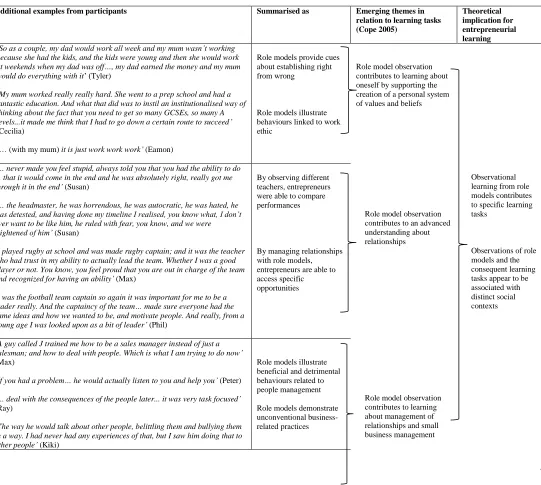
The examples that Phil and Max offer suggest that role model observations in the workplace significantly affect future entrepreneurial behaviours. These accounts of observational learning from role models in the workplace would seem to be linked to continuing and refining the individual’s formative process towards entrepreneurship. Most participants reported that observational learning was mostly a source of understanding the professional context, interactions in the workplace and access to best practices. Table 2 summarises learning from observing role models prior to start-up.
--- Insert Table 2 about here ---
Observations post-start-up
19 in the domestic setting (either parents or partners), in the workplace (business partners and staff) and seek out other entrepreneurs as role models.
A wide variety of behaviours was reported post-start-up. Following the decision to engage in entrepreneurship, individuals appear to observe parents and/or partners as role models. The close relationship between the entrepreneur and role model generates observations that participants articulated as noteworthy and meaningful. Eamon explained:
‘Mum used to go to this yoga thing at the weekend… So I’ll go for a Yoga class and see
how that works. It’s been fantastic, really enjoy it. It’s just like a safety valve; you can
just release some air’ (Eamon)
The accounts also describe a number of behaviours observed in close role models demonstrating their partner’s support for their entrepreneurial decisions. Cecilia and Bruno illustrate this supportive behaviour:
‘We have a life like this, maybe we are alright, we don’t know! Maybe we are off track,
we don’t know! He is so positive, hence always encouraged me to be what he believes is
right for me and this is right for me’ (Cecilia)
‘My dad has always had his own businesses. And I think that is where my inner drive
came from because I was always encouraged to go that way. He was a partner at
Century 21 estate agency, so hence the background, sold out to a big bank when he was
about 30 and started a construction company building new houses (…) He has always
been an advocate of taking risks because the rewards are much greater (...) I actually
thrive like that’ (Bruno)
20 The participants also reported learning from observing role models in their business, commonly from business partners or staff and related to the entrepreneurial firm and its development. Many articulated how business partners functioned as role models who demonstrated complementary behaviours to those of the entrepreneur. Max explained:
‘Some of the customers I find irritating; I would say get lost. He doesn’t, he stays calm
and he is very good with this type of customer’ (Max)
Within the business context, numerous examples of role model behaviours were offered that helped participants learn to improve performance in specific functional areas of the organisation. Eamon described how Anthony, a salesman, enacted a significant behaviour in relation to maintaining customer satisfaction:
‘… what I have taken from him is just to know when to say no. Basically know your
power position and your dynamic. Being a lot more reflective of where you are
positioned in relation to customers and a dealer network’ (Eamon)
In a similar example, Matthew described how his business partner demonstrated new ways of recruiting top talent to his organisation:
‘… what he does, which is a great gift, is that he brings people into his business who
have those skill, rather than a lot of people who don’t have a good education being
envious or jealous or have a chip on their shoulder because of that, he embraces it’
(Matthew)
These examples suggest that observation of partners or colleagues in the business context generates impactful learning for the entrepreneur and potential improvements in functional areas of the business.
21 business. Max describes an attitude that is contrary to what he believes can generate a successful entrepreneurial endeavour:
‘That P had a unit near us, he had no idea of promoting or selling, he couldn’t do
accounts, he just wasn’t interested in the business. I think he only set it up so he didn’t
have to work for somebody else. He never made money and never had money’ (Max)
These examples illustrate that observation of these role models creates a sense of reassurance in the decisions and course of actions followed by participants. Cecilia summarises learning generated from observing other entrepreneurs and businesses:
‘What you actually learn is that they have the same problems you have, no matter what
size they are… I found that certain things that I’ve learnt are just about confidence and
a belief’ (Cecilia)
Particularly significant is that by observing similar entrepreneurs, insight is gained on the most effective way of exploiting entrepreneurial opportunities. John and Robert asserted:
‘… he is the director of a brewery in L. He actually has the perfect setup. Their brewery
is 99% owned by one person. Down there, they’ve got a proven formula for family
succession in the business. There is only one family member who is going to be the
boss, that’s it, and they are chosen from early age’ (John)
‘… he said this is my third recession, just cut costs. I am still here and I will still be
here after this recession; cut costs, batten down the hatches, and come out the other
side’ (Robert)
22 preceded by an identification process where participants discover additional information on the role model. This identification process would also seem to facilitate observational learning. In addition to the discussion above, Table 2 summarises observational learning post-start-up.
Interpretation and analysis
Extending the work of Gibb (1997) on the ‘learning environment’, this research underlines the significance of the social context in observing role models and how this affects entrepreneurial learning. Our findings suggest that entrepreneurs do not learn merely from being exposed to role models, but more significantly, they learn from observing role models in distinct social contexts. Moreover, our findings suggest that observing role models in distinct social contexts is intrinsically related to the pre- and post-start-up entrepreneurial stages.
Distinguishing the nature of observations pre- and post-start-up
We demonstrate that prior to start-up, most observations were unpremeditated and unplanned. While these observations appear to be central to the individual’s development, the participants’ accounts underline that they were prompted by sharing a setting with a prominent or recurrent role model (Bosma et al. 2012; Hoffmann et al. 2015). This tells us that role modelling prior to start-up is underpinned by multiple and frequent contacts leading to strong relationships that in turn facilitate further role modelling and enhance future observations.
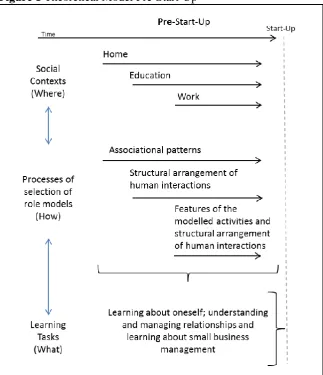
23 Moving beyond the where and how, this study demonstrates that observing role models in different contexts prior to start-up contributes to learning associated with specific learning tasks according to Cope (2005). Extending previous studies adopting an experiential stance (Cope 2005; Harvey and Evans 1995), this study shows that the observation of role models is associated with fundamental entrepreneurial learning tasks (Cope 2005), such as learning about oneself, understanding and managing relationships, and the initial stock of learning concerning the management of small businesses. Our study also echoes the insights of Cope (2001) showing that the acquisition of pre-start-up learning tasks is a long process that occurs in multiple social contexts rather than those immediately accessed prior to start-up.
Figure 1 summarises our theoretical understanding of how subsequent observation of role models in distinct social contexts prior to start-up is underpinned by specific observation processes associated with particular learning tasks for the entrepreneur.
--- Insert Figure 1 about here ---
Having discussed pre-start-up learning, we now move to the post-start-up findings. In this regard, we show that starting a new venture appears to propel entrepreneurs to using their observational opportunities in a more purposeful way. Post-start-up, the participants illustrate that observation contributed to their own learning needs as well as those of the venture.
24 learning. Dealing with diversified and concurrent challenges, entrepreneurs scan multiple social contexts and role models in search of potential solutions.
Our findings demonstrate that these entrepreneurial challenges affect the process through which role models are selected. In line with prior literature, we also find that role models are usually found in the entrepreneur’s close networks (Bosma et al. 2012). Role models perceived as having achieved high performance behaviours in their personal and professional endeavours are purposefully observed and engaged. This is an important addition to literature focusing on the behaviours of role models (Bosma et al. 2012) albeit neglecting how role modelling is linked to the personal and professional challenges faced along the entrepreneurial journey.
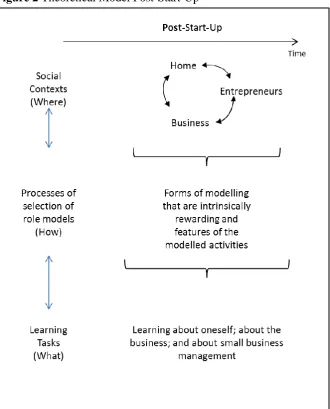
In relation to the entrepreneurial learning tasks proposed by Cope (2005), our findings suggest that entrepreneurs learn mostly about themselves, the external business environment and small business management. By comparing their own behaviours with post-start-up role models, entrepreneurs find better ways of dealing with their own personal challenges and specific areas of the business where they can improve and critically observe behaviours that lead to high performance in others.
--- Insert Figure 2 about here
---Figure 2 summarises our understanding of how role models are observed post-start-up. Given specific problems or entrepreneurial challenges, entrepreneurs simultaneously access multiple social contexts in the pursuit of potential solutions.
Observation of role models and entrepreneurial learning
25 et al. 1989; Van Auken et al. 2006). However, less appears to be known about the processes with which role models are selected and subsequently observed (Bosma et al. 2012). As an example, Cope (2005) argues that more work should focus on understanding with whom, how and what is learned from social interactions with role models. While Cope (2005) is particularly interested in how learning from observing role models influences preparedness for entrepreneurship, we consider it equally important to understand how entrepreneurs continue to observe role models in the context of leading their ventures post-start-up (Lans et al. 2008).
The findings suggest that role model observation occurs in different social contexts accessed pre- and post-start-up. Particularly interesting is that our study suggests a link between interpersonal attraction and the selection of role models for each of these contexts. Thus, this study shows that the processes of observing role models are distinct pre- and post-start-up and based on the different social contexts the entrepreneur accesses. In line with this finding, our study also shows that entrepreneurs learn about distinct learning tasks at each stage. While pre-start-up observations appear to trigger understanding of developing a personal and entrepreneurial value and belief system as well as social relationships and small business management, post-start-up observations lead to outcomes linked to personal and entrepreneurial development. Our argument, as depicted in the distinct characteristics of our pre- and post-start-up theoretical models (Figures 1 and 2), is that the social contexts, processes and learning tasks accrued from observations in these two stages are substantially distinct in relation to these dimensions.
In view of the evolving nature of observing role models in entrepreneurship, our study contributes to entrepreneurial learning literature as follows.
26 observing role models although through distinct learning processes and learning tasks. We address calls for greater understanding of how, when and where entrepreneurs learn as part of their preparation for entrepreneurship (Cope 2005) showing that entrepreneurs learn from observing role models in a multitude of social contexts through distinct mechanisms that are in turn associated with particular learning tasks essential to start-up. Moreover, we extend previous studies that mainly focus on the influence of role models at start-up (Mungai and Velamuri 2011; Scherer et al. 1989) by exploring role models beyond start-up. In this regard, we show that role models are particularly important to accelerate the search for potential solutions to personal or entrepreneurial challenges. Thus, we complement previous approaches to entrepreneurial learning considering learning from experience as critical to entrepreneurial problem solving (Young and Sexton 1997) by developing understanding of how social learning can provide alternatives to entrepreneurial problem solving.
In addition, we show that learning tasks are associated with observing role models. In this regard, we extend the work of Cope (2005) on the content dimension of entrepreneurial learning showing that observing role models contributes to key learning tasks in entrepreneurship. Specifically, we show that learning about oneself, about the business, about relationships and small business management can ensue from observing role models. In providing insights on entrepreneurial learning tasks as outcomes of observation, we complement prior research that largely considers the role of experiences and experiential learning in the formation of these tasks (Cope 2005; Pittaway and Thorpe 2012).
27 distinct contexts, entrepreneurs learn about a range of entrepreneurial practices. In developing in-depth understanding of how each context contributes to the overall process and practices, this paper responds to Wang and Chugh’s (2014) call urging researchers to develop understanding at the intersection of learning and entrepreneurship.
Conclusions
Calls have been made for work that continues the development of entrepreneurial learning from a contextualised and situated perspective (Cope 2011; Hamilton 2011; Sardana and Scott-Kemmis 2010). We respond to these calls by generating knowledge on how entrepreneurs learn from others, specifically from observing role models. In addressing the overarching question: ‘How do entrepreneurs learn from observing role models?’ we also considered two sub-questions. The first relates to the social context: ‘Where and how are role models observed?’. The second relates to the content of entrepreneurial learning: ‘What is learned from observing role models?’. We show that entrepreneurs navigate through different social contexts to generate insightful and effective observations relevant to their own development and the management of their entrepreneurial venture. Underpinned by a life course approach, we demonstrate an important link between the venture creation stage and the social contexts associated with observing role models. Pre-start-up, entrepreneurs learn mostly from unplanned learning interactions with a wide range of role models who contribute to the development of their professional self (Gibson 2004). In contrast, the post-start-up observation of role models appears to be purposeful and linked to personal or business challenges. This paper also demonstrates that observations in multiple contexts accessed by entrepreneurs pre- and post-start-up contribute to the development of distinct entrepreneurial learning tasks (Cope 2005).
28 models in distinct social contexts is associated with learning tasks essential to entrepreneurship.
Implications for entrepreneurship educators
The findings of this study emphasise that role models support learning associated with specific entrepreneurial learning tasks along the entrepreneurial journey. Indeed, this study posits that individuals have learned and continue to learn complex practices and behaviours over time (Bosma et al. 2012) from observing role models. In doing so, it carries implications for educators dedicated to enterprise education.
Based on the core insights of this paper, enterprise educators working with students prior to start-up may consider creating curriculum activities that require students to shadow entrepreneurs and reflect on the practices they observe. Taking this exercise further, educators could, for example, ask students to conduct shadowing exercises (Roan and Rooney 2006) with multiple entrepreneurs over the duration of their degree. The evidence in our study suggests that the opportunity to observe distinct entrepreneurs will provide students with understanding of the benefits of observation as well as enhancing the acquisition of entrepreneurial learning tasks.
For enterprise educators working towards developing entrepreneurs, our study shows that entrepreneurs continue to consider observation as a way of developing themselves and their businesses. For example, post-start-up, our findings show that entrepreneurs can locate solutions for their learning needs within their business through observing business partners or members of staff. This implies that observations within the business are equally important to acquiring and updating learning tasks and should be encouraged by entrepreneurship educators.
30
References
Bandura, A. 1977. Social Learning Theory. Prentice Hall.
Bansal, P., and K. Corley. 2012. “Publishing in AMJ - Part 7: What’s Different about Qualitative Research?” Academy of Management Journal 55 (3): 509-513. doi:10.5465/amj.2012.4003.
Belli, R. F., D. F. Alwin, and F. P. Stafford. 2009. Calendar and Time Diary: Methods in Life Course Research. London: Sage.
Belli, R. F., and M. Callegaro. 2009. “The Emergence of Calendar Interviewing: A Theoretical and Empirical Rationale.” In Calendar and Time Diary: Methods in Life Course Research, edited by R. F. Belli, D. F. Alwin, and F. P. Stafford. London: Sage. Bosma, N., J. Hessels, V. Schutjens, M. Van Praag, and I. Verheul. 2012. “Entrepreneurship
and Role Models.” Journal of Economic Psychology 33 (2): 410-424. doi:10.1016/j.joep.2011.03.004.
Boyd, N. G., and G. S. Vozikis. 1994. “The Influence of Self-Efficacy on the Development of Entrepreneurial Intentions and Actions.” Entrepreneurship Theory and Practice 18: 63-77.
Bruton, G. D, and D. 2003. “An Institutional View of China’s Venture Capital Industry.” Journal of Business Venturing 18 (2): 233–259. doi:10.1016/S0883-9026(02)00079-4. Chenail, R. J. 2009. “Communicating Your Qualitative Research Better.” Family Business
Review 22 (2): 105-108. doi:10.1177/0894486509334795.
Clausen, J. 1998. “Life Reviews and Life Stories.” In Methods of Life Course Research: Qualitative and Quantitative Approaches, edited by J. Z. Giele and G. H. Elder, 189-212. Thousand Oaks: SAGE.
31 Cope, J. 2005. “Toward a Dynamic Learning Perspective of Entrepreneurship.” Entrepreneurship Theory and Practice 29 (4): 373-397. doi:10.1111/j.1540-6520.2005.00090.x.
Cope, J. 2011. “Entrepreneurial Learning from Failure: An Interpretative Phenomenological Analysis.” Journal of Business Venturing 26 (6): 604-623. doi:10.1016/j.jbusvent.2010.06.002.
Davis, A. E., and K. G. Shaver. 2012. “Understanding Gendered Variations in Business Growth Intentions Across the Life Course.” Entrepreneurship Theory and Practice 36 (3): 495-512. doi:10.1111/j.1540-6520.2012.00508.x.
Denzin, N. K., and Y. S. Lincoln. 2000. Handbook of Qualitative Research. 2nd ed. SAGE. Dunn, T., and D. Holtz-Eakin. 2000. “Financial Capital, Human Capital, and the Transition to
Self‐Employment: Evidence from Intergenerational Links.” Journal of Labor Economics 18 (2): 282-305. doi:10.1086/209959.
Edwards, R. 1993. “An Education in Interviewing.” In Researching Sensitive Topics, edited by C. M. Renzetti and R. M. Lee, 181-196. Newbury Park, California: Sage Publications. Eisenhardt, K. M. 1989. “Building Theories from Case Study Research.” Academy of
Management Review 14 (4): 532–550.
Erikson, T. 2003. “Towards a Taxonomy of Entrepreneurial Learning Experiences among Potential Entrepreneurs.” Journal of Small Business and Enterprise Development 10 (1): 106-112. doi:10.1108/14626000310461240.
Falck, O., S. Heblich, and E. Luedemann. 2010. “Identity and Entrepreneurship: Do School Peers Shape Entrepreneurial Intentions?” Small Business Economics 39 (1): 39-59. doi:10.1007/s11187-010-9292-5.
32 Gabrielsson, J., and D. Politis. 2012. “Work Experience and the Generation of New Business Ideas among Entrepreneurs: An Integrated Learning Framework.” International Journal of Entrepreneurial Behaviour & Research 18 (1): 48-74. doi:10.1108/13552551211201376.
Gemmell, R. M., R. J. Boland, and D. A. Kolb. 2011. “The Socio-Cognitive Dynamics of Entrepreneurial Ideation.” Entrepreneurship Theory and Practice 36 (5): 1053-1073. doi:10.1111/j.1540-6520.2011.00486.x.
Gephart, R. P. 1999. “Paradigms and Research Methods.” Research Methods Division (AoM). http://division.aomonline.org/rm/1999_RMD_Forum_Paradigms_and_Research_Method s.htm.
Gephart, R. P. 2004. “Qualitative Research and the Academy of Management Journal.” Academy of Management Journal 47 (4): 454-462. doi:10.5465/AMJ.2004.14438580. Gibb, A. 1997. “Small Firms’ Training and Competitiveness. Building Upon the Small
Business as a Learning Organisation.” International Small Business Journal 15 (3): 13-29. doi:10.1177/0266242697153001.
Gibson, D. E. 2004. “Role Models in Career Development: New Directions for Theory and Research.” Journal of Vocational Behavior 65 (1): 134-156.
Giele, J. Z., and G. H. Elder. 1998a. Methods of Life Course Research : Qualitative and Quantitative Approaches. Thousand Oaks, California: Sage Publications.
Giele, J. Z., and G. H. Elder. 1998b. “Life Course Research: Development of a Field.” In Methods of Life Course Research: Qualitative and Quantitative Approaches, edited by Janet Zollinger Giele and Glen H. Elder. Thousand Oaks, California: Sage Publications. Glaser, B. G., and A. L. Strauss. 1967. The Discovery of Grounded Theory: Strategies for
33 Gordon, I., E. Hamilton, and S. L. Jack. 2012. “A Study of a University-Led Entrepreneurship Education Programme for Small Business Owner/managers.” Entrepreneurship & Regional Development 24 (9-10): 767-805. doi:10.1080/08985626.2011.566377.
Green, L. 2010. Understanding the Life Course : Sociological and Psychological Perspectives. Cambridge; Malden, MA: Polity.
Hamilton, E. 2011. “Entrepreneurial Learning in Family Business: A Situated Learning Perspective.” Journal of Small Business and Enterprise Development 18 (1): 8-26. doi:10.1108/14626001111106406.
Hamilton, E. 2013. Entrepreneurship across Generations: Narrative, Gender and Learning in Family Business. Cheltenham, UK; Northampton, MA: Edward Elgar Publishing. Harvey, M., and R. Evans. 1995. “Strategic Windows in the Entrepreneurial Process.”
Journal of Business Venturing 10 (5): 331–347. doi:10.1016/0883-9026(95)00037-9. Hoffmann, A., M. Junge, and N. Malchow-Møller. 2015. “Running in the Family: Parental
Role Models in Entrepreneurship.” Small Business Economics 44 (1): 79-104. doi:10.1007/s11187-014-9586-0.
Holcomb, T. R., R. D. Ireland, R. M. Holmes Jr., and M. A. Hitt. 2009. “Architecture of Entrepreneurial Learning: Exploring the Link Among Heuristics, Knowledge, and Action.” Entrepreneurship Theory and Practice 33 (1): 167-192. doi:10.1111/j.1540-6520.2008.00285.x.
Jack, S. L., and A. R. Anderson. 2002. “The Effects of Embeddedness on the Entrepreneurial Process.” Journal of Business Venturing 17 (5): 467-487.
34 Jayawarna, D., J. Rouse, and J. Kitching. 2011. “Entrepreneur Motivations and Life Course.”
International Small Business Journal 31 (1): 34-56. doi:10.1177/0266242611401444. Jayawarna, D., J. Rouse, and A. Macpherson. 2014. “Life Course Pathways to Business
Start-Up.” Entrepreneurship & Regional Development 26 (3-4): 282-312. doi:10.1080/08985626.2014.901420.
Kacperczyk, A. J. 2012. “Social Influence and Entrepreneurship: The Effect of University Peers on Entrepreneurial Entry.” Organization Science 24 (3): 664-683. doi:10.1287/orsc.1120.0773.
Kempster, S. 2009. “Observing the Invisible: Examining the Role of Observational Learning in the Development of Leadership Practice.” Journal of Management Development 28 (5): 439-456. doi:10.1108/02621710910955976.
Kempster, S., and J. Cope. 2010. “Learning to Lead in the Entrepreneurial Context.” International Journal of Entrepreneurial Behaviour & Research 16 (1): 5-34. doi:10.1108/13552551011020054.
Konopaski, M., S. L. Jack, and E. Hamilton. 2015. “How Family Business Members Learn About Continuity.” Academy of Management Learning & Education 14 (3): 347-364. doi:10.5465/amle.2014.0244.
Lafuente, E., Y. Vaillant, and J. Rialp. 2007. “Regional Differences in the Influence of Role Models: Comparing the Entrepreneurial Process of Rural Catalonia.” Regional Studies 41 (6): 779-796. doi:10.1080/00343400601120247.
Lans, T., H. Biemans, J. Verstegen, and M. Mulder. 2008. “The Influence of the Work Environment on Entrepreneurial Learning of Small-Business Owners.” Management Learning 39 (5): 597-613. doi:10.1177/1350507608098117.
35 Marshall, C., and G. B. Rossman. 2006. Designing Qualitative Research. 4th ed. Thousand
Oaks, California: Sage Publications.
Martyn, K. 2009. “Adolescent Health Research and Clinical Assessment. Using Self-Administered Event History Calendars.” In Calendar and Time Diary: Methods in Life Course Research, edited by R. F. Belli, D. F. Alwin, and F. P. Stafford. London: Sage. Martyn, K, and R. F. Belli. 2002. “Retrospective Data Collection Using Event History
Calendars.” Nursing Research 51 (4): 270-274.
Mason, J. 2002. Qualitative Researching. Sage Publications.
McKeever, E., A. R. Anderson, and S. L. Jack. 2014. “Entrepreneurship and Mutuality: Social Capital in Processes and Practices.” Entrepreneurship & Regional Development 26 (5-6): 453-477. doi:10.1080/08985626.2014.939536.
McKeever, E., S. Jack, and A. Anderson. 2015. “Embedded Entrepreneurship in the Creative Re-Construction of Place.” Journal of Business Venturing 30 (1): 50-65. doi:10.1016/j.jbusvent.2014.07.002.
Miles, M., and A. M. Huberman. 1994. Qualitative Data Analysis: A Source Book of New Methods. Beverly Hills, CA: Sage Publications.
Mungai, E., and S. R. Velamuri. 2011. “Parental Entrepreneurial Role Model Influence on Male Offspring: Is It Always Positive and When Does It Occur?” Entrepreneurship Theory and Practice 35 (2): 337-357. doi:10.1111/j.1540-6520.2009.00363.x.
Nanda, R., and J. B. Sorensen. 2010. “Workplace Peers and Entrepreneurship.” Management Science 56 (7): 1116-1126. doi:10.1287/mnsc.1100.1179.
36 Patton, M. Q. 2002. Qualitative Research and Evaluation Methods. 3rd. Thousand Oaks, CA:
SAGE.
Pittaway, L. A., J. Gazzard, A. Shore, and T. Williamson. 2015. “Student Clubs: Experiences in Entrepreneurial Learning.” Entrepreneurship & Regional Development 27 (3-4): 127-153. doi:10.1080/08985626.2015.1014865.
Pittaway, L. A., E. Rodriguez-Falcon, O. Aiyegbayo, and A. King. 2011. “The Role of Entrepreneurship Clubs and Societies in Entrepreneurial Learning.” International Small Business Journal 29 (1): 37-57. doi:10.1177/0266242610369876.
Pittaway, L. A., and R. Thorpe. 2012. “A Framework for Entrepreneurial Learning: A Tribute to Jason Cope.” Entrepreneurship & Regional Development 24 (9-10): 837-859. doi:10.1080/08985626.2012.694268.
Politis, D. 2005. “The Process of Entrepreneurial Learning: A Conceptual Framework.” Entrepreneurship Theory and Practice 29 (4): 399-424.
Pratt, M. G. 2009. “For the Lack of a Boilerplate: Tips on Writing Up (and Reviewing) Qualitative Research.” Academy of Management Journal 52 (5): 856-862. doi:10.5465/AMJ.2009.44632557.
Radu, M., and C. Loue. 2008. “Motivational Impact of Role Models as Moderated by ‘Ideal’ vs. ‘Ought Self Guides.’” Journal of Enterprising Culture 16 (4): 441-465.
Rae, D., and M. Carswell. 2000. “Using a Life-Story Approach in Researching Entrepreneurial Learning: The Development of a Conceptual Model and its Implications in the Design of Learning Experiences.” Education + Training 42 (4/5): 220-228.
Rae, D., and M. Carswell. 2001. “Towards a Conceptual Understanding of Entrepreneurial Learning.” Journal of Small Business and Enterprise Development 8 (2): 150-158.
37 Renzetti, C. M., and R. M. Lee. 1993. Researching Sensitive Topics. Sage Publications. Reuber, A.R., and E. Fischer. 1999. “Understanding the Consequences of Founders’
Experience.” Journal of Small Business Management 37 (2): 30-45.
Roan, A., and D. Rooney. 2006. “Shadowing Experiences and the Extension of Communities of Practice: A Case Study of Women Education Managers.” Management Learning 37 (4): 433-454. doi:10.1177/1350507606070215.
Sardana, D., and D. Scott-Kemmis. 2010. “Who Learns What? A Study Based on Entrepreneurs from Biotechnology New Ventures.” Journal of Small Business Management 48 (3): 441-468. doi:10.1111/j.1540-627X.2010.00302.x.
Scherer, R. F., J. S. Adams, S. S. Carley, and F. A. Wiebe. 1989. “Role Model Performance Effects on Development of Entrepreneurial Career Preference.” Entrepreneurship Theory and Practice 13 (3): 53-71.
Scott, J., and D. F. Alwin. 1998. “Retrospective versus Prospective Measurement of Life Histories in Longitudinal Research.” In Methods of Life Course Research: Qualitative and Quantitative Approaches, edited by J. Z. Giele and G. H. Elder, 81-97. Thousand Oaks, California: Sage Publications.
Segal, G., J. Schoenfeld, and D. Borgia. 2007. “Which Classroom-Related Activities Enhance Students’ Entrepreneurial Interests and Goals? A Social Cognitive Career Theory Perspective.” Academy of Entrepreneurship Journal 13 (2): 79-98.
Sexton, D. L., N. B. Upton, L. E. Wacholtz, and P. P. McDougall. 1997. “Learning Needs of Growth-Oriented Entrepreneurs.” Journal of Business Venturing 12 (1): 1-8.
Shepherd, D. A. 2004. “Educating Entrepreneurship Students about Emotion and Learning from Failure.” Academy of Management Learning & Education 3 (3): 274-287. doi:10.5465/AMLE.2004.14242217.
38 Suddaby, R. 2006. “From the Editors: What Grounded Theory Is Not.” Academy of
Management Journal 49 (4): 633-642.
Taylor, D. W., and R. Thorpe. 2004. “Entrepreneurial Learning: A Process of Co-Participation.” Journal of Small Business and Enterprise Development 11 (2): 203-211. Van Auken, H., F. Fry, and P. Stephens. 2006. “The Influence of Role Models on
Entrepreneurial Intentions.” Journal of Developmental Entrepreneurship 11 (2): 157-167.
Wang, C. L., and H. Chugh. 2014. “Entrepreneurial Learning: Past Research and Future Challenges: Advancing Entrepreneurial Learning Research.” International Journal of Management Reviews 16 (1): 24-61. doi:10.1111/ijmr.12007.
39
Appendix 1
Interview script
Initial Protocol - Questions on entrepreneurs/ventures
1. Company/business project - Can you give me a brief description of your company
and your specific role?
2. Start-up processes and motivations - When you started your project, what was/were
your main motivation/s?
3. Previous background and experience - Can you describe your background and
activities prior to starting the company?
4. Decisions and important moments - Can you tell me about important moments in
your company’s development so far? Proud moments? Main challenges ahead?
Timeline Exercise
5. In our phone call/email, I asked you to bring along your timeline. Can you briefly
describe your timeline, highlighting for each person:
a. Why the person is on your timeline
b. What you have learned from them that is significant in the way you
operate/run your business today
6. After completing the above task: Would you like to add anyone else to the
40
Table 1 Summary of participants’ characteristics
Participant Gender Industry Age Highest level of education
Entrepreneurial engagement year
Entrepreneurial configuration
Bruno Male Energy Services 26 University degree 2007 SME
Cecilia Female Internet Trade 36 University degree 2009 SME
Carola Female Entertainment for
Children 40
Postgraduate
degree (MBA) 2006 SME
Eamon Male Heavy Machinery
Manufacturing 28 University degree 2008 Family Business
Fabian Male Financial Services 57 Postgraduate
degree 1993 SME
John Male Tourism and Hospitality 42 University degree 1998 Family Business
Kiki Female Care 45 A Levels 2005 SME
Matthew Male Business Services 50 University degree 2010 SME
Max Male Machinery Manufacturing 59 A Levels 1995 SME
Peter Male Financial Services 44 University degree 1994 SME
Phil Male Recruitment Services 30 A Levels n/a Family Business
Ray Male Tourism and Hospitality 38 University degree 1996 SME
Robert Male IT 41 University degree,
PGCE 2003 SME
Susan Female Manufacturing 53 A Levels 1994 Family Business
Roderick Male Accoustics and Sound
consultancy 38
Postgraduate
Degree 2005 SME
41
Table 2 Analytical themes by stage
Entrepreneurial stage
Social contexts (role models observed)
Additional examples from participants Summarised as Emerging themes in
relation to learning tasks (Cope 2005) Theoretical implication for entrepreneurial learning Pre-start-up Home (parents, close family members)
‘So as a couple, my dad would work all week and my mum wasn’t working because she had the kids, and the kids were young and then she would work at weekends when my dad was off…, my dad earned the money and my mum would do everything with it’ (Tyler)
‘My mum worked really really hard. She went to a prep school and had a fantastic education. And what that did was to instil an institutionalised way of thinking about the fact that you need to get so many GCSEs, so many A levels...it made me think that I had to go down a certain route to succeed’
(Cecilia)
‘… (with my mum) it is just work work work’ (Eamon)
Role models provide cues about establishing right from wrong
Role models illustrate behaviours linked to work ethic
Role model observation contributes to learning about oneself by supporting the creation of a personal system of values and beliefs
Role model observation contributes to an advanced understanding about relationships
Role model observation contributes to learning about management of relationships and small business management
Observational learning from role models contributes to specific learning tasks
Observations of role models and the consequent learning tasks appear to be associated with distinct social contexts Education (teachers and colleagues)
‘… never made you feel stupid, always told you that you had the ability to do it, that it would come in the end and he was absolutely right, really got me through it in the end’ (Susan)
‘… the headmaster, he was horrendous, he was autocratic, he was hated, he was detested, and having done my timeline I realised, you know what, I don’t ever want to be like him, he ruled with fear, you know, and we were frightened of him’ (Susan)
‘I played rugby at school and was made rugby captain; and it was the teacher who had trust in my ability to actually lead the team. Whether I was a good player or not. You know, you feel proud that you are out in charge of the team and recognized for having an ability’ (Max)
‘I was the football team captain so again it was important for me to be a leader really. And the captaincy of the team… made sure everyone had the same ideas and how we wanted to be, and motivate people. And really, from a young age I was looked upon as a bit of leader’ (Phil)
By observing different teachers, entrepreneurs were able to compare performances
By managing relationships with role models, entrepreneurs are able to access specific opportunities Work (entrepreneurs, managers, work colleagues)
‘A guy called J trained me how to be a sales manager instead of just a salesman; and how to deal with people. Which is what I am trying to do now’
(Max)
‘If you had a problem… he would actually listen to you and help you’ (Peter)
‘… deal with the consequences of the people later... it was very task focused’
(Ray)
‘The way he would talk about other people, belittling them and bullying them in a way. I had never had any experiences of that, but I saw him doing that to other people’ (Kiki)
Role models illustrate beneficial and detrimental behaviours related to people management
42
‘What I liked about him is that, no matter where he went, he would go up to every single member of our staff, be it a cleaner, a janitor or the site manager, shake their hands and ask them whether we, as a company, were looking after them’ (Matthew)
‘She always made the point that if you want someone to change something, you have to put it in writing, committing yourself completely. Put it in writing and then follow up, follow up, follow up’ (Eamon)
Post-start-up
Domestic setting / home
(parents and partners)
‘If I start to become too big headed she brings me back to earth, and if I start to feel down she lifts me up’ (Matthew)
‘Parents are in the organizational chart and work… financially your parents want you to achieve as much as possible’ (Carola)
‘(Mum) she must have started more businesses that I have dinners, she gets bored very quickly and I think I have a little bit of both within’ (Bruno)
‘If she thinks you’re doing something wrong she will tell you. And I think we all need that from time to time, to keep us on the straight and narrow... I have become a lot more humble and tolerant of things and more patient’ (Matthew)
‘My wife taught me the value of self-confidence,, my wife is 5 years older than me (…) I always try to give them a fair chance so they might not be best friends, but there will be people who don’t like me and we just have to accept the fact that they won’t like me for one reason or another and that’s just life. And just be happy! Because life is full of people who like different things, isn’t? So I think she brought that kind of maturity’ (Tyler)
Entrepreneurs observe behaviours that
demonstrate support for the entrepreneurial decision
Entrepreneurs observe role models illustrating behaviours that help them deal with the
entrepreneurial day-to-day challenges
Role model observations contribute to learning about oneself
Role model observations contribute to learning about small business management Observations of role models continues post-start-up in different social contexts Observations post-start-up are informed by entrepreneurial challenges Observations post-start-up are associated with particular learning tasks Business (business partners and staff)
‘And I don’t think I would be able to do what he has done and maybe he can’t do what I can do now at this stage of moving forward. We bring different things to the table’ (Eamon)
‘We are very different, but very alike… so I am able to take a step back and perhaps give a different perspective to S. Not in a nasty way, but in a stronger way, yeah, detached definitely. I am down as sort of being of a different nature. He is exceptionally patient’ (Susan)
‘He will make sure that everyone is looked after… He gives a share of the profits of the company to all the staff, from the top managing director, to all managers, right way through the cooks and the cleaners… he always tells me that if you invest and you give back you get the most work from them’ (Phil)
‘he is actually very good in telling people when they done well, praising you and he gets, I think he gets a lot of respect for that’ (Robert)
Entrepreneur observe behaviours in role models that are complementary to their own