Thai second language writing: the development of
language knowledge and cross-cultural influence
WOODWARD, Nigel
Available from Sheffield Hallam University Research Archive (SHURA) at: http://shura.shu.ac.uk/8556/
This document is the author deposited version. You are advised to consult the publisher's version if you wish to cite from it.
Published version
WOODWARD, Nigel (2014). Thai second language writing: the development of language knowledge and cross-cultural influence. Doctoral, Sheffield Hallam University.
Copyright and re-use policy
See http://shura.shu.ac.uk/information.html
Thai second language writing: the development of language knowledge and
cross-cultural influence
Nigel Woodward
A thesis submitted in fulfilment of the requirements of
Sheffield Hallam University
for the degree of Doctor of Philosophy
Abstract
A key element in improving both the assessment and learning of English as a second
language (ESL) in English-medium schools is a deeper understanding of how language
knowledge develops. However, relatively few studies have investigated the development of
academic language in learners with ESL, and there appear to be no studies of this kind
focusing on Thai learners. This study investigates the language knowledge of Thai learners
of English in an English-medium international school in Bangkok, Thailand. The objective of
the study was to understand both the developmental trajectory of features of academic
language and the influence of Thai culture on English writing. The writing of two groups of
Thai learners in year 9 of secondary school, Early Immersion (6-10 years in English-medium
education) and Late Immersion (3-4 years of English-medium education) was compared.
The writing of these two groups was also compared to that of English mother tongue (EMT)
writers of similar age and the Thai writing of a group of Thai students of similar age
studying in a Thai secondary school. The broad developmental pattern of Thai learners of
English in this environment can be summarized as a movement from simplicity, through
complexity to control and towards increasing flexibility. Late Immersion writers have
achieved a degree of complexity but still lack control of some basic elements of clause
structure. Early Immersion writers have achieved control of these features and are moving
towards increasing flexibility, marked by the developing use of logical and experiential
grammatical metaphor. Some features differentiating the English writing of Thai and
English mother tongue writers can be best explained as the results of cultural influence.
These include a tendency for Thai writers to make relatively frequent use of modal verbs
with a deontic function when writing on certain topics and to be more indirect and less
explicit when expressing opinions. The findings of the study have implications for both
assessment and teaching. Assessment tools for both EMT and ESL writers would benefit
from a more direct and precise reference to linguistic elements. Similarly, when teaching
learners with ESL alongside EMT learners in secondary English classrooms, planning and
teaching that includes exploration of how the grammar of English enables effective
Candidate’s Statement
I, Nigel Woodward, declare that this thesis, 'Thai second language writing: the
development of language knowledge and cross-cultural influence ' submitted
in partial fulfilment of the requirements for the award of Doctor of
Philosophy, in the Faculty of Development and Society, Sheffield Hallam
University, is wholly my own work unless otherwise referenced or
acknowledged. The material has not been submitted, either in whole or in
part, for an award or qualification at any other academic institution.
Acknowledgements
I would like to acknowledge the patience, encouragement support and advice
of my supervisors, Diana and Guy. I would also like to acknowledge the
support of the schools participating in the current study, Saint John’s
International School, Saint John’s Thai School and Bangkok Patana School, and
the participating students from these schools. Finally, I would like to
acknowledge the help and support of my current school, Kinabalu
Contents
List of Figures 1
List of Tables 3
Section 1 – Introduction
7Chapter 1 – Introduction 8
1.1BACKGROUND 8
1.2OVERVIEW OF PREVIOUS RESEARCH 8
1.3CONTRIBUTION OF THE CURRENT STUDY 11
1.4RESEARCH QUESTIONS 11
1.5THE ORGANIZATION OF THIS THESIS 13
Section 2 – Theoretical Framework
14Chapter 2 Bilingual Language Knowledge 15
2.1 INTRODUCTION 15
2.2 COMMUNICATIVE COMPETENCE 15
2.3 SYSTEMIC FUNCTIONAL GRAMMAR (SFG) i. Ideational resources
ii. Interpersonal resources
iii. Textual resources and rhetorical competence
17
2.4 DISCUSSION OF THE SFG APPROACH 24
2.5 RHETORICAL STRUCTURE THEORY (RST) 24
2.6 DISCUSSION OF RST 27
2.7 MULTICOMPETENCE, BILIGUALISM AND THE CONCEPT OF THE NATIVE SPEAKER
28
2.8 STUDYING LANGUAGE KNOWLEDGE 30
2.9 CONCLUSIONS AND IMPLICATIONS FOR THE STUDY 31
Chapter 3 Academic Language Knowledge and the Later Language Development of native Speakers
32
3.1 INTRODUCTION 32
3.2 ACADEMIC LANGUAGE 32
3.3 DISCUSSION OF THE CONSTRUCT OF ACADEMIC LANGUAGE 35
3.5 CONCLUSION AND IMPLICATIONS FOR THE STUDY 42
Section 3 – Literature Review
45Chapter 4 The Development of Academic Language Knowledge in Students with ESL
46
4.1 INTRODUCTION 46
4.2 THE ACADEMIC LANGUAGE KNOWLEDGE OF STUDENTS WITH ESL
i. Nominal groups
ii. Verbal Groups
iii. Clause complexes – expansion and projection iv. Interpersonal features of academic discourse
v. Cohesive conjunctions and rhetorical knowledge
46
4.3 DISCUSSION OF STUDIES OF ACADEMIC LANGUAGE KNOWLEDGE IN ESL STUDENTS
56
4.4 THE INFLUENCE OF TIME ON THE DEVELOPMENT OF LANGUAGE KNOWLEDGE
59
4.5 DISCUSSION OF RESEARCH INTO THE INFLUENCE OF TIME 62
4.6 CONCLUSIONS 63
4.7 IMPLICATIONS FOR THE CURRENT STUDY 66
Chapter 5Culture and Language Knowledge 69
5.1 INTRODUCTION 69
5.2 WHAT IS CULTURE? 69
5.3 CROSS-CULTURAL AND CROSS-LINGUISTIC INFLUENCE 70
5.4 VARIATIONS IN CULTURAL PSCYCHOLOGY 71
5.5 DISCUSSION OF CULTURAL PSYCHOLOGY 72
5.6 THAI CULTURE 73
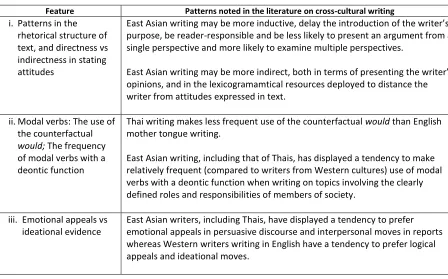
5.7 WRITTEN LANGUAGE AND CULTURE
i. Rhetorical structure, reader vs writer responsibility and variation in directness ii. Culture and the use of modal verbs
iii. Preference for logical or emotional persuasive appeals
75
5.8 DISCUSSION OF RESEARCH INTO WRITTEN LANGUAGE AND CULTURE 82
Section 4 – Methodology
86Chapter 6 – Methodology 87
6.1 INTRODUCTION 87
6.2 GENERAL RESEARCH QUESTIONS AND METHODOLOGY 87
6.3 PARTICIPANT GROUPS AND SPECIFIC RESEARCH QUESTIONS 90
6.4 DETAILS OF PARTICIPANT GROUPS:
i. Early and Late Immersion Thai Groups
ii. The English Mother Tongue Group
iii. The Thai Mother Tongue Group Writing in Thai
93
6.5 POTENTIAL SOURCES OF BETWEEN-GROUP VARIATION 98
6.6 THE COLLECTION OF TEXTS:
i. Writing Prompts
ii. Writing conditions
99
6.7 ETHICAL CONSIDERATIONS 102
6.8 DATA ANALYSIS
i. Counting lexicogrammatical features
ii. The analysis of rhetorical structure and associated features
iii. The analysis of how certain features function within texts written by the four groups
103
Section 5 – Results
115Chapter 7 – Results of the Study of Lexicogrammar 116
7.1 INTRODUCTION 116
7.2 OVERVIEW OF CORPUS 116
7.3 VARIATION WITHIN THE THAI IMMERSION GROUPS 117
7.4 ORGANISATION OF RESULTS 119
7.5 CLAUSE PARTICIPANTS AND PROCESSES
i. EXPLANATION OF GRAMMATICAL CATEGORIES AND MEASURES: Processes; The
complexity of participant noun groups; Abstract nouns and nominalizations ii. STATISTICS
iii. ANALYSIS: Relational Processes vs material processes; Subject length and object length; Abstract nouns iv. SUMMARY 120 120 123 124 128
7.6 COMPLEXITY IN THE VERBAL GROUP
i. EXPLANATION OF GRAMMATICAL CATEGORIES AND MEASURES ii. STATISTICS
iii. ANALYSIS: Secondary tenses; Passive voice
iv. SUMMARY 128 128 129 132 132
7.7 MODAL VERBS
i. EXPLANATION OF GRAMMATICAL CATEGORIES AND MEASURES ii. STATISTICS
iii. ANALYSIS: Deontic modality in the verbal group; Epistemic modality in the verbal group; The counterfactual would
iv. SUMMARY 132 132 133 133 136
7.8 THE THEMATIC ADJUNCT SLOT
i. EXPLANATION OF GRAMMATICAL CATEGORIES AND MEASURES ii. STATISTICS
iii. ANALYSIS
7.9 COMPLEXITY AND CLAUSE COMPLEXES
i. EXPLANATION OF GRAMMATICAL CATEGORIES AND MEASURES: Parataxis and hypotaxis; Expansion and projection; Clause complexes and the division of T Units ii. STATISTICS
iii. ANALYSIS: Hypotactic expansion; Hypotactic Projection and Mental and Verbal Processes; Paratactic expansion (and, so, but, or); Overall Complexity and variations in the function of dependent clauses between groups
iv. SUMMARY
140
140
144 145
150
7.10 PATTERNS IN DISCOURSE:
i. More involved, interactional discourse vs Less involved, abstract discourse
ii. The expression of attitudes and predicative adjectives
iii. Summary
150
7.11 ERROR ANALYSIS
i. EXPLANATION OF GRAMMATICAL CATEGORIES AND MEASURES ii. STATISTICS
iii. ANALYSIS: Overall patterns of error; Comparing error density to other potential indicators of development
iv. SUMMARY
157
157 159 159
161
7.12 SUMMARY OF RESULTS 163
Chapter 8 – The Rhetorical Structure of English Texts 166
8.1 INTRODUCTION 166
8.2 WHOLE TEXT STRUCTURES AND THE SOURCE OF ATTITUDES IN TEXTS:
i. The Perfect Teacher task
ii. The Park Letter task
iii. The Robot Progress task
168
8.3 RHETORICAL STRUCTURES DIFFERENTIATING THAI AND EMT WRITERS 177
8.4 RHETORICAL DEPTH AND THE COMBINING OF RHETORICAL STRUCTURES WITHIN TEXTS
i. Rhetorical depth
ii. Combining rhetorical structures within a text
179
8.5 RHETORICAL STRUCTURE TREES FOR COMPLETE TEXTS 185
Chapter 9 – Thai Language Texts Written by Thais 193
9.1 INTRODUCTION 193
9.2 THE LEXICOGRAMMAR OF THE THAI TEXTS WRITTEN IN THAI(the TWT
group)
194
9.3 THE THAI LANGUAGE:
i. Background ii. Processes
iii. Thai Modal Auxiliaries
195
9.4 RESULTS OF THE STUDY OF TWT LEXICOGRAMMAR:
i.The use of modal verbs with deontic and epistemic functions ii. The use of ja, will and would
iii. The frequency of material and behavioural processes compared to relational processes
198
9.5 THE RHETORICAL STRUCTURE OF TWT TEXTS 207
9.6 DISTINCTIVE FEATURES OF TWT RHETORICAL STRUCTURE AND PERSUASIVE STRATEGIES
214
Section 6 – Discussion and Conclusion
225Chapter 10 – Discussion 226
10.1 INTRODUCTION 226
10.2 THE INTERPRETATION OF FREQUENCY VARIATIONS 227
10.3 THE DEVELOPMENT OF LANGUAGE KNOWLEDGE
i. The developmental level of Late Immersion Thai students ii. The development of academic language - comparing LIT to EIT
iii. The use of clauses in writing and Biber’s (1988) dimensions of language variation iv. The development of rhetorical knowledge and knowledge of cohesion
v. Very late developmental features: EIT compared to EMT and the “8-year rule” vi. A model of the developmental trajectory of Thai immersion learners
228
10.4 CULTURAL INFLUENCE ON LANGUAGE KNOWLEDGE AND WRITING
i. Directness vs indirectness in rhetorical structure and in the presentation of attitudes ii. Culture and persuasion – the content of evidence
iii. Culture and the use of modal verbs
iv. The interaction between cultural and developmental factors
246
10.5 THE DEVELOPMENTAL AND CULTURAL FEATURES OF THAI IMMERSION WRITING
259
10.6 THE DEVELOPMENTAL PROCESS, CULTURAL INFLUENCE AND ESL PEDAGOGY 264
Chapter 11 – Conclusion 268
11.1 INTRODUCTION 268
11.2 CONCLUSIONS
i. How does the academic language knowledge of Thai Immersion learners develop?
ii. How is the language knowledge of Thai Immersion learners different to that of English mother tongue writers of similar age?
iii. How does Thai culture influence the language knowledge and writing of Thai immersion learners of English?
268
11.3 PRACTICAL IMPLICATIONS
i. Teaching English to Thai learners in an English-medium classroom ii. Assessment and the tracking of learner progress
273
11.4 ORIGINAL CONTRIBUTION 275
11.5 SHORTCOMINGS 277
11.7 FINAL REMARKS 280
References
282Appendices
294Appendix i. Rhetorical Structure Theory relation definitions 295
Appendix ii. Test used to assess grammatical knowledge of EIT and LIT participants at the end of year 6
298
Appendix iii. Task prompts for the writing tasks used in the study 302
Appendix iv. Detailed developmental trajectory based on the current study 305
Appendix v. National Curriculum levels for English (levels 3 to 5) 311
Appendix vi. Further examples of whole-text RST tree diagrams 312
Appendix vii. The investigation of material used in persuasion 321
Appendix viii. The Investigation of indirectness vs directness in opening paragraphs of the Park Letter task.
Appendix ix. Examples of Grammatical Analysis
323
1
List of Figures Chapter 2
Figure 2.1 The fundamental components of communicative competence 16
Figure 2.2 Communicative competence model of Celce-Murcia, Doryei and Thurell
(1995)
16
Figure 2.3 The nuclear model of the clause 20
Figure 2.4 The Appraisal system of interpersonal language resources 22
Figure 2.5 An example of an RST relation 25
Chapter 3
Figure 3.1 Cummins’ conception of academic language 33
Chapter 5
Figure 5.1 The three most important Thai cultural values (Komin, 1990) 74
Chapter 6
Figure 6.1 Text written by LI_PK at the end of year 6 (3 years prior to the current study) 95
Figure 6.2 Text written by LI_PG at the end of year 6 (3 years prior to the current study) 96
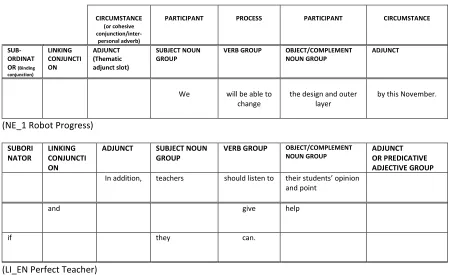
Figure 6.3 Placing elements of the clause in columns 104
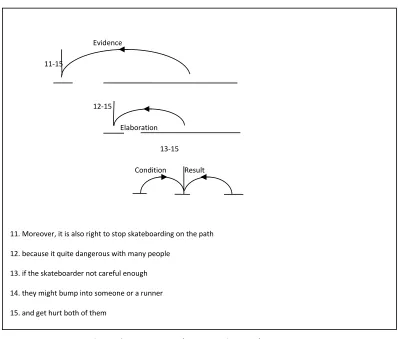
Figure 6.4 RST Analysis of a text segment 107
Figure 6.5 Two excerpts illustrating the investigation of persuasion 111
Chapter 7
Figure 7.1 Examples of interpersonal and textual themes from the study 138
Figure 7.2 Clause complexes forming single t units 141
Figure 7.3 A clause complex divided into more than one t unit. 141
Figure 7.4 Clause complex in the column format used in the study to enable the
counting of features
142
Figure 7.5 Example of hypotactic projection 142
Figure 7.6 Bar graph comparing complexity in clauses per t unit on the Perfect Teacher
task
149
Figure 7.7 Bar graphs comparing the relative frequency of some components of complexity,
and abstract nouns, in an LIT text (LI_PN) to an EMT text (NE_1) 149
Figure 7.8 Text excerpt exemplifying clause participants in an EMT text for the Perfect Teacher
task (NE_1) 152
2
List of Figures (Continued) Chapter 8
Figure 8.1 Whole-text schemas used on the Perfect Teacher task 168
Figure 8.2 Example of justify and evidence relations 169
Figure 8.3 Whole-text schemas used on the Park Letter task 173
Figure 8.4 The whole- text schemas used on the Robot Progress task 176
Figure 8.5 The justify/disclaimed relation 178
Figure 8.6 Examples of how writers from the three groups combine rhetorical
structures
182
Figure 8.7 An example of the way a more proficient LIT writer combined rhetorical
structures
183
Figure 8.8 An example of rhetorical structures deployed by a less effective EMT writer 185
Figure 8.9 An example of whole text rhetorical structure tree by an LIT writer 188
Figure 8.10 An example of whole text rhetorical structure tree by an EMT writer 189
Figure 8.11 An example of whole text rhetorical structure tree by an EIT writer 190
Chapter 9
Figure 9.1 TWT response to the Park Letter task (NT_4 Park Letter) highlighting
epistemic and deontic uses of modal verbs
200
Figure 9.2 Excerpt from an EMT writer’s response to the Park Letter Task 201
Figure 9.3 Excerpts from the LIT, EMT and TWT group responses to the Perfect Teacher
task
202
Figure 9.4 Excerpt from a native Thai response to the Park Letter task 203
Figure 9.5 Two excerpts from EMT responses to the Park Letter task 204
Figure 9.6 Excerpts from three Early Immersion responses to the Park Letter task
showing use of will and would
205
Figure 9.7 Translated excerpt from a TWT response to the Perfect Teacher task divided
into numbered clauses
207
Figure 9.8 Excerpt from an EIT response to the Perfect Teacher task divided into
numbered clauses
207
Figure 9.9 Rhetorical structure of TWT group Perfect Teacher texts 209
Figure 9.10 Rhetorical structure of TWT group Park Letter texts 209
Figure 9.11 Rhetorical structure of TWT group Park Letter text with nucleus at the end
of the text
209
Figure 9.12 Rhetorical structures of TWT texts on the Robot Progress task 210
3
List of Figures (Continued)
Figure 9.14 RST Diagram of a translated TWT response to the Perfect Teacher task 212
Figure 9.15 The conclusion from an EIT Perfect Teacher text 213
Figure 9.16 justify/disclaimer segments from the TWT and Thai Immersion groups
writing in English
215
Figure 9.17 Topic- Comment Structure by a TWT writer 217
Figure 9.18 Topic- Comment Structure by an EIT writer 217
Figure 9.19 Topic-Comment Structure by an EMT writer 218
Figure 9.20 Bar chart showing the frequency of various beginnings to the Park Letter
task by the four groups in the study
219
Figure 9.21 Bar chart showing the frequency of various beginnings to the Park Letter
task by the four groups in the study
220
Figure 9.22 Examples of the approach writers from different groups took to persuading
the reader
4
List of Tables Chapter 2
Table 2.1 The Systemic-Functional Model of language knowledge 19
Table 2.2 Process types 20
Table 2.3 Examples of expansion and projection 21
Table 2.4 Examples of the resources of the Appraisal system 22
Table 2.5 Options within the theme system 23
Chapter 3
Table 3.1 Biber’s dimensions differentiating English text types 34
Table 3.2 A developmental trajectory for English writing 41
Table 3.3 The resources of academic language 43
Chapter 4
Table 4.1 Patterns of usage of interpersonal adjuncts in the study of Hinkel (2002) 53
Table 4.2 Summary of studies on the academic language knowledge of learners with ESL 58
Chapter 5
Table 5.1 The central characteristics of Thai culture (Hofstede, 1980) 74
Table 5.2 Area of focus for the investigation of cultural influence 84
Chapter 6
Table 6.1 The groups in the study and the time and culture variables 91
Table 6.2 The Late Immersion Group 94
Table 6.3 The Early Immersion Group 95
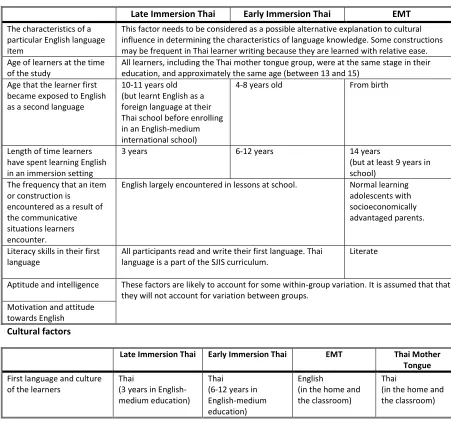
Table 6.4 Developmental and cultural factors potentially influencing language
knowledge
98
Table 6.5 An analysis of the writing tasks used in the study 100
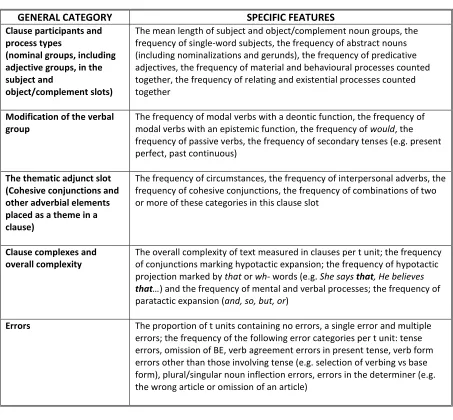
Table 6.6 Measures of the features of lexicogrammar adopted in the current study 105
Table 6.7 Evidence relation from RST 108
5
List of Tables (Continued) Chapter 7
Table 7.1 Descriptive statistics for the total word length of texts for all groups in the study
117
Table 7.2 Descriptive statistics for all texts written by the Late Immersion Thai group 118
Table 7.3 Descriptive statistics for all texts written by the late immersion group 119
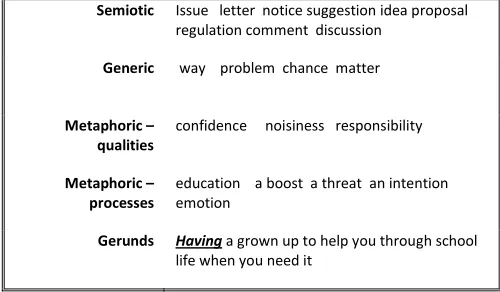
Table 7.4 Categories of abstract noun (adapted from Martin and Rose, 2007) 122
Table 7.5 Statistics for process types 123
Table 7.6 Statistics for clause participants 123
Table 7.7 Statistics for abstract nouns and nominal clauses 124
Table 7.8 Summary of results – clause participants and processes 128
Table 7.9 Statistics for secondary tense and passive voice 129
Table 7.10 Summary of results on secondary tense and passive voice 132
Table 7.11 Statistics for modal verbs 133
Table 7.12 Summary of the results for modal verbs 136
Table 7.13 Textual, interpersonal and topical themes 137
Table 7.14 Statistics for the thematic adjunct slot 139
Table 7.15 Summary of results for the thematic adjunct slot 140
Table 7.16 Categories of subordinator 143
Table 7.17 Statistics for overall complexity 144
Table 7.18 Statistics for clause complexes involving expansion 144
Table 7.19 Statistics for clause complexes involving projection 145
Table 7.20 Summary of results for clause complexes 150
Table 7.21 Statistics for predicative adjectives 155
Table 7.22 Summary of the study of lexicogrammar and discourse 157
Table 7.23 Error categories investigated in the study 158
Table 7.24 Statistics for errors 159
Table 7.25 Comparing different indicators for selected participants on the Park Letter
task
161
6
List of Tables (Continued) Chapter 8
Table 8.1 The source of attitudes in responses to the Perfect Teacher task 170
Table 8.2 The frequency of different whole text schemas on the Perfect Teacher task 171
Table 8.3 Formal definition of the Elaboration rhetorical relation 172
Table 8.4 The frequency of different whole text schemas on the Park Letter task 174
Table 8.5 The source of attitudes in responses to the Park Letter task 175
Table 8.6 The frequency of different whole text schemas on the Robot Progress task 177
Table 8.7 A definition for a justify (disclaimer) relation 179
Table 8.8 Rhetorical depth on all three tasks 180
Chapter 9
Table 9.1 Thai modal auxiliary verbs 197
Table 9.2 The relative proportion of relational, material and mental processes used by
the TWT, EIT and EMT groups
198
Table 9.3 The relative frequency of modal auxiliary verbs used by the TWT, EIT and
EMT groups
198
Chapter 10
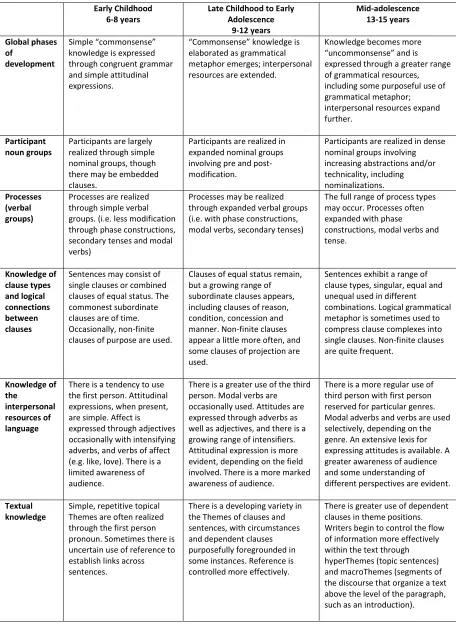
Table 10.1 The developmental trajectory of clause participants 242
Table 10.2 The developmental trajectory of processes and expanded verbal groups 243
Table 10.3 The developmental trajectory of clause complexes 244
Table 10.4 The developmental trajectory of cohesive conjunctions, rhetorical
knowledge and interpersonal resources
7
8
Chapter 1 – Introduction
1.1 BACKGROUND
The current study investigates the language knowledge of Thai learners in a small
international school in Bangkok. The initial motivation for the study arose from the
observation that testing procedures designed to evaluate the language development of
native speakers in the UK (The English National Curriculum Levels, QCA, 2010) failed to
adequately capture the levels of proficiency of the Thai learners with ESL in the
international school in which I was working, often assigning the same English National
Curriculum level to learners with quite different understandings of English and durations of
exposure to the language. A more complete picture of the details of the developing
language knowledge of these learners seemed crucial in accurately assessing their levels of
proficiency and gaining a clearer understanding of how best to support their language
learning. Woodward (2008) investigated the language knowledge of year 9 Thai pupils in
this international school, comparing the writing of Early Immersion (Thai students in
English-medium education since year 2 or earlier) and Late Immersion (Thai students in
English-medium education from year 6 or later). The current study seeks to build on this
earlier study by looking at the language used by two similar groups of Early and Late
Immersion students in greater detail, and identifying the cultural and developmental
factors that have shaped the students’ language knowledge and, therefore, their writing.
1.2 OVERVIEW OF PREVIOUS RESEARCH
This study is primarily an investigation of the development of academic language
knowledge, the language knowledge students need to gain access to the “registers of
schooling” (Cummins, 2000 pp. 67). Cummins introduced the notion of academic language
initially as a dichotomy between basic interpersonal communication skills (BICS) and
cognitive, academic language proficiency (CALP), and later as a framework with 4
quadrants (see Chapter 3) highlighting that academic language was characteristically
lacking immediate contextual guides to meaning and expressed cognitively challenging
9
Fang, Schleppegrell and Cox, 2005; Bailey, 2007) have added to this conception by
identifying some important linguistic components of academic language both within
schools and higher education. This work is complemented by research into the later
language development and writing development of native speakers (e.g. Berman, 2004;
Nippold, 1998; Christie and Derewianka, 2008; Myhill, 1999, 2008), which shows how
developing the language required to communicate flexibly in a wide range of contexts and
for a range of purposes is protracted, involving not only a development in pragmatic
knowledge, but also changes in lexicogrammatical resources with increasing age. Features
that become more frequent in the language of more mature language users include more
elaborate nominal and verbal groups (Nippold, 1998), an increase in the frequency of
abstract nouns (Nippold, Ward-Lonergan and Fanning, 2005), more frequent use of
subordinate clauses (Crowhurst, 1980; Nippold, Ward-Lonergan and Fanning, 2005) and a
more nuanced use of the interpersonal resources of the language (e.g. Meyer, 2008). The
features of academic language are, therefore, late developing in native speakers, and rely
on exposure to literate varieties of the language (Tolchinsky, 2004), such as the language
used in literature and in school text books encountered by children as they engage in the
process of education (Schleppegrell, 2001; Parkenson and Adendorf, 2005; Fang,
Schleppegrell and Cox, 2006; Bailey, Butler, Stevens and Lord, 2007)
The development of academic language knowledge in second language learners has been
examined from at least three perspectives: i) the time required for learners of a second
language to develop parity with native speakers in academic language investigated by
collecting data from examination results and officially mandated tests and examining them
using statistical tools (e.g. Cummins, 1981; Collier, 1987, 1992; Hakuta, Butler and Wit,
2000); ii) the language knowledge of second language learners investigated by comparing
their performance to that of native speakers from what is basically a developmental
perspective (e.g. Hinkel, 2002; Cameron, 2003; Cameron and Besser,2004; Reynolds, 2005);
iii) how the first language and culture influences writing in the second language (e.g Kaplan,
1966; Hinds, 1987, 1990; Hinkel, 1997, 2002, 2008; Indrasuta, 1988; Bickner and
10
Researchers investigating (i) have concluded that as many as 8 years are required for ESL
learners to achieve parity with native speakers in their academic language proficiency,
though learners can achieve fluency in basic, interpersonal language in as little as 2 years in
countries where English is the mother tongue. Research into (ii) has revealed that the
language knowledge of advanced learners of ESL differs from that of native speaking peers
in a number of ways that go beyond the typical errors made by many learners with ESL,
with certain constructions less frequent in the writing of ESL learners and other
constructions more frequent in ESL writing than EMT (English mother tongue) writing. This
work has led to suggestions that factors including the nature of language items and
constructions (simple or complex), the learning experiences of the learners (whether
exposed to literate registers) and the first language and culture of the learners can each
play a role in shaping the English language knowledge that develops. Research into (iii) has
revealed that cultural patterns from the first culture are often drawn upon by learners
writing in their second language, sometimes leading to distinctively non-native-like textual
features. In the case of East Asian learners, research has suggested that expository writing
may be organized more inductively, or with a delayed expression of purpose; texts may
have a distinctively more indirect tone realized through lexicogrammatical choices such as
modal adverbs; and that, when writing about certain topics, learners may write with a
“hortatory style”, making relatively frequent use of deontic modals such as should.
Overall, it can be concluded that in order to understand the language knowledge of second
language learners, it may be necessary to consider both cultural and developmental
factors. Each may influence the rhetorical structures and lexicogrammatical choices
learners make in their writing, and though it may not always be possible to categorically
determine whether features that characterize the written language of learners with ESL
arise primarily as a result of cultural or developmental factors, a careful review of literature
into cultural psychology and cross-cultural variation in written language coupled with the
conclusions of research into the academic language development of ESL learners compared
11
1.3 CONTRIBUTION OF THE CURRENT STUDY
International schools offer natural laboratories for the study of language learning in
immersion contexts, and yet few studies of second language development have been
undertaken within these schools (see Wakabayashi, 2002, for a study in a Japanese
international school). Moreover, there appears to be no published research on the
development of academic language in students of secondary school age learning ESL in
Thailand. Conclusions regarding the rates of progress made by learners and effectiveness
of language learning through immersion have largely involved similar languages such as
English and French (e.g. Harley et al, 1990; Lightbown, 2000). Very little work has been
done on the development of the writing of school-age learners with first languages
belonging to entirely different language families, such as English and Thai (see Tarone et al,
1993) for a study of South East Asian students in the United States). In addition, while
studies of type (i) above suggest that acquisition of academic English is a prolonged
process, the details of this process have received rather less attention. Important questions
remain regarding the way constructions key to academic language accumulate within a
learner’s repertoire, and which constructions students struggle to learn. This is particularly
true in the context of Thailand, where the few studies that have been undertaken on
school-age learners have focused on cultural influences on writing (Indrasuta, 1988;
Bickner and Peyasantiwong, 1988). Finally, few studies systematically investigate both the
contribution of cultural and developmental components of the developing language
knowledge of learners (Chao, 2008, is a rare example), though the research reviewed
above suggests that both factors are likely to be important in understanding learning
outcomes for students.
1.4 RESEARCH QUESTIONS
The current study seeks a better understanding of the developmental trajectory (changes
over time) and cultural influences shaping the language knowledge and writing of Thai
secondary school learners. The research, therefore, addresses two overarching themes: 1)
12
second language knowledge and writing. In order to investigate these themes, the
language knowledge evidenced in the writing of four groups of learners is compared: i) The
Early Immersion Thai (EIT) group, comprising Thai learners who joined an English-medium
international school in the early primary school years; ii) The Late Immersion Thai (LIT)
group, comprising Thai learners who joined the international school in year 6 of primary or
later, and were educated in Thai schools prior to that; iii) An English Mother Tongue (EMT)
group studying in an English international school in Bangkok; iv) A Thai Mother Tongue
group learning in a Thai school and writing in Thai (TWT). All groups of learners are
approximately the same age and at the same stage in their education, year 9 in the English
system. By comparing the language used by the Early and Late Immersion Thai groups to
each other and to the other groups, it is hoped that an understanding of the way the
resources of language develop, and the influence of culture on the use of these resources
can be achieved.
The current study is exploratory in nature. In terms of research questions the study is best
conceived on two levels: what might be termed a concrete level and an interpretive level.
The latter identifies the general questions that the study seeks to answer; the former level
operationalises these questions by framing them as specific questions about language
knowledge that can be answered by the counting of lexicogrammatical features, comparing
frequencies of features within texts, and the comparison of the way lexicogrammatical
features are used by participants from different groups and the rhetorical structures
developed within texts.
On an interpretative level the study asks the following questions:
1. How does the academic language knowledge of Thai learners in an English-medium
international school develop over time?
2. To what extent and in what ways does Thai culture influence the writing of Thai
students in English-medium education in Thailand?
The concrete questions asked by the study, which guide data collection and analysis, are as
13
1. How is the language knowledge of Early Immersion Thai learners different to that of
Late Immersion Thai learners?
2. How is the language knowledge of Thai Immersion learners different to that of
English mother tongue writers of similar age?
3. Which anomalous features of Thai Immersion writing (when compared to EMT
writing) parallel the features of Thai students of similar age completing the same
writing tasks in Thai?
1.5 THE ORGANISATION OF THIS THESIS
The thesis begins by establishing a theoretical framework for the study: First, in chapter 2,
linguistic theory identifying the nature of bilingual language knowledge and how it can be
studied is reviewed. Second, in chapter 3, the nature of academic language and later
language development in native speakers is discussed and some key linguistic features of
academic language knowledge are identified. Following this, there is a literature review
divided into two chapters which relate to the developmental and cultural themes
investigated in the study: Chapter 4 reviews research into the academic language
knowledge of second language learners, and how it develops over time. Chapter 5
examines research into culture and its influence on the English writing of writers with
English as a second language. Following the literature study, the method (chapter 6) and
then the results (chapters 7, 8 and 9) of the study are presented. Finally, the results are
discussed (chapter 10) with focus on the developmental trajectory of Thai ESL learners and
cultural factors that influenced the writing of the Thai subjects of the study. The
implications of the study for both the teaching and assessment of language proficiency are
14
15
Chapter 2 Bilingual Language Knowledge
2.1 INTRODUCTION
This chapter examines the nature of bilingual language knowledge and the theoretical
frameworks that can be employed to describe it. The chapter answers the following
questions: What is being studied in this research project? What theories of language
underpin the study? What basic methodological approach should the study adopt? Two
theoretical approaches to the investigation of language knowledge are addressed in
particular, Systemic Functional Grammar (SFG) (e.g. Halliday and Matthiessen, 2004;
Martin, 1992; Martin and Rose, 2007, 2008) and Rhetorical Structure Theory (RST) (e.g.
Mann and Thompson, 1988; Taboada and Mann, 2006). These approaches are described
and then discussed critically with respect to the requirements of the current study.
Following this, the nature of bilingualism and the notion of the native speaker are
discussed and the concept of multicompetence (Cook, 1999) is introduced. Finally,
approaches to researching language knowledge and writing are discussed.
2.2 COMMUNICATIVE COMPETENCE
The current study is an investigation of both writing and language knowledge. It is
therefore important to establish what is meant by the term language knowledge before
proceeding further. The terms competence and performance have been used to capture
the difference between the knowledge system underlying language and the language
produced under the processing constraints of real time communication (Chomsky, 2006,
pp. 102). The notion of communicative competence extends the concept by including
components of language knowledge beyond the initial Chomskyan conception of rules
underlying core syntax: grammatical knowledge, pragmatic knowledge and strategic
competence (Canale and Swain 1979; Douglas, 2000; Bachman and Palmer, 1996). Figure
2.1 below presents a model of communicative competence illustrating these points
16
Figure 2.1: The fundamental components of communicative competence – summary of the construct (based on model by Douglas, 2000)
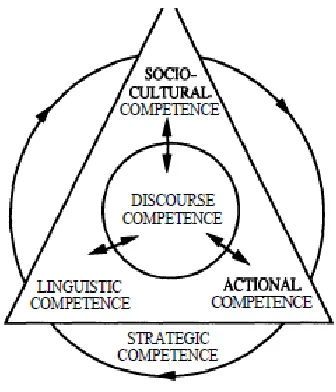
The diagram below (Figure 2.2, Celce-Murcia, Dornyei and Thurell, 1995) presents a very
similar model in a manner that highlights the interconnected nature of these components
of language knowledge. Actional competence corresponds to functional and textual
knowledge, and when communication is in the written mode, the term rhetorical
competence, the knowledge of how to organize propositional content to achieve local and
global goals in a text, is preferred (Celce-Murcia, Dornyei and Thurell, 1995).
Figure 2.2: Communicative competence model put forward by Celce-Murcia, Dornyei and Thurell Linguistic knowledge
Knowledge of the lexical, morphological and syntactic building blocks of language.
Pragmatic knowledge
Functional knowledge: how to act with language
Textual knowledge: how to organise a message; stereotypical organisational structure of written and spoken texts
Sociolinguistic knowledge: how to modulate language according to the social situation
Strategic competence
17
The model by Celce-Murcia, Dornyei and Thurell (1995) highlights the important point that
the components of language work together to enable a speaker/writer to participate in a
discourse event. In the current study, the term language knowledge refers to both
linguistic and pragmatic knowledge. In a study that investigates language knowledge by
analyzing writing, there is an implicit assumption that the language that writers use is
representative of their underlying knowledge systems. It should be acknowledged that
strategic competence may also have an effect which cannot be separated from linguistic
and pragmatic knowledge.
2.3 SYSTEMIC FUNCTIONAL GRAMMAR (SFG)
Systemic Functional Grammar (SFG) (Halliday and Mathiessen, 2004; Martin, 1992; Martin
and Rose, 2007, 2008) provides a powerful complementary view of language knowledge,
forging a link between functions of language and the lexicogrammatical items and
constructions that realize these functions. The construct of communicative competence,
discussed above, highlights the fact that text production relies on three broad components,
linguistic knowledge, pragmatic knowledge and strategic competence. The SFG approach to
language knowledge seeks to tie grammatical form to pragmatic function in its account of
language, and to provide an explicit link between context and the language that is used in
that context.
The notion of discourse competence as explicated in the model of Celce-Murcia et al (1995)
implies competence in a communicative situation: If one has discourse competence, one is
able to participate in a speech event, or construct a written text, drawing upon the
requisite pragmatic and linguistic elements. In writing research, the term genre knowledge
has been applied with similar meaning (Tardy,2006; see also the term rhetorical fluency
used by Reynolds,2005). The model of genre developed in the Sydney School of systemic
functional linguistics develops the idea of genre knowledge further (Martin, 1992; Martin
and Rose,2007, 2008). In SFG, A genre is defined as a staged, goal oriented social process,
a definition that includes all modalities of language, not only writing (Martin and Rose,
18
In the model of genre proposed by Martin (e.g. Martin and Rose, 2008), genre is viewed as
the context of culture in which language plays a part. The model also invokes a framework
to define the context of situation in terms of three variables, field, tenor and mode (see
table 2.1, below). The combination of these three variables gives rise to a particular
register of language. The field of discourse is what is going on in the social process, or the
topic area that is being dealt with in a text. Important questions to ask relating to field
include whether or not a field involves some sequence of activities and whether the field
involves a general class of things or one specific thing (Martin and Rose, 2008); the tenor
refers to the relationships enacted through language, and notions such as relative power
and social distance between interlocutors, or writer and audience; mode refers to the role
language is playing in a social process – Is the field constructed through language, as in an
academic text, or does language accompany the field, as in a sports commentary on the
TV? Configurations of field, tenor mode and genre are the cues that members of a culture
draw upon when participating in a social process, and becoming a member of a particular
culture involves socialization into the language choices expected in various contexts of
situation.
Returning to the notion of discourse competence put forward by Celce-Murcia, Dornyei
and Thurell (1995), and genre knowledge (Tardy,2006), the idea of genre within systemic
functional linguistics elaborates on this construct by developing a theory linking the context
to the language choices made, from the level of the clause to the whole text. In addition, a
clearer link is made between the linguistic competence component in communicative
competence, and other aspects of language knowledge. In SFG, lexicogrammar fulfils three
meta-functions: ideational, interpersonal and textual. Ideational resources represent
human experience, interpersonal resources enable language to negotiate human
relationships and textual resources enable the message to be presented in such a way that
it is understood. Language knowledge can be understood in terms of these three
meta-functions. In other words, language knowledge is the knowledge of how to use linguistic
resources to realise the three meta-functions appropriately, given a particular
19
language is viewed as the unfolding of the texts through which cultures are enacted, and
therefore the theory is not marooned at the level of the clause, but provides a framework
for understanding and analysing discourse.
Table 2.1: The Systemic-functional model of language knowledge (Adapted from Martin and Rose, 2007)
REGISTER VARIABLE ASSOCIATED META-FUNCTION
Field – What is happening in the social process? What topic is being addressed?
The Ideational Meta-Function: Resources of language that represent human experience
Tenor – What is the nature of the relationship between speaker and listener, or writer and audience?
The Interpersonal Meta-Function: Resources of language that enable the negotiation of relationships, the expression of attitudes and emotions and the exchange of goods, information and services
Mode – What role is language playing in the social process?
The Textual Meta-Function: Resources of language that enable information to be organized into a clear message that can be understood by the listener or reader
i. Ideational Resources
The ideational resources of language include the basic structure of the clause. Systemic
functional theory represents the resources available to construe experience at the level of
the clause by reference to a nuclear model (Halliday and Matthiessen, 2004; Martin and
Rose,2007, illustrated below in figure 2.3).
The central element in the clause, at the heart of the “quantum of change” (Halliday and
Matthiessen, 2004, pp 170) it represents, is the process, a verbal group. Moving outwards
from the core, the second layer in the model represents the participants, nominal groups
that are involved in the process. The third level in the model represents more peripheral
elements, or circumstances, providing information such as the when, where, why or how of
a process. This function is commonly performed by an adverb group or prepositional
20
Figure 2.3: The nuclear model of the clause
The following clause exemplifies this model: She lost her bagin the cinema.
The participants of the clause are the nominal groups She and her bag; the process is the
verbal group lost; a circumstance is expressed through the prepositional phrase in the
cinema.
Process types are classified into the six groups (Halliday and Mathiessen, 2004) as
illustrated in table 2.2 below.
Table 2.2: Process types (Based on Halliday and Matthiessen, 2004)
Process Type Description Examples
Material Doings and happenings in the material
world
The branch broke.
They went to school.
Behavioural Physiological and psychological behaviour
He was breathing slowly. The crowd laughed.
Relational Processes that relate one participant to another
They had a huge garden. The movie was tedious. Crocodiles are reptiles.
The earthquake caused massive destruction. His late arrival means he drank too much last night.
Existential Processes of existing There were a lot of angry people.
Mental Processes of perception, affect, cognition
and volition
He saw them arrive. She liked the song.
He understood what Sam meant. They hoped for the best.
Verbal Processes of saying He says he likes her.
She told him to come back later.
Participants Circumstances
Participants
21
Above the level of the clause, the ideational resources of language enable clauses to be
combined by expanding information using linking (coordinating) and binding
(subordinating) conjunctions, and projecting clauses through mental and verbal processes.
In SFL, a paratactic clause complex involves clauses of equal rank; a hypotactic clause
complex involves a relationship between main and subordinate or dependent clauses.
Table 2.3 below exemplifies the resources of expansion and projection.
Table 2.3: Examples of expansion and projection
PARACTACTIC CLAUSE COMPLEXES HYPOTACTIC CLAUSE COMPLEXES
Expansion They enjoy tennis and have often visited Wimbledon.
Chimps are often referred to as monkeys but they are actually apes.
Although he arrived early, all tickets were sold.
He was late because the traffic was terrible.
Projection “What times should I arrive?” he asked. I think that you should come.
She understands that he is busy.
The categories and frameworks for describing the structure of a clause and how clauses
may be combined to form clause complexes, described above, are drawn upon extensively
in the current study (see chapters 6 and 7).
ii. Interpersonal Resources
Interpersonal resources of language enable speakers and writers to “enact relationships”
(Martin and Rose, 2007, pp. 7) through language; in other words, to make effective and
appropriate use of language in a given situation by attending to the nature of the
relationship between speaker/writer and audience and selecting language appropriate to
realise the communicative goals of the speaker/writer.
As with the ideational resources of language, interpersonal resources operate at the level
of the clause and above the level of the clause. The Mood system of grammar enables the
giving and demanding of information, goods and services through declarative, interrogative
22
resources are used to negotiate attitudes at the level of the text. Martin and Rose (2007)
expand on the notion of the interpersonal meta-function by presenting a system
framework for analysing the interpersonal resources of language, which they refer to as
the Appraisal system. They suggest that an important aspect of the interpersonal features
in text are concerned with “evaluation – the kinds of attitudes that are negotiated in text,
the strength of feelings involved and the ways in which values are sourced and readers
aligned” (Martin and Rose, 2003, pp. 25). The framework is illustrated below in figure 2.4
and exemplified further in table 2.4.
Figure 2.4: The Appraisal system of interpersonal language resources (From Martin and Rose,2007)
Diagram removed for copyright reasons.
Table 2.4: Examples of the resources of the Appraisal system
RESOURCE EXAMPLES
Affect Angry, pleased, bored, anger, pleasure boredom
Judgment Intelligent, kind, kindness, a moron
Appreciation Fantastic a good idea
Amplification Gradable adjectives – good vs brilliant, intensifiers – very, really, absolutely swearing
Source Mental and verbal processes for quoting and reporting speech and thought: I think… Some people say…
Concession clauses and modal hedges that imply other voices in a text without explicitly referring to them: It could be argued that Zoos are cruel animal prisons.
This framework is of particular importance to the current study in that it enables a
23
iii. Textual resources and rhetorical competence
Textual resources enable speakers and writers to organize information so that the message
can be followed by the listener or reader. At the level of the clause, the grammar provides
options for the writer to make a choice regarding which element is presented in the
foreground as the messages point of departure, and what is presented as new information.
Table 2.5 below illustrates some of the choices that are available at the level of the clause.
Table 2.5: Options within the theme system
THEME NEW (RHEME)
Frogs are amphibians.
In the corner of the room there was an old armchair.
Personally however, I like durian.
In the first example above, the subject of the sentence, Frogs, acts as the point of
departure for the message. This is the typical or “unmarked” situation in English. In the
second example, a circumstance, the prepositional phrase in the corner of the room, has
been placed in the theme slot. This use of a “marked” theme can allow writers greater
flexibility in organizing the message, enabling transition between sub-topics (Martin and
Rose, 2007, pp. 192). The third example includes an interpersonal theme (the adverb
Personally) and a textual theme (the conjunction however) prior to the topical theme (I). The foregrounding of interpersonal elements and conjunctions in this way allows a writer
to “make explicit the way the clause relates to the surrounding discourse (textual)” and
project “his or her own angle on what the clause is saying (interpersonal)” (Halliday and
Matthiessen, 2004, pp. 83). The current study examines the use of textual and
interpersonal themes, and circumstances as themes (see chapter 7), which provide some
insight both into how writers create cohesive links in text, and their ability to express ideas
24
2.4 DISCUSSION OF THE SFG APPROACH
The current study involves the identification and counting of linguistic features. Many
studies that have involved the categorising and counting of features (e.g. Hinkel, 2002;
Biber, 1988) have drawn upon more traditional grammatical descriptions. The advantage of
using SFG is the clear and comprehensive framework it provides linking language use from
the word, up through the clause and clause complex, to the text. The categories defined
within SFG provide a descriptive framework for studying the clauses, sentences and texts
used in writing. How this is achieved is detailed in chapter 6, which presents the method of
the study. A possible criticism of the SFG approach is that certain categories suffer from a
degree of indeterminacy, where categories are blurred and may overlap. For example, the
verb want can be both a mental process and a phase verb (like start or stop) that modifies
another verb. It can be argued, however, that this indeterminacy is a characteristic of
language rather than systemic functional grammar, and should therefore not be seen as a
weakness in the approach.
2.5 RHETORICAL STRUCTURE THEORY (RST)
As well as focusing on the lexicogrammatical resources of writers, the current study is also
concerned with the ways in which writers organise propositional content within their texts.
Two complementary but distinct approaches have been taken to text structure analysis: i)
move structure analysis (Swales, 1990); ii) clause relation analysis (e.g. Rhetorical Structure
Theory, Thompson and Mann, 1987). The former approach, pioneered by Swales (1990),
seeks to divide a text into a series of rhetorical moves, which each contribute to the overall
communicative purpose of the text. In the latter approach, the juxtaposition of
propositional content at the level of the clause, or larger segments depending on the
purpose of the analysis (O’Brien, 1995), is analysed with a view to understanding the
writer’s purpose in placing one segment of text adjacent to another. For reasons detailed
below, the current study draws upon Rhetorical Structure Theory.
Rhetorical Structure Theory ((RST)Thompson and Mann, 1987; Mann and Thompson, 1988;
25
approach to analysing text structure in a “bottom up” manner, enabling analysts to identify
how propositional content has been organized to achieve local and global rhetorical goals.
The fundamental idea underpinning rhetorical structure theory is that segments of
coherent written discourse are purposefully juxtaposed by the writer with the intention of
acting on the reader. Related text segments, from the level of the clause up, that have
been juxtaposed are identified as either the nucleus or the satellite. The nucleus is the
segment more central to the text’s purpose; the satellite is content that is added in order
to achieve a particular effect on the reader, such as to promote belief in a proposition by
providing evidence. The simple clause pair below (Figure 2.5) exemplifies this.
Buy one. Get one free.
1) Buy one. (nucleus) 2) Get one free. (satellite)
Figure 2.5: An example of an RST relation (Adapted from Azar, 1999)
In rhetorical structure theory (RST) two text segments related by a particular rhetorical
relationship are represented by lines (1 and 2 in the diagram above). A vertical line
represents the nucleus and an arc connects the satellite to the nucleus, with an arrow
pointing in the direction of the nucleus. In the example above, the two elements are
related by the rhetorical relation known as motivation. That is, the satellite motivates the
reader to perform the action in the nucleus. Rhetorical relations are formally defined in
terms of the constraints on the nucleus and satellite elements, and the effect the
juxtaposition of nucleus and satellite is intended to have on the reader. Appendix i.
presents a list of relation definitions used in the current study (from Taboada, 2014, RST
website). RST relations are further exemplified in the section presenting the method of the
study.
1-2 motivation
26
An RST analysis of a text identifies a hierarchy of such relations, ultimately including a
single relation that defines the purpose of the whole text. For example, in a persuasive
text, the overall text might be represented by the evidence relation, where the satellite
segment of the whole text, which may consist of several paragraphs, works to increase the
reader’s belief in the nucleus, perhaps located at the beginning or the end of the text. This
is exemplified in the section presenting the method of the study.
As Kong (1998) has argued, move structure analysis and RST analysis are complementary,
bringing different aspects of text structure to light. Move structure analysis focuses on the
conventions of a particular discourse community, identified in terms of a genre’s typical
rhetorical moves, and the realisation of these conventions by writers; Rhetorical Structure
Theory focuses on the individual writer and the rhetorical choices the writer makes as a
text is constructed. The current study concerns young ‘apprentice’ writers, with a
developing but potentially incomplete awareness of the conventions of many genres. One
reason why Rhetorical Structure Theory was preferred as an approach in the current study
is that it does not take the organisational conventions of a particular genre as its point of
departure for the analysis, as is the case with move structure analysis. The structure of a
text emerges from the analysis rather than being the basis for the analysis. O’Brien (1995)
used RST analysis in a study of student writing, finding it useful in identifying areas of text
where cohesion broke down. This suggests RST is appropriate for unpicking the structure of
inexpert writers. Similarly, Woodward (2008) used RST to analyse the structure of the
English writing of Thai immersion writers.
The current study is concerned with both developmental and cultural factors influencing
writing. The move structure conventions of texts may vary somewhat between cultures
(Taylor and Chenghuang, 1991), and move structure analysis has been used to study
cross-cultural variation and influence in writing (Taylor and Chenghuang, 1991; Kong, 1998).
However, when approaching texts written by young writers, it could be argued that RST
analysis is preferable as a means of identifying cultural patterns and cross-cultural
27
conventions of their first and second languages. Nevertheless, cultural understandings may
still be manifest in the choices that young learners make as they construct texts, and these
features may be examined through the clause relational approach of Rhetorical Structure
Theory. In other words, rhetorical relations within a text may be sensitive to a deeper
cultural psychology that underlies the move structure conventions of a culture (see
discussion of cultural psychology in chapter 5).
2.6 DISCUSSION OF RST
It should be acknowledged that rhetorical structure analysis as an approach to the
investigation of discourse structure has been the focus of some criticism. Martin (1992)
highlights a number of issues with the approach, notably the argument that RST analysis
does not accurately represent the way texts unfold in the writing and under-represents the
importance of multi-nuclear relations such as conjunction (see Appendix i. for formal
definitions). Martin points out that text segments may have more than one rhetorical
relation simultaneously. For example, in an argument, the evidence may be related to the
thesis by the evidence relation and to other evidence segments by the relation of
conjunction. RST, however, only allows one of these relations to be represented. A further issue regards texts in which a thesis is stated initially and then reiterated in a final segment
of the text. One of these segments has to be designated as the nucleus of the whole text, a
somewhat arbitrary decision, according to Martin (1992). It could, in addition, certainly be
argued that the key assumption that underpins RST analysis, namely, that texts articulate a
single, overarching rhetorical purpose which can be neatly represented as a single relation,
does not necessarily hold for texts written by school pupils under exam conditions. Finally,
as an analytical technique, it is also important to acknowledge the subjective nature of an
RST analysis. An RST analysis of a text is a “reading” (Mann, Matthiessen and Thompson,
1989) of the writer’s intent by the analyst, and in many instances more than one reading
may be valid. Nevertheless, in the current study, rhetorical structure theory was preferred
to move structure analysis, as the approach is appropriate to the requirements of the
28
2.7 MULTICOMPETENCE, BILIGUALISM AND THE CONCEPT OF THE NATIVE SPEAKER
The current study is concerned with understanding the English language knowledge of Thai
learners. An approach frequently adopted in research (e.g. Hinkel, 2002; Cameron and
Besser, 2004) is to compare the writing of native speakers of English to that of writers with
English as a second language. This approach is adopted in the current study, and it is
therefore of some importance to explore what is meant by the term “a native speaker of
English” in the current study, and how the language knowledge of Thai Immersion learners,
bilingual in English and Thai, should be viewed relative to the language knowledge of native
speakers.
English is increasingly a World language (Crystal, 2003) in the sense that it has been
adopted as an official language within a relatively large number of countries, and is the
primary foreign language taught within schools in many other countries (Crystal, 2003).
Given that this is the case, the term, “native speaker” with its implication of language
ownership might be considered somewhat problematic. Nevertheless, it can be argued that
the concept of an English mother tongue group is meaningful and useful in the context of
the current study. The purpose of comparing the language knowledge of Thai Immersion
writers to an EMT group in the current study is twofold: 1) to help identify features of
language knowledge that are acquired with difficulty by Thai Immersion learners in an
immersion context even after many years of immersion in English at school; 2) to help
identify features of the English writing of Thai Immersion learners that may indicate the
influence of Thai culture. In this context, to provide a useful point of comparison with the
Thai Immersion groups, members of the EMT group need to be culturally Anglophone. This
is taken to mean that English is the only language spoken at home, with parents from a
country where English is the native language, such as the United Kingdom, who are thus
likely to hold Anglophone cultural values (Hofstede, 1980; Hofstede, 2009 a.; Schwartz,
1999). They therefore contrast with the Thai Immersion groups in terms of their primary
culture and its associated values and with respect to the language they learned at home
29
It is also important to consider how the English language knowledge of the Thai Immersion
learners in the current study should be viewed relative to their EMT peers. The models of
language knowledge outlined above capture the nature of communication and the
components of language knowledge that enable successful communication to take place.
In studying the language knowledge of bilingual learners such as the Thai Immersion
groups in the current study, it is necessary to extend these conceptions to encompass two
or more languages in one mind. The view of language knowledge as multicompetence, put
forward by Cook (Cook, 1999; Hall, Cheng and Carlson, 2006; Jarvis and Pavlenko, 2008),
stresses that the bilingual’s knowledge of a second language is not simply a deficient
version of a mono-competent individual’s knowledge. Rather, bilingual language
knowledge is viewed as a complex system (Larsen-Freeman, 1997) where the languages of
a multi-competent individual interact leading, amongst other things, to ‘transfer’
phenomena (Jarvis and Pavlenko, 2008). Such phenomena can involve all the components
of communicative competence (Jarvis and Pavlenko, 2008), may be bidirectional in nature,
with the second language influencing the first (Jarvis and Pavlenko, 2008) and do not
necessarily result in a language deficit. The fact that knowledge primarily built using one
language may be drawn upon when communicating in another has also been highlighted
by Cummins (2000 pp. 38), who used the term common, underlying proficiency (CUP) to
refer to “the cognitive/academic proficiency that underlies academic performance in both
languages.” This accounted for the fact that students with literacy skills in one language
were able to draw upon this knowledge when using a second language.
In the current study, therefore, the language knowledge of Thai learners is compared to
that of EMT learners, since these groups differ along cultural and linguistic dimensions
significant to the objectives of the study. The Thai learners of English in the study are
viewed as multicompetent, with systems of language knowledge that involve two
languages and cultures, Thai and English. The current study seeks to better understand the
development of this language knowledge system and the ways in which language use in