RESEARCH ARTICLE
DESIGN OF POWER SYSTEM STABILIZER WITH PI, PD, PID AND LEAD-LAG CONTROLLERS
*Sanjeeva Rao, V. and Dr. Sanker Ram, B. V.
Department of Electrical and Electronically Engineering JNTUCEH, Hyderabad, India
ARTICLE INFO ABSTRACT
Stability of power system is an important factor in electric system operation. In this paper, power system stabilizer (PSS) based on four controllers were implemented on a single machine infinite bus system for attaining stability. Four controllers used were PI, PD, PID and lead-lag. Then a comparison study was done with the above controllers. These results were simulated in MATLAB. Each controller has its own advantages and disadvantages. The comparative study was done for speed deviations, load angle deviations and terminal voltage deviations. Then the lead-lag controller was tuned using Particle Swarm Optimization method and was optimized.
Copyright © 2014 Sanjeeva Rao and Dr. Sanker Ram. This is an open access article distributed under the Creative Commons Attribution License, which permits unrestricted use, distribution, and reproduction in any medium, provided the original work is properly cited.
INTRODUCTION
Electricity which is an increasing demand leads to the persistent demand to operation of the power system. So power system stability and the quality power to the consumers have equal importance that as the electric power demands. The size and structural components of electric power system vary even though they have some basic characteristics. For the generation of electricity synchronous machines are used. Prime mo vers convert the primary source of energy to mechanical energy which in turn converts to electrical energy by synchronous generators. Electric power generated at generating stations, through a complex network of individual components is transmitted to consumers. The individual components include transmission lines, transformers and switching devices. With a high degree of efficiency and reliability form of electrical energy can be transported and controlled. A wide variety of disturbances occurs frequently and electric system must withstand and remain intact for these disturbances.
Power systems are highly non-linear and exhibit low frequency oscillations and so the stability of power systems is one of the most important aspects in electric system operation. An electric power system is an interconnection of many large and complicated components where the system oscillates spontaneously for 0.2 to 3.0Hz, i.e, for very low frequencies.
*Corresponding author: Sanjeeva Rao, V.
Department of Electrical and Electronically Engineering JNTUCEH, Hyderabad, India.
Power system stability could be defined generally as a property of the power system, which gives it the ability to remain in equilibrium state or regain that state after occurrence of disturbance (Kundur 1994). In modern power systems for improving small signal stability or to enhance system damping power system stabilizers (PSS) are widely used. The most practical power system stabilizers involve frequency responses (Lam and Yee 1998) and it provides supplementary feedback stabilizing signals in the excitation system.
Different types of controllers like Proportional-plus derivative (PD), Proportional-plus integral (PI), Proportional-plus-derivative-plus-integral (PIO) and Lead Lag controllers were designed to stabilize the system. A lead Lag controller which is characterized by its simple implementation is the traditional type of controllers. PID which is a combination of proportional, derivative and integral is the leading type of controllers. It calculates the error between the measured and the desired variables and tries to minimize the error by adjusting the input parameter. In this paper, a single machine infinite bus was considered and the system model for it was done. PSS with PID, PD, PI and lead-lag controllers were designed and tuned. Then based on these controllers a comparison was done between the different structures of controllers with respect to speed deviation, load angle deviation and terminal voltage deviation. The gain of the lead-lag controller was then tuned using particle swarm optimization method.
ISSN: 0975-833X
International Journal of Current Research Vol. 6, Issue, 09, pp.8724-8729, September, 2014
INTERNATIONAL JOURNAL OF CURRENT RESEARCH
Article History: Received 15thJune, 2014 Received in revised form 26thJuly, 2014
Accepted 05thAugust, 2014
Published online 30thSeptember, 2014
Key words:
Single Machine Infinite Bus (SMIB), Power System Stability,
Power system Stabilizer (PSS),
Controllers, Particle Swarm Optimization.
RESEARCH ARTICLE
DESIGN OF POWER SYSTEM STABILIZER WITH PI, PD, PID AND LEAD-LAG CONTROLLERS
*Sanjeeva Rao, V. and Dr. Sanker Ram, B. V.
Department of Electrical and Electronically Engineering JNTUCEH, Hyderabad, India
ARTICLE INFO ABSTRACT
Stability of power system is an important factor in electric system operation. In this paper, power system stabilizer (PSS) based on four controllers were implemented on a single machine infinite bus system for attaining stability. Four controllers used were PI, PD, PID and lead-lag. Then a comparison study was done with the above controllers. These results were simulated in MATLAB. Each controller has its own advantages and disadvantages. The comparative study was done for speed deviations, load angle deviations and terminal voltage deviations. Then the lead-lag controller was tuned using Particle Swarm Optimization method and was optimized.
Copyright © 2014 Sanjeeva Rao and Dr. Sanker Ram. This is an open access article distributed under the Creative Commons Attribution License, which permits unrestricted use, distribution, and reproduction in any medium, provided the original work is properly cited.
INTRODUCTION
Electricity which is an increasing demand leads to the persistent demand to operation of the power system. So power system stability and the quality power to the consumers have equal importance that as the electric power demands. The size and structural components of electric power system vary even though they have some basic characteristics. For the generation of electricity synchronous machines are used. Prime mo vers convert the primary source of energy to mechanical energy which in turn converts to electrical energy by synchronous generators. Electric power generated at generating stations, through a complex network of individual components is transmitted to consumers. The individual components include transmission lines, transformers and switching devices. With a high degree of efficiency and reliability form of electrical energy can be transported and controlled. A wide variety of disturbances occurs frequently and electric system must withstand and remain intact for these disturbances.
Power systems are highly non-linear and exhibit low frequency oscillations and so the stability of power systems is one of the most important aspects in electric system operation. An electric power system is an interconnection of many large and complicated components where the system oscillates spontaneously for 0.2 to 3.0Hz, i.e, for very low frequencies.
*Corresponding author: Sanjeeva Rao, V.
Department of Electrical and Electronically Engineering JNTUCEH, Hyderabad, India.
Power system stability could be defined generally as a property of the power system, which gives it the ability to remain in equilibrium state or regain that state after occurrence of disturbance (Kundur 1994). In modern power systems for improving small signal stability or to enhance system damping power system stabilizers (PSS) are widely used. The most practical power system stabilizers involve frequency responses (Lam and Yee 1998) and it provides supplementary feedback stabilizing signals in the excitation system.
Different types of controllers like Proportional-plus derivative (PD), Proportional-plus integral (PI), Proportional-plus-derivative-plus-integral (PIO) and Lead Lag controllers were designed to stabilize the system. A lead Lag controller which is characterized by its simple implementation is the traditional type of controllers. PID which is a combination of proportional, derivative and integral is the leading type of controllers. It calculates the error between the measured and the desired variables and tries to minimize the error by adjusting the input parameter. In this paper, a single machine infinite bus was considered and the system model for it was done. PSS with PID, PD, PI and lead-lag controllers were designed and tuned. Then based on these controllers a comparison was done between the different structures of controllers with respect to speed deviation, load angle deviation and terminal voltage deviation. The gain of the lead-lag controller was then tuned using particle swarm optimization method.
ISSN: 0975-833X
International Journal of Current Research Vol. 6, Issue, 09, pp.8724-8729, September, 2014
INTERNATIONAL JOURNAL OF CURRENT RESEARCH
Article History: Received 15thJune, 2014 Received in revised form 26thJuly, 2014
Accepted 05thAugust, 2014
Published online 30thSeptember, 2014
Key words:
Single Machine Infinite Bus (SMIB), Power System Stability,
Power system Stabilizer (PSS),
Controllers, Particle Swarm Optimization.
RESEARCH ARTICLE
DESIGN OF POWER SYSTEM STABILIZER WITH PI, PD, PID AND LEAD-LAG CONTROLLERS
*Sanjeeva Rao, V. and Dr. Sanker Ram, B. V.
Department of Electrical and Electronically Engineering JNTUCEH, Hyderabad, India
ARTICLE INFO ABSTRACT
Stability of power system is an important factor in electric system operation. In this paper, power system stabilizer (PSS) based on four controllers were implemented on a single machine infinite bus system for attaining stability. Four controllers used were PI, PD, PID and lead-lag. Then a comparison study was done with the above controllers. These results were simulated in MATLAB. Each controller has its own advantages and disadvantages. The comparative study was done for speed deviations, load angle deviations and terminal voltage deviations. Then the lead-lag controller was tuned using Particle Swarm Optimization method and was optimized.
Copyright © 2014 Sanjeeva Rao and Dr. Sanker Ram. This is an open access article distributed under the Creative Commons Attribution License, which permits unrestricted use, distribution, and reproduction in any medium, provided the original work is properly cited.
INTRODUCTION
Electricity which is an increasing demand leads to the persistent demand to operation of the power system. So power system stability and the quality power to the consumers have equal importance that as the electric power demands. The size and structural components of electric power system vary even though they have some basic characteristics. For the generation of electricity synchronous machines are used. Prime mo vers convert the primary source of energy to mechanical energy which in turn converts to electrical energy by synchronous generators. Electric power generated at generating stations, through a complex network of individual components is transmitted to consumers. The individual components include transmission lines, transformers and switching devices. With a high degree of efficiency and reliability form of electrical energy can be transported and controlled. A wide variety of disturbances occurs frequently and electric system must withstand and remain intact for these disturbances.
Power systems are highly non-linear and exhibit low frequency oscillations and so the stability of power systems is one of the most important aspects in electric system operation. An electric power system is an interconnection of many large and complicated components where the system oscillates spontaneously for 0.2 to 3.0Hz, i.e, for very low frequencies.
*Corresponding author: Sanjeeva Rao, V.
Department of Electrical and Electronically Engineering JNTUCEH, Hyderabad, India.
Power system stability could be defined generally as a property of the power system, which gives it the ability to remain in equilibrium state or regain that state after occurrence of disturbance (Kundur 1994). In modern power systems for improving small signal stability or to enhance system damping power system stabilizers (PSS) are widely used. The most practical power system stabilizers involve frequency responses (Lam and Yee 1998) and it provides supplementary feedback stabilizing signals in the excitation system.
Different types of controllers like Proportional-plus derivative (PD), Proportional-plus integral (PI), Proportional-plus-derivative-plus-integral (PIO) and Lead Lag controllers were designed to stabilize the system. A lead Lag controller which is characterized by its simple implementation is the traditional type of controllers. PID which is a combination of proportional, derivative and integral is the leading type of controllers. It calculates the error between the measured and the desired variables and tries to minimize the error by adjusting the input parameter. In this paper, a single machine infinite bus was considered and the system model for it was done. PSS with PID, PD, PI and lead-lag controllers were designed and tuned. Then based on these controllers a comparison was done between the different structures of controllers with respect to speed deviation, load angle deviation and terminal voltage deviation. The gain of the lead-lag controller was then tuned using particle swarm optimization method.
ISSN: 0975-833X
International Journal of Current Research Vol. 6, Issue, 09, pp.8724-8729, September, 2014
INTERNATIONAL JOURNAL OF CURRENT RESEARCH
Article History: Received 15thJune, 2014 Received in revised form 26thJuly, 2014
Accepted 05thAugust, 2014
Published online 30thSeptember, 2014
Key words:
Single Machine Infinite Bus (SMIB), Power System Stability,
Power system Stabilizer (PSS),
Test system model
[image:3.595.48.279.138.267.2]Fig 1 shows a Single machine which is a synchronous generator is connected to an infinite bus through a transmission line. The transmission line is having impedance Ze.
Fig 1. Single machine infinite bus power system model
Power system stabillzer
Figure 2 shows the power system block which consists of the gain block, washout block and the phase compensation block. Rotor speed deviation is the input to the PSS and supplementary excitation signal given to the generator excitation system is the output. The states space model is given in equation (I) and by analyzing the model it's a fourth order model.
ẋ = Ax + Bu ... (1)
The states are
Δδ, Δω, Δeq,Δefd
Where δ forms the torque angle,ωforms the angular velocity, eq, efdforms q-axis and field voltage.
The expression (2) is the matrix 'A' given by
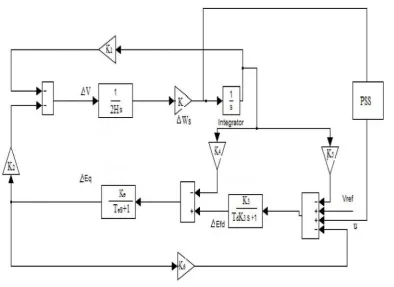
Figure 3 shows the model with power system stabilizer.
A. PI Controller
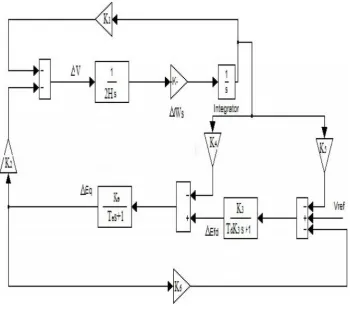
[image:3.595.324.544.158.271.2]Figure 4 shows the block diagram of PSS based PI controller. Proportional-plus-integral controller consist of two terms producing an output which one is proportional to the input signal and other proportional to the integral of input signal. It improves the relative stability and steady state tracking accuracy.
Fig. 2. System model
[image:3.595.123.474.324.635.2]Fig 4. PSS based PI controller structure
B. PD controller
[image:4.595.38.292.385.456.2]Proportional-plus-derivative controller produces an output which consists of two terms, where one is proportional to input signal and other proportional to the derivative of input signal. The PD controller increases the damping of the system which results in reducing the peak overshoot. Figure 5 shows the block diagram of PSS based PD controller.
Fig 5. PSS based PD controller structure
C. P1D controller
[image:4.595.316.550.386.444.2]PID controller stabilizes the gain, reduces the steady state error and peak overshoot of the system. Figure 5 shows the block diagram of PSS based PID controller.
Fig 5. PSS based PID controller structure
D. Lead-Lag controller
[image:4.595.311.561.537.588.2]Figure 6 shows the block diagram of PSS based lead-lag controller.
Fig 6. PSS based lead-lag controller structure
Particle swarm optimization for leadlag controller
Inspired from social behavior of bird f10cking and fish schooling, Eberhert and Kennedy developed a population based stochastic optimization technique called particle swarm optimization (PSO) in 1995. Group of random particles initiates PSO and then by updating generations it searches for optima. There are two best values obtained from every iterations- pbest and gbest. Pbest forms the position corresponding to the best fitness and gbest is the overall best out of all the particles. From the current position, current velocities and the distance between the current position, and
[image:4.595.46.283.602.668.2]pbest and gbest each agent tries to modify its position. By the concept of velocity this modification can be represented and is given by the equation
….(3)
The current position can be modified by
Where Siis the position of the particle i,
Viis the velocity of particle i,
C1C2are social parameters and
[image:5.595.126.468.275.487.2]R1, R2 are constant parameters. Fig 6. Searching point modification concept
Fig 7. Speed deviation without PSS
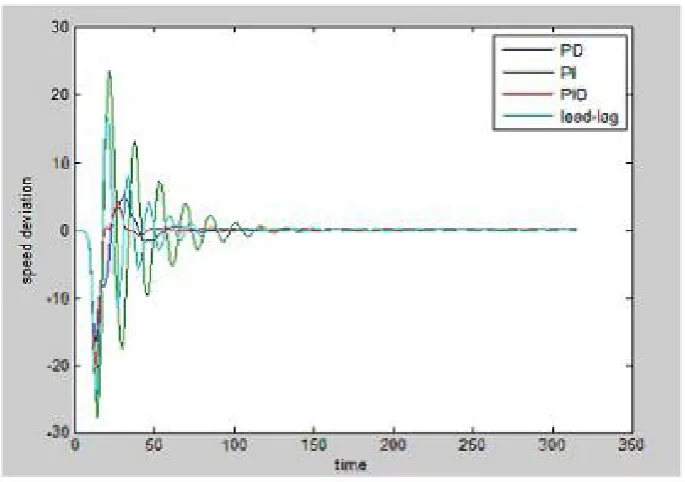
Fig 8. Speed deviation with the four PSS designs
[image:5.595.125.468.527.768.2]PSO tunes the gain value in the lead-lag controller. The objective function was to minimize the overshoots and settling time. The size of the swarm selected was in the range of 10 to 30. The learning factor Cl and C2 were set below I.
RESULTS AND DISCUSSIONS
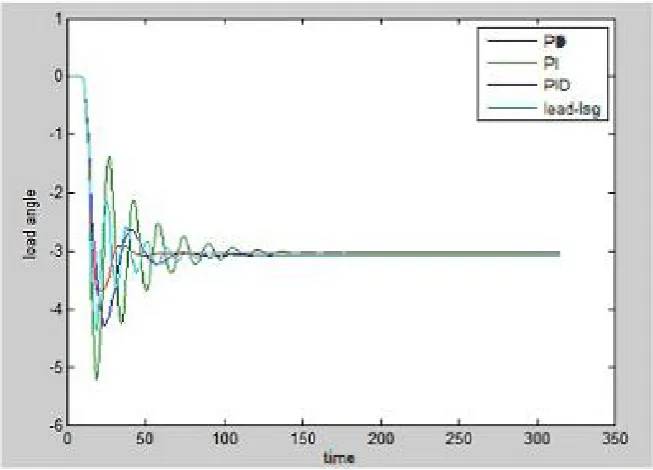
The system was tested for various deviations like speed deviation, load angle deviation and voltage deviation were done in MATLAB. Figure 7,8 and 9 shows the respective simulations. At first the system model for SMIB was simulated and was seen that the disturbances were more and seems to be unstable. Hence need some stabilization which made to the addition of PSS.
Figure 11 shows the result of PSO based lead-lag controller and was seen that the overshoots were reduced to comparably a better value and the settling time was also reduced.
[image:6.595.136.463.234.469.2]Figure 7 shows the simulation results of the system without power system stabilizer. The system was given a step disturbance and the system was unstable as it is seen. So the system needs stabilization which is provided by various controllers based power system stabilizer.
[image:6.595.138.463.510.740.2]Fig 9. Load angle deviation with the four PSS designs
Conclusion
In this paper, single machine infinite bus together with PSS was simulated and the influence of PSS on the system was noticeable. Four different controllers PI,PO,PID and lead-lag controllers were implemented to the basic system and the results were compared. The results shows PI controller stabilizes the system but due to very long settling time and oscillations, it was not so effective. The number of oscillations was lower for PD controller and was having low overshoots. But the drawback was of long error duration. Conversely PID controller was able to reduce this long duration existing for the errors. Lead-lag controllers were somewhat acceptable compared with PI but not with PO and PID. The optimum value of PSS parameters was computed by the PSO algorithm. The PSO based lead lag controller shows a better result than all the above four controllers based on our objective function.
APPENDIX
REFERENCES
Abdel Magid YL., M. Bettayeb, M. M. Dawoud, 2011. "Simultaneous stabilization of power systems using genetic algorithms", in proceedings of the Conference on Generation, Transmission, and Distribution.Available: IEEE Xplore, (Accessed: 20 April 2011).
Abdul Jaleel J. And Thanvy N, 2013. “Comparative Study
between PLPD, PID and Lead-Lag controllers for Power
System Stabilizer” 2013 International Conference on
Circuits, Power and Computing Technologies (ICCPCT-2013).
AI-Hinai A S., S. M. Al-Hinai, 2009. "Dynamic Stability Enhancement using ParticleSwarm Optimization Power System Stabilizer", 1EEE.
AkkawiMuhamad AR., Haj Ali L. A Lamont L. EI Chaar 2011. "Comparative Study between Various Controllers forPower System Stabilizer using Partic1e SwarmOptimization".
Al-Hinai AS. and M. S. Al-Hinai, 2011. "Dynamic Stability Enhancement using Particle Swarm Optimization Power System Stabilizer", in proceedings of the 2009 2nd International Conference on Adaptive Science & Technology. Available: IEEE Xplore,(Accessed: 17 April 2011).
Das T. K., G. K. Venayagamoorth Y, 2006."Optimal Design of Power System Stabilizers Using a Small Population Based PSO", IEEE.
Keayand F. W., W. H. South, 1971. "Design of a power system stabilizer sensing frequency deviation," IEEE Trans. Power App. Syst., vol. PAS-90, no. 2, pp. 707-713, Mar./Apr.
Kundur P. 1994. Power system stability and control Toronto, Ontario: McGraw-Hill, pp. 17.
Lam D M, H.Yee, 1998. "A study of frequency responses of generator electrical torques tor power system stabilizer design". JEEE transactions on power systems, vol. 13,No. 3, August 1998.
Raczkowski, C. 1974. "Complex root compensator-A new concept fordynamic stability improvement," IEEE Trans. Power App.Syst., vol. PAS-93, no. I, pp. 1842-1848, Nov/Dec. 1974.
Shivakumar R., Dr. R. Lakshmipathi," 2009. An Innovative Bio Inspired PSO Algorithm to Enhance Power System Oscillations Damping", International Conference on Advances in Recent Technologies in Communication and Computing.
[image:7.595.121.477.59.287.2]*******
Fig 11. Frequency deviation of PSO tuned lead -lag controller