© 2019, IRJET | Impact Factor value: 7.211 | ISO 9001:2008 Certified Journal | Page 2776
A Reliable and Robust Video Watermarking Scheme over Cloud
Swati Tanpure
1, Dr.Sunil Rathod
21,2
Department of Computer Engineering, Dr. D. Y. Patil School of Engineering, Pune
---***---Abstract -
These days, Digital video is one of themainstream interactive media information traded in the web. Business action on the web and media expect assurance to improve security. The 2D Barcode with a computerized watermark is a generally intriguing exploration with regards to the security field. In this paper propose a video watermarking with text information (confirmation message) by utilizing the Quick Response (QR) Code system in cloud. The QR Code is set up to be watermarked by means of a hearty video watermarking plan dependent on the (Singular Value Decomposition) SVD and (Discrete Wavelet Transform) DWT. Not with standing that logo (or) watermark gives the approved responsibility for video document. SVD is an appealing mathematical transform for watermarking appli- cations. SVD is connected to the cover I-frame. The separated corner to corner esteem is combined with logo (or) watermark. DWT is connected on SVD cover picture and QR code picture. The backwards transform on watermarked picture and include the frame into video this watermarked (include logo and QR code image) the video record sends to approved clients on cloud. In the turnaround process check the logo and QR code for approved ownership of shared video on cloud. In cloud computing, user can share his/her video with other user by using proposed system. These exploratory outcomes can accomplish satisfactory imperceptibility and certain robustness in video preparing.
Key Words
:
Watermarking, 2D Barcode, Quick Response
(QR) Code, Singular Value Decomposition (SVD), Discrete Wavelet Transform (DWT)
1. INTRODUCTION
The primary thought of steganography is the installing of mystery information into data under the suspicion that others can’t know the mystery information in data. The primary thought of watermarks is to check the logo installed in data or not. Based on the type of document to be watermarked, Text Watermarking: Line move coding, word move coding, and highlight coding. Visible Watermark: The information is noticeable in the image or video. Ordinarily, the information is text or a logo which distinguishes the owner of the media. Invisible Watermark: An invisible watermark is an overlaid picture which can’t be se en, however which can be identified algorithmically. Dual Watermarking: Dual watermark is a mix of an visible and an invisible watermark. In this kind of watermark, an invisible watermark is utilized as reinforcement for the visible watermark. It very well may be utilized to confirm
ownership. A quick response (QR) code is a two-dimensional barcode imagined by the Japanese corporation Denso Wave. Information is encoded in both the vertical and picture which can’t be se en, however which can be identified algorithmically. Dual Watermarking: Dual watermark is a mix of an visible and an invisible watermark. In this kind of watermark, an invisible watermark is utilized as reinforcement for the visible watermark. It very well may be utilized to confirm ownership. A quick response (QR) code is a two-dimensional barcode imagined by the Japanese corporation Denso Wave. Information is encoded in both the vertical and horizontal direction, in this way holding up to a few hundred times a larger number of information than a conventional bar code (figure 2). QR Codes holds an impressively greater volume of data than a 1D Barcode (figure 1). QR Code can encode in numerous sorts of characters, for example, numeric, alphabetic character, Kanji, Kana, Hiragana, symbols, binary, and control codes.
2. REVIEW OF LITERATURE
© 2019, IRJET | Impact Factor value: 7.211 | ISO 9001:2008 Certified Journal | Page 2777
Yixiao Sun, et al., represent the current video dataconceal- ing algorithms dependent on H.264 can’t meet prerequisite of constant transmission and get the bargain between inserting quality and changing abundance of the bits stream. To take care of these issues, a continuous video data concealing strategy in CAVLC for H.264/AVC is proposed, which is joins data covering up with CAVLC process, and inserts secret data in quantity of trailing coefficients of 44 large scale squares. Going for reducing video corruption and inserted secret continuously transmission, the strategy is robust and time proficient. The trial results demonstrate that inserting procedure can’t bring perceptible video debasement, and just purpose a little change in the length of video stream. In addition, the inserted secret data can be recuperated accurately while being exchanged under various types of RTP lost chan- nels. Also, secret data can be separated straightforwardly from encoded stream without turning to the first video. [2]
Huimin Zhao et al, represent the information secure prepar- ing is the critical issue of video validation in cloud environ- ment. In this article, a novel plan to secure respectability of video content for normal video information activities by uti- lizing a semi-delicate CS-watermark innovation. In proposed plan, CS-watermark information are produced from the square compressed sensing (CS) estimations which depend on the learning of the estimation grid utilized for detecting I casing’s DCT coefficients. Our examination and results demonstrate that the CS-watermark information can precisely confirm the uprightness of the first video content and have higher security than other watermarking strategies. [3]
Chang-yin Liang et al., represent the wide spread of the ad- vanced video, its integrality and the truth is drawn increasingly more consideration. In this article, an invariant component discovery strategy depends upon shot division approach is proposed. Furthermore, a plan of video content verification dependent on the invariant element recognition and cloud watermark is proposed to unravel the altering location in the space area and the time area for video content. The examination of the related outcomes, this proposed plan is performed to execution on constant and process multifaceted nature. [4]
Bhavna Goel et al., displays a novel quick and robust video watermarking plan for RGB uncompressed AVI video succes- sion in discrete wavelet transform (DWT) domain utilizing sin- gular value decomposition (SVD). For installing scene change recognition is performed. The solitary estimations of a binary watermark are installed inside the particular estimations of the LL3 sub-band coefficients of the video frames. The resultant marked video displays great quality. To test the robustness of the proposed algorithm six diverse video handling tasks are performed. The high registered PSNR values show that the visual nature of the marked and attacked video is great. The low piece mistake rate and high
standardized cross connection esteems demonstrate a high relationship between the extricated and installed watermark. Time unpredictability investigation demonstrates that the proposed plan is reasonable for con- tinuous application. It is presumed that the implanting and extraction of the proposed algorithm are all around optimized. The algorithm is powerful and demonstrates an enhancement over other comparable revealed strategies. [5]
Iwan Setyawan et al., propose a content-dependent spatio- temporal watermarking scheme for digital videos. Content reliance is accomplished by fusing the hash of the video grouping into the watermark. The video arrangement is treated as a 3-dimensional spatio- temporal signal for the motiva- tions behind video hash calculation and watermark inserting and recognition. Our tests demonstrate that the video hash calculation has great segregating force and strength against different attacks. The watermark is likewise appeared in the trials to have great robustness against a variety of attacks, specifically when the watermark is replicated starting with one video succession then onto the next. [6]
Rituja S. Darandale et al., says, one of the prominent mixed media information traded in the web is Digital video. Insur- ance requires in requires improving safety in business action on the web just as media. A broadly intriguing examination is the 2D Barcode with a computerized watermark is in the field of security. By utilizing the Quick Response (QR) Code method, in this paper system suggest a video watermarking with text information. By means of a strong video watermark- ing plan the QR Code is set up to be watermarked dependent on the SVD (Singular Value Decomposition) and DWT (Dis- crete Wavelet Transform). SVD is an appealing arithmetical change for watermarking applications. Notwithstanding that logo (or) watermark gives the approved responsibility for report. For the cover I-frame the SVD is connected. With logo (or) watermark there melded the extricated askew value. For SVD cover picture and QR code picture the SVD is connected. The watermarked picture reverse transform and include the frame into video, to approved clients this watermarked video document sends. In the switch procedure for approved owner- ship check the logo and QR code. Satisfactory indistinctness accomplished by these exploratory outcomes and in video handling their certain robustness. [7]
© 2019, IRJET | Impact Factor value: 7.211 | ISO 9001:2008 Certified Journal | Page 2778
Σhiding by applying the QR Code procedure. By utilizing QR code system have pro- pose DWT (Discrete-Wavelet-Transform), SWT (Stationary- Wavelet-(Discrete-Wavelet-Transform), SVD (Singular-Value Decomposition) strategy for watermarking method. The 2D barcode identifi- cation with a computerized watermark is a generally intrigue explore in security. The blend of DWT and SWT with SVD give better security, robustness and imperceptibility. [8]
Supriya Hasarmani et al., present day years there is no trou- ble to make immaculate duplicates which direct broad unap- proved replicating, which is an immense concern to the movie, music, programming and book distributing company. In view of this unease over copyright issues, numerous technologies are created to guard against illicit replicating. Utilization of digital watermarks is one of these innovations. Watermarking does the installing a possession motion into the information specifically. So that, the signal is constantly present with the information (picture, sound, video). DWT DFT-SVD strategies are utilized in the proposed plan to enhance the robustness and by and large calculation necessities. The proposed algorithm is tried utilizing three video arrangements of various organizations. In this methodology accomplished PSNR of the first and watermarked video signal is in excess of 60 dB. The proposed plan demonstrates high robustness against a few attacks. [9]
3. EXISTING SYSTEM
In Existing system, few methods embed watermark in the spatial space by altering the pixel esteems in each casing yet these techniques are not strong to assaults and normal flag bends. Interestingly, different types of systems are progres- sively strong to bends when they include watermark in the recurrence space. In these sorts of plans, the watermark is implanted by changing the change coefficients of the edges of the video succession.
4. PROPOSED METHODOLOGY
The large portion of video confirmation plans were proposed to produce the watermark with the substance-based component of video. What’s more, the watermark was inserted into the video signals with secret keys. In this article, a video validation plot dependent on the invariant component recognition and the cloud watermark is proposed. The strategies that removing the invariant component from the shot division, this plan would adjust the edge between the noxious control and the substance safeguarding controls.
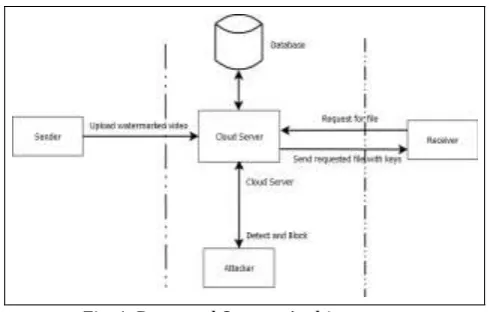
Figure shows the system architecture of A Reliable and Robust Video Watermarking Scheme over Cloud. In this figure there are four modules, in which Sender, Receiver, Cloud Server and Attacker. The Sender wants to send data securely watermarked video on cloud server and then receiver send
request for file to cloud server. The cloud server verifies the authenticate receiver (user) and send the requested file with keys to receiver. Receiver receives the video (watermarked) also decrypted key to decrypt data embedded in video. If attacker attacks on cloud server for accessing the file, then cloud servers declined the file request of attacker and block the attacker.
[image:3.595.315.560.212.368.2]4.1 Architecture
Fig. 1. Proposed System Architecture
4.2 Algorithms
Algorithm for Embedding Process:
Step 1: Read the video file and extract RGB P-frame, B-frame, and I-frame.
Step 2: Read the I-frame image as a cover image. Step 3: Generate a QR code image with company name. Step 4: Apply SVD to I frame and get three singular coefficients as u, , vt.
Step 5: Add logo with components of an SVD image to get an SVD cover image.
Step 6: Apply DWT on both SVD cover image and QR code image to get combined image.
Step 7: Take the inverse DWT on the combined image to get Watermarked I frame.
Step 8: Finally watermarked I frame image to get the watermarked video files.
Algorithm for Decoding Process
Step 1: Read the watermarked video files and extract Watermarked I frame.
© 2019, IRJET | Impact Factor value: 7.211 | ISO 9001:2008 Certified Journal | Page 2779
Step 3: Apply DWT on both videos I frame.Step 4: Subtract watermarked video I frame coefficient with original video I frame coefficient and take Inverse DWT to get a QR code image.
Step 5: By using QR code reader extract company name From QR code image.
Step 6: Apply SVD on watermarked I frame to recover the logo by using the singular value component.
5. RESULT ANALYSIS AND DISCUSSION
5.1 Results
In experiment, robustness of the system can test using PSNR values calculated after applying different attacks on generated video. Also calculating similarity between extracted message and added message. PSNR values is used to calculate the quality between watermarked and original video. PSNR value and quality of watermarked video or extracted message is directly proportion.
5.2 Comparison with existing technique
The proposed work is compared with the existing technique based on parameters namely, Without attack, Gaussian noise attack, Median filtering attack, Frame rotation attack, Histogram equalization, Contrast adjustment, and Sharpness Attack. Figure shows the value of the extracted watermark by the existing algorithm and the proposed algorithm.
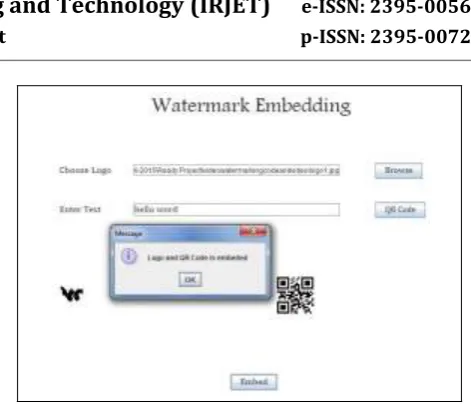
[image:4.595.323.559.53.255.2]In embedding process, logo and text message are water- marked with video frames. While embedding logo with frames SVD algorithm is used. After applying SVD algorithm logo is embedded with frames. Text message is get converted into QR code and then process with DWT algorithm, also video frames with logo passed through DWT then add two matrices of output and then pass through IDWT algorithm to get image back and this is watermarked frames with logo and QR code.
[image:4.595.50.287.601.755.2]Fig. 2. Comparison with Previous Technique
Fig. 3. Watermark Embedding
5.3 System Requirements
1.Software Requirement:
-Operating System: Microsoft Windows 7 or Above -IDE: Netbeans 8.2
-Language: Java -Database: MySql
2. Hardware Requirement: -Processor: Core Intel 3 or Above -RAM: 2 GB (min) or Above -Hard Disk: 50 GB (min)
This technique has accomplished the enhanced intangibility and security watermarking. In this QR code encoding process and get staggering showcases. In the basic method watermark was installed in the inclining part. Obviously presenting writings in the QR code picture. As such, the double procedure given two check subtleties. The logo is found securely in the QR code picture. This procedure is favorable, conceivable and in every practical sense used for giving copyright pro- section. Test outcomes demonstrate that our framework can accomplish elegant certain solidarity to video preparing. This technique has achieved the upgraded trustworthy and secure watermarking. In this QR code encoding process and achieved best displays. In the essential strategy watermark was in build in the dimensional part. In addition, the contrary side texts in the QR code picture. Along these lines, the double technique given two check focal points. The logo is found safely in the QR code picture. This technique is worthwhile, reachable and in every way that really matters used for giving copyright confirmation. Exploratory results exhibit that our strategy can achieve satisfactory certain capacity to video dealing with.
© 2019, IRJET | Impact Factor value: 7.211 | ISO 9001:2008 Certified Journal | Page 2780
In future, this framework to expand effectiveness offrame- work sound records can likewise include videos.
REFERENCES
[1] Tushar Chand Kapoor, Ankur Choudhary, “Image
Watermarking using LTP and DCT”, IEEE, 2018.
[2] Yixiao Sun, Renjun Zhan, Gengrui Wu, Yang Wu, “A
Real-Time Video Information Hiding Method Based on CAVLC Encoding”, 10th International Conference on P2P, Parallel, Grid, Cloud and Internet Computing, 2015.
[3] Huimin Zhao, Fangyuan Lei, “A Novel Video
Authentication Scheme with Secure CS-Watermark in Cloud”, IEEE International Conference on Multimedia Big Data, 2015.
[4] Chang-yin Liang, Hao Wu, Ang Li, “Video Content
Authentication Technique Based on Invariant Feature Detection and Cloud Watermark”, IEEE, Eighth International Conference on Intelligent Systems Design and Applications, 2008.
[5] Bhavna Goel, Charu Agarwal, “An Optimized
Un-compressed Video Watermarking Scheme based on SVD and DWT”, IEEE, 2013.
[6] Iwan Setyawan, Ivanna K. Timotius, “Content
-Dependent Spatio- Temporal Video Watermarking using 3 -Dimensional Discrete Cosine Transform”, IEEE, 2013.
[7] Rituja S. Darandale , Siddhi S. Kasabe , Tripti D. Chikhale,
“Video Watermarking Scheme Based On Robust QR-Code”, International Jour- nal of Advanced Research in Electrical, Electronics and Instrumentation Engineering, 2015.
[8] Kor Ashwini N, N. M. Kazi, “A Watermark Technique
based on SVD and DWT composite Function with QR-code”, International Journal of Application or Innovation in Engineering & Management (IJAIEM), 2014.
[9] Supriya Hasarmani, Mangal Patil, P. R. Naregalkar,
“Digital Video Watermarking Using DWT-DFT Transforms and SVD Technique”, In- ternational Journal of Computer Science and Network, Volume 4, Issue
[10] G. Prabakaran, R. Bhavani, M. Ramesh, “A Robust QR-
Code Video Watermarking Scheme Based On SVD and DWT Composite Domain”, Proceedings of the 2013 International Conference on Pattern Recogni- tion, Informatics and Mobile Engineering (PRIME) February 21-22.
[11] Bhavna Goel, Charu Agarwal, “An Optimized
Un-compressed Video Watermarking Scheme based on SVD and DWT”, IEEE, 2013.
[12] Soumik Das, Pradosh Bandyopadhyay, Dr. Monalisa
Banerjee, Prof. Atal Chaudhuri, “Uncompressed Video Authentication Through A Chip Based Watermarking Scheme”, IEEE, Second International Conference on Emerging Applications of Information Technology, 2011.
[13] Xiaohong Li, Keke Hu, Guofu Zhang, Jianguo Jiang,
Zhaopin Su, “An Adaptive Video Watermarking Based On Secret Image Sharing”, IEEE, Fifth International Symposium on Computational Intelligence and Design, 2012.
[14] Luo Wei , “A Improved Video Watermarking Scheme
Based on Spread- spectrum Technique”, International Conference on Networking and Digital Society, IEEE, 2010.
[15] Lin Kezheng, Yang Wei, Fan Bo, “Digital Watermarking
Synchro- nization Algorithm of MPEG-4 Video”, IEEE, International Multi- symposiums on Computer and Computational Science, 2008.
[16] Radu O. Preda, Dragos N. Vizireanu, “Blind