Proceedings of NAACL-HLT 2018, pages 560–568
Crowdsourcing Question-Answer Meaning Representations
Julian Michael1, Gabriel Stanovsky*1,3, Luheng He1, Ido Dagan2, and Luke Zettlemoyer1
1Paul G. Allen School of Computer Science&Engineering, University of Washington, Seattle, WA 2Bar-Ilan University Computer Science Department, Ramat Gan, Israel
3Allen Institute for Artificial Intelligence, Seattle, WA
{julianjm,luheng,lsz}@cs.washington.edu [email protected],[email protected]
Abstract
We introduce Question-Answer Meaning Representations (QAMRs), which repre-sent the predicate-argument structure of a sentence as a set of question-answer pairs. We develop a crowdsourcing scheme to show that QAMRs can be labeled with very little training, and gather a dataset with over 5,000 sentences and 100,000 questions. A qualitative analysis demon-strates that the crowd-generated question-answer pairs cover the vast majority of predicate-argument relationships in exist-ing datasets (includexist-ing PropBank, Nom-Bank, and QA-SRL) along with many pre-viously under-resourced ones, including implicit arguments and relations. We also report baseline models for question gener-ation and answering, and summarize a re-cent approach for using QAMR labels to improve an Open IE system. These results suggest the freely available1 QAMR data
and annotation scheme should support sig-nificant future work.
1 Introduction
Predicate-argument relationships form a key part of sentential meaning representations, and sup-port answering basic questions such as who did what to whom. Resources for predicate-argument structure are well-developed for verbs (e.g. Prop-Bank (Palmer et al., 2005)) and there have been efforts to study other parts of speech (e.g. Nom-Bank (Meyers et al.,2004) and FrameNet (Baker et al.,1998)) and introduce whole-sentence struc-tures (e.g. AMR (Banarescu et al.,2013)). How-ever, highly skilled and trained annotators are
re-∗Work performed while at Bar-Ilan University.
1github.com/uwnlp/qamr
Pierre Vinken, 61 years old, will join the board as a nonexecutive director Nov. 29.
Who willjoinasnonexecutive director? - Pierre Vinken What isPierre’s last name? - Vinken
Who is61 years old? - Pierre Vinken HowoldisPierre Vinken? - 61 years old What will hejoin? - the board
What will hejoin the boardas? - nonexecutive director What type ofdirectorwillVinkenbe? - nonexecutive What day willVinken join the board? - Nov. 29
Figure 1: Example QAMR.
quired to label data within these formulations for each new domain, and it takes significant effort to model each new type of relationship (e.g., noun ar-guments in NomBank). We propose a new method to annotate relatively complete representations of the predicate-argument structure of a sentence, which can be done easily by non-experts.
We introduce Question-Answer Meaning Rep-resentations (QAMRs), which represent the predicate-argument structure of a sentence as a set of question-answer pairs (seeFigure 1). Follow-ing the QA-SRL formalism (He et al.,2015), each question-answer pair corresponds to a predicate-argument relationship. There is no need for a care-fully curated ontology and the labels are highly in-terpretable. However, we differ from QA-SRL in focusing onall words in the sentence rather than just verbs, and allowing free form questions in-stead of using templates.
The QAMR formulation provides a new way of thinking about predicate-argument structure. Any form of sentence meaning—from a vector of real numbers to a logical form—should support the challenge of determining which questions are an-swerable by the sentence, and what the answers are. A QAMR sidesteps intermediate formal rep-resentations by surfacing those questions and
swersasthe representation. As with any other rep-resentation, this can then be reprocessed for down-stream tasks. Indeed, the question-answer format facilitates reprocessing for tasks that are similar in form, for example Open IE (seeSection 4).
A key advantage of QAMRs is that they can be annotated with crowdsourcing. The main chal-lenge is coverage, as it can be difficult for a sin-gle annotator to write all possible QA pairs for a sentence. Instead, we distribute the work be-tween multiple annotators in a novel crowdsourc-ing scheme, which we use to gather a dataset of over 100,000 QA pairs for 5,000 sentences in Newswire and Wikipedia domains.
Although QAMR questions’ free-form nature is crucial for our approach, it means that predicates are not explicitly marked. However, with a simple predicate-finding heuristic, we can align QAMR to PropBank, NomBank, and QA-SRL and show high coverage of predicate-argument structure, in-cluding more than 90% of non-discourse relation-ships. Further analysis reveals that QAMRs also capture many phenomena that are not modeled in traditional representations of predicate-argument structure, including coreference, implicit and in-ferred arguments, and implicit relations (for exam-ple, with noun adjuncts).
Finally, we report simple neural baselines for QAMR question generation and answering. We also highlight a recent result (Stanovsky et al., 2018) showing that QAMR data can be used to improve performance on a challenging task: Open Information Extraction. Together, these results show that there is significant potential for follow up work on developing innovative uses of QAMR and modeling their relatively comprehensive and complex predicate-argument relationships.
2 Crowdsourcing
We gather QAMRs with a two-stage crowd-sourcing pipeline2 using monetary incentives and
crowd-driven quality control to ensure high cov-erage of predicate-argument structure.Generation
workers write QA pairs andvalidationworkers an-swer or reject the generated questions. Full details of our setup are given in Appendix A.
Generation Workers receive an English sen-tence with up to fourtarget words. They are asked to write as many QA pairs as possible containing 2Built using Amazon Mechanical Turk: www.mturk.
com
PTB Train Dev Test
Sentences 253 3,938 499 480
Annotators 5 1 3 3
QA Pairs 27,082 73,561 27,535 26,994 Filtered 18,789 51,063 19,069 18,959 Cost $2,862 $7,879 $2,919 $2,919 Cost/token $0.44 $0.08 $0.25 $0.25
Table 1: Summary of the data gathered.
each target word in the question or answer, subject to light constraints (for example, the question must contain a word from the sentence and be answered in the sentence, and they must highlight the answer in the sentence). Workers must write at least one QA pair for each target word to receive the base pay of 20c. An increasing bonus of3(k+ 1)cents is paid for eachk-th additional QA pair they write that passes the validation stage.
Validation Workers receive a sentence and a batch of questions written by an annotator in the first stage (with no marked target words or an-swers). The worker must mark each question asinvalidorredundantwith another question, or highlight its answer in the sentence. Two workers validate and answer each set of questions. They are paid a base rate of 10c for each batch, with an extra 2c for each question past four.
Quality control Question writers are disquali-fied if the percentage of valid judgments on their questions falls below 75%. Validators need to pass a qualification test and maintain above 70% agree-ment with others, where overlapping answer spans are considered to agree.
2.1 Data Preparation and Annotation
We drew our data from 1,000 Wikinews arti-cles from 2012–2015 and 1,000 artiarti-cles from Wikipedia’s 1,000 core topics,3 partitioned by
document into train, dev, and test, and prepro-cessed using the Stanford CoreNLP tools (Man-ning et al., 2014). We also annotated 253 sen-tences from the Penn Treebank (Marcus et al., 1993) chosen to overlap with existing resources for comparison (seeSection 3).
For each sentence, we group its non-stopwords sequentially into groups of 3 or 4 target words, removing sentences with no content words. By presenting workers with nearly-contiguous lists of
3https://en.wikipedia.org/wiki/
0% 20% 40% 60% 80%
All agree Two agree None agree At least one invalid At least one redundant
74.9% 10.1%
11.3% 0.6%
[image:3.595.319.516.59.192.2]3.2%
Figure 2: Agreement and validation statistics on all data gathered. Answers were considered to agree if their spans overlapped. High agreement on answers in-dicates that questions were generally interpretable and answers were consistent.
[image:3.595.73.298.63.128.2]target words, enforcing non-redundancy, and pro-viding bonuses, we encourage exhaustiveness over all possible QA pairs. By allowing the target word to appear in the questionorthe answer, we make the requirements flexible enough that there is al-most always some QA pair that can be written.
Figure 2shows agreement statistics for question validation. We removed questions either validator counted invalid or redundant, as well as questions not beginning with a wh-word,4which we found to
be of low quality. We also annotated the partitions at different levels of redundancy to allow for more exhaustive dev, test, and comparison sets. See Ta-ble 1for statistics.
3 Data Analysis
In this section, we show that QAMR has high cov-erage of predicate-argument structure and uses a rich vocabulary to label fine-grained and implicit semantic relations.
Coverage To show that QAMR captures the same kinds of predicate-argument relations as ex-isting formalisms, we compare our data to Prop-Bank, NomProp-Bank, and QA-SRL. Since predicates in the questions are not explicitly marked, we use a simple predicate-finding heuristic to help align to other formalisms: for each minimal span that appears in the QAMR questions and answers (i.e., none of its subspans appear independently of it elsewhere in the QAMR), we compute its predi-cate scoreas the proportion of its appearances that are in a question rather than in an answer.5 We
then choose the span with the highest predicate score in each question as its predicate.
We measure recall on the shared Penn Treebank sentences for each resource by randomly sampling n annotators out of 5 for each group of target
4who, what, when, where, why, how, which,andwhose 5This follows the intuition that predicates are more likely to appear in the question; for example, seejoinin Figure1.
1 2 3 4 5
Number of Annotators 0.5
0.6 0.7 0.8 0.9 1.0
R
eca
ll
NomBank PropBank QA-SRL
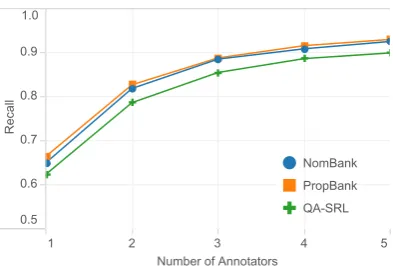
Figure 3: Recall of predicate-argument relations for sentences shared with each of our reference datasets, with increasing number of annotators.
words, which simulates the situation for the train-ing set (1 annotator) and the dev/test sets (3 anno-tators). For eachnwe took the mean of 10 runs. Full details of our comparison are in Appendix B. Results are shown inFigure 3. Single annota-tors cover over 60% of relationships, and coverage quickly increases with the number of annotators, reaching over 90% with all five. This shows that QAMR’s representational capacity covers the vast majority of relevant predicate-argument relations in existing resources. However, coverage in our training set is low due to low annotation density.
For a qualitative analysis, we sample 150 QA pairs (see Table 2 for examples).6 Of our
sam-ple, over 90% of question-answer pairs correspond to a predicate-argument relation expressed in the sentence,7 including arguments and modifiers of
nouns and verbs as well as relationships like those within proper names (Table 2, ex. 2c, 3a) and coreference (ex. 3c, 4c). Questions that do not align to predicate-argument structure often target shallow inferences (ex. 3b, 7c).
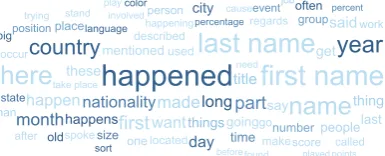
Rich vocabulary Annotators use the open ques-tion format to introduce a large vocabulary of ex-ternal phrases which do not appear in the sen-tence. Overall, 5,687 different external phrases are introduced (excluding stopwords), appearing 25,952 times in 38.7% of the questions (see Fig-ure 4). These include typing words likestateand
country(Table 2, ex. 5), most often directly after the wh-word, and relation-denoting phrases like
work for (ex. 2b), last name(ex. 3a), and victim
6This sample, and statistics for the remainder of this sec-tion, were taken from the filtered train and development sets, with a total of about 70k QA pairs.
Sentence Ann. Question Answers
(1) Climate change affects distribution of
weeds, pests, and diseases. VAR (a) What affects distribution of diseases?(b) What is affected? Climate changedistribution of... / distribution (2) Baruch ben Neriah, Jeremiah’s scribe,
used this alphabet to create the later scripts of the Old Testament.
SYN (a) Who wrote the scripts? Baruch ben Neriah ROLE (b) Who did Baruch work for? Jeremiah
(c) What is old? Testament / the Old Testament (3) Mahlunga has said he did nothing
wrong and Judge Horn said he “failed to express genuine remorse”.
ROLE (a) What is the Judge’s last name? Horn INF (b) Who doubted his remorse was genuine? Judge Horn CO (c) Who didn’t express genuine remorse? Mahlunga (4) In Byron’s later memoirs, “Mary
Chaworth is portrayed as the first object of his adult sexual feelings.”
(a) Who is portrayed in the work? Mary Chaworth IMP (b) Who was the object of his sexual feelings? Mary Chaworth VAR (c) Who was Mary the object of sexual feelings for? Byron (5) Volunteers are presently renovating
the former post office in the town of Edwards, Mississippi, United States for the doctor to have an office.
(a) What town is the post office in? Edwards (b) What state is the post office in? Mississippi IMP (c) What country are the volunteers renovating in? United States VAR (d) What country is the city of Edwards in? United States (6) The ossicles are the malleus (hammer),
incus (anvil), and the stapes (stirrup). VAR (a) What is the malleus one of? The ossicles / ossicles (7) Liam “had his whole life in front
of him”, said Detective Inspector Andy Logan, who was the senior investigator of his murder.
ROLE (a) Who is the murder victim Logan is investigating? Liam
ROLE (b) What rank of investigator is Andy Logan? Detective Inspector / senior INF (c) Who was Detective Logan speaking about? Liam
(8) This cemetery dates from the time of Menkaure (Junker) or earlier (Reisner), and contains several stone-built mastabas dating from as late as the 6th dynasty.
INF (a) How old are the stone-built mastabas? dating from as late as the 6th dynasty / from as late as the 6th dynasty
IMP (b) What period was earlier than Menkaure? Reisner
[image:4.595.75.521.63.319.2](c) What dates from the 6th dynasty? mastabas / several stone-built mastabas
Table 2: Examples of question-answer pairs capturing various semantic relations, annotated with interesting phe-nomena they exhibit: syntactic variation (VAR), synonym use (SYN), explicit role names for implicit relations (ROLE), coreference (CO), implicit arguments (IMP), and inferred relations (INF).
yearwork want used trying title time things thing these
there
take placestate stand spoke sort size score say said regards position points played play place person percentage percent people part one old often occur number need nationality
name
month mentioned man make madelong locatedlast name
last language job involved held happens happeninghappened
happen group goinggo get foundfirst name
first event described day countrycolor city cause
called big
before
after
Figure 4: Novel phrases appearing more than 50 times.
Darker phrases appear more commonly after who,
which, orhow. The vast majority of external phrases are used to denote entity/event types or semantic rela-tions.
(ex. 7a). Despite the open format, synonyms are not a major issue, obscuring the semantic relation in only 2% of our sample (ex. 2a).
We also find verbal paraphrases of noun com-pounds, as proposed by Nakov (2008). For ex-ample, whereGallup pollappears in the text, one annotator has written Who conducted the poll?, which explicates the relationship betweenGallup
andpoll. Similarly,Who received the bailouts?is written for the phrasebank bailouts.
Semantics, not just syntax Only 63% of QA pairs characterize their predicate-argument rela-tion using the same syntactic relarela-tionship as in the sentence. 5% have answers coreferent with the
syntactic argument (Table2, ex. 3c, 4c); 17% ex-hibit syntactic variation, using different preposi-tions (ex. 4c, 6a), alternating between active and passive (ex. 1b), or changing between the noun and verb form of the predicate (ex. 8a); 6% ask about implicit arguments (ex. 4b, 5c, 8b); and 6% ask about inferred relations (ex. 3b).
4 Models
To establish initial baselines, we apply existing neural models for QAMR question generation and answering. We also briefly summarize a recent end task result, where QAMR annotations were used to improve an Open IE system.
Question generation In question generation (QG), we learn a mapping from a sentencew to
a set of questionsq1, . . . , qm. We enumerate pairs
of words (wq, wa) from the sentence to seed the generator. During training, outputs are questions qand inputs are tuples(w, wq, wa), wherewq∈q andwais inq’s answer. We also add negative sam-ples where the output is a special token and the input haswq,wathat never appear together.
[image:4.595.87.280.389.467.2]we run all pairs of content words(wi, wj)where |i−j| ≤ 5 through the model to yield a set of questions. On the QAMR test set, this achieves 28% precision and 24% recall with fuzzy match-ing (multi-BLEU8>0.8).
Question answering The format of QAMRs al-lows us to apply an existing question-answering model (Seo et al., 2016) designed for the SQuAD (Rajpurkar et al., 2016) reading compre-hension task to answer QAMR questions. Train-ing and testTrain-ing with the SQuAD metrics on QAMR, the model achieves 70.8% exact match and 79.7% F1 score. We further improve perfor-mance to 75.7% exact match and 83.9% F1 by pooling our training set with the SQuAD training data. The relative ease of QA in comparison to QG suggests that in QAMR, most of the information is contained in the questions.
Open IE Finally, we also expect that the predicate-argument relationships represented in QAMRs will be useful for many end tasks. Such a result was recently shown for Open IE (Stanovsky et al., 2018), using our QAMR corpus. Open IE involves extracting tuples of natural language phrases that express the propositions asserted by a sentence. They show that, using a syntactic de-pendency parser, a QAMR can be converted to a list of Open IE extractions. Augmenting their training data with a conversion of our QAMR dataset yields state-of-the-art performance on sev-eral Open IE benchmarks (Stanovsky and Dagan, 2016b; Xu et al., 2013; de S´a Mesquita et al., 2013; Schneider et al., 2017). The gains come largely from the extra extractions (e.g., with nom-inal predicates) that QAMRs support over tradi-tional resources focusing on verbal predications.
5 Related Work
In addition to the semantic formalisms (Palmer et al.,2005;Meyers et al.,2004;Banarescu et al., 2013; He et al., 2015) we have already dis-cussed, FrameNet (Baker et al.,1998) also focuses predicate-argument structure, but has more fine-grained argument types. Gerber and Chai (2010) target implicit nominal arguments. Stanovsky and Dagan(2016a) annotate non-restrictive noun phrase modifiers on top of QA-SRL. Other lin-guistically motivated annotation schemes include
8An average of the BLEU1–BLEU4 scores.
UCCA (Abend and Rappoport,2013), HSPG tree-banks (Flickinger et al.,2017), and the Groningen meaning bank (Basile et al.,2012).
Crowdsourcing has also been applied to gather annotations of structure in the setup of multiple choice questions, for example, for Dowty’s se-mantic proto-roles (Reisinger et al.,2015;White et al., 2016) and human-in-the-loop parsing and classification (He et al., 2016;Duan et al., 2016; Werling et al., 2015), while Wang et al. (2017) use crowdsourcing with question-answer pairs to annotate some PropBank roles directly. Our ap-proach recovers paraphrases of noun compounds similar to those crowdsourced byNakov(2008).
More broadly, non-expert annotation has been used extensively to gather question-answer pairs over natural language texts, for example in reading comprehension (Rajpurkar et al., 2016; Richard-son et al.,2013;Nguyen et al., 2016) and visual question answering (Antol et al.,2015). However, while these treat question answering as an end task, we regard it as a representation of predicate-argument structure, and focus annotators on a smaller selection of text (a few target words in a single sentence, rather than a paragraph) aiming to achieve high coverage.
6 Conclusion
QAMR provides a new way of thinking about meaning representation: using open-ended natu-ral language annotation to represent rich semantic structure. This paradigm allows for representing a broad range of semantic phenomena with data eas-ily gathered from native speakers. Our dataset has already been used to improve the performance of an Open IE system, and how best to leverage the data and model its complex phenomena is an open challenge which our annotation scheme could sup-port studying at a relatively large scale.
Acknowledgments
References
Omri Abend and Ari Rappoport. 2013. Universal
con-ceptual cognitive annotation (ucca). InProceedings
of the 51st Annual Meeting of the Association for Computational Linguistics.
Stanislaw Antol, Aishwarya Agrawal, Jiasen Lu, Mar-garet Mitchell, Dhruv Batra, C. Lawrence Zitnick, and Devi Parikh. 2015. VQA: Visual Question
An-swering. InInternational Conference on Computer
Vision (ICCV).
Collin F Baker, Charles J Fillmore, and John B Lowe.
1998. The berkeley framenet project. In
Proceed-ings of the 17th International Conference on Com-putational Linguistics.
Laura Banarescu, Claire Bonial, Shu Cai, Madalina Georgescu, Kira Griffitt, Ulf Hermjakob, Kevin Knight, Philipp Koehn, Martha Palmer, and Nathan Schneider. 2013. Abstract meaning representation
for sembanking. In Proceedings of the Linguistic
Annotation Workshop.
Valerio Basile, Johan Bos, Kilian Evang, and Noortje Venhuizen. 2012. Developing a large semantically
annotated corpus. In Proceedings of the 2012
In-ternational Conference on Language Resources and Evaluation.
Manjuan Duan, Ethan Hill, and Michael White. 2016. Generating disambiguating paraphrases for
struc-turally ambiguous sentences. InProceedings of the
10th Linguistic Annotation Workshop.
Dan Flickinger, Stephan Oepen, and Emily M. Bender.
2017. Sustainable Development and Refinement of
Complex Linguistic Annotations at Scale.
Matthew Gerber and Joyce Y Chai. 2010. Beyond nombank: A study of implicit arguments for
nom-inal predicates. InProceedings of the 48th Annual
Meeting of the Association for Computational Lin-guistics, pages 1583–1592. Association for Compu-tational Linguistics.
Luheng He, Mike Lewis, and Luke Zettlemoyer. 2015. Question-answer driven semantic role labeling: Us-ing natural language to annotate natural language. In Proceedings of the 2015 Conference on Empiri-cal Methods in Natural Language Processing. Luheng He, Julian Michael, Mike Lewis, and Luke
Zettlemoyer. 2016. Human-in-the-loop parsing. Christopher D. Manning, Mihai Surdeanu, John Bauer,
Jenny Finkel, Steven J. Bethard, and David
Mc-Closky. 2014. The Stanford CoreNLP natural
lan-guage processing toolkit. InAssociation for Com-putational Linguistics (ACL) System Demonstra-tions, pages 55–60.
Mitchell P Marcus, Mary Ann Marcinkiewicz, and Beatrice Santorini. 1993. Building a large annotated
corpus of english: The penn treebank.
Computa-tional Linguistics.
Adam Meyers, Ruth Reeves, Catherine Macleod, Rachel Szekely, Veronika Zielinska, Brian Young, and Ralph Grishman. 2004. The nombank project:
An interim report. InHLT-NAACL 2004 workshop:
Frontiers in corpus annotation.
Preslav Nakov. 2008. Noun Compound
Interpreta-tion Using Paraphrasing Verbs: Feasibility Study. Springer Berlin Heidelberg, Berlin, Heidelberg.
Tri Nguyen, Mir Rosenberg, Xia Song, Jianfeng Gao, Saurabh Tiwary, Rangan Majumder, and Li Deng.
2016. MS MARCO: A human generated machine
reading comprehension dataset. In Advances in Neural Information Processing Systems.
Martha Palmer, Daniel Gildea, and Paul Kingsbury. 2005. The proposition bank: An annotated corpus
of semantic roles.Computational Linguistics.
Pranav Rajpurkar, Jian Zhang, Konstantin Lopyrev, and Percy Liang. 2016. Squad: 100,000+ questions
for machine comprehension of text. arXiv preprint
arXiv:1606.05250.
Drew Reisinger, Rachel Rudinger, Francis Ferraro, Craig Harman, Kyle Rawlins, and Benjamin Van
Durme. 2015. Semantic proto-roles. Transactions
of the Association for Computational Linguistics.
Matthew Richardson, Christopher JC Burges, and Erin Renshaw. 2013. MCTest: A challenge dataset for the open-domain machine comprehension of text. In
EMNLP, pages 193–203.
Filipe de S´a Mesquita, Jordan Schmidek, and Denil-son Barbosa. 2013. Effectiveness and efficiency
of open relation extraction. InProceedings of the
2013 Conference on Empirical Methods in Natural Language Processing, EMNLP 2013, 18-21 Octo-ber 2013, Grand Hyatt Seattle, Seattle, Washing-ton, USA, A meeting of SIGDAT, a Special Interest Group of the ACL, pages 447–457.
Rudolf Schneider, Tom Oberhauser, Tobias Klatt, Fe-lix A. Gers, and Alexander Loser. 2017. Analysing errors of open information extraction systems.
CoRR, abs/1707.07499.
Minjoon Seo, Aniruddha Kembhavi, Ali Farhadi, and Hannaneh Hajishirzi. 2016. Bidirectional attention
flow for machine comprehension. arXiv preprint
arXiv:1611.01603.
Gabriel Stanovsky and Ido Dagan. 2016a. Annotating and predicting non-restrictive noun phrase
modifica-tions. InProceedings of the 54rd Annual Meeting of
the Association for Computational Linguistics (ACL 2016).
Gabriel Stanovsky and Ido Dagan. 2016b. Creating a large benchmark for open information extraction. In
Gabriel Stanovsky, Julian Michael, Luke Zettlemoyer, and Ido Dagan. 2018. Supervised open
informa-tion extracinforma-tion. InProceedings of the 2018
Confer-ence of the North American Chapter of the Asso-ciation for Computational Linguistics: Human Lan-guage Technologies. Association for Computational Linguistics.
Chenguang Wang, Alan Akbik, laura chiticariu,
Yun-yao Li, Fei Xia, and Anbang Xu. 2017.
Crowd-in-the-loop: A hybrid approach for annotating seman-tic roles. In Proceedings of the 2017 Conference on Empirical Methods in Natural Language
Process-ing, pages 1914–1923. Association for
Computa-tional Linguistics.
Keenon Werling, Arun Tejasvi Chaganty, Percy S Liang, and Christopher D Manning. 2015.
On-the-job learning with bayesian decision theory. In
Ad-vances in Neural Information Processing Systems.
Aaron Steven White, Drew Reisinger, Sakaguchi Tim Vieira, Sheng Zhang Rachel Rudinger Kyle Rawl-ins, and Benjamin Van Durme. 2016. Universal de-compositional semantics on universal dependencies.
Ying Xu, Mi-Young Kim, Kevin Quinn, Randy Goebel,
and Denilson Barbosa. 2013. Open information
ex-traction with tree kernels. In Proceedings of the 2013 Conference of the North American Chapter of the Association for Computational Linguistics: Hu-man Language Technologies, pages 868–877, At-lanta, Georgia. Association for Computational Lin-guistics.
Qingyu Zhou, Nan Yang, Furu Wei, Chuanqi Tan, Hangbo Bao, and Ming Zhou. 2017. Neural ques-tion generaques-tion from text: A preliminary study.
arXiv preprint arXiv:1704.01792.
A Crowdsourcing Details
In this section we provide full details of the data collection methodology described in Section 2. For the exact text of the instructions shown to workers, and code to reproduce the annotation or demo the interface, seegithub.com/uwnlp/ qamr.
Stages Data collection proceeded in two stages:
generation and validation. These were run as two types of HITs (Human Intelligence Tasks) on the Amazon Mechanical Turk platform. Work-ers wrote questions and answWork-ers for the genera-tion task, and those quesgenera-tions would be immedi-ately uploaded as new HITs for the validation task, which ran concurrently. Two workers would vali-date each question. The worker writing the ques-tion would be assessed based on the validators’ judgments, and the validators would be assessed
based on their agreement. In this way, the qual-ity of workers in either stage could be quickly as-sessed so spammers or low-quality workers could be disqualified before causing much damage.
Question constraints In both stages, we define avalidquestion to
(1) contain at least one word from the sentence,
(2) be about the sentence’s meaning,
(3) be answered obviously and explicitly in the sentence,
(4) not be a yes/no question, and
(5) not beredundant,
where we define two questions as being redun-dant by the informal criterion of “having the same meaning” and the same answer. These require-ments are illustrated with examples.
Workers in the generation phase are instructed only to write valid questions, while workers in the validation phase are instructed only to answer valid questions (marking the rest invalid or redun-dant).
When we ask that the question contains a word from the sentence, we allow for changing forms of the word through inflectional or derivational mor-phology (with examples of both). The only con-straint on questions that is strictly enforced by the interface is a length limit of 50 characters.
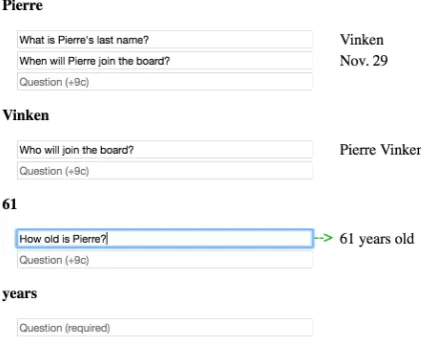
Figure 5: Annotation interface for generation.
balance of scope that was small enough to get ex-haustive annotation, but not so small that it cor-nered workers into writing awkward questions or getting frustrated.
Interface In the generation stage, below the sen-tence, each target word is listed with a text field below it where they write a question for that target word. While the text field is focused, they high-light the answer tokens in the sentence using cus-tom implemented highlighting functionality. The highlighted tokens then appear next to the focused question. The answer tokens need not be a con-tiguous span in our interface (though they almost always are in practice). Once a question is writ-ten and answered, a new text field appears directly below it for another question, allowing the anno-tator to write as many questions as they can. See Figure 5for a screenshot of the generation task in-terface.
In the validation stage, no target words are indi-cated to the user; they only see a list of questions written in a single HIT by a worker in the gen-eration stage. They use the arrow keys to switch between the questions, and use the mouse to as-sess them: either highlighting the answer in the sentence, clicking another question to mark the se-lected one redundant, or clicking theinvalidbutton to mark a question invalid. SeeFigure 6.
Incentives and payment Base pay for the gen-eration stage was 20c, with a bonus of 3(k+ 1) cents for each question beyond the number re-quired (so, the first extra question would reward them 6c, the next 9c, and so on). However, their
Figure 6: Annotation interface for validation.
bonuses were only calculated based on the number of questions considered valid by annotators. So if a worker in the generation task wrote 2 extra ques-tions, but any 2 (or 3, or more) of their questions were judged invalid, then they would receive no bonus.
In the validation stage, workers were paid 10c plus a bonus of 2c per question beyond four.
Quality control We used Mechanical Turk’s quality control mechanisms in several ways. First, we used the built-in Locale qualification to limit the tasks to workers based in the United States as a proxy for English proficiency. Second, we wrote a multiple-choice qualification test for the validation task, which tested workers’ understand-ing of the definitions of question validity and re-dundancy. Workers were required to get a score of 75% on this test before working on the validation task.
Finally, we used Mechanical Turk’s built-in qualification mechanism to keep track of worker accuracy and agreement ratings. Before working on either task, a worker would have to request a qualification which stored their accuracy or agree-ment value. Then as they worked, it would be updated over time and they could check its value in their Mechanical Turk account to see how they were doing. In the generation task, accuracy was calculated as the proportion of all judgments (ag-gregating those from both validators) that were not
invalidorredundant, and accuracy had to remain above 75% to avoid disqualification. In the vali-dation task, agreement was calculated by treating answer spans as agreeing if they had any overlap, andredundantjudgments agreeing if their targets had agreeing answer spans. A worker’s agreement had to stay above 70% for them to remain quali-fied.
dropped within 5% of the threshold, the worker was automatically sent an email with a warning and a list of common mistakes and tips they might use to improve.
Implementation All of our code was written in Scala, using the Java AWS SDK on the backend to interface with Mechanical Turk, Akka Actors and Akka HTTP to implement the web server and quality control logic, and Scala.js with React to implement the user interface.
Dataset Our dataset was gathered over the course of 1 month from 330 unique workers. See Section 2.1 for details.
B SRL Comparison
In this section we provide the full details of the comparison of QAMR to PropBank, NomBank, and QA-SRL given in Section 3.
Preprocessing For each of these resources, there were certain predicate-argument relation-ships that we filtered out of the comparison for being out of scope.
For PropBank, we filter out predicates and ar-guments that are auxiliary verbs, as well as ref-erence (R-) roles since aligning these properly is difficult and their function is primarily syntactic. We also remove discourse (-DIS) arguments such asbutandinstead: these may be regarded as in-volved in discoursestructure separately from the predicate-argument structure we are investigating. 78% of the original dependencies remain.
For NomBank, we also remove auxiliaries, and we remove arguments that include the predicate— which are present for words like salesman and
teacher—leaving 83% of the original dependen-cies.
For QA-SRL, we use all dependencies, and where multiple answers were provided to a ques-tion, we take the union of the answer spans to be the argument span.
Alignment Because QAMR does not mark predicates explicitly, we use a simple predicate-finding heuristic to align the QA pairs in a QAMR to the predicate-argument relations in each re-source independently.
For each QAMR, we identify every minimal spanappearing in its questions and answers, i.e., a span from the sentence where none of its sub-spans appear independently of it in the QAMR.
We then calculate apredicate scorefor each span, as the proportion of times it appeared in a ques-tion versus an answer. Then for each QA pair, we identify the span in the question with highest predicate score as itspredicate span, and the an-swer as its argument span. This is then aligned to the predicate-argument arc in the chosen resource with the greatest non-zero argument overlap such that the predicate is contained within the ques-tion’s predicate span. If there is no such ment, we check for an opposite-direction align-ment where the predicate is in the answer of a QA pair and the argument completely contains the question’s predicate span.
Results See Section 3 for a description of the re-sults. With 1 annotator, we get around 60% recall, but it begins to level off over 85% with 3 annota-tors.
We manually examined 25 sentences to study sources of coverage loss in the 5-annotator case. In comparison to PropBank and NomBank, the missing dependencies are due to missing QA pairs (44%), mistakes in our alignment heuristic (28%), and subtle modifiers/idiomatic uses (28%). For example, annotators sometimes overlook phrases such asso far (marked as a temporal modifier in PropBank) or let’s(where ’sis marked as a core verbal argument). Comparing to QA-SRL, 60% of the missed relations are inferred/ambiguous re-lations that are common in that dataset. Missed QA pairs in QA-SRL account for another 20%.