Frustratingly Easy Meta-Embedding – Computing Meta-Embeddings by
Averaging Source Word Embeddings
Joshua N Coates
Department of Computer Science University of Liverpool
Danushka Bollegala Department of Computer Science
University of Liverpool [email protected]
Abstract
Creating accurate meta-embeddings from pre-trained source embeddings has received at-tention lately. Methods based on global and locally-linear transformation and concatena-tion have shown to produce accurate meta-embeddings. In this paper, we show that the arithmetic mean of two distinct word embed-ding sets yields a performant meta-embedembed-ding that is comparable or better than more com-plex meta-embedding learning methods. The result seems counter-intuitive given that vector spaces in different source embeddings are not comparable and cannot be simply averaged. We give insight into why averaging can still produce accurate meta-embedding despite the incomparability of the source vector spaces.
1 Introduction
Distributed vector representations of words, henceforth referred to as word embeddings, have been shown to exhibit strong performance on a variety of NLP tasks (Turian et al., 2010; Zou et al., 2013). Methods for producing word em-bedding sets exploit the distributional hypothesis to infer semantic similarity between words within large bodies of text, in the process they have been found to additionally capture more complex lin-guistic regularities, such as analogical relation-ships (Mikolov et al.,2013c). A variety of meth-ods now exist for the production of word embed-dings (Collobert and Weston,2008;Mnih and Hin-ton, 2009; Huang et al., 2012; Pennington et al.,
2014;Mikolov et al.,2013a). Comparative work has illustrated a variation in performance between methods across evaluative tasks (Chen et al.,2013;
Yin and Sch¨utze,2016).
Methods of “meta-embedding”, as first pro-posed by Yin and Sch¨utze (2016), aim to con-duct a complementary combination of informa-tion from an ensemble of distinct word embedding
sets, each trained using different methods, and re-sources, to yield an embedding set with improved overall quality.
Several such methods have been proposed. 1TON (Yin and Sch¨utze, 2016), takes an ensem-ble of K pre-trained word embedding sets, and
employs a linear neural network to learn a set of meta-embeddings along withKglobal projection
matrices, such that through projection, for every word in the meta-embedding set, we can recover its corresponding vector within each source word embedding set. 1TON+ (Yin and Sch¨utze,2016), extends this method by predicting embeddings for words not present within the intersection of the source word embedding sets. An unsupervised lo-cally linear meta-embedding approach has since been taken (Bollegala et al.,2017), for each source embedding set, for each word; a representation as a linear combination of its nearest neighbours is learnt. The local reconstructions within each source embedding set are then projected to a com-mon meta-embedding space.
The simplest approach considered to date, has been to concatenate the word embeddings across the source sets (Yin and Sch¨utze,2016). Despite its simplicity, concatenation has been used to pro-vide a good baseline of performance for meta-embedding.
A method which has not yet been proposed is to conduct a direct averaging of embeddings. The validity of this approach may perhaps not seem ob-vious, owing to the fact that no correspondence ex-ists between the dimensions of separately trained word embedding sets. In this paper we first pro-vide some analysis and justification that, despite this dimensional disparity, averaging can provide an approximation of the performance of concate-nation without increasing the dimension of the em-beddings. We give empirical results demonstrat-ing the quality of average meta-embedddemonstrat-ings. We
make a point of comparison to concatenation since it is the most comparable in terms of simplicity, whilst also providing a good baseline of perfor-mance on evaluative tasks. Our aim is to highlight the validity of averaging across distinct word em-bedding sets, such that it may be considered as a tool in future meta-embedding endeavours.
2 Analysis
To evaluate semantic similarity between word em-beddings we consider the Euclidean distance mea-sure. For `2 normalised word embeddings,
Eu-clidean distance is a monotonically decreasing function of the cosine similarity, which is a popu-lar choice in NLP tasks that use word embeddings such as semantic similarity prediction and analogy detection (Levy et al., 2015;Levy and Goldberg,
2014). We defer the analysis of other types of distance measures to future work. By evaluating the relationship between the Euclidean distances of pairs of words in the source embedding sets and their corresponding Euclidean distances in the meta-embedding space we can obtain a view as to how the meta-embedding procedure is combin-ing semantic information. We begin by examincombin-ing concatenation through this lens, before moving on to averaging.
2.1 Concatenation
We can express concatenation by first zero-padding our source embeddings, before combin-ing them through addition.
Without loss of generality, we consider both concatenation and averaging over only two source word embedding sets for ease of exposition. Let
S1andS2be unique embedding sets of real-valued
continuous embeddings. We make no assumption thatS1andS2were trained using the same method
or resources. Consider two semantically similar wordsuandvsuch thatu,v∈ S1∩ S2. LetuS1
andvS1, anduS2andvS2denote the specific word
embeddings ofuandvwithin the embeddingsS1,
andS2respectively.
Let the dimensions of embeddings S1, andS2
be denoted dS1, and dS2 respectively. We zero-pad embeddings fromS1by front-loadingdS2zero
entries to each word embedding vector. In con-trast, we zero-pad embeddings fromS2by adding
dS1 zero entries to the end of each embedding
vec-tor. The resulting embeddings fromS1andS2now
share a common dimension ofdS1 +dS2. Denote
the resulting embeddings of any wordu∈ S1∩S2,
asuzeroS1 anduzeroS2 respectively. Now, combining
our source embeddings through addition we obtain equivalency to concatenation.
uzeroS1 +uzeroS2 =
uS2(1) uS2(2)
...
uS2(d S2)
uS1(1) uS1(2)
...
uS1(d S1)
=
uS2
uS1
(1)
Note that the zero-padded vectors are orthogonal. Let the Euclidean distance between these words in each embedding be denoted byES1 andES2.
Note that for any vector u ∈ Rn the addition of zero-valued dimensions does not affect the value of its`2-norm. So we have
ES1 =||uS1 −vS1||2 =uzeroS1 −vzeroS1 2 (2) ES2 =||uS2 −vS2||2 =uzeroS2 −vzeroS2 2 (3)
Consider the Euclidean distance betweenuandv
after concatenation.
ECON C
=
uS2 uS1
−
vS2 vS1
2
=(uzeroS1 +uzeroS2 )−(vzeroS1 +vzeroS2 )2 =(uzeroS1 −vzeroS1 )−(vzeroS2 −uzeroS2 )2
=
q
(ES1)2+ (ES2)2−2ES1ES2cos(θ)
=
q
(ES1)2+ (ES2)2−2ES1ES2(0)
=
q
(ES1)2+ (E
S2)2
For any two words belonging to the resultant em-bedding obtained by concatenation, the distance between these words in the resultant space is the root of the sum of squares of Euclidean distances between these words inS1andS2.
2.2 Average word embeddings
Here we now make the assumption thatS1 andS2
have common dimensiond.1
Despite there being no obvious correspondence between dimensions of S1 and S2 we can show
that the average embedding set retains semantic information through preservation of the relative distances between words.
Consider the positioning of wordsu, andv
af-ter performing a word-wise average between the source embedding sets. The Euclidean distance betweenuandvin the resultant meta-embedding
is given by
EAV G
=
(uS1 +2 uS2) −(vS1+2 vS2)
2
= 1
2||(uS1 −vS1)−(vS2−uS2)||2
∝ q
(ES1)2+ (E
S2)2−2ES1ES2cos(θ)
Now in this case, unlike concatenation, we have not designed our source embedding sets such that they are orthogonal to each other, and so it seems we are left with a term dependant on the angle be-tween(uS1−vS1)and(vS2−uS2). However,Cai
et al.(2013) showed that, ifX is a set of random points∈ Rn with cardinality |X |, then the limit-ing distribution of angles, as|X | → ∞, between
pairs of elements fromX, is Gaussian with mean π/2. In addition,Cai et al.(2013) showed that the
variance of this distribution shrinks as the dimen-sionality increases.
Word embedding sets typically contain in the order of ten thousand or more points, and are typ-ically of relatively high dimension. Moreover, assuming the difference vector between any two words in an embedding set is sufficiently random, we may approximate the limiting Gaussian distri-bution described by Cai et al. (2013). In such a case the expectation would then be that the vec-tors(uS1−vS1)and(vS2−uS2)are orthogonal,
leading to the following result.
E[EAV G] = 1
2
q
(ES1)2+ (ES2)2 ∝ECON C
(4)
To summarise, if word embeddings can be shown to be approximately orthogonal, then averaging will approximate the same information as concate-nation, without increasing the dimensionality of the embeddings.
3 Experiments
We first empirically test our theory that word embeddings are sufficiently random and high di-mensional, such that they are approximately all orthogonal to each other. We then present an empirical evaluation of the performance of the meta-embeddings produced through averaging, and compare against concatenation.
3.1 Datasets
We use the following pre-trained embedding sets that have been used in prior work on meta-embedding learning (Yin and Sch¨utze,2016; Bol-legala et al.,2017) for experimentation.
• GloVe(Pennington et al., 2014). 1,917,494 word embeddings of dimension 300.
• CBOW(Mikolov et al.,2013b). Phrase
em-beddings discarded, leaving 929,922 word embeddings of dimension 300.
• HLBL(Turian et al.,2010). 246,122
hierar-chical log-bilinear (Mnih and Hinton,2009) word embeddings of dimension 100.
Note that the purpose of this experiment is not to compare against previously proposed meta-embedding learning methods, but to empirically verify averaging as a meta-embedding method and validate the assumptions behind the theoretical analysis. By using three pre-trained word beddings with different dimensionalities and em-pirical accuracies, we can evaluate the averaging-based meta-embeddings in a robust manner.
We pad HLBL embeddings to the rear with 200 zero-entries to bring their dimension up to 300. For GloVe, we `2 normalise each dimension of
the embedding across the vocabulary, as recom-mended by the authors. Every individual word embedding from each embedding set is then `2
-normalised. The proposed averaging operation, as well as concatenation, operate only on the inter-section of these embeddings. The interinter-sectional
vocabularies GloVe ∩ CBOW, GloVe ∩ HLBL,
and CBOW∩HLBL contain 154,076; 90,254; and
140,479 word embeddings respectively.
3.2 Empirical distribution analysis
We conduct an empirical analysis of the distribu-tion of the angle ^[(uS1 − vS1), (vS2 − uS2)]
0.75 1.00 1.25 1.50 1.75 2.00 2.25 Angle in Radians.
[image:4.595.310.525.60.209.2]0.0 0.5 1.0 1.5 2.0 2.5 3.0 3.5
Figure 1: Distribution of angles between embeddings within GloVe∩CBOW.
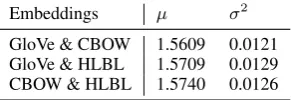
from samples of 200,000 random pairs of words from each intersectional vocabulary. We find that the angles are approximately normally distributed aroundπ/2.
Embeddings µ σ2
[image:4.595.77.285.67.210.2]GloVe & CBOW 1.5609 0.0121 GloVe & HLBL 1.5709 0.0129 CBOW & HLBL 1.5740 0.0126
Table 1: Observed distribution parameters.
Figure 1 shows a normalised histogram of the results for GloVe ∩ CBOW, along with a nor-mal distribution characterised by the sample mean
and variance. GloVe ∩ HLBL, and CBOW ∩
HLBL plots are not shown due to space limita-tions, but are similarly normally distributed. This result shows that the pre-trained word embeddings approximately satisfy the predictions made byCai et al.(2013), thereby empirically justifying the as-sumption made in the derivation of (4).
3.3 Evaluation Tasks 3.3.1 Semantic Similarity
We measure the similarity between words by cal-culating the cosine similarity between their em-beddings; we then calculate Spearman correlation against human similarity scores. The following datasets are used: RG (Rubenstein and Goode-nough, 1965), MC (Miller and Charles, 1991),
WS (Finkelstein et al.,2001),RW(Luong et al.,
2013), andSL(Hill et al.,2015).
3.3.2 Word Analogy
Using the Google dataset GL (Mikolov et al.,
2013b) (19544 analogy questions), we solve ques-tions of the forma is to b as c is to what?, using
Embeddings RG MC WS RW SL GL
sources
HLBL 100 35.3 49.3 35.7 19.1 22.1 15.0 CBOW 300 76.0 82.2 69.8 53.4 44.2 67.1 GloVe 300 82.9 87.0 75.4 48.7 45.3 68.7 AVG
CBOW+HLBL 300 69.2 81.0 60.1 48.7 37.3 49.4 GloVe+CBOW 300 82.2 87.0 74.5 52.9 46.5 73.8 GloVe+HLBL 300 73.7 74.1 64.2 44.6 38.8 49.5 CONC
CBOW+HLBL 400 68.7 80.2 62.9 49.1 39.6 53.2 GloVe+CBOW 600 83.0 88.8 76.4 54.8 46.3 75.5 GloVe+HLBL 400 73.7 80.1 65.5 46.4 40.0 53.8
Table 2: Results on word similarity, and analogical tasks. Best performances bolded per task. Dimension-ality of the meta embedding is shown next to the source embedding names.
the CosAdd method (Mikolov et al.,2013c) shown in (5). Specifically, we determine a fourth wordd
such that the similarity between(b−a+c)andd
is maximised.
CosAdd(a:b, c:d) = cos(b−a+c, d) (5)
3.4 Discussion of results
Table 2 shows task performance for each source embedding set, and for both methods on every pair of datasets. In our experiments concatenation ob-tains better overall performance. However, aver-aging offers improvements over the source embed-ding sets for semantic similarity taskSLand word analogy task GL, on the combination of CBOW and GloVe. HLBL has a negative effect on CBOW and GloVe, but the performance of averaging is close to that of concatenation. An advantage of averaging when compared against concatenation, is that the dimensionality of the produced meta-embedding is not increased beyond the maximum dimension present within the source embeddings, resulting in a meta-embedding which is easier to process and store.
4 Conclusion
[image:4.595.109.255.321.371.2]References
Danushka Bollegala, Kohei Hayashi, and Ken-ichi Kawarabayashi. 2017. Think globally, embed locally—locally linear meta-embedding of words.
arXiv preprint arXiv:1709.06671.
Tony Cai, Jianqing Fan, and Tiefeng Jiang. 2013. Distributions of angles in random packing on spheres.The Journal of Machine Learning Research
14(1):1837–1864.
Yanqing Chen, Bryan Perozzi, Rami Al-Rfou, and Steven Skiena. 2013. The expressive power of word embeddings. arXiv preprint arXiv:1301.3226.
Ronan Collobert and Jason Weston. 2008. A unified architecture for natural language processing: Deep neural networks with multitask learning. In Pro-ceedings of the 25th international conference on Machine learning. ACM, pages 160–167.
Lev Finkelstein, Evgeniy Gabrilovich, Yossi Matias, Ehud Rivlin, Zach Solan, Gadi Wolfman, and Eytan Ruppin. 2001. Placing search in context: The con-cept revisited. InProceedings of the 10th interna-tional conference on World Wide Web. ACM, pages 406–414.
Felix Hill, Roi Reichart, and Anna Korhonen. 2015. Simlex-999: Evaluating semantic models with (gen-uine) similarity estimation. Computational Linguis-tics41(4):665–695.
Eric H Huang, Richard Socher, Christopher D Man-ning, and Andrew Y Ng. 2012. Improving word representations via global context and multiple word prototypes. InProceedings of the 50th Annual Meet-ing of the Association for Computational LMeet-inguis- Linguis-tics: Long Papers-Volume 1. Association for Com-putational Linguistics, pages 873–882.
Omer Levy and Yoav Goldberg. 2014. Linguistic reg-ularities in sparse and explicit word representations. InCoNLL.
Omer Levy, Yoav Goldberg, and Ido Dagan. 2015. Im-proving distributional similarity with lessons learned from word embeddings. Transactions of Association for Computational Linguistics3:211–225.
Thang Luong, Richard Socher, and Christopher D Manning. 2013. Better word representations with recursive neural networks for morphology. In
CoNLL. pages 104–113.
Tomas Mikolov, Kai Chen, Greg Corrado, and Jef-frey Dean. 2013a. Efficient estimation of word representations in vector space. arXiv preprint arXiv:1301.3781.
Tomas Mikolov, Ilya Sutskever, Kai Chen, Greg S Cor-rado, and Jeff Dean. 2013b. Distributed representa-tions of words and phrases and their compositional-ity. InAdvances in neural information processing systems. pages 3111–3119.
Tomas Mikolov, Wen-tau Yih, and Geoffrey Zweig. 2013c. Linguistic regularities in continuous space word representations. In Hlt-naacl. volume 13, pages 746–751.
George A Miller and Walter G Charles. 1991. Contex-tual correlates of semantic similarity. Language and cognitive processes6(1):1–28.
Andriy Mnih and Geoffrey E Hinton. 2009. A scal-able hierarchical distributed language model. In
Advances in neural information processing systems. pages 1081–1088.
Jeffrey Pennington, Richard Socher, and Christopher D Manning. 2014. Glove: Global vectors for word representation. InEMNLP. volume 14, pages 1532– 1543.
Herbert Rubenstein and John B Goodenough. 1965. Contextual correlates of synonymy. Communica-tions of the ACM8(10):627–633.
Joseph Turian, Lev Ratinov, and Yoshua Bengio. 2010. Word representations: a simple and general method for semi-supervised learning. InProceedings of the 48th annual meeting of the association for compu-tational linguistics. Association for Computational Linguistics, pages 384–394.
Wenpeng Yin and Hinrich Sch¨utze. 2016. Learning word meta-embeddings. InProceedings of the 54th Annual Meeting of the Association for Computa-tional Linguistics (Volume 1: Long Papers). Asso-ciation for Computational Linguistics, Berlin, Ger-many, pages 1351–1360.
Will Y Zou, Richard Socher, Daniel M Cer, and Christopher D Manning. 2013. Bilingual word em-beddings for phrase-based machine translation. In